




Abstract
As the most important cutting tools during tunnel-boring machine tunneling construction process, V-type disk cutter’s rock-breaking mechanism has been researched by many scholars all over the world. Adopting finite element method, this article focused on the interaction between V-type disk cutters and the intact rock to carry out microscopic parameter analysis methods: first, the stress model of rock breaking was established through V-type disk cutter motion trajectory analysis; second, based on the incremental theorem of the elastic–plastic theory, the strain model of the relative changes of rock displacement during breaking process was created. According to the principle of admissible work by energy method of the elastic–plastic theory to analyze energy transfer rules in the process of breaking rock, rock-breaking force of the V-type disk cutter could be regarded as the external force in the rock system. Finally, by taking the rock system as the reference object, the total potential energy equivalent model of rock system was derived to obtain the forces of the three directions acting on V-type disk cutter during the rock-breaking process. This derived model, which has been proved to be effective and scientific through comparisons with some original force models and by comparative analysis with experimental data, also initiates a new research strategy taking the view of the micro elastic–plastic theory to study the rock-breaking mechanism.
Keywords
Introduction
Hard rock tunnel-boring machine (TBM) is a kind of mechanical, electrical, and hydraulic highly integrated complex system. With many other advantages such as fast construction speed, low pollution, and staff safety, TBM has been extensively used in underground engineering construction and has become an important symbol of stereoscopic city construction.
TBM cutterhead is the key device for tunneling progress. In order to meet the needs of the geological adaptability requirements, cutterhead design quality mainly depends on theoretical rock-breaking force analysis of disk cutters installed on the cutterhead. Many scholars have worked in this field through theoretical numerical research. Chiaia 1 and Carpinteri et al., 2 using the lattice model of finite element method (FEM) software DIANA™, simulated the propagation process of crack in homogeneous rock under the action of vertical force and tangential force of the wedge cutter cutting rock. Gong et al.3,4 made use of the two-dimensional discrete element software (UDEC) to simulate the propagation process of crack in rock under the action of boundary force, and the influence of joint geometric parameters is considered. Liao et al., 5 based on meso damage mechanics and dynamic FEM, simulated and analyzed the damage failure process of jointed rock mass through disk cutter cutting rock under dynamic loading. Cho et al. 6 used AUTODYN 3D software to simulate the three-dimensional dynamic cutting process. Through simulating eight kinds of rock fragmentation modes, combined with the specific energy concept, different cutter spacings were analyzed which should have certain reference value for cutter design and TBM performance evaluation. Mo et al. 7 researched that the main drive mechanism of crack initiation and propagation is tension damage in the processing of disk cutter cutting rock using the universal discrete element code (UDEC) method to stimulate rock breaking.
Comprehensive analysis showed that during TBM tunneling, inseparable relationships exist between disk cutter characteristics and rock properties, and applying finite element simulation software has become an effective way to study the rock-breaking process. Although finite element software is a large computational simulation software, its model development has a certain hysteresis based on the elastic–plastic theory. Therefore, some researchers apply the elastic–plastic theory to analyze coupling relationship between disk cutters and rock. Using the Cerchar abrasivity index (CAI), Alber, 8 who have found that the ground stress and confining pressure jointly affect rock CAI, demonstrated that the CAI is definitely stress dependent. Additionally, stress at different underground openings is discussed, and application of the CAI values for estimating wear of TBM disk cutters is carried out. Based on the elastic–plastic theory, Okubo and Fukui 9 proposed experimental data analysis method to model force–penetration curves instead of the conventional linear springs. By drawing the penetration-time and force–time curves for excavation machines, load distribution of TBM in the process of excavation can be qualitatively analyzed and applied to more realistic and sophisticated simulations combined with the FEM or other appropriate calculation methods. To sum up, based on the elastic–plastic theory, the overall stress–strain analysis of the excavation face of tunnel is still at the primary stage, which has attracted more and more attention of scholars. In this article, by adopting the finite element idea and with the aid of the elastic–plastic theory, disk cutter stress model in the process of rock breaking has been successfully established, and according to the energy principle of the elastic theory, load variation of disk cutters has also been fully analyzed.
Single disk cutter stress model in the process of rock breaking
In the excavation process, the motion trajectory of each disk cutter not only rotates around the center of the disk cutter but also rotates around of the center of the cutterhead. Failure forces acting on each disk cutter applied by rock include vertical pushing force FV, tangential rolling force FR, and lateral force FS. Typical disk cutter force model 10 is shown in Figure 1. According to the elastic–plastic theory, the disk cutter’s three directional forces are external forces which correspond to Pr, Pθ, and Px, respectively, in cylindrical coordinates.
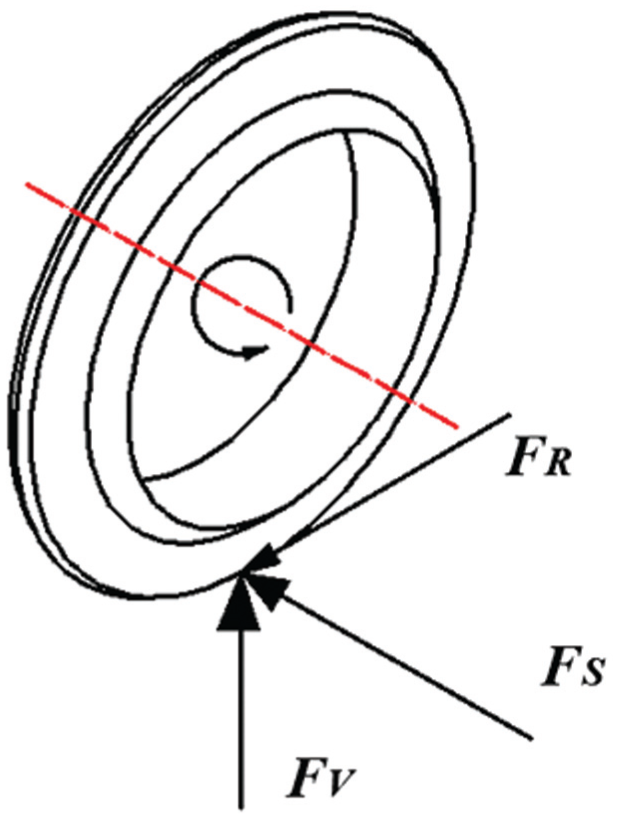
Force analysis diagram of disk cutter.
As shown in Figure 2, disk cutter’s cutting edge plays an important role in the rock-breaking process. The common cutting edge angle is usually V-type (cutting edge angle is 2α). Assuming one point A is on the V-type disk cutter cutting edge angle, for cylindrical coordinates of the center of the circle, point A can be expressed as (


(a) Disk cutter rock-breaking force diagram and (b) the stress distribution of the knife edge.
First, to analyze the rotation load function of disk cutter, select the disk cutter center as the center of the cylindrical coordinate system. When cutting rock, disk cutter rotates generating inertial force

where

(a) Disk cutter loading direction diagram during rock-breaking process and (b) the stress distribution of knife edge unit.
Second, by ignoring the disk cutter’s own rotation, cutters also rotate around the cutterhead center. As shown in Figure 4, on the cutterhead by defining disk cutter’s installation radius as R and cutterhead’s center as the center of cylindrical coordinates, with inertial force generated by cutter’s rotation around the cutterhead center under consideration, point A on the cutterhead can be expressed as (

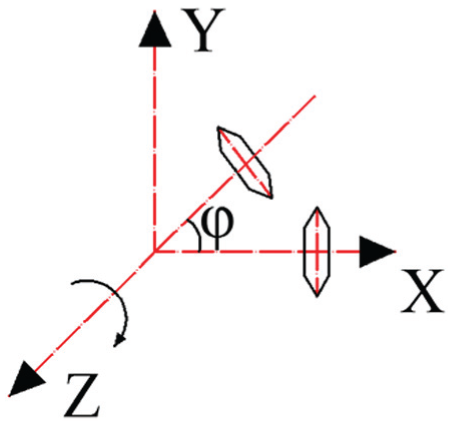
Disk cutter installation position on cutterhead.
Then, the equilibrium differential equations expressed by stress for disk cutter’s rotation around the cutterhead center can be established as follows

where
Considering the symmetry of disk cutters’ installation on cutterhead and assuming the disk cutter material as ideal elastic material, no wear occurred. To facilitate calculation, ignoring the influence of shear stress and shear strain on cutter load and considering mainly the stress direction, the deformation, and the displacement, through combining with the physical equation and the geometric equation, 11 the deformation coordination equations by stress can be obtained as follows

where
Applying equation (1) as force boundary conditions, the disk cutter’s three directional stresses during rock-breaking process are obtained as follows



Analysis result of the above equations showed that the maximum stress occurs at the center of the disk cutter (


where
Rock strain model of single disk cutter in the process of rock breaking
When disk cutter breaks rock, in Lagrange coordinates, point A on the cutter can be defined as

In the process of cutting rock under the vertical thrust force, disk cutter penetrates into the rock to a certain depth

where

According to the incremental model of the plastic theory, 12 rock strain corresponding to point A in the rock cutting process can be expressed as
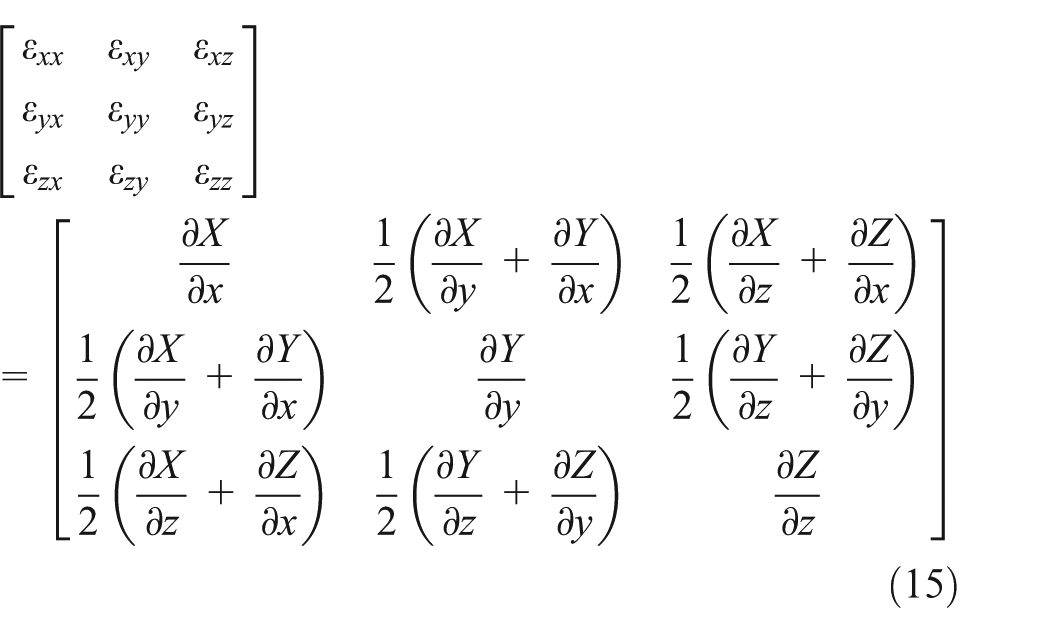
where


For convenient calculation, according to equation (17), substitute equations (13) and (14) into equation (15), considering that

Solving mechanical model under the conditions of conservation of energy
According to the thermodynamics first and second laws, when TBM is tunneling, it is a dynamic energy transfer process including the energy input, energy accumulation, energy dissipation, and energy output, a total of four steps, as shown in Figure 5.
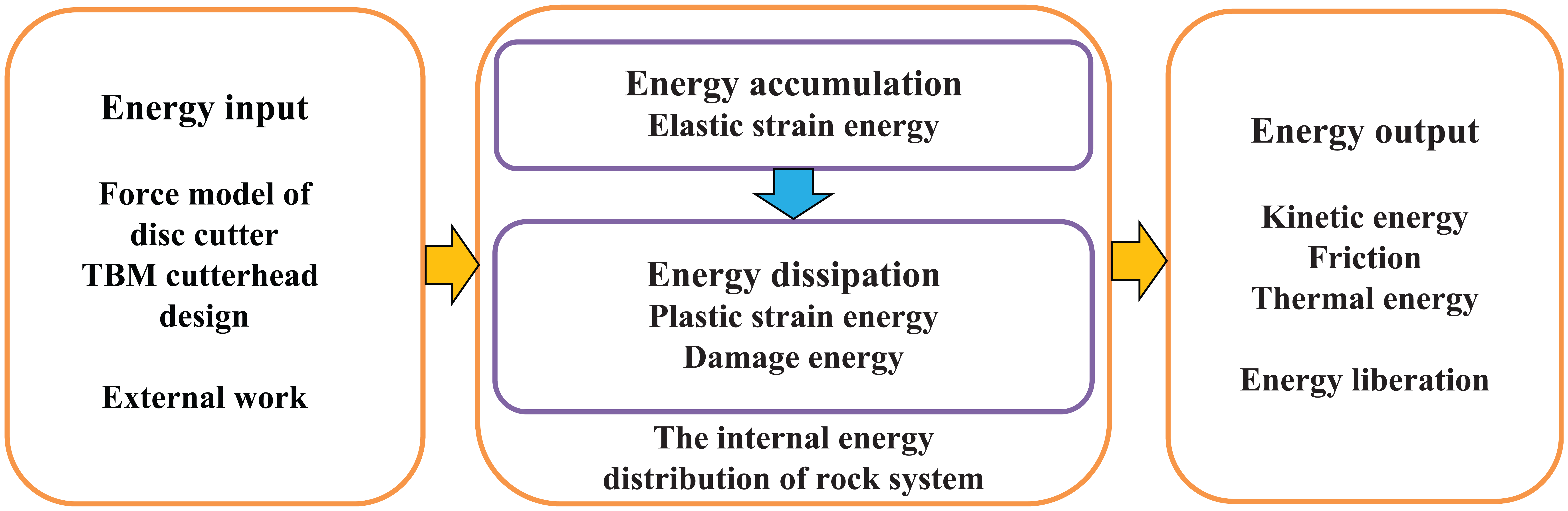
Disk cutter cutting rock system energy transfer process.
The process when disk cutters under the action of external forces begin to work on rock can be regarded as energy input. In the next procedure, energy transfers to the rock system to generate energy accumulation causing elastic strain energy in rock mass; when the energy reaches a certain saturation state, the plastic strain energy and the damage energy form to generate energy dissipation; finally, energy releases in the form of kinetic energy, friction, and thermal energy. Hypothesizing all external work on the process of disk cutter cutting rock should be used to accumulate energy in the rock mass, under the condition assuming the rock system is infinite roughly and making rock system as the reference object, the disk cutter rock-breaking system can be regarded as under the influence of external force (the traction force of

Assuming the main stress direction of rock is corresponding to the main stress direction of disk cutter in cylindrical coordinates, according to equations (9)–(11), (18), and (19), disk cutter’s traction force on cutting wedge surface can be solved



where
Single disk cutter’s cutting force analysis from energy perspective
Energy model analysis
During the course of rock-breaking process, energy imposed by disk cutter is related to cutting path. According to equations (20)–(22), based on the stress–strain relationship, single disk cutter’s three directional forces such as vertical pushing force FV, tangential rolling force FR, and lateral force FS can be solved through analysis of energy input



In order to verify the three directional force models, examples of applying this model to derive energy variations for single disk cutter are listed below. In this article, one selected 17-in disk cutter 6 cutting granite 13 is analyzed as an example. Disk cutter parameters are shown in Table 1, while granite parameters are shown in Table 2.
Cutter parameters of 17-in disk.

Granite property parameters.

Adopting given values of disk cutter geometric parameters and rock geological parameters, model (23) is compared with Evans and Pomeroy 10 and Colorado School of Mines (CSM) 14 about vertical pushing force model from energy perspective with the disk cutter penetration from 2 to 16 mm. The energy variations for the three models can be shown in Figure 6. As can be seen from this figure, the energy changes of model (23) are between Evans model and CSM model, and energy increases with the increase in penetration. At the same time, it can be noted that model (23) is also associated with the rotation speed of cutterhead and mounting radius of disk cutter as shown in Figure 7. In Figure 7, energy increases with the increase in disk cutter mounting radius and with the increase in cutterhead’s rotation speed.

Disk cutter rock-breaking process vertical pushing force energy model comparison.

Relationships among disk cutter vertical pushing force energy, angular velocity, and installation radius.
Model (24) has been compared with Roxborough and Phillips 15 and CSM 14 based on energy of tangential rolling force and tangential rolling force, while the disk cutter’s penetration is from 2 to 16 mm and disk cutter’s mounting radius is from 0 to 5000 mm. The three tangential rolling force models of energy variation are shown in Figure 8. As can be seen from this figure, energy model (24) is between CSM model and Roxborough model. The rolling energy consumed in model (24) is closer to that of the CSM model. The energy variation is the same as that of CSM model and Roxborough model. In addition, energy increases with the increase in penetration and disk cutter’s mounting radius.

Disk cutter rock-breaking process tangential rolling force energy model comparison: (a) CSM energy model, (b) Roxborough energy model, (c) Wθ energy model.
As shown in Figure 9, the deduced tangential rolling force of energy model (24) also shows that tangential rolling force energy is also associated with the rotation speed of cutterhead, assuming that the mounting radius of disk cutter is 2 m and has the same cutting depth (the cutting penetration is 8 mm). At the same time, disk cutter’s energy variation with the angular velocity (the rotational speed of cutterhead is from 0 to 10 rad/min) is obvious. As can be seen from Figure 9, disk cutter tangential rolling force used to break rock energy is closely related to the angular velocity of cutterhead. That is to say, when rotational speed increases, cutting energy for disk cutter’s tangential rolling force also increases.

Relationships between disk cutter tangential rolling force energy and angular velocity.
Model (25) is compared with the Roxborough 15 model and the Akiyama 16 model about lateral force model of energy with the disk cutter’s penetration from 2 to 16 mm. Energy variations for the three models are shown in Figure 10. It shows that according to model (25), energy consumed in the rock-breaking process is between the Roxborough model and Akiyama model. The energy value is closer to the Roxborough model although the energy consumption is very small. It should be noted in model (25) that energy variation is associated with the rotational speed of cutterhead and disk cutter’s mounting radius. Under the condition that cutting penetration is 8 mm, energy values needed for lateral force will vary with the mounting radius (disk cutter mounting radius is from 0 to 5000 mm) and the rotational speed (the rotational speed of cutterhead is from 0 to 10 rad/min) as shown in Figure 11. At the same time, energy variation increases when the disk cutter’s mounting radius increases and when the rotational speed increases

Disk cutter rock-breaking process lateral force energy model comparison.

Relationships among disk cutter lateral force energy, angular velocity, and installation radius.
In conclusion, using LS-DYNA to simulate disk cutter under different rotational speed conditions to obtain energy variations, the derived energy model for three forces in this article, namely, vertical pushing force energy model (23), tangential rolling force energy model (24), and lateral force energy model (25), has been shown to be in good accordance with the literature,17,18 which can be hoped to have certain reference value for engineering applications.
Comparative analysis of experimental data: application of the energy model
In order to further analyze the rationality of the energy-based force model of disk cutter, experiment analysis to investigate the effects of different rock structural properties and a V-type disk cutter on rock cutting efficiency have been carried out using experimental data. 19 These adopted cutter parameters and geological parameters are shown in Tables 3 and 4.
Disk cutter parameters.

Rock property parameters.

Using linear cutting experiment, Balci and Tumac carried their work on V-type 380-mm-diameter disk cutter to record experimental data. Adopting these data, the comparison result has been listed in Table 5, and the difference in energy change is shown in Table 6, assuming that cutting straight line trajectory is 1 m.
Experimental and theoretical force model results.

Experimental energy and theoretical energy results.
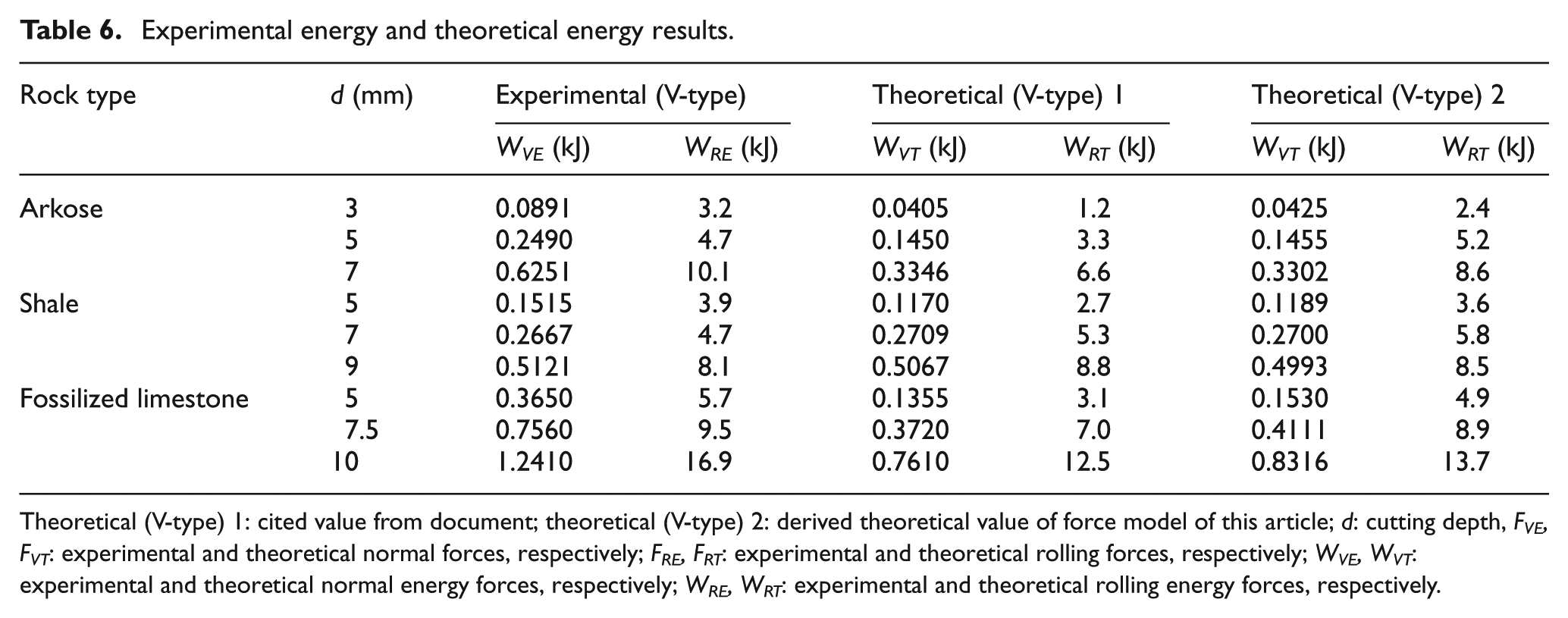
Theoretical (V-type) 1: cited value from document; theoretical (V-type) 2: derived theoretical value of force model of this article; d: cutting depth, FVE, FVT: experimental and theoretical normal forces, respectively; FRE, FRT: experimental and theoretical rolling forces, respectively; WVE, WVT: experimental and theoretical normal energy forces, respectively; WRE, WRT: experimental and theoretical rolling energy forces, respectively.
It can be seen from Tables 5 and 6 that when the rock uniaxial compressive strength is greater, under the action of vertical pushing force, the disk cutter’s force value of derived model in this article is more close to that of experimental data. Under the action of tangential rolling force, when the uniaxial compressive strength of rock is greater, tangential rolling force of the derived model is more close to the actual experimental data. When the rock is harder, under the same penetration, the calculation result of the model is more close to the actual result. In brief, applying microscopic energy analysis method can better reflect the force and energy characteristics in the process of TBM rock breaking.
Conclusion
Today, in TBM industry, many researchers study the disk cutter’s rock-breaking mechanism. At present, many models have been obtained through not only carrying out cutting experiments but also deriving theoretical models. However, these models are all based on either macro empirical model or semi-empirical model. Considering the special nature of rock structure, based on the principle of admissible work, disk cutter’s theoretical force prediction model from the microscopic point of view has been derived in this article by means of FEM. The conclusion is as follows:
In the rock-breaking process, macroscopic force characteristics of disk cutter can be transformed to the micro stress model. Based on the fact that in the rock research field stress and strain changes are consistent with each other and according to the conditions of energy conservation, the disk cutter stress model finally can be solved to obtain the new forecast model in the rock-breaking process.
The model has a certain theoretical value. Result of comparative analysis showed that the prediction model proposed in this article can almost give the same force changes and the energy changes as the other two classical forecasting models. Furthermore, with the disk cutter rotating speed and disk cutter mounting radius jointly used to analyze characteristics of cutter force and cutter energy in the process of rock breaking, the same conclusion can be acquired as the literature18,19 showed that using the finite element simulation software, with the increase in the rotational speed, the three directional forces also increase.
The model has certain engineering application prospects. According to the derived model, when the rock strength is improved, the disk cutter’s penetration increases. It has been proved that the calculated data result derived from the derived model is close to the experimental data.
The calculated results of the model are smaller than those of the actual data. In order to simplify the calculation, the energy model derived in this article makes some simplification in terms of energy output based on the rock micro properties, such as only considering elastic energy, ignoring the influence of injury energy, and ignoring the effect of shear stress and shear strain during the process of analyzing disk cutter stress model and rock strain.
Footnotes
Academic Editor: Yangmin Li
Declaration of conflicting interests
The author(s) declared no potential conflicts of interest with respect to the research, authorship, and/or publication of this article.
Funding
The author(s) disclosed receipt of the following financial support for the research, authorship, and/or publication of this article: This work was financially supported by the National Key Basic Research Development Plan (973 Plan) Project of China (grant no. 2013CB035402) and Tianjin City Cooperation Demonstration Project of China (grant no. 2012GKF-0606).