




Abstract
Product service system is a new-type production system with high-degree integration and overall optimization of product and service. The participation of suppliers in product service system development will greatly shorten the development cycle and enhance the production efficiency. The task planning of product design is one of the key phases of product service system development process, which mainly contains the design task decomposition and the design task allocation. Aiming at product service system product design, this article conducts the decomposition of design tasks, performs the recognition of coupling design task set, and realizes the structured modeling of design tasks. Outsourcing decision-making analysis is conducted on the design tasks obtained through decomposition process so as to confirm the design tasks that need the participation of suppliers. The allocation model of design tasks is constructed, and the suppliers that take part in product service system development are confirmed based on genetic algorithm. Taking the numerical control machine tool as an example, this article conducts the instance analysis and verifies the feasibility of the forenamed methods.
Introduction
The manufacturing industry is the principal part of national economy, and it is the foundation for building the country, the tool for evolving the country, and the basis for strengthening the country. The level of manufacturing industry reflects the developmental level of national productivity, and it is an important basis for measuring the development degree of country. Globalization, greenization, and servitization are all goals for the development of manufacturing industry. The position of service industry in the manufacturing industry has been gradually increasing. The boundary between traditional manufacturing industry and service industry has become unclear. It is more and more common for the enterprises to provide value-added services to realize higher profit by relying on product. Under this background, the conception of the product service system (PSS) has emerged at the right moment. PSS is new-type production system with high-degree integration and overall optimization of product and service, and it forms under the service mode of full life cycle.
However, the development of PSS is very complicated, and it becomes more and more difficult for only one enterprise to implement that. It has been the inevitable path of realizing “development of PSS for high-end equipment” to reasonably introduce suppliers and fully motive their enthusiasm to make them participate in the product design and manufacturing in the core manufacturer. The task planning of product design is one of the key phases of PSS development, which mainly contains the task decomposition and the task allocation of product design. Aiming at PSS product design, this article studies the modeling method of task planning of product design in PSS development with the participation of suppliers, analyzes the decomposition of design tasks, recognizes the coupling design task set, and realizes the structured modeling of design tasks. Next, this article analyzes the outsourcing decision-making on the design tasks obtained through task decomposition and builds the allocation model of design tasks to confirm the design tasks that need the participation of suppliers. Finally, taking the numerical control machine tool as an example, this article verifies the feasibility of forenamed methods.
Literature review
At present, many articles have been published about PSS development methods and applications. For product development, many researchers have considered the participation of suppliers in development process and carried out deep studies on the topic named early supplier involvement (ESI). However, there are few researches that consider the participation of suppliers in PSS development process.
Research on PSS
Baines et al. 1 summarized the literature available on PSS and concluded that manufacturers need to configure their products, technologies, operations, and supply chain to support the adoption of PSS. Beuren et al. 2 analyzed the positive and negative aspects of PSS and found that the researches on PSS mostly are theoretical, and more case studies are needed. Bertoni 3 proposed a kind of two-dimensional (2D) visual test method of the color coding, so as to enhance the awareness of the designer during the design process of PSS and highlight the considerations about the problem-solving strategies and aspects of PSS. Bertoni et al. 4 analyzed the fundamental and process of PSS and analyzed its potential in the application in light industry. Joore and Brezet 5 put forward multi-layer design model and proved its practical value and potential in solving complicated design process by taking sustainable transportation and electrical transmission as object. Long et al. 6 divided customer demand into functional demand and sensory demand and established a multi-category support vector machine (MSVM), so as to realize PSS that meets specific needs of customer. Geum et al. 7 proposed the conception of “technical interface” of the product service integration and provided six types of technical interface according to the interactive configuration of PSS. Lin et al. 8 emphasized the strategic choice of PSS design, confirmed strategic suggestion by case-based reasoning, and selected 12 varieties of index to describe cases.
Research on product design with supplier participation
Imai et al. 9 have been the very first people studying product development with the participation of suppliers and explored the effect of supplier participation in product development. Yeniyurt et al. 10 proposed the longitudinally theoretical framework of product development with the participation of suppliers and proved that the supplier participation in product development will produce more mutual benefits between suppliers and manufacturer by taking the auto industry in North America as an example. Potter and Lawson 11 built the organization model of causal ambiguity and showed that the oriented participation of suppliers in the inter-organization new product development team will reduce ambiguity. Ragatz et al. 12 pointed out that the supplier participation in product development can give the manufacturing enterprise higher procurement quality and decrease the cost of product development and shorten development cycle. Braha 13 described the relationship between task and task attribute using axiomatization design matrix and proposed the way of task decomposition. Simatupang and Sridharan 14 clarified the architecture of supply chain collaboration and proposed a design for supply chain collaboration, which enabled participating members to create and develop key elements of the proposed architecture.
Decomposition of product design task
Decomposition of product design task is an essential issue of PSS development with the participation of suppliers. It is actually a complicated task. It is to decompose the task into several design subtasks through appropriate algorithm and to confirm the relationship between each subtask and another, so as to provide convenience for the cooperation of the undertaker of design task. The decomposition of design task will be accompanied by the transmission of information and affect the execution timing sequence of design task.
Decomposition of design task
The decomposition of design task is to decompose a large design task into several executable design subtasks, and the mutual independence of each design subtask should be guaranteed. The first step of the decomposition is to build a model of design task decomposition. In this article, a decomposition method with the combination of function and structure is used, and the mapping model of three domains (function–structure–task) is established, as shown in Figure 1.

Domain mapping model of function–structure–task.
Since both the product function and the product structure are expressed through hierarchical structure tree, and the design task is a mapping of product function and product structure, hierarchical structure tree is used for describing the decomposition of design task in this article. The general task of product design is the top layer, represented by T, and it can be decomposed into several design subtasks, represented by
Relationship analysis of design task
The design subtasks obtained through the initial decomposition of design task are not completely independent, but they have mutual effect. The relationships between the design tasks mainly contain serial relationship, parallel relationship, and coupling relationship. The relationships between design tasks can be expressed through directed graph, but the development of numerical control machine tool is a complicated process of collaborative design, and only the directed graph cannot fully express that. In this article, a combination of the directed graph and design structure matrix (DSM) 15 will be adopted to describe the development process of numerical control machine tool.
Assume the design task set obtained through decomposition of design task is {T 1, T 2,…, Tn }, and n × n matrix A can be used to indicate the relationships between the design tasks
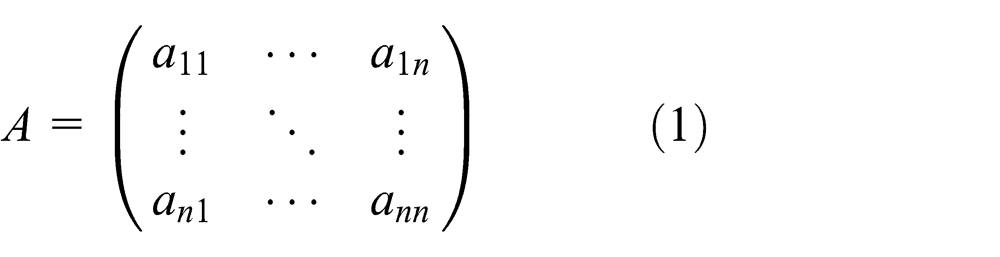
The element along the leading diagonal is the design task itself. This article regards that the design task itself has no relationship, so aii
= 0. And other elements present the existence of the relationships between the design tasks. aij
= 1 (i, j = 1, 2,…, n) shows that the design task Ti
transmits information to design task Tj
, and aij
= 0 (
Serial relationship. If ai,aj ∈ A, aij = 1, and aji = 0, the two design tasks are in serial relationship.
Parallel relationship. If ai,aj ∈ A, aij = 0, and aji = 0, the two design tasks are in parallel relationship.
Coupling relationship. If ai,aj ∈ A, aij = 1, and aji = 1, the two design tasks are in coupling relationship.
Boolean-type DSM can reflect the existence of the relationship between design tasks, but cannot reflect the strength of the relationship. The numeric-type DSM has just supplemented this shortage. Assume the fuzzy language set reflecting the strength of relationship between design tasks is {none, weak, medium, strong, very strong}, and the corresponding values are {0, 0.25, 0.5, 0.75, 1}.
Recognition of coupling design task set
Among the relationships between design tasks, the design task set composed of design tasks having strong connected relationships is called coupling design task set. In the coupling design task set, any two design tasks have a bidirectional passageway. In DSM, the row and the column in matrix corresponding with the coupling design tasks, respectively, contain at least one nonzero element. The analysis and process of product design task set mainly contain two steps, partition of independent design task and recognition of coupling design task set.
Partition of independent design task
If vacant column exits in the relationship matrix of design task, the design task corresponding with the vacant column will not accept any information, and this design task should be put at the first place. If vacant row exits in the relationship matrix of design task, the design task corresponding with the vacant row will not output any information to other design tasks, and this design task should be put at the last place. After the recognition of independent design task, the matrix B forms

Recognition of coupling design task set
Ao is the coupling design task set. Process the elements in the coupling design task set as below. Let cij = (aoij + aoji )/2. Then the symmetric matrix C can be obtained. Take the lower diagonal, and set the element of the leading diagonal as 1, as the new matrix R. Intercept matrix R with λ by means of fuzzy clustering 16 and divide design task units into different clusters.
Structured modeling of design task
The building of structured model of design task can help the optimization and reorganization of design task. It can reduce the repeating and recycling during the implementation process of design task caused by improper execution order, enhance the parallelism degree of design task, and improve the customer satisfaction. The bases for optimization and reorganization of design task are as follows:
In DSM, if all elements in a row are 0, it indicates that the design task corresponding with this row outputs no information to other design tasks and this design task can be put at the last place for execution.
In DSM, if all elements in a column are 0, it indicates that the design task corresponding with this column does not necessarily need information from other design tasks and this design task can be put at the first place for execution.
The coupling design task set includes design tasks having close relationship with each other, and this coupling design task set should be classified as independent integrity.
Grade the design tasks into different classes and re-construct DSM according to the order of grades.
Assuming P is a reachable matrix, boil the coupling design task set down to an independent integrity, that is, boil the row and the column corresponding with the design task that contains subsets with strong connection down to one row and one column. Through the dimension reduction process like this, it can get the simplified matrix

and the necessary sufficient condition for the design task
Allocation of design task with participation of suppliers
Outsourcing decision-making analysis of design task
After finishing the decomposition of design task of PSS development, the design tasks should be assigned to the execution team. Before the assignment, the outsourcing decision-making analysis of design task shall be conducted. By taking cost and core competitive power as the analysis basis, this article has established an outsourcing decision-making model of design task of components, and the decision-making indexes include core value, capacity of supply chain, benefits of outsourcing, complex rate of components, and risk of outsourcing. It introduces the conception of index of outsourcing. The higher the combined index of the outsourcing of a component, the more appropriate it is to assign the design tasks to the supplier; the lower the combined index of the outsourcing, the more reasonable it is to assign the design task to the internal department of the manufacturer. The expert scoring method is adopted here, and the index, comment, and index of outsourcing are shown in Table 1. Using the empowerment method of expert multi-layer correlation matrix, the ultimate index weights of outsourcing decision-making are calculated as shown in Table 2.
Quantization indexes of design task outsourcing.

Index weights of design task outsourcing.

Mark the weights of the five evaluation indexes in Table 2 as
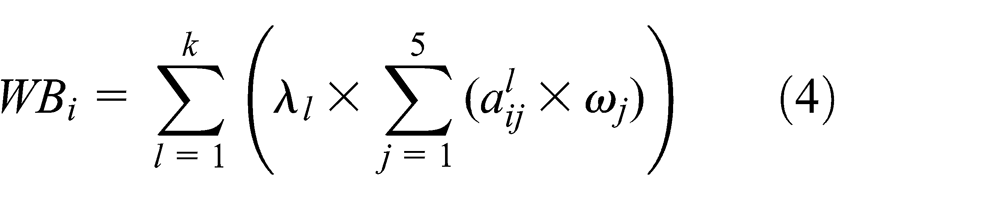
Give scores to the design tasks obtained through decomposition, and the obtained comprehensive evaluation values and combined index of outsourcing are as shown in Table 3.
Evaluation values of design task outsourcing.

Set the threshold value of outsourcing decision-making as λ = 3.0. If Wi ≥ λ, the design task of ith component should be outsourced; otherwise, it should be manufactured by the manufacturer itself. For the design task that should be outsourced, when Wi ≥ 4.0, the supplier is in a common position; when Wi is between 3.0 and 4.0, the supplier is in a strategic position. The results of outsourcing decision-making of design tasks are indicated in Table 4.
Decision-making result of design task outsourcing.

Modeling of design task allocation
Problem description
Assume the number of outsourced design tasks is n, that is, T = {T 1, T 2,…, Tn }. Now there is the set of l suppliers, P = {P 1, P 2,…, Pl }, for the manufacturer to choose. Here, the ith supplier set includes ki suppliers, namely, Pi = {Gi 1, Gi 2,…, Giki }.
Matching degree of design task
During the design task allocation, the fact whether the supplier is qualified for the design task it receives will have significant influence on the rationality of allocation planning of design task and smoothness of coordination and dispatching.
Definition 1
The quantitative index about the suitability of design task given by the supplier is called matching degree of design task. The factors affecting the matching degree of design task include technical capacity, level of supporting facility, degree of interest, degree of leisure of supplier, degree of urgency of design task, and geographical factor.
Technical capacity
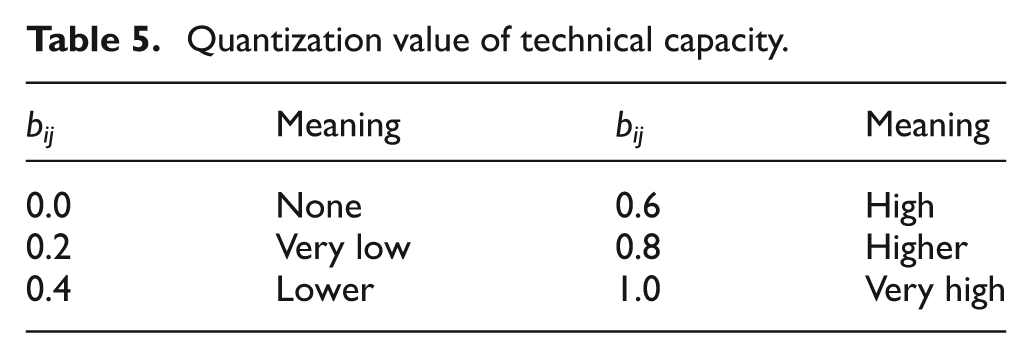
The technical capacity of the supplier for design task can be represented by the matrix B. Here, bij indicates the technical capacity of the supplier i for the design task j. The value and meaning of bij are shown in Table 5.
Quantization value of technical capacity.
Level of supporting facility
The level of software and hardware supporting facilities of the supplier can be represented by the matrix Q. Here, qij indicates the level of supporting facility of the supplier i for the design task j, the value is {3, 2, 1}, respectively, corresponding with {internationally advanced, nationally advanced, average level}.
Degree of interest
The degree of interest that the supplier has in the corresponding design task can be represented by the matrix C. Here, cij indicates the degree of interest of the supplier i for the design task j; the value range is (0, 1). The closer cij is to 1, the more the supplier is interested in the design task.
Degree of leisure of supplier
The supplier generally has many customers, that is, the supplier will face with many manufacturers and should finish many design tasks within a period, so it is necessary to evaluate the degree of leisure of supplier, which is represented by the matrix R. The value range is (0, 1). The bigger the degree of leisure, the bigger the ri , indicating it is more appropriate for the supplier to participate in design.
Degree of urgency of design task
It can be represented by the matrix E. ei represents the degree of urgency of design task i, and the value range is (0, 1).
Geographical factor
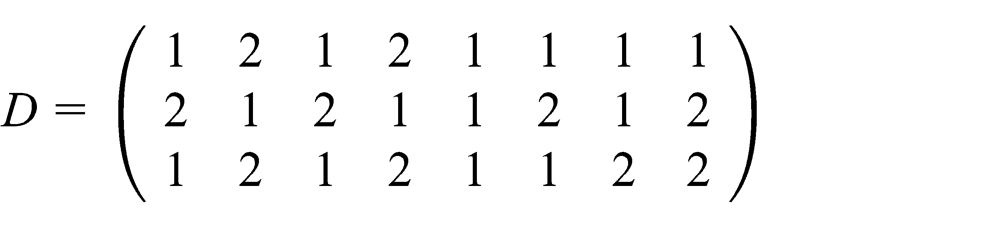
The geographic position of the site where the supplier executes corresponding design task can be represented by the matrix D. If the supplier is in other place, dij = 1; if the supplier is in local, dij = 2.
Through the analysis above, the matrix of matching degree of design task A can be obtained. aij = ω 1 × bij + ω 2 × qij + ω 3 × cij + ω 4 × ri + ω 5 × ej + ω 6 × dij , where ω 1, ω 2,…, ω 6 is the corresponding weights.
Coordination degree of design task
During the allocation of design task of PSS, the level of enforcement of coordination of the design task is a key factor that affects the execution of design task. It is necessary to analyze the coordination between the bearers of the design tasks.
Definition 2
The degree of coordination of design task is a quantitative index of the coordination degree between the manufacturer and the supplier, or between the suppliers. It is represented as the matrix S of the coordination degree of design task.
Optimization model of design task allocation
The purpose of the allocation of design task of PSS development is to maximize the matching degree and the coordination degree of design task

where xij is the factor for judging whether the design task j is assigned to the supplier i. If yes, xij = 1; otherwise, xij = 0; yli is the factor for judging whether the design task i is assigned to the supplier l; yvj is the factor for judging whether the design task j is assigned to the supplier v, and the computing method is the same as xij; α and β are the weights of the matching degree and the coordination degree of design task, respectively.
Design task allocation based on genetic algorithm
Genetic algorithm (GA) originated from the research on computer simulation of biological evolution process. Professor Holland et al. proposed this self-adaption probabilistic optimization technique by simulating the heredity and evolutionary mechanism of “natural selection and survival of the fittest” in the living nature. This article carries out the allocation of design task based on GA.
Encoding and decoding
This article uses multiple number systems to encode, X = {x 1, x 2,…, xi,…, xn }. xi indicates the number in different number systems of chromosome at the position i, corresponding with the number of supplier for the design task i. The position of each gene in the chromosome corresponds with the design task, and the number in gene corresponds with the serial number of the supplier undertaking this design task. The decoding process is actually the inverse process of encoding.
Population initialization
An initial solution is needed to create after the chromosome encoding, which is called population initialization. In this article, the initial population is generated by random method.
Confirmation of fitness function
The fitness function of GA should conform to the restrictions including monodrome, continuity, non-negative, maximization, and so on. Through analysis, the mathematic model of design task allocation meets the constructing requirements of the fitness function. fit(z) is the fitness of the chromosome z

Determination of selection operator
The roulette wheel selection is used to determine the selection operator in the example of this article. For the roulette wheel selection, the probability of the individual into next generation is equal to the proportion of the fitness function of the individual in that of whole population.
Determination of crossover and mutation operators
This article used single-point crossover operation between the chromosome in odd-numbered line and that in next even-numbered line. And in this article, the population scale is set to be even. Current population is selected as the mutation operator to carry out mutation on every element in some probability.
Instance analysis
Product design task decomposition
Design task decomposition
Based on the mapping theory of three domains, “function–structure–task,” the decomposition will be conducted by taking cutting module, feeding module along Z direction, and feeding module along X direction as examples. The design task after decomposition is shown in Figure 2.

Decomposition of design tasks of machine tool.
Formalized description of design task
T 111 = {111; delivery of primary motion; rigidity; running accuracy, vibration resistance, thermal deformation, abrasive resistance}; the recognition degree of the customer on each attribute is {1, 1, 0.75, 0.75, 0.75}. Since the design task of spindle units can be undertaken by the manufacturer of machine tool, it can meet the requirements of attributes.
T 112 = {112; delivery of motion; rigidity, running accuracy, vibration resistance, thermal deformation, abrasive resistance}; the recognition degree of the customer on each attribute is {1, 1, 0.75, 0.75, 0.75}. Since the design task of transmission shaft can be undertaken by the manufacturer of machine tool, it can meet the requirements of attributes. Similarly, it can be concluded that the decomposition of other design tasks is also feasible.
Recognition of coupling design task set
After finishing the design task decomposition, the design subtasks are not mutually independent completely, but they have serial, parallel, and coupling relationship. This article first uses the directed graph to express the relationships between design tasks; then the directed graph is converted into numeric-type DSM; next, it recognizes the independent design task and coupling design task set using recognition theory of design task set; finally, the structured model of design task is built to enhance the execution parallelism of design task and improve design efficiency. For the convenience of expression, this article re-numbers the above design tasks as A–P. The numeric-type matrix of relationships between design tasks is shown in Table 6.
Numerical relationship matrix R of design tasks.

According to Table 6, and combining with the recognition theory of design tasks, it can be concluded that the design task P has no influence on other design tasks, so it can be executed finally. Similarly, it can be concluded that design task D can be placed before P and after other design tasks. It can be seen that the design task D is independent, while design task P belongs to type of BUS. Remove D and P, and we can get matrix Ra . Rebuild the matrix, and cut out the matrix with the intercept of λ = 0.6. When the element value of the matrix is more than 0.6, it shall be represented by “※”; when that is less than 0.6, this element is vacant. The diagonal element is indicated by serial number. The clustering results of design tasks are {A, B}, {C}, {D}, {E, F, G}, {H, I, J, K, N}, {L, M, O}, and {P}.
Structured modeling of design task
Cut out the matrix of relationships between design tasks of numerical control machine tool with the intercept value of λ = 0.6. When the element value of the matrix is more than 0.6, it shall be set as 1; when that is less than 0.6, this element is 0. And from this, we can get the Boolean-type matrix of relationships between design tasks. The reachable matrix of this matrix is shown in Table 7.
Reachable matrix of design tasks.

According to the clustering result of design tasks, cut the reachable matrix short. Delete the elements in row and column corresponding with B, F, G, I, J, K, N, M, and O, and we can get the reduced matrix
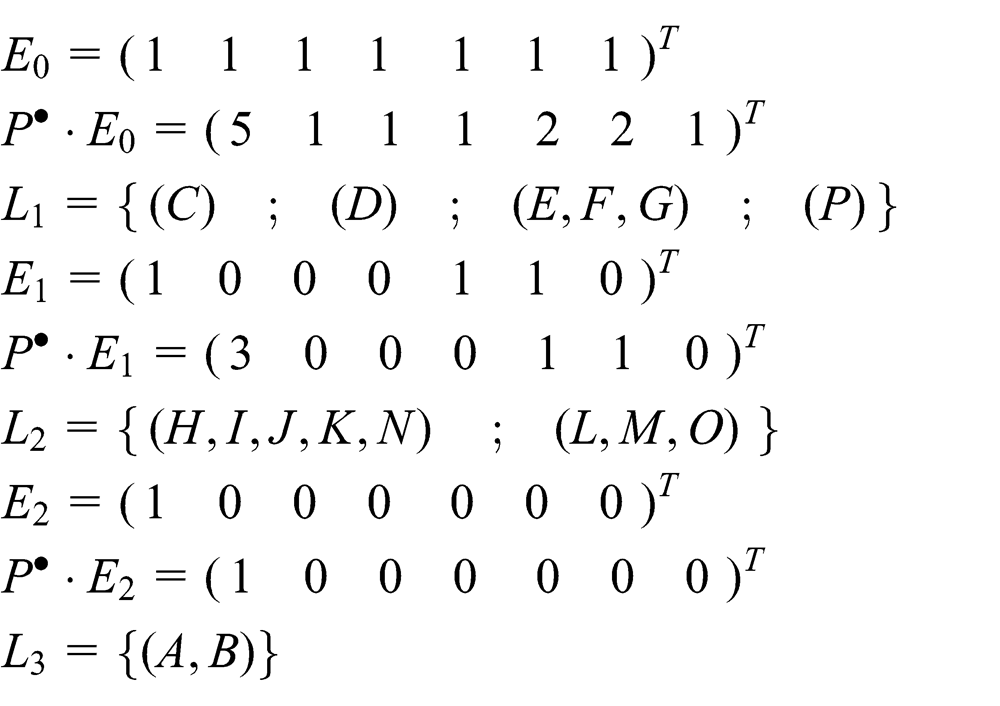
According to the grading of design tasks, the rebuilt Boolean-type DSM of concurrent design process for numerical control machine tool is shown in Figure 3. Here, the ignored elements are all 0, and the area in dark color indicates the coupling design task set.

Rebuilt DSM model.
Figure 4 shows the structured model of concurrent design process of numerical control machine tool. From the rebuilt Boolean-type DSM and the structured model of design process, the parallelism between the design tasks and the execution coordination between the design tasks can be seen. After implementing the design task {A, B}, the {H, I, J, K, N} and {L, M, O} can be implemented, followed by {C}, {D}, and {E, F, G}, and the last is {P}. If the design tasks are assigned to the appropriate suppliers, the timing and degree of the participation of suppliers in PSS development of numerical control machine tool are obtained.

Structured model of design tasks.
Product design task allocation
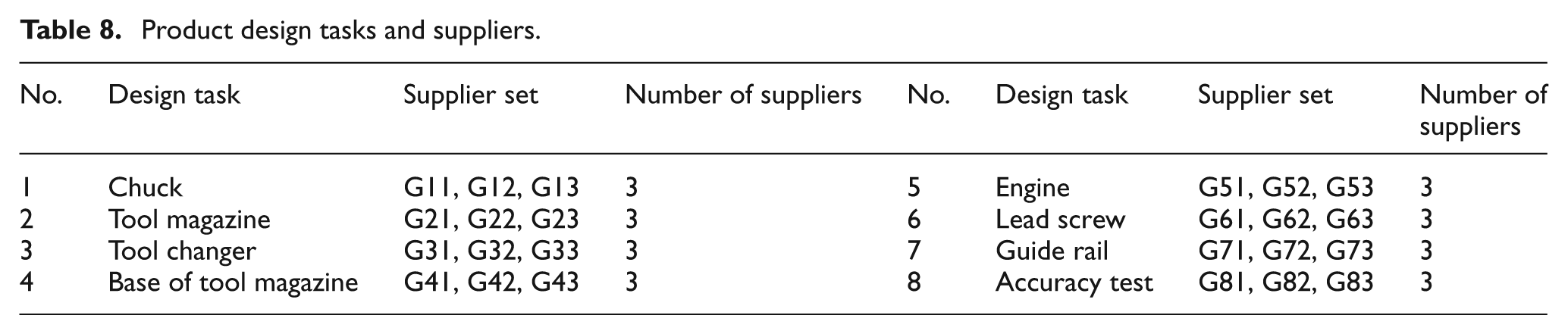
According to the analysis result of product design of PSS development, 11 design tasks need to be outsourced. By analyzing these design tasks, it can be found that “engine at Z direction” and “engine at X direction” can be one category of design task, “lead screw at Z direction” and “lead screw at X direction” can be classified into the same category of design task, and “guide rail at Z direction” and “guide rail at X direction” can be in the same category. The merged design tasks and the corresponding supplier set are shown in Table 8.
Product design tasks and suppliers.
Calculation of matching degree
The technical capacity of each supplier is

The level of supporting facility of each supplier is

The degree of interest of each supplier is

The degree of leisure of each supplier is

The degree of urgency of each supplier is

The geographical factor of each supplier is
Take the weight of each index as

and matching degree of design task is

Calculation of coordination degree of design task
The matrix of coordination degree of design task is shown in Table 9.
Coordination degree matrix of design tasks between suppliers.

Parameter setting of GA
The parameter setting of GA is shown in Table 10.
Parameter setting of GA.

Result analysis of design task allocation
Set the parameters and operate GA. The results are indicated in Figure 5. From Figure 5, it can be seen that the maximum number of generations is 40, and it will converge at the 12th generation. The obtained objective function value is 1.7195, the serial number of corresponding chromosome is [2 2 0 0 2 1 2 1], and the combination of suppliers through decoding is [3 3 1 1 3 2 3 2]. After allocating the design tasks, the planning model of product design tasks of PSS development of machine tool that the suppliers can participate is established, as shown in Figure 6.

Generation and optimal result of GA.
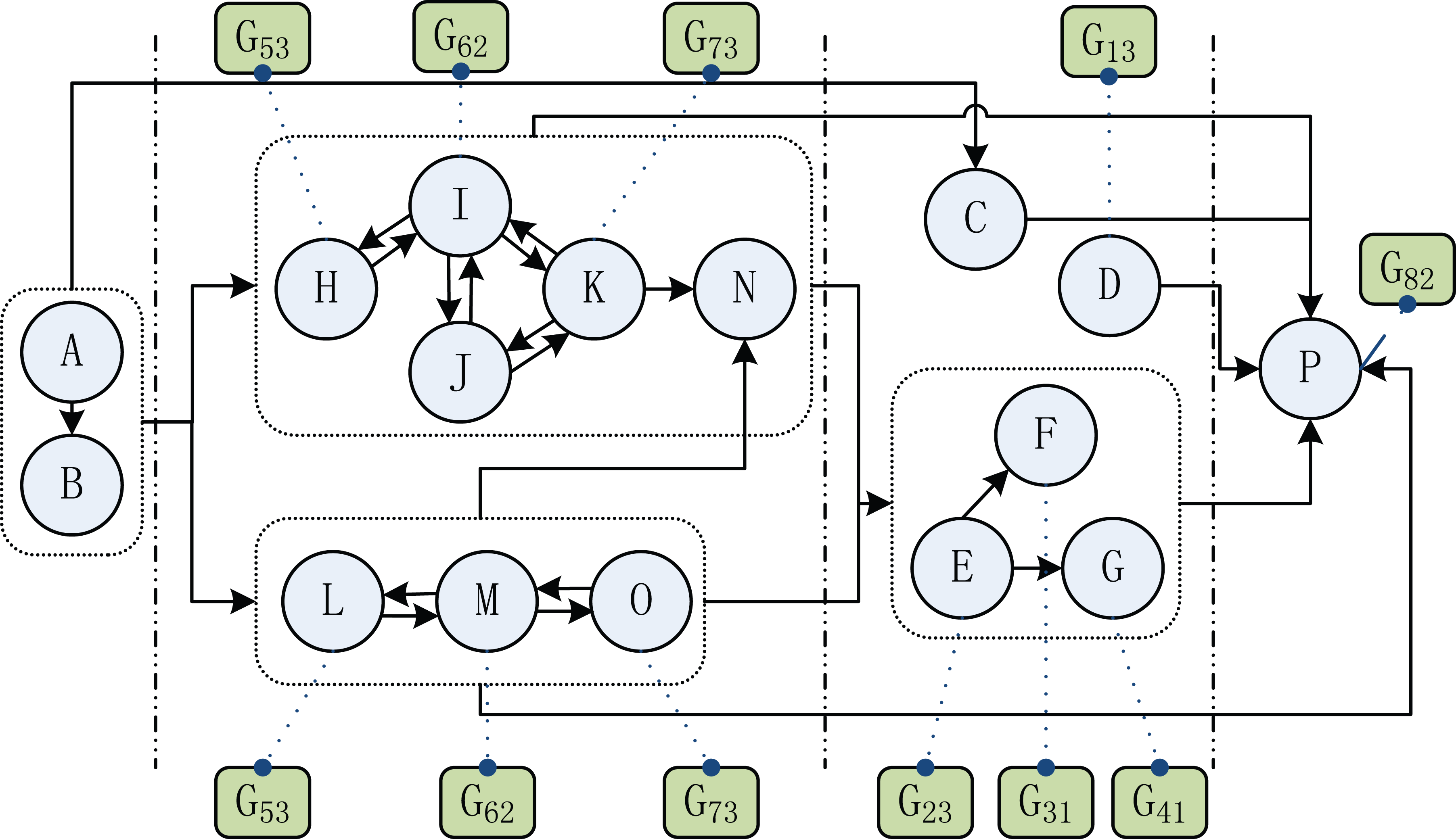
Design task planning with supplier participation.
Conclusion
In order to meet the customer requirements for integrated solution of “product + service,” the researchers have proposed the conception of PSS and accomplished many application cases. This research of PSS has developed into industrial application from theoretical analysis. The PSS development is complicated, which is unpractical only depending on the ability of the manufacturer and needs the participation of suppliers. This article studied the task planning of product design in PSS development with the participation of suppliers. The decomposition of design tasks was realized by combining product function with product structure and adopting the mapping model of three domains. Analyzing the relationships between design tasks, this article conducted the recognition of coupling design task set based on fuzzy clustering and implemented the structured modeling of design tasks based on DSM. By the allocation model of design tasks, this article analyzed the outsourcing of design tasks and allocated the design tasks with GA. Taking the numerical control machine tool as an example, the feasibility of the methods was verified.
Footnotes
Academic Editor: ZW Zhong
Declaration of conflicting interests
The author(s) declared no potential conflicts of interest with respect to the research, authorship, and/or publication of this article.
Funding
The author(s) disclosed receipt of the following financial support for the research, authorship, and/or publication of this article: This work was supported by the Fundamental Research Funds for the Central Universities (N140305001) and the Natural Science Fund of Liaoning Province (2013020052, 2011216010).