



Abstract
The optimum configuration parameters of tractor–trailer combinations for lateral stability performance are proposed by adjusting the length of dolly and the second trailer’s center of gravity. A linear yaw plane model of vehicle combinations is adopted for dynamic analysis, and the model is calibrated by TruckSim. According to the yaw rate rearward amplification ratio of lateral response index, and combining the simulation results of MATLAB/Simulink, dolly and the second trailer are the dominate factors for lateral stability of vehicle combinations. Simulation results show that the distance between articulation joints of dolly is 1.6 m; simultaneously, the rate of distance between front hitch and center of gravity of the second trailer to its front and rear wheelbase is 0.41 and may gain the best lateral performance. Compared with configuration parameters of the original vehicle combinations, the results also illustrate that the one derived from adjustment approach reduces high-speed rearward amplification ratio by 11.4%. The proposed approach might be used for identifying desired design variables of the tractor–two trailer combinations and provided theoretical basis for stability tests.
Keywords
Introduction
Double-trailer combinations consist of a tractor, first trailer, a dolly, and second trailer, and also known as tractor–trailer combinations or tractor/full-trailer combinations. 1 The advantages of tractor–trailer combinations are not only limited to the reduction in the congestion problems but also included economic and environmental benefits. However, unstable motion modes of tractor–trailer combinations, such as jack-knifing, trailer swing, trailer lateral oscillations, and roll-over, 2 are caused by its big size, heavy weights, larger center of gravity (CG) height, articulated joints, and complex configurations. From a safety perspective, conflicting views exist among transport experts, and there are some concerns about maneuverability and stability issues of tractor–trailer combinations which have been interested various in this field.
The study by J Aurell et al. 3 and G Bózsvári et al. 4 argued that tractor–trailer combinations have in general better dynamic stability or as stable as conventional combinations. A Aoki et al. 5 have investigated the effects of multiple axles on lateral dynamics of multi-articulated vehicles using a linear planar model, and non-oscillatory stability and steering sensitivity in steady-state turning are analyzed using a stability factor. P Fancher and C Winkler 6 have reviewed the directional performance issues in evaluation and design of articulated heavy vehicles. For the effects of different design configuration parameters such as number of articulation joints, wheelbase length, and number of axles on the safety of heavy vehicle combinations, refer to the article by PS Fancher and A Mathew. 7 In order to improve the lateral stability of tractor–two trailer combinations, active steering based 8 and braking based 9 of the trailer control systems are proposed. Compared with configuration parameters for designing tractor–trailer combinations, control methods have its limits.
All the above studies lack the optimum configuration parameters related to dolly and the second trailer, which have great effects on lateral stability of tractor–trailer combinations. In addition, different speeds, the distance between articulation joints of dolly, and CG of the second trailer have influence on the lateral performance of vehicle combinations.
The rest of this article is organized as follows. Section “Modeling and verification” describes the linear yaw plane model of tractor–trailer combinations, and model verification is made by comparing with TruckSim. The proposed yaw rate rearward amplification ratio (RWA) for lateral performance measure of vehicle combinations is presented in section “Lateral performance measures.” Section “Simulation results and discussion” presents the relationship among different speeds, the distance between articulation joints of dolly, the CG location of the second trailer, and the yaw rate RWA in this model. Finally, conclusions are drawn in section “Conclusion and forward.”
Modeling and verification
In order to investigate the effects of configuration parameters on lateral dynamics of vehicle combinations, which refers to Figure 1, an appropriate model is made and validated the fidelity of the developed model by TruckSim.

Illustration of tractor–two trailer combinations.
Vehicle combinations model
A linear dynamic model, including lateral motions, yaw motions of each unit, and articulation angle between two units, is considered. In this model, aerodynamic forces, rolling and pitching motions, and longitudinal forces between tire and road are ignored; vehicle units are considered as rigid masses and frame flexibility is neglected; and the left and right wheels of each axle are equal to steer angle (refer to Figure 2).

Model of the vehicle combinations.
From Newton’s laws of dynamics, the equations of motion for the tractor are written as

The equations of motion for the first trailer are casted as

The equations of motion for dolly are casted as

The equations of motion for the second trailer are casted as

where the notation is given in Appendix 1.
To derive the simplified vehicle model, the following assumptions have been made:
The model is at constant speed;
The tractor steer angle δf is small;
The articulation angle Ψi (i = 1, 2, 3) is relatively small;
The lateral tire force is linear functions of side-slip angle.
So


where

And the relationship between yaw rate and articulation angle of each unit is



Linearizing and differentiating the kinematical constraint equation results in


Finally, eliminating the joint force and putting the equations together in state space form, then giving the model of four vehicle units as

The matrices

Model verification
To evaluate the fidelity of the developed model of tractor–trailer combinations, one type of tractor–trailer–dolly–trailer combinations in TruckSim has been used. The data of Simulink and TruckSim are the same, selecting yaw rate and lateral velocity in different simulation environments to verify whether the developed model is correct.
As it is depicted in Figure 3, yaw rate and lateral velocity of tractor, first trailer, and second trailer in Simulink and TruckSim have consistent trends. But the results in TruckSim have oscillation apparently, especially lateral velocity. It is due to the rolling motion of sprung mass, suspension, nonlinear tire models, and so on, which are considered in the software. Consequently, results from MATLAB/Simulink and TruckSim are conformed to a large extent, which verify the accuracy of the developed model.
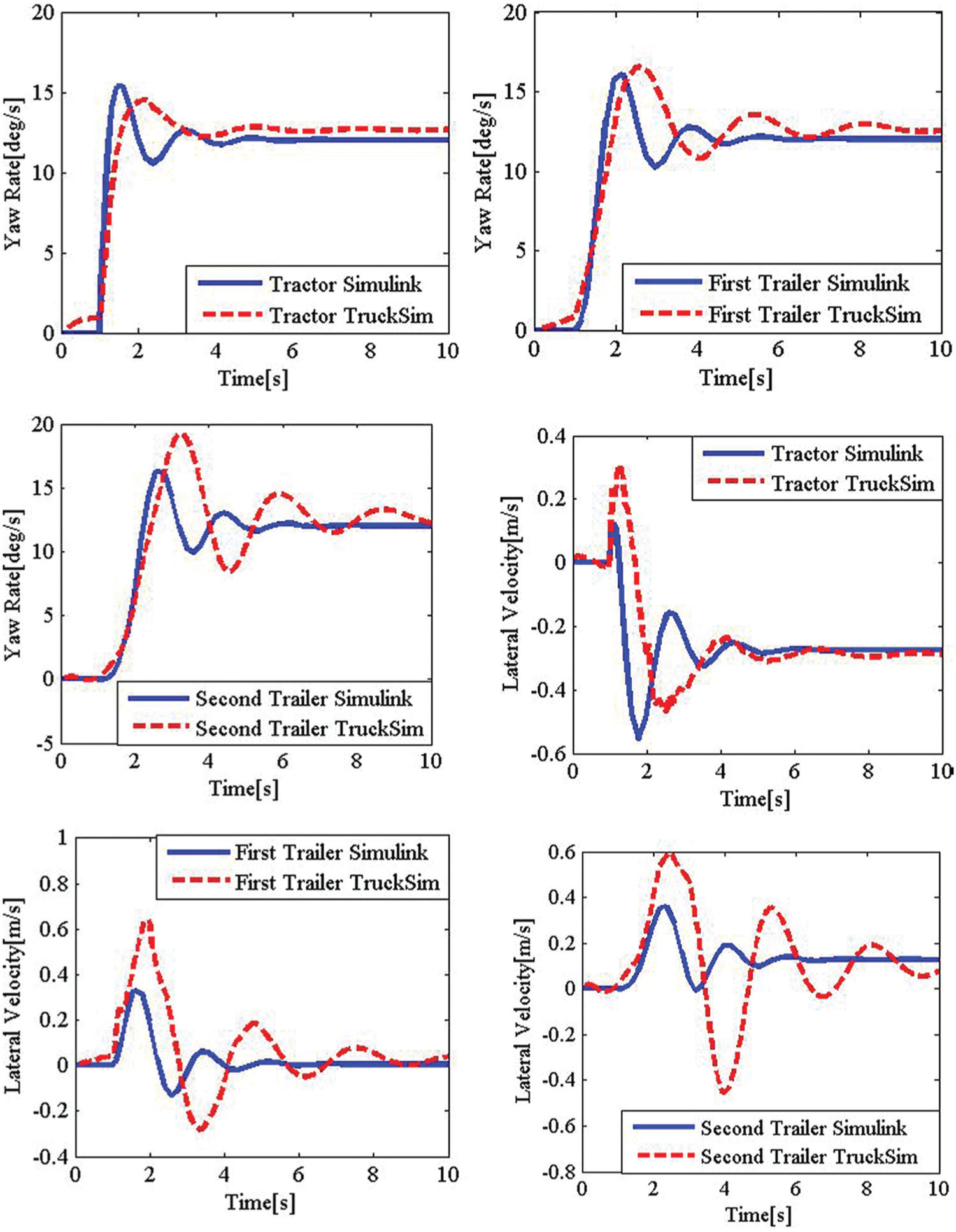
Comparison results: simulation of MATLAB/Simulink and TruckSim.
Lateral performance measures
In order to describe trailer swing and lateral oscillations of vehicle combinations correctly, RWA is selected for lateral performance measures. RWA is defined as the ratio of the maximum value of a motion variable of interest for the rear-most unit to that of the lead unit. 10 It is often given in terms of yaw rate or lateral acceleration. In this article, the yaw rate RWA is used for lateral stability analysis, which means the ratio of the peak yaw rate of the second trailer to that of the tractor in an obstacle avoidance lane-change maneuver. By defining the following term

Note that ω 1max and ω 4max are the peak yaw rate of the tractor and the second trailer, respectively.
Simulation results and discussion
The vehicle combinations speed is set at 20 m/s (72 km/h), and the steering angle of front wheels is 0.086 rad in step response. The data of simulation come from the Nihon University. 5 The simulation results are depicted in Figure 4.
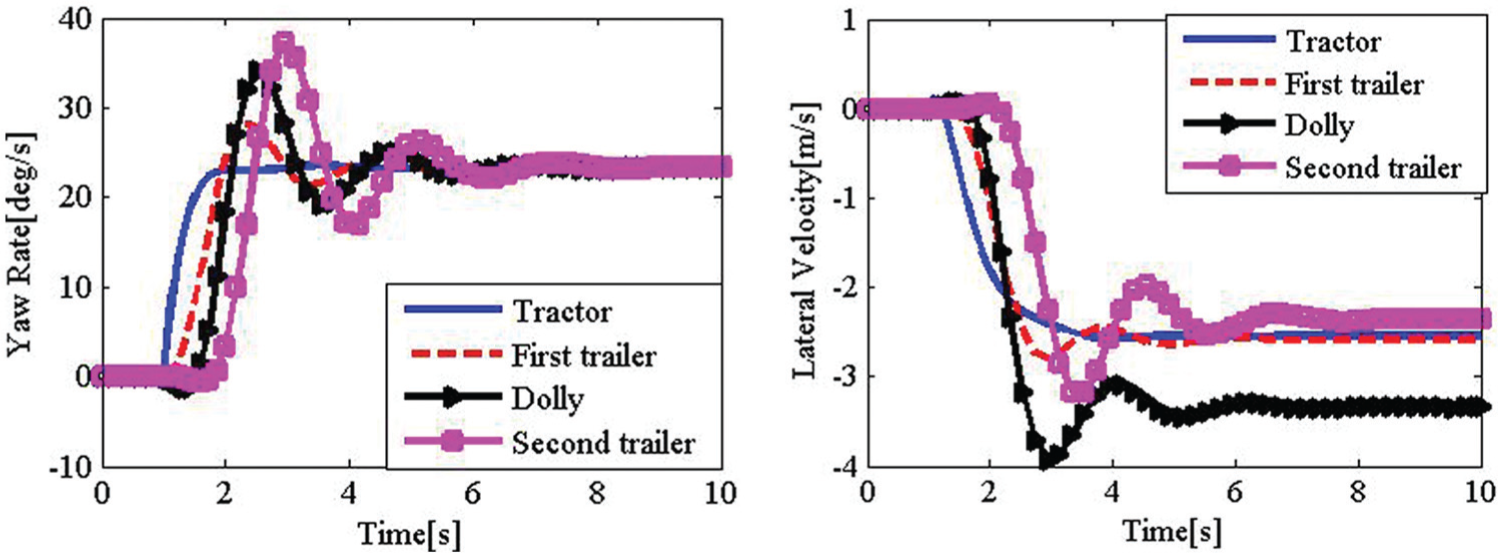
State variables of tractor–trailer combinations.
Figure 4 shows that dolly and the second trailer are the main factors in lateral stability of tractor–trailer combinations. Yaw rate of the second trailer increased dramatically to 37.2°/s, prone to instability. When the vehicle speed reaches a certain degree, a little steer angle of tractor can be quickly restore to a steady-state situation; however, the inertia of the trailer maintains the original state of motion. In addition, between tractor and the second trailer have different time lags, which make the combinations easier to roll-over in steering and trailer lateral oscillations largely after steering. Then the yaw rate RWA of combinations is 1.58.
Therefore, the study in lateral stability of tractor–trailer combinations should take different vehicle speeds, configuration parameters of dolly, and the second trailer into consideration. The optimum parameters will help the drivers choose the appropriate steering angle with different speeds and provide the reference in the length of dolly and CG of the second trailer for designer.
Effects of different vehicle speeds on lateral performance
To improve transport efficiency while fuel-saving, the tractor–trailer combinations are driven generally in medium or high speed. Vehicle speed is chosen as 15–25 m/s (54–90 km/h), combining with the developed model and lateral performance measures, to analyze different speed effects on the yaw rate RWA at the same steer angle of tractor front wheels, which is 0.086 rad. All the different speeds are in steady-state steering which has been verified by TruckSim.
Figure 5 shows that the yaw rate RWA increases along with the increase in speed. When the vehicle speed is less than 17 m/s, the lateral performance RWA is less than 1, which indicated that trailer swing or lateral oscillation will not happen. While the vehicle combinations speed is 24–25 m/s, the second trailer swings so sharply that causes lateral instability in transient response. Therefore, in order to reduce the incidence possibility of lateral swing instability, the driver should slow down in advance or make small-angle turning in high speed.

The relationship between vehicle speed and RWA.
Effects of dolly on lateral performance
The dolly is used to connect first trailer and second trailer. It plays a vital role in stability of the vehicle combinations. The distance between articulation joints of dolly is selected to analyze the effects of dolly on the yaw rate RWA of the vehicle combinations in high-speed steering. Suppose that the vehicle speed is 20 m/s (72 km/h), and the steer angle of front wheels is 0.086 rad.
Figure 6 shows that when the distance between articulation joints of dolly approaches to 2 m, the rate of changing curve is in exponential growth, and the vehicle combinations prone to instability. When the distance is close to 0.5 m, the second trailer swings apparently, while the distance is 1.6 m, the yaw rate RWA of tractor–trailer combinations is in the minimum value, which makes the best lateral stability of vehicle combinations in high-speed steering. In consequence, the distance between articulation joints of dolly should design appropriately for better lateral performance of vehicle combinations.

The relationship between dolly and RWA.
Effects of the second trailer on lateral performance
The CG location of the second trailer tends to be the most significant factor for the risk of rearward amplification. Research on the second trailer is important and necessary for lateral performance.
By defining the following term

where e is the rate, which is the distance between articulation joints and CG of the second trailer to the distance between front and rear wheelbase of it. Suppose that the vehicle speed and the steering angle of the front wheels are constant.
Figure 7 shows that the CG location of the second trailer has a significant impact on the RWA of lateral performance. When shifting to rear and setting e at 0.6, the yaw rate RWA increases exponentially and the vehicle combinations trend to instability. When e is at 0.4–0.5, the yaw rate RWA reduced obviously; especially, when e is at 0.48, the yaw rate RWA is in the minimum value, which means that the vehicle combination is safer in transient response. In order to improve the driving stability at high speed, the CG location of the second trailer should be in front of its center.

The CG location of the second trailer and RWA.
The optimum configuration parameters
In order to acquire the optimum configuration parameters for vehicle combinations, dolly and the second trailer are adjusted on the basis of the minimum RWA above, setting the distance between articulation joints of dolly at 1.6 m, as well as the ratio e of the second trailer at 0.41 by trying a lot of simulation results.
Compared with Figure 4, Figure 8 shows that the yaw rate and the lateral velocity of dolly and the second trailer have reduced obviously. The yaw rate RWA is 1.4 and the one derived from adjustment reduces RWA by 11.4%.

State variables of tractor–trailer combinations after adjustment.
Conclusion and forward
The developed model of tractor–two trailer combinations for lateral performance analysis is proposed, which is also verified by TruckSim. By selecting the optimum configuration parameters for minimum RWA of vehicle combinations, the obtained conclusions are as follows:
The distance between articulation joints of dolly and the CG location of the second trailer are the main factors which affect lateral performance of the vehicle combinations.
When the combination is driving at medium and at high speed, the lateral performance RWA becomes larger as the speed increases.
By adjusting the configuration parameters of dolly and the second trailer in tractor–trailer combinations, the yaw rate RWA is reduced by 11.4%.
Forward
The vehicle combination is simplified as a linear yaw plane model, ignoring the rolling and nonlinear tire model and so on, which will be studied in the future.
Footnotes
Appendix 1
Appendix 2
The vehicle combinations model system matrices
In matrix
Academic Editor: Yongjun Shen
Declaration of conflicting interests
The author(s) declared no potential conflicts of interest with respect to the research, authorship, and/or publication of this article.
Funding
The author(s) disclosed receipt of the following financial support for the research, authorship, and/or publication of this article: This research was supported by the National Natural Science Foundation of vehicle and road cooperative security evolution state (51078167).