




Abstract
The numerical approximation of the Caputo–Fabrizio fractional derivative with fractional order between 1 and 2 is proposed in this work. Using the transition from ordinary derivative to fractional derivative, we modified the RLC circuit model. The Crank–Nicolson numerical scheme was used to solve the modified model. We present the stability analysis of the numerical scheme for solving the modified equation and some numerical simulations for different values of the order of derivation.
Keywords
Introduction
In the recent decade, several researchers have proposed new definitions of the concept of derivative with fractional order. These definitions go from Riemann–Liouville to the newly proposed one by Caputo and Fabrizio. The old editions of the designed definition of the fractional derivative are a product of convolution of a derivative of a function
Definition 1. Let

In the above definition, the function M is a normalized function that takes the value 1 when α takes the values 0 and 1.7–9 The anti-derivative associated with the new derivative was proposed by Losada and Nieto and is given as follows.
Definition 2. Let

Losada and Nieto remarked that according to Definition 2, the fractional integral of Caputo-type of a function of order

The above condition allowed them to find a particular case of the normalized function

Without any doubt, this new derivative will be used in all the branches of sciences for modeling. 8 In order to translate from ordinary differential equations to fractional differential equations, we present the following mathematical transition for the time and space components: for the time component, we have

The new parameters

In the above equation, L is the representation of the inductance because of the magnetic field around the wires, C is the capacitance between the two conductors, R is the resistance of the conductors, and G is the conductance of the electric material separating the conductors. 10
Using the proposed transition, we suggest the following fractional RLC circuit model

with
We shall present in the next section the numerical approximation of space and time Caputo–Fabrizio derivative with fractional order.
Numerical approximation of the new fractional derivative
Definition 3.
Let

where

Let

Theorem 1. Let

Proof. The corresponding second order of the new fractional derivative is given by

However, for any given
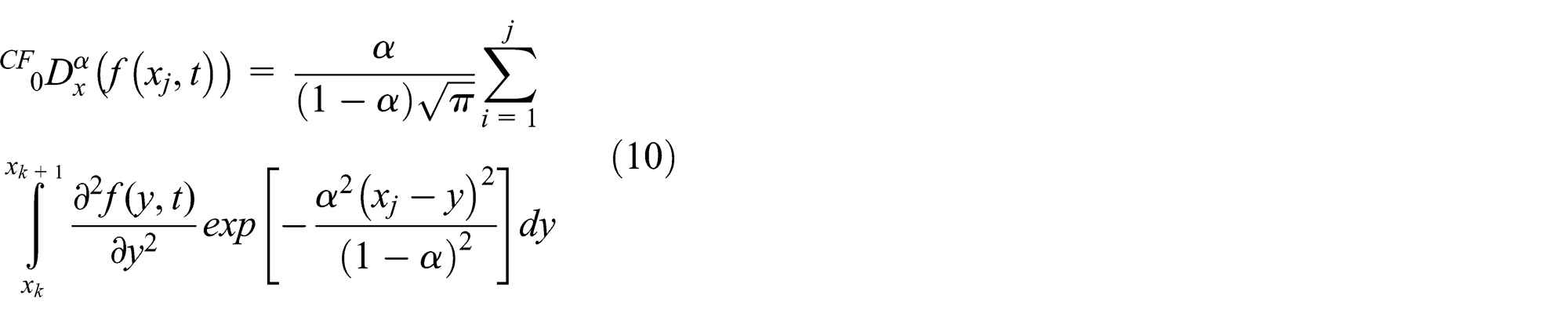
Using the Crank–Nicolson scheme for the usual second-order derivative, the above equation can be reformulated as
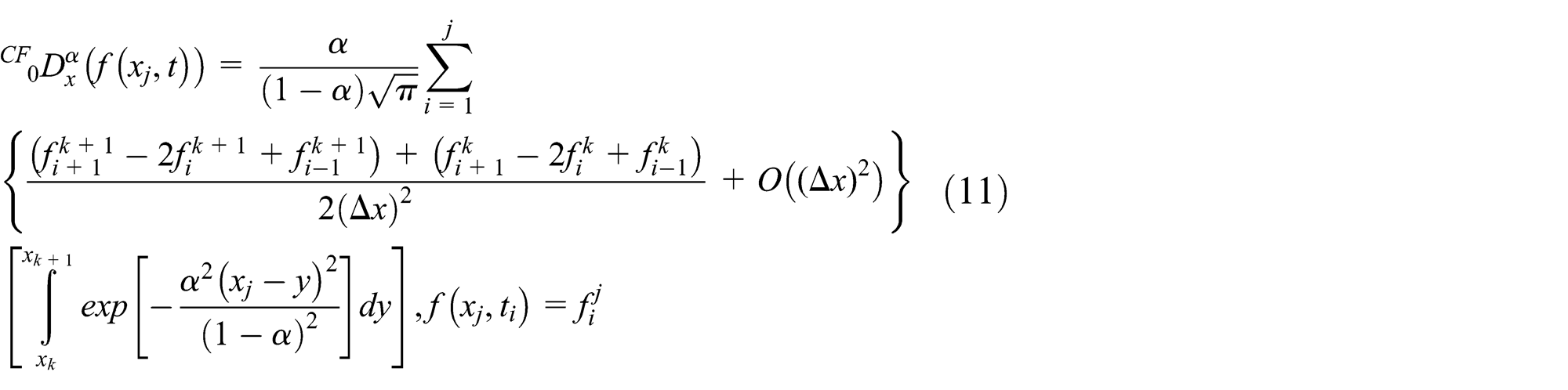
Nevertheless, the integral in the right-hand side is evaluated as

Therefore, equation (11) becomes

The above equation can be rewritten as follows

Note that

Using the Abromowitz and Stegun series approximation of the error function, equation (14) is reduced to

This completes the proof.
Numerical solution of time fractional transmission line with losses
For some positive integer N, the grid sizes in time for finite difference technique I are defined by

The grid points in the time interval
For some positive integer N, the grid sizes in time for finite difference technique I are defined by

The grid points in the time interval

with initial and boundary conditions

The main aim of this section is to solve the above equation numerically using the well-known Crank–Nicolson numerical scheme. To achieve this, we first replace in equation (17) the numerical approximation of space and time fractional Caputo–Fabrizio derivative, and this produces

For simplicity, let us put


Stability analysis
In this section, we will use the Fourier method to establish the stability of the numerical method used to solve the modified time fractional transmission line with losses model. Equation (18) can now become

We let

By replacing the above equation (20) into equation (19) and, for simplicity, assuming that β is 1, equation (1) becomes

If

Then, rearranging and applying on both sides the absolute value, we obtain

This implies

Theorem 2. Assuming that

Proof. We achieve this proof by employing the recursive technique on the natural number

Therefore, applying the norm on both sides, we obtain the following result

Employing the triangular equality and other properties, we obtain

Nevertheless, using the recursive, we have
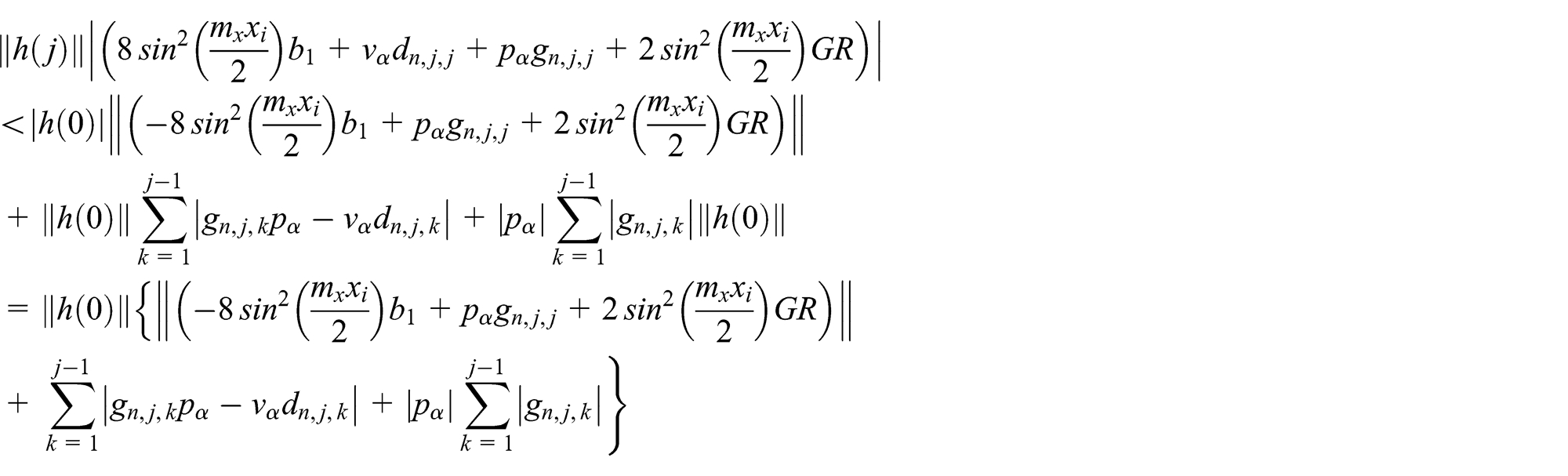
Then

Thus

This completes the proof.
Numerical simulations
In this section, we present some numerical simulations of the solution when N = 100 and for different values of α and β. In this simulation, the following theoretical parameters are chosen:

Numerical simulation for β = 1.96 and α = 0.95.

Numerical simulation for β= 1.66 and α= 0.65.

Numerical simulation for β= 1.46 and α= 0.45.

Numerical simulation for β= 1.26 and α= 0.25.
From the figures, we observe a significant variation in the numerical solutions as the coupled values of α and β decrease.
Conclusion
The aim of this work is to propose the numerical version of the Caputo–Fabrizio fractional derivative with order between 1 and 2. The second-order special approximation is therefore achieved using the Crank–Nicolson approach. An error analysis of this approximation is presented in detail. In order to be consistent, we propose a transition between the ordinary derivatives to Caputo–Fabrizio fractional derivative. Making use of this transition, we modified the model underpinning the RLC circuit as function of space and time. The new model is solved numerically and numerical simulations are presented for different values of α and β.
Footnotes
Academic Editor: Xiao-Jun Yang
Declaration of Conflicting Interests
The author(s) declared no potential conflicts of interest with respect to the research, authorship, and/or publication of this article.
Funding
The author(s) disclosed receipt of the following financial support for the research, authorship, and/or publication of this article: This work has been partially supported by the Ministerio de Economia y Competitividad of Spain under grant MTM2013-43014-P, Xunta de Galicia under grants R2014/002 and GRC 2015/004, and co-financed by the European Community fund FEDER.