



Abstract
A large number of pedestrian fatalities are caused by the vehicle-pedestrian accidents. The application of new theory and technological approaches may hold great potential to reduce the accident frequency and severity for pedestrians. Considered the different driving cultures between China and Germany, the adaptation of such application in new market triggers an “intercultural comparison” related to the road user behavior and traffic safety. Field traffic data have been collected by video recording and image processing at unsignalized mid-block crosswalks both in Beijing, China and Munich, Germany. Centered Vehicle-Pedestrian conflict situation, pedestrian speed performance in different pedestrian categories and walking phases, pedestrian waiting behavior related to waiting decision choice and waiting time, pedestrian gap acceptance were statistically analyzed for understanding the pedestrian behavior in the conflict process. Intercultural comparisons were made between China and Germany. The research results addressed how the conflict participants (pedestrians only) behave differently and would hopefully be the impetus for further intercultural analyses from urban traffic side.
Introduction
Today, car mobility has reached maximum levels in developed countries and the aftereffects of high energy costs, congestion, and aging of the population become the countervailing forces to car dependency, especially in urban areas. Significant efforts are being made to develop more intelligent, energy-saving, and accident-free urban traffic environment in developed countries. 1 However, the developing countries are undergoing the initial stage that had already been experienced in developed countries like the growth of urban population, the growth of car ownership, and development of infrastructure. Compared with traffic situations in developed countries, where road traffic are highly regulated and adequate infrastructure is provided, urban traffic in China is more complex and volatile with the characteristics as highly mixed traffic, large proportion of pedestrians and bicyclists, huge trip volume, traffic non-compliance, and so on.
Different driving cultures reflect different traffic safety situations within which the pedestrian accidents are identified as an extremely important issue. Among the total number of fatalities in road traffic accidents, the proportion of pedestrian deaths is particularly high. Thus, priority should be given to this road user group in research studies on safe urban transportation. 2 In China, pedestrians alone make up of 25% of all traffic accident fatalities and 17% of all injuries, most of them resulting from conflicts with motor vehicles. 3 In Germany, pedestrian deaths make up about 14% of all traffic accident fatalities.4,5 Figures 1 and 2 compare pedestrian fatalities between Germany and China per 100,000 people (from 1999 to 2010) and 100,000 motorized vehicles (from 1999 to 2010). Pedestrian safety problems are clearly more serious in China. Considering the pedestrian fatality rate per 100,000 motorized vehicles, China has a death rate about 18 times higher than that in Germany.

Comparison of pedestrian fatalities per 100,000 populations between Germany and China (MPSPRC source, 2011; Destatis, 1999–2010).

Comparison of pedestrian fatalities per 100,000 motor vehicles between Germany and China (MPSPRC source, 2011; Destatis, 1999–2010).
Considered the severe traffic situation in urban areas, analysis on traffic conflict could be a solution to the safety problems. It also provides an active protection to the pedestrians involved in an unsafe level. Accordingly, this study focuses on the Pedestrian-Vehicle conflict. Generally, the studies of traffic conflicts with pedestrians are summarized in three directions. The first one is to analyze the characters of the road users involved in the conflicts. The second direction is the conflict mechanism analysis.6–8 The last direction is the traffic engineering improvement related to conflict safety 9 and industrial approaches like the pedestrian protection system 10 and pedestrian detection system. 11
Framed on the first direction, many studies have been conducted to investigate the characteristics of pedestrian conflict behavior. For the most important characteristic, pedestrian speed, the factors that significantly influence the speed have been analyzed.12–15 Pedestrian waiting behavior is also a research hotspot. Researchers made studies in crossing situations related to various pedestrian facilities like the signalized intersection crosswalks, the unsignalized mid-block crosswalk, roundabout crosswalk, etc.16–19 As the indicator of waiting behavior, it was found that waiting time within a maximum period of 30 and 45 s invokes a feeling of impatience among pedestrians 20 by observations. And in China, this period is 60–90 s. 21 Some studies in other developing countries have also analyzed the pedestrian waiting time. 22 Compared with vehicle gap acceptance, pedestrian behavior varies. Such a variation may be attributed to drivers who accept smaller gaps because they have higher speeds and can thus move more quickly than pedestrians can. 23 Many studies on this topic have been conducted, with a focus on the statistical analysis, 24 influencing factors,25,26 and different methods used to determine the acceptable gap.27,28
Refer to the huge situational differences between China and Germany, culture adaptation must be made to validate the need for the application and design of pedestrian protection modules within Driver Assistance Systems in developing countries. To address the adaptation process, studies to discover differences in pedestrian behavior in certain traffic activities are a favorable first step.
Methodologies and data collection
Field observation
Urban traffic situations with mixed traffic flows and various traffic signs and signals are much more complex than normal highway traffic situations, causing traffic conflicts and even traffic accidents to occur more frequently in urban areas. Even crosswalks, where traffic participants are overloaded by multi-traffic information, pose serious threats to pedestrian safety. 29 In this study, the urban mid-block unsignalized crosswalk is determined as the objective pedestrian facility for observation.
Field video recording and image processing are utilized as the major data collection methods for traffic conflict and pedestrian behavior analyses. The considerations in determining the field study sites related to an intercultural analysis are on the basis of the current traffic environment. Similar traffic environments between China and Germany are selected, focusing on the road user flow rate, proportion of passenger cars, and land use of the selected locations.
Six field observation sites have been selected, including three unsignalized mid-block crosswalk in Beijing and three in Munich, with similar vehicle flow rates (average flow rate at 800–1200 pcu/h/d with 1500–2000 pcu/h/d as peak rate), pedestrian flow rates (150–300 ped/h), average vehicle speeds (20–35 km/h), and passenger car proportions (ca. 90%). Although the traffic environment and crosswalk geometry are different, according to observations, the average pedestrian crossing speed in each country remains constant over a certain range and does not vary with the width of the crosswalk. Thus, the observation data from these two countries are assumed to be independent of location and are analyzed as single sample set. 30
A driver would theoretically need to notice a mid-block crosswalk 38 m before reaching it at a speed of 11 m/s and have a clear view of both sides of the crosswalk from that distance to effectively scan for pedestrians. 31 Considering the average speed of the vehicle at the study sites (about or lower than 11 m/s), a lane length of at least 40 m before the crosswalk is selected in the study to estimate the entire conflict process. Figure 3 shows a sketch map to depict the location of the observation point. Here, the camera view covers the entire length of a zebra crosswalk and a 50 m approaching lane before a mid-block crosswalk. The observation time can be composed of certain time segments at peak and/or non-peak hours on workdays (non-holidays) based on the traffic flow rate.
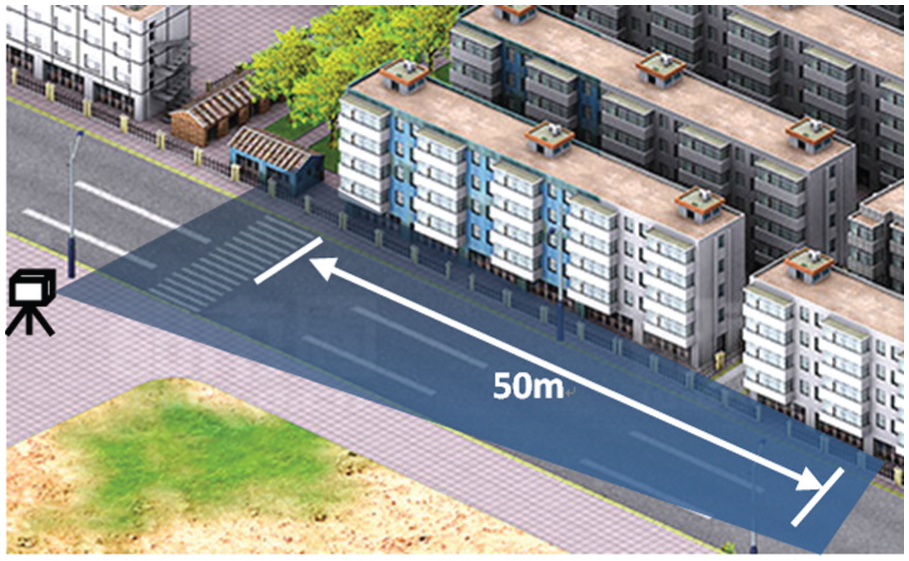
Location of the camera and the observation view for the mid-block crosswalk.
As the observed zebra crosswalks are perpendicular to the road lane and the vehicle could be treated as a lane-based movement, the conflict situation occurs at a right angle. Pedestrians who use the zebra crosswalk to cross the road (or are less than 2 m from the zebra crosswalk) are recorded as sample pedestrians. During the observation period, the influence of non-motorized vehicles is ignored because of the low flow rate. In all, 619 sample pedestrians and 237 sample pedestrians are recorded in Beijing and Munich, respectively.
Video recording of pedestrian conflict behavior
The movement of the crossing pedestrian can reflect the pedestrian behavior in conflict with an approaching vehicle. And this proximity can be defined by the distance in space or the distance in time between two road users. From studying the trajectories of the subject pedestrians/vehicles with time matrix and the kinematic equations of motion in relation to a fixed coordinate system, basic characteristics that describing the individual behavior can be derived.
The global polynomial model was used for changing the image coordinates to road coordinates with the below general equation


where the (x, y) denotes the road coordinate and (X, Y) denotes the image coordinate. The value n will influence the accuracy of global polynomial method in the nth power function. Generally, when n equals to 2, nine control points with their image coordinates and road coordinates were measured and substituted into equations (1) and (2) for calculating the transformation coefficients aij and bij.
Data analyses and comparison
Pedestrian speed performance
Pedestrian walking speed is one of the three basic characteristics of pedestrian traffic, and pedestrian walking speed related to certain pedestrian traffic facilities (pedestrian side-walk, pedestrian crosswalk, passenger corridor, etc.) is also one kind of fundamental parameters to define the pedestrian behavioral states.
Speed by pedestrian categories
Various factors contributing to pedestrian traffic activities, such as pedestrian age, gender, trip purpose, street scene, and traffic conditions, among others, were studied. Among these factors, pedestrian gender and age have been proven to have significant influences on pedestrian safety. 20 In this study, we chose gender, age, and group size as variables with which to summarize pedestrian classifications and conduct an intercultural comparison.
Figure 4 illustrates a comparison of pedestrian crossing speeds in terms of gender and age. Significant differences can be seen from the bar diagrams.
For the same pedestrian categories, the average crossing speed of German pedestrians in conflict situations is about 7%–9% higher than that of Chinese pedestrians.
Females display average crossing speeds about 7% lower than males both in Germany and China.
The crossing speed of elderly pedestrians in China is 9% lower than the average speed of all samples; in Germany, the crossing speed of elderly pedestrians is 11% lower than the average speed.
Differences in standard deviation are not significant.
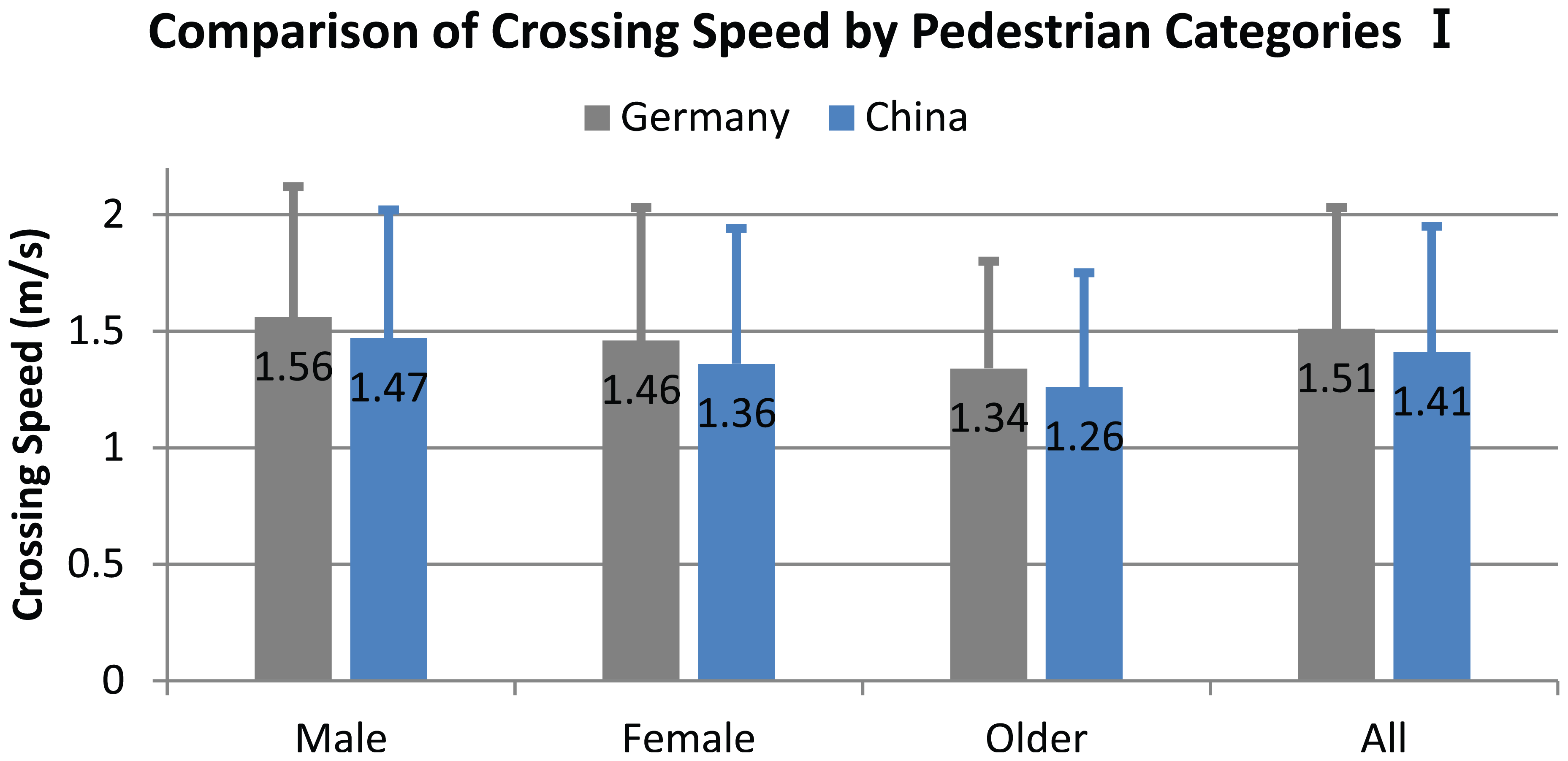
Comparison of pedestrian crossing speed by gender and age.
Figure 5 illustrates a comparison of pedestrian crossing speeds in terms of group size. Similar to the results in Figure 4, a 7%–8% speed difference is found between German and Chinese pedestrians, both in single- and group-crossing activities. Groups of pedestrians have lower speeds and overall standard deviations compared with pedestrians walking alone.32,33 This phenomenon may be attributed to the “group psychology” of pedestrians when walking in groups and the release of individual control to form a group activity. Interactions among pedestrians in groups may also slow down their walking behavior. No exactly significant difference in this phenomenon is observed between Germany and China, and pedestrian groups in both countries show a slightly slower walking speed (2%) than single pedestrian.

Comparison of pedestrian crossing speed by group size.
Speed by walking phases
Pedestrian crossing process can be categorized into three parts. These parts reflect different walking phases in pre-conflict and post-conflict situations.
Pre-conflict situation
Phase I: Side-walking toward the crosswalk (about 7 m to the crosswalk, 10 pedestrian stride lengths).
Phase II: Crossing from roadside curb to potential conflict point.
Post-conflict situation
Phase III: Crossing from potential conflict point to the opposite road to finish the crossing process.
The walking purposes in these three phases differ. In the first phase, pedestrians try to use the zebra crosswalk to cross the road and decide where and when to start crossing. In the second phase, pedestrians aim for a safe crossing and make decisions to avoid collision. In the last phase, the pedestrians aim to stay away from the potential risks and to end the crossing task as soon as possible. Consequently, the pedestrians’ basic behavioral characteristics, such as their walking speed, are different. The analysis of pedestrian speed as it relates to the walking phases can provide an understanding of the speed variation in the entire conflict process.
Figure 6 illustrates the walking speed in the three aforementioned phases and compares German data and Chinese data.
In the first and second phases, the average walking speed of German pedestrians is about 8% higher than that of Chinese pedestrians, and this difference decreases to 6% in the last phase.
When the pedestrians turn to the second phase after side-walking, the walking speed changes slightly for both the German and Chinese pedestrians (a variation of less than 1%).
The average crossing speeds before and after the potential conflict point differ greatly; the increasing trend of the crossing speed of Chinese pedestrians from phase II to phase III is about two times greater than that of German pedestrians, and the increasing proportions are 5.8% and 3.3%, respectively.
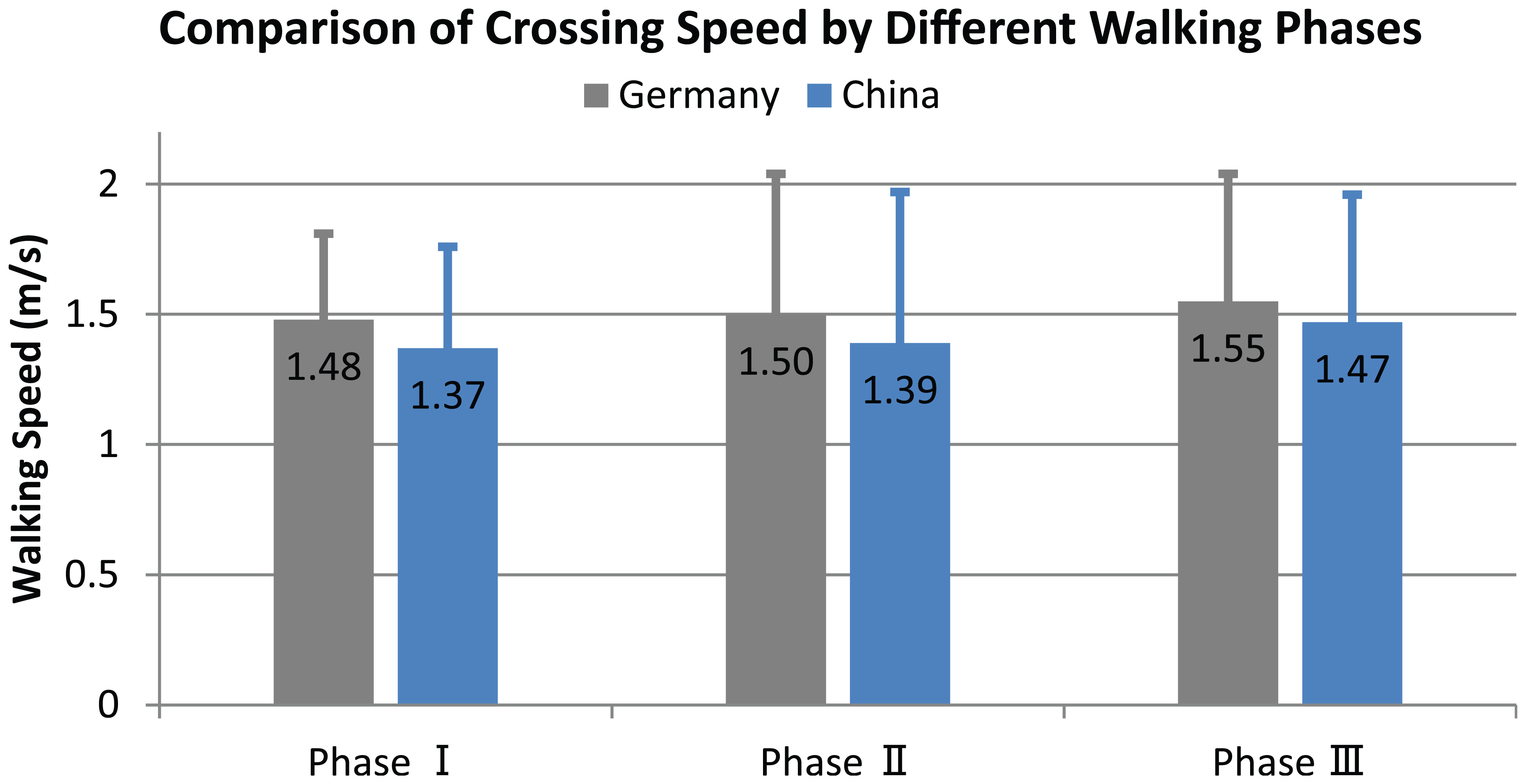
Comparison of pedestrian speed by walking phases.
Pedestrian waiting behavior
Waiting decision choice
The different driving culture of Germany and China noticeably affects road user behavior in many ways. With regard to pedestrian waiting behavior in the road-crossing process, interesting differences exist. Table 1 lists the proportions related to five waiting decisions in Germany and China.
In all conflict situations, most of the Chinese pedestrians (more than 80%) stop at the roadside and wait to cross. On the contrary, a majority of pedestrians in Germany (about 70%) cross directly without stopping before entering the crosswalk.
In conflict with vehicle platoons, only about 10% of Chinese pedestrians wait for less than two vehicles. By contrast, 80% of the German pedestrians cross the road directly and use the gap between the first and second vehicles in the platoon to cross the road.
About 70% of pedestrians caught in Veh-Ped conflicts in China are forced to wait until the entire vehicle platoon passes the crosswalk. Comparatively, 6 in 100 pedestrians make such a choice.
Comparison of the pedestrian waiting decisions.

The proportion results can be considered the opposite of one another. In China, according to the traffic rules at unsignalized crosswalk, the pedestrians as the vulnerable road users have the right of way and the drivers are required to give precedence to the pedestrians. In reality, however, pedestrians do not seem to “trust” drivers, and they prefer to wait rather than cross without stopping. In Germany, the willingness of drivers to give way to pedestrians at zebra crossing is very high and “yielding to pedestrians” is a common acceptable driving practice. Thus, the waiting decision for most of German pedestrians is unnecessary. So traffic management and educations are needed to highlight this problem when two road users scramble for the right of way.
Waiting time
Studies have suggested that waiting time affects the behavior of pedestrians when they are attempting to cross a road. Figure 7 plots the pedestrian waiting time related to the vehicle flow rate. According to the field observation, the sample size of the pedestrians who may stop walking and wait in the middle of the roadway in Munich is very small. Thus, only the pedestrian waiting time at the roadside is recorded. A comparative discussion is presented below:
At a low vehicle flow rate (≤1500 pcu/h/d), the average waiting time of Chinese pedestrians at the roadside curb is about nine times higher than that of German pedestrians. At a high vehicle flow rate (2000 pcu/h/d), this number decreases to about eight.
The average waiting time of German pedestrians when arriving at a crosswalk is less than 2 s, during which the pedestrians pause for a moment to scan the road and then head toward the road to cross. On the contrary, pedestrians in China wait until the gap is acceptable.
When the vehicle flow rate is about 1500 pcu/h/d, the waiting times at the 85th percentile for German and Chinese pedestrians are 1.66 and 18.9 s, respectively.

Comparison of pedestrian waiting time (roadside).
Pedestrian gap acceptance
Generally, in a car-following phase, the driver in a platoon will continuously be influenced by the vehicle in front until the rear bumper of the front vehicle reaches the conflict point on the crosswalk. A major conflict then arises between the following vehicle and the pedestrian. The acceptable gap partially characterizes this situation. The definition of the gap here is related to two successive vehicles not only in platoon driving situations but also in single driving situations. Table 2 gives a statistical description of the pedestrian crossing gaps classified as “accept” (the gap used by pedestrians to cross the road) and “reject” (the gap not used by pedestrians to cross the road). The following points can be highlighted:
A slightly smaller acceptable gap for Chinese pedestrians;
Unobvious difference in rejected gap between Chinese and German pedestrians;
A 5.0s critical gap (the shading in Table 2) to determine acceptance for both Chinese and German pedestrians.
Comparison of pedestrian gap choice.

Conclusion and future work
For the significant differences in traffic situations between developed countries and developing countries, cultural adaptation is needed to cover the gap caused by an unavailable application of new theoretic or technological achievement in growing market. Intercultural comparison is conducted from the behavioral side to address such differences and lay the groundwork in the target of creating adaptation database for pedestrian protection modules of Driver Assistance Systems. Based on the field observation and road user trajectory estimation, the empirical results reveal the pedestrian behavioral differences between China and Germany. Pedestrian speed distribution in conflict situation is proved to fit the normal distribution. The Chinese pedestrian speed is statistically recorded as 7%–9%, lower than the German samples in certain pedestrian categories and walking phases. Huge differences in pedestrian waiting behavior are addressed and interculturally interpreted. The proportion of waiting decisions can be considered to be the opposite of one another between these two countries. Pedestrian gap threshold (5.0 s) is suggested according to the analyses on the conflict behavior. Because of the limitations in the field data collection for some individual behavioral characters from the psychological perspective sides, further work will gather these characters, and considered pedestrian facility taxonomies, extended intercultural analyses of pedestrian behavior should be given for different traffic environment.
Footnotes
Academic Editor: Ling Zheng
Declaration of Conflicting Interests
The author(s) declared no potential conflicts of interest with respect to the research, authorship, and/or publication of this article.
Funding
The author(s) disclosed receipt of the following financial support for the research, authorship, and/or publication of this article: This work was supported in part by the National Natural Science Foundation of China (NSFC) 51378062 and by the research fund of Beijing Institute of Technology.