




Abstract
Condensation occurs in the inner layers of construction materials at whatever point the partial pressure of water vapor diffuses and reaches its saturation pressure. Condensation, also called sweating, damages materials, reduces thermal resistance, and by increasing the total heat transfer coefficient, results in unwanted events such as increased heat loss. This study applied minimization of thermal insulation thickness with consideration given to condensation in the external walls. The calculations of heat and mass transfers in the structure elements are expressed in a graphical form. While there was an increase in the required thermal insulation thickness subsequent to an increase in the internal environment’s temperature, relative humidity, and the external environment’s relative humidity, the required thickness decreased with an increase in the external environment’s temperature. The amount of water vapor transferred varied with internal or external conditions and the thickness of the insulation. A change in the vapor diffusion resistance of the insulation material can increase the risk of condensation on the internal or external surfaces of the insulation.
Introduction
The environmental pollution caused by increasing populations, industrialization, urbanization, and increasing energy consumption has created the need for energy savings. One of the most effective ways to do this is to reduce the energy consumption of buildings, which comprise approximately one-third of global energy consumption.1–3 In many previous studies, the application of thermal insulation to the external walls of a building was determined as the most effective means of reducing energy consumption.4–7
Several studies have researched the optimization of thermal insulation thickness.1,8–11 To calculate heat loss, these studies used the degree–day method. The goal of optimization of thermal insulation thickness is the minimization of the total cost of the energy source (natural gas, coal, electricity, etc.) and the thermal insulation. In some studies,12–16 the solar air (sol-air) temperature concept was used, rather than the classic external environment temperature, to consider the effect of solar heating. In a study by Al-Sanea et al., 17 by examining the air cavities and thermal insulation configuration in construction materials, the wind effect was taken into consideration, using an equation with the heat transfer coefficient obtained for buildings. In all these studies, the basis of the calculation of optimum thermal insulation thickness was the minimization of energy costs; however, they did not consider condensation within the construction materials.
Very few studies in the literature have considered condensation in the calculation of optimum thermal insulation thickness. Atmaca and Kargici 18 examined the incidence of steam permeation and condensation in building construction in the province of Konya. Heperkan et al. 19 developed a computer program that determined the point at which condensation occurred in construction materials, which facilitated the calculations of steam diffusion and condensation. In a study by Arslan and Kose 20 in the province of Kutahya, the thermo-economic optimization of insulation thickness was examined with consideration given to condensation. Using exergy analysis, Ucar 21 calculated the optimum thermal insulation thickness in different internal environment temperatures for four provinces in different climactic regions. In the exergo-economic analysis, the amount of water, as condensation within the construction materials, was considered, but there was no focus on the effect of internal and external relative humidities on condensation and thermal insulation thickness.
Condensation occurs when the temperature of the surface of the material in contact with the air is below the dew point temperature of the air; this creates a serious problem for a building’s thermal insulation. Condensation is often visible on the surface of the structural materials but sometimes also remains within the materials. When water vapor reaches the external environment in the gas phase, there is no problem for the structural element. However, when water vapor passes into the structure element, it may return to water form. If this occurs, condensation on the walls can cause mold, fungal growth, smell, spoilt paint, or may negatively affect the building materials and/or thermal insulation. To prevent condensation, the resistance of the building components against water vapor diffusion must be increased. The simplest and most basic way to do this is to increase the thickness of the thermal insulation. Questions then arise as to how much the insulation thickness can be increased and the degree of variance in the increase, depending on the environmental conditions.
In this study, a procedure was employed for the minimization of thermal insulation thickness of a building wall with consideration given to condensation. The necessary minimum thermal insulation thickness was calculated to prevent condensation on external walls. The effects of the minimum insulation thickness were examined for internal and external environmental conditions (temperature and relative humidity) of different buildings, as well as the diffusion resistance of thermal insulation materials.
Mathematical model
Heat conduction and water vapor diffusion in a composite plane wall
Similar to the Fourier laws of heat conduction, water vapor diffusion differential equation in a one-dimensional steady-state regime is defined as follows

In this equation, w is a unit of water vapor passing from the surface in a unit of time (water vapor flow; kg/h m2), µp is the vapor permeability of the building material (kg/h m mmSS), and dP/dx is the water vapor pressure gradient (mmSS/m). Just as the direction of heat always flows from the high to low temperature in the Fourier law of heat conduction, in the Fick law, water vapor flows from high to low pressure.
In the external wall, shown in Figure 1, the heat flow in a steady state, with the internal heat transfer coefficient hi, the external heat transfer coefficient ho, the conductivity of the materials k, and thicknesses x, can be written as


Composite plane of the wall.
Similarly, heat flow for completion of the composite plane of the wall can be written as

Similar to heat conduction, water vapor flow in the composite plane wall can be written, depending on the vapor permeability coefficient of the internal side of wall βi, vapor permeability coefficient of the external side βo, vapor permeability of the construction materials µp, and thickness x as


While equation (5) calculates the internal and external environments, equation (6) calculates for the layers of construction materials

In equation (7), because the internal and external water vapor partial pressures are Pi and Po, respectively, the relationship between the internal and external relative humidities is thus

In equation (8), Ps,i and Ps,o are the pressures of the saturated water vapor in the internal and external environment temperatures, respectively. Instead of using the vapor permeability (µp) of the construction materials from equation (7), the vapor permeability resistance (δ) was used, and the vapor permeability resistance is defined as follows

With δair as the diffusion resistance of air, the resistance factor of construction materials depending on the air (µ) is thus given as

The diffusion resistance of air can be calculated as follows

Here, R is the gas constant of water vapor (N m/mg K), T is the temperature (K), and D is the diffusion coefficient of water vapor (m2/h). With the calculations of equation (11), the δair value for air of 10°C can be taken as approximately 1.5105 mmSS m h/kg.18,20 In addition, it has been reported that this value in the range of −20°C to +30°C can be used in water vapor diffusion processes. Considering these approaches, equation (7) is thus stated as follows

The internal surface vapor permeability coefficient may be taken as βi = 0.00111 kg/m2 h mmSS and external surface vapor permeability coefficient as βo = 0.0039 kg/m2 h mmSS. 22
The temperature within the wall and partial pressure distribution
The possible temperature and pressure distributions in a wall with thermal insulation are shown schematically in Figure 2. The possible condensation point where the partial and saturation pressures intersect (four-plane line) is also shown in this figure. In the use of high water vapor diffusion resistance values of the construction materials, the place of the condensation point can be changed. The consequence of this situation was later examined. Every Ps pressure point seen in this figure is the saturated pressure of water vapor at that temperature. The temperature distribution of the plane wall was calculated from heat flow equations (equations (2)–(4)), and if there was partial pressure for every point, equations (5) and (12) were used.

Distribution of temperature and pressure in the wall.
Minimization method
First, considering the defined inside and outside environmental conditions (temperature and relative humidity) and the wall material properties, the heat transfer rate and the temperature distribution in the wall were calculated. The partial pressure of water vapor at the saturation point and the mass transfer rate were determined. Then, the partial pressures for each point in the wall were computed, and the distribution of the partial pressure was also obtained. Finally, a comparison between the saturation pressure and partial pressure was carried out for each point. If Pi is greater than Ps, i , the condensation occurs, and the thermal insulation thickness should increase. Minimum thermal insulation thickness which prevents the condensation (Pi is less than Ps, i ) was aimed in the study. Therefore, the objective function of the minimization becomes the following

After determining the saturation and partial pressure distributions of the wall, the objective function for each control point should be done in the wall structure, and the function of providing the minimum thermal insulation thickness value was considered the optimum value.
Results and discussion
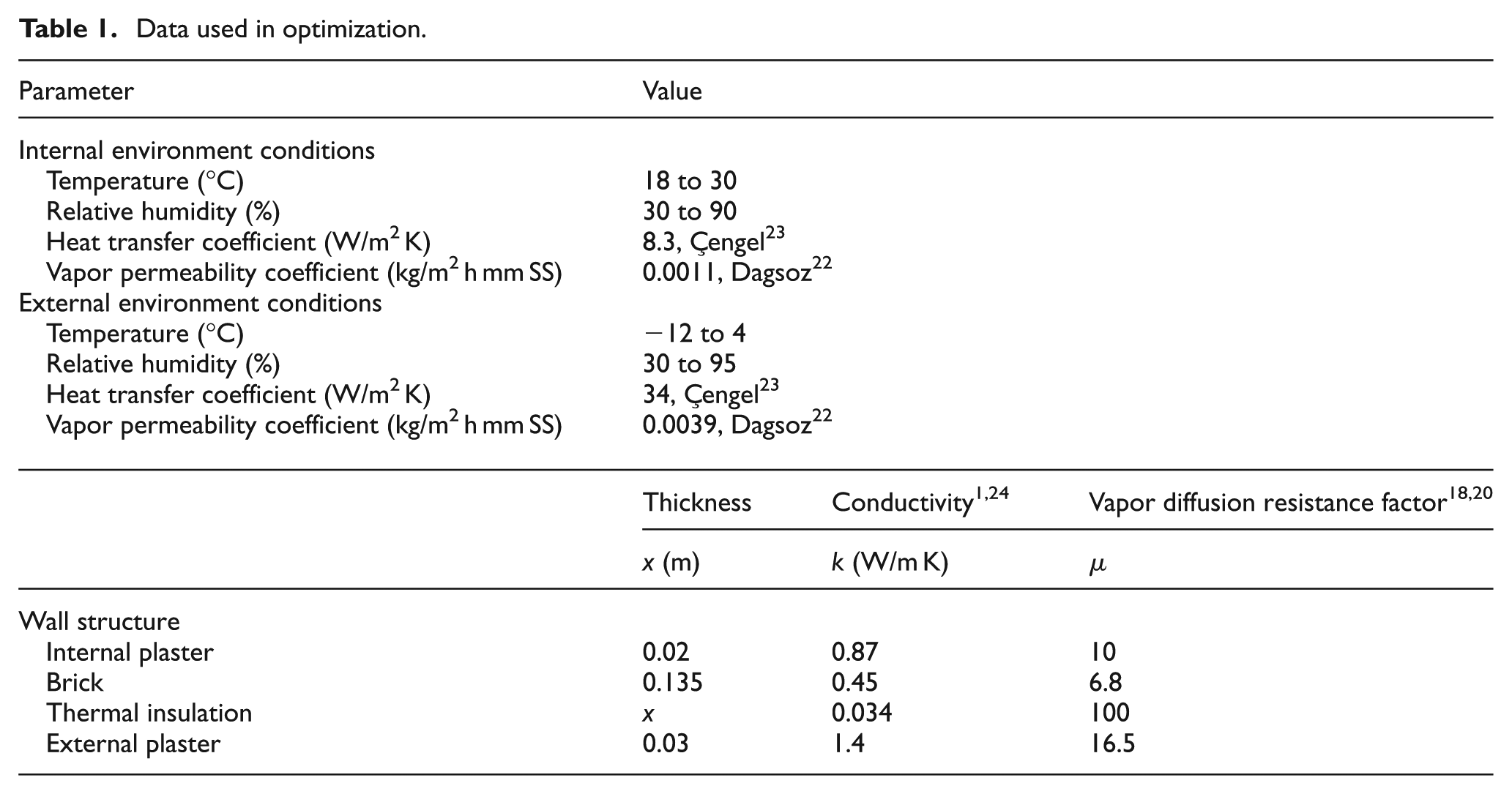
The fixed and variable parameters used in this study are given in Table 1. For this analysis, made via the data in Table 1, the results of the heat and mass transfers from a unit area of the wall and the temperature and partial pressure distributions within the wall structure are given in Tables 2 and 3. The internal and external conditions were taken as 22°C, 55% and −3°C, 70%, respectively. Table 2 reflects that when the thickness of thermal insulation increases naturally, a decrease in the total heat transfer coefficient and the heat transfer flow from the wall appears. When the temperature distribution within the wall structure was examined, the temperatures (T1, T2, and T3) from the internal wall surface to the thermal insulation increased with the thermal insulation thickness. The water vapor saturation pressures, which are the function of those temperatures, increased with the increasing thermal insulation thickness (Table 3). The transfer of water vapor per unit time from the wall decreased with increased thermal insulation thickness. As previously stated, condensation within the wall occurs when partial pressure of water vapor exceeds saturated pressure. The pressure values in Table 3 reflect condensation at points 3 and 4 in the wall without thermal insulation (because Ps3 < P3 and Ps4 < P4). With an increase in thermal insulation thickness, condensation was prevented, first at point 3 (at value xins = 0.006 m) and then at point 4 (at value xins = 0.012 m). At a thermal insulation thickness of 0.012 m and above, water vapor partial pressure did not exceed its saturated pressure at any point within the wall; therefore, condensation was not observed. In conclusion, it can be said that a thermal insulation thickness of 0.012 m for the internal and external environmental conditions in question is the smallest value able to prevent condensation.
Data used in optimization.
Distribution of heat transfer rate and temperature within the wall.

Distribution of water vapor flow and partial pressure within the wall.

The effect of internal environment conditions (temperature and humidity) on thermal insulation thickness
The minimum thermal insulation thickness change required to prevent condensation with interior relative humidity is given in Figure 3. As condensation did not occur in the wall at θo = 60% in low internal relative humidity conditions (as far as approximately θi = 45%), thermal insulation was not required and xins = 0. However, as humidity increased, there was increased water vapor transfer from the internal environment to the external environment, and this triggered condensation. To prevent this, it was necessary to increase the thickness of the thermal insulation. As seen in Figure 3, the minimum thermal insulation thickness value that prevents condensation increases with an increase in internal environment relative humidity. For example, while xopt = 0.9 cm for 60% interior relative humidity, for 85%, xopt = 6.3 cm.

Changes in minimum thermal insulation thickness with internal relative humidity (Ti = 22°C, To = −3°C, θo = 60% and 80%).
The minimum thermal insulation thicknesses for 60% and 80% external relative humidities are given in Figure 3. When external relative humidity increased, the partial pressure difference between the internal and external environments decreased, resulting in a decreased amount of vapor transfer; the partial pressure of the water vapor within the wall increased. This situation creates an increased risk of condensation (because the partial pressure is close to the saturated pressure). Therefore, when external relative humidity increased from 60% to 80%, the required thermal insulation thickness increased, as seen in Figure 3.
For the same conditions with internal environment relative humidity, the heat and vapor transfer changes from the wall are given in Figures 4 and 5, respectively. To prevent condensation with increased internal environment relative humidity from the required thermal insulation thickness, the amount of heat transfer from the internal environment to the external environment was decreased, as shown in Figure 4. Because the required thermal insulation is not from θo = 60%, as far as θi = 45%, the heat transfer rate from the wall remained stable. Additionally, with the thermal insulation effect, the heat transfer rate decreased. For example, the required thermal insulation thickness at 90% internal humidity was 1.1 cm, as shown in Figure 3, and by decreasing the heat transfer of this thermal insulation at a rate of 85% of the uninsulated area, there was a drop from approximately 50 to 7 W/m2.

Heat transfer rate at minimum thermal insulation thicknesses (Ti = 22°C, To = −3°C, θo = 60% and 80%).
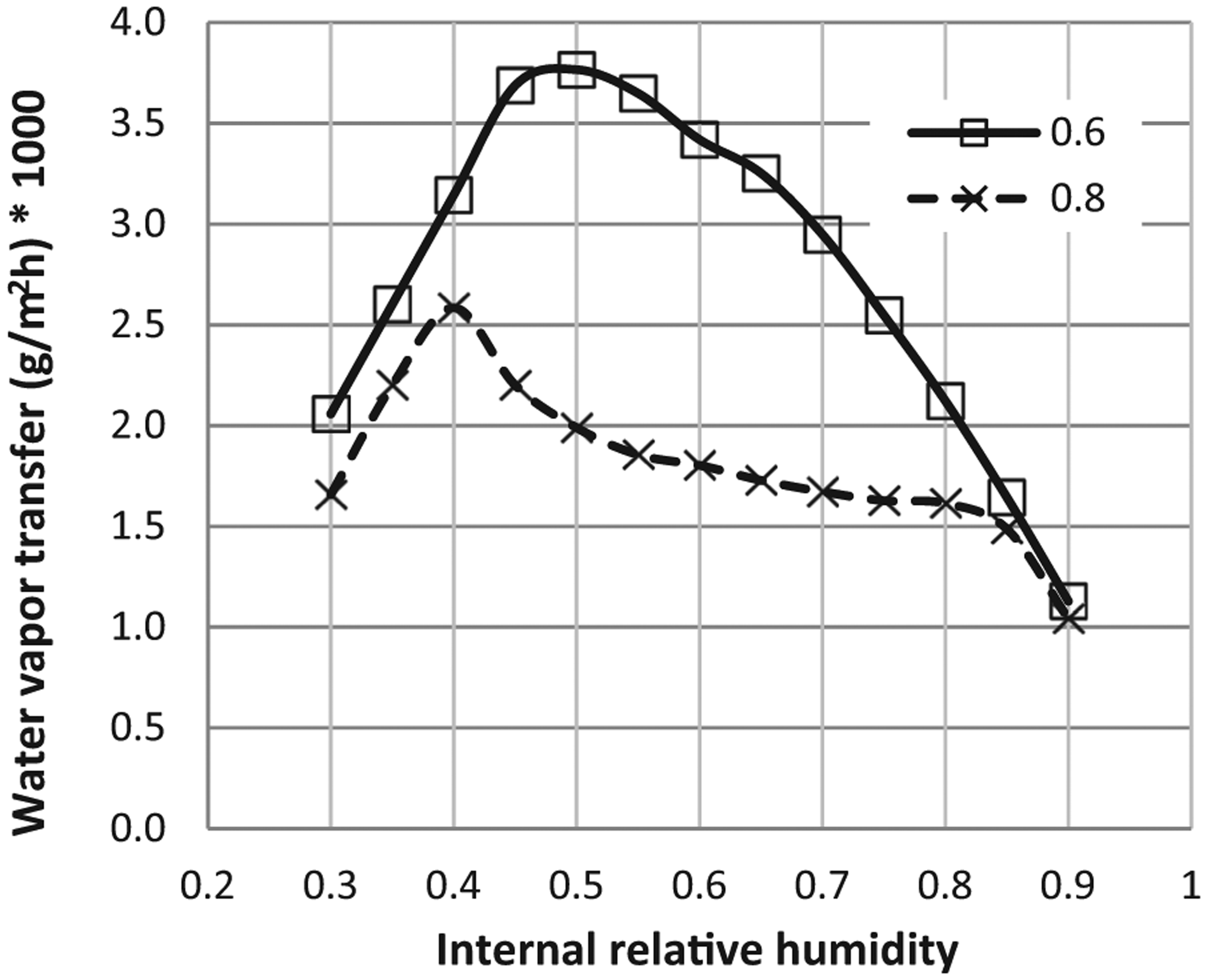
Water vapor transfer at minimum thermal insulation thicknesses (Ti = 22°C, To = −3°C, θo = 60% and 80%).
With an increase in internal relative humidity, the difference between internal and external environment pressures increased, which resulted in increased water vapor transfer, as seen in Figure 5. However, after a certain value (at θi = 45% for θo = 60% and at θi = 40% for θo = 80%), to prevent condensation, it was necessary for the thermal insulation to reduce the transfer of water vapor from the internal environment to the external environment. In addition, when the external relative humidity increased (from 60% to 80%), the difference in the internal and external pressures reduced; therefore, there was generally less transfer of water vapor. However, after approximately θi = 80%, because of the effectiveness of rapidly increasing the thickness of the thermal insulation (creating resistance), no evident difference remained between the amounts of water vapor transferred at values of θo = 60% and 80%.
To prevent condensation, the minimum thermal insulation thicknesses necessary, depending on the changes in interior temperature, are given in Figure 6. Until the interior temperature reached a certain value (approximately 19°C), thermal insulation was not necessary to prevent condensation in the wall, and xins = 0 was obtained. However, when the interior temperature increased, the difference in water vapor pressure between the internal and external environments grew, and this increased the risk of condensation in the wall. Therefore, when temperatures increase, it is necessary for the thermal insulation thickness to increase to prevent condensation.

Change in minimum thermal insulation thickness with interior temperature (θi = 50%, To = −3°C, θo = 70%).
The same conditions of changes in heat and mass transfers from the wall with internal temperatures are shown in Figures 7 and 8. Because there was no need for thermal insulation up to a certain temperature (approximately 19°C), heat and mass transfers increased up to this value. Then, as there was increased resistance because of the application of thermal insulation to prevent condensation, heat and mass transfers from the internal environment to the external decreased, as seen in Figures 7 and 8.

Heat transfer rate for minimum thermal insulation thicknesses (θi = 50%, To = −3°C, θo = 70%).

Mass transfer rates for minimum thermal insulation thicknesses (θi = 50%, To = −3°C, θo = 70%).
The effect of external environment conditions (temperature and humidity) on thermal insulation thickness
The effect of external relative humidity on minimum thermal insulation thickness is shown in Figure 9. When external relative humidity increases, the partial pressure of external environment water vapor increases, and the amount of water vapor transfer decreases. However, with an increase in external relative humidity, the partial pressure values of the water vapor in the wall increase and approach saturation pressures. This increases the risk of condensation in the wall layers. Therefore, increased external relative humidity results in an increase in the necessary thermal insulation thickness, as seen in Figure 9. Particularly at high relative humidity values, the rate of increase in the minimum thermal insulation thickness is higher. In addition, Figures 3 and 9, when compared, show that the general effect of external relative humidity on minimum thermal insulation thickness is greater than that of internal relative humidity.

Changes in minimum thermal insulation thickness with external relative humidity (Ti = 22°C, θi = 50% and 70%, To = −3°C).
The same conditions of change in heat and mass transfers from the wall with external relative humidity are shown in Figures 10 and 11. Because of increasing external relative humidity, the thermal insulation thickness was increased to prevent condensation so that the amount of heat and water vapor transfers from the internal environment to the external environment would decrease, as seen in Figures 10 and 11. For θi = 0.50, because there was no thermal insulation until the value of θo = 0.55, heat transfer remained stable and then decreased due to the thermal resistance formed by the thermal insulation (Figure 10). For θi = 0.70, even at low external relative humidity values, the heat transfer rate was lower because thermal insulation was required, as seen in Figure 9. Water vapor transfer was similar to heat transfer for θi = 0.50; there was a decrease until thermal insulation was applied (until θo = 0.55) because of the decrease in the difference between internal and external water vapor partial pressures. With the added effect of thermal insulation, the decrease was greater (Figure 11).
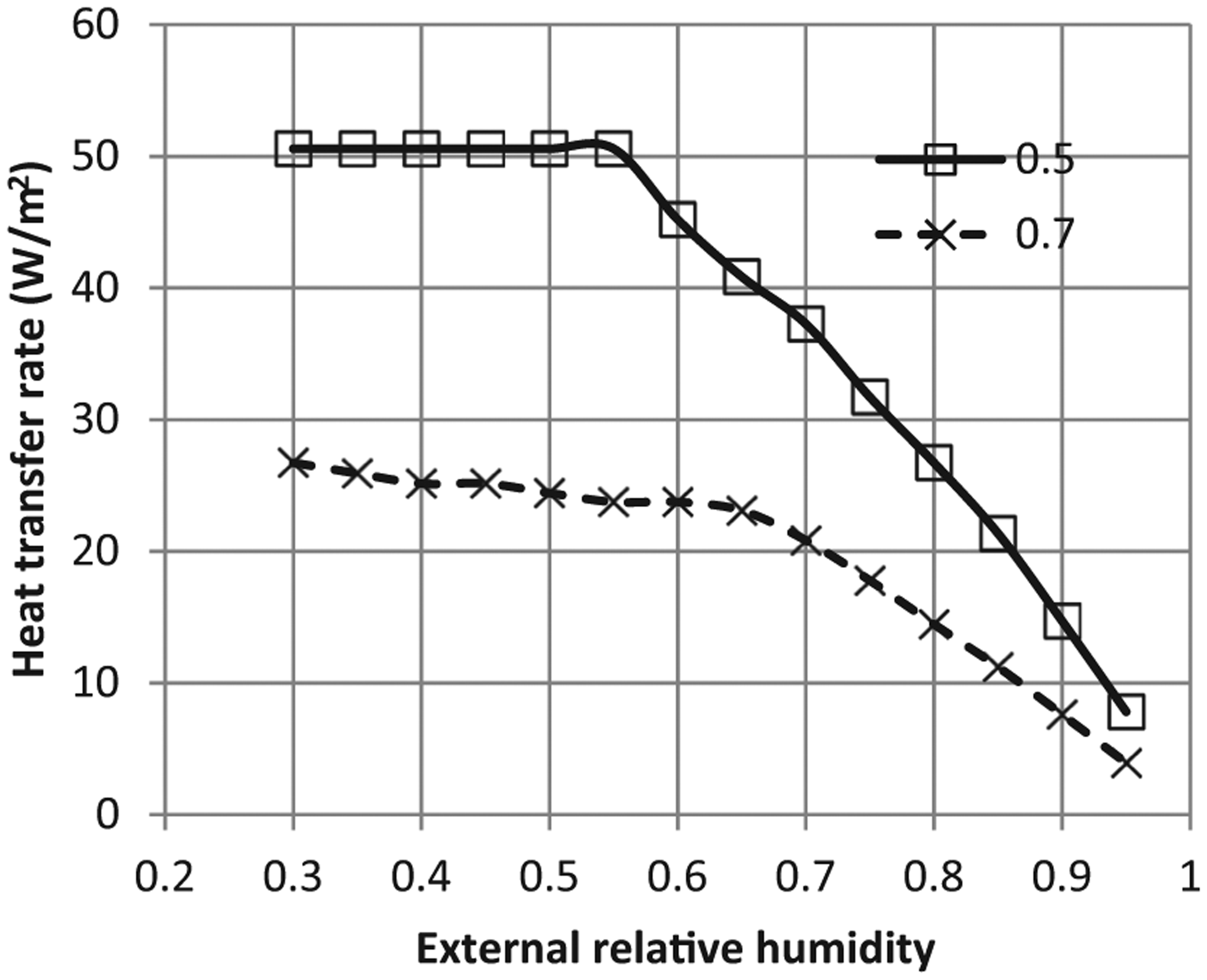
Heat transfer rate at minimum thermal insulation thicknesses (Ti = 22°C, θi = 50% and 70%, To = −3°C).
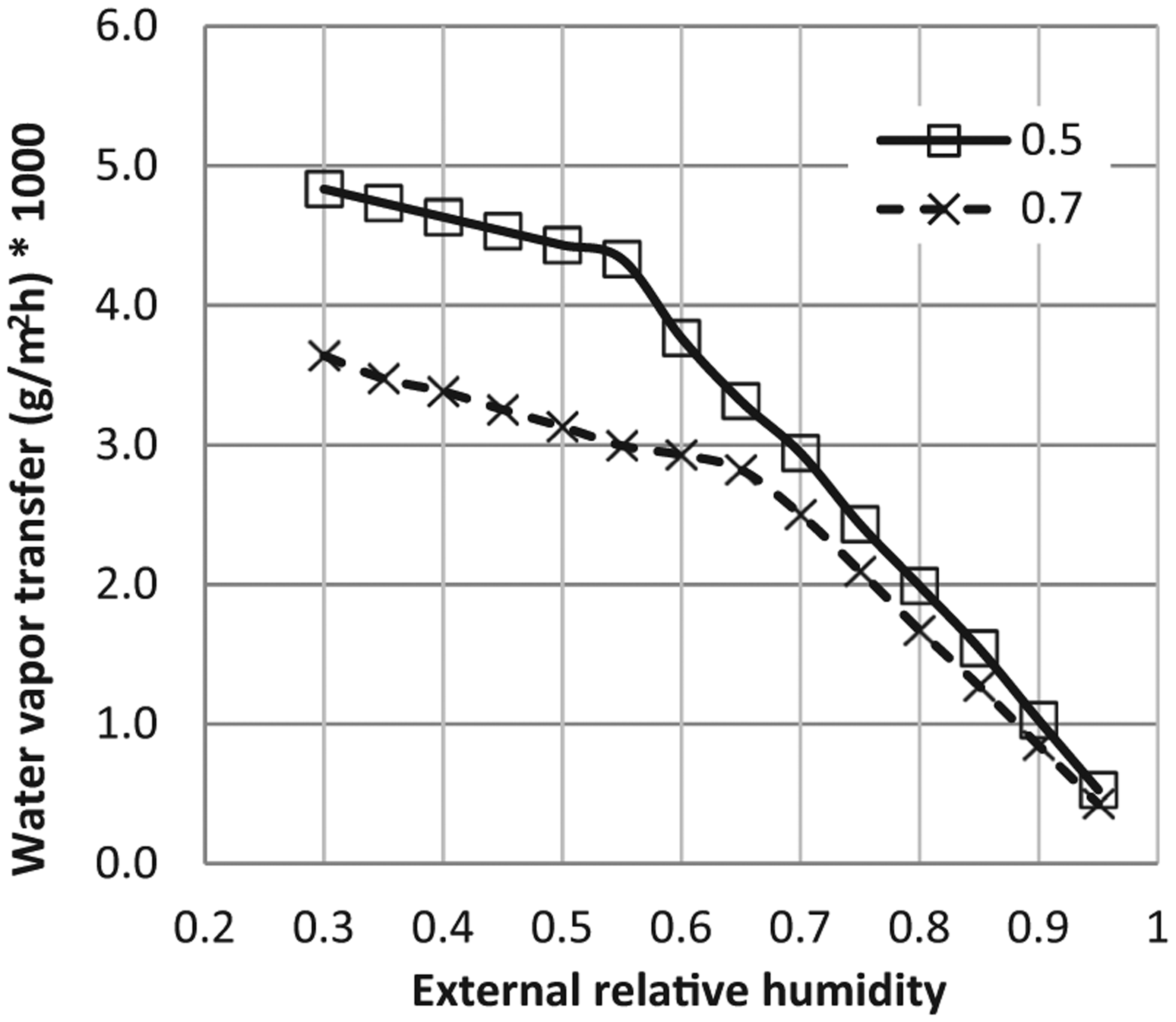
Mass transfer rates at minimum thermal insulation thicknesses (Ti = 22°C, θi = 50% and 70%, To = −3°C).
The required thermal insulation thicknesses to prevent condensation due to changes in external temperature are shown in Figure 12. Above a certain value of external temperature (approximately 0°C for Ti = 22°C), thermal insulation was not required to prevent condensation in the wall and xins = 0. However, at low temperatures, the difference between internal and external water vapor pressures grew, and the risk of condensation in the wall increased. Therefore, when external temperatures decrease, the required thermal insulation thickness increases to prevent condensation.
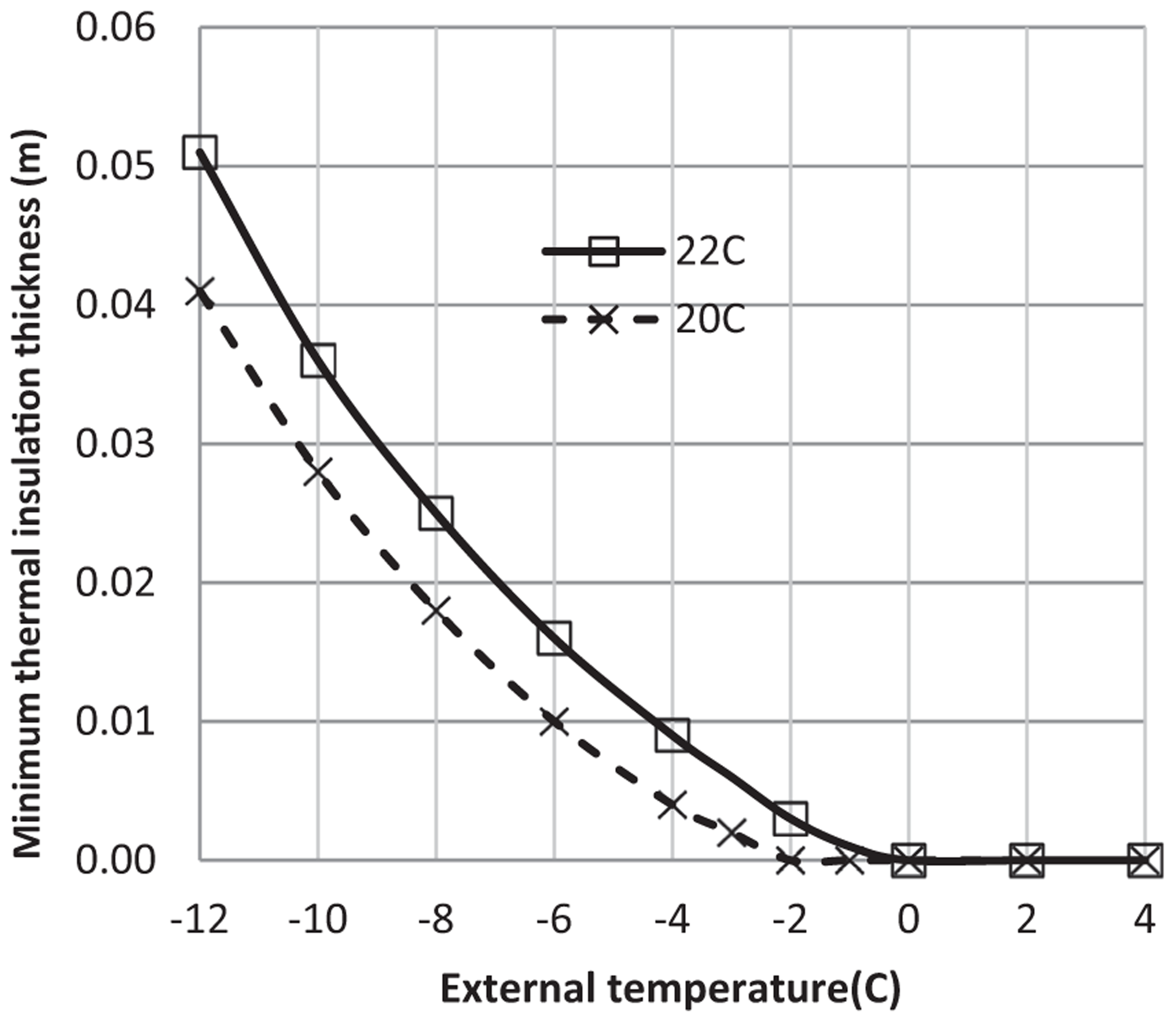
Changes in minimum thermal insulation thickness with external temperature (Ti = 20°C and 22°C, θi = 50%, θo = 70%).
For the same conditions, the changes in heat and mass transfer rates from the wall are given in Figures 13 and 14. When external temperatures increase, while heat and mass transfer rates are generally expected to decrease, the reason for an increase is decreased thermal insulation thickness. At temperatures higher than 0°C, the amount of heat and water vapor transfer rates decreases with the increase in external temperature because thermal insulation is not required.
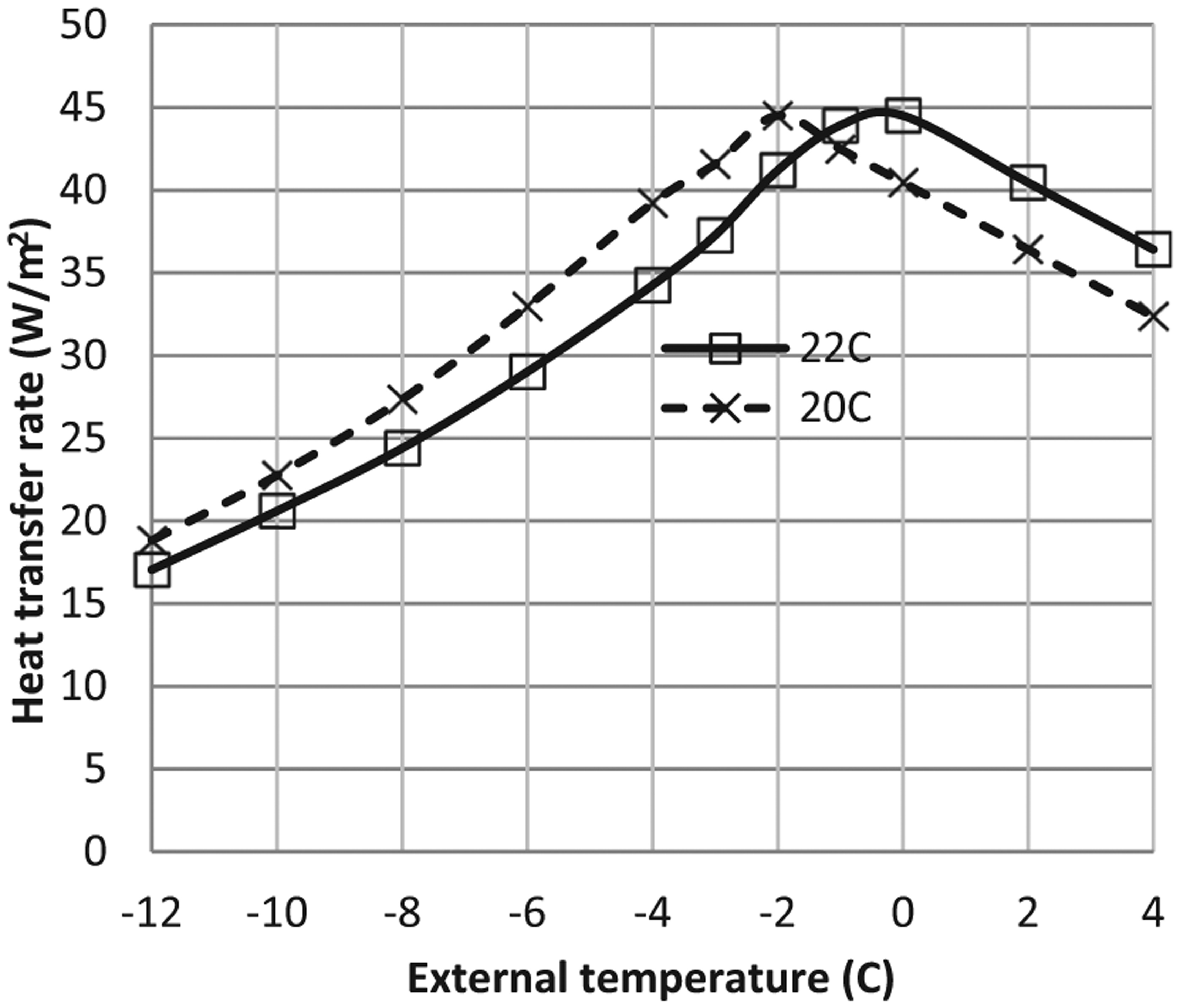
Heat transfer rate at minimum thermal insulation thicknesses (Ti = 20°C and 22°C, θi = 50%, θo = 70%).

Mass transfer rate at minimum thermal insulation thicknesses (Ti = 20°C and 22°C, θi = 50%, θo = 70%).
The effect of the water vapor diffusion resistance of the thermal insulation material on condensation
The effect of the water vapor diffusion resistance of the thermal insulation material on condensation within the wall is shown in Figure 15. Heat and mass transfers within the wall were calculated for three different water vapor diffusion resistance values, which are shown in this figure as distributions of saturated and partial pressure values in the wall layers. The internal and external conditions remained fixed; only the thermal insulation diffusion resistance value changed. When the thermal insulation material water vapor diffusion resistance increases, the amount of water vapor transfer from the thermal insulation material decreases, and the water vapor partial pressure of the external surface (at four points) of the thermal insulation material decreases. This reduces the risk of condensation at those four points. However, the water vapor partial pressure of the internal surface (at three points) of the thermal insulation material increases, which increases the risk of condensation as partial pressure approaches its saturation pressure. Therefore, the use of thermal insulation material with very high water vapor resistance has the risk of increasing the possibility of condensation on the internal surface of the thermal insulation. The use of thermal insulation materials with very low or very high water vapor diffusion resistance can increase the risk of condensation within the wall on the external and internal surfaces of the thermal insulation.
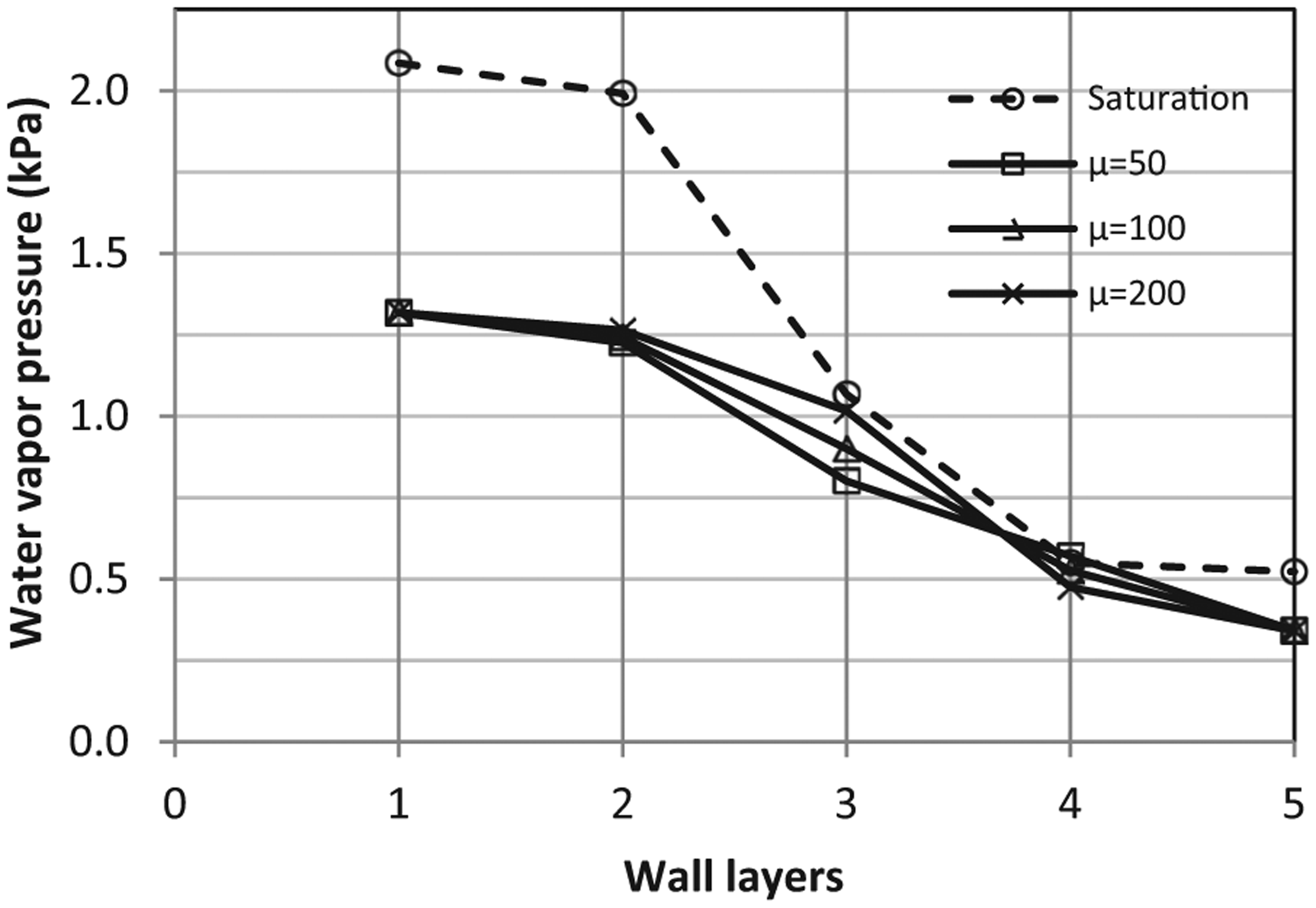
The effect of the water vapor diffusion resistance of the thermal insulation materials on condensation (Ti = 22°C, θi = 50%, To = −3°C, θo = 70%, xins = 0.01 m).
Conclusion
To determine the minimum thermal insulation thickness for external walls, it was necessary to control condensation by considering the internal and external relative humidity values in addition to factors such as internal and external temperatures, solar radiation, and the wind. The water vapor transfer should be considered in thermal insulation applications in buildings in addition to the heat transfer. This study examined the effect of internal and external environmental conditions and water vapor diffusion resistance of the thermal insulation material on the condensation in a wall; the necessary thermal insulation thicknesses to prevent condensation were calculated as well. In conclusion, the following results can be summarized:
When the difference in relative humidity between the internal and external environments increases, the risk of condensation increases by a significant degree. Similarly, when the difference between internal and external environment temperatures increases, there is an increased possibility of heat and water vapor transfers from internal to external walls as well as condensation. Therefore, in conditions of high differences between internal and external environmental conditions (temperature and humidity), it is necessary to increase thermal insulation thickness to prevent condensation.
The effect of external relative humidity is greater than that of internal relative humidity on the minimum thermal insulation thickness. This is also true for external environment temperature. Therefore, the external environment conditions (climate conditions throughout the year) should be considered to control condensation on the external walls of a building. Determining the limit values for external environment temperature and humidity is of the utmost importance in the condensation control. The possibility of condensation at high internal and external environmental humidity values, in particular, should be considered to have a positive effect on thermal insulation thickness.
The water vapor diffusion resistance of thermal insulation materials is extremely important in regard to condensation risk. The use of thermal insulation materials with very low or very high water vapor diffusion resistance can increase the risk of condensation at different points within the wall structure. In cases of low diffusion resistance, the risk of condensation increases on the external surface of the thermal insulation material. However, in cases of high diffusion resistance, the risk is on the internal surface.
Footnotes
Appendix 1
Academic Editor: Oronzio Manca
Declaration of conflicting interests
The author(s) declared no potential conflicts of interest with respect to the research, authorship, and/or publication of this article.
Funding
The author(s) received no financial support for the research, authorship, and/or publication of this article.