




Abstract
This work emphasizes on the influence of the TiN and AlCrN coatings fabricated on high speed steel form tool using physical vapor deposition technique. The surface microstructure of the coatings was studied using scanning electron microscope. Hardness and corrosion studies were also performed using Vickers hardness test and salt spray testing, respectively. The salt spray test results suggested that the bilayer coated (TiN- bottom layer and AlCrN- top layer) substrate has undergone less amount of corrosion, and this is attributed to the dense microstructure. In addition to the above, the influence of the above coatings on the machining performance of the high speed steel was also evaluated and compared with that of the uncoated material and the results suggested that the bilayered coating has undergone very low weight loss when compared with that of the uncoated substrate depicting enhanced wear resistance.
Introduction
High speed steel (HSS) is being widely used in manufacturing industries due to its excellent hardness at higher temperature. However, due to the continuous usage of this HSS, it will be subjected to high contact pressures, high temperatures, and severe chemical attack which will result in severe wear.1–3 In order to effectively overcome the aforesaid problems, several surface modification techniques such as physical vapor deposition (PVD), chemical vapor deposition (CVD), and various tool materials such as cemented carbides, cermets, cubic boron nitride (CBN) are still frequently used in cutting tool industry. 4 Among these two techniques, PVD is preferred as it is a line-of-sight process. In addition to this, very thin coating of thickness ranging from 3 to 5 µm can be deposited which works very well on sharp edge tools. Moreover, this technique will lead to better adhesion, and it can be performed relatively at low temperatures without affecting the bare substrate when compared with that of CVD process.
TiN coating is well known for its higher hardness, low coefficient of friction, and high oxidation resistance, and it is also evident that CrN coating provides higher hardness, low coefficient of friction, high toughness, and higher wear resistance5–7
Xin Wang et al. 8 have performed TiN coating on M2 Steel using PVD and observed a substantial improvement in the wear resistance when compared to that of the bare substrate. Lim et al. 9 have deposited TiN using PVD on aluminum extrusion die and noted a remarkable improvement in the hardness and wear resistance. Tribological behavior of TiN coating using PVD was investigated by means of dry and lubricated sliding wear test at room temperatures and at 200°C, and their results revealed significant decrease in the wear of the tool steel under sliding wear test. 10 Batista et al. 11 have reported that the CrN coating deposited by PVD process resulted in higher abrasive wear resistance when compared with that of the TiN coatings. Although lot of works have been carried out using TiN and CrN coatings for cutting tools, only few works were carried out using AlCrN coating. For instance, Swapnagandha et al. have carried out AlCrN/TiAlN coating on carbide inserts using PVD technique and observed significant improvement in its corrosion resistance. Hence, in this work, both the TiN and AlCrN coatings have been fabricated on the HSS using PVD technique, and the properties such as hardness and corrosion behavior of the above-mentioned coated substrates are compared in detail.
Materials and methods
Sample preparation
HSS substrate T grade 800 HV was procured from Ambattur Industrial Estate, Chennai, India. Wire cut electric discharge machining (EDM) was used to machine the samples into pieces for metallurgical investigation. The approximate size of the samples after EDM is 10 mm × 10 mm × 10 mm. The surface morphology of the coating and the substrate were analyzed using scanning electron microscope (SEM). The samples were thoroughly cleaned with ethanol/acetone mixture, washed with distilled water, and finally dried before salt spray test. Mountings of TiN, AlCrN, bilayer samples are prepared for micro hardness test and surface roughness test. Hardness testing was performed across the cross section of the coatings by applying a load of 200 g with a dwell time of 15 s. The surface roughness (Ra) of the sprayed coatings was tested using Mitutoyo Surf test-211 profilometer. Thermosetting plastic-bakelite is heated above 160°C and molded as a mounting placed in a cylindrical die. The samples were polished using emery papers of 300, 600, 1000, 1600 grit sizes and subsequently on 1/0, 2/0, 3/0, and 4/0 grades and then mirror polished using cloth polishing wheel machine with 1 µm alumina powder suspension.
Fabrication of coatings
TiN, AlCrN, TiN/AlCrN coatings were deposited on HSS substrate using PVD thermal evaporation method, with a thickness of coating around 4 ± 0.5 µm. The components are as follows: stainless steel cylindrical vessel used as a vacuum chamber to carry out deposition process; a vacuum system used to maintain a pre-set pressure inside chamber of the reactor using a rotary pump to bring the pressure down to 10−3 torr. Base pressure reaches 10−5 torr which is low enough to provide good quality depositions. The chamber pressure is monitored by a wide range manometer, composed by ion and capacitive gauges; a tungsten wire used as an electric heater is connected with potential organizer power supply of 10 kW.
Salt spray test
TiN, AlCrN, and bilayer coated samples were subjected to an accelerated corrosion testing, that is, salt spray test according to ASTM B-117-9 standard in MICROLAB Ambattur Industrial Estate, Chennai, India. The salt solution of 5 wt% of NaCl is continuously sprayed as a salt mist over the coated surface of the sample at 30° angle held on specimen table. The salt spray test was carried out for 6 h at room temperature. The exposed surface areas of all specimens were 1 cm2, and the remaining portion except the coated surface was waxed with good quality in order to prevent the initiation of corrosion.
Results and discussion
Microstructure of coatings
The photographs of the PVD coated HSS are depicted in Figure 1. Figure 2(a) shows the microstructure of uncoated HSS Tool. The microstructure of the uncoated HSS was found to be rough, and few minute pores were observed on the surface of the cutting tool. The pore formation is mainly due to the very low heating rate involved in this process. Figure 2(b) shows the microstructure of TiN coating on HSS Tool. TiN coated tool surface was found to be rough, and few macro-droplets were detected on the coated surface like the uncoated substrate. On contrary, the surface of the AlCrN cutting tool was found to be smooth when compared with that of TiN coating (Figure 2(c)). No pores were observed on its surface. Figure 2(d) depicts the microstructure surface of the bilayered coating AlCrN coating on TiN. The surface of the bilayered coating was found to be smooth when compared with other two coatings. No pores and cracks were detected on its surface.
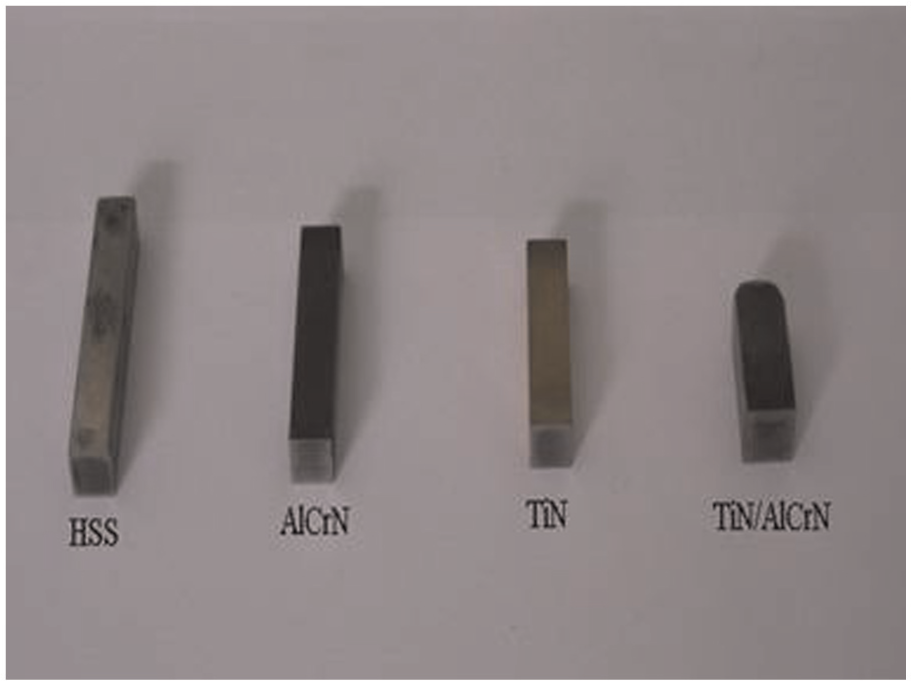
Photograph of the PVD coated high speed steel.

SEM images of (a) Uncoated HSS (b) TiN (c) AlCrN, and (d) TiN/AlCrN Coatings.
Hardness
There has been a remarkable improvement in the hardness of TiN and AlCrN coatings when compared with the uncoated substrate. This remarkable improvement in the hardness of the coated substrate is mainly due to the presence of very few pores observed in the coating. Besides this, the bilayered coating possesses a lower hardness of around 915 VHN. The increase in hardness of all the above-mentioned coatings when compared with that of the uncoated substrate may be due to the presence of reduced amount of pores observed on the surface. The hardness and roughness values are shown in Table 1.
Wear of the cutting tools.

HSS: high speed steel.
Salt spray test
The above figures show the morphology of the samples after subjecting to salt spray testing. Figure 3(a) shows the corroded TiN coated surface. The red rust indicates that the substrate is subjected to more amount of corrosion. Figure 3(b) shows the AlCrN coated surface tool. In the case of AlCrN coating, no rust formation was noted, and this is mainly because of the presence of stable alumina layer observed on the surface of the coating. On the other hand, Figure 3(c) shows the surface morphology of bilayered coating after salt spray test. In this, AlCrN coating is subjected to less amount of rust formation. This is due to the presence of smaller pores observed on the surface. Few cracks were detected on the surface, and this is attributed to the presence of larger amount of TiN, which in turn has resulted in higher residual tensile stress on the coating. On the other hand, the surface of the AlCrN coating subjected to salt spray test was found to be little rough and no cracks were observed like TiN coating. This indicates that the alumina layer has protected the substrate from corrosion. In addition to this, the corroded surface of the bilayer coating was found to be very smooth, indicating that the presence of the hard alumina particles and chromium oxide layer has resulted in very good corrosion resistance. This result is well correlated with that of the salt spray test results as indicated earlier.

Surface of the (a) TiN, (b) AlCrN, and (c) bilayered TiN/AlCrN coatings after the salt spray test.
Performance analysis of coatings
Among all the three coatings, the bilayered coating has shown very less weight loss after performing turning operation, and this is chiefly due to its higher hardness and less porosity. In addition to this, the enhanced adhesion between the two layers of the coating has resulted in minimum weight loss. Apart from this, the presence of hard alumina particles on the surface has resulted in minor amount of material removal rate. Whereas the mono-layered coating has undergone larger amount of weight loss, depicting that the coatings exhibited bigger wear. This is due to the larger roughness observed in the coatings.
Conclusion
In this study, AICrN, TiN, and bilayered coatings were successfully performed on HSS tool using PVD technique and the following conclusions can be drawn:
Surface morphology of the bilayered coating was found to be smooth with minimum porosity.
There has been a significant improvement in the corrosion resistance for bilayered coated cutting tool, and this is mainly due to the presence of very few pores.
The bilayered coated cutting tool possesses very low wear rate, thereby indicating enhanced tool life. Hence, it can be implemented for cutting tool applications.
Footnotes
Academic Editor: Chow-Shing Shin
Declaration of conflicting interests
The author(s) declared no potential conflicts of interest with respect to the research, authorship, and/or publication of this article.
Funding
The author(s) received no financial support for the research, authorship, and/or publication of this article.