



Abstract
This article conceptually proposes a new method to tune the resonance frequency of piezoelectric vibration energy harvesters, in which the supporting position of the vibrator can be adjusted for frequency tuning. The corresponding analytical model is established to predict the performances of the harvester based on the principles of energy. First, the equivalent stiffness and mass of the vibrator in bending mode are derived explicitly for the different supporting positions. A simple analysis method is then established for the frequency, output voltage, and output power. Finally, some numerical examples are given to demonstrate the presented method. The results are also compared with those by finite element method and good agreement is observed.
Introduction
Piezoelectric vibration energy harvesters have been paid much attention since they can scavenge mechanical energy in ambient vibration through the electromechanical coupling properties of piezoelectric materials.1,2 Bending, tension, and shear deformation of piezoelectric materials were three main modes in the transformation of the mechanical and electric energy. Umeda et al. 3 proposed an energy harvester which collected the impact energy of a steel ball. A clamped beam adhesively bonded piezoelectric layer was bended by the impact of the steel ball and electric voltage was generated on the electrodes of the piezoelectric layer. The efficiency of the output power was investigated using equivalent circuit method. Goldfarb and Jones 4 analyzed the efficiency of the electric power generation with piezoelectric stack also using equivalent circuit. Ericka et al. 5 investigated the capability of harvesting the electric energy from mechanical vibrations in a dynamic environment through a unimorph piezoelectric membrane transducer. Kim et al. 6 studied the effect of the styles of the electrode of the clamped circular unimorph on the energy harvesting from vibration, which was also validated by experiments. 7 The cantilever bimorph and unimorph were the most popular vibrators of the piezoelectric vibration energy harvester. They were usually simulated by the model of single degree of freedom (SDOF) for the sake of simplicity. In such a way, the output voltage and power density could be derived explicitly if the ambient vibration was also assumed in a resonant form. Consequently, the optimization of the parameters of the energy harvesters could be readily achieved. Therefore, the SDOF model was applied by many researchers.8–12 Besides these SDOF models, some distributed parameter models based on the classical beam theory were also developed to discuss the electromechanical behavior of the piezoelectric vibration energy harvesters. For example, Lu et al. 13 presented a model to analyze micro-piezoelectric power generators for micro-electromechanical-system (MEMS) applications using a single mode and neglecting the inverse piezoelectric effect. DuToit et al. 14 discussed in detail the design consideration for MEMS-scale piezoelectric mechanical vibration energy harvesters and presented some analytical models of lumped and distributed parameters. Chen et al. 15 proposed a distributed parameter model through modal expansion technique, in which the inverse piezoelectric effect was simulated by a viscous damper. However, the viscous damper was not exact for the inverse piezoelectric effect since the piezoelectric effect was bidirectional and affected both the amplitude and frequency of the vibrator. Erturk and Inman 16 developed a distributed parameter electromechanical model for cantilevered piezoelectric energy harvesters. In their model, both the direct and inverse piezoelectric effects were taken into account and the assumption of resonant ambient vibration was abandoned. The analytical solutions of the output voltage and power were also given.
For piezoelectric vibration energy harvesters, the efficiency of the energy collection was significantly dependent on the frequencies of the ambient vibration and the vibrator of the harvester. If the frequency of the vibrator of the harvester was far away from the frequency of the ambient vibration, the efficiency would be very low. Multi-frequency or wideband energy harvesters were developed for this purpose using multiple cantilevers with different length and tip mass.17–20 However, the power densities of these harvesters were not high because all the cantilevers cannot work in high efficiency simultaneously. Leland and Wright 21 proposed a method to tune the resonant frequency of piezoelectric vibration energy harvesters by acting compressive axial preload on the vibrator, which was a simply supported beam with a lumped mass at the mid-span. Challa et al. 22 developed a cantilevered energy harvester with bidirectional resonance frequency tunability. They set up permanent magnets nearby the tip of the cantilever. The distances between the permanent magnets could be adjusted to change the magnetic forces. The resulting resonant frequency of the cantilever was also modified. The permanent magnets could be considered as a spring with adjustable stiffness on the tip of the cantilever. However, the above-mentioned methods to tune frequency need a reaction device with enough rigidity and strength to apply axial force or fix the permanent magnets. Recently, the effects of non-linearities in vibratory energy harvester attracted more attentions, and these effects could be used to improve the performance of the energy harvesters.23–25 For example, Wickenheiser and Garcia 26 presented a non-linear, magnetically excited energy harvester that exhibits efficient broadband frequency-independent performance utilizing a passive auxiliary structure that remains stationary relative to the base motion. Masana and Daqaq 27 also proposed a non-linear model to analyze the energy harvesters with axial load and found that the axial load could increase the steady-state response amplitude, output power, and bandwidth of the harvesters. More details on the effects of non-linearities in vibratory energy harvesters were well reviewed by Daqaq et al. 28
This work conceptually proposed a new method to tune frequency of piezoelectric vibration energy harvester. The supporting position of the vibrator of the energy harvester was adjusted to change its resonant frequency. Based on the principles of energy, the equivalent stiffness and mass were obtained for the bending modes. The simplified model was then established to derive the explicit expressions for the resonant frequency, output voltage, and output power. Finally, numerical examples were given to demonstrate the presented method. The results were also compared with those by finite element method (FEM) for validation and good agreement was observed. It was noticeable that this work just proposed a conceptual method to adjust the resonant frequency of the oscillator through the changing of its supporting position. The detailed implementation of this conceptual method was not discussed here. This detailed implementation was necessary and should also be further investigated if the presented conceptual method was used to self-adaptively tune the resonant frequency of the energy harvester.
Formulation
A piezoelectric vibration energy harvester with a bimorph and a tip mass is shown in Figure 1. For the sake of tuning frequency, the bearing at position x
0 is designed to be adjustable. For the case of

Schematic of a piezoelectric bimorph vibration energy harvester.
Simplified model
The 3-1 mode, that is, bending mode of the piezoelectric material, is used in this work. It is assumed that only the axial normal stress

where

where

The strain energy and static electric energy of the bimorph shown in Figure 1 are
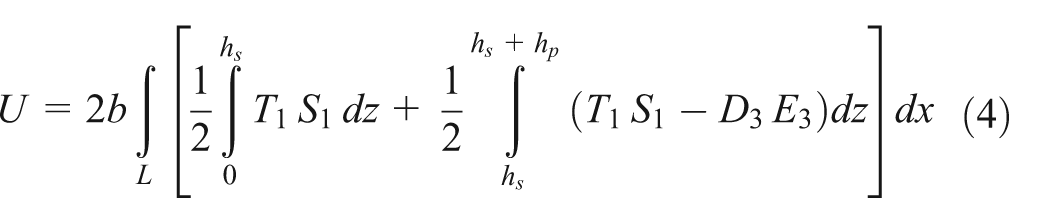
Substituting the constitutive relations of piezoelectric and non-piezoelectric materials into equation (4), the strain energy and static electric energy of the bimorph can be rendered in terms of strain and electric field, namely

where

In addition, because electrode is covered on the top and bottom surfaces of the piezoelectric layer, the electric field

where
Substituting equations (6) and (7) into equation (5) and finishing the integral in the

where

If

where the dot means the derivative with respect to time
If free charge

In which the factor 2 is due to the series connection of two piezoelectric layers as shown in Figure 1. According to Hamilton’s principle, we have

It is supposed that the deflection of the bimorph is

where


where

and


If the viscous damping

Moreover, if the electric resistance of the output circuit of the energy harvester is

where the factor 2 is also because of the bimorph connection as shown in Figure 1. Consequently, equation (15) should become

Equations (19) and (21) are the governing equations of the simplified model and also given by DuToit et al. 14 in a similar form.
Frequency of free vibration
This section analyzes the frequency of free vibration of the bimorph, which is dependent on the bearing position

Substituting equation (22) back into equation (14) and let

where

Thus, the frequency for the opened circuit is

If the circuit is shorted, we have

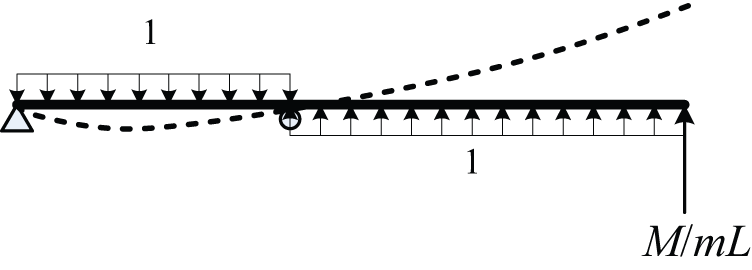
The mode shape

where




Approximate mode shape of the first order.
The numerical examples show that the approximate mode shape in equation (27) can give an accurate fundamental frequency which agrees very well with one of the FEMs. If the frequencies of higher orders are required, the mode shapes should be assumed in higher order forms correspondingly.
Deflection and voltage due to the excited base
If the vibration of the base of the energy harvester is denoted by

From equations (19) and (21), we have

in which the frequency response function

where

For the case of opened circuit, that is,

The voltage in equation (33) is also simplified to

If the acceleration of the base is specified, that is,

from equations (19) and (21), where the frequency response function

Numerical examples
To validate the presented model, some numerical examples are given as follows. The geometrical parameters and material properties of the bimorph are listed in Table 1. The solid lines in Figure 3 show the variation of the fundamental frequencies with the position
Geometrical and material properties of the energy harvester.

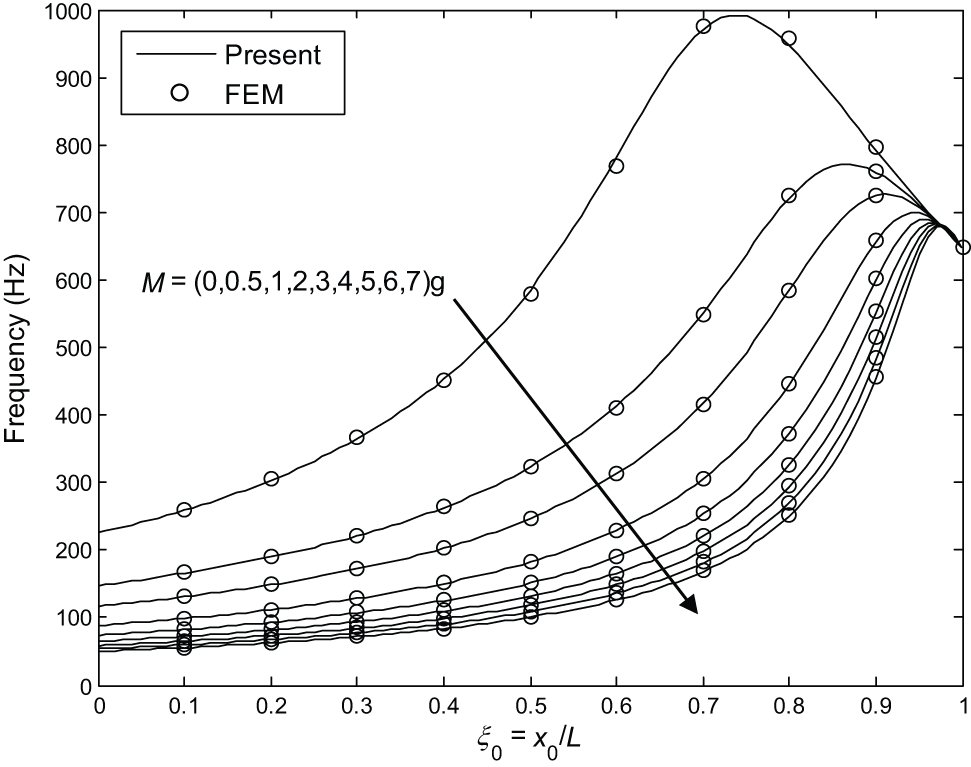
Fundamental frequency of the energy harvester with different bearing positions.
The voltage of the energy harvester is also investigated for different damping in the case of opened circuit. The peak value of the acceleration of the base is assumed as

Output voltage magnitude of the energy harvester with different damping ratios.
Finally, the effect of the electric resistance of the circuit on the output power is studied. The peak value of the power is determined by

Output power magnitude of the energy harvester with different circuit resistances.
Conclusion
This work conceptually proposed a new method to tune frequency of piezoelectric vibration energy harvester through changing the bearing position of the vibrator. An analytical model is also established to derive the equivalent stiffness and mass based on the principle of energy. The resonant frequency, output voltage, and output power are then obtained explicitly. The final numerical examples show that the presented model can accurately predict the behaviors of the energy harvester. The idea of changing the bearing position to adjust the frequency can be extended to other structural types of the oscillators.
Footnotes
Academic Editor: Francisco D Denia
Declaration of conflicting interests
The authors declare that there is no conflict of interest.
Funding
This work was supported by the National Natural Science Foundation of China (no. 10872180), the Zhejiang Province Natural and Science Foundation of China (grant no. LY12A02001), and The Science Technology Department of Zhejiang Province, China (no. 2014C33001).