Eigenvalue problems of grouped turbo blades were numerically formulated using a radial basis function. This study investigated different boundary conditions, which accompany the radial basis function, for transforming partial differential equations of grouped turbo blades into a discrete eigenvalue problem. The numerical results show the validity and efficiency of the radial basis function for solving this problem. The crack depth considerably affects the dynamic behavior of grouped turbo blades.
With the increasing availability of various numerical methods, such as the finite difference, finite element, and boundary element methods, static and dynamic solutions for numerous complex structures are now achievable. However, exploring alternative efficient techniques remains necessary. For designing turbo-machinery, high efficiency is required; therefore, the complex shape of a blade in turbomachinery is unavoidable. Because of the complex shape of a turbo blade, a pretwisted taper beam has been used to approximate it. Rao,1 Hodges et al.,2 Abrate,3 Dawson,4 and Dawson and Carneige5 have calculated the natural frequencies of single-tapered and pretwisted turbo blades by using the Rayleigh–Ritz method. Gupta and Rao6 applied the finite element method to locate natural frequencies of vibrations in double-tapered and twisted beams. Swaminathan and Rao7 solved the vibration problem of a rotating, pretwisted, and tapered blade. Subrahmanyam et al.8,9 have determined the natural frequencies and the mode shapes of a uniform pretwisted cantilevered blade by using the Reissner method. Chen and Keer10 analyzed the transverse vibrations of a rotating pretwisted Timoshenko beam subjected to axial loading. Storiti and Aboelnaga11 studied the transverse deflections of a straight-tapered symmetric beam attached to a rotating hub and used it as a model for examining the bending vibration of blades in turbo machinery. Wagner12 calculated the forced vibration response of subsystems with various natural frequencies and damping; these subsystems were attached to a foundation with finite stiffness or mass. Griffin et al.13–15 has determined the dynamic responses of frictionally damped turbine blades. Wagner and Griffin16,17 have analyzed the harmonic responses of grouped-blade and flexible-disk systems. For simplicity, tapered pretwisted beams have been used to approximate blades.18,19 To improve the dynamic behavior of a rotating shroud blade disk, the blades are shrouded and grouped frequently. The dynamic characteristics of grouped blades are crucial in turbo machinery designs. To analyze the blade-group effect on the dynamic behavior of a turbo disk, it was assumed that blades are grouped periodically. The integrity and computational efficiency of the radial basis functions (RBFs) in this problem were demonstrated through a series of case studies.
Formulation of the eigenvalue problem
The periodic shrouded-blade structure, as shown in Figures 1 and 2, consists of a rigid hub and a cyclic assembly of -grouped blades.18 In each blade group, the blade is coupled by a spring k with an adjacent blade through a shroud. The massless spring is assumed to model the function of this shroud. The dynamic characteristics of edge-cracked beams are crucial in numerous designs. The flexibility caused by a crack of depth can be determined using the Broek approximation19–21 as follows:
where is the stress intensity factor under mode I loading, μ is the Poisson’s ratio, denotes the bending moment at the crack, and is the flexibility of the blade. The magnitude of the stress intensity factor can be determined using the Tada formula20,21 as follows:
where
and
Geometry of the grouped turbo blade disk system.
Geometry of a cracked, pretwisted, tapered blade.
Substituting the stress intensity factor into equation (1) yields
Because
the bending stiffness of the cracked section of a blade can be expressed as
The equations of motion of the blade can be derived as follows18:
We assume that the cross section of the blade symmetrically encompasses two principal axes, and only flexural bending can occur. Consider the cross-sectional area of the tapered pretwisted blade at position to be
where ρ is the density of the blade, and and denote, respectively, the breadth and thickness at the root of the blade, as shown in Figures 1 and 2, and
where and are, respectively, the breadth and thickness at the blade tip. In this equation, is the radius of the hub; Ω is the rotational speed; and , , and are the moments of the area. Consider the tapered blade to be pretwisted with a uniform twist angle θ; the moments of the area at position can then be derived as follows18:
where is the length of the tapered blade
The corresponding boundary conditions are
A crack can be represented as a spring of zero length and zero mass.18 The corresponding boundary conditions are
and
Consider the displacements to be of the following form:
For simplicity, equations (29) and (30) can be rewritten in a dimensionless form as
with
The corresponding nondimensional boundary conditions are
where
and
The dimensionless shroud stiffness is .
Radial basis function
Mesh-free approximation methods are a new area of research in the mathematics and engineering and have gained much attention in recent years. An RBF is a real-valued function and its value depends on its distance from its point of origin. Kansa22,23 studied a given function or the partial derivatives of a function with respect to a coordinate direction, which is expressed as a linear weighted sum of all functional values at all mesh points along the direction that was initiated on the basis of the concept of the RBF. The node distribution in their algorithm was completely unstructured. Elfelsoufi24 investigated the buckling, fluttering, and vibration of beams by using RBFs. Wang and Liu25 proposed a point interpolation meshless method that was based on RBFs and incorporated the Galerkin weak form for solving partial differential equations. Hon et al.26 employed RBFs for function fitting and solving partial differential equations using global nodes and collocation procedures. Liu et al.27 constructed shape functions with the delta function property based on radial and polynomial basis functions. In this study, shape functions are constructed using RBFs. A RBF can be expressed as follows28,29:
where is a constant. The RBF is typically used to develop the functional approximations28,29:
where and are the coefficients that must be determined. The blade deflections and denote a sum of RBFs, each associated with a different center . The domain contains collocation points. Although these nonlinear equations of the grouped turbo blades do not have an analytical solution, numerical approaches can be adopted to solve it. These nonlinear partial differential equations are solved numerically using the RBF approach, which does not require a mesh. By using the RBF approach, equations (55) and (56) can be substituted into equations (31)–(53). The equation of motion of the grouped turbo blades can be rearranged into a formula based on the RBF approach
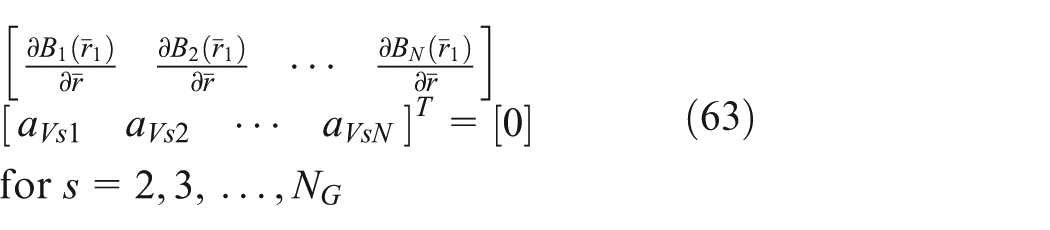
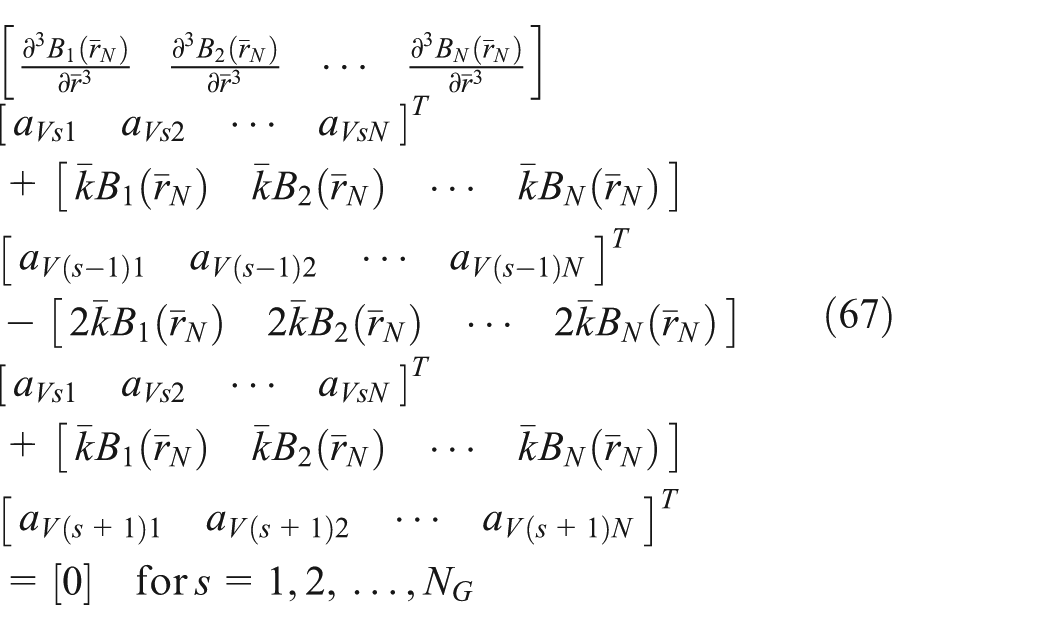
Based on the RBF approach, the boundary conditions of a clamped-free blade with an edge crack can be rearranged into matrix forms as follows:
and
Results and discussion
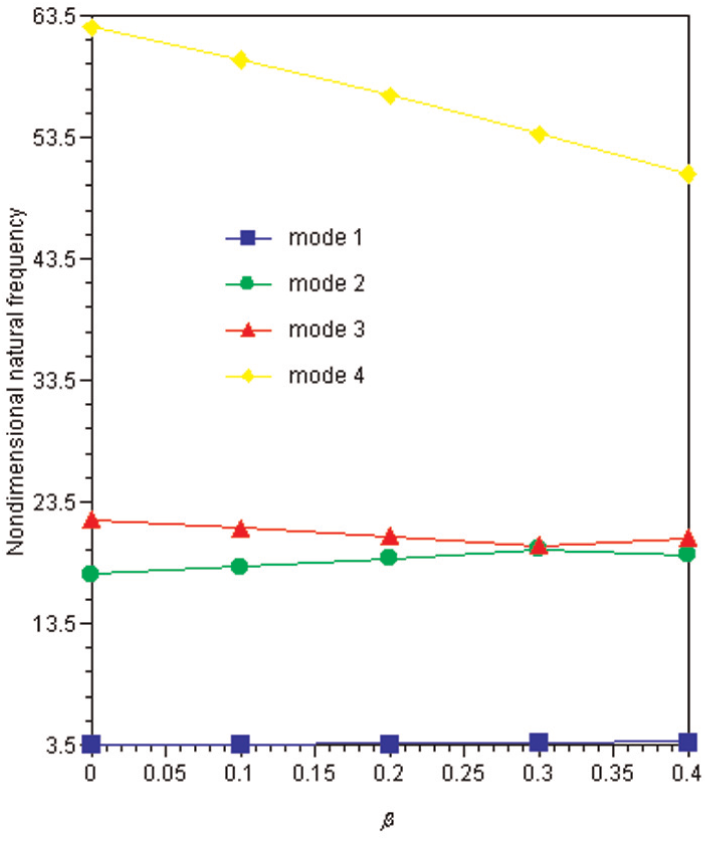
A model of a bladed disk with a rigid hub attached to 60 blades was assembled. The shroud ring segments on the blade tips coupled the blades. A group consisted of six blades. Figure 3 shows the calculated natural frequencies of the grouped turbo blade disk with different values of . The nondimensional parameters of the rotating disk system are , , and .18 We used constant c = 1. A higher nondimensional natural frequency was calculated for the grouped-blade system when high . The crack depth considerably affects the dynamic behavior of grouped turbo blades. They also suggested that nondimensional natural frequencies calculated using the RBF approach are extremely close to the solutions obtained using the differential quadrature method. Figure 4 shows nondimensional natural frequencies of a rotating turbo disk with different pretwist angles. Higher second and fourth nondimensional natural frequencies were calculated for the grouped-blade system when the total pretwisted angle was smaller. Figure 5 shows calculated nondimensional natural frequencies of the grouped-turbo disk with different values of shroud stiffness. A higher nondimensional natural frequency was calculated for the grouped-blade system when the shroud stiffness was higher. The results show that a strong shroud may considerably increase the nondimensional natural frequencies of a grouped turbo blade system. Figure 6 shows calculated nondimensional natural frequencies of the grouped turbo disk for various rotating speeds. A higher nondimensional natural frequency was calculated for the grouped-blade system when the rotating speed was higher. Figure 7 shows the calculated nondimensional natural frequencies of the grouped turbo disk for various values of α. A higher nondimensional natural frequency was calculated for the grouped-blade system when α was higher. Figure 8 shows the calculated nondimensional natural frequencies of the grouped turbo disk for various values of β, and a higher first nondimensional natural frequency and lower fourth nondimensional natural frequency were calculated for the grouped-blade system when β was higher.
Calculated nondimensional natural frequencies of a grouped turbo blade disk with different values of .
Calculated nondimensional natural frequencies of a rotating turbo disk with different pretwist angles.
Calculated nondimensional natural frequencies of a grouped turbo disk with different values of shroud stiffness .
Calculated nondimensional natural frequencies of the grouped turbo disk for various rotating speeds.
Calculated nondimensional natural frequencies of the grouped turbo disk for various values of α.
Calculated nondimensional natural frequencies of the grouped turbo disk for various values of β.
Concluding remarks
The developed approach is convenient for solving problems associated with fourth-order differential equations. In addition to the problem examined here, numerous other applications can be modeled using the RBF. Furthermore, this method can be used to solve a wide variety of boundary value problems, and the simplicity of the formulation renders it a suitable candidate for modeling more complex applications. The crack depth considerably affects the dynamic behavior of grouped turbo blades.
Footnotes
Academic Editor: Hamid Reza Shaker
Declaration of conflicting interests
The authors declare that there is no conflict of interest.
Funding
The authors thank the National Science Council of the Republic of China, Taiwan for financially supporting this research under Contract Nos. NSC 100-2221-E-346-011.
References
1.
RaoJS. Flexural vibration of pre-twisted tapered cantilever blades. J Eng Ind Trans ASME1972; 94: 343–346.
2.
HodgesDHChungYYShangXY. Discrete transfer matrix method for non-uniform rotating beams. J Sound Vib1994; 169: 276–283.
3.
AbrateS. Vibrations of non-uniform rods and beams. J Sound Vib1995; 185: 703–716.
4.
DawsonB. Coupled bending-bending vibrations of pre-twisted cantilever blading treated by Rayleigh-Ritz energy method. J Mech Eng Sci1968; 10: 381–386.
5.
DawsonBCarneigeW. Model curves of pretwisted beams of rectangular cross-section. J Mech Eng Sci1969; 11: 1–13.
6.
GuptaRSRaoSS. Finite element eigenvalue analysis of tapered and twisted Timoshenko beams. J Sound Vib1978; 56: 187–200.
7.
SwaminathanMRaoJS. Vibration of rotating, pre-twisted and tapered blades. Mech Mach Theor1977; 12: 331–337.
8.
SubrahmanyamKBKulkarniSVRaoJS. Coupled bending-bending vibrations of pre-twisted cantilever blading allowing for shear deflection and rotary inertia by the Reissner method. Int J Mech Sci1981; 23: 517–530.
9.
SubrahmanyamKBRaoJS. Coupled bending-bending vibrations of pretwisted tapered cantilever beams treated by the Reissner method. J Sound Vib1982; 82: 577–592.
10.
ChenWRKeerLM. Transverse vibrations of a rotating twisted Timoshenko beam under axial loading. J Vib Acoust1993; 115: 285–294.
11.
StoritiDAboelnagaY. Bending vibrations of a class of rotating beams with hypergeometric solutions. J Appl Mech1987; 54: 311–314.
12.
WagnerJT. Coupling of turbomachine blade vibrations through the rotor. J Eng Power Trans ASME1967; 89: 502–512.
13.
GriffinJH. Friction damping of resonant stresses in gas turbine engine airfoils. J Eng Power Trans ASME1980; 102: 329–333.
14.
GriffinJHSinhaA. The interaction between mistuning and friction in the forced response of bladed disk assemblies. J Eng Gas Turb Power1985; 107: 107–205.
15.
SinhaAGriffinJH. Effects of static friction on the forced response of frictionally damped turbine blades. J Eng Gas Turb Power1984; 106: 65–69.
16.
WagnerLFGriffinJH. Forced harmonic response of grouped blade systems: part I—discrete theory. J Eng Gas Turb Power1996; 118: 130–136.
17.
WagnerLFGriffinJH. Forced harmonic response of grouped blade systems: part II—application. J Eng Gas Turb Power1996; 118: 137–145.
18.
KuangJHHuangBW. Mode localization in a grouped bladed disk. In: International gas turbine & aeroengine congress, Munich, 8–11 May 2000, paper no. 2000-GT-369. New York: ASME.
19.
KuangJHHuangBW. The effect of blade crack on mode localization in rotating bladed disks. J Sound Vib1999; 227: 85–103.
20.
BroekD. Elementary engineering fracture mechanics. Leiden: Martinus Nijhoff Publishers, 1986.
21.
TadaHParisPCIrwinGR. The stress analysis of crack handbook. New York: Professional Engineering Publishers, 2000.
22.
KansaEJ. Multiquadrics—a scattered data approximation scheme with applications to computational fluid dynamics—I. Surface approximations and partial derivative estimates. Comput Math Appl1990; 19: 127–145.
23.
KansaEJ. Multiquadrics—a scattered data approximation scheme with applications to computational fluid dynamics—II. Solutions to parabolic, hyperbolic, and elliptic partial differential equation. Comput Math Appl1990; 19: 147–161.
24.
ElfelsoufiLA. Buckling, flutter and vibration analyses of beams by integral equation formulations. Comput Struct2005; 83: 2632–2649.
25.
WangJGLiuGR. A point interpolation meshless method based on radial basis functions. Int J Numer Meth Eng2002; 54: 1623–1648.
26.
HonYCLuMWXueWM. Multiquadric method for the numerical solution of a biphasic mixture model. Appl Math Comput1997; 88: 153–175.
27.
LiuGRZhaoXDaiKY. Static and free vibration analysis of laminated composite plates using the conforming radial point interpolation method. Compos Sci Technol2008; 68: 354–366.
28.
WrightGB. Radial basis function interpolation: numerical and analytical developments. PhD Thesis, University of Colorado Boulder, Boulder, CO, 2003.
29.
BuhmannMD. Radial basis functions: theory and implementations. Cambridge: Cambridge University Press, 2003.