




Abstract
The magnetohydrodynamic flow of an incompressible, steady and electrically conducting fluid is considered in double lid-driven square cavity under an inclined magnetic field. The non-dimensional governing equations are solved numerically using a radial basis function (RBF) approximation meshless method in order to obtain the flow patterns. Hartmann number
Introduction
Lid-driven cavity problem is studied for many researchers as a benchmark problem, which can be classified in two types: single-lid or two sliding sided. Ghia et al. 1 employed the implicit multi-grid method to the lid-driven cavity problem, which is modeled by the Navier-Stokes (NS) equation. A novel fully implicit finite volume method is implemented to solve both steady and unsteady NS equations Sahin and Owens. 2 Choi and Balaras 3 presented the application of dual reciprocity boundary element method to NS equations in terms of primitive variables. Turkyilmazoglu 4 considered a driven flow motion by a dually moving lid (two active/passive stirrers) of a square cavity. Numerical simulations are carried out to investigate the streamlines and pressure contours and the mixing properties of the flow exploring a broad parameter space. In the double sided wall cavity problems, Kuhlmann et al. 5 investigated the steady flow in a two sided lid-driven rectangular cavity. They found that two separate co-rotating vortices to the moving walls for low Reynolds number. The flow behavior in a two sided lid-driven cavity is simulated using Lattice Boltzmann method by Arun and Satheesh. 6 They showed the impacts of Reynolds number on streamlines, velocity profiles and pressure contours. Chowdhury and Kumar 7 investigated the flow behavior of non-newtonian fluids in a two sided lid-driven cavity with the use of stabilized finite element method. They observed that the aspect ratio of the domain and the direction of the moving lid affect vortices. Moreover, heat transfer in a double lid-driven cavity is conducted by many researchers. Oztop and Dagtekin 8 studied the problem of steady state mixed convection in an enclosure with vertical two-sided lid-driven and differentially heated square cavity. They found that both Richardson number and direction of lid affect the fluid flow and heat transfer. Azizul et al. 9 examined the heat line visualization of the mixed convection mechanism in a double lid-driven square cavity having a heated wavy wall. The numerical results are obtained for several values of Reynolds number, Richardson number, Prandtl number and oscillation number.
The effect of magnetic field on heat transfer in a two sided lid-driven cavity is analyzed by Sajjadi et al. 10 They reported that the heat transfer declines with an increment of the Hartmann number for various Richardson numbers. Sivasankaran et al. 11 simulated magnetohydrodynamic (MHD) and heat transfer of Cu-water nanofluid in a porous cavity with a partial slip. They observed that the direction of moving wall is not influenced by flow and heat transfer subject to the slip parameter. Soomro et al. 12 examined the flow behavior of MHD mixed convection inside a water filled semicircular cavity containing a cylindrical obstacle. The results demonstrated that the presence of cold obstacle causes the splitting of water flow in two parts. The impact of inclination angle of the magnetic field on heat transfer is also analyzed by many researchers. Hussain et al. 13 performed numerical simulations to determine the effect of inclination angle on the heat transfer of Al2O3–water nanofluid for mixed convection flows in a partially heated double lid driven inclined cavity. Kaladhar et al. 14 figured out the inclined magnetic field effects on mixed convection flow by using spectral quasilinearization method. Finite element method is applied to solve laminar governing equations with buoyancy term by Hussain and Öztop. 15 It is concluded that the inclination angle can be used as a control parameter for heat and mass transfer with different power law index. The comparison of single sided mowing lid and double sided moving lid is discussed in the impact of copper-water nanofluid. 16 They implemented finite element method to find solutions for various ranges of distance among fins, Hartmann number, length of fins, Richardson number, and magnetic field inclination. Al Khasawneh et al. 17 numerically surveyed on the gaseous flow in a rectangular micro channel subject to the inclined magnetic field. The results revealed that the temperature increases as Hartmann number increases, but decreases as Darcy number increases. Mansour and Bakier 18 investigated the mixed convection phenomenon of hybrid nanofluids within an undulating porous cavity due to presence of double-moving lid. They concluded that the driven lids mounting at top and bottom surfaces enforces the forced convection dominance.
There are many studies on the investigation of flow bifurcations in different shape of cavities. Gürcan et al.
19
considered Stokes flow in a rectangular driven cavity with double-lid to analyze eddy genesis and transformation by variation of the cavity aspect ratio A and speed ratio S. Gürcan
20
also investigated the effect of Reynolds numbers
Radial basis function (RBF) approximation is a power-full numerical method to find the solutions of various types of PDEs such as flow problems, elasticity applications. Besides its efficiency, 26 its applicability is quite easy. Indeed, this method does not require lattice-type node layout and can be easily applied to regions with both uniform and curved boundaries. 27 Therefore, the RBF method has been attracted the attention of many researchers. In 1990, Kansa 28 introduced the RBF collocation method. Chinchapatnam et al. 29 solved the stream function-vorticity form of the Navier-Stokes equations by using the RBF approximation. They considered three model problems: lid-driven square cavity, rectangular cavity and backward-facing step channel. Colaço et al. 30 implemented RBF approximation to the MHD convection flow in a square cavity. Gürbüz and Tezer-Sezgin 31 investigated the effects of applied magnetic field on Stokes flow in lid-driven cavity and backward-facing step channel. They also employed the RBF approximation to MHD convection flow in different channels.32,33 Geridonmez and Oztop 34 adopted RBF to MHD natural convection in a cavity subjected to cross partial magnetic field. They reported that the augmentation of Lorentz force decreases the convective heat transfer. RBF-FD is implemented to steady MHD duct flow in a square annulus duct with an obstacle by Prasanna Jeyanthi and Ganesh. 35 They also analyzed the effects of size and shape of the obstacle. Moreover, RBF based algorithm is extended to three-dimensional application for different boundary value problems in Refs.36–38
Based on the literature survey, we are motivated by the lack of study on the flow of an electrically conducting fluid under the uniform inclined magnetic field in a double-lid driven enclosure. The governing equations are solved iteratively by using the very popular meshless method RBFs. Then, the flow patterns for different lid case
Governing equations with boundary conditions
The schematic representation of the problem is depicted, and the boundary values are presented in Figure 1.
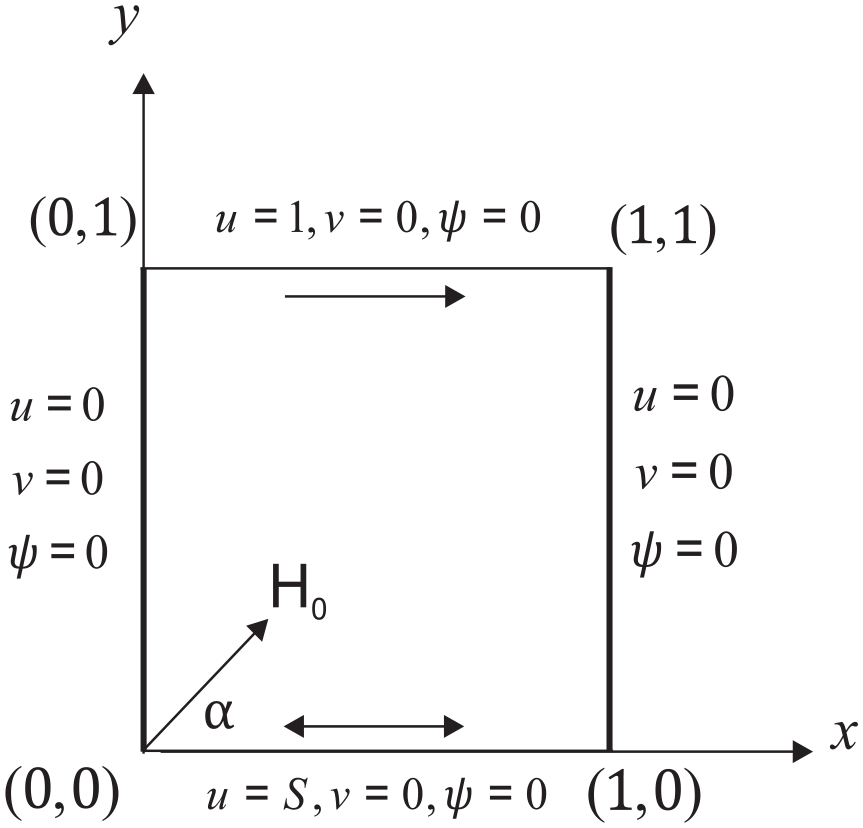
Schematic view of the flow field.
The cavity under the magnetic field with the inclination angle


where

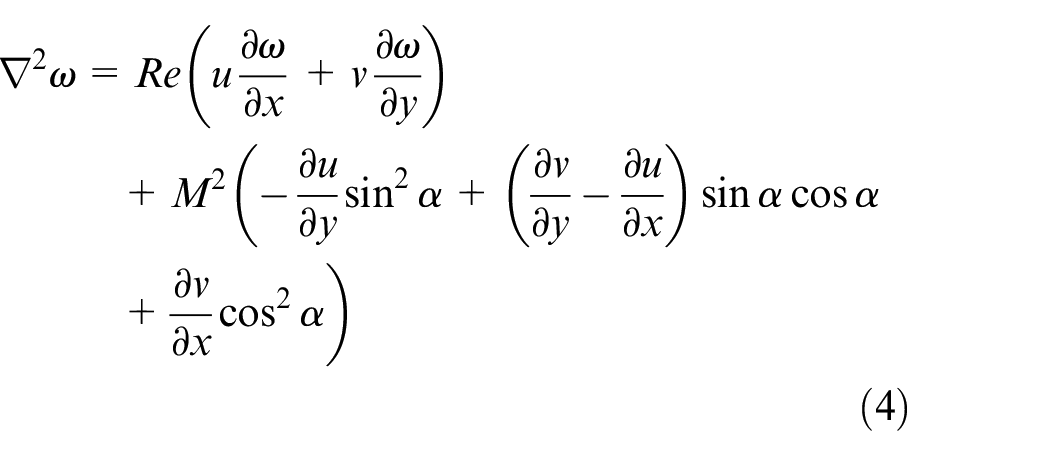
The unknown vorticity boundary conditions are obtained from the vorticity definition by using coordinate matrix
Numerical method: Radial basis function (RBF) approximation
RBF approximation29,40,41 is a meshless method to find the approximate solution of the differential equation

and the approximate solution u is written as a summation of

which satisfies the boundary condition

where ‖·‖ represents Euclidean distance between collocation points. The matrix-vector form of (5) and (7) is

Substituting



where

The MHD equations (3) and (4) include space derivatives of the unknown functions which are approximated by similar procedure in (5)

where the coordinate matrix

Substituting the unknown coefficient which is obtained from (13) into (14) gives the approximation of the desired derivatives of unknowns as

In the literature, different types of radial basis functions are used. Some of them and their corresponding particular solutions for
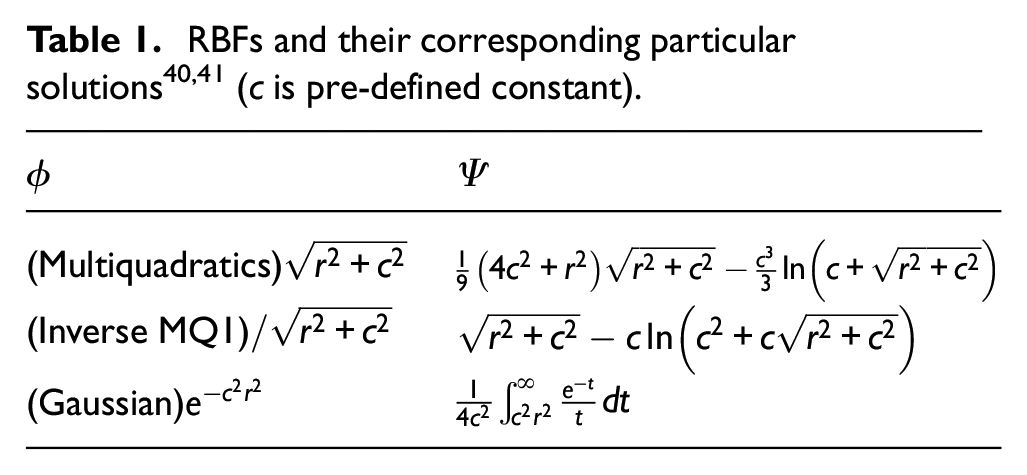
The iterative method is used for the solution of RBF system of the coupled equations (3) and (4). The computation starts with initial guess for

Iteration continues until the relative error
Preliminary on streamline topologies
In this section, streamline topology in two-dimensional incompressible flows is briefly explained. Streamlines are derived from the stream function (

In order to have local information about the flow structure around the critical point, which is often thought of

Linear approximation of (17)−(18) leads the following dynamical system for the streamlines

which has the determinant of the Jacobian matrix
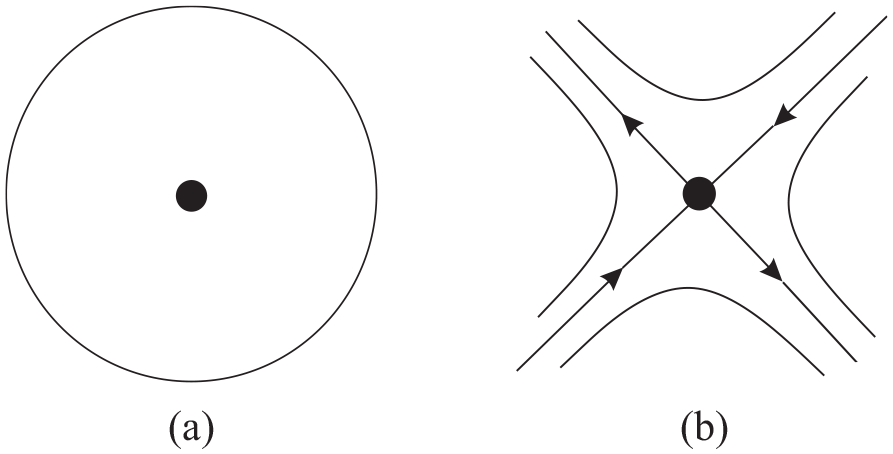
Non-degenerate critical points: (a) center and (b) saddle.
Flow bifurcation is called a change in the flow’s structure or in the number of critical points in the flow pattern (e.g. from center to saddle or vice versa). Brøns and Hartnack 42 investigated the bifurcation in view of a topological point near the degenerate critical point away from the boundary. They used normal form transformations to examine the higher terms of (18) and constructed bifurcation diagrams according to degrees of normal form. Some of them are shown in Figure 3. Saddle-node bifurcation, also called cusp, is the bifurcation of the degenerate point into a saddled center (Figure 3(a)). The term pitchfork bifurcation refers to the transformation of critical points from the center to the saddle (Figure 3(b)). To have more information and related procedures, see Brøns and Hartnack 42 and the others.43,44
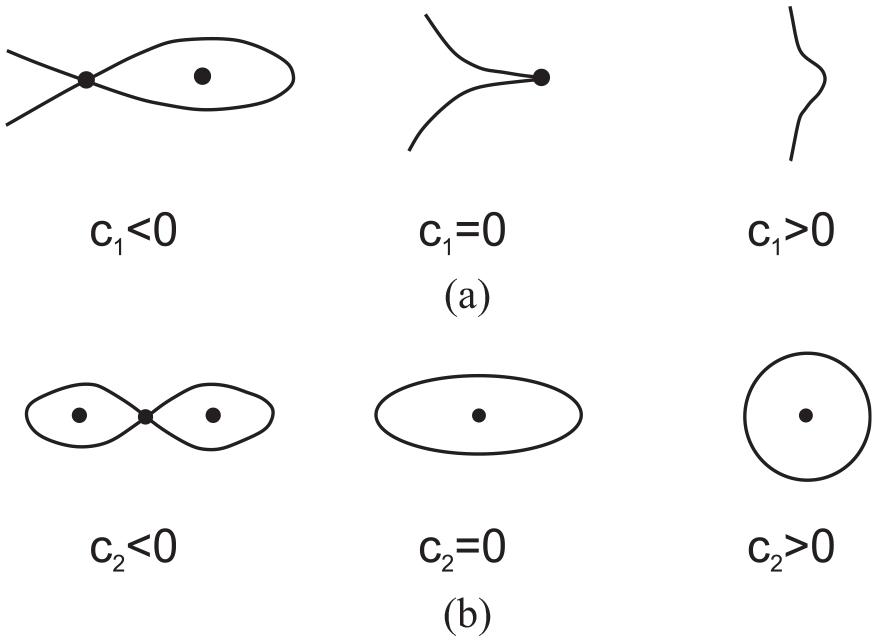
Bifurcation diagram for: (a) normal form of order 3 and (b) symmetric normal form of order 4.
Numerical results
Validation case: Single lid-driven cavity
This subsection presents the numerical results of the test problem using the RBF scheme with polynomial basis function. Obviously, the coupled equations (3) and (4) reduces to the Navier-Stokes equations by taking
The flow domain
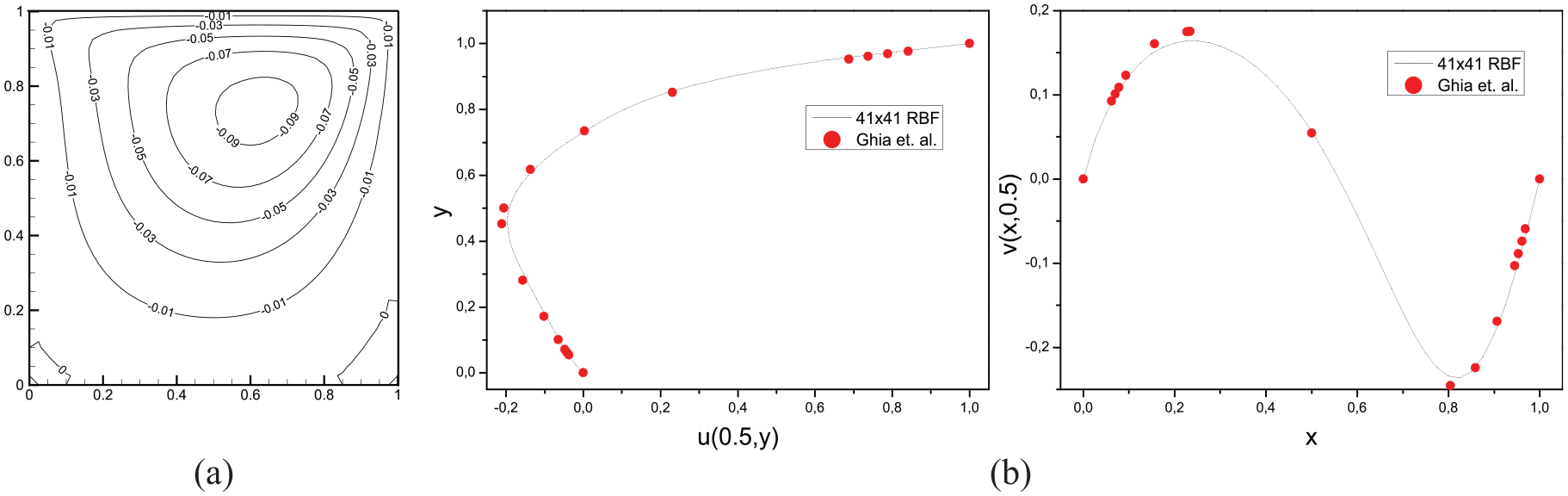
Single lid-driven cavity for
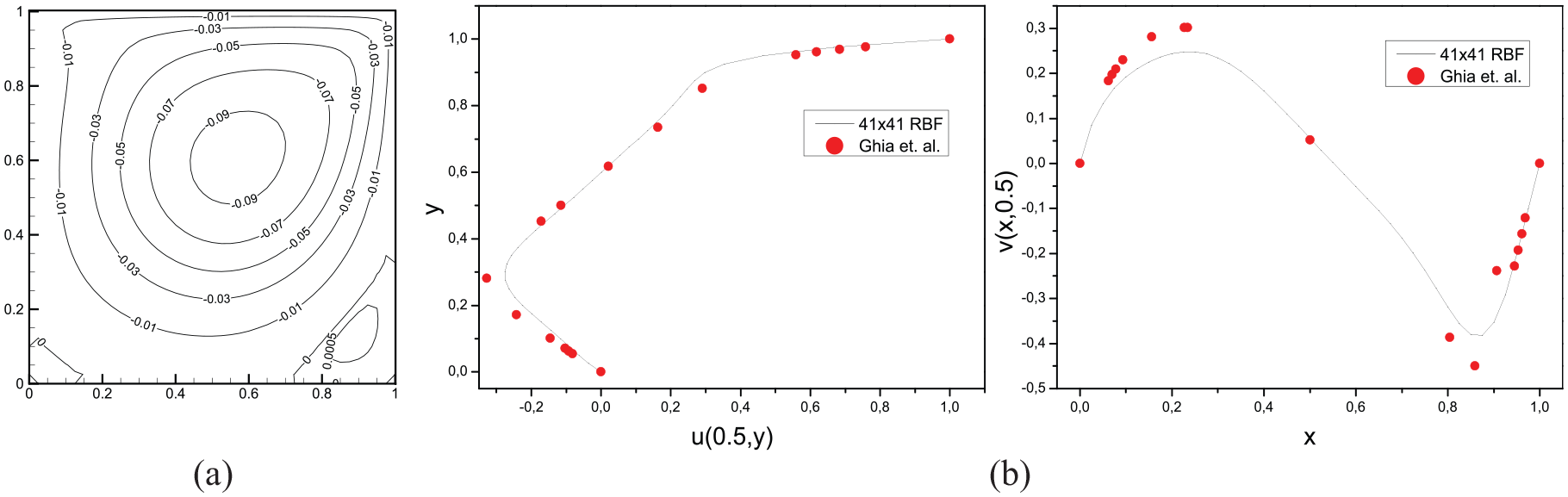
Single lid-driven cavity for
In the test case, calculations are carried out by using the radial basis function without shape parameters. It can be derived from the results, even if the distance function with shape parameter is not used, the results show that the polynomial function can be preferred in the RBF approximation for flow problems with moderate Reynolds numbers. Thus, the rest of the computations in this study are carried out with polynomial RBF.
Double lid-driven cavity
Streamlines of the double lid-driven MHD flow exposed to the magnetic field at different angles are presented. Flow is driven by translating lids in the confined region. Then the results are analyzed in two cases: the lids move in opposite direction, i.e.
Case 1: Lids moving in the opposite
Figure 6 shows the effect of the Hartmann number and the angle of magnetic field on the streamlines. When the magnetic field is applied horizontally
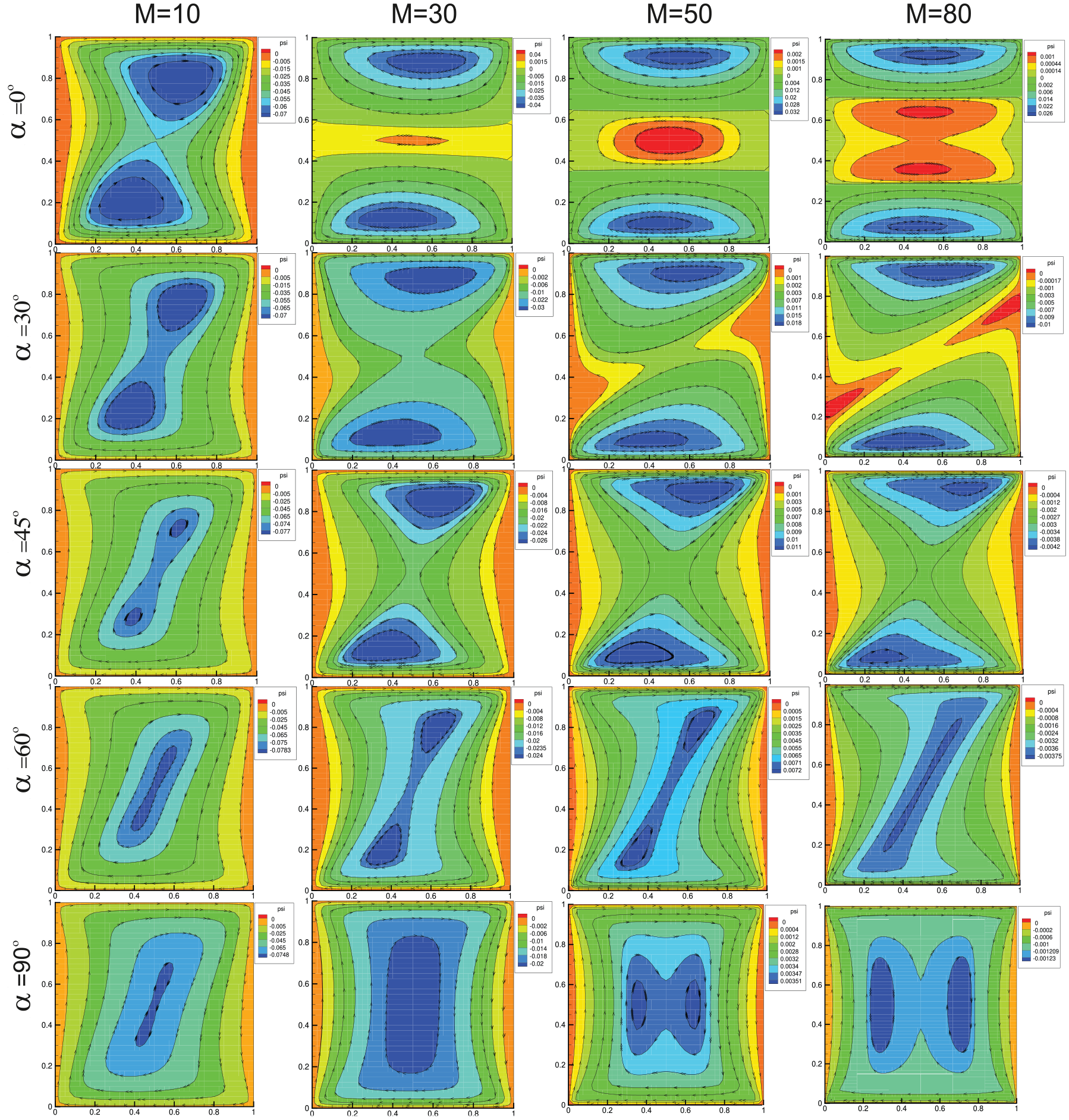
Streamlines for different values of Hartmann number, inclination angle of magnetic field and
The exposure of the flow field to the magnetic field at different angles has a strong effect on the flow patterns. Indeed, the streamlines are distorted by the change of the angle, but the flow structures remain topologically the same except for
Computations are also carried out for different values of Reynolds number for fixed
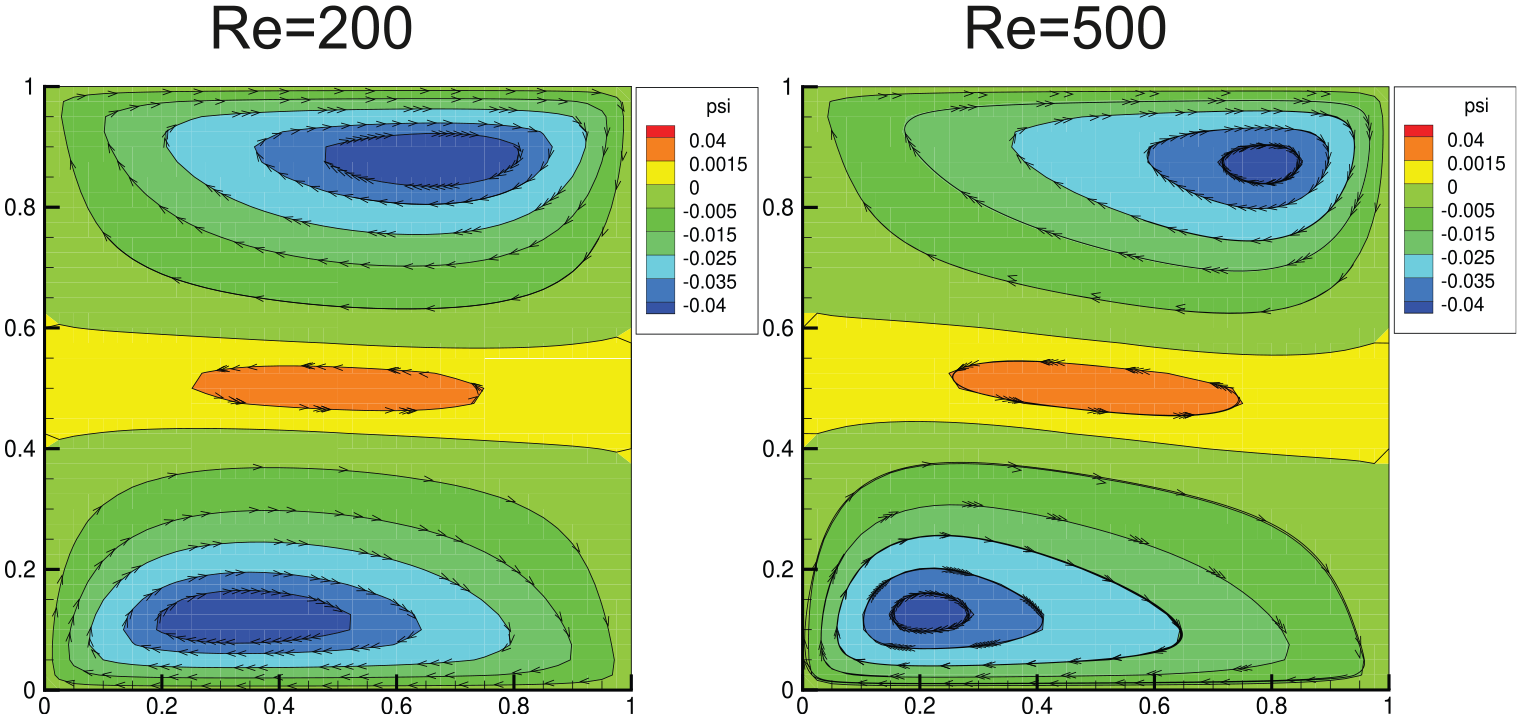
Flow structures for
Case 2: Lids moving in the same
In Figure 8, the variation of the flow patterns in the cavity under the effect of inclination angle of the magnetic field and Hartmann number is presented. For
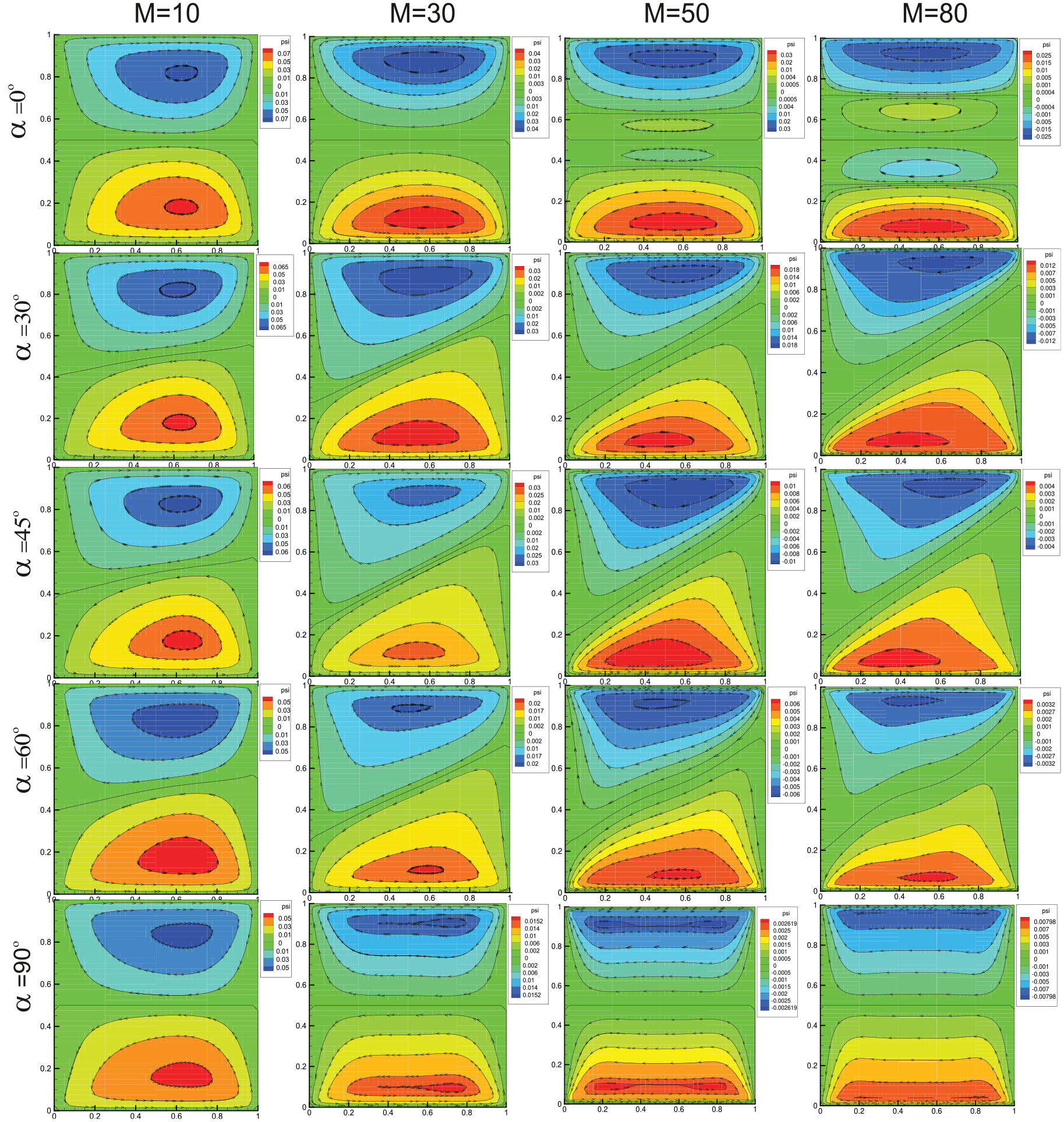
Streamlines for different values of Hartmann number inclination angle of magnetic field and
Figures 9 and 10 illustrate the influence of the inclination angle on the u- and v-profiles along the mid-points of the cavity. Along
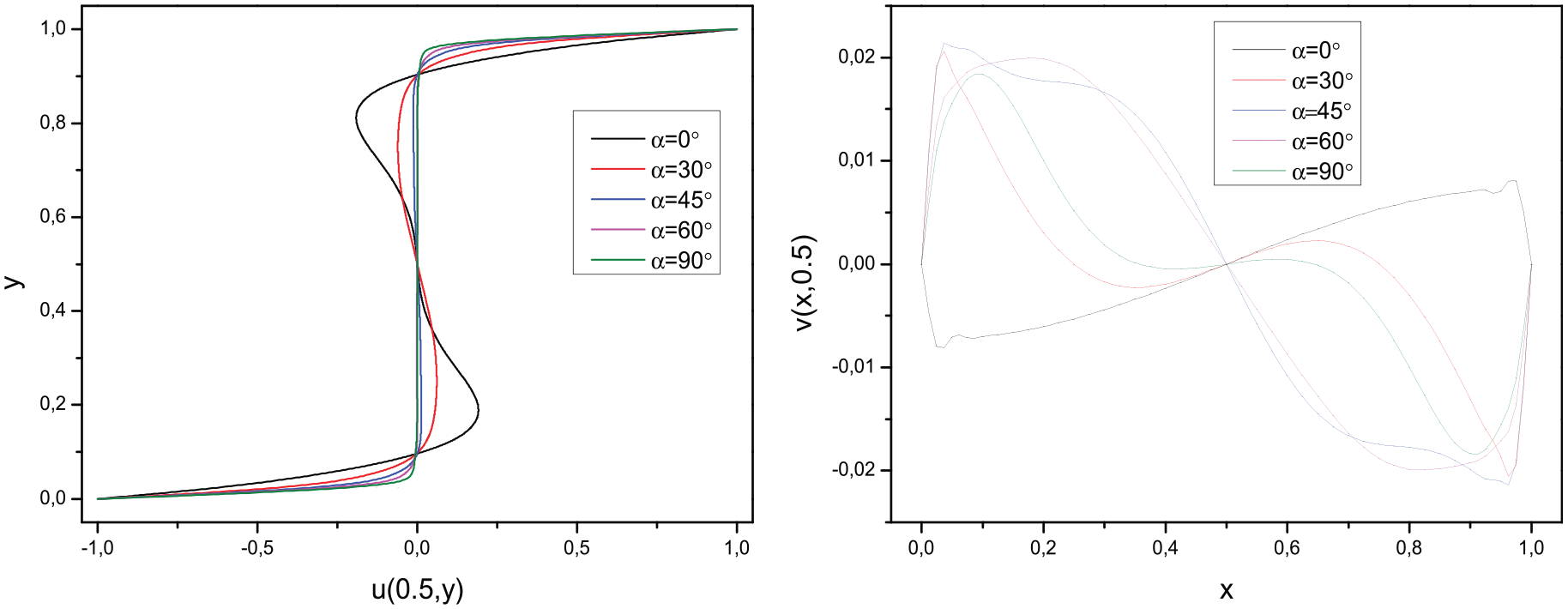
Effect of inclination angle on velocity profile with fixed parameters
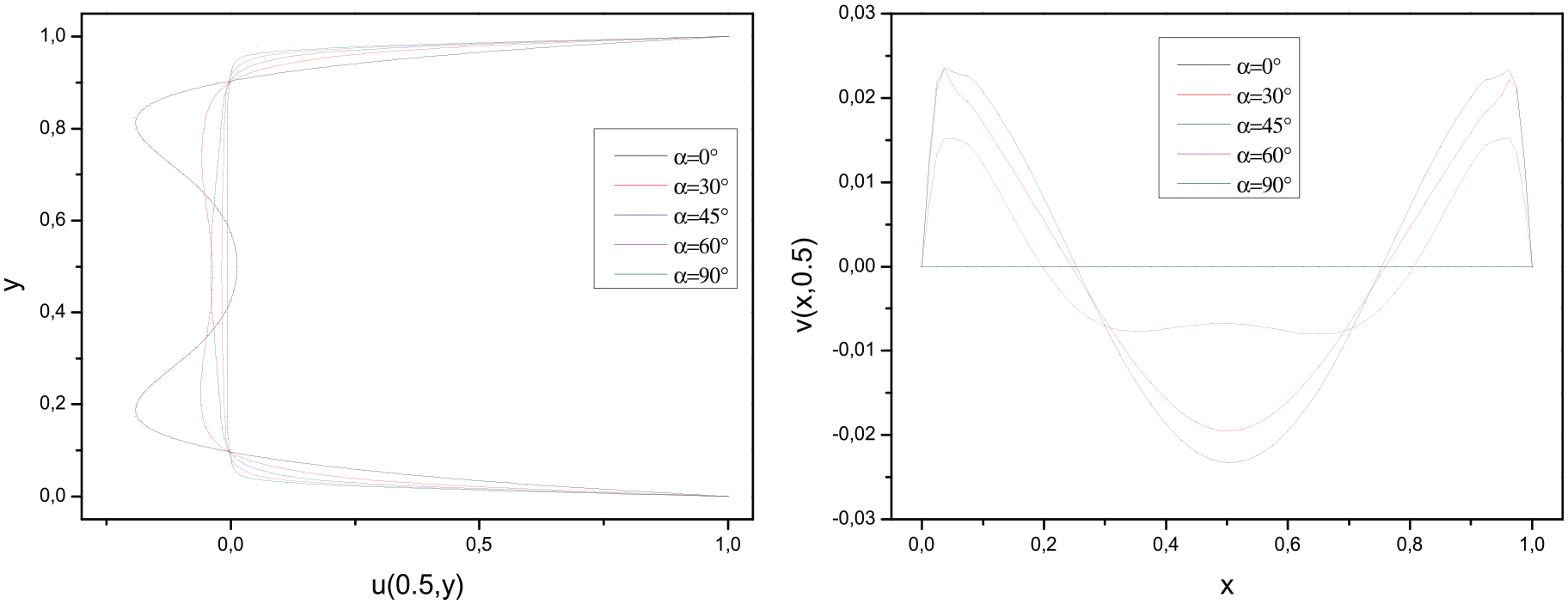
Effect of inclination angle on velocity profile with fixed parameters
Conclusion
A numerical study of MHD flow in a cavity which has two sliding edges (opposite
Footnotes
Appendix
Declaration of conflicting interests
The author(s) declared no potential conflicts of interest with respect to the research, authorship, and/or publication of this article.
Funding
The author(s) received no financial support for the research, authorship, and/or publication of this article.
