




Abstract
In this study, the suitability of using cogeneration system for the Aktürk Building Complex (located in İstanbul) was investigated using electricity and heat consumption data by considering five different cogeneration system capacities (800, 1200, 1400, 2000 and 2600 kW). The different capacities were compared using data of the payback period of investment, amount of net savings, ratio of meeting demand and part-load efficiency of the cogeneration system. Although payback periods of the investment for different capacities are close to each other, 1200 kW capacity cogeneration system is proved to be suitable for the Aktürk Building Complex because it has the shortest payback period (1 year 5 months).
Introduction
Energy has been a key element to achieve the development goals around world of the livelihood. Energy, which is an inseparable part of nature and the universe, dates back to the beginning of human history. Currently, the energy can be generated by using many different techniques. Energy consumption has very strong social and environmental effects. Energy demand is increasing with the increasing population and development. Different technologies can be used to meet energy demands.
In many applications, both heat and electricity are needed. Combined heat and power systems (cogeneration technology), which produce both heat and power simultaneously, are required for widespread use around the world, especially in Turkey. Cogeneration systems work seamlessly with a variety of applications worldwide. Additionally, numerous studies on cogeneration systems are available in the literature.
The exergy and economic analyses of the system were carried out using the measured data for a cogeneration plant in Turkey previously. 1 First and second laws of thermodynamics were applied to the measured data. Fuel utilisation efficiency, rate of power heat and rate of process heat were defined. As a result of the study, the second law efficiency and the payback period were calculated as 89.5% and 3.5 years, respectively.
In the optimum design of cogeneration systems, hourly heat and electricity loads are needed. In the study of Huamani and Orlando, 2 a methodology, which was developed for the calculation of hourly thermal and electrical load profiles using the available data, was presented. The developed model was validated by comparing the measured data.
In a study examining a cogeneration system driven by gas engine, the primary energy rate and the comparative primary energy saving were calculated to compare the cogeneration system with the conventional separate system. 3 The comparative primary energy saving was calculated as more than 37%. Total annual income, total annual saving and payback period were determined to be more advantageous for the cogeneration system. In another study investigating the results of the data analyses for industry and commercial buildings, it was concluded that 817 factories (total 2540) and 966 commercial buildings (total 1651) were suitable for the cogeneration systems. 4
In the study of Pusat and Erdem, 5 the district heating system techno-economic model, developed for the determination of the effective parameters on district heating systems based on a cogeneration plant, was presented. The results of the model were useful both to understand the district heating systems economically and to investigate the effective parameters on the cost of district heating. It was found that the district heating systems were economically highly favourable.
Luz-Silveira et al. 6 evaluated the technical and economic aspects of replacing a cogeneration unit in a university campus. The results of the feasibility study using the parameters of the maximum saving and the payback period revealed that the replacement of the gas turbine cogeneration plant that exists on the university campus was the most appropriate option.
In the first part of the work, which was carried out by Abusoglu and Kanoglu, 7 formulations developed for the analysis of the diesel-powered cogeneration plant in terms of energy, exergy and exergoeconomic aspects were presented. Various efficiency and performance parameters were defined by applying mass, energy and exergy balances to each system component and subsystem. In the second part of the study, the diesel-powered cogeneration system, founded in Gaziantep, Turkey, was evaluated using the formulations developed in the first part of the study. 8 The exergy efficiency of the facility was calculated as 40.6%, while the specific unit exergetic cost of the power produced by the plant was 10.3 US$/GJ.
Gas turbine cogeneration systems were evaluated and compared with other systems in the study of Najjar. 9 The use of gas turbine cogeneration systems was projected to increase worldwide with their advantageous characteristics such as low cost and energy efficiency.
In another study conducted by Najjar, 10 combined cycle power generation systems were evaluated. General features of the system were listed as follows: high thermal efficiency, low installation cost, fuel flexibility, low operating and maintenance costs, operational flexibility, high reliability and availability, short set-up times and high efficiency in small capacity increases. It was indicated that combined cycle power output and thermal efficiency may increase up to 60%. In addition, it was evaluated that share of the gas turbine engines and the combined cycle power plants will increase.
Rosen et al. 11 carried out energy and exergy analyses for a cogeneration-based district energy system and had a case study for the city of Edmonton, Canada. It was observed that the energy efficiency increased from 83% to 94% and the exergy efficiency increased from 28% to 29%. The behaviour of the energy efficiency was found to be significantly better than the behaviour of the exergy efficiency.
For residential and industrial applications, the fuel cell devices concerning the combined heat and power production are one of the most innovative solutions. 12 A comparison was made between the conventional power generation systems and the cogeneration fuel cell systems. It was mentioned that fuel cell devices have thermal storage problems and are energetically better than the conventional power systems.
In this study, the electricity and heat consumption data of the Aktürk Building Complex (located in İstanbul, Çekmeköy) are taken from building complex managers on a monthly basis. The cogeneration system capacities are selected using monthly electricity and heat load data. Additionally, the cost of energy and payback period are calculated for the selected systems. The Aktürk Building Complex has 563 independent apartments, is heated by a central heating system and has four boiler rooms fed by 8 × 800,000 kcal/h boilers. Five different cogeneration system capacities (800, 1200, 1400, 2000 and 2600 kW) are considered. The different system capacities are compared using data of the payback period of investment, amount of net savings, ratio of meeting demand and part-load efficiency of the cogeneration system. Although the payback periods of the investment for different capacities are closer to each other, 1200 kW capacity cogeneration system is proved to be suitable for the Aktürk Building Complex because it has the shortest payback period (1 year 5 months).
Selected building complex
In this study, the Aktürk Building Complex, located in Çekmeköy district of İstanbul, is considered (Figure 1). The Aktürk Building Complex has 563 independent apartments and is heated by a central heating system. The central heating system consists of four boiler rooms which are fed by 8 × 800,000 kcal/h boilers. Natural gas is used as fuel for the heating system. 13

Aktürk Building Complex satellite image. 13
The required data about the monthly heating and electricity consumptions of the building complex are obtained from Çekmeköy Municipality, and the monthly values are presented in Table 1. The highest and the lowest heating energy consumptions occurred in January (3,028,762 kW h) and August (254,265 kW h), respectively. Monthly electricity consumption values do not show too much variation, and the mean monthly and the mean yearly consumptions are 434,700 and 5,216,400 kW h, respectively.
Monthly energy consumptions and loads. 13
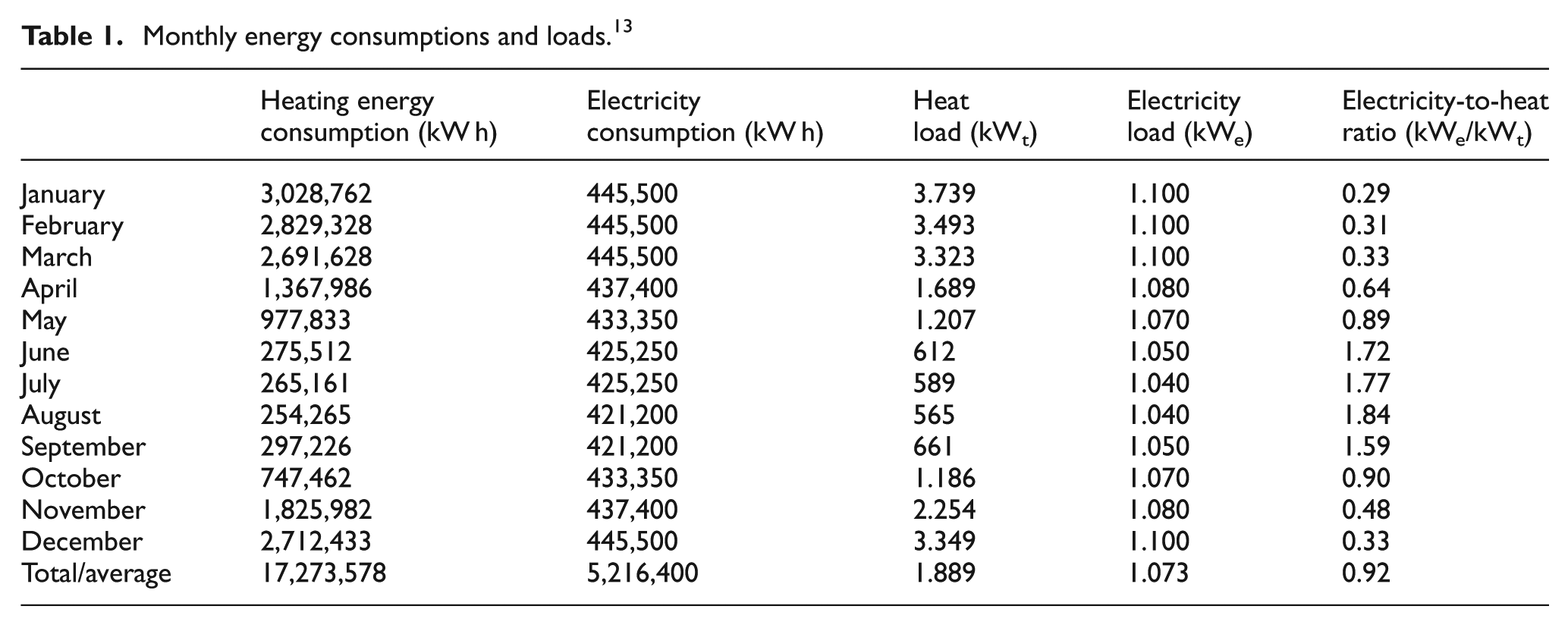
The monthly average heat load is 1889 kWt, while the electricity load is 1073 kWe. Electricity-to-heat ratio is an important parameter used in the selection of the cogeneration system. For the Aktürk Building Complex, the monthly and the annual average electricity-to-heat ratios are determined using monthly heat and electricity loads. The average yearly electricity-to-heat ratio is calculated as 0.92.
Selection of the cogeneration system is made using electricity-to-heat ratio. 13 The highest and the lowest electricity-to-heat ratio values are 1.84 kWe/kWt (August) and 0.29 kWe/kWt (January), respectively. The electricity-to-heat ratio range fits well to the gas engine–based cogeneration systems. 13 The fuel used in the building complex is already natural gas. Therefore, gas engine–based cogeneration system is planned for the considered building complex in this study.
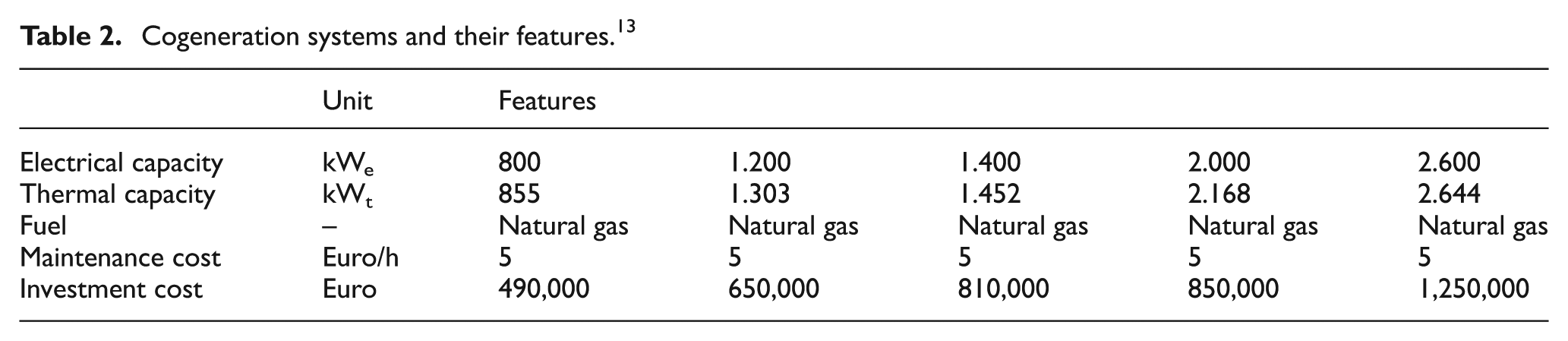
The cogeneration system capacity selection is made according to the electricity loads. In our case, monthly electricity load range is 1040–1100 kWe. Cogeneration system capacities are selected in a wide range to be able to evaluate the effect of different capacities on economic parameters. As a result, real gas engine capacities are taken from a manufacturer, and then five different cogeneration system capacities are selected as 800, 1200, 1400, 2000 and 2600 kW. 13 The installed cogeneration system will provide both heat and electricity to the building complex.
Cogeneration system and methodology
For the selected cogeneration capacities (800, 1200, 1400, 2000 and 2600 kW), technical and economic calculations are made, and the comparisons are made between different capacities. General features of cogeneration systems are provided in Table 2. The system is assumed to work for 700 h per month. Residential price of natural gas, commercial price of natural gas and price of electricity are accepted as 0.18 Euro/m3, 0.21 Euro/m3 and 0.07 Euro/kWeh, respectively.
Cogeneration systems and their features. 13
Calculations in this study are made for two time zones, 11:00–23:00 (daytime) and 23:00–11:00 (night-time). It is accepted that the night-time average heating demand is 25% more than the daytime average heating demand in January, February, March, April, May, November and December, and the night-time average heating demand is 25% lower than the daytime average heating demand in June, July, August, September and October. A similar acceptance is made for the electricity demand: the night-time average electricity demand is eight times that of the daytime average electricity demand for all the months. 13
The capacity of the possible cogeneration system for the Aktürk Building Complex affects the natural gas and electricity consumptions. Demands of heating and electricity are covered in varying rates with the different capacities of the cogeneration system. In cases of being unable to meet the heat or electricity demands of the Aktürk Building Complex entirely, the remainder of the heat or electricity demands is covered by the existing boilers or electricity grid. Therefore, the amount of electricity and natural gas consumptions in different system capacities vary.
Costs vary depending on the ratio of the cogeneration system to meet the energy needs. The payback period of the investment is used as an economical parameter to compare the different cogeneration capacities. Therefore, the cogeneration capacity with the shortest payback period is determined as appropriate system capacity for the Aktürk Building Complex.
Results and evaluations
A possible cogeneration system is evaluated on both technical and economic points of view for the Aktürk Building Complex. First, heat and electricity loads are calculated for daytime and night-time (Figure 2). The average monthly heat load of the complex occurs as 2060 kWt in the night-time, while it is 1889 kWt in the daytime. The highest heat loads occur in January as 3739 and 4674 kWt in the daytime and night-time, respectively. Average monthly electricity load of the complex occurs as 1073 kWe in the daytime, while it is 134 kWe in the night-time. The highest electricity loads occur in January, February, March and December as 1100 and 138 kWt in the daytime and night-time, respectively. As can be seen from the figure, there is not much variation in the monthly electricity loads.

Monthly (a) heat and (b) electricity loads (day and night).
The ratio of meeting the heat and electricity demands of the building complex changes depending on the monthly heat and electricity loads of the cogeneration system. For the different cogeneration capacities, the rate of meeting the heat demand is calculated using the monthly heat loads and presented in Figure 3. The rate of meeting the demand of heating increases with the increasing cogeneration system capacity. For 800 kW system capacity, the average rate of meeting the heat demand is 58%, while it is 86% for 2600 kW system capacity. Cogeneration system can provide all the heat demand in the summer due to the low heat requirements. Conversely, the rate of meeting the heat demand decreases in the winter. For instance, in January, the rate of meeting the heat demand is 20% for the system of 800 kW, and from June to September, the rate of meeting the heat demand is 97%.

Monthly rate of meeting the heat demand.
For different cogeneration capacities, the rate of meeting the electricity demand is calculated using the monthly electricity loads and presented in Figure 4. The rate of meeting the electricity demand is different from the rate of meeting the heat demand. Cogeneration system can meet the electricity demand of the building complex almost completely (97%) for all the capacities except 800 kW system capacity. Figure 4 is not clear due to the overlapping of monthly rate of meeting the electricity demand values (97%) for 1200, 1400, 2000 and 2600 kW cogeneration capacities. It is calculated that the monthly average rate of meeting the electricity demand is 75% for the 800 kW system.
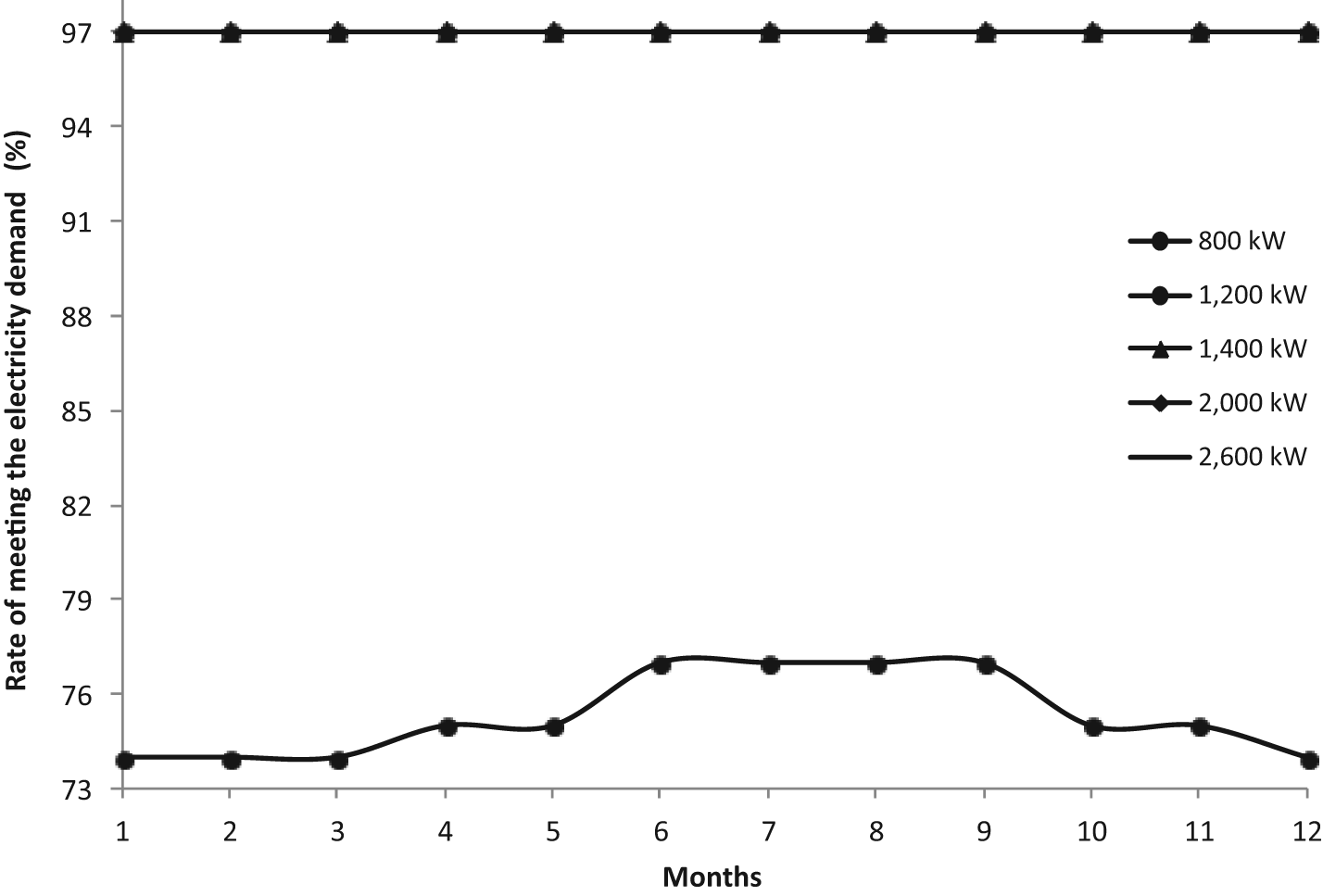
Monthly rate of meeting the electricity demand.
As the performance indicator of the cogeneration system, the part-load efficiency, which is equal to the ratio of the amount of the produced electricity and possible amount of electricity that can be produced by the cogeneration system, is used. Monthly part-load efficiencies are presented in Figure 5 for each cogeneration capacity. The maximum amount of the electricity that can be produced increases with the increasing system capacity. However, cogeneration part-load efficiency decreases with the increasing capacity due to not changing of the electricity demand.
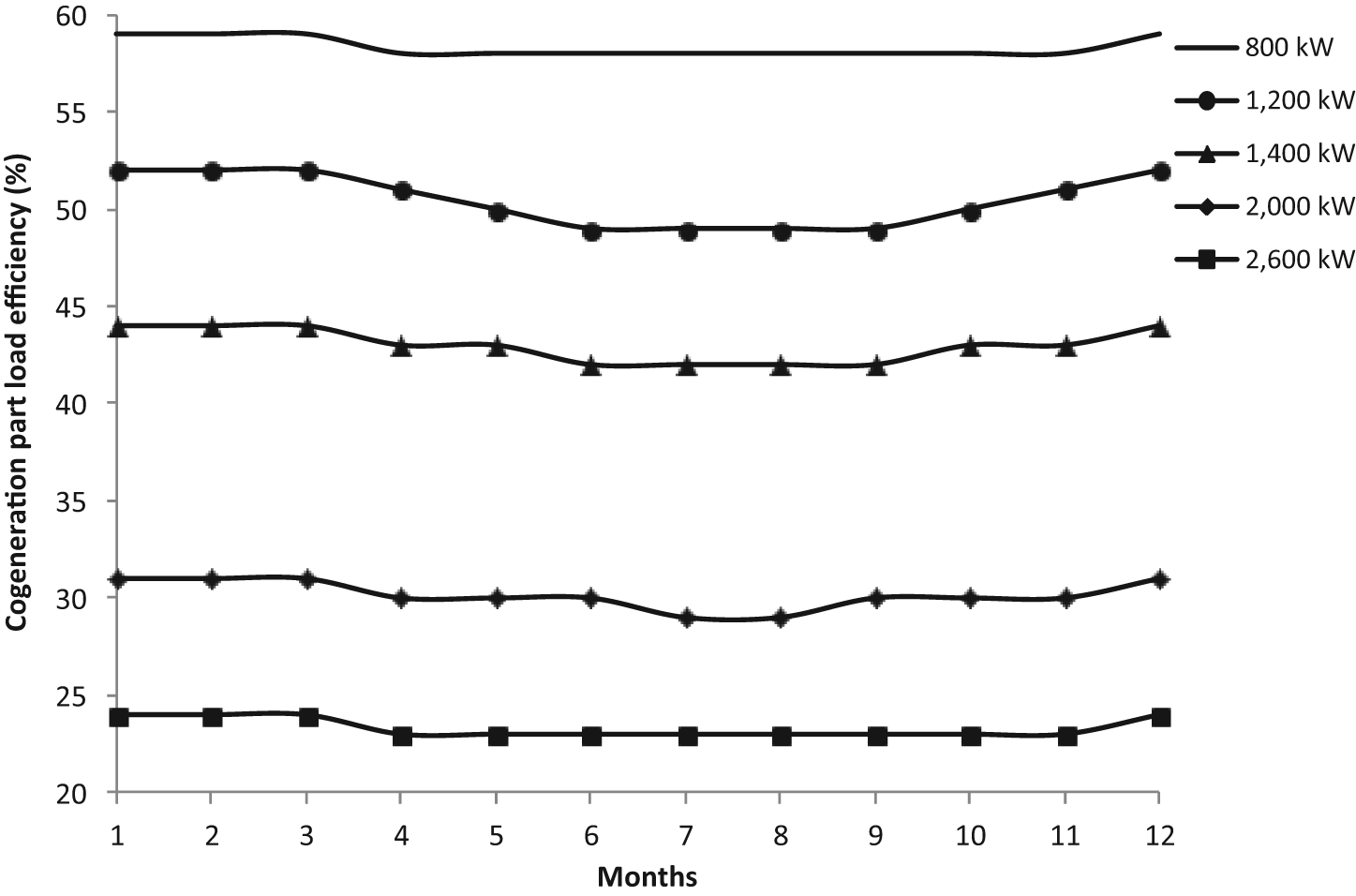
Monthly cogeneration part-load efficiencies for different capacities.
The monthly net savings are calculated for different cogeneration capacities using the results of the technical calculations. The monthly net savings achieved with different system capacities are seen in Figure 6. The total annual net saving is calculated as 1,124,301 Euro for 2600 kW system capacity, while it is calculated as 599,932 Euro for 800 kW. The net saving increases with the capacity of the system. The heat demand is higher in the winter and also net saving is higher in the winter.

Monthly net saving for different capacities.
The investment payback period parameter can be used to compare the different capacities of cogeneration system. The payback period of cogeneration system investment is calculated as 1.5, 1.4, 1.8, 1.5 and 2 years for the selected capacities of 800, 1200, 1400, 2000 and 2600 kW, respectively. Although the payback periods of the investments for different capacities are close to each other, 1200 kW capacity cogeneration system seems better for the Aktürk Building Complex due to the shortest payback period.
Conclusion
In this study, the suitability of using cogeneration system for the Aktürk Building Complex (located in İstanbul, Çekmeköy) was investigated using electricity and heat consumption data and by considering five different cogeneration system capacities (800, 1200, 1400, 2000 and 2600 kW). These different capacities were compared using data of the payback period of the investment, amount of net savings, ratio of meeting demand and part-load efficiency of the cogeneration system.
The rate of meeting the heat demand increases with the increasing cogeneration system capacity. The average rate of meeting the heat demand is 58% for 800 kW system capacity, while it is 86% for 2600 kW capacity. The cogeneration system can provide all the heat demand in the summer, although the rate of meeting the heat demand decreases in the winter due to the high demand. Cogeneration system can meet the electricity demand of the building complex almost completely (97%) for all the capacities except 800 kW (75%). The cogeneration system part-load efficiency decreases with the increase in the capacity.
The total annual net saving is calculated as 1,124,301 Euro for 2600 kW system capacity, while it is calculated as 599,932 Euro for 800 kW. The net saving increases with the capacity of the system. Although payback periods of the investment for different capacities are close to each other, the 1200 kW capacity cogeneration system is proved to be the most suitable selection for the Aktürk Building Complex because it has the shortest payback period.
Footnotes
Academic Editor: Sridhar Idaparapati
Declaration of conflicting interests
The authors declare that there is no conflict of interests regarding the publication of this article.
Funding
The authors do not have any direct financial relation with any commercial identity, supporting grants or any other entity for their article.