




Abstract
The design of stiffeners is an effective approach to enhance the stiffness of panel-type structures. However, the stiffness–mass efficiency depends largely on the spacing, orientation, and cross-section of the stiffeners. In order to improve the stiffness–mass efficiency, this article presents a combined use of topology optimization and finite element analysis to the dynamic design of stiffeners for a typical panel. Finite element models of a flat and a stiffened rectangular panel were constructed. Modal analysis was conducted on the two panels to obtain the basic dynamic properties. Topology optimization model of the stiffened panel, so-called initial structure, was built based on the variable density method. According to the loading case and the predominant mode of the system, the objective function was determined to maximize the fundamental frequency of the panel. The stiffeners were chosen as the design domain. Optimal material density distributions of the stiffeners were obtained at different mass fraction. The finite element model of the optimal stiffened panel was built to reanalyze the dynamic properties and responses. An increase in the relative rate of change in the fundamental frequency versus mass was observed between before and after the optimization.
Introduction
Skin-panels are widely used on the flight vehicle structure, for example, the airfoil, rudder, and cabin, due to their light weight, fine aerodynamic configuration, and high structural efficiency. However, these structures are characterized by low normal stiffness. The skin-panel surfaces of hypersonic flight vehicles are exposed to severe aerodynamic, acoustic, and thermal loading in service.1,2 These dynamic loadings cover a large range of exciting frequencies, which can include one or more natural frequencies of the panel-type structures. It is difficult to avoid resonance for the structures of aircraft fuselage, thin skins, and stiffened panels. Excessive dynamic responses of skin-panels may occur due to the inadequate normal stiffness of the structures and severe vibro-acoustic loading. The resonant effect can produce cyclic stress, resulting in fatigue damage and cracks in the structures. Thus, structural integrity may be disrupted by the alternating stress induced by these dynamic loadings, which is the so-called vibration fatigue.3,4 In quasi-static fatigue analysis, the factors influencing the fatigue life mainly include stress concentration, mean stress, and structural operating environments. However, as for vibration fatigue, apart from the conventional factors, the structural dynamic characteristics largely impact the structural lifetime, since the dynamic responses are determined by the loadings and the inherent dynamic characteristics of structures. 5 Hence, design for stiffness, damping, and mass of a structure can serve as a surrogate for dynamic strength design. Optimizing the dynamic properties of stiffened panels is important for the structural integrity and durability of hypersonic flight vehicles.
Dynamic optimization design has achieved rapid development and wide application with the progress of the finite element method (FEM) and software. A relatively extensive attention was paid to the following two topics with respect to optimizing the dynamic properties of panel-type structures. One is the topology optimization of the eigenvalues of the flat plate. The design domain was specified as the plate itself, and the optimization results are usually an irregular plate with void domains. For example, Pedersen 6 used topology optimization to optimize the eigenvalues of a plate, which itself was chosen as the design domain. Pagnacco et al. 7 concerned the optimization of linear two-dimensional (2D) planar metallic structures subjected to stationary Gaussian random loading. In order to maximize the nonfailure probability, the thicknesses of the 2D elements were considered as the design variables for redistributing the amount of the material. Yoon 8 used model reduction schemes to calculate dynamic responses and sensitivity values with adequate efficiency and accuracy for topology optimization in the frequency domain, taking a plane structure as an example. Another hot topic is concerning the composite panel. Due to the designability of the ply angles and local thickness, the lamination parameters are widely used to optimize the dynamic properties. Variable thickness and variable stiffness were studied to maximize the natural frequencies.9,10 All these researches made great contributions to the design of panel-type structures and provided the engineers with excellent references for the design and manufacture of new panel structures.
For some occasions, neither designing the thickness of the plate only nor optimizing the topology shape of the plate itself with void areas left after the optimization can meet the requirements of dynamic design, for example, the thermal protection system (TPS) of the hypersonic flight vehicle. The TPS panels should integrate the functions of heat shielding, bearing loads, weight reduction, and so on. For such cases, stiffeners are often used to improve the normal stiffness. The common forms of the stiffeners are cross stiffeners, #-shaped stiffeners, parallel stiffeners, and so on. This article presents a dynamic design of the stiffeners using topology optimization and FE analysis. The initial form of stiffeners is based on engineering experience. The topology optimization and FE analysis were used to design the dynamic properties.
FE model and modal analysis
In this section, a rectangular flat panel and a stiffened panel are taken as the example of the typical structures. The in-plane size of the flat panel is 600 mm × 400 mm, with the thickness of 3 mm. The initial form of the stiffeners was based on one of the most common layouts, with three short-edge stiffeners and one long-edge stiffener. And, all the cross-sections were assumed to be identical, with 4 mm width and 30 mm height. It is because the attention was fixed on the layout and form of the stiffeners, rather than on the cross sections. The FE model was built using the commercial software MSC Patran. The thin plate was modeled using CQUAD4 element (a 4-node, 2D shell element with 5 degrees of freedom per node, that is, three translational and two rotational). A total of 2400 elements and 2501 nodes were used for the flat panel, as shown in Figure 1(a). The stiffened panel was also built using the CQUAD4 element and consists of 3840 elements and 3949 nodes, as shown in Figure 1(b). The boundary conditions of the two panels are restricting the three translational degrees of freedom of the nodes at four edges, that is, simply supported constraints. Young’s modulus of the linear elastic material is E = 108 GPa, the Poisson ratio is µ = 0.34, and the density is ρ = 4.5 × 10³ kg/m3.

FE model of the (a) flat panel and (b) stiffened panel.
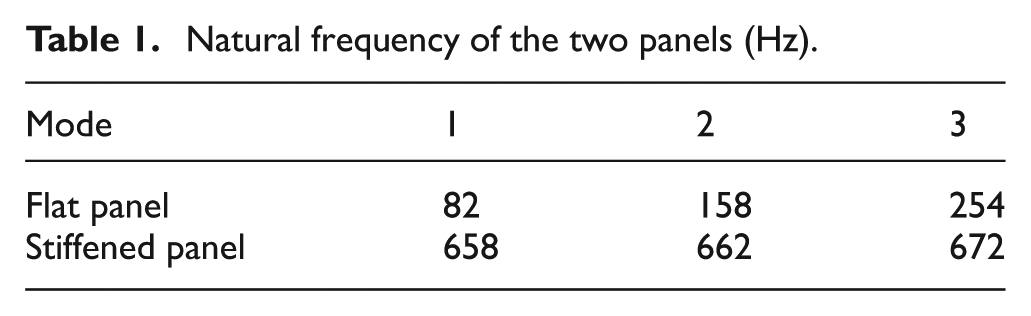
Lanczos method was chosen in modal analysis, for it does not miss roots and has high efficiency. The mass normalization was applied in eigenvector normalization, which scales each eigenvector to result in a unit value of generalized mass. The results of natural frequency from modal analysis of the structures are shown in Table 1, together with a few of the mode shapes depicted in Figure 2.
Natural frequency of the two panels (Hz).

Mode shapes of the (a)–(c) flat panel and (d)–(f) stiffened panel.
Comparing the modal characteristics of the two panels, it could be found that the stiffeners increase the natural frequencies greatly, about 8 times of the fundamental frequency. The first-order mode shapes of the two panels are nearly the same; however, the latter two mode shapes become more complex both in the positions and directions of the peak values of the stiffened panel. It could also be observed that the deformation of the stiffeners differs at different positions for a certain mode shape. For example, at the third mode of the stiffened panel, there is almost no deformation on the middle short-edge stiffener, which indicates that it makes a minor contribution to the third modal stiffness.
Optimization formulation and solution
The first step of optimization design is formulating the engineering problems to mathematical expressions, which search for optimization objective. An optimization problem in mathematics can be described as

where
There mainly exist the homogenization method,
11
the variable density method,
12
the evolutionary structural optimization method,
13
and the level set method
14
for continuum topology optimization. Among them, the variable density method is characterized by simplicity in concept and high efficiency of optimization, whose basic idea is to consider the material density as a variable and to assume a corresponding relationship between the density and Young’s modulus of the material. Young’s modulus and density are used as intermediate variables of each element designed, while the actual design variable
The classic interpolation scheme for variable density method consists of the solid isotropic microstructures with penalization (SIMP) model 15 and the rational approximation of material properties (RAMP) model. 16 The SIMP model has experienced popularity because of its conceptual simplicity and implementation easiness. As an extension of the homogenization method, the SIMP model is to relax the original 0 (void) and 1 (solid) discrete optimization to an optimization with continuous design variables from 0 to 1. Such a relaxation will allow the design variables having intermediate densities, and then, a “power-law” penalty is applied to push the relaxed design close to the discrete 0 and 1 bounds. Taking the normalized density of an element as the design variable xi (i = 1, 2, ..., n), the interpolation schemes of the structural density (mass density) ρi and Young’s modulus Ei based on the SIMP model are given as


where ρ0 and E0 are the density and Young’s modulus, respectively, when xi = 1, that is, the element is full; Emin is Young’s modulus when xi = 0, that is, the void element; and P is the penalty factor to impulse the design variable xi ∈ [0, 1], generally taken as [2, 5] and set to 3 here; and Emin is usually far less than E0, so that it could be negligible. Thus, equation (3) can be simplified to

As for panel-like structures, a review conducted by Cunningham and White 17 indicates that the major part of the dynamic responses depend on the contribution of the first mode, the so-called predominant mode. This theory is still used as a design tool for panel structures subjected to random pressure loading, and the agreement with experimental measurements is satisfactory. Thus, in order to suppress the dynamic response, the objective function was selected to maximize the first modal frequency. Not considering the damping, the mathematical model of the topology optimization maximizing the fundamental frequency subject to the volume constraint is formulated as follows

where

According to the optimization formulation and sensitivity formula, the topology optimization was conducted using MSC/Nastran SOL 200. The mass fraction (MF) is set equal to 60%, 40%, and 20% of the design domain. The results of optimized material density distribution are shown in Figure 3.

Optimized material density distribution at different MFs: (a) 60% MF, (b) 40% MF, and (c) 20% MF.
The MF as shown in Figure 3(a)–(c) is decreasing, purpose of which is to identify the most important part for increasing the fundamental frequency. It can be intuitively observed that the density of the long edge is rather low on the whole. High density is distributed at the three short stiffeners, especially at the middle one. The corners and innerness of the short stiffeners are also low density distributed. The corners of the short stiffeners can be removed. However, for the purpose of mechanical connection between the panel and stiffeners, the innerness of the stiffeners should be retained. Thus, the optimal stiffened configuration is in the form of three short stiffeners with trapezoid in the side view, instead of the initial rectangle.
Reanalysis and assessment
The FE model of the optimized stiffened panel was created using the CQUAD4 element, as shown in Figure 4. The boundary condition is still the simply supported constraint. The first three modal frequencies are 438, 444, and 539 Hz, respectively, and the corresponding mode shapes are depicted in Figure 5. Unlike the first mode shape (unidirectional bending) of both the flat and initial stiffened panels, the first-order mode shape of the optimized stiffened panel is more complex, that is, bending in different directions.
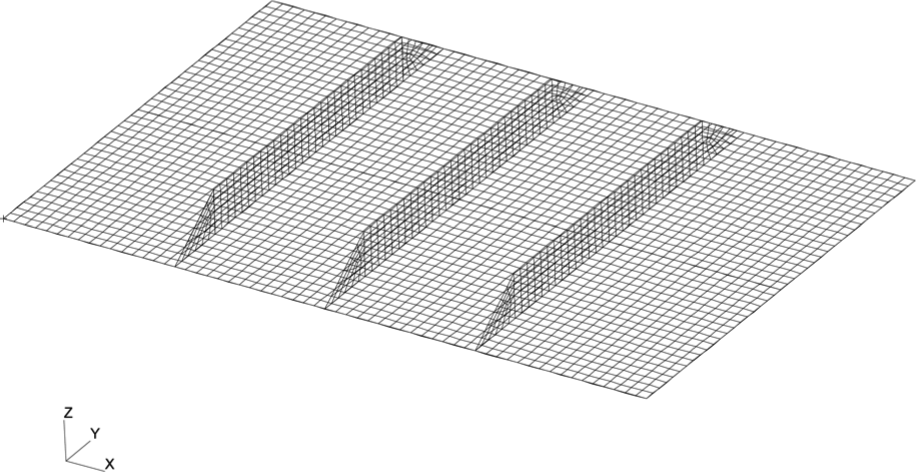
FE model of the optimal stiffened panel.

Mode shapes of the optimal stiffened panel: (a) first mode, (b) second mode, and (c) third mode.
In order to evaluate the improvement of the optimization, an index of relative rate of change in the fundamental frequency versus mass was used to assess the stiffener efficiency, which is defined as

where f0 and m0 are the fundamental frequency and mass of the flat panel, respectively, and Δf and Δm are the fundamental frequency increment and mass increment of the stiffened panel against the flat panel, respectively. Table 2 gives the masses and fundamental frequencies of the three panels. According to equation (7), η of the initial stiffened panel versus the flat panel equals 17.56, while the value is 20.84 for the optimized stiffened panel versus the flat panel. This indicates that the contribution to increasing the fundamental frequency per mass is higher for the optimized stiffeners.
Mass and fundamental frequency of the three panels.

Furthermore, the dynamic responses of the three panels were computed to make a contrast. As the reentry speeds of hypersonic flight vehicles can reach as high as Mach 7, the panel-type surfaces are subjected to severe aerodynamic noise (as pressure waves) when the vehicles reentry into the atmosphere. The aerodynamic noise loading is characterized by broadband and acting on the structural surfaces. The random acoustic excitation acting vertically to the panel surface is considered to be a stationary Gaussian random pressure with zero mean and uniform magnitude over the whole surface. The power spectral density (PSD) of the acoustic pressure loading is transformed based on the 1/3 octave spectrum in US military standard MIL-STD-810D, 19 with the overall sound pressure level (SPL) at high excitation level of 160 dB (re 2 × 10⁻⁵ Pa). Figure 6 gives the PSD curve of the acoustic pressure loading. The displacement PSD curves of the panels were computed under the excitation of acoustic loading, and the maximum root mean square (RMS) values of displacement responses of each panel were listed in Table 3, together with the locations of the maximum. It obviously shows that both the displacements of the initial and optimized stiffened panel are limited to an acceptable range.

The PSD curve of the loading.
RMS displacements and locations of the panels.

RMS: root mean square.
From Figure 7, the numerical results of the dynamic responses clearly support the law that the major part of the response results from the contribution of the first mode, that is, the predominant mode, for both the flat and stiffened panels. The response at the first modal frequency is far larger than that at higher modes. This further demonstrates that optimizing the first-order mode is effective.

The PSD curves of the responses.
Conclusion
This article presents the dynamic design of stiffeners for a typical panel using topology optimization and FE analysis. The FE models of a typical flat and an initial stiffened panel were constructed. Modal analysis was employed to obtain the inherent dynamic properties for both the flat and initial stiffened panels. Then, topology optimization of the initial stiffened panel was formulated based on the variable density method to maximize the fundamental frequency, taking the stiffeners as the design domain. An optimal stiffened panel was obtained based on the optimization results, with the long-edge stiffener and the corners of the short stiffeners removed. Reanalysis was carried out to assess the efficiency of the optimization. An increase in the relative rate of change in the fundamental frequency versus mass was observed between before and after the optimization.
Footnotes
Academic Editor: Weidong Zhu
Declaration of conflicting interests
The authors declare that there is no conflict of interest regarding the publication of this article.
Funding
This research received financial support from the National Natural Science Foundation of China (10902024), the New Century Excellent Talent in University (NCET-11-0086), the Fundamental Research Funds for the Central Universities, and the College Postgraduates Scientific Research Innovation Program of Jiangsu Province (KYLX_0093).