




Abstract
The effect of a magnetic field on the fully developed forced convection of Fe3O4 flow inside a copper tube is experimentally and numerically investigated. The flow is assumed to be under uniform heat flux. This study aims to examine the effects of the nanoparticle volume fraction, as well as alternating magnetic field strength and frequency, on the convective heat transfer for different Reynolds numbers. To ensure accuracy, the numerical results are validated by empirical results with similar geometry and boundary conditions. A satisfying agreement was achieved. The results show that the heat transfer increases with increase in alternating magnetic field frequency but decreases with increase in volume fraction. At a fixed Reynolds number, increased frequency of the alternating magnetic field leads to an increase in the local heat transfer coefficient; however, this increase is unproportional to that of frequency. In high frequencies, increase in frequency leads to a slight increase in the heat transfer coefficient.
Introduction
In 1995, Choi 1 was the first to call the fluids containing nanometer particles as nanofluids by conducting a set of studies in US Argonne National Laboratory. Measuring the thermal conductivity of these fluids, he pointed out their outstanding thermal properties. Subsequent studies conducted by Eastman et al. 2 showed an approximate 60% increase in the thermal conductivity of water containing 5% nano-copper particles in volume, and that using nanoparticles is an effective method for improving the thermal properties of the fluids. Xuan and Li 3 proposed methods for obtaining nanofluids with suitable properties which may be used in the practical applications. The use of different nanoparticles such as copper and carbon nanotubes with the water as base fluid and the oil as cooling agent is investigated by researchers.4–7 Notwithstanding all the studies conducted so far, since the emergence of nanofluids and ferrofluids, increased heat transfer of small systems is among researchers’ concerns.8,9
Magnetic fluids or ferrofluids are colloidal suspensions of magnetic nanoparticles that react to external magnetic fields. This allows the resting place of this solution to be controlled by employing a magnetic field. Numerous researches are conducted on the thermal conductivity of magnetic fluids. Li et al. 10 measured the viscosity and thermal conductivity of magnetic fluids under the effect of external magnetic fields. They studied effects of the volume fraction and surfactant concentration on thermal properties and concluded that increased strength of a magnetic field leads to increase in viscosity and thermal conductivity unless the magnetic particles are saturated. Gavili et al. 11 measured the thermal conductivity in saturation mode of ferrofluid under the effect of different magnetic field strengths and achieved a maximum of 200% increase in the thermal conductivity.
Ashouri et al. 12 performed a numerical investigation on the ferrofluid heat transfer and Nusselt number in a two-dimensional cavity. They introduced a general relation for Nusselt number. The flow between two parallel surfaces exposed to a source line of a bipolar magnetic field demonstrated increased heat transfer. 13 In addition, the ferrofluid heat transfer in an alternating magnetic field is described by Belyaev and Smorodin 14 in light of the external magnetic field frequency and power as well as layer thickness and temperature. Li and Xuan 15 conducted studies on effect of the uniform and nonuniform magnetic fields on ferrofluid convection in low Reynolds numbers. Recebli et al. 16 investigated liquid lithium flow inside a tube in the fully developed thermal conditions and while developing hydraulically with the boundary condition of fixed temperature using ANSYS Fluent. The results suggested that an increase in the magnetic field intensity increases the convection. Kenjereš and Hanjalić 17 numerically examined the natural convection of an electricity conducting fluid inside a cube in the presence of a normal magnetic field using T-RANS. The results showed that the calculated Nusselt number is highly dependent on the orientation of the gravitational field and that of the magnetic field. In another research, conducted by Yamaguchi et al., 18 the natural convection flow of a magnetic fluid is investigated in a square case under the effect of a magnetic field. Applying the magnetic field led to increased heat transfer.
In addition to numerical investigation, empirical research has been conducted on increasing the forced convection of laminar and turbulent flows with different topics such as the effect of particle type and particle thickness. The results of this research have led to a considerable increase in the heat transfer coefficient.19–26 However, the ferrofluid heat transfer has not been sufficiently studied so far. The ferrofluid heat transfer process under the effect of an alternating magnetic field is very complicated. An empirical research may be of great help to studying this phenomenon. The main weak spot of the experimental method is its being costly and time-consuming, whereas the numerical method is not so. Precise analytical solutions of models with complex geometry are inefficient in most of nonlinear problems particularly where equations are highly nonlinear, and only numerical methods are helpful in this respect. Given the vague effect of the alternating magnetic field frequency on Fe3O4 fully developed flow convection, this research aims mainly at performing a numerical modeling, validating the model, and then investigating the effect of the alternating magnetic field frequency on Fe3O4 fully developed flow convection.
Problem statement
The flow passing through a straight tube, which is under the effect of a magnetic field in specific points, is numerically simulated. The tube has an internal diameter of 4.8 mm and a length of 1254 mm and is considered to be under uniform heat flux (13 kW/m2) and absolute external pressure of 1 atm (Figure 1). The nanofluid containing Fe3O4 magnetic particles is considered inside the base fluid (water) with three volume percentages of 1.25%, 2.5%, and 5%. To verify the numerical results, the results of the experiments performed by the authors were used for comparison purposes as described in what follows. The effect of increasing different Fe3O4 thicknesses on convection coefficient was investigated in the absence of a magnetic field for one of the flow regimes. Afterward, the convection coefficient was studied by applying an alternating 0.07-T magnetic field in different frequencies for various volume percentages. The Reynolds numbers of 1176 and 1634 were used, and certain parts of the tube were considered to be under the effect of the magnetic field.

Fluid flow inside a tube under the effect of a magnetic field.
Equations governing ferrofluid flow under the effect of a magnetic field
Equations governing ferrofluid flow under the effect of gravity and an external magnetic field that will be applied are the followings: Maxwell equations, continuity equation, momentum equations, and energy equation in the form of Boussinesq approximation.
Simplified Maxwell equations for a nonconducting fluid without a convective flow are as follows


where

where
The continuity equation for a noncompressible fluid is as follows

The momentum equations for magneto-convection, in view of the effect of magnetic field, turn into

where

where

where

Solution
The fundamental equations governing of the problem are solved using semi-implicit finite volume method by means of SIMPLE algorithm iterative method until convergence was obtained. The SIMPLE algorithm is employed for simultaneously solving velocity and pressure in a steady, laminar, and two-dimensional flow where the continuity equation, energy equation, and momentum equations are solved in the x- and y-directions with the aid of the second-order upwind method.
The specific boundary conditions of the problem are considered for the purpose of calculations regarding the normal collision of the electromagnetic wave and the dielectric’s smooth border for the surface of the tube which is in contact with the ferrofluid passing through it. The related equations are solved in terms of the internal impedances, and dimensionless equations are obtained for reflection and transmission coefficients of electromagnetic waves, and the user defined functions (UDFs) were written. The ferrofluid properties are calculated in different volume fractions using mathematical formulas presented in section “Grid and investigating the sensitivity of computational nodes.”
Grid and investigating the sensitivity of computational nodes
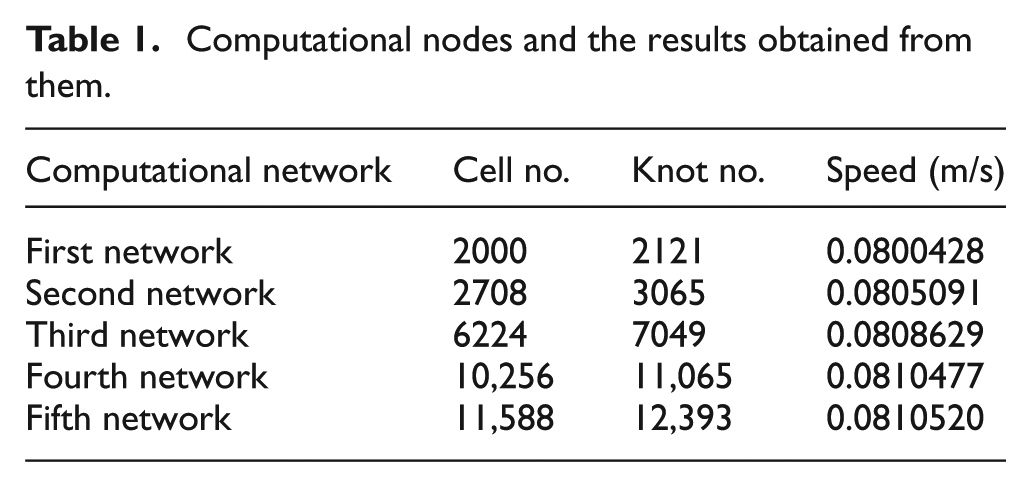
To clarify whether or not the nodes used for the computational area meet the requirements of the model employed in this analysis, the variations of one of the fundamental parameters should be investigated in terms of design by changing the sizes of the analyzed nodes. For independence from and idealizing the grid, the number of computational nodes may be increased. This was properly done. As a criterion for examining flow convergence on the computational grid, velocity variations at the tube exit are monitored for φ = 2.5% and Re = 667. The results of nodes’ sensitivity are presented in Table 1. According to this table, from among the nodes generated for the two-dimensional model, the fifth grid, compared to other nodes, has yielded a better result for velocity at the tube exit as the criterion for measuring node independence. In view of Table 1, it may be observed that as the number of computational nodes increases, in the grids 4 and 5, the velocity value remains almost constant.
Computational nodes and the results obtained from them.
Relations for calculating ferrofluid properties
In this work, the water is used as base fluid with Fe3O4 nanoparticles added to it. The properties of the base fluid and nanoparticles are demonstrated in Table 2. 25
The properties of the base fluid and nanoparticles.

Relation (7) gives nanofluid density 27

Relation (8) is used for calculating nanofluid thermal expansion coefficient

The nanofluid specific heat capacity is calculated using relation (9)

Nanofluid dynamical viscosity is calculated using relation (10)

Nanofluid thermal conductivity coefficient is obtained from relation (11)

where

In the relations used in this section,
Validating numerical investigation
Convection in a two-dimensional tube caused by variations of a magnetic field is studied numerically using semi-implicit finite volume method. To verify the numerical results, the results of the present research were compared to those of experiments the equipment of which was validated by Shah’s equation as in Figure 2. The results may be found in Table 3 and Figures 3 and 4. There is proper agreement between the results obtained from numerical investigation and those of the empirical data. The maximum error of numerical method used was less than 8%.
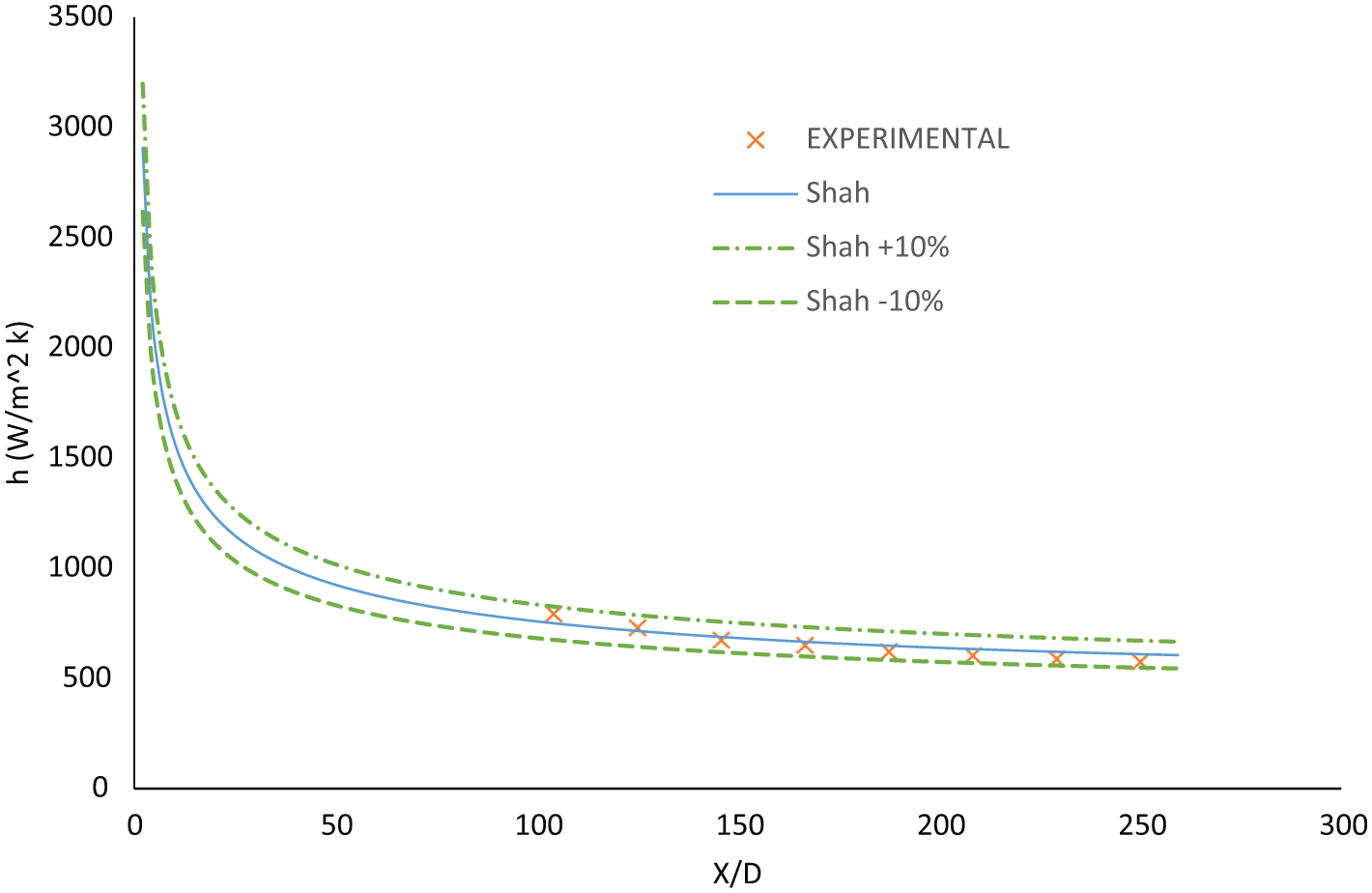
Comparison between experimental distilled water local convection coefficient and Shah’s equation.
Comparison between the numerical and experimental results of convection coefficient for Fe3O4 (

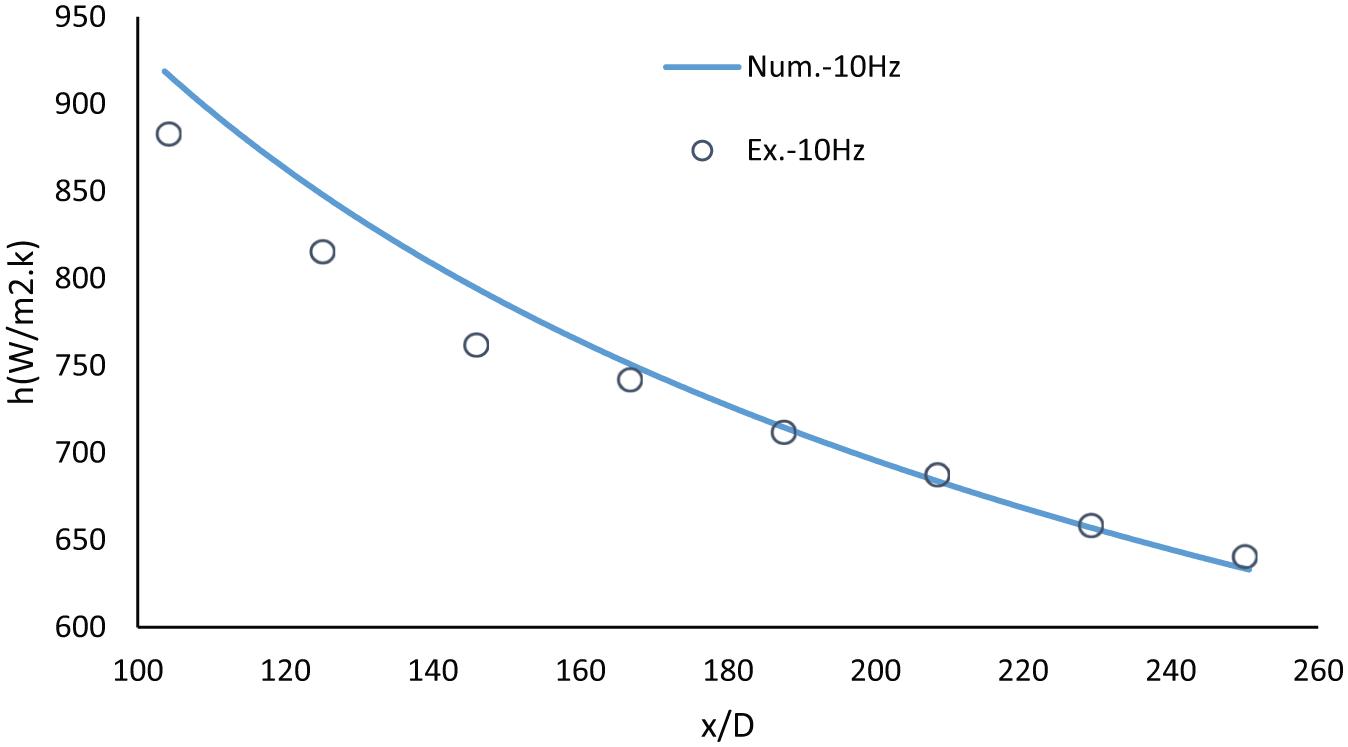
Comparison between numerical and empirical results for local convection coefficient variations with 10 Hz frequency of magnetic field along the axial distance (

Comparison between numerical and empirical results for local convection coefficient variations with constant magnetic field along the axial distance (
Results and discussion
Convection in a two-dimensional tube by variations of a magnetic field was numerically investigated using semi-implicit finite volume method. The modeling results of heat transfer coefficient variations in the absence of a magnetic field for different Reynolds numbers, frequencies, and volume percentages are presented further on.
Examining the effect of using Fe3O4 instead of pure water on local convection coefficient
At the first stage, the laminar flow within the tube is modeled in the absence of a magnetic field. The result obtained from ferrofluid convection coefficient with a volume percentage of 1.25%, 2.5%, and 5% and Re = 1176 is shown in Figure 5.

Diagram of comparison between ferrofluid and water convection coefficient along the axial distance with a volume percentage of 1.25%, 2.5%, and 5% and Re = 1176.
This diagram indicates that using ferrofluid considerably improves convection coefficient resulting in greater heat transfer. Given the scale-up relation of convection coefficient for h = k/δ, adding Fe3O4 particles to pure water increases Fe3O4 nanofluid thermal conductivity coefficient thus increasing convection coefficient.
Examining the effect of alternating magnetic field on convection coefficient
At this stage, an alternating magnetic field is simulated with three different frequencies and magnetic field strength of 0.07 T for a volume fraction of 2.5% at Re = 1176. Figure 6 shows convection coefficient variations in the presence of an alternating magnetic field. The results suggest that an increase in the magnetic field frequency increases convection coefficient. However, the rate of increase diminishes, as the frequency increases. Furthermore, the effect of increase in frequency is greater at the beginning of developed flow.

Variations of local convection coefficient with those of a magnetic field along the axial distance (Re = 1176 and
Examining the effect of Reynolds number on local convection coefficient at fixed frequency
The heat transfer enhancement is improved with increasing Reynolds number. The main reason is enhancing Brownian motion and chaotic movement of nanoparticles at the higher velocities. The results are presented in Figure 7.
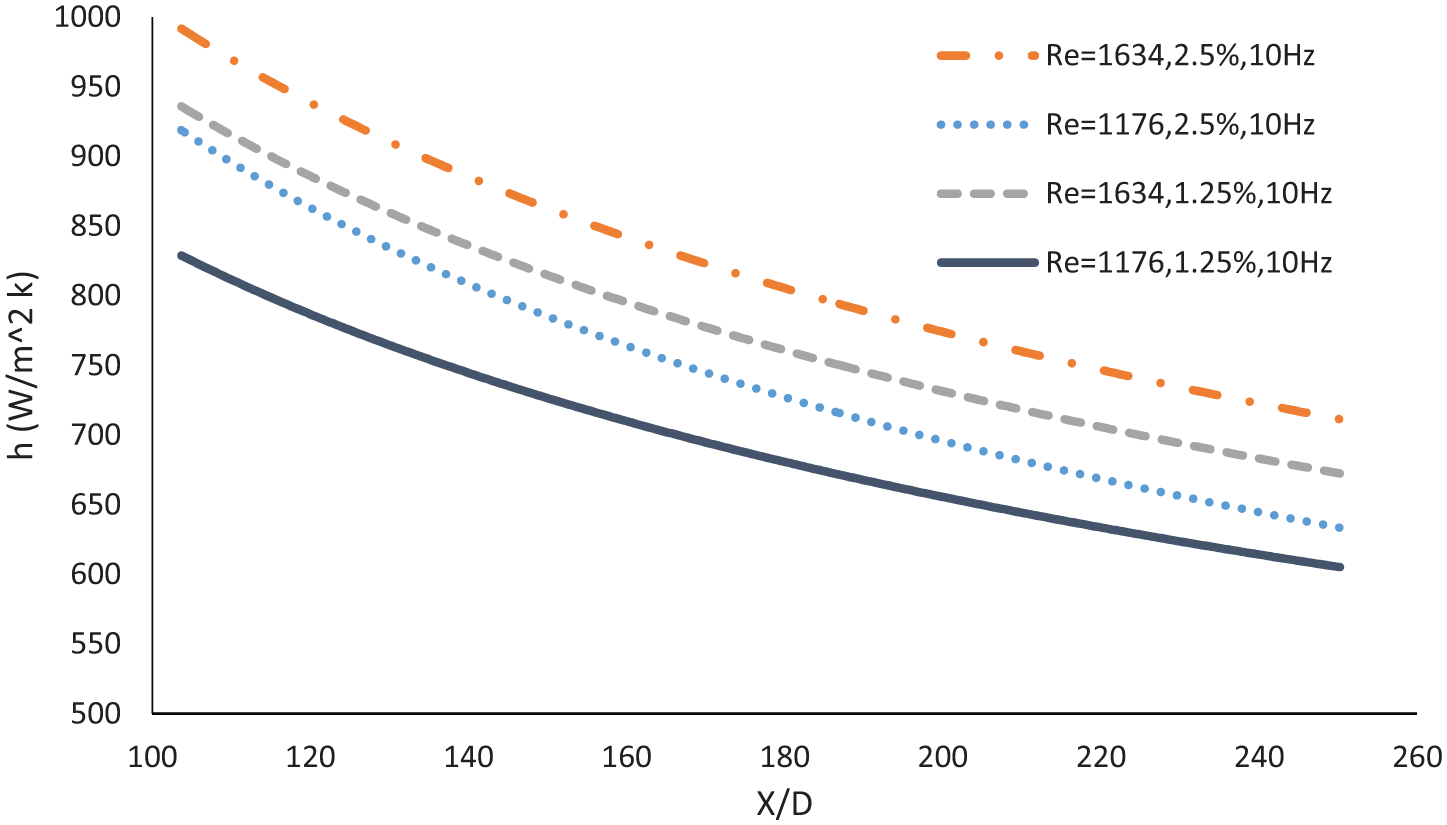
Local heat transfer variations versus Reynolds number and nanofluid concentration through the axial distance of tube at a frequency of 10 Hz.
Examining the effect of Fe3O4 volume percentage at fixed frequency and Reynolds number on local convection coefficient
The convective heat transfer of ferrofluid without magnetic field is better than the base fluid, which is acceptable due to the change in fluid properties. The ferrofluid concentration has significant effect on the heat transfer enhancement. Also, at the higher concentrations, the heat transfer enhances because the variations in ferrofluid properties are more significant (Figures 8 and 9).

Local heat transfer variations with volumetric fraction of ferrofluid through the axial distance at a magnetic field frequency of 10 Hz and Re = 1634.

Local heat transfer variations with volumetric fraction of ferrofluid through the axial distance at a magnetic field frequency of 10 Hz and Re = 1176.
Convection heat transfer coefficient increase theory
When adding Fe3O4 particles to water and forming magnetic nanofluid, Brownian motion and fluid displacement under the effect of the magnetic field cause local convection coefficient to increase, while the fluid heat transfer coefficient increases. Additionally, the magnetic property of nanofluid causes the nanoparticles to move toward the internal wall of the tube and increases local convection coefficient and decreases the boundary layer thickness. The results indicate that the increased volume percentage of nanoparticles in the fluid increases local convection coefficient owing to increased absorption of nanofluid mass toward the wall. The same thing happens with increase in frequency causing more particles to be absorbed to the tube wall at the same time, thus increasing the local convection coefficient.
Conclusion
The fully developed heat transfer of Fe3O4 flow within a tube under constant thermal flux was investigated numerically. Parameters such as volume percentage, Reynolds number, and magnetic field frequency were investigated. Studying the results confirms the following points:
Adding Fe3O4 particles to pure water in the absence of a magnetic field increases considerably the local convection coefficient. This increase is greater in higher volume percentages.
Given the slight difference between empirical and numerical results, it may be claimed that the numerical solution can properly model problems containing magnetic fields.
The effect of an alternating magnetic field on Fe3O4 causes local convection coefficient to increase. This increase is more visible in higher frequencies.
Footnotes
Declaration of conflicting interests
The authors declare that there is no conflict of interest.
Funding
This research received no specific grant from any funding agency in the public, commercial, or not-for-profit sectors.