



Abstract
This study investigates the forced vibrations of double simply supported Euler-Bernoulli beams with initial deflections connected through a distributed linear and nonlinear elastic layer. It is assumed that the upper beam is subjected to a concentrated transverse harmonic force located at its midspan. The integro-partial differential equations of motion are introduced. The Galerkin approach is utilized, and the mode shapes of uniform simply supported beams are used to establish the nonlinear governing equations of motion that incorporate quadratic and cubic nonlinearities. The harmonic balance method (HB) in conjunction with the pseudo arc-length continuation scheme are applied to obtain the amplitude-frequency curves. To assess the accuracy and validity of the proposed method and solution, some findings obtained by the suggested approach have been compared with those found through numerical integration, where a strong concordance was demonstrated. The influences of several factors such as the linear and nonlinear stiffness parameters, and the initial deflections of the beams on the steady state amplitudes have been examined. It is observed that these factors have considerable influences on the dynamic responses of the double beams. For the sake of generality and convenience, the results are displayed in dimensionless forms.
Keywords
Introduction
The rapid advancements in mechanical, marine, civil, and aeronautical engineering have led to the emergence of new and distinctive structures, including double-beam systems. Double-beam systems are employed to model various applications and structures, including composite and sandwich beams, double-walled carbon nanotubes, vibration absorbers, double-beam cranes, pipelines, and railway tracks situated on elastic or viscoelastic foundations. 1 Double-beam systems typically comprise two parallel beams that are constantly linked by elastic linear or nonlinear springs. These systems serve as effective mechanical analogs for a wide range of real engineering and nanoscale structures. Such configurations are found in sandwich and laminated panels in aerospace, marine, and automotive industries, where two stiff face sheets are bonded to a soft or viscoelastic core that exhibits geometric and material nonlinearities under dynamic loading conditions.2–4 Moreover, similar formulations are used to describe adhesive-bonded joints and double-cantilever beam tests, where a nonlinear interlayer models adhesive softening, hyperelasticity, or interfacial slip during vibration or debonding.5,6 At smaller scales, coupled micro- and nano-beam resonators and multi-walled carbon nanotubes can be accurately modeled as double-beam systems with nonlinear coupling due to electrostatic, van der Waals, or interlayer forces.7,8
In civil and transport engineering, twin-girder bridge decks and railway tracks have been modeled as double beams connected by nonlinear or viscoelastic layers to capture the response of connectors, sleepers, and fasteners under moving or harmonic loads. 7 Likewise, composite or functionally graded two-layer beams with imperfect interfaces can be represented as double beams with nonlinear interfacial stiffness to account for interlayer slip, hysteresis, and energy dissipation.4,6 Studies have further shown that initial imperfections or geometric defects—such as curvature, residual stresses, or localized deviations—strongly influence the nonlinear vibration response, often leading to bifurcations and jump phenomena when the upper beam is subjected to harmonic excitation.2,3,8
It is known that to achieve high-performance and efficient structures, and to enhance the applicability and reliability of proposed designs, it is essential to understand their vibrational behavior thoroughly. Many researchers investigated the dynamic characteristics of double beam systems. For example, Fei et al. 9 examined the dynamic behavior of a double tilted and tensioned beam system. The two different beams were linked by elastic springs, and the governing equations of motion were formulated by considering the impacts of the flexural rigidity, sag, inclined angle, and boundary conditions. The double beam system was reduced to four degrees of freedom system, and a semi analytical semi numerical method was presented to obtain the frequency equation of the structure.
Furthermore, Murmu and Adhikari 10 explored the stability and vibration analyses of coupled nanobeams under initial compressive pre-stressed conditions and linked by elastic springs. Eringen’s non-local elasticity theory was utilized to find the relations for the transverse vibrations of the double nanobeams. The nanoscale and connecting spring impacts were addressed, and it was observed that they have a major effect on the natural frequencies of the nonlocal double-nanobeams. The findings have shown that the non-local impacts and the rise of the pre-stressed force tend to reduce the natural frequencies. Szmidt 11 used experimental and analytical methods to study the dynamics of twin cantilever beams linked by a viscoelastic layer undergoing shear deformation. A continuous system was presented to describe the model, and the stiffness and the damping properties were found.
Li et al. 12 focused on the free and forced oscillations of a double-beam system joint by a viscoelastic member. A semi-analytical approach was used to determine the natural frequencies and the mode shapes. The forced vibration responses were found by using a modal-expansion iterated technique to obtain an orthogonality condition that is needed to decouple the differential equations of motion of the double beam. The reliability of the suggested approach was validated by various examples. Additionally, Nguyen 13 studied the influence of a point mass location on the natural vibrations of cracked double beams linked by an elastic member. Numerical simulations were carried out, and it was revealed that the frequency of the cracked double-beams intermittently alters when the point mass is placed at the crack location, and the crack position can be identified by the location of peaks of the wavelet transform of the frequency mass location. A normal mode method was applied by Kelly and Srinivas 14 to determine the natural frequencies and the mode shapes for a set of Euler-Bernoulli beams acted upon axial forces and linked by continuous elastic spring layer.
Mirzabeigy et al. 15 used the differential transform method to find natural frequencies and mode shapes of two parallel beams linked by a layer with variable stiffness. It was presumed that the edges of the beams were elastically restrained against translation and rotation by connecting them to translational and rotational springs. The effects of the stiffness layer, flexural rigidity of the beams, and the boundary conditions on the vibration performance were analyzed. Oniszczuk 16 used the Bernoulli-Fourier approach to calculate the natural frequencies of two parallel simply supported beams connected by a Winkler elastic member. Two partial differential equations were used to study the dynamics of the system, and the initial-value problem was considered to obtain the natural frequencies and the corresponding mode shapes. Hadian Jazi 17 used the modified couple stress theory to report the nonlinear forced vibrations of double nanobeams under translating particle load. The system was presumed to be lying on an elastic layer. Hamilton’s principle and Timoshenko beam theory were adopted to derive the partial differential equations of motion. The Galerkin approach was used to obtain the reduced nonlinear temporal equations of motion. A parametric study was performed, and it was illustrated that the material length scale, the stiffness of the elastic layers, and the velocity of the moving particle have significant impacts on the displacements of the double nanobeams.
Rezaiee-Pajand and Hozhabrossadati 18 performed the free vibration analysis of a double-beam system with elastic restraints at one end and free at the other end. The beams were linked by a mass-spring device. The Fourier transform was employed to determine the frequency parameters and the mode shapes of the system under study. Zhou et al. 19 introduced a new Hamiltonian-based method to determine the natural frequencies, the mode shapes, and the displacements of double nanobeams resting on an elastic layer. Besides, Mohanty et al. 20 used computational techniques to explore the natural vibrations of a two-layer elastic beam lying on a variable Pasternak layer. Rahman and Lee 21 used a modified version of the harmonic balance method to study the forced nonlinear vibrations of axially loaded single and double beams. Beams with simply supported and clamped were considered. The Galerkin method was adopted to formulate the ordinary differential equations of motion. The modal amplitudes were expressed as the summation of the zero, first, and second level responses. Hence, a set of decoupled nonlinear algebraic equations is generated at each solution level. The impacts of the damping coefficient, the axial force, and the excitation level on the dynamic behavior of the single and double beam systems were conducted.
Eshtehardiha et al. 22 presented a nonlinear energy harvester employing magnetically coupled double cantilever beams with piezoelectric layers. Unlike typical linear harvesters with limited bandwidth, the suggested system exploits magnetic nonlinearity and internal resonance to improve performance. The assumed modes method was used to formulate the vibration equations that were solved numerically. It was revealed that magnetic coupling broadens the harvesting frequency range. Experimental validation confirmed the model’s accuracy. Fang et al. 23 performed the natural and forced oscillations of double Euler-Bernoulli beams. It was assumed that the primary beam carries a tip mass with rotary inertia, linked to a secondary beam through an elastic layer. A parametric study was conducted to examine the impacts of the tip mass, the rotary inertia, the elastic layer stiffness, and the beam rigidity on the system frequencies and dynamic behavior.
Based on the above literature, one can observe that no efforts have been dedicated to conduct the nonlinear forced behavior of double simply supported Euler-Bernoulli beams with initial deflections. Hence, the purpose of this research is to fill this gap. To provide a more structured comparison of the literature, Table 1 has been established to clarify the research gap. In this table, a comparison of 11 key studies based on their beam models, coupling laws, imperfection modeling, and solution methods have been considered. The table explicitly demonstrates that the simultaneous treatment of geometric imperfections and nonlinear interlayers in double-beam systems under forced excitation remains a distinctive contribution of this work.
Comprehensive summary of key studies on the dynamic behavior of double beams.

Although this study focuses on Euler-Bernoulli beams, the suggested formulation may serve as a basis for several significant extensions. Future advancements may include Timoshenko beam theory to account for shear deformation and rotating inertia, which are essential for the analysis of thicker beams or high-frequency modes. Additionally, the model might be used to investigate the performance of multi-layered systems (more than two beams) or structures that are subjected to moving loads and particles, simulating high-speed transport infrastructure. Besides, considering non-local elasticity effects would allow the formulation to be adapted for nano-electromechanical systems (NEMS), where small-scale impact becomes more significant. As observed in Table 1, most studies on double-beam systems assume perfectly straight members. While some researchers have considered initial pre-stress to analyze stability and frequency shifts, the dynamic performance under the effect of initial geometric imperfections remains under-explored, particularly in the presence of quadratic and cubic interlayer nonlinearities.
The rest of this article is organized as follows. In Section 2, the details of the model are presented, and the governing equations of motion of double simply supported beam with initial deflections are shown. In Section 3, the Galerkin approach is used to obtain the temporal nonlinear equations of motion. Then, the harmonic balance method and the arc length continuation scheme are applied. The nonlinear forced vibrations are investigated. In section 4, the proposed model is validated, and the findings are presented and examined. In section 5, conclusions are drawn, and further developments are suggested in Section 5.
Mathematical modeling
Figure 1 shows double Euler-Bernoulli beams with initial deflections connected through a distributed linear and nonlinear elastic layer. It is assumed that the upper beam is subjected to a harmonic force located at its midspan. In this study, it is assumed that the nonlinear restoring force of the elastic layer is expressed as Huang et al. 24

where
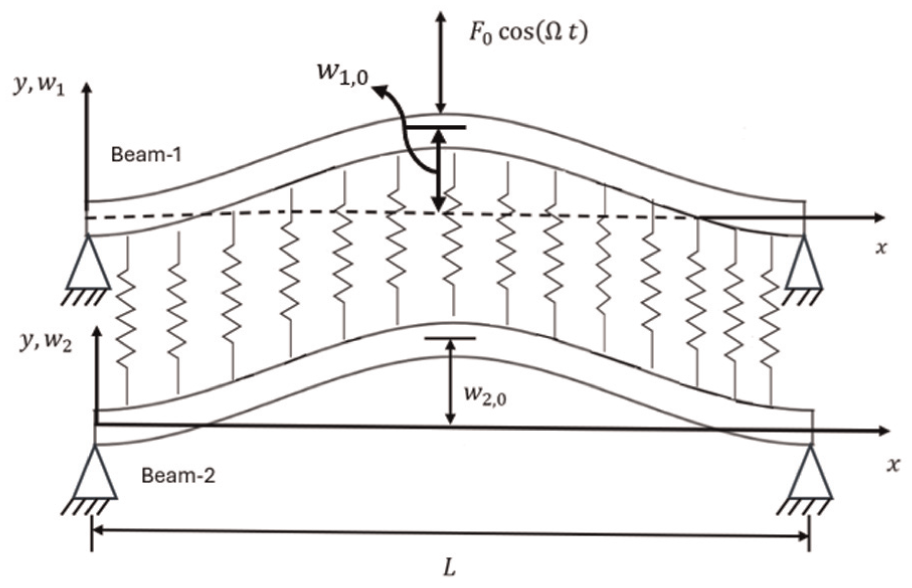
Schematic diagram of double Euler–Bernoulli beams with initial deflections connected by a nonlinear elastic layer and subjected to a harmonic force.
The nonlinear coupling layer, defined by the restoring force given in equation (1), is a generalized model designed to represent several physical configurations depending on the engineering application. For example, in aerospace and automotive sandwich panels, the layer models a soft or viscoelastic core or adhesive bonded joints where nonlinearities arise from material behavior such as adhesive softening or hyperelasticity. Moreover, in transport engineering, specifically for railway tracks and twin-girder bridges, the distributed nonlinear layer represents the combined response of connectors, sleepers, and fasteners under dynamic loads. Besides,
With the aid of Zhai et al., 25 the governing partial differential equations of motion for double Euler-Bernoulli beams with initial deflections and subjected to a harmonic force are given as

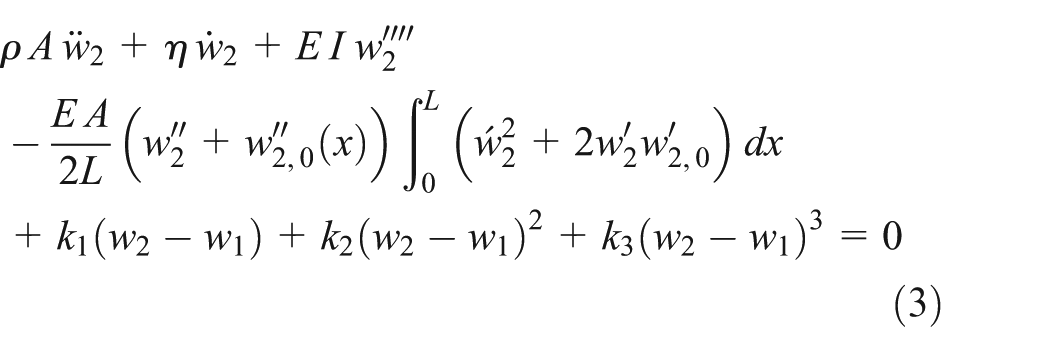
where
To simplify the equations of motion, the following dimensionless parameters are introduced as
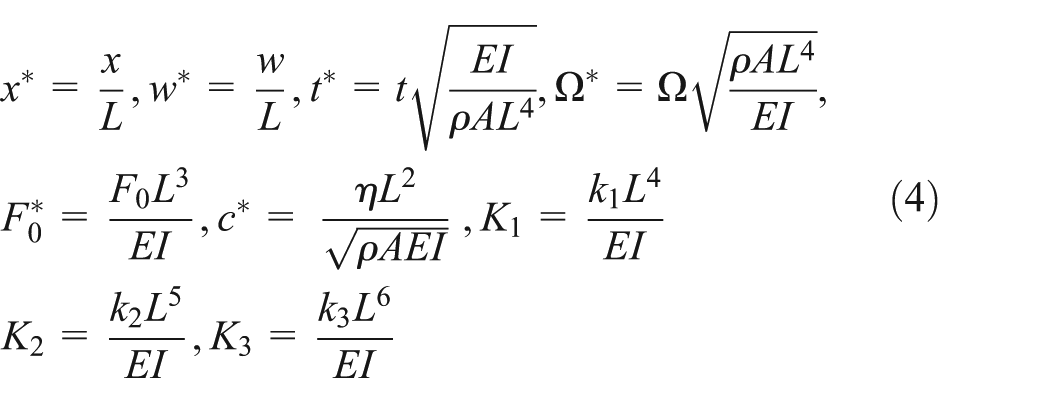
These dimensionless parameters are substituted into equations (2) and (3) to convert the governing equations of motion into a non-dimensional form. It should be stated that the asterisk notations are removed for simplicity. The governing equations of motion are expressed as


The authors would like to emphasize that the mathematical background presented here for double-beam systems with initial deflections can be adapted for emerging technologies. For example, the nonlinear coupling model can be used to design nonlinear energy harvesters, where the interaction between parallel beams is tuned to broaden the frequency bandwidth for improved power scavenging. Moreover, the inclusion of the initial deflections provides a fundamental metric for structural health monitoring (SHM). By understanding how these geometric changes shift resonance peaks and trigger bifurcations, engineers can find early signs of damage or delamination in composite sandwich panels used in aerospace and marine hulls. These systems also serve well models for micro-electromechanical systems (MEMS) resonators, where nonlinear interlayer forces like van der Waals or electrostatic interactions control the sensitivity and the stability of these devices.
Solution procedure
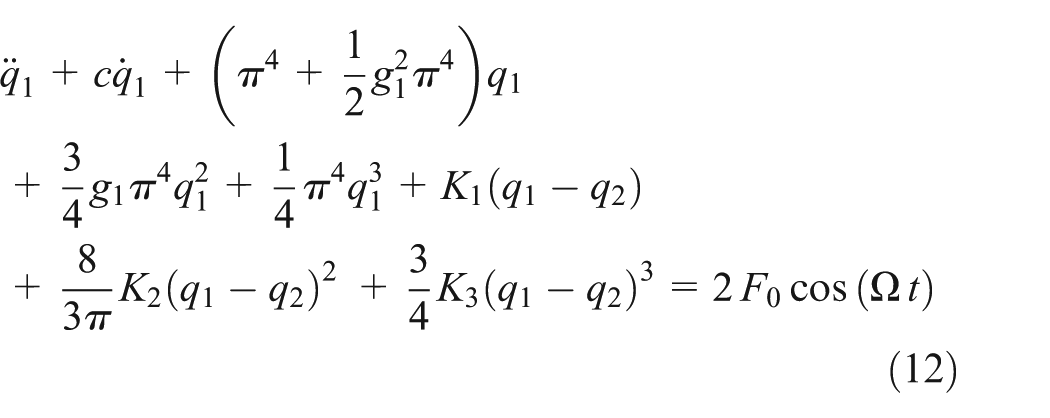
The nonlinear partial differential equations (5) and (6) can be discretized in space and time utilizing the Galerkin’s approach as 26

where N denotes the number of retained modes,


where the first bending mode shape of the beams is given as

The initial deflections for the simply supported beams are given as 30

where

Harmonic balance
The periodic solutions of the equations of motion can be obtained using the harmonic balance method. The periodic solutions are assumed as

where

where

Arc length continuation method
In nonlinear systems, it is essential to obtain periodic steady-state responses and to identify jump phenomena and nonlinear resonances.31,32 Several numerical methods can be employed, including Incremental Harmonic Balance (IHB), Newton–Raphson continuation on frequency, path-following algorithms, and frequency stepping with stability switching. In this article, the pseudo arc-length continuation scheme is employed to find all possible stable and unstable periodic solutions of

Using a quadratic form of the pseudo arc length, equation (17) is rewritten as

where
The slope of the equilibrium path (

The initial estimation of the next point is determined as

To obtain the periodic solution, the prediction obtained in equation (20) is corrected iteratively utilizing the Newton-Raphson method until the exact solution on the equilibrium path is found. An adaptive pseudo-arc-length continuation method is utilized to trace the solution branches of the nonlinear system. To ensure robust convergence across high-curvature regions and turning points, the algorithm employs a linear predictor that extrapolates the subsequent state from the previous two solution points. The linear predictor is coupled with a Newton-Raphson corrector that is configured with a residual tolerance of 10−11 and a maximum limit of 60 iterations per step. The system Jacobian is evaluated numerically through a finite difference scheme. The step size is managed dynamically as the arc-length increment is automatically reduced via bisection upon a convergence failure in the Newton loop and increased by a certain factor following successful iterations to maintain computational efficiency. Turning points and bifurcations are detected by monitoring sign changes in the determinant of the augmented Jacobian matrix. Upon detection of such a transition, the scheme employs a recursive bisection improvement to determine the critical coordinate where the determinant of the Jacobian is approximately zero. This adaptive logic further enables the solver to navigate “jumps” or gaps in the solution manifold by locally enhancing the arc-length resolution until convergence is achieved.
Results
In this section, the frequency response curves of double simply supported beams are presented. The upper beam is presumed to experience a centrally concentrated harmonic force. It is known that a convergence test is essential to ascertain the adequate number of harmonics utilized in the study. Consequently, the steady-state amplitudes are ascertained and graphed against the excitation frequency for varying harmonic counts for a double simply supported beam with parameters


The frequency response of
In the current research, the expressions shown in equations (21) and (22) will be utilized to examine the dynamic behavior of the double beams system at different parameters.
A comparative study has been conducted to validate the accuracy of the proposed solution derived from the harmonic balance method (HB). Figures 3 to 6 compare the frequency amplitude curve derived from HB with those produced using numerical integration (NI) for a double simply supported beam, with the parameters used in Figure 1. The solid line represents the steady state amplitudes derived from the HB, whereas the circles denote the results produced by the NI approach. The efficacy of the proposed method can be corroborated by observing that the outcomes of both approaches align closely. In all presented figures, the force and the damping coefficients are taken as

The frequency responses of

The frequency responses of (a)
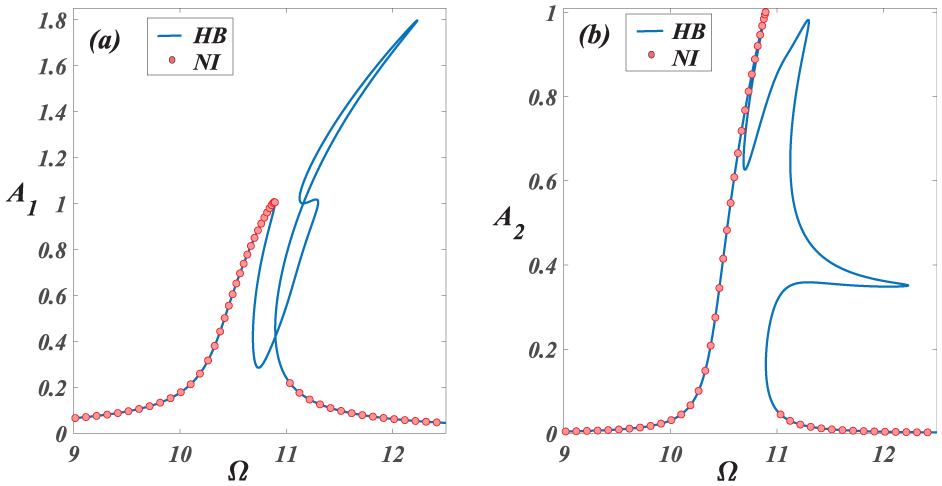
The frequency responses of (a)
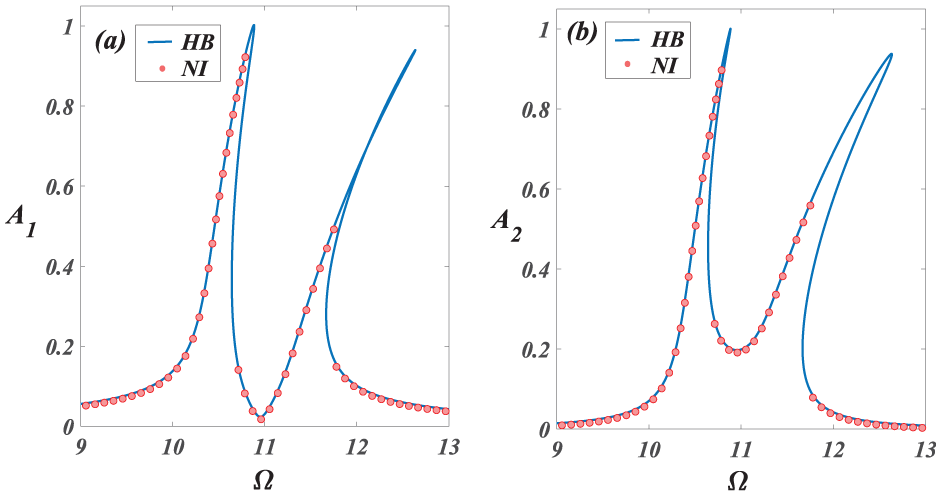
The frequency responses of (a)
Then, the steady-state amplitudes derived from numerical integration were subsequently compared with those obtained from harmonic balance solutions. The comparison exhibited excellent agreement over the entire range of excitation frequencies considered, including near resonance peaks and turning points where nonlinear effects such as jump phenomena and multi-valued solutions occur. This agreement confirms that the proposed solution strategy accurately captures both stable and unstable branches of the nonlinear frequency–response curves. By investigating Figures 3 to 6, one can observe that validation has been done for multiple cases spanning different values of
In the present study, the authors first calculate a periodic steady-state solution using the Harmonic Balance (HB) method and then use the values of this solution at the initial time (
In the examination of nonlinear vibrations in beams, quadratic and cubic nonlinearities frequently arise as a result of geometric effects and material properties. These nonlinearities are essential in determining the system’s dynamic behavior. Quadratic nonlinearities, frequently associated with asymmetry in deformation or boundary conditions, can induce softening behavior, resulting in a decline in the beam’s effective stiffness as the amplitude increases. Cubic nonlinearities are typically linked to mid-plane stretching and geometric nonlinearity. This often induces a hardening response, wherein stiffness grows with amplitude. The coexistence of both types of nonlinearities leads to competition, resulting in varied dynamic behaviors due to their combined influence. The system may exhibit a net hardening effect, a net softening effect, or, in certain instances, almost linear behavior where nonlinear terms cancel each other out. This is contingent upon their respective magnitudes and signs. The competition between quadratic and cubic nonlinearities is crucial for practical applications of beam structures, as it directly influences resonance characteristics, stability, and the amplitude-frequency relationship in nonlinear vibration analysis.
Figure 7 illustrates the impact of several values of the linear stiffness parameter

The Influence of the linear stiffness parameter on the frequency-response curves of a double simply supported beam system with
Figure 8 illustrates the influence of the linear stiffness parameter
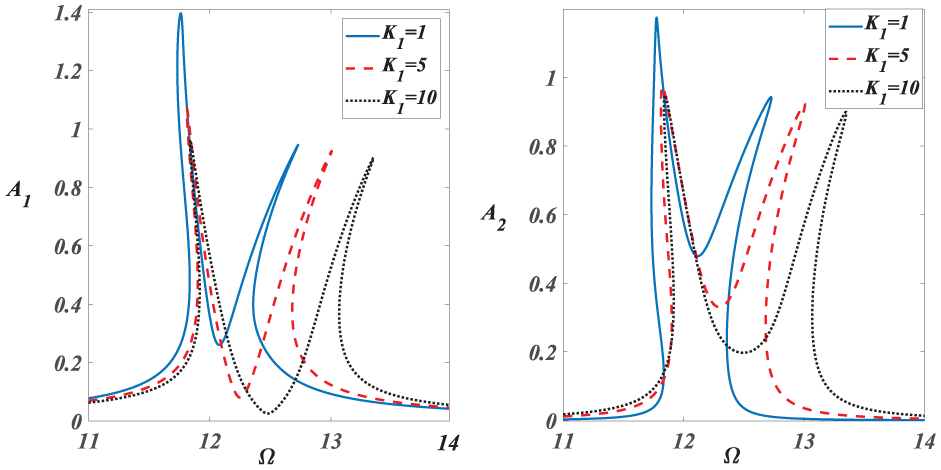
The effect of the linear stiffness parameter on the frequency-response curves of a double simply supported beam system with
Figure 9 depicts the effect of varying nonlinear quadratic stiffness parameter values

The impact of the nonlinear quadratic stiffness parameter on the frequency-response curves of a double simply supported beam system with
Figure 10 illustrates the influence of the nonlinear quadratic stiffness parameter

The influence of the nonlinear quadratic stiffness parameter on the frequency-response curves of a double simply supported beam system with
Figure 11 shows the influence of the nonlinear cubic stiffness parameter

Variations of the frequency-response curves for different nonlinear cubic stiffness parameters of a double simply supported beam system with
In Figure 12, the primary resonance regions for both beams are marginally displaced to the left, indicating softening behavior. The behaviors of the steady-state amplitudes of the second peaks for both beams exhibit linearity for

Variations of the frequency-response curves for different nonlinear cubic stiffness parameters of a double simply supported beam system with
Figure 13 demonstrates the amplitude-response curves for amplitudes
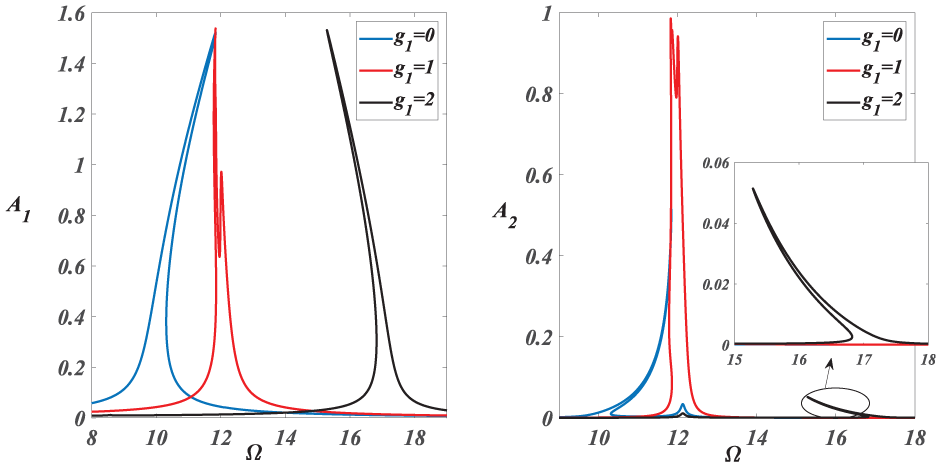
The effect of the initial rise of the upper beam on the frequency-response curves of a double simply supported beam system with
Figure 14 further shows that the vibration amplitude of the upper beam initially increases and then decreases with rising imperfection magnitude. This trend suggests the existence of an optimal imperfection level that maximizes vibration response. Such sensitivity underscores the necessity of accounting for manufacturing tolerances and geometric defects in practical designs, as small geometric imperfections can significantly alter dynamic performance.
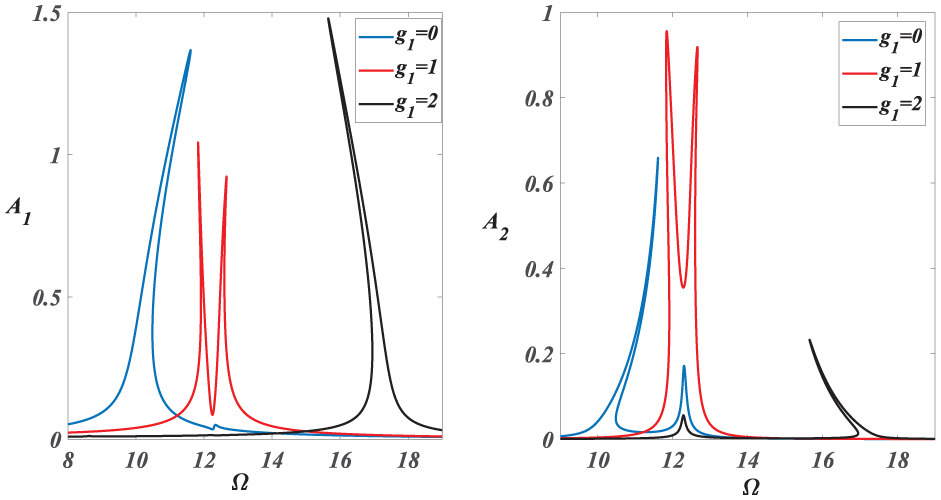
The influence of the initial rise of the upper beam on the frequency-response curves of a double simply supported beam system with
Figure 15 elucidates the impact of the initial rise of the lower beam

The effect of the initial rise of the lower beam on the frequency-response curves for (a) q1(t) and (b) q2(t) of a double simply supported beam system with
In Figure 16, at elevated values of the linear and nonlinear stiffness parameters (

The effect of the initial rise of the lower beam on the frequency-response curves of a double simply supported beam system with
Figure 17 presents the time history, the fast Fourier transform, and the phase portrait of the double-beam system with

(a) and (d) The steady state forced responses, (b) and (e) the FFT, (c) and (f) the phase portraits obtained for a double simply supported beam system with
Figure 18 illustrates the time history, the fast Fourier transform, and the phase portrait of the double-beam system with
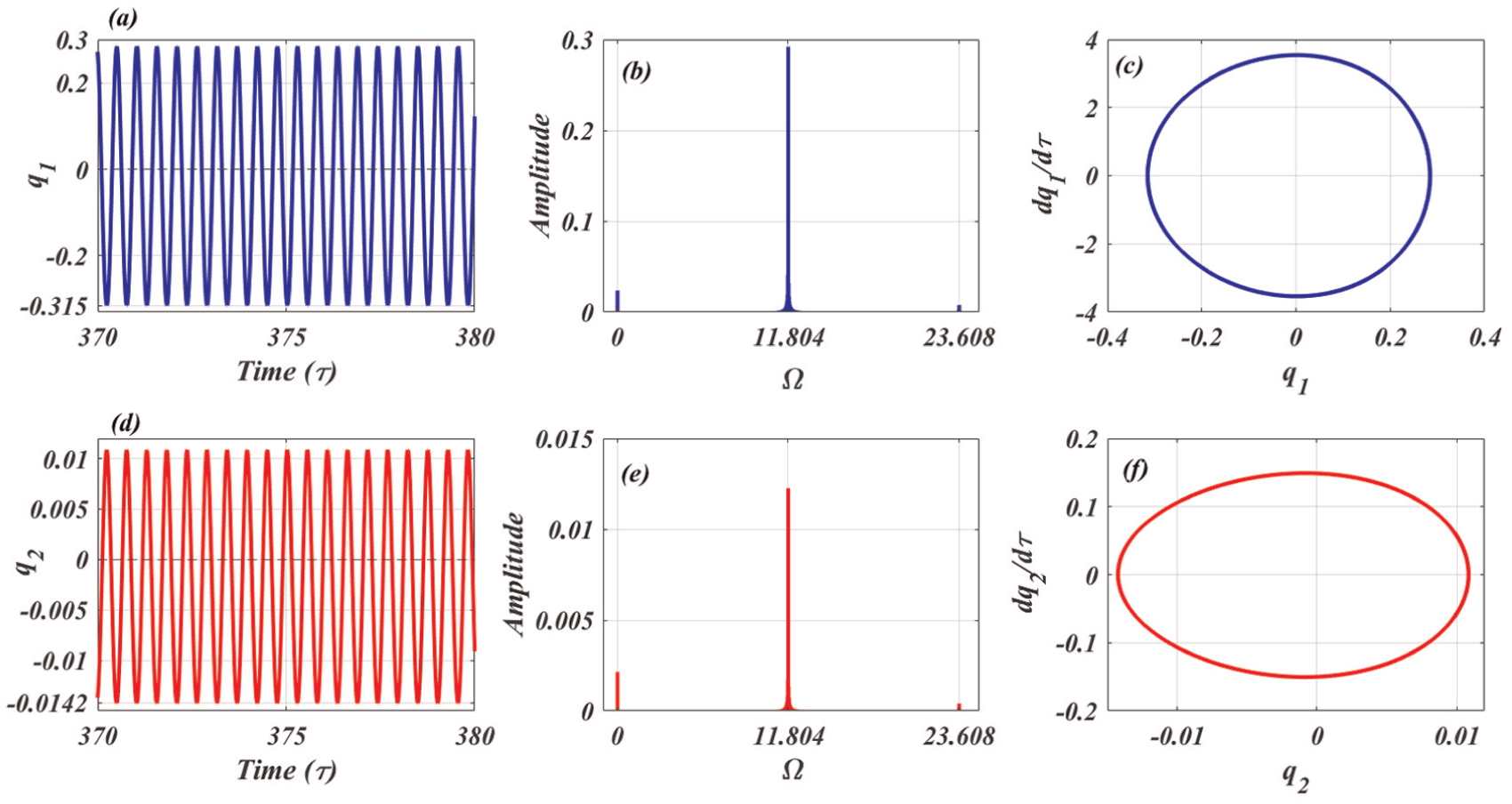
(a) and (d) The steady state forced responses, (b) and (e) the FFT, and (c) and (f) the phase portraits obtained for a double simply supported beam system with
Conclusions
The forced nonlinear response of double simply supported Euler-Bernoulli beam system with initial deflections connected with an elastic nonlinear elastic layer was conducted. In this work, a central harmonic transverse force was acting on the upper beam. The governing integro-partial differential equations of motion were presented, and the system was effectively converted into nonlinear ordinary differential equations through the application of the Galerkin method. The HB approach, along with the pseudo-arclength continuation scheme, was employed to produce frequency-amplitude curves. Certain results were corroborated by comparing them with those obtained from direct numerical integration of the ordinary differential equations of motion.
The findings indicate that increasing the linear stiffness of the connecting layer reduces steady-state amplitudes and shifts resonance regions to higher frequencies while simultaneously reducing hardening nonlinear behavior. In contrast, advancing the quadratic nonlinear stiffness leads to a growth in steady-state vibration amplitudes and a potential diminution of hardening nonlinearity. The influence of cubic nonlinear stiffness was found to be more intricate and dependent on other system parameters; however, its progression clearly facilitates a shift from softening to hardening behavior within the second resonance region. Furthermore, the advancement of both linear and quadratic nonlinear stiffness parameters promotes the formation of multi-valued solutions, including jumps and hysteresis loops, in specific frequency ranges. Ultimately, the initial deflections of the upper and lower beams play a significant role in influencing the system’s linear and nonlinear characteristics, natural frequencies, and steady-state amplitudes.
This work offers a comprehensive analytical framework and significant insights into the nonlinear dynamics of double-beam systems with initial imperfections, emphasizing the crucial effect of linear and nonlinear coupling stiffness, along with geometric initial deflections, on the overall vibrational characteristics. Additionally, the utilization of double beam systems may assist sustainable advancement in industrial applications. This study advances new design and methodology that can improve the resilience and efficiency of infrastructure. It is recommended to analyze the dynamic behavior of other double structures, including plates and rods.
Footnotes
Appendix 1
After neglecting the axial displacement, the longitudinal strain of the mid-plane, accounting for stretching and initial geometric imperfection, is given by 35
For a double beam system, we define these strains for each beam (i = 1, 2) as
The total energy of the system is the sum of the energies of the two beams, and is given as
The total bending potential energy
The stretching potential energy
The potential energy of the continuous elastic
The total potential energy is expressed as
Extended Hamilton’s principle can be written as
Where
Substituting equations (25)–(28) into equation (30) and performing the integrations yields the following two nonlinear coupled integro-partial differential equations:
Handling Editor: Divyam Semwal

Funding
The authors received no financial support for the research, authorship, and/or publication of this article.
Declaration of conflicting interests
The authors declared no potential conflicts of interest with respect to the research, authorship, and/or publication of this article.