



Abstract
To address the limitations of traditional hydraulic equipment, such as large size and poor sealing performance, this paper proposes a novel double-acting scraper pump characterized by high efficiency, low pulsation, and a compact structure. Firstly, the structure of the pump and the rotor profile are introduced, and a sine rotor profile equation applicable to any number of blades is established. Using a five-leaf rotor as an example, differential geometry derivation reveals that the curvature undergoes periodic sinusoidal changes, confirming the geometric smoothness of the rotor profile. The derived volumetric utilization coefficient equation provides a theoretical basis for rotor optimization. The study further develops an equivalent leakage model and related flow rate formulas. The instantaneous flow curve demonstrates that flow rate variation is periodic and output remains stable. Finally, the system analyzes the coupled motion laws of the scraper’s swing angle, angular velocity, and angular acceleration. Theoretical calculations and ADAMS simulation verification yield corresponding variation curves that show good agreement, with an error margin of less than 5%. The correctness of the theoretical geometric analysis has been confirmed. This provides a theoretical basis for the design of non-pulsating scraper pumps, as well as the development and performance optimization of prototype machines.
Introduction
Against the backdrop of the rapid development of energy engineering both at home and abroad, the efficient utilization of energy has become a core issue that needs to be addressed globally. Hydraulic transmission, as one of the fundamental transmission methods in modern industry, is widely applied in machinery, automation equipment, and various industrial applications. 1 Hydraulic transmission is not only an indispensable power transmission method in modern industry, but also an important tool for enhancing energy utilization efficiency, promoting industrial upgrading, and driving technological innovation. Green, low-carbon and efficient operation have become the development trends of mechanical engineering equipment. As the core component of the hydraulic system, the hydraulic pump continues to play a significant role in the layout of the transmission system. 2
With the rapid development of the global economy, the demand for volumetric pumps continues to increase, and corresponding technological advancements and market applications have received increasing attention.3,4 The commonly used types of volumetric pumps include gear pumps, piston pumps, vane pumps, rotor pumps, and reciprocating piston pumps, etc. However, although gear-type volumetric pumps have the advantages of compact structure and small size, they still have problems such as low efficiency, high noise, severe oil trapping, and unbalanced radial forces during operation.5,6 Xuan et al. 7 tested on the linear conjugate internal meshing gear pump showed that at the rated speed of 3000 r/min, the instantaneous flow non-uniformity coefficient still reached 0.18, indicating that the traditional gear form is unable to meet the low pulsation requirements. The piston-type volumetric pump has a high rated pressure and strong reliability. However, due to its own structural limitations, this pump will generate significant vibration during operation, accompanied by an increase in flow pulsation, as well as a high noise level and a tendency to experience cavitation.8,9 Li et al. 10 pointed out regarding the high-speed cooling pump that by specifying a bent suction inlet, the cavitation volume fraction decreased by 35%, but the energy dissipation still accounted for 4.2% of the shaft power, indicating that the coupling effect of cavitation and energy consumption cannot be ignored. The blade-type volumetric pump features a compact design, light weight, high efficiency, but it is prone to leakage increase, intensified flow pulsation, and cavitation problems.11,12 He et al. 13 demonstrated through a visual experiment that for every 0.05 mm increase in the leaf tip gap, the volume fraction of gas in the high-speed zone increases by approximately 12%, accompanied by an intensification of pressure pulsation.
Due to the limitations of its basic principle, the performance improvement of the aforementioned volumetric pumps has reached a bottleneck. They are already approaching the limit. Moreover, the global demand for energy conservation and emission reduction is increasing, and more advanced new principle volumetric power machinery is needed to support this. The double-acting swing scraper pump is a new type of volumetric pump that was proposed under the above-mentioned circumstance. 14 Taking the double-acting five-blade rotor swing scraper pump shown in Figure 1 as an example, the upper and lower scraper plates remain in constant contact with the rotor surface (this friction pair exhibits self-sealing characteristics). As the rotor rotates, the scraper plates oscillate, allowing the flow medium to enter and exit through the volumetric changes occurring on both sides of the scraper chambers. The pump displacement is twice the volume enclosed by the cylindrical surface formed between the rotor’s outer surface and blade tips. Compared to traditional gear pumps, piston pumps, and vane pumps, the double-acting swing scraper pump represents significant innovations in both structure and performance. Structurally, it features a continuous sine curve rotor profile combined with an upper and lower double-swing scraper design. This eliminates the need for complex components such as the flow distribution plate commonly required in traditional volumetric pumps, resulting in a more compact, integrated structure. A self-sealing friction pair and oil film are formed through line contact between the scraper and the rotor surface. Unlike the non-conjugate tooth surface contact in gear pumps, the sharp-angle cylindrical contact in vane pumps, and the sliding shoe-slit point contact in piston pumps, this design effectively reduces impact wear and prolongs service life. In terms of performance, the double-acting working mechanism allows the rotor to complete two oil discharges per revolution, significantly improving volumetric efficiency and oil delivery capacity. The rotor curvature is smooth and changes periodically, causing the instantaneous flow rate to vary in a sinusoidal pattern. This results in significantly reduced noise and vibration during operation. Additionally, based on a micro-gap laminar leakage model, the pump demonstrates extremely low radial and end-face leakage. Overall, the comprehensive efficiency has been greatly enhanced, establishing a new paradigm for the green and efficient development of fluid machinery. It has broad applicability across various fields, including automotive, machine tools, construction machinery, agricultural machinery, and marine systems. Furthermore, it can be integrated into novel complete machine systems, such as distributed hydraulic power ships and scraper-type hydrostatic transmission vehicles, thereby providing substantial social and economic benefits.
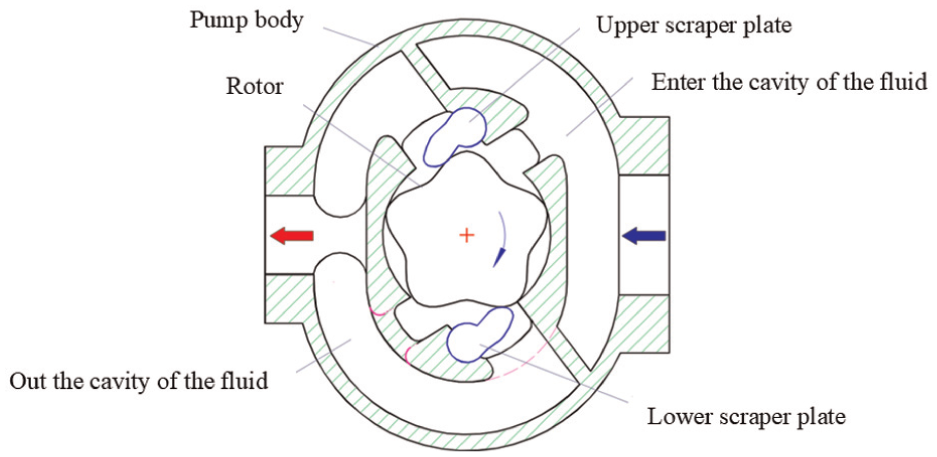
Schematic diagram of the structure and principle of the double-acting five-blade rotor swing scraper pump.
For the scraper pump, the designers directly addressed the friction between the structural components of the pump. They first proposed the structural principle of a reciprocating scraper pump and developed an elliptical rotor reciprocating scraper fan. However, when the rotational speed was slightly higher, the scraper and rotor separated. If the return spring of the scraper is too large, the power density of the system will be too low, and its promotion value will be limited. Therefore, a single-acting elliptical rotor swinging-scraper-type fan was proposed and developed. Its efficiency and volume are significantly better than those of traditional rotary vane fans. 15 In the early stage, Zhang et al. 16 used the Adams software to conduct simulation modeling of the kinematics of the fan. Cao et al. 17 analyzed the self-locking characteristics of a swing scraper through three-dimensional modeling and mathematical simulation. Zheng et al. 18 investigated the theoretical flow characteristics using the area-sweeping method. Li et al. proposed a method for analyzing the transient flow field characteristics of a double-acting five-blade rotor swing scraper pump based on a viscous wall strategy. By employing 2.5D dynamic grid technology and a viscous wall strategy, they studied the internal flow characteristics of a scraper pump under different operating conditions. 19 Wang et al. proposed a kinematic analysis method for the accompanying trajectory of a five-blade rotor swing scraper pump. The accuracy of this method was verified through theoretical analysis and an ADAMS simulation. The structural principle and performance of the pump were validated through flow field simulations and experimental tests, providing theoretical support for the design and optimization of the swing scraper pump. 20
However, the impact of the number of rotor vanes in a double-acting swing scraper pump on the characteristics of the rotor profile, as well as the mathematical relationships between the pump displacement, volumetric utilization coefficient, theoretical average flow rate, and theoretical instantaneous flow rate with respect to the rotor profile parameters-particularly the positioning of contact points between the scraper and the rotor-requires further in-depth, comprehensive, and systematic investigation. Such research is essential for establishing the necessary boundary conditions for subsequent fluid-solid coupling dynamic simulations and is also the fundamental theoretical basis for the development of prototypes and optimization of product performance.
The innovation of this paper lies in establishing a unified type line equation for the sinusoidal rotor of a double-acting scraper pump, applicable to any number of blades. It derives formulas for curvature and the volumetric utilization coefficient, identifies the factors influencing volumetric utilization, and constructs a leakage model for the double-acting scraper pump. Additionally, the paper derives equations for displacement, as well as average and instantaneous theoretical flow rates, and verifies the accuracy of these theoretical calculations, thereby providing a theoretical foundation for designing non-pulsating scraper pumps. Furthermore, it derives the rotational relationships between the scraper and the rotor, including equations for angle, angular velocity, and angular acceleration, and obtains corresponding theoretical and simulation curves. The results show that all errors are less than 5%, confirming the correctness of the geometric analysis, establishing boundaries for fluid-solid coupling dynamic simulations, and offering a fundamental theoretical basis for prototype development and product performance optimization.
Geometric design of the double-acting swing scraper pump
The structural of the double-acting scraper pump, which is used as a booster pump in high-pressure hydraulic systems, is shown in Figure 2. It mainly consists of a special rotor, upper and lower swinging scrapers, torsion springs, sealed bearing kits, and the pump body. Through the coordinated movement of the scraper and the rotor, high-pressure and low-pressure fluid chambers are separated, and self-sealing is achieved by relying on fluid pressure. The rotor is designed with a sine curve. The sine curve forms a pump chamber with an inner wall of the pump body. When the rotor rotates once, it outputs twice the volume of the pump chamber fluid, thereby improving the volumetric utilization rate and enhancing the fluid transportation capacity. The large end of the scraper maintains close contact with the rotor surface, forming a continuous oil film. The scraper and rotor surface engage in line contact. Compared to the non-conformal line contact between the tooth surfaces of a gear pump, the sharp edge–rounded cylinder contact of a blade pump, and the sliding shoe–slip point contact of a plunger pump, this design effectively reduces impact and wear, thereby extending service life. The torsion spring installed at the end of the scraper shaft ensures the scraper’s followability, enabling the scraper to come into contact with the rotor even during idle operation. Compared with traditional volumetric pumps, the double-acting swing scraper pump has a compact structure, is easy to install and maintain, has low operating costs, and has broad prospects for application and potential for promotion.

Geometric design diagram of double-acting scraper pump.
Geometric characteristics of the double-acting swing scraper pump
Sinusoidal rotor theoretical contour line equation
The rotor profile refers to the geometric shape of the rotor surface and blades. A reasonable rotor profile can enhance the efficiency, flow rate, and stability of the pump, while also reducing noise and vibration and prolonging the pump’s service life.21,22 The sinusoidal profile is a common type of profile design for rotor pumps. Its characteristic is that the profile is constructed along the circumference of the rotor based on the sine function. The straight-line type rotor profile has smooth curvature changes, uniform flow variation and low pulsation. At the same time, it has good meshing sealing performance, which can reduce leakage. The force distribution of the sinusoidal line is more uniform, resulting in less wear. This can extend the service life of the scraper pump and is applicable to various working conditions, such as high viscosity, low-pressure transportation, and high rotational speed.
Based on the numerous advantages of the sinusoidal rotor profile, the use of a sinusoidal rotor profile in a double-acting scraper pump is a choice that offers both performance and cost benefits.
The general equation for the sinusoidal rotor profile is as follows:

where r b is the base circle radius of the rotor profile(mm). A c is the amplitude of the sine wave, which determines the undulation amplitude of the rotor profile (mm). i is related to the number of cycles of the sine wave and the number of blades of the rotor. t is the rotational angle of the rotor.
Theoretically, a sinusoidal rotor profile can be applied to rotor structures with any number of blades. Specifically, by adjusting parameter i, rotor profiles with varying numbers of blades can be generated, as shown in Figure 3.
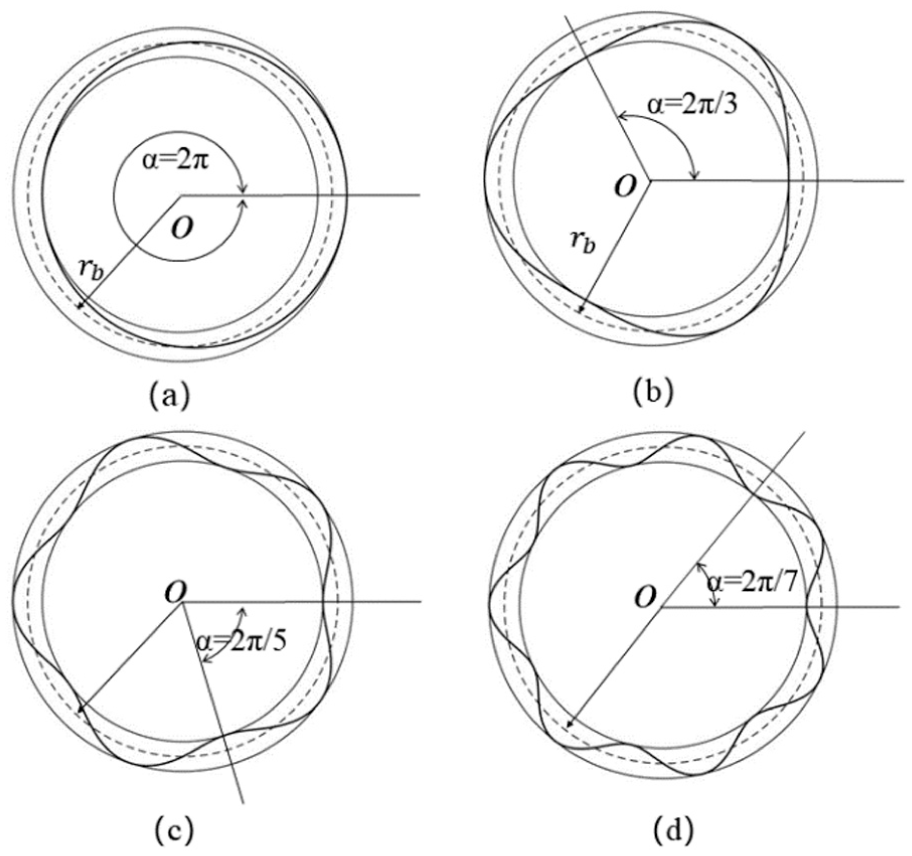
The sinusoidal rotor profile varies with i: (a) i = 1, (b) i = 3, (c) i = 5, and (d) i = 7.
Formula (1) can be transformed into polar coordinates as follows:

Where ρ(θ) is the radius of the rotor’s contour in the polar coordinate system, which varies with the angle θ, in millimeters. θ is the angle parameter, with a range from 0 to 2π.
The curvature of the sinusoidal rotor profile is a parameter that describes the degree of curvature of the curve at a certain point, which is the rate at which the tangent direction angle changes with the arc length at that point. The curvature reflects the bending or turning characteristics of the sine curve at that point. 23 Smooth curvature changes can improve the fluid transmission characteristics and thereby enhance the efficiency of the pump. The curvature expression in differential calculus is:

By combining equations (1) and (2) can obtain:
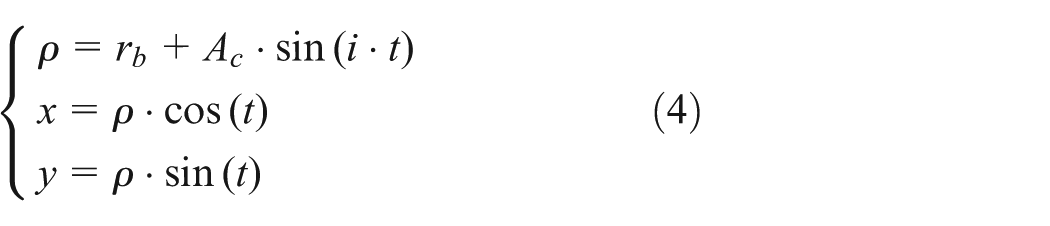
Where
After taking the first and second derivatives of x and y in equation (4) and substituting them into equation (3), the curvature formula of the sinusoidal rotor is obtained as follows:

The prototype design adopted a five-blade rotor. Figure 4 shows the variation pattern of the curvature of the five-blade sinusoidal rotor profile. The results show that the curvature of the sinusoidal rotor profile undergoes a significant periodic change, which is consistent with the sine function characteristics. The fluctuation range was approximately −0.04 to 0.1, with a relatively high frequency, indicating the accuracy and predictability of the rotor profile design. Simultaneously, the curve presents a smooth sine wave shape, indicating that the sinusoidal rotor profile has good smoothness.

Curvature of the sinusoidal rotor profile.
Volume utilization coefficient of double-acting swing scraper pump
The volumetric utilization coefficient of the double-acting scraper pump is a key indicator for evaluating the efficiency of the sinusoidal rotor in utilizing space within the pump chamber. The volumetric utilization coefficient represents the proportion of the volume occupied by the sinusoidal rotor within the pump chamber, and it directly affects the pump displacement and fluid transportation efficiency.
A schematic diagram of the calculation of the volumetric utilization coefficient of the sine rotor is shown in Figure 5.
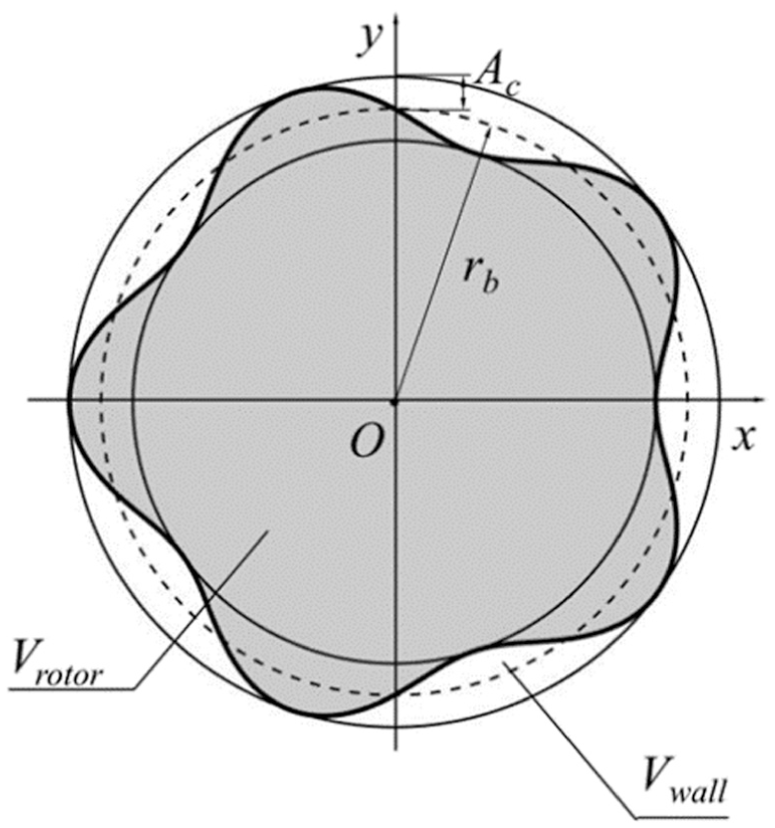
Schematic diagram of volume utilization of sine rotor.
When the sine rotor rotates through one full cycle, the variation range of the rotation angle t is [0, 2π]. During this rotation process, the volumetric utilization coefficient of the rotor indicates the extent to which the rotor utilizes the space of the pump chamber. The calculation formula for the volumetric utilization coefficient of the rotor can usually be expressed as:

where λ is the volume utilization coefficient. Vwall is the total volume of the pump chamber. Vrotor is the volume occupied by the rotor.
The calculation formula for the volume Vrotor occupied by the rotor is:

The overall volume Vwall of the pump chamber was calculated using the following formula:

Where L is the length of the intermediate rotor.
From (6), the calculation formula for the volumetric utilization coefficient is as follows:

From equation (9), the rotor volume utilization coefficient λ is only related to the base circle radius r b and the amplitude value A c , and is not related to the number of blades of the intermediate rotor.
Figure 6(a) illustrates the influence of the base circle radius on the volumetric utilization coefficient. When the value of amplitude A c is constant, the volumetric utilization coefficient exhibits a downward trend as the radius of the base circle increases. A larger base circle radius may decrease the volumetric utilization efficiency. Figure 6(b) illustrates the influence of the amplitude on the rotor volume utilization coefficient when the base circle radius r b is fixed. As the amplitude increased, the volume utilization coefficient gradually increased, indicating that within a certain range, appropriately increasing the amplitude can help improve the volume utilization efficiency.

Volumetric utilization coefficient of the sine rotor: (a) the influence of the base circle radius on the volumetric utilization coefficient and (b) the influence of sine amplitude on the volumetric utilization coefficient.
The volumetric utilization coefficient is an important indicator for evaluating the volumetric utilization performance of the rotor profile. The larger the volumetric utilization coefficient, the greater the space that can be utilized within one rotation of the rotor. This affects both the displacement and flow rate of the pump. Moreover, it is an important parameter for optimizing the design of the rotor profile. 24
Leakage analysis of double-acting swing scraper pump
During the operation of the double-acting scraper pump, not all hydraulic oil is smoothly discharged through the outlet. A small portion of the hydraulic oil is lost due to radial leakage and end-face leakage. Radial leakage in the double-acting scraper pump refers to the leakage caused by the gap between the tips of the rotor blades and the inner wall of the pump body. Because the gap between the rotor and the inner wall of the pump is small, the fluid movement within this gap can be considered laminar flow. 25 The radial leakage equivalent model of the double-acting scraper pump is illustrated within the black box at the top of Figure 7. This radial leakage can be effectively represented by a flow model between two parallel plates.

Radial leakage model of double-acting scraper pump.
When calculating gap leakage, it is assumed that the hydraulic oil behaves as an incompressible Newtonian fluid. The motion equation is described by the Navier-Stokes equation. For laminar flow between two parallel plates, the motion equation simplifies to:

where
The x-directional motion component of the fluid in the gap is:

When the three migration items are all zero, equations (2)–(20) can be simplified to a form that only contains the remaining non-migration items:

Where μ is the dynamic viscosity of the hydraulic oil.
At this point, the equivalent modal boundary conditions for the radial clearance are set as follows:

where ω is the angular velocity of the rotor.
By integrating equation (11) based on equation (12), we obtain:

where S is the total width of the rotor blades in the sealed cavity area; Δp is the pressure difference between the high-pressure chamber and the low-pressure chamber.
Based on the above parameter analysis, the radial leakage flow of the double-acting scraper pump can be expressed as:

Where Q
r
is the radial leakage quantity;
Figure 8(a) shows the trend of radial leakage flow Q r with respect to the gap height h1. As the gap height h1 increases, the radial leakage flow Q r increases non-linearly, and the leakage flow significantly increases under larger gap heights. Figure 8(b) shows the trend of radial leakage flow Q r as the rotor speed ω changes. As the rotor speed ω increases, the radial leakage flow Q r also increases; however, the rate of growth gradually diminishes. Regarding the radial leakage volume, the effect of rotor speed is relatively smaller compared to that of the radial clearance height. In practical design, optimizing the clearance height can effectively reduce leakage and enhance pump efficiency.

Curve showing the variation of radial leakage quantity of the double-acting scraper pump: (a) the trend of radial leakage flow Qr with respect to the gap height h1 and (b) the trend of radial leakage flow Qr as the rotor speed ω changes.
The end face leakage of the double-acting scraper pump refers to the phenomenon of medium leakage between the sliding bearing and the rotor, which is caused by factors such as lubrication and sealing. 26 The equivalent model of end-face leakage is shown in the blue box below Figure 7. This leakage mainly occurs in the gap between the middle rotor end face and the left and right sliding bearing end faces (the gap h2 shown in Figure 7).
The leakage of the rotor on one end surface can be expressed as:

Where h2 is the clearance between the rotor and the sliding bearing end face; R b is the inner radius of the sliding bearing.
The two sides of the rotor of the double-acting scraper pump have cross-sectional leakage. Therefore, the total cross-sectional leakage is:

Figure 9(a) shows the trend of the end face leakage flow rate Q t as the end face gap height h2 changes. As the end face clearance height h2 increases, the end face leakage flow Q t shows a non-linear upward trend, and especially in cases of larger clearances, the leakage flow significantly increases. Figure 9(b) shows the trend of the end-face leakage flow rate Q t with respect to the pressure difference Δp. As the pressure difference Δp increases, the end-face leakage flow Q t increases approximately linearly. This indicates that in the design of the pump, controlling the height of the clearance is particularly important for reducing leakage, while the influence of the pressure difference is more linear and predictable.

Curve showing the variation of end face leakage of the double-acting scraper pump: (a) the trend of the end face leakage flow rate Qt as the end face gap height h2 changes and (b) the trend of the end-face leakage flow rate Q t with respect to the pressure difference Δ p .
According to formula (16), it can be concluded that the larger the ratio of the rotor base circle radius to the inner radius of the sliding bearing, the smaller the end face leakage. Based on the above, it can be concluded that the total leakage of the double-acting scraper pump is the sum of the radial leakage and the end face leakage:

Based on the above analysis of the leakage in the double-acting scraper pump, it is evident that both radial leakage and cross-sectional leakage are influenced by the gap between the contact surfaces. Therefore, appropriately reducing this gap can help decrease the leakage volume. Additionally, increasing the ratio of the rotor base circle radius to the inner radius of the sliding bearing also contributes to reducing leakage.
This paper focuses on the geometric characteristics research of the double-acting scraper pump. Therefore, unless otherwise specified, in all theoretical calculations and kinematic simulations in this paper, the working medium is incompressible and isothermal. Changes in pressure and temperature are not considered, nor are pressure-temperature coupled deformations and viscosity changes. When deriving the performance parameters such as displacement, no leakage conditions are taken into account, and the data required for deriving the performance parameters are as shown in Table 1.
Performance calculation parameters of double-acting scraper pump.

Theoretical displacement equation of double-acting swing scraper pump
Theoretical displacement refers to the theoretical volume of fluid output by the rotor during one full rotation. When the rotor rotates once, the sealed volume of the scraper pump is filled twice. Therefore, the displacement of the pump can be calculated using the following formula:

Reduce it to its simplest form:

From equation (20), it can be seen that the displacement
Theoretical average flow rate of double-acting swing scraper pump
The theoretical average flow rate Qavg of the double-acting scraper pump represents its conveying capacity under ideal operating conditions, that is, the volume of fluid discharged per unit time without considering leakage and efficiency loss. It is an important parameter in pump design and is commonly used to evaluate the performance and conveying capacity. The expression for the theoretical average flow rate of the scraper pump is:

Reduce it to its simplest form:

where n is the rotational speed of the rotor in r/s; ω is the angular velocity of the rotor in rad/s.
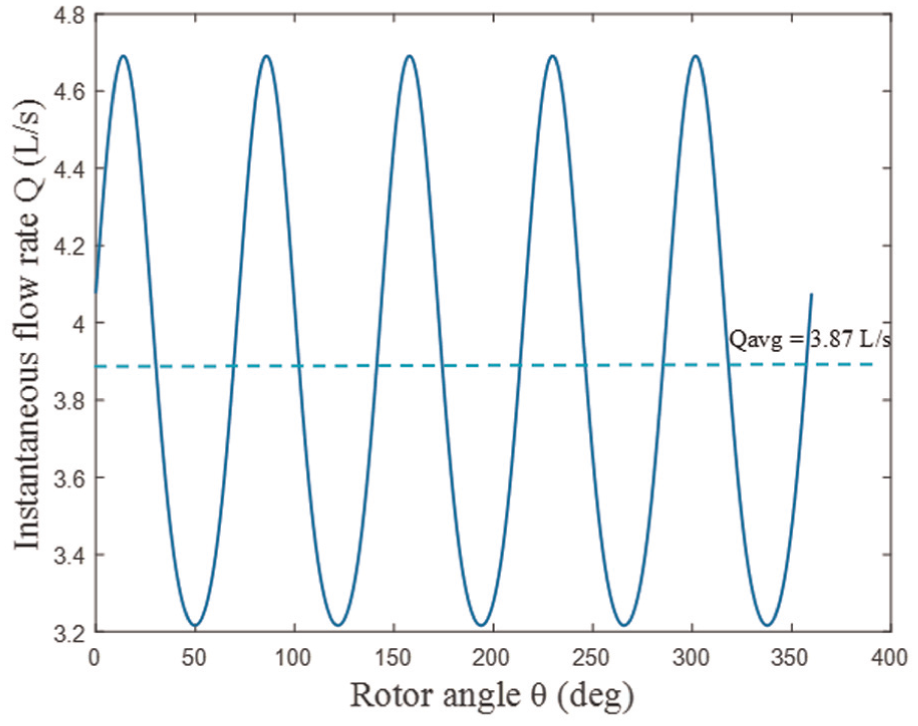
From equation (22), it can be seen that the theoretical average flow rate Qavg of the scraper pump is related to the rotor base circle radius r b , sine amplitude A c , width L of the rotor, and rotational speed n of the rotor. The design of the prototype in this article has a base circle radius of 29.3 mm, a sine amplitude of 2.8 mm, a rotor width of 100 mm, a rotor speed of 2200 r/min, and an average flow rate of approximately 3.87 L/s.
Theoretical instantaneous flow rate of double-acting swing scraper pump
The theoretical instantaneous flow rate of the double-acting scraper pump is an important parameter that can reflect its instantaneous flow characteristics and provide a reference for the optimization design of the pump. The double-acting scraper pump, mainly featuring a five-blade rotor, has a rotor profile formed by a completely smooth curve through the rotation of five identical sine curves. Therefore, it was sufficient to analyze the fluid characteristics of the pump when the rotor rotated by 2π/5.
Taking the center O of the rotor as the coordinate origin, using the line connecting the center of the rotor and the swing center of the scraper as the y-axis, and drawing an axis perpendicular to the y-axis through the center of the rotor as the x-axis, a rectangular coordinate system was established, as shown in Figure 10. Figure 10(b) shows the position of the rotor after it rotates counterclockwise by an angle of dθ.

Diagram for deriving theoretical instantaneous flow rate: (a) The initial angle of the rotor position; (b) The angle after the rotor rotates by dθ.
During a very short period of time dt, the rotor rotates through a very small angle of dθ, and the volume of the fluid in the pump changes by dV. The formula is:

From the inversion method, it can be determined that when the rotor rotates counterclockwise by an angle of dθ, it is equivalent to the pump body rotating clockwise by the same angle of dθ. Using the inversion method to calculate the area of dS1, the formula is:

Similarly, the area formula for dS2 is:

Combining the above equations, when the rotor rotates through an angle of dθ within a very short time of dt, the theoretical instantaneous flow rate Q of the scraper pump is:
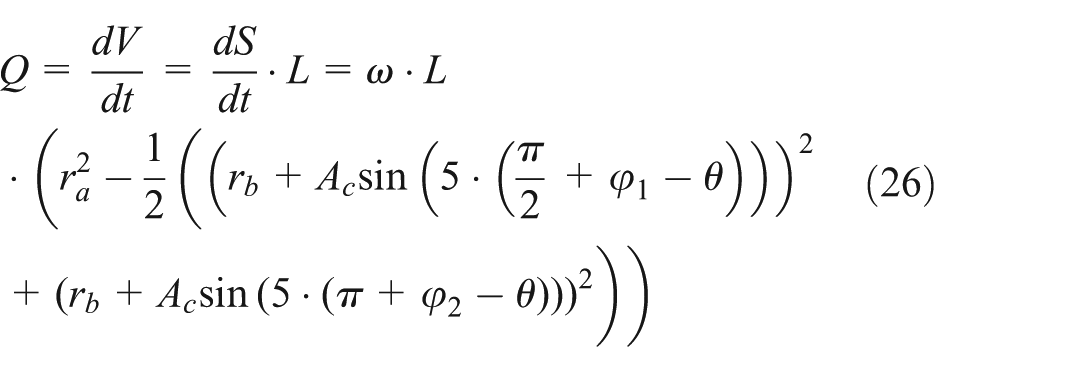
When the angular velocity ω is 230.38 rad/s, rotor width L is 100 mm,
Instantaneous flow curve of the five-blade rotor.
Figure 11 shows the instantaneous flow variation curve of the five-blade rotor. The instantaneous flow rate Q shows a distinct periodic fluctuation with respect to the rotor rotation angle θ, conforming to the variation pattern of a sine curve. The flow rate ranged between 3.2 and 4.8 L/s, indicating that the output flow rate of the pump varied significantly at different rotation angles. Owing to the structural characteristics of the five-blade rotor, the pulse frequency of the flow rate was five times per revolution, and the pulse amplitude was approximately 1.6 L/s. Although there are pulses, the flow rate variation is relatively stable, indicating that the double-acting scraper pump has good stability and can stably output the flow rate. Meanwhile, the dotted lines shown in the figure represent the average theoretical displacement, which is consistent with the calculated result, thereby verifying the accuracy of the derived theoretical instantaneous flow rate.
Geometric relationship between the swing angle of the scraper and the rotation of the rotor
The up-and-down swinging scraper of the double-acting scraper pump serves as the core component, and its motion characteristics play a crucial role in influencing the performance of the pump. Torsion springs were installed at the front ends of the upper and lower scrapers. By generating additional torque, they maintained a constant pressure between the scrapers and the rotor, ensuring their sealing and stability and enabling the synchronous movement of the scrapers and rotor. The center of the swing of the scraper fixed. The key to its movement lies in determining the position variation rule of the curvature center of the contact end profile line of the scraper relative to the rotation center of the rotor, that is, the accompanying trajectory of the scraper.
Based on the sinusoidal rotor profile, the coordinate system shown in Figure 12(a) was established. Suppose the polar coordinates of the rotor profile are (

Trajectory of the five-blade rotor and the scraper: (a) Trajectory diagram including rotor profile lines; (b) Remove the trajectory diagram of the rotor profile.
Figure 12(b) is obtained by removing the rotor contour from Figure 12(a). In the figure, N1N1 is the tangent line of the scraper accompanying trajectory at point C, MM is the normal line and r0 is the radius of the base circle of the accompanying trajectory. C0 is the intersection point of the arc drawn with AC as the radius and the base circle;
Based on the vector relationship, the polar radius
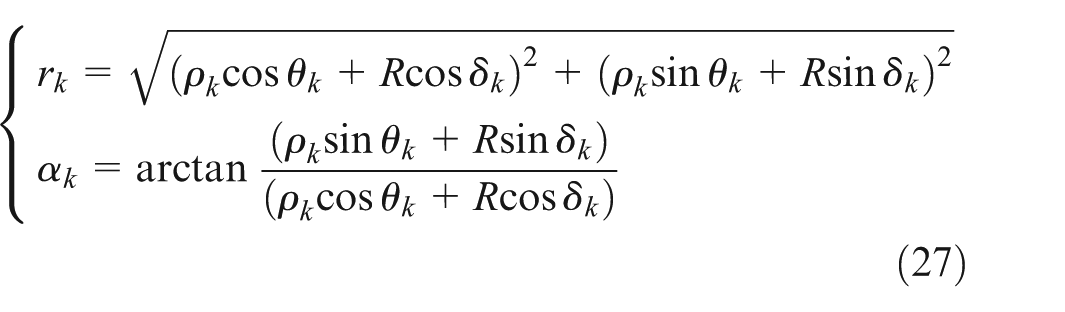
After a simple derivation, the expressions for



Where
Through geometric reasoning and theoretical derivation, the expression for the swing angle

where h is the distance from the rotation center of the rotor to the swing center of the scraper. l is the length of the scraper.

The specific expression for the scraper pressure angle is:

where τ is the angle between the scraper AC and radial direction OC, and its expression is:

When the rotational angle of the rotor is φ
k
, the angular velocity of the scraper is

where ω is the angular velocity of the rotor.
The angular acceleration ε of the scraper can be obtained by taking the first derivative of the angular velocity of the scraper with respect to time t. The expression is:

where ε is the angular acceleration of the scraper. Ω is the angular velocity of the scraper. φ is the rotation angle of the rotor.
The calculation of angular acceleration requires combining the use of MATLAB software to calculate the angular velocity of the scraper and the rotation angle of the cam. Then, using the curve fitting toolbox of this software, the method of approximation with a sine curve (sum of sine) was selected to fit the relationship curve between Ω and φ. The fitting formula is:
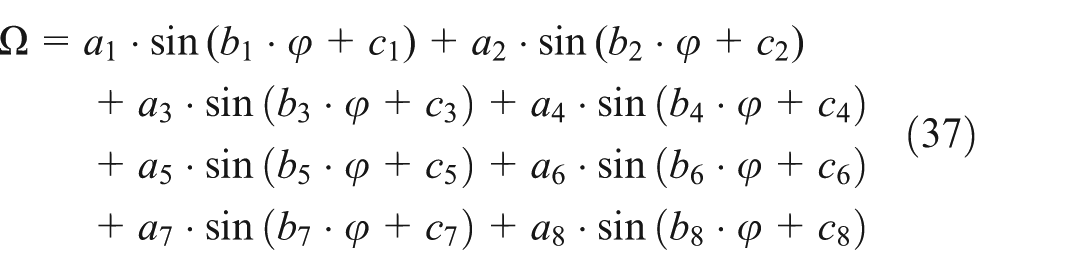
where a1,b1,c1,a2,b2,c2,… are coefficients, as obtained from the software MATLAB, and the specific size is as shown in Table 2.
The specific values of the coefficients.

The derivative of the scraper angular velocity with respect to the rotor angle, dΩ/dφ, is:

By combining formulas (27) and (28), the angular acceleration ε of the scraper can be obtained.
Verification of the geometric characteristics of the rotor and scraper of the double-action swing scraper pump
The basic structural parameters of the prototype designed in this paper are as shown in Table 3.
Basic parameters of the double-acting scraper pump.

Based on the input conditions described above, the kinematic characteristics of the five-blade rotor swing scraper pump were calculated using MATLAB. The model of the five-blade rotor swing scraper pump was created in ADAMS, where contacts, connections, drives, and other components were defined. The rotor speed was set to 2200 r/min, and the initial state for the simulation was chosen as the position where the five-blade rotor is symmetrical about its left and right sides. To verify the accuracy of the calculation results, the first four cycles of the scraper pump operation were selected for validation.
Figure 13 presents the comparison curves of the theoretical and simulated values of the swing angle, angular velocity, and angular acceleration of the scraper of the double-acting scraper pump. The results show that when the rotor of the double-acting scraper pump rotates one full circle, the scraper undergoes five swings. In Figure 13(a), the theoretical peak value of the scraper’s swing angle is 28.343°, while the simulation peak value is 28.867°, with an error of only 1.85%, verifying the accuracy of the theoretical derivation. In Figure 13(b), the angular velocity of the scraper is divided into the return process and the push process. During the return process, the theoretical peak angular velocity is 218.45 rad/s, while the simulated peak angular velocity is 237.86 rad/s, with an error of 3.12%; During the push process, the theoretical peak angular velocity is 404.50 rad/s, and the simulated peak angular velocity is 435.25 rad/s, with an error of 4.94%. In Figure 13(c), the angular acceleration of the scraper experiences significant fluctuations in the initial stage. This is due to the presence of a small gap between the rotor and the scraper, and the collision between the rotor and the scraper. During the return process, the peak value of the theoretical angular acceleration was 3.52 × 10⁵ rad/s2, while the peak value of the simulation angular acceleration was 3.81 × 10⁵ rad/s2, with an error of 2.47%. During the forward process, the peak value of the theoretical angular acceleration was 8.20 × 10⁵ rad/s2, while the peak value of the simulation angular acceleration was 3.81 × 10⁵ rad/s2, with an error of 1.11%.

Theoretical and simulation results curves: (a) Angle variation curve, (b) Angular velocity variation curve, and (c) Curves of angular acceleration variation.
From the above conclusion, it can be seen that the theoretical and simulation results of the scraper in the double-acting scraper pump have the same trend of change, both showing periodic variations, and the errors are all below 5%, which indicates the correctness of the geometric analysis of the scraper. Additionally, the curves change rapidly near the peak values, further demonstrating the high response characteristic of the scraper.
Conclusion
As a new type of volumetric pump with high operational efficiency, compact structure and high working efficiency, the double-acting scraper pump can be applied in a wide range of industrial scenarios. Through in-depth research on the geometric characteristics of the double-acting scraper pump, the following conclusions have been drawn:
(1) The structure of the double-acting scraper pump and the rotor profile are introduced. The sinusoidal profile is selected as the rotor profile, and a unified profile equation applicable to any number of blades is established. Taking the five-leaf rotor as an example, the curvature variation curve is obtained. The results show that the curvature changes periodically, with a fluctuation range of approximately −0.04 to 0.1. The curve presents a smooth sinusoidal waveform, indicating that the sinusoidal rotor has good smoothness. The volume utilization coefficient equation was derived and the corresponding variation curve was plotted. The volume utilization coefficient depends on the base circle radius r b and the amplitude A c . A larger base circle radius may lead to a decrease in volume utilization efficiency. Appropriately increasing the sine amplitude helps improve the volume utilization coefficient, laying the foundation for the design of multi-blade rotors and the optimization of rotor profiles.
(2) An equivalent leakage model for the double-acting scraper pump was developed, and equations for radial leakage and end-face leakage were derived. Corresponding leakage variation curves were plotted. The results indicate that by properly controlling the contact gap and increasing the ratio of the rotor base circle radius to the inner circle radius of the sliding bearing, the increase in leakage can be effectively managed. At the same time, through theoretical analysis, the performance parameters such as displacement and flow rate of it were derived. Based on the parameters of the prototype, the theoretical average flow rate was calculated to be approximately 3.87 L/s. The instantaneous flow rate variation curve was plotted, with the flow range being between 3.2 and 4.8 L/s. The curve exhibited a stable periodic variation, indicating a smooth change in flow rate. The average flow rate was consistent with the calculated value, thereby confirming the accuracy of the theoretical analysis. This provides a solid theoretical foundation for the design of the non-pulsating scraper pump.
(3) An in-depth study was conducted on the geometric relationship between the swinging angle of the scraper in the double-acting scraper pump and the rotation of the rotor. Through geometric characteristics and theoretical analysis, the equations for the swing angle, angular velocity, and angular acceleration of the scraper were derived. Based on the geometric characteristic equations of the scraper and through the simulation analysis of the scraper using the ADAMS software, the theoretical and simulation result curves of the corresponding equations of the scraper were obtained. By comparison, the theoretical results of the scraper and the simulation results exhibit consistent variation trends. The error in the scraper’s swing angle is approximately 1.85%, the maximum error in angular velocity is about 4.94%, and the maximum error in angular acceleration is approximately 4.47%. All the errors are less than 5%, which proves the correctness of the geometric analysis of the scraper and provides a reliable basis for the development of the prototype and performance optimization.
Footnotes
Handling Editor: Aarthy Esakkiappan

Ethical considerations
This article does not contain any studies with human or animal participants.
Consent to participate
Not applicable.
Consent for publication
Not applicable.
Author contributions
Conceptualization H.Z.; methodology, Q.Z. and Z.Z.; software, Q.Z. and C.W.; validation, H.Z., Q.Z., and Z.Z.; formal analysis, C.W.; investigation, M.L.; resources, H.Z.; data curation, Q.Z., Z.Z., and S.Z.; writing—original draft preparation, Q.Z.; writing—review and editing, H.Z. and M.L.; visualization, Q.Z.; supervision, C.W.,S.Z., and M.L.; project administration, H.Z.; funding acquisition, H.Z. All authors have read and agreed to the published version of the manuscript.
Funding
The authors disclosed receipt of the following financial support for the research, authorship, and/or publication of this article: This research was funded by the National Natural Science Foundation of China (project number 52075278); the Qingdao Science and Technology for the Benefit of the People Demonstration Project (project number 24-1-8-cspz-2-nsh); the Shandong Province’s Technological Innovation Guidance Program (project number YDZX2025107); and the Key Technology Research and Development Program of Shandong Province (2025TSGCCZZB0239).
Declaration of conflicting interests
The authors declared no potential conflicts of interest with respect to the research, authorship, and/or publication of this article.
Data availability statement
The datasets generated during and/or analyzed during the current study are available from the corresponding author on reasonable request.