



Abstract
This paper develops a gradient-enhanced finite-strain crystal plasticity framework with two distinct intrinsic length scales associated with lattice incompatibility and higher-order orientation gradients. The formulation is built on a curvature-based description of elastic rotation and its associated incompatibility measures, and it provides a clear separation between dislocation-driven mechanisms and curvature-gradient (disclination-type) mechanisms within a unified kinematic setting. A differential-geometric interpretation is used to connect these measures to torsion- and curvature-type incompatibilities, thereby clarifying the physical meaning of the additional fields and the origin of size effects. The constitutive structure is posed within a thermodynamically consistent internal-variable framework, yielding coupled relations for classical stress and higher-order stress measures, along with the corresponding balance laws at multiple scales. Analytical validation is established through a set of canonical boundary-value problems. A benchmark single-crystal strip in simple shear demonstrates size-dependent hardening under constrained deformation and reveals boundary-layer formation. Complementary analytical studies treat torsion of a cylindrical bar, bending of a crystal plate, and a bicrystal tilt boundary, providing closed-form reductions that highlight how the two length scales govern the localization of orientation gradients and the spatial organization of defect-related fields. A finite-element implementation is then presented, including an integration-point constitutive update and a mixed variational formulation tailored to the higher-order structure of the theory. Numerical simulations of cantilever micro-bending quantify thickness-dependent strengthening and distinguish the roles of curvature-amplitude strengthening versus curvature-gradient regularization. Finally, the computed micro-bending trends are compared with reported single-crystal copper micro-beam experiments, demonstrating that the proposed two-length framework captures the primary thickness dependence while offering a unified continuum route to incorporate defect geometry into predictive crystal plasticity simulations.
Introduction
Crystal plasticity modeling is a cornerstone of modern solid mechanics and materials science, offering critical insights into the mechanical behavior of crystalline materials under complex loading conditions. The primary challenge lies in developing constitutive frameworks that accurately capture the anisotropic response driven by crystallographic slip while also accounting for microstructural phenomena such as dislocation interactions, lattice curvature, and subgrain formation. Classical crystal plasticity models, rooted in the multiplicative decomposition of the deformation gradient
The absence of length scales in classical models stems from their focus on homogeneous deformation fields, neglecting the spatial gradients associated with microstructural defects like geometrically necessary dislocations (GNDs). GNDs arise to accommodate lattice incompatibilities caused by non-uniform plastic deformation, significantly influencing mechanical responses at small scales.3,35 For instance, phenomena such as the Hall-Petch effect, where yield strength increases with decreasing grain size, or the enhanced hardening observed in micro-scale torsion, underscore the need for models that incorporate gradient effects.10,11 To address these limitations, strain gradient plasticity (SGP) theories have emerged, introducing higher-order stresses and energetic length scales to capture the effects of strain gradients and defect density.19,27
The concept of strain-gradient plasticity (SGP) was first introduced in the pioneering works of Aifantis,1,2 who emphasized the role of internal length scales in regularizing plasticity models. Later developments, such as Fleck and Hutchinson, 19 extended these ideas into higher-order continuum frameworks, demonstrating that strain gradients introduce size-dependent hardening through additional energetic contributions. Gurtin and Anand 27 and Gurtin 26 extended these concepts to single-crystal plasticity, incorporating GNDs within a microforce balance framework that accounts for the work conjugate to plastic strain gradients. Similarly, Acharya and Bassani 3 proposed a theory where the incompatibility of the plastic distortion field directly informs the dislocation content, linking lattice curvature to defect density. From a computational perspective, prior work has demonstrated that complex constitutive systems can be implemented in robust finite-element settings once the internal variables and their evolution equations are cast in a thermodynamically consistent form; see, for example, the implementation-oriented development of evolving internal state variables in He et al. 31 These advancements highlight the importance of embedding microstructural length scales into constitutive models to capture phenomena driven by non-local effects.
Among gradient-enhanced models, Bammann’s contributions8,9 are particularly notable for introducing a natural length scale through a curvature tensor defined as
To overcome these shortcomings, micromorphic and higher-order theories have been proposed. Eringen and Claus 17 introduced a micromorphic approach that accounts for additional degrees of freedom associated with micro-rotations, providing a framework to model disclination effects. Forest and Sievert 23 and Forest 24 further developed micromorphic crystal plasticity models, incorporating lattice curvature and micro-deformation fields to capture size effects and defect evolution. Ohno and Okumura 36 and Steinmann 38 explored higher-order stress contributions, demonstrating their role in regularizing strain localization and enhancing hardening predictions. These efforts underscore the need for a unified framework that integrates both curvature and its gradients to fully describe the geometric complexity of defect fields.
The present work proposes a novel crystal plasticity model that systematically incorporates two internal length scales associated with lattice curvature and its gradient. Building on Bammann’s curvature-based approach,
9
the framework is extended to include higher-order effects by introducing the gradient of the curvature tensor,
By incorporating both
Recent developments in strain-gradient and higher-order plasticity theories have highlighted the importance of internal length scales in capturing size-dependent phenomena such as strain localization, strengthening in small-scale crystals, and dislocation patterning.1,19,24,26 While conventional formulations often rely on phenomenological gradients of plastic strain, our approach embeds these effects into a rigorous geometric framework grounded in differential geometry.
Specifically, the model is formulated on a Riemann–Cartan manifold, where dislocations and disclinations arise naturally as torsion and curvature of the material connection. The elastic rotation
The dual internal length scales of the present model acquire a clear physical interpretation:
Beyond interpretation, the two-length-scale structure has concrete computational benefits. First, the energetic embedding of torsion and curvature terms yields well-defined generalized stresses and higher-order boundary conditions, which clarifies what must be prescribed (or left natural) in boundary-value problems and supports a systematic weak formulation suitable for finite-element discretization. Second, the distinct numerical roles of
In this way, the model provides not only a higher-order energetic extension of multiplicative plasticity, but also a genuine differential-geometric foundation. Section 3 develops this framework in detail, explicitly introducing connections on
The remainder of this paper is structured as follows:
Kinematics: This section establishes the kinematic framework, detailing the multiplicative decomposition of the deformation gradient, polar decomposition, velocity gradient, and definitions of the curvature tensor
Geometric interpretation: A differential geometric framework is developed, linking curvature and its gradient to torsion and curvature in a Riemann–Cartan manifold, providing a rigorous description of defect-induced incompatibilities.
Thermodynamics: A thermodynamically consistent model is formulated, incorporating internal variables into a generalized Helmholtz free energy and deriving constitutive relations for stresses and higher-order moment stresses.
Crystal plasticity model: The model couples backstress and moment stress to crystallographic slip evolution, using a power-law flow rule and specifying the evolution of statistically stored dislocations.
Balance laws at multiple scales: Mesoscopic and macroscopic balance laws are derived to account for internal stress and couple stress fields, ensuring regularization of strain localization.
Analytical validation: Beyond simple shear of a single-crystal strip—where the framework is compared against classical single-slip formulations and shown to reproduce size-dependent hardening consistent with established theories—analytical reductions are presented for bending of crystal plates, torsion of cylindrical bars, and bicrystal tilt boundaries. These examples highlight the distinct roles of the two internal length scales:
Finite element simulations and comparison with experiments: This section details the finite-element formulation and the local constitutive update used for the computational implementation. The same section presents some numerical simulations, with emphasis on cantilever micro-bending size effects and comparisons with representative experimental trends.
Conclusion: The model’s contributions are summarized, emphasizing its thermodynamic and geometric rigor and outlining potential for future additional analytical or numerical investigations.
Kinematics
The formulation of finite-strain crystal plasticity relies on a precise kinematic framework to capture large deformations, rotations, and their gradients, which are essential for constitutive modeling and numerical implementation. 13 Unlike infinitesimal plasticity theories limited to small displacements, finite-strain models accommodate arbitrary deformations and microstructural incompatibilities, such as those induced by dislocations and disclinations. 26 This section establishes the kinematic foundation for a gradient-enhanced crystal plasticity model incorporating two internal length scales, associated with lattice curvature and its gradient, to address size-dependent phenomena.
Multiplicative decomposition of the deformation gradient
The kinematic description begins with the multiplicative decomposition of the deformation gradient

where
Before introducing the curvature and disclination measures, it is useful to recall the role of the intermediate configuration in the multiplicative decomposition and to specify where Curl operations are consistently evaluated.
The intermediate configuration

and the disclination density:

are consistently evaluated in
To avoid any ambiguity between different classes of variables, the present framework explicitly distinguishes between the degrees of freedom, state variables, and internal variables. The degrees of freedom are the primary kinematic fields, such as the deformation gradient and the elastic rotation, which evolve from balance laws. The state variables are those that enter the Helmholtz free energy, namely the elastic strain, curvature tensor, and disclination density, which define reversible energetic contributions. Finally, the internal variables represent history-dependent quantities, such as the statistically stored dislocation density, that evolve according to phenomenological laws and capture dissipative microstructural mechanisms. Table 1 summarizes this taxonomy, ensuring clarity in the logical structure of the model.
Classification of variables in the dual-length-scale crystal plasticity model.

DOFs: degrees of freedom; SSD: statistically stored dislocation.
Polar decomposition and velocity gradient
To incorporate lattice rotations, the elastic deformation gradient

where

The velocity gradient

with:
Equation (4) decomposes the deformation rate into elastic, rotational, and plastic components, consistent with finite-strain kinematics. 8
To analyze these quantities in the intermediate configuration

A transformation of equation (4) yields:

where:
The components are split into symmetric and skew-symmetric parts:

where
Curvature tensor and geometrically necessary dislocations
Lattice incompatibility due to geometrically necessary dislocations (GNDs) is quantified by the curvature tensor:

where

with
Geometrically necessary dislocations emerge to accommodate nonuniform slip, and their density is represented by the curvature tensor
Curvature gradient and disclination effects
Higher-order incompatibilities, associated with disclinations, are captured by the disclination density tensor:

with components:

This tensor measures the spatial variation of lattice curvature, introducing a second length scale tied to rotational non-uniformity.
17
Disclinations are critical in materials undergoing large rotations, twinning, or grain boundary evolution, contributing to subgrain formation and enhanced hardening.
24
By including
These higher-order tensors are not only formal geometric objects but also possess clear experimental significance, as illustrated below.
The curvature tensor

becomes nonzero in regions of sharp misorientation such as grain boundaries or twin interfaces, which can be characterized by EBSD kernel misorientation or Laue diffraction mapping. This correspondence provides a direct bridge between the geometric tensors of the model and experimentally accessible quantities.
Geometric interpretation
The present gradient crystal plasticity model is grounded in a differential-geometric framework where internal variables naturally align with the constructs of a Riemann–Cartan manifold.
39
In such a setting, the elastic rotation
The crystal as a differentiable manifold
The reference configuration

In the presence of defects, global compatibility fails, and the manifold must be described with a nontrivial connection possessing torsion and curvature.
Within the multiplicative decomposition,

the plastic part
Connections on
Let

Equivalently, for the rotation tensor itself,

where
Torsion and dislocations
The torsion tensor is the skew part of the connection acting on the basis vectors,

with
In terms of the elastic rotation, torsion reduces to the lattice curvature tensor:

This tensor coincides with the density of geometrically necessary dislocations (GNDs) introduced in the kinematic formulation. Thus, dislocations are identified with torsion in the Riemann–Cartan framework.
To quantify dislocation content explicitly, one recovers the Kröner–Bilby relation,

where
Curvature and disclinations
The curvature of the connection is obtained from the commutator of covariant derivatives,

A nonzero curvature indicates rotational mismatch of the lattice frame upon parallel transport around a closed loop, corresponding to disclinations with nonzero Frank vector.
In our framework, curvature is captured by the disclination density tensor:

Thus, torsion
Incompatibility in Riemann–Cartan geometry
In a conventional (Riemannian) elastic body, compatibility requires that the deformation gradient

ensuring that the strain field is compatible with a single-valued displacement field
In a Riemann–Cartan manifold, incompatibility arises naturally from nonzero torsion and curvature:
The torsion tensor
The curvature tensor
Thus, dislocations and disclinations are not auxiliary constructs, but intrinsic geometric features of the connection on the intermediate configuration.
Compatibility conditions
A defect-free state is recovered when both torsion and curvature vanish:

In this limit,
Energetic embedding with dual length scales
The Riemann–Cartan interpretation motivates a natural embedding of incompatibility into the free energy. The dual length scales

Here,
These terms extend the conventional multiplicative decomposition
The framework of
Thermodynamics
The present section develops a thermodynamically consistent internal variable model for finite-strain crystal plasticity, extending the classical framework of Anand and Gurtin. 6 Following the conventional structure of continuum thermodynamics, the Helmholtz free energy is first postulated as a function of the chosen state variables; the internal power is then defined in terms of standard and higher-order stresses; and finally, the dissipation inequality is derived in general form and subsequently reduced using the corresponding energetic conjugates. This sequence ensures that the reduced dissipation inequality emerges naturally from the free-energy postulate and the internal power statement, in accordance with the classical approaches of Coleman–Noll, Germain, and Gurtin.
The formulation is inspired by continuum dislocation theory3; however, the generalized defect energy is postulated in quadratic form in order to capture both torsion- and curvature-driven mechanisms, incorporating geometrically necessary dislocations (GNDs) and disclinations through higher-order tensorial measures. Defined in the intermediate configuration, the model accounts for lattice curvature and its gradient, thereby introducing two intrinsic length scales associated with dislocation and disclination fields. These length scales enable the prediction of size-dependent phenomena, such as enhanced hardening and strain localization, which are critical for microscale applications.19,27
Internal variables and curvature measures
To capture the microstructural effects of GNDs and disclinations, the Helmholtz free energy

where
The SSD variable is defined as:

where
Constitutive relations from free energy
Assuming


where
These general Coleman–Noll relations provide the thermodynamic structure of the theory. To obtain explicit constitutive laws, the form of the Helmholtz free energy is specified next.
Free energy specification
Guided by the physical mechanisms of elasticity, dislocation curvature, and disclination density, a quadratic Helmholtz free energy functional is proposed that incorporates energetic contributions from elastic strain, SSDs, curvature, and curvature gradients, motivated by prior gradient plasticity models19,24:

where
Substituting this free energy into the constitutive framework of Section 4.2 yields explicit expressions for the stresses, presented next.
Resulting constitutive equations
Differentiating the free energy equation (28) with respect to its arguments yields the constitutive relations:




where
Connection to balance laws
The micro- and macro-balance equations presented in this section follow directly from the principle of virtual power applied to standard and higher-order stresses. The explicit derivation is provided here to clarify the role of the curvature tensor
Let
Internal and external virtual power


Here
Linearization of virtual measures
Use is made of the standard kinematic linearizations (details omitted here):

Integration by parts (adjoint identities)
Applying tensorial Green-type identities (adjoint of


where
Principle of virtual power
Enforcing
Field (Euler–Lagrange) equations in


where
Natural boundary conditions on



Comment on equation (54) and slip-system form
Equation (54) in the manuscript is the specialization of the micro-balance (equation (39)) written in the intermediate configuration
Having established the micro- and macro-balance equations through the principle of virtual power, the thermodynamic consistency of the framework is now addressed. In particular, the reduced dissipation inequality in the intermediate configuration is derived, ensuring that the constitutive choices introduced above are compatible with the second law of thermodynamics.
Reduced dissipation inequality in the intermediate configuration
Following standard nonequilibrium thermodynamics,6,27 the local form of the second law in the intermediate configuration is obtained by combining the balance of energy, the entropy inequality, and the definition of the Helmholtz free energy. Specifically, the first law reads:

while the entropy inequality is:

Introducing the Helmholtz free energy

where
The mapping of the Cauchy stress

where

The stretching is split into elastic and dissipative parts,

The chain rule yields:

Thermodynamic consistency requires the identification of reversible forces,

together with the conjugacy relation:

Substituting equations (47) and (48) into equation (45), and applying equations (49) and (50), all reversible contributions cancel. The inequality reduces to the reduced dissipation inequality:

in the intermediate configuration.
Finally, the constitutive equation (49) couple naturally with the balance laws. The backstress
Crystal plasticity model
To formulate a thermodynamically consistent crystal plasticity model that accounts for size-dependent phenomena, the internal stresses derived in the preceding sections—namely, the backstress
Recent advances in gradient-enhanced crystal plasticity have sought to incorporate length scales through various microstructural mechanisms. Acharya and Bassani 3 introduced the Curl of the elastic distortion into hardening laws to account for lattice incompatibility. Shu and Fleck 37 proposed slip-gradient contributions to the critical shear stress, enhancing size effects in micro-scale deformation. Steinmann 38 incorporated second-order gradients of the plastic deformation gradient to define internal stresses on slip systems, while Forest 24 developed a micropolar crystal plasticity framework that accounts for micro-rotations. Acharya and Beaudoin 4 utilized lattice curvature to predict stage IV hardening, demonstrating the role of GNDs in large-strain deformation. Building on these works, the present model integrates curvature and curvature-gradient effects into a unified constitutive framework, leveraging the thermodynamic structure established earlier.
For a crystalline material with slip systems defined by unit normal


where
The slip rate

where
The operator “:” denotes the double contraction. For two second-order tensors

The gradient term
To close the constitutive model, the evolution of the SSD density

where

where the GND density

approximating the scalar projection of
The evolution of

where

so that:

This evolution law introduces length-scale dependence through
The physical interpretation of this coupling mechanism between SSDs and GNDs is summarized below, clarifying how it differs from classical hardening models.
The interaction between SSDs and GNDs is central to the present framework. As GND density increases through lattice curvature, the mean free path of mobile dislocations decreases, which accelerates SSD storage. Consequently, regions with strong gradients accumulate both GNDs and SSDs, leading to enhanced isotropic hardening. This differs from classical models where SSDs evolve independently of GNDs. The proposed coupling mechanism captures stronger size effects and more pronounced hardening during large plastic deformation, consistent with experimental trends in small-scale crystals.
The backstress

where

allowing

and the backstress follows from the constitutive relation:

where
In summary, the proposed crystal plasticity model integrates gradient effects through the curvature tensor
Balance laws at multiple scales
The presence of geometrically necessary dislocations (GNDs) and disclinations in crystalline materials introduces internal stress and couple stress fields that classical continuum mechanics cannot capture.24,26 These defects, arising from lattice incompatibilities, necessitate a multi-scale formulation of balance laws that incorporate contributions from the dislocation density tensor
Mesoscopic scale
At the mesoscopic scale, balance laws are enhanced to account for incompatibilities in the elastic strain and curvature fields driven by GNDs and disclinations. The dislocation density tensor

where
The internal stress

where
The disclination density tensor

where

where
The mesoscopic balance laws are derived from the principle of virtual work, incorporating contributions from internal stresses and couple stresses. The linear momentum balance for the internal stress field is:

ensuring that the dislocation-induced stress is divergence-free, thus self-equilibrated within the mesoscopic domain. 6 The angular momentum balance, accounting for the interaction between couple stresses and the skew-symmetric part of the internal stress, is expressed as:

where
The interconnection between these equations is evident through the coupling of defect fields. Substituting
Macroscopic scale
At the macroscopic scale, the classical balance laws of continuum mechanics are recovered, as the effects of internal stresses and couple stresses are homogenized. The conservation of linear momentum is given by:

where

ensuring that no net macroscopic couple stresses arise from external loading.
27
These macroscopic balance laws involve not only the standard Cauchy stress but also implicit contributions from the higher-order fields
Remarks
The present formulation provides a consistent extension of higher-order crystal plasticity models, combining energetic and balance considerations in a way, that is, both mathematically structured and physically motivated. The internal stress
Analytical validation
To validate the proposed gradient crystal plasticity model with two internal length scales, an analytical solution for the simple shear of a single crystal strip is derived, this benchmark problem induces non-uniform deformation and engages the model’s gradient-enhanced features.6,26 The strip, of height
Problem formulation
A single crystal strip, that is, infinite in the

from which the only non-zero component of the deformation gradient is the shear strain,

A single active slip system is assumed in the intermediate configuration, characterized by the slip direction
The boundary conditions are specified at the macroscopic and microscopic levels. At the macroscopic level, the displacement field satisfies:

where

The analysis is conducted under the assumptions of small elastic strain (i.e.

(The approximation

For small rotation angles
The lattice curvature is measured by the third-order tensor

From this, the disclination density tensor is defined as:

where
To account for size effects and internal resistance due to geometrically necessary dislocations (GNDs), the internal backstress tensor is introduced as:

and the higher-order moment stress tensor is given by:

where
The plastic flow rule is modified to incorporate these nonlocal effects, following the thermodynamically consistent frameworks proposed in Bammann 9 and Forest. 24 In the absence of rate dependence, the resolved shear stress driving slip is given by:

and is subject to a critical stress condition modified by the presence of statistically and geometrically stored dislocations, as developed in subsequent sections.
Analytical solution
The deformation is characterized by a shear displacement in the

Applying the standard multiplicative decomposition

where
The elastic rotation tensor, linearized for small angles, is approximated by:

From this, the curvature tensor is defined as:

and the disclination density follows as:

The backstress and couple stress tensors are thus given by:

The local flow rule, accounting for backstress and SSD hardening, reads:

The mesoscopic balance laws yield the following nontrivial conditions:


These imply:

The macroscopic equilibrium

At steady state, the statistically stored dislocation density satisfies:

Solving the quadratic yields:

and substituting back into the flow rule gives the closed-form expression:

Approximating
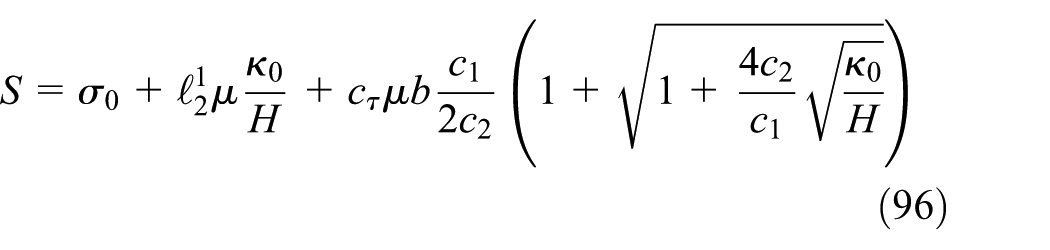
Finally, the average shear strain is composed of the elastic and plastic contributions:

where the plastic strain field is taken to be:

satisfying the boundary conditions
Validation and discussion
The closed-form expression for the shear stress,

exhibits a clear dependence on the sample height
In contrast, classical crystal plasticity models, which neglect gradient contributions (i.e.

failing to capture the observed strengthening in micron-scale specimens. The inclusion of the backstress
Moreover, although the disclination-related moment stress
The model’s predictions are in qualitative agreement with both numerical solutions of gradient-enhanced plasticity theories 6 and experimental studies reporting grain- and sample-size effects. This consistency confirms the model’s capability to embed intrinsic material length scales into a physically motivated continuum framework, thereby extending the descriptive power of classical plasticity into regimes where gradient effects cannot be neglected.
Additional analytical illustrations of curvature and disclination effects
To demonstrate in concrete terms how the proposed dual-length-scale model activates both curvature (

with generalized stresses:

The associated balance laws (derived in Section 6 of the manuscript) reduce to:

for macro- and micro-equilibrium, respectively.
Remark on one-dimensional reduction
In the full three-dimensional theory, the curvature and disclination tensors are defined as:

with

Here
The reduced free energy then simplifies to:

which preserves the structure of the governing equations while allowing closed-form analytical solutions.
The governing Euler–Lagrange equation associated with the reduced one-dimensional energy functional:

follows from stationarity with respect to variations in the rotation field

which can be recast in normalized form as:

The characteristic polynomial of equation (104) has roots
It is convenient to introduce the emergent intrinsic length scale:

Whereas
From a physical perspective,
Torsion of a cylindrical bar
Kinematics
A cylindrical bar of length

where

The reduced free energy density is:

and the Euler–Lagrange equation becomes:

Boundary conditions
Two representative cases are considered:
Uniform torsion (free micro-tractions): prescribed end rotations
Nonuniform torsion (micro-clamping): prescribed end rotations
Solution
For uniform torsion, the solution of the governing ODE is linear:

In this case, the bar develops a constant GND density but no disclinations.
For nonuniform torsion with micro-clamping, the higher-order ODE admits solutions containing hyperbolic functions. Imposing the boundary conditions yields:



with denominator:

In this case,
Interpretation
These two solutions illustrate the contrasting roles of the internal length scales. With free micro-tractions, torsion is uniform: GNDs are present but disclinations vanish. When micro-clamping is imposed, the slope is blocked at the ends, enforcing curvature gradients that activate disclination density
Bending of a crystal plate
Kinematics
Consider a crystalline plate of thickness
Reduced problem
In this simplified setting, the curvature and disclination tensors reduce to:

The reduced free energy density therefore reads:

which penalizes both curvature (through

with
Boundary conditions
To model macroscopic bending, the following conditions are imposed:
Macroscopic curvature:
Free micro-tractions:
Together, these four conditions provide the closure required to solve the fourth-order ODE.
Solution
The general solution of

Enforcing symmetry about the mid-plane (

Differentiation gives:

Applying the boundary conditions

Interpretation
The field

where
Bicrystal tilt boundary
Kinematics
Consider two crystals meeting at

Reduced problem
As in the previous cases,

and the free energy density is:

Governing equation
The Euler–Lagrange equation is again:

The natural boundary conditions at
Solution
The minimization problem with these asymptotic boundary conditions yields a diffuse interface of characteristic thickness

with:

The interface thickness is controlled by:

Interpretation
The bicrystal misorientation is accommodated by a localized GND distribution
Summary
These analytical examples show that: (i) simple shear or uniform torsion activate only
Numerical implementation of the multi-length scale model
Constitutive model summary
This subsection summarizes the constitutive equations and the local update procedure implemented at each Gauss point in the finite-element discretization. The presentation is structured to reflect the sequence of operations required in a computational implementation.
State variables
At each integration point, the constitutive state is characterized by the set:

where
Free energy and thermodynamic forces
The Helmholtz free-energy density is taken in quadratic form as:
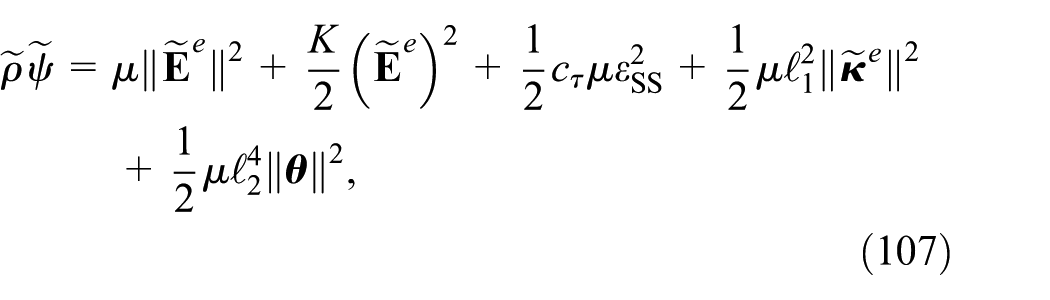
with




Here
Resolved shear stress and flow rule
For a single active slip system with slip direction

Plastic flow is governed by a rate-dependent power-law relation,

where
SSD evolution
The evolution of the SSD density is driven by slip activity and accounts for interactions with geometrically necessary dislocations (GNDs). The GND density is estimated from the curvature tensor as:

The SSD density then evolves according to:

where
Update of elastic rotation and curvature
The elastic rotation evolves from the elastic spin relation:

where

providing the quantities required to evaluate
Algorithmic structure (Gauss point update)
For a given time increment

Remark
This local constitutive structure is modular and directly compatible with the mixed finite-element formulation described in Section 9.2. It provides a clear separation between the integration-point physics (slip, hardening, curvature) and the global solution of the coupled macro–micro balance equations, facilitating both validation studies and future extensions to multiple slip systems and finite-strain kinematics.
Finite element implementation
This section summarizes the finite-element (FE) implementation adopted to solve the coupled macro–micro boundary value problem associated with the proposed dual-length-scale gradient crystal plasticity model. The objective is to provide a reproducible computational procedure suitable for validation studies and for subsequent coupling with microstructure-evolution models.
Mixed formulation and primary unknowns
The free-energy density contains a curvature contribution and a curvature-gradient contribution through the disclination density:

which would introduce second spatial derivatives if
In the two-dimensional plane-strain setting used for the illustrative examples, the global unknowns are:

while all internal variables associated with crystal plasticity (slip, hardening, etc.) are stored and updated at Gauss points.
Spatial discretization
The computational domain
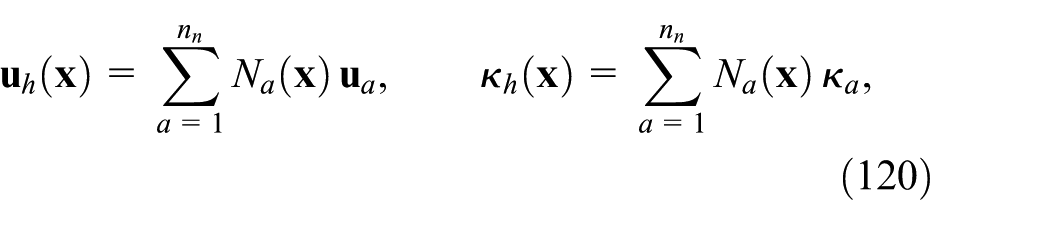
where
For plane strain, the standard small-strain kinematics are employed in the prototype implementation:

and the Cauchy stress
Discrete Curl operator in two dimensions
The curvature-gradient term is driven by the row-wise Curl of

With
Weak form and residual statements
The discrete problem is written in residual form. Let
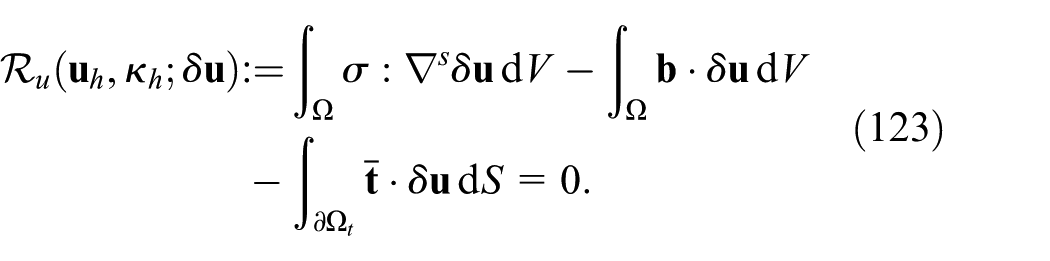
The curvature field is governed by the energetic microforce balance associated with the curvature part of the free energy,

leading to the weak form:

Here

with a coupling parameter
Constitutive update and internal variables
Crystal plasticity is integrated at Gauss points through an operator-split algorithm. For each time increment
A rate-dependent flow rule is used in the implementation to regularize the local problem and ensure robust convergence:

where

where
Solution strategy and Newton iterations
The coupled discrete problem is solved by Newton iterations on the global unknown vector. For the Q4 plane-strain implementation, each node carries:

leading to a block-structured linearized system. In the baseline implementation, a staggered quasi-Newton approach is employed for robustness:
1. Update the crystal plasticity variables locally at Gauss points given the current
2. Assemble and solve the macro problem for
3. Assemble and solve the curvature problem for
This strategy yields stable convergence for the benchmark problems and is sufficient for the validation section. A fully monolithic Newton method can be obtained by retaining the off-diagonal Jacobian blocks resulting from the dependence of
Boundary conditions and benchmark loading
Standard Dirichlet and Neumann boundary conditions are prescribed on the displacement field. For the curvature field, natural boundary conditions emerge from equation (125) via the integration by parts of the Curl term and are interpreted as micro-tractions
Remark
The present implementation summary is intended as a computationally tractable realization of the proposed theoretical framework. The mixed formulation retains the dual internal length scales
Numerical results: Micro-bending and size effects
This section presents numerical illustrations of the proposed gradient-enhanced crystal plasticity model with two internal length scales. The objective is twofold: (i) to demonstrate the well-posedness and numerical robustness of the formulation, and (ii) to highlight its added value compared to classical crystal plasticity through size-dependent responses in micro-bending.
Problem setup and numerical implementation
A two-dimensional cantilever beam of length
The left edge (
The constitutive response follows a single-slip viscoplastic crystal plasticity model, augmented by a curvature-dependent backstress of the form:

and governed by a curvature evolution equation involving both a mass-like term
The coupled problem is solved using a staggered Newton scheme, where the macroscopic equilibrium and the curvature field are updated iteratively, while the local slip variables are integrated at the Gauss-point level using an implicit viscoplastic update. Unless otherwise specified, the simulations reported below use identical material parameters and differ only in the values of the internal length scales.
Reaction–deflection response
Figure 1 shows the load–deflection curves obtained from the cantilever micro-bending test for three models: (i) classical crystal plasticity, obtained by suppressing the curvature field (

Load–deflection response for the cantilever micro-bending test. Comparison between classical crystal plasticity and gradient-enhanced formulations.
All models exhibit a nonlinear response associated with the activation of viscoplastic slip. However, the gradient-enhanced models display a systematically higher effective stiffness compared to the classical formulation. This behavior reflects the additional energetic cost associated with curvature development and the resulting backstress opposing plastic flow.
Size effect induced by internal length scales
To assess the size sensitivity of the model, the micro-bending test is repeated for three beam thicknesses,

which would collapse onto a single curve for a classical scale-free continuum.
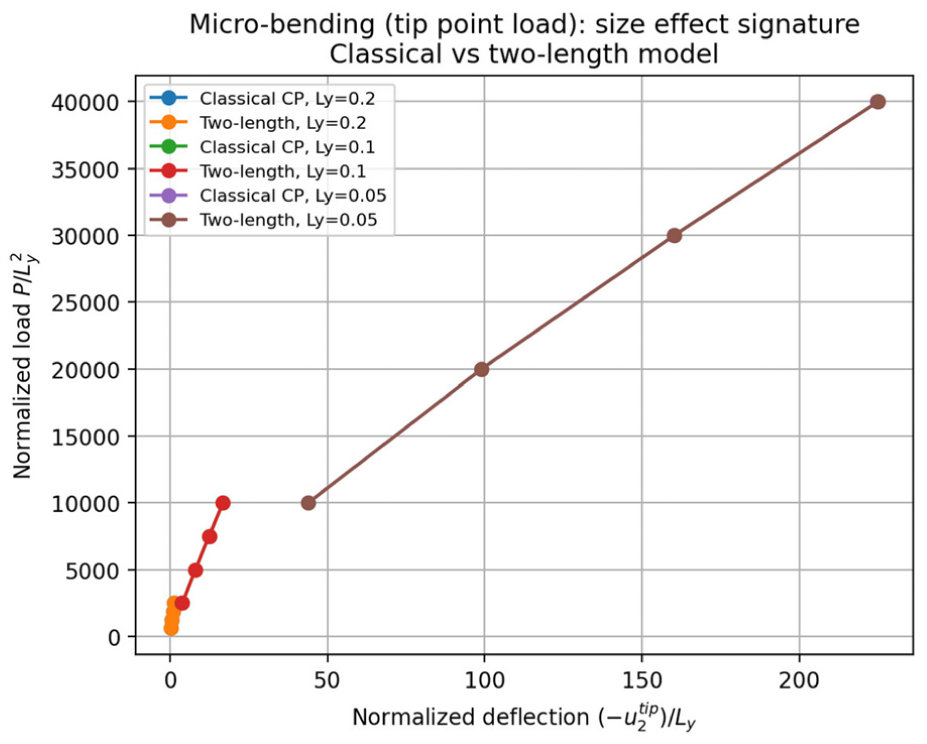
Normalized load–deflection response under tip point loading. The two-length model exhibits a clear thickness-dependent response, in contrast to the classical crystal plasticity formulation.
The classical crystal plasticity model shows an almost perfect collapse of the normalized curves, indicating the absence of intrinsic size effects. In contrast, the gradient-enhanced model exhibits a clear separation between the responses corresponding to different thicknesses. Thinner beams display an increased resistance to bending, consistent with the physical interpretation of curvature-induced hardening.
This size effect originates from the competition between the internal length scales
Role of the second internal length scale
A key feature of the proposed formulation is the introduction of a second internal length scale
Numerically, this manifests as smoother curvature distributions and a reduced localization of
Discussion and implications
These numerical results highlight the added value of the proposed two-length crystal plasticity model. Unlike classical formulations, the model naturally captures size effects in bending-dominated problems without introducing ad hoc boundary conditions or nonlocal averaging procedures.
The curvature-based framework provides a physically transparent mechanism for size dependence, rooted in the energetics of lattice curvature and dislocation structures. Moreover, the formulation is compatible with multiscale extensions, such as coupling with phase-field descriptions of microstructure evolution or discrete dislocation dynamics, while retaining a well-defined continuum structure.
Overall, the micro-bending simulations demonstrate that the proposed model is both computationally tractable and capable of reproducing key non-classical features observed in small-scale plasticity.
Comparative discussion with strain-gradient and dislocation-based crystal plasticity
The micro-bending simulations reported in Section 10 exhibit a thickness-dependent strengthening, that is, absent in classical (scale-free) crystal plasticity. This behavior is consistent with a large body of experimental and theoretical evidence on “smaller is stronger” effects in bending, torsion, and indentation at the micron scale. In this subsection, the present two-length curvature-based formulation is positioned relative to canonical strain-gradient plasticity (SGP) and gradient crystal plasticity (GCP) frameworks.
Comparison with phenomenological SGP (Fleck–Hutchinson)
The Fleck–Hutchinson family of phenomenological strain-gradient plasticity theories introduces additional hardening through dependence on plastic strain gradients, typically through an effective measure combining classical plastic strain and one or more invariants of
First, the curvature variable provides a more direct kinematic proxy for geometrically necessary dislocations (GNDs) and lattice curvature effects, which are known to dominate size dependence in single crystals. Second, the model naturally yields a two-parameter regularization:
Comparison with gradient crystal plasticity of Gurtin–Anand type
The Gurtin–Anand framework introduces gradients of slip (or slip-system hardening variables) and associated microforce balances, producing higher-order stresses conjugate to slip gradients.28,29 This class of theories is physically attractive because it is formulated at the slip-system level and provides a thermodynamically consistent microforce structure, including boundary conditions that can model micro-free or micro-hard surfaces. The present formulation shares the same thermodynamic philosophy: an energetic penalty is associated with nonuniform internal fields and gives rise to additional stresses (backstresses) that oppose slip.
The key difference lies in the choice of the gradient variable and the resulting boundary data. In Gurtin–Anand-type GCP, the gradient typically acts on slip
Comparison with dislocation-density and Nye-tensor based approaches
A substantial body of GCP work defines the defect content through a dislocation density tensor (often related to the Nye tensor), built from gradients of plastic distortion, and uses energetic penalties in terms of this density.5,7,35 In many such formulations, the internal length scale emerges through the energetic cost of GND density, yielding size effects in torsion and bending. The present model is compatible with this spirit: the curvature tensor
Implications for micro-bending and “added value” of the two-length structure
From a modeling perspective, the two-length model refines the description of size effects by decoupling two roles often merged in single-length formulations: (a) strengthening through an internal backstress proportional to curvature (amplitude control) and (b) regularization through Curl-type smoothing (spatial structure control). This is analogous in spirit to introducing both energetic and higher-gradient regularization channels, but here achieved within a curvature-based architecture tailored to crystal plasticity.
In the micro-bending simulations, the classical CP response collapses under normalization, as expected for a scale-free theory, whereas the gradient-enhanced response exhibits a thickness dependence. This qualitative signature aligns with the predictive trends of Fleck–Hutchinson SGP and Gurtin–Anand GCP, while offering an alternative route based on curvature kinematics, that is, well suited for coupling with defect-transport or phase-field microstructure models.
Limitations and outlook
The present numerical examples are illustrative and intended to validate implementation and demonstrate qualitative size dependence. A quantitative validation against experimental micro-bending data and/or benchmark simulations from established GCP models (e.g. slip-gradient formulations) is the natural next step. Such a study will also enable calibration of
Numerical results: Numerical simulations versus Demir et al. 15 ’ experiments
In this section, the numerical micro-bending response predicted by the present finite-element implementation is compared with the cantilever micro-bending experiments reported by Demir et al.
15
(see Figure 3) on single-crystal copper micro-beams. The experiments were performed at three representative thickness levels, ∼
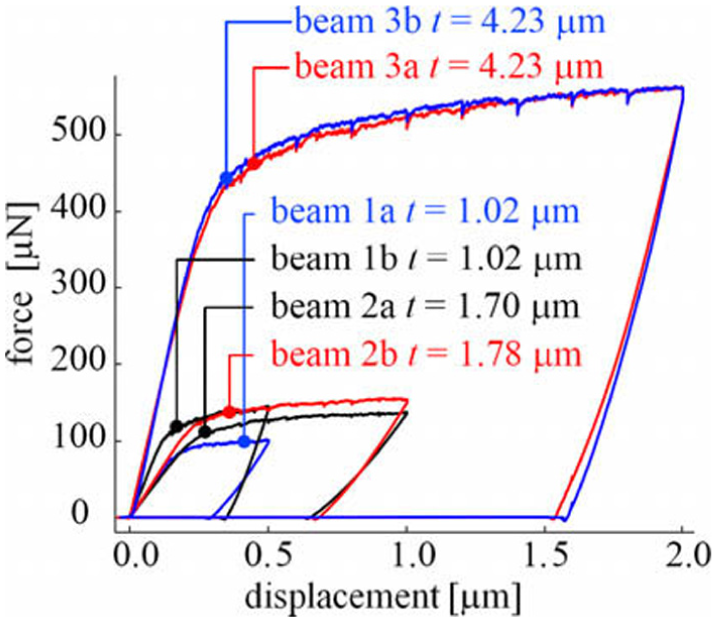
Experimental micro-bending force–displacement curves for single-crystal copper micro-beams reported by Demir et al. 15 (see Figure 3 therein). The results exhibit a pronounced thickness dependence and an intermittent serrated response. The figure is adapted from Demir et al. 15 These experiments provide a qualitative reference for the size-effect trend captured by the numerical simulations in Figure 4.
Numerical set-up and force definition
The simulations consider a 2D plane-strain cantilever bending configuration discretized with bilinear Q4 elements and a single-slip viscoplastic crystal plasticity update. The vertical tip deflection

where
Two constitutive descriptions are contrasted: (i) a classical crystal plasticity model (no intrinsic length scale) and (ii) the proposed two-length formulation. In the latter,
Force–deflection response and thickness dependence
Figure 4 reports the computed reaction–deflection curves for the three thicknesses, comparing the classical CP and the two-length model. The simulations exhibit a clear thickness dependence: thinner beams display a higher apparent bending resistance, that is, a size effect. Moreover, the two-length model predicts a systematically stronger size effect than classical CP, which is consistent with the additional energetic penalty associated with curvature gradients and with the strengthening mechanisms underlying strain-gradient-type theories.

Numerical micro-bending response: reaction force
Figure 3 reproduces the experimental force–displacement curves of Demir et al. The experiments show (i) a strong thickness dependence and (ii) intermittent force drops/serrations, typically attributed to discrete dislocation activity and localized plastic events at the microscale. While the present single-slip, monotonic-loading prototype does not aim to reproduce the full hysteretic and serrated signature quantitatively, it captures the primary experimental trend: decreasing thickness leads to an increased bending resistance.
Scope and limitations of the validation
The present comparison is intended as a first validation in the sense of: (i) verifying that the proposed two-length model reproduces the experimentally observed trend of micro-bending strengthening with decreasing thickness and (ii) demonstrating that the additional length scale
Conclusion
This paper has developed a gradient-enhanced finite-strain crystal plasticity framework that introduces two intrinsic length scales to represent, within a single continuum theory, both lattice-curvature effects and curvature-gradient effects. The primary objective has been to advance the predictive modeling of size-dependent plastic deformation in crystalline materials by embedding defect-sensitive mechanisms directly into the kinematic, energetic, and balance-law structure of the model. The resulting formulation goes beyond classical, scale-free crystal plasticity by providing a transparent separation between (i) curvature-amplitude strengthening associated with dislocation-type incompatibilities and (ii) curvature-gradient regularization associated with higher-order incompatibilities of disclination type. This separation is not only conceptually important; it is also essential for capturing the distinct spatial patterns and boundary-layer phenomena observed in small-scale tests and in boundary-constrained crystalline deformation.
A first major contribution of the work is the systematic organization of the theoretical framework, from kinematics to constitutive structure to balance laws. The paper establishes the defect-sensitive measures in a finite-strain setting and clarifies their physical meaning through a differential-geometric viewpoint. This perspective provides a coherent interpretation of the additional fields and operators that appear in the theory, and it shows how the model naturally connects to established notions from generalized continua and curvature-based plasticity. Within this kinematic setting, a thermodynamically consistent internal-variable structure is then posed to define the material response. The free-energy statement is used as the unifying mechanism that generates the full set of work-conjugate stress measures, including both classical stresses and higher-order stresses associated with curvature and curvature gradients. As a consequence, the balance structure of the theory arises in a systematic way and yields higher-order equilibrium relations that are tightly linked to the defect measures. This approach ensures that the model is not an ad hoc regularization but a constitutive framework grounded in a clear energetic interpretation.
A second major contribution is the explicit coupling between the curvature-driven fields and crystallographic slip. The paper specifies how defect-sensitive internal stresses enter the driving force for slip and how the evolution of internal variables is linked to defect content and plastic flow. This coupling is essential for translating the geometric content of the theory into observable macroscopic effects such as strengthening, size dependence, and boundary-layer formation. In particular, by distinguishing the roles of the two length scales, the framework provides a direct means to control and interpret (i) the amplitude of curvature-related internal resistance and (ii) the spatial organization and smoothing of curvature gradients. This feature is important because many size effects in crystals are governed not only by the magnitude of incompatibility but also by how it localizes near boundaries and interfaces.
The analytical studies developed in the paper provide direct validation and physical insight. The simple-shear single-crystal strip problem serves as a benchmark demonstrating that the model produces enhanced hardening under constrained deformation, together with the emergence of boundary layers that localize orientation gradients and defect-related fields. This canonical setting clarifies the role of curvature-induced internal stresses in generating a backstress-like resistance that increases with decreasing specimen dimension. Beyond this primary validation, the analytical program is extended to additional canonical boundary-value problems—torsion of a cylindrical bar, bending of a crystal plate, and a bicrystal tilt boundary. These problems are not merely illustrative; collectively, they probe the theory across distinct classes of deformation modes and boundary conditions. Torsion highlights the interaction between rotation gradients and geometry-induced incompatibilities; bending reveals the localization of orientation gradients through thickness and the emergence of characteristic boundary-layer structures; and the bicrystal tilt boundary provides a structurally meaningful setting in which incompatibility localizes at an interface, thereby emphasizing the relevance of higher-order fields in modeling orientation mismatch. Across all these cases, the analysis underscores how the two length scales govern boundary-layer thickness, orientation-gradient localization, and the distribution of defect-related internal stresses.
A third major contribution is the establishment of a practical computational route and its use to produce structural-scale simulations that complement the analytical benchmarks. The paper describes a finite-element implementation strategy compatible with the higher-order structure of the governing equations, including the local integration-point constitutive update and the mixed weak form required to represent curvature-related fields. This implementation discussion is central to the utility of the theory: the presence of higher-order stresses and additional balance relations places nontrivial demands on discretization, linearization, and solution strategy, and the paper’s algorithmic presentation provides a clear pathway for reproducing and extending the results. The numerical studies reported for cantilever micro-bending quantify thickness-dependent strengthening and demonstrate how the curvature-gradient length scale influences not only the overall reaction–deflection behavior but also the spatial organization of curvature-related fields. In this sense, the computational results serve a dual purpose: they verify that the formulation can be implemented robustly in a finite-element framework, and they show how the two-length structure manifests in a representative structural configuration. The comparison with reported micro-beam experiments on single-crystal copper further supports the relevance of the proposed framework for capturing experimentally observed thickness dependence in micro-bending.
Taken together, the theoretical development, analytical validations, and numerical simulations establish a comprehensive two-length-scale gradient crystal plasticity framework that provides a defect-informed continuum route to size-dependent strengthening and localization control. The theory unifies dislocation-type and disclination-type mechanisms within a single energetic setting and clarifies their distinct contributions through both canonical closed-form reductions and structural-scale computations. In doing so, the paper provides a consistent bridge between defect geometry and macroscopic response, while also delivering an implementation-ready formulation for continued exploration in computational mechanics.
Several immediate extensions follow naturally from the present results. On the analytical side, the established approach can be further applied to additional boundary-value problems that probe different combinations of constraint, loading mode, and orientation structure, including tension/compression, multiaxial loading, and mixed boundary conditions. On the computational side, the finite-element route opens the door to simulations of more complex specimen geometries and to studies of localization and pattern formation in settings where boundary layers interact with structural features. In addition, the two-length-scale structure offers a natural basis for systematic parameter identification using size-effect data across multiple tests, since the two length scales can be linked to distinct signatures in boundary-layer thickness and curvature-gradient localization. Finally, because the framework is posed in a general internal-variable and energetic format, it provides a clear foundation for coupling with additional physics (e.g. microstructural evolution mechanisms) whenever such couplings are of interest.
Overall, this work provides a robust theoretical and computational foundation for gradient-enhanced crystal plasticity with two intrinsic length scales. By integrating curvature-based strengthening and curvature-gradient regularization within a finite-strain, thermodynamically consistent framework and by supporting the formulation with analytical benchmarks, a detailed implementation strategy, and micro-bending simulations, the paper advances a mechanism-based continuum route for predicting crystalline deformation and hardening at reduced length scales.
Footnotes
Appendix A: Derivation of the dislocation density tensor
This appendix derives the dislocation density tensor
Appendix B: Adjoint of the row-wise Curl operator
For a second-order tensor field
where
Given two second-order tensors
Substituting equation (B1) and integrating by parts yields:
Thus the adjoint operator
In compact form:
where the boundary operator
Handling Editor: Divyam Semwal

Funding
The author received no financial support for the research, authorship, and/or publication of this article.
Declaration of conflicting interests
The author declared no potential conflicts of interest with respect to the research, authorship, and/or publication of this article.