



Abstract
New regulations and methods of vehicle inspections offer an opportunity to reduce the number of road traffic fatalities. Driving dynamics simulations and traffic accident simulations can be carried out to assess the impact of new test regulations. Appropriate vehicle simulations should therefore be carried out for a suitable parameter space. This work presents the statistical distribution of important vehicle concept parameters in the German vehicle field in 2021 and provides a database of the 50 most frequently occurring vehicle parameter classes, which represent almost 50% of all vehicles in Germany. Among other data, the database contains information on vehicle mass, wheelbase, track widths, wheel dimensions, axle load distribution and axle concepts. The parameter database is extended with additional vehicle parameters, such as stiffness, damping, and inertia, using estimation methods from vehicle development and empirical databases. In the second part of the publication, the database is used to derive a criterion for evaluating suspension damping during slow speed bump crossings. The criterion is validated with 7688 slow speed bump crossings performed with 1165 different vehicles with intact and degraded shock absorbers. The developed criterion is able to detect degraded suspension damping with two degraded shock absorbers with an accuracy of 99.4%.
Introduction
In 2020, the European Union set itself the goal of reducing the number of fatalities and serious injuries in European road traffic to zero by 2050 with the implementation of Vision Zero. 1 In recent years, it has been observed that the number of road fatalities in the European Union, and in Germany in particular, has fallen less significantly than until 2015. 2 Figure 1 shows the number of fatalities in German road traffic for the years 1960–2024. Everyone involved is looking for new methods to further reduce the number of fatalities and serious injuries on roads. Periodic technical inspections (PTI) are becoming increasingly important against the trend towards an ageing vehicle fleet. 3 Figure 2 shows the average age of the vehicle field in Germany for the years 1960–2024. The effect of a mandatory PTI on the reduction of road traffic fatalities and serious injuries has been demonstrated in various studies in different countries.4–6
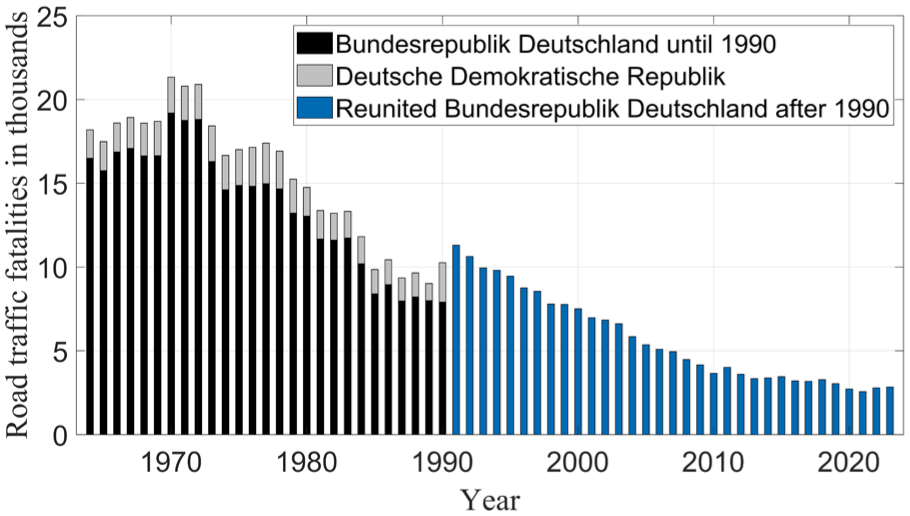
Number of fatalities in German road traffic from 1960 to 2024. 2
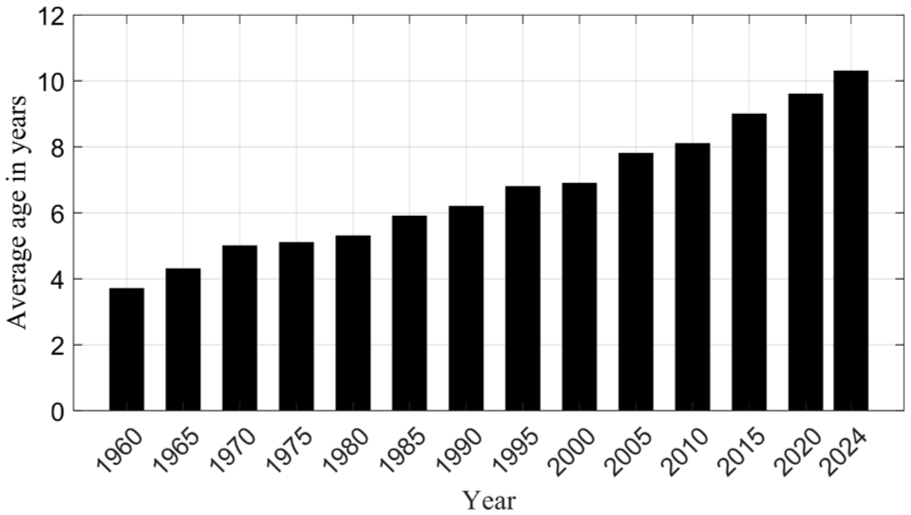
Average age of the vehicle field in Germany from 1960 to 2024. 3
Degraded shock absorbers (SAs) and thus degraded suspension damping have a strong negative effect on the safety-critical driving dynamics of passenger cars. Schramm et al. and Zwosta showed that an oil loss of just 10% in twin-tube SAs can lead to a damping work reduction of up to 50% when excited by high amplitudes and high velocities.7,8 An oil loss of 50% can lead to a nearly complete loss of damping performance of the twin-tube SA due to oil foaming and cavitation at high amplitude excitations and high velocities. The loss of damping work due to oil and gas loss leads to a significant increase in braking distance of the vehicle during emergency braking and to a significant reduction in the transmittable lateral forces of vehicle axles.9–12
However, the effect of degraded SAs on the driving dynamics of passenger cars is highly dependent on other chassis characteristics. 10 It has been shown that a higher radial tire stiffness, a higher unsprung mass and a higher anti-roll bar stiffness increase the effect of degraded SAs on the maximum transmittable lateral forces of vehicle axles. In order to be able to estimate the effect of degraded SAs on road safety, an effect analysis should be carried out which takes into account the realistic parameter space of the relevant vehicle parameters in the vehicle field. It can also be assumed that vehicle parameters, like vehicle mass, wheelbase, and wheel dimensions, also have an effect on suspension damping inspection methods, like suspension parameters do.
The aim of this work is to determine the statistical distribution of parameter sets of all passenger cars in the vehicle field in Germany. This information can be used to derive the most relevant parameter data sets for vehicle dynamics simulations. Such a parameter database can be used to analyze the effect of degraded vehicle components on vehicle safety. Suspension damping inspection methods can also be developed virtually.
After introducing the parameter space, the development of a criterion for evaluating suspension damping using the parameter space is presented. A characteristic-based mathematical five-mass full vehicle model is used to develop the criterion for evaluating suspension damping. First, an elementary effect analysis is conducted with the full vehicle model, which identifies the most relevant full vehicle parameters for the criterion. 13 The realistic parameter space is then used to simulate a large proportion of the vehicles in Germany. The simulation results are used to develop an evaluation criterion for assessing suspension damping during slow speed bump crossings. The criterion is validated and verified on 35,535 real speed bump crossings with 1165 different vehicles.
Realistic parameter space of the vehicle concept parameters in Germany
The parameter space presented here is based on a database of the German Kraftfahrtbundesamt, which contains information of all passenger cars registered as of January 1, 2022. 14 It contains 38.6 million passenger cars with 88,628 different vehicle models. For the evaluation of the parameter space, all vehicle models with a minimum of ten vehicles are taken into account. This reduces the number of vehicles to 38.5 million and the number of vehicle models to 44,854.
The corresponding vehicle concept parameters from Internet sources are assigned to the vehicle models in the database.15,16 The following vehicle parameters are assigned to each vehicle:
Vehicle mass
Wheelbase and track widths
Dimensions (length, width, height)
Axle concepts
Wheel dimensions
The wheel diameter and tire widths for each vehicle are derived from the wheel dimension information. As several permitted tire dimensions can be assigned for each vehicle model, only the smallest permitted values are considered in the following analysis. The vehicle parameters listed could be assigned to 86%–98% of all vehicle models in the database. This corresponds to between 90% and 98% of all vehicles in Germany. The variation is due to the fact that not all parameters could be assigned to each vehicle.
Figure 3 shows the distributions of the vehicle mass, wheelbase, minimum tire width, and wheel diameter of the parameter space. To evaluate the parameter space, all variables were divided into 20 classes of equal size, which were defined by the extreme values of the parameters. The figures show that all depicted parameters exhibit a normal distribution. It is particularly noticeable that the distribution of the vehicle mass of all vehicles and the distribution of the wheel widths of all vehicles are asymmetrical. The distribution of vehicle masses may be interpreted such that vehicles in the small, compact, and mid-size classes are more frequently represented than vehicles in the premium class. The asymmetrical distribution of the wheel widths can be explained by the distribution of the vehicle mass and the inclusion of the minimum wheel widths.

Distributions of vehicle mass (a), wheelbase (b), minimum wheel width (c), and wheel diameter (d) of all passenger cars in Germany in 2021.
Figure 4 shows the distributions of the axle concepts of all vehicles for the front and rear axle. As it was not possible to assign an axle concept to all vehicles, the distributions shown represent 78% of all vehicles in the entire vehicle field for the front axle and 70% for the rear axle. The figure shows that the MacPherson axle concept is clearly dominant for the front axle. Even if all unassigned vehicles did not have a MacPherson axle installed as a front axle, which is unlikely, at least 50% of all front axles in the vehicle field would be MacPherson axles.
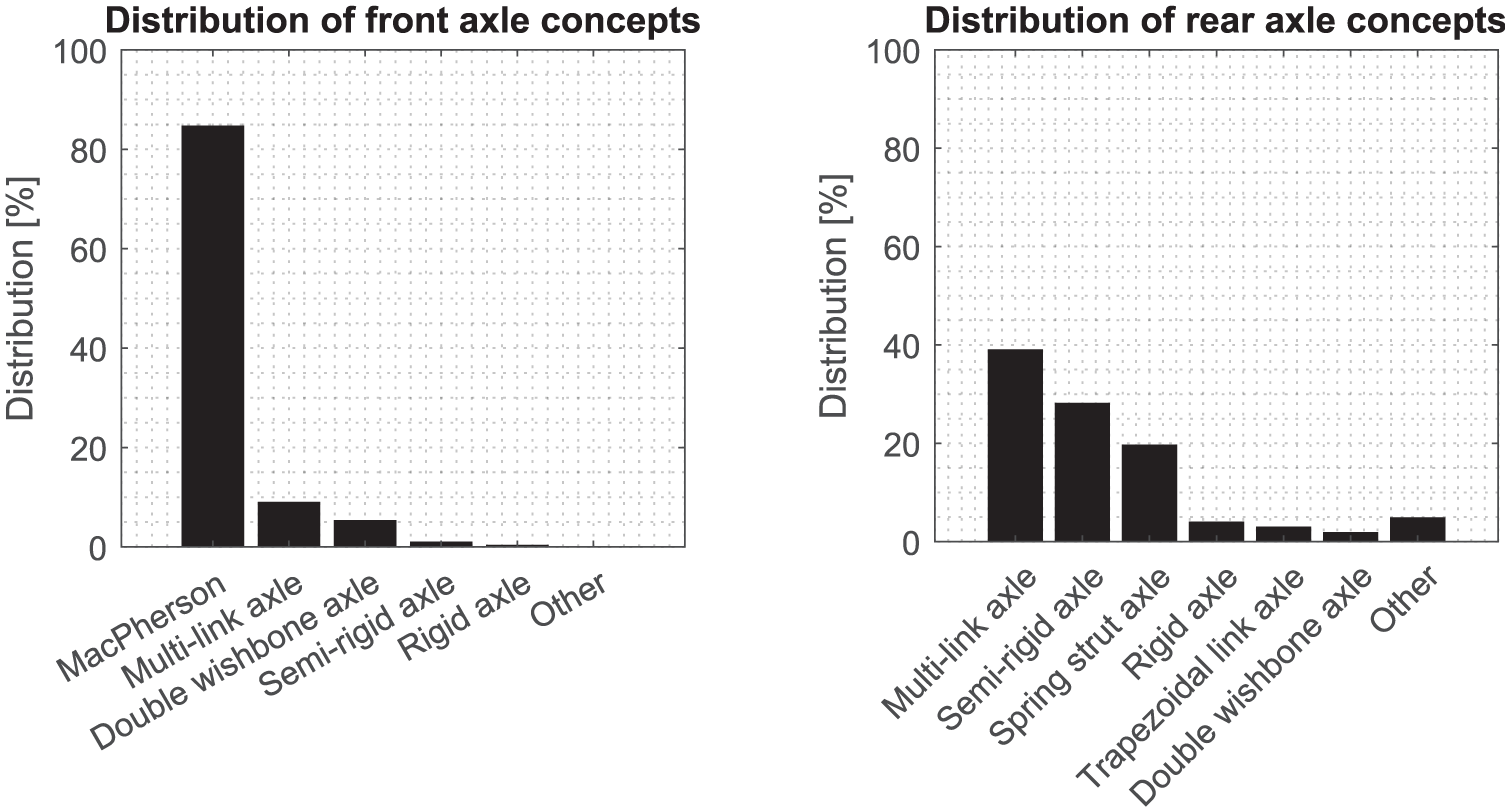
Distributions of front and rear axle concepts for all analyzed passenger cars in Germany in 2021.
In addition to the one-dimensional visualization, the parameter space can also be displayed in multiple dimensions. Figure 5 shows the distribution of the class combinations of vehicle mass and wheelbase. Only classes with at least 10,000 vehicles are shown in the figure, which therefore correspond to at least 0.26% of the total number of vehicles. A total of 95.23% of all vehicles are shown in the figure. In addition to the parameter space of the simulation database, the figure shows the data points of the 1165 different vehicles used to validate the criterion for detecting degraded suspension damping. The vehicles were selected to cover the entire parameter space of the German vehicle fleet. The figure shows that both parameter spaces overlap and thus validate each other.

Distribution of the combination of wheelbase and unladen mass of 95.23% of all passenger cars in Germany in 2021 and the 1165 different vehicles measured.
The NHTSA published measured mass and inertia characteristics of 1270 different vehicles and provided a simple calculation rule for estimating the vehicle center of gravity (COG) and inertia parameters using the total mass of road vehicles. 17 The measurement results show that the moments of inertia and the COG height of the vehicles increase over the vehicle mass.
To extend the parameter database to include the mass and inertia properties, equations are defined based on the empirical data which take into account the scattering of these properties. Equations (1) to (18) show the calculation of the center of gravity heights













The axle load distribution of the vehicles has also been added to the database. The Canadian government regularly publishes information on the axle load distribution of registered vehicles in Canada. 16 Based on this information, 50% of all vehicle models could be assigned a corresponding static axle load distribution. All vehicle models that could not be assigned a static axle load distribution were assigned a static axle load distribution of 56% for the front axle. This corresponds to the average value of all vehicle models examined.
Table 1 shows the parameter data sets with the 50 largest vehicle numbers for the parameter combinations: Vehicle mass, wheelbase, minimum tire width, track width of the front axle, wheel diameter, static axle load distribution of the front axle, center of gravity height, and the moments of inertia of the full vehicle. The 50 parameter data sets shown represent around 50% of all vehicles in Germany as of January 1, 2022.
Parameter database of the 50 most frequently occurring vehicle parameter data sets in Germany.

The vertical body eigenfrequency of passenger cars ranges from 0.8 to 1.8 Hz.18,19 This information can be used to estimate a range of vertical axle stiffness as a function of half the body mass for the front axle and rear axle. Figure 6 shows the correlation between the vertical body eigenfrequency and half the body mass. 18 The vertical chassis stiffnesses can be estimated using the vehicle body mass, the static axle load distribution and the equation for the vehicle body eigenfrequency (equation (19)). A minimum, an average and a maximum value of the respective vertical axle stiffness are calculated. Each vehicle class is assigned a vehicle mass. This corresponds to a column in Table 1. The vehicle body mass is estimated to be 200 kg less than the full vehicle mass. 20 With the estimation approach, three vertical axle stiffnesses are assigned to each vehicle class for the front axle and rear axle, depending on the vehicle mass and axle load distribution. In the full vehicle model in the next section, axle stiffness is modeled using a nonlinear characteristic curve. The stiffness values calculated here are used to scale these characteristic curves.

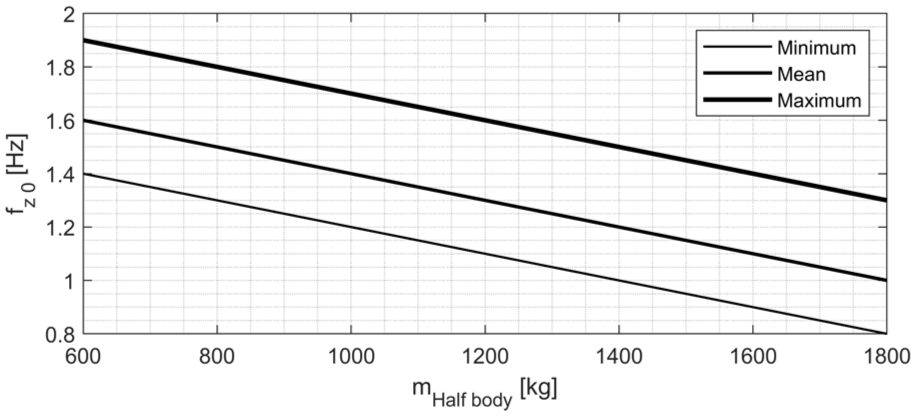
Empirical correlation between the vertical body frequency and half the vehicle body mass. 18
The body damping coefficient of a vehicle axle is specified in the literature with values between 0.2 and 0.25.
21
Equation (20) describes the calculation of the suspension damping constant d as a function of half the body mass




B: measured values of test vehicle; i: database vehicle.


There is also a correlation between the tire width and the radial tire stiffness. With increasing tire width, an increasing radial tire stiffness can be observed empirically.18,23 A scaling factor for calculating the vertical tire stiffness was derived from this context. Equations (26) to (28) show the estimation of the vertical tire stiffness for a scattering range as a function of a reference stiffness


Evaluation criterion for degraded suspension damping
The effectiveness and benefits of the realistic parameter space are illustrated in the following sections showing the development of a criterion for suspension damping inspection. The criterion is applied to the measurement data of a slow speed bump crossing. The slow speed bump crossing is a single obstacle crossing with a vehicle speed of ~7–9 km/h. During the maneuver, the accelerations and angular velocities of the vehicle body are measured at a sampling frequency of 100 Hz by a mobile measuring system placed on the vehicle floor in the passenger compartment. Figure 7 shows the geometry of the speed bump, the test setup, and the mobile measuring equipment on the vehicle floor behind the driver’s seat.

Test setup of the slow speed bump crossing and geometry of the speed bump.
The measured pitch velocity of the vehicle

Pitch velocities of a vehicle with intact SAs and with two degraded SAs on the front axle and rear axle during a speed bump crossing at 8.7 km/h.
These four short time signals are lengthened to a length of 5.12 s using zero padding. The energy spectral density (ESD) are calculated from the time signals using Fourier transformation. The energy spectral density (ESD) is used for energy signals with finite total energy. Such signals are often transient and may be time-limited. In contrast, the power spectral density (PSD) is used for power signals with infinite energy but finite average power, such as periodic signals or stationary processes. Figure 9 shows the ESD of the four ranges up to 6 Hz graphically. In the range up to 5 Hz, the maxima of the spectra are determined, which serve as the basis for the evaluation criteria of the suspension damping. It can be seen that the maxima of the spectra for the range of oscillation for the intact vehicle and the vehicle with degraded front axle SAs differ significantly, while the maxima of the spectra of the excitation are similar. The ratio between the maxima of the spectra of the excitation range and the oscillation range is a good indicator of how rapidly the oscillation diminishes in the successive time ranges. This ratio is therefore a good indicator of suspension damping.

Energy spectral density of the pitch velocity for the evaluation ranges of the front axle for an intact vehicle and a vehicle with degraded front axle SAs.
Simulation of the slow speed bump crossing
This section describes the application of the developed parameter space. A characteristic-based mathematical five-mass full vehicle model is used to simulate the slow speed bump crossing. Equations (29) to (36) show the calculation of the six degrees of freedom, the vertical axle force at one vehicle corner


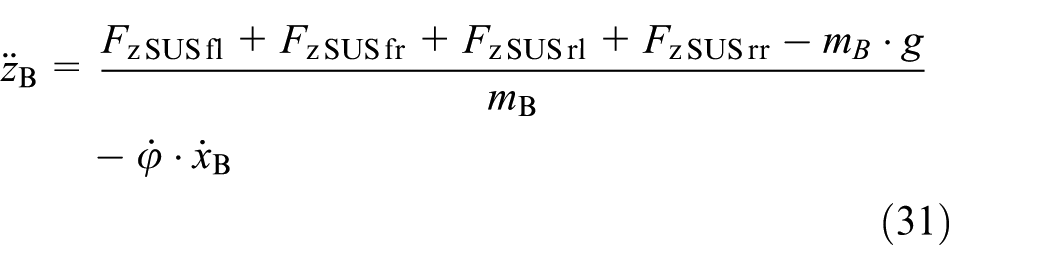

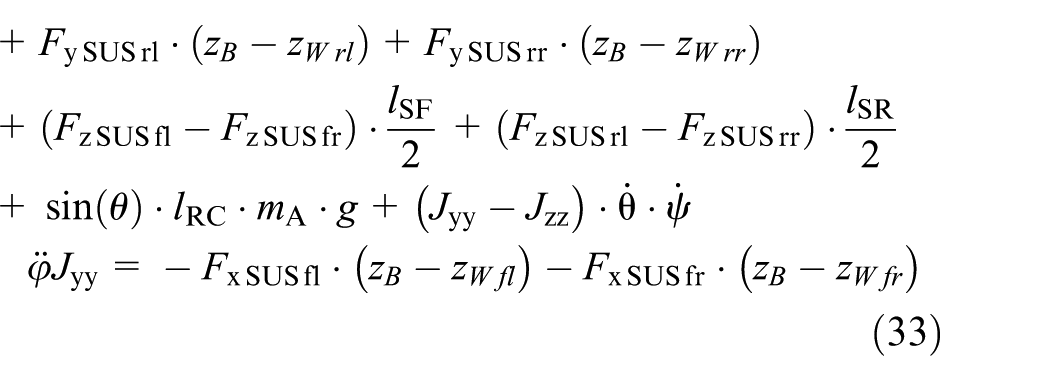


Equation symbol explanation.

A force-velocity characteristic reduced by the friction force is used to model the SA. For the simulation of the vehicle with degraded SAs with an oil level of 0%, this characteristic curve is reduced to 0 N. Axial friction is calculated using a Dahl friction model. 26 The front axle of the test vehicle is a MacPherson axle. Deubel and Prokop found that the friction of a MacPherson axle depends on the horizontal forces at the wheel contact point. 27 The dependence of the axial friction of the MacPherson axle on the horizontal wheel forces is parameterized on the basis of this research. 28
To validate the model, speed bump crossings were conducted with a Volkswagen Passat B8. The vehicle model was parameterized with the parameters of this test vehicle. Figure 10 shows the measured and simulated pitch velocity of the test vehicle with intact SAs, degraded SAs on the front axle and on the rear axle. Identical SAs with 0% oil filling were used as degraded SAs. The qualitative comparison of the measurement data with the simulation data shows that the model is well suited to represent the necessary vehicle characteristics. Deviations can occur due to deviating SA temperatures between component measurements at 23 °C and the test drives. According to Hryciów, the work performed by a SA is reduced by around 2% when the temperature is increased by 5 K. 29 It can be assumed that the modeling of the axle friction has a major influence on the correct simulation of the speed bump crossing with degraded SAs.

Measured and simulated pitch velocities of the test vehicle with intact and degraded shock absorbers on both the front and rear axles.
First, an elementary effect analysis is conducted to apply the parameter space. 13 Each parameter in Table 3 is varied individually and the effect on the criteria is examined. Table 3 shows the type of variation of the individual parameters. If the mass of the base vehicle is 1639 kg, the effect of the vehicle mass was evaluated by running the simulation with a vehicle mass of 1475 kg, which corresponds to 90% of the base mass. These speed bump crossings were simulated at a velocity of 8.73 km/h according to one specific test drive. The angle between the longitudinal axis of the vehicle and the speed bump was always 90°.
Vehicle parameters of the elementary effect analysis.

Figures 11 and 12 show the results of the parameter variations for the maxima of the ESD for the front axle. The figures show that the vertical stiffness of the vehicle front axle has a similar effect on the values for both ranges. The lower the stiffness, the lower the maximum values of the spectra. The wheelbase is the only variable that shows an opposing trend for both evaluation ranges. If the wheelbase is reduced by 10%, the maximum ESD in the oscillation is increased by 40%. This makes it difficult to evaluate the suspension damping. This parameter effect is compensated for by multiplying the fourth power of the vehicle’s wheelbase. Equation (37) shows the calculation of the criteria.


ESD maximum of the pitch velocity of the parameter variation for the time range of the speed bump excitation of the front axle.

ESD maximum of the pitch velocity of the parameter variation for the time range of the oscillation of the front axle.
In the next step, the most common 200 parameter classes of the parameter space of the vehicle field are simulated for vehicles with intact SAs and with two degraded SAs on the front axle and two degraded SAs on the rear axle. Three parameter levels are simulated for each parameter class. These three parameter levels are the minimum values, the average values, and the maximum values of the axle stiffnesses and damping, as described in the previous section.
Figure 13 shows the calculated values of the pitch criterion




Pitch criterion for measured and simulated speed bump crossings for the speed bump crossing range of an axle and the oscillation of an axle for intact shock absorbers and the front axle crossing range (a) and rear axle crossing range (b), as well as for the condition of two oil-empty shock absorbers on the front axle during front axle crossing (c) and two oil-empty shock absorbers during rear axle crossing (d).
Figure 14 shows the pitch criterion for the measured speed bump crossings as in Figure 13 and for simulated vehicles with an mass of <1300 kg for which the damping ratio was not adjusted according to equation (25). The figure shows that these simulated vehicles in intact condition exhibit significant deviations from the measured speed bump crossings for both the front axle and the rear axle. It can be seen that these simulated vehicles with low mass all have a significantly higher pitch rate than all measured vehicles. Figure 5 shows that many of the vehicles measured also have an unladen weight of <1300 kg. This analysis therefore leads to the conclusion that the damping ratio for vehicle axles of vehicles with low mass must be higher on average than for vehicles with higher mass, as otherwise the vehicle axles would be underdamped.

Pitch criterion for measured and simulated speed bump crossings for vehicles with an unladen mass of <1300 kg and without adjustment of the damping coefficient according to equation (25), in each case for the range of the speed bump crossing of one axle and the oscillation of one axle for intact shock absorbers and the range of the front axle crossing (a) and rear axle crossing (b) as well as for the condition of two oil-empty shock absorbers on the front axle during front axle crossing (c) and two oil-empty shock absorbers during rear axle crossing (d).
Discussion
The goal of this work is to define a parameter space for full vehicle simulations that describes the entire German vehicle field. Simplifications are being made in a number of areas. Mass properties such as center of gravity height and mass inertia are estimated based on an NHTSA database. This database contains measurement results of 1270 different vehicles built between 1971 and 2021. Due to the increased prevalence of battery electric vehicles in recent years, it can be assumed that the distribution of mass parameters in the vehicle field has changed. Depending on the application, the estimation functions of the mass properties must therefore be adjusted.
Equation (19) for describing the body natural frequency does not take damping into account and is therefore a simplification. The axle stiffness and damping are scaled by factors. These values are based on the nonlinear characteristics of a test vehicle. Depending on the application, it may also be necessary to vary the shape of the characteristic curves. In particular, the shape of the force-velocity characteristic curve for shock absorber modeling can vary greatly between vehicles.
The application of the parameter space is highly dependent on the use case. The parameter space was used as an example for investigating a criterion for evaluating suspension damping. The resolution of individual parameters in the parameter space should be adjusted to the sensitivity of the parameters. For example, if a parameter has no significant effect on an evaluation criterion, the resolution of the parameter can be set to a significantly lower level for a simulation study.
When applying the parameter space, it must be ensured that the influence of environmental parameters on vehicle parameters is taken into account and discussed. One crucial parameter, for example, is temperature, which has a significant impact on the properties of vehicle shock absorbers.
The criterion for evaluating suspension damping is presented in this paper in order to demonstrate the application of the realistic parameter space of the vehicle field. The criterion is suitable for evaluating degraded front axle SAs with high sensitivity and specificity with the slow speed bump crossing. However, no conditions with one degraded front axle SA are considered. For the correct assessment of one degraded front axle SA, the corresponding method must be extended. The same applies to the assessment of the degraded rear axle SAs.
Furthermore, only one vehicle velocity is considered in the simulation and only a fixed 90° angle between the longitudinal axis of the vehicle and the speed bump is taken into account. Similarly, only degraded SAs with an oil level of 0% are simulated. However, the criterion is suitable as a foundation for developing a SA inspection method based on the slow speed bump crossing.
The large number of vehicles recorded and the high number of speed bump crossings represent the vehicle field well. The validation of the criterion shows that the parameter space presented can represent the vehicle field.
The assumption that vehicles that could not be assigned have a static axle load distribution on the front axle of 56% is a simplification. However, the elementary effect analysis of the criterion, which is shown in Figures 11 and 12, shows that the influence of this parameter on the examined criterion is rather small. Such simplifications of the static wheel load, as well as the wheel width, must be re-examined for the analysis of further criteria using a sensitivity analysis.
Conclusion
This paper presents a database of vehicle concept parameters that represents the realistic parameter space of the German vehicle field for vehicle dynamics simulations. The realistic parameter space is based on a database of the German Kraftfahrt-Bundesamtes, which includes all vehicle models and their respective numbers as of January 1, 2022. Relevant vehicle concept parameters from Internet sources are assigned to each vehicle model in the database. The assigned parameters are the vehicle mass, the wheelbase, the track width, the tire dimensions, the axle load distribution, the mass and inertia characteristics, and the axle concepts. It also shows how relevant axle parameters such as stiffness and damping can be assigned to the database. When evaluating the parameters, it can be seen that the individual vehicle parameters are normally distributed in the vehicle field. Furthermore, it can be stated that over 80% of the vehicles evaluated have a MacPherson axle installed as the front axle. The parameter database was then categorized into classes and sorted by the numbers of vehicle. The 50 most common parameter data sets are shown in a table. These 50 parameter data sets represent around 50% of all vehicles in the Germany.
To demonstrate the application of the parameter database to simulations, the database was used to define a criterion for the suspension damping inspection based on the slow speed bump crossing and to determine limit values. A mathematical characteristic-based five-mass full vehicle model is presented and validated for slow speed bump crossings. A criterion for detecting degraded suspension damping during slow speed bump crossings is presented. The full vehicle model and the presented realistic parameter space of the vehicle field are used to simulate speed bump crossings for the 200 most common parameter classes. The simulation data is used to derive limit values for evaluating the damping of the front axle. The criterion is validated with 7688 speed bump crossings of 1165 different vehicles with five different SA conditions. The criterion shows a specificity of 99.7%, a sensitivity of the degraded front axle of 97.0% and thus an accuracy of 99.3%.
The parameter database presented can therefore be used to simulate the realistic parameter space of the vehicle field. The presented criterion for evaluating suspension damping can serve as the basis for a method for evaluating suspension damping when crossing speed bumps at low speed.
Footnotes
Appendix
Table of abbreviations.
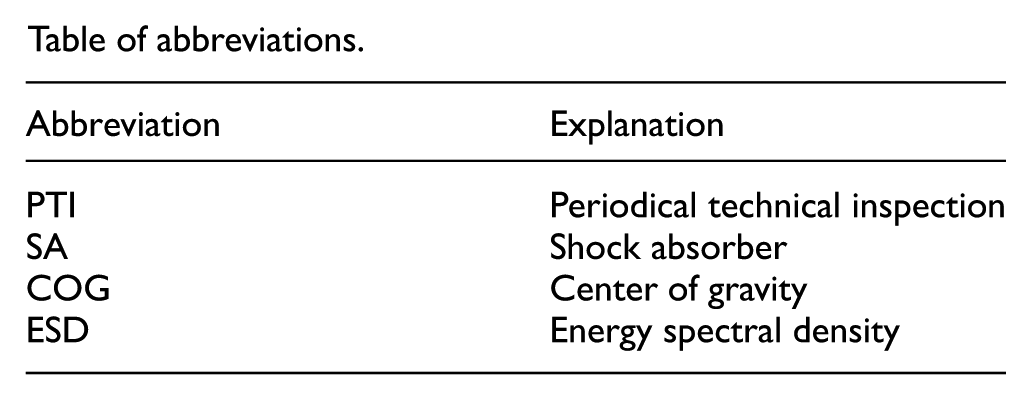
| Abbreviation | Explanation |
|---|---|
| PTI | Periodical technical inspection |
| SA | Shock absorber |
| COG | Center of gravity |
| ESD | Energy spectral density |
Handling Editor: Madalina Dumitriu

Funding
The authors received no financial support for the research, authorship, and/or publication of this article.
Declaration of conflicting interests
The authors declared no potential conflicts of interest with respect to the research, authorship, and/or publication of this article.