



Abstract
Thin-walled tubes are crucial for automotive energy absorption, protecting vehicles and occupants during collisions. This study presents the origami crash box, a novel design featuring inner concave and outer convex structures on a parallelogram tube to enhance energy absorption. These structures act as geometric defects, reducing initial buckling forces and promoting efficient collapse modes. Numerical simulations show that, compared to conventional tubes, the origami crash box triggers high-performance folding patterns, notably the complete diamond mode, leading to greater plastic damage, higher energy absorption, and lower peak forces. Parametric studies highlight the impact of geometric parameters on performance, guiding the design of origami crash boxes. Optimally designed origami crash boxes exhibit over 30% greater energy absorption and a maximum 40% reduction in initial peak force compared to traditional tubes, showcasing significant application potential.
Introduction
In automobile, train, airplane, high-speed railway, and various other engineering fields, safety considerations have become increasingly paramount. A prevalent approach to enhancing the crashworthiness of products involves the integration of energy absorption devices, which are engineered to convert kinetic energy into alternative forms upon collision. Axially fractured thin-walled tubes, particularly those with metal composition and either a round or square cross-section, are extensively employed for this purpose owing to their inherent stability, predictable collapse behavior, extended stroke length, and cost-effectiveness. 1
In the past decade, traditional thin-walled metal tubes2–14 have been widely employed as energy-absorbing devices to safeguard passengers in the event of collisions. The primary metrics used to quantitatively assess the energy absorption capabilities of these thin-walled devices are the initial peak force and average crushing force.15,16 Typically, a well-designed energy absorption device should exhibit a low initial peak force and a high average crushing force value. However, numerous experiments have revealed that traditional metal tubes often demonstrate high initial peak values and subpar energy absorption performance during collisions. Consequently, to enhance the crashworthiness of thin-walled structures, various features such as corrugations, 17 porous structures,18,19 foam fillers,20–22 and variable thicknesses23–26 have been deliberately introduced to mitigate the peak force and control the collapse mode. Moreover, in the 1960s, Alexander 27 and Pugsley 28 proposed simplistic collapse models for circular tubes and developed approximate theories to predict average breaking forces. These efforts aimed to elucidate the primary mechanisms of energy absorption in thin-walled structures at a theoretical level and guide the geometric design of such structures. While these approaches have shown promise in enhancing collision performance, they often entail complex manufacturing processes and pose challenges in theoretical research. Inspired by the ancient art of origami, researchers have begun exploring the integration of various patterns onto the surfaces of thin-walled structures to induce high-energy absorption collapse patterns with minimal peak force during compression. The novelty of the proposed origami crash box lies in its unique combination of inner concave and outer convex structures, which act as geometric defects to reduce the initial buckling force and promote efficient collapse modes. Unlike traditional thin-walled tubes, the origami-inspired design allows for controlled folding patterns, leading to enhanced energy absorption and reduced peak forces. This innovative approach not only improves crashworthiness but also simplifies the manufacturing process by enabling the folding of flat sheets into complex three-dimensional structures. For instance, Zhang et al. 29 introduced two modes into the traditional steel pipe and designed a new type of energy absorption structure. Under the same conditions, the new collapse mode was realized by introducing crease, which absorbed 15%–32.5% more energy than the non-crease steel pipe, with only a marginal increase in mass. Song et al. 30 numerically and experimentally investigated a new type of tube with an origami pattern, demonstrating that patterned pipes exhibited lower peak forces and more uniform crushing processes compared to conventional pipes. Kshad et al. 31 first investigated three distinct Ron-Resch-like origami patterns by adjusting the number of branches in the star-shaped creases and the internal crease area, systematically exploring their mechanical properties and deformation characteristics. Through finite element simulations and experimental testing, they analyzed the shape recovery effects of these origami structures under load, as well as their damping and energy dissipation capabilities when subjected to compressive and impact forces. These studies demonstrate the immense potential of origami patterns across diverse engineering applications. Additionally, Ma and You proposed two novel origami patterns, namely the diamond-shaped rigid origami pattern 32 and kite-shaped origami pattern, 33 which numerical and theoretical studies revealed reduced peak forces by 20.9% and increased average crushing forces by 92.1% compared to traditional square tubes. Yang et al. 34 studied circular tubes featuring a diamond-shaped pattern. The findings indicated a significant reduction in the peak force of origami tubes, while maintaining or enhancing their energy absorption capacity. To direct the desired failure mode and enhance the energy absorption capability of the composite origami tube, Song et al. 35 incorporated a metal layer onto the exterior of the composite origami tube. They conducted a series of experiments and numerical simulations on tubes featuring origami patterns. The findings revealed that the addition of the metal layer facilitated the conversion of the diamond crease into a mobile plastic hinge line, compelling the composite layer to fail along the crease. This transformation led to a substantial enhancement in the energy absorption performance of the composite, by approximately 58%. In recent years, research on origami tubes36–45 has flourished, with various innovative origami patterns continuously emerging and demonstrating significant potential for practical applications.
A good energy absorption device not only needs to maintain a small peak force during the collision process, but also needs to ensure that the energy absorption is at a high level and a high specific energy absorption. Although the collapse mode of the energy absorbing device can be controlled by the introduction of crease, thus ensuring a low peak force during collision; Different geometries are introduced to act as geometric defects, promoting effective collapse modes and increasing plastic deformation damage, thus enhancing energy absorption performance.
Although various energy absorption devices have been extensively studied, most designs only focus on the surface pattern and ignore the potential of multiple feature combinations. At the same time, the relationship between geometric parameters and energy absorption performance has not been systematically discussed and verified. Therefore, how to obtain an energy absorption device with improved comprehensive performance remains to be further studied. To address the above issues, the design of the origami energy absorption box proposed in this study is an innovative development based on previous studies, especially the diamond pattern proposed by Ma and You32,33 and the round tube pattern proposed by Yang et al. 34 A novel prefolded thin-walled energy absorbent box is designed by combining the geometrical defects of origami and concave and convex structures. Different from previous designs that mainly focus on surface patterns, the purpose of this hybrid method is to better control the folding mode, reduce the peak force during collision while improving the energy absorption capacity and the specific energy absorption capacity. This paper explores the geometric design and numerical simulation of the COB origami crash box. And the structural parameters are optimized to obtain the optimal geometric parameters.
The layout of the article is as follows: Firstly, the geometric design of the COB origami collision box is introduced in Section “Designed of the origami crash box.” Next, in Section “Experiments and finite element models,” a series of geometric structures of COB origami impact boxes are designed, and finite element simulation and experimental settings are conducted. Subsequently, the numerical and experimental results are presented in Section “Results.” An in-depth analysis of outcome-based parameter values is then provided in Section “Parameter study of COB.” Finally, the conclusions are summarized in Section “Conclusion.”
The terms involved in this paper are interpreted according to Table 1.
Terminology and notation.

Designed of the origami crash box
Geometry
The origami crash box was used as the basic configuration of the origami energy absorption box, and the shape of the cross section was changed by adjusting the geometrical parameters to provide better deformation control ability. At the same time, the geometric defect structure of concave and convex is innovatively introduced, and the two form a synergistic effect to enhance the plastic damage in the collision process, so as to enhance the overall performance of the energy absorbing box. It uses the origami pattern shown in Figure 1(a). The red solid lines in the figure stand for hill creases and the blue dashed ones stand for valley creases. In addition, the four parallelogram basic units are divided by a red solid line with horizontal angle of k1, forming four equal trapezoids and two congruent triangles. Furthermore, the adjacent four parallelogram basic units at the connection points give rise to two congruent isosceles triangles with base angles of k2. The side length, side width, and acute angles of the parallelogram basic units are a, b, and

(a) The origami pattern of a module, (b) a module of the origami crash box, (c) the origami crash box of five layers welded by a module of the origami crash box, and (d) the origami crash box of three layers welded by a module of the origami crash box.
The upper and lower ends of a module consist of identical quadrilaterals, which allows for the use of a single module or multiple modules stacked axially to meet different height requirements in practical use. The structures shown in Figure 1(c) and (d) are assembled hybrid origami crash boxes consisting of three and five layers, respectively.
Equation (1),
46
which establish the relationships between these angles (

The correlation between


The relationship between flatness, rectangular characteristic, and the geometric parameter
At the initial folding stage, the sheet is entirely flat. Therefore, both
The analysis above demonstrates that a trapezoid origami crash box can be folded from a flat sheet. This characteristic makes it possible to streamline the manufacturing process and reduce the production costs associated with trapezoid origami crash boxes.
The hybrid origami crash box is divided into two types (low-wide and high-narrow) and each type further consist of two characteristics (rectangular and flatness).
First, when a < b and

(a) The low-wide rectangular origami crash box, (b) the high-narrow flatness origami crash box, (c) the low-wide flatness origami crash box, and (d) the high-narrow rectangular origami crash box.
Geometric relationship between conventional tubes and origami crash boxes
Distinguished from the parallelogram origami crash box, the triangular folded lobe serves as a crucial energy absorption structure in the hybrid origami crash box. Therefore, when

(a) A module of the hybrid origami crash box, (b) a module of the parallelogram origami crash box, and (c) conventional square tube.
Furthermore, the parameters
Experiments and finite element models
Finite element models
By numerically constructing several conventional square tubes, parallelogram tubes, and 90 origami crash boxes, the latter are further divided into three groups, with each group containing 30 crash boxes: one group with single-layer boxes, one group with three-layer boxes, and one group with five-layer boxes.
In addition, the conventional square tubes and the parallelogram tubes is used as a benchmark. The dimensions, including length (a), width (b), acute angles (

The geometric parameters of the conventional square tube (CST), the parallelogram tube (PLT), and 90 origami crash boxes (COB), divided into three groups, each consisting of 30, are summarized in Table 2. Notably,
Configurations of origami crash boxes and corresponding numerical results.

The quasi-static crushing process of origami crash boxes was simulated using the commercial FEA software package Abaqus/Explicit, as shown in Figure 5. The box was primarily meshed with quadrilateral shell elements (S4R), supplemented by a few triangular elements (S3) to prevent excessive distortion. In the simulation, the box was positioned on a stationary rigid panel, while a moving rigid panel, initially in contact with the top edge of the box, advanced axially to crush it. No additional clamping or holding apparatus was utilized to restrict the box ends. All degrees of freedom (DOFs) of the stationary rigid panel were fixed, whereas only the translational DOF in the axial direction of the box was unconstrained for the moving rigid panel. A prescribed downward displacement
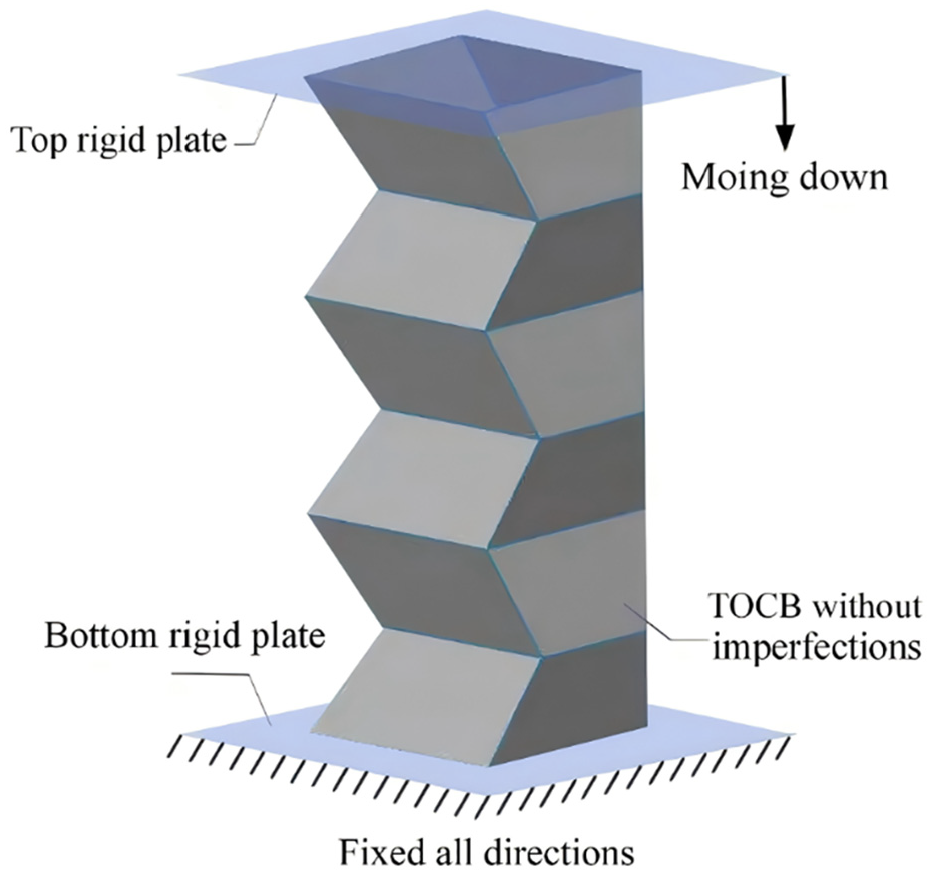
The diagram illustrating the Finite Element Model (FEM).
Q316L material parameters.

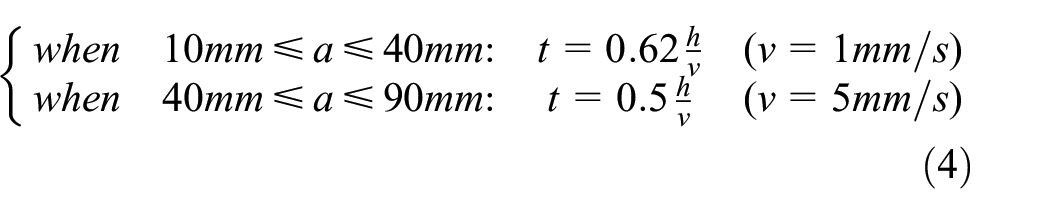
To enhance computational efficiency while ensuring accuracy, parameter a values for origami crash boxes with dimensions between 10 and 40 mm were loaded by the top plate at a constant speed of 1 mm/s. For origami crash boxes with a values ranging from 40 to 90 mm, loading occurred at a constant speed of 5 mm/s. To ensure the accuracy of the simulation, a convergence test for the finite element model with measured geometric imperfections was conducted, as depicted in Figure 6. It is evident that the change in

Mesh convergence test.
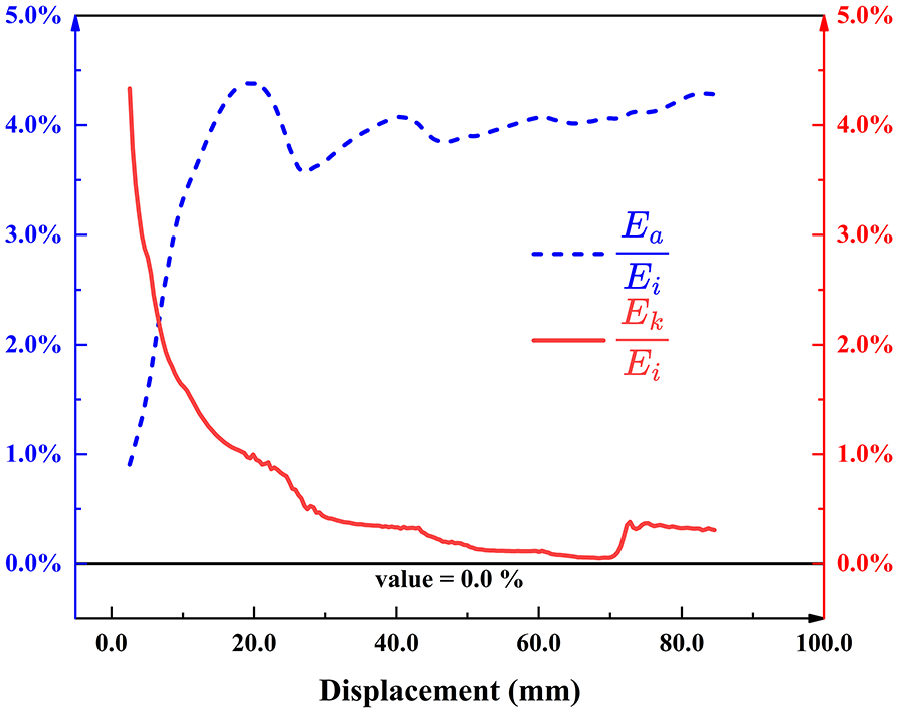
Energy feasibility analysis.
When the value of a falls within the range of 10–40 mm, according to equation (2), the overall height of the origami collision box is relatively low. Consequently, the downward compression distance of the top rigid plate is small, resulting in a lower computational burden. Therefore, the compression time factor can be increased appropriately, and in this paper, a value of 0.62 is chosen. Conversely, for a values between 40 and 90 mm, the overall height of the origami collision box is higher, leading to a larger computational burden. In such cases, the compression time factor can be appropriately reduced, and in this paper, a value of 0.5 is chosen. All of the above selected values are less than 0.73, 30 which meets the requirement.
Four key parameters were applied to evaluate the energy absorption performance: the specific energy absorption (SEA), defined as the energy absorption per unit mass, and the load uniformity, CFE, defined as the ratio of the initial peak force to the mean crushing force. The initial peak force,

Where
Quasi-static axial compression experiment
Quasi-static axial crushing experiments were conducted using a material test system (electronic universal testing machine) to investigate the energy absorption performance of the origami crash boxes, as illustrated in Figure 8. Stainless steel 316L was chosen as the material for the energy absorption boxes, with its stress-strain curve shown in Figure 9. Subsequently, models B-32-81 and B-38-83 were selected as representatives, and experimental models of the energy absorption boxes were fabricated using 3D printing technology.

Experimental setup.

Material stress-strain curve.
After manufacturing these experimental models, the energy absorption boxes were positioned at the lower end of the electronic universal testing machine, with steel plates fixed at both the bottom and top of the boxes. The top steel plate was then moved downward at a speed of 1 mm/min until the crushing displacement was achieved. Force-displacement curves were recorded to evaluate the energy absorption performance of the crash boxes.
Results
In this research, the initial peak force (
The quantitative basis for each evaluation indicator is:
A smaller initial peak force (
A higher specific energy absorption (SEA) signifies a superior origami collision box. A larger SEA implies that the origami collision box can deliver a greater energy absorption capacity for the same mass. This ensures effective crash protection performance, even under the constraints of lightweight design.
A smaller the load uniformity (CFE) indicates the superiority of the origami crash box. A reduced CFE signifies more stable performance, lower impact force, and enhanced safety performance of the origami crash box. This implies that the load is evenly distributed across the origami crash box during a collision.
A higher mean crushing force (
Single module simulation and experimental analysis
In this paper, most of the research tools are simulation analyses, in order to verify the accuracy of the simulation analyses and at the same time reduce the computational burden, two single-cell origami crash box models are studied.
The crushing processes of the experimental and numerical results with single-cell origami crash box are shown in Figure 10. It could be seen from Figure 10 that the creases were transformed into traveling plastic hinge lines during the crushing process. As the crushing displacement increased, the plastic hinge lines moved along the hill and valley creases centered on the median lines. Despite the short compression displacement, the final collapse mode of the experiment and simulation will be the complete diamond mode (CDM).

Force–displacement curves from the experiments and numerical simulations of the origami crash box.
The force-displacement curves and percentage error curve of experimental results and numerical results are depicted in Figure 10. Experimental results were utilized as benchmarks and compared with numerical models incorporating imperfections. It is evident from Figure 10 that the force-displacement curves of the experimental and numerical results closely aligned, with the force rapidly increasing to a peak value of approximately 15–20 kN. Two different types of single-cell origami crash boxes, characterized by distinct geometric parameters, exhibited similar trends in force-displacement curves between experiment and simulation, with a maximum error of less than 5%. This confirms the accuracy of the simulation analysis, lays the groundwork for subsequent studies on multimode origami crash boxes, and eliminates result randomness.
Determination of optimal origami tube size based on value of the a/b
Several five-mode crash origami boxes were employed in the study with the objective of identifying the most suitable origami collision box characterized by lower peak force, higher mean crushing force, higher SEA, and lower CFE. Geometric parameters along with the results of simulation experiments are provided in Table 2. It should be noted that the selection of parameters is partially based on the grid search algorithm. 47
In order to study the effect of a/b values on the performance of the origami crash box during the collision, different geometric models were established and the collapse modes of the origami crash box with different a/b values were studied by using finite element software under the same compression conditions. As shown in Figure 11, by comparing the collapse pattern at the end of compression, a number of origami crash boxes were divided into three collapse modes, as follows complete diamond mode (CDM), incomplete diamond mode (IDM), symmetric mode (SM). For boxes with identical

Crushed configurations of: (a) A-13-86, (b) A-17-83, (c) A-15-81, (d) B-27-80, (e) B-30-83, (f) B-47-86, (g) C-83-89, (h) C-85-59, and (i) C-89-90.
The computational data from simulating several sets of origami boxes were analyzed and plotted as four sets of judgment parameter curves, as shown in Figure 12. The overall trend of

Four judgment parameter curves corresponding to different a/b values.
Comparative analysis of traditional square tubes and parallelogram tubes
Conventional square tubes, parallelogram tubes were fabricated with geometric parameters based on the selected origami crash box A-15-81, see equation (6).

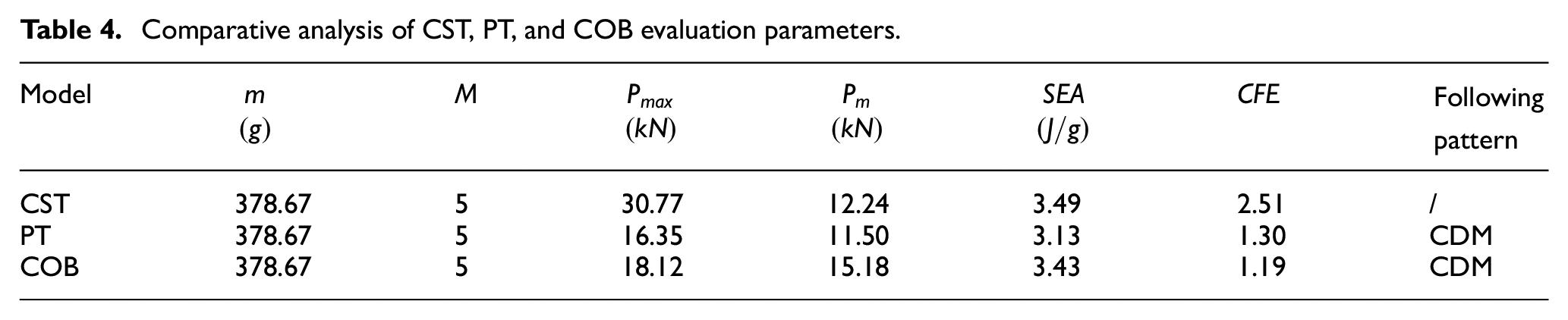
Hereinafter, traditional square tubes, parallelogram tubes, and origami crash boxes are referred to as CST, PT, and COB, respectively. The quasi-static compression study is carried out for CST, PT, and COB respectively, and the simulation and analysis settings are the same as in the previous section, and the simulation and analysis results are shown in Figure 13. The top end of the CST destroys first, followed by a gradual downward compression, in contrast to the PT and COB which destroys first from the mid-end, followed by the bottom end-destruction, and finally the top end in Figure 13. Upon comparing and analyzing Figures 13 and 14, it becomes evident that the CST exhibits a higher initial peak force due to the failure of the top at the onset of compression, leading to insufficient buffering time. Conversely, during compression, PT and COB fold and expand along the creases, thereby prolonging the plastic matrix failure time and effectively mitigating the initial peak force.

Comparative analysis: (a) traditional square tube, (b) parallelogram tube, and (c) origami crash box.

Comparative analysis of CST, PT, and COB force displacement curves.
It is evident that PT and COB outperform CST. Next, the focus will be on comparing PT and COB to elucidate the structural advantages of COB. According to Figure 13 and Table 4, compared with PT, COB exhibits significant improvements in
Comparative analysis of CST, PT, and COB evaluation parameters.
Parameter study of COB
Through the above analyses, a COB with optimal values of a/b is identified. To further elucidate the damage mechanism of this structure, parametric studies for
Effect of k1 value
A three-dimensional localized schematic of an outer convex surface is depicted in Figure 15(a). A1B1F1I1 and B1C1D1G1 represent two parallelogram cells of an unfolded former 2D crash box, with their overlap denoted as B1G1F1. The outer convex surface B1H1E1 is derived from the two overlapping parallelograms by the lines B1H1 and B1E1. As

(a) Geometrical analysis of convex surfaces and (b) geometric analysis of concave surfaces.
According to Figure 16(c), a variation in k1 does not affect the quality of COB and has a negligible impact on CFE. The slight decrease in SEA with increasing k1 may be attributed to the reduction in the extent of the outer convex surface, leading to decreased plastic matrix destruction during compression and reduced energy absorption. The corresponding equivalent plastic strain (PEEQ) contour maps of k1 change process, which are plotted on the undeformed shape for clarity, are shown in Figure 17(a) to (c). With the increase of k1, the scope of local plastic deformation occurring in the folding carton shrinks, but the phenomenon of stress concentration and local damage intensification also occurs. This is the main reason why the reduction of SEA fluctuation is not obvious. Furthermore, this phenomenon also leads to the overall uneven force during compression, which significantly reduces the average crushing force.

Parameter study: (a) effect of

(a) PEEQ contour maps of
Effect of k2 value
The 3D localized schematic of the inner concave surface is depicted in Figure 15(b). A2B2F2I2 and B2C2D2G2 represent the two parallelogram cells of the unfolded former 2D collision box, with the additional segment of their stitching designated as B2G2F2. When k2 increases, B2H2 and B2E2 move to B2J2 and B2K2 respectively, and when k2 decreases, B2H2 and B2E2 move to B2L2 and B2M2 respectively. In contrast to k1, due to geometric principles, changes in
According to Figure 16(d), the change in k2 has no effect on the mass of the origami box. However, as k2 increases, there is a more significant increase in SEA, maximum peak force, and average crushing force. In conjunction with Figure 17(d) to (f), the main reason for this phenomenon is that when k2 is small, the coverage of the inner concave surface is too large, leading to mainly physical folding during compression. Although physical folding increases the instantaneous impact time and helps reduce the peak force, it significantly reduces plastic deformation and results in relatively low energy absorption. Conversely, when k2 is larger, the coverage of the inner concave surface shrinks, reducing the likelihood of physical folding during compression. This leads to increased plastic deformation and gradual improvement in the energy absorption ratio. However, it should be noted that the absence of physical folding results in a decrease in the instantaneous impact time and a rapid increase in the peak force.
Effect of
value
The change in

(a) PEEQ contour maps of
Effect of
value
According to Figure 16(a), as

(a) PEEQ contour maps of
Furthermore, as
Summary of parameter effects
These geometric parameters affect the overall structural properties, including energy absorption rate, peak force, average breaking force, and load uniformity, by changing the geometric characteristics of the origami-origami-energy absorption box, such as folding mode, plastic deformation region, and stress distribution.
It is found that the value of α affects the folding pattern of the energy absorbing box and the position and size of the convex and concave surfaces. A smaller value of α may lead to a more concentrated stress distribution and a larger plastic deformation region, thus improving the energy absorption efficiency. However, a larger value of α will lead to an increase in physical folding, and an increase in buffer time will reduce the average breaking force. Changes in the value of θ will affect the curvature of the structure and the size of the bevel Angle
Based on the simulation results of the COB configuration under different structural parameters, as shown in Table 5, the performance comparison of the optimal and suboptimal structural parameters of the model is obtained:
Comparison table for parameter analysis.

Conclusion
A novel origami pattern has been proposed for the design of a high-performance energy absorption device known as the origami crash box. The overarching design concept involves integrating a unique structure onto the surface of the parallelogram tube, termed the inner concave and outer convex surfaces, to initiate a high-performance folding pattern. This mode is characterized by increased traveling plastic hinge lines. The results indicate that, when compared to a conventional square tube of equivalent mass, the origami crash box experiences a 41.09% reduction in peak force, a 24.02% increase in average crushing force, a 1.57% decrease in specific absorption energy (SEA), and a 52.52% decrease in the force uniformity index (CFE). Similarly, when compared to a conventional parallelogram tube of the same mass, it is observed that despite the initial peak force of COB increasing by 10.58%, the average crushing force increases by 32.1%, the SEA increases by 9.61%, and the CFE decreases by 8.07%. This superior performance can be attributed to the unique geometric features of the origami crash box, particularly the inner concave and outer convex structures. These features act as geometric defects, reducing the initial buckling force by promoting controlled folding patterns such as the complete diamond mode (CDM). The CDM allows for more extensive plastic deformation, leading to higher energy absorption. Additionally, the pre-folded design ensures that the structure collapses in a predictable and efficient manner, minimizing peak forces and enhancing overall crashworthiness.
The geometric parameters of the origami crash box, including the parallelogram aspect ratio (a/b), parallelogram vertex angle (
The primary determinant of collapse mode is the a/b value, where a lower a/b value is more inclined to induce the complete diamond mode (CDM). This deformation mode is conducive to the formation of extensive plastic deformation and high energy absorption characteristics.
When other parameters remain constant, variations in the
Although the plastic deformation of the convex surface is the primary energy-absorbing element in the collapse process of the origami crash box, it can be concluded from the previous analysis that when other parameters remain constant, variations in the
When other parameters remain constant, increasing the
In the future, this study will conduct a series of dynamic impact simulations, comparing the obtained data with the results from the initial quasi-static simulation analysis. This will investigate the relationship in the trends of change between the results of quasi-static simulations and dynamic impact simulations, verifying the accuracy of the COB configuration determined by the earlier quasi-static simulations. Furthermore, ongoing theoretical research on the governing equation aims to comprehensively understand how various parameters of the origami crash box influence energy absorption during the compression process. This endeavor seeks to achieve a deeper understanding of the internal mechanism of the origami crash box collapse process.
The COB structure designed in this study is not only applicable to the automotive industry but can also be widely applied in fields such as aerospace, railway transportation, and construction industries. The fabrication of experimental models utilized 3D printing technology, which has the disadvantage of high costs and limited widespread application. This presents certain challenges for the mass production and application of origami crash boxes. In the future, this research will conduct a series of studies on how to reduce the cost of origami crash boxes to promote their widespread use, such as employing methods like mold manufacturing or mechanical cutting. This will facilitate their application across various fields, drive the advancement of related technologies, and foster industrial development.
