



Abstract
This study examines how electro kinetics and peristaltic motion affect intestinal fluid flow in bio-microfluidic devices and electrokinetic separation methods. The Oldroyd-B fluid is ideal for modeling complicated gastrointestinal fluids like chyme and mucus because to their viscoelasticity. Including electroosmotic effects allows realistic gut wall nutrient transport and absorption models. Debye-Huckel approximations, low Reynolds number assumptions for the gut channel, and continuity, Poisson, and momentum equations provide the mathematical framework. Analytical solutions are developed using perturbation methods to examine Reynolds number, dimensionless wave number, relaxation and retardation time parameters, electroosmotic parameter, and Heltmholtz-Smoluchowski velocity. Graphic study shows that electroosmotic parameter and Heltmholtz-Smoluchowski velocity increase axial velocity near channel walls. Peristaltic flow alone does not increase pressure gradient as much as electroosmotic actions do. As electroosmotic parameter rises, bolus size and streamlines decrease. This paper provides a solid mathematical framework for understanding intestinal fluid dynamics and provides biological insights. Validating and improving the model with particular examples and current research, this work seeks to improve gastrointestinal illness knowledge and medicine delivery system design by revealing gastrointestinal fluid dynamics.
Keywords
Introduction
Electroosmosis can be conceptualized as the electrically induced propulsion of an electrolyte fluid within a restricted microfluidic or porous framework in response to an externally imposed electric field. This phenomenon emerges from the mutual interaction between electric charges at the solid-liquid boundary and the electric field, leading to a directed motion of the liquid. The name of Reuss 1 gleams as the first pioneer to illuminate the phenomenon of electroosmosis, conveyed to the world in his pioneering 1809 investigation of clay diagraphs. Wiedemann 2 investigated the phenomenon further to determine the underlying mathematical argument. Electroosmosis has grown in importance due to its numerous and compelling applications in biotechnology, biochemistry, and biopharmaceutical research. Electroosmosis enables precise fluid control, low-flow rate handling, reduced dead volumes, and gentle sample manipulation which facilitates in the development of compact and efficient lab-on-a-chip devices for medical diagnostics and DNA analysis. These microfluidics applications have been described by Nguyen et al. 3 Recent attention has been directed toward the exploration of pattern formation and instabilities within viscoelastic fluid dynamics. In the current year, researchers examined the flow-switching and mixing phenomena present in electroosmotic flows of viscoelastic fluids. Some of the theoretical research include the three-dimensional rotational behavior of Oldroyd-B nanofluid incorporating relaxation and retardation viscous dissipation investigated in 2021. The solution for two-fluid electroosmotic flows of viscoelastic fluids was determined on numerical approach. Electroosmotic flow in a square microchannel was studied experimentally to find a composite correlation of the given parameters for the velocity of fluid. Studies4,5 in which numerical approach is employed to examine the electroosmotic slip flow of fractional Oldroyd-B fluids at elevated zeta potentials, and rotating electro-osmotic flow of fractional Maxwell fluids is done by Wang et al. Ranjit et al. 6 investigated the electrothermal characteristics in the framework of two-layered couple stress fluid flow within an asymmetric microchannel via peristaltic pumping. The research by Vasista et al. 7 delves into electroosmotic flow in a microchannel, considering the influence of a viscoelastic fluid and slip-dependent zeta potential. Understanding the electroosmotic behavior of Oldroyd-B contributes in improving polymer processing techniques, in biomedical engineering for precise fluid flow and in technologies related to electrokinetic pumps.
Peristalsis is a natural phenomenon through which biofluids, and physiological fluids travel within tubes and channels in a synchronized way forming rhythmic sinusoidal waves along the tube’s length. This sophisticated mechanism plays a vital role in wide-ranging biological processes, encompassing vital functions like worm locomotion and urine expulsion. In addition to its prominent application in biological systems, peristalsis is quite useful within microfluidics technology. Peristaltic pumping is quite beneficial as it ensures the safety and controlled flow of fluid through various systems. Through peristaltic pumping, the transferring of fluids such as hazardous liquids and sterile hygienic liquids has become highly secure and efficient. Moreover, technological innovations such as lung machines and dialysis machines, both are dependent on the peristaltic mechanism for their flawless operation. This process is also advantageous in drug delivery systems, offering precise control over medical procedure. Latham, 8 Shapiro et al., 9 Fung and Yih, 10 Burns and Parkes, 11 and Pozrikidis 12 were the ones who performed earliest research on the peristaltic transport of fluids. Many further investigations13–18 provide light on the underlying dynamics of peristalsis in non-Newtonian fluids, allowing engineers to better utilize this phenomenon in practical applications. The peristaltic movement of non-Newtonian fluids in diverse circumstances is the focus of the works cited in References 15, 19–22. The studies about the peristaltic flow of nanofluids along with considerations such as heat transfer, electroosmosis, electromagnetohydrodynamic (EMHD) radiative transport, hall and ion-slip currents effect have been conducted.23–30 The Carreau-Yasuda fluid model under induced magnetic field along with slip effects is being invested by Vaidya et al. 31
Electroosmotic flow (EOF) and peristaltic flow were first studied together in depth by Chakraborty. 32 The correlation between EOF and peristaltic flow has been investigated later on, however, most of that research used the viscous fluid model. 33 The heat transfer applications in the curved channel is explored in a recent study. 34 In Magesh et al., 35 researchers examined magnetic field influence on the EOF of a Jeffrey fluid through a non-symmetric regime. A mathematical model to investigate the influence of electroosmosis on the flow of Newtonian hybrid nanofluid flowing through a peristaltic tube is studied. 36 The analysis to understand the effect of modified Darcy’s law on electroosmotically driven magneto-hydrodynamics (MHD) flow of viscoelastic fluid was performed. 37 Some of the other recent studies focusing the combined effect of electroosmosis and peristalsis are cited.38–40 Viscoelastic models like Oldroyd-B are used to approximate arterial blood flow, accounting for its combined viscous and elastic properties. This flow is also influenced by peristaltic mechanisms. Incorporating both electroosmotic and peristaltic behaviors of Oldroyd-B fluids is highly beneficial in optimizing microfluidic devices.
Although many non-Newtonian fluids have been investigated41,42 to represent human body fluids but very little is known about the best suited body fluid as peristaltic flow of viscoelastic fluids like Oldroyd-B fluid that is driven by electroosmosis. The extra stress tensor and the strain rate tensor are linearly related in Oldroyd-B fluid, a type of viscoelastic fluid. Like Maxwell fluids, Kelvin-Voigt fluids, and Burger fluids, it is categorized as a viscoelastic fluid. A recent study was done to understand the viscoelastic instabilities of Oldroyd-B fluid. 43 A study about pressure driven flow of Oldroyd-B fluid in slowly varying non-uniform narrow channel is conducted to deduce relation between flow rate and pressure drop. 44 Thermally coupled electroosmotic flow of viscoelastic fluid through porous microchannels is stated in study. 45 Imran et al. 46 explored the electroosmotic flow of Jeffrey viscoelastic model through scraped surface heat exchanger. A theoretical study about peristaltic flow of electrically actuated viscoelastic fluid in a microfluidic configuration is performed. 47
By CFD modeling a structured view has been provided for fluid flow patterns, mixing and digestion of food in human gut. 48 As for the computational study of magnetized gold-blood Oldroyd-B model has been used. 49 Our research intends to fill a gap in the literature by focusing on electroosmosis rather than the previously studied peristaltic flow of viscoelastic fluids in human gut. Considering the fluid properties we opted for Oldroyd-B fluid model for viscoelastic fluids like chyme in human gut, which is well-suited, as it divides the stress into elastic and viscous components.
How does the electrokinetics forces effects the delivery of nutrients and drugs in the human gut along with peristalsis? Can the viscoelasticity of the fluid in human gut be effected and controlled by electroosmotic parameter? How can be this used in the advancement of biomicrofluidic devices and lab-on-chip devices? By conducting this analysis, we will find the patterns of the velocity, pressure gradient and trapping behavior of the viscoelastic fluid under the impact of electrokinetics, which will help to answer the above problems. This study will be useful in tasks like cell-sorting or separating in lab-on-chip devices, accurate sample transport and targeted delivery in biological and chemical assays as EOF combined with peristaltic flow provides more precise and enhanced directional control of fluid. By introducing this concept in the designing of microfluidic device such as dialysis machine, flow resistance can be reduced, will give a good directional control of fluid and prevention of fouling and clogging to improve waste removal within the dialyzer can be done.
Formulation of problem
Flow regime
The investigation considers the flow due to electroosmosis in two dimensions of a viscoelastic fluid (incompressible) in a symmetric geometry which has width
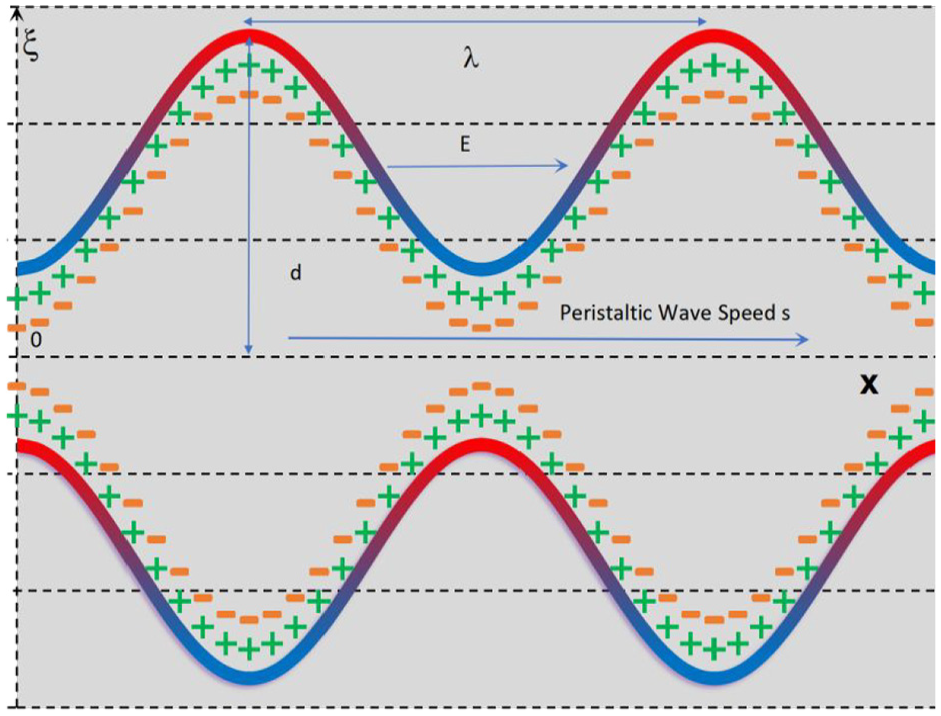
Visual framework of regulation of Oldroyd-B fluid flow via electroosmotic effect.
We will use this model to visualize the fluid flow in the human gut. As the walls of human gut are negatively charged, it will interact with the ions present in the chyme. As result, electric double layer (EDL) will be formed in the gut. The figure below, shows the peristaltic motion in the human gut. The positive charges (shown in green color) and negatively charges (shown in orange color) shows the formation of EDL.
Let

where
Fluid model
Within the context of the Oldroyd-B fluid, the constitutive equation that characterizes the Cauchy stress tensor is provided as:

Here
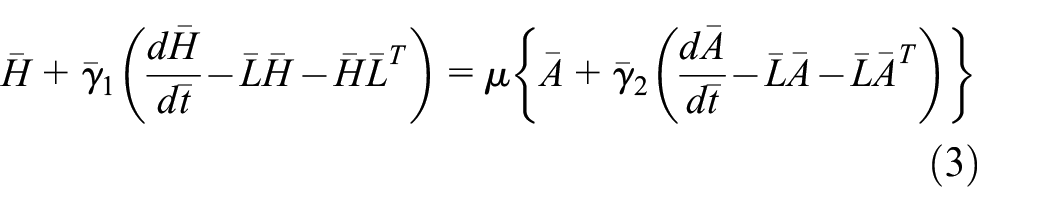
where

where
Potential distribution
The Poisson equation used in developing electric potential is given by

where
The electric potential of the system is described with the help of the Poisson equation

where

Now considering at where


Here equation (9) gives the Boltzmann distribution, to relate the potential with charge. Accordingly, the Boltzmann distribution provides the statistical framework for the net charge density

here
By modifying equation (5) in wave frame we get, here

Interrelating the laboratory and wave frame as

And introducing the dimensionless variables as following

The dimensionless form of equation (11) will be of form

Here
Overview of solution methodology
The continuity equation, momentum equation, and additional stress tensor equations of the Oldroyd-B fluid model serve as the foundation for the governing equations for our fluid issue. In equations (15)–(20), these equations are first shown in the lab frame. The equations are converted into the wave frame via the Galilean transformation, as seen in equations (21)–(26). These equations’ dimensionless version is then obtained and given in equations (28)–(33). The equations become equations (34)–(38) once the stream function is included. We use a perturbation approach with a tiny wave number, δ, to solve these equations. Equations (45)–(51) provide the zeroth-order equations, whereas equations (53)–(59) provide the first-order equations. Wolfram Mathematica is used to solve the zeroth and first-order equations; the results are described in equations (67)–(70).
Governing equations for the system
The expressions that dictate the conduct of the Oldroyd-B fluid in the laboratory frame are articulated as 50 :




where
The flow in the channel is unsteady in the laboratory frame but by the adoption of a moving coordinate system, denoted as




Non-dimensionalizing the system as


We get,



where the

which deduces the equations (28)–(33) as follows,







Volumetric flow rate and boundary constraints
The formulation representing the fluid’s volumetric flow rate in the laboratory frame is provided as,

Within this framework,

where

And the boundary conditions chosen are given below


where

signifies the proportion of amplitude or occlusion, subject to
Perturbation solution
It is observed that equations (34)–(38) represent nonlinear partial differential equations of order four. In consequence, for the small wave number




Zeroth-order equations


with the boundary conditions


First-order equations

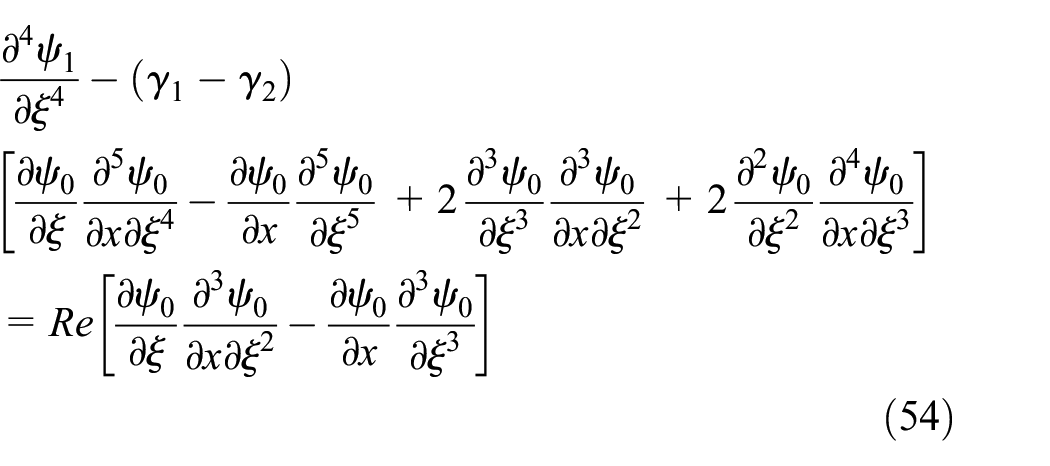



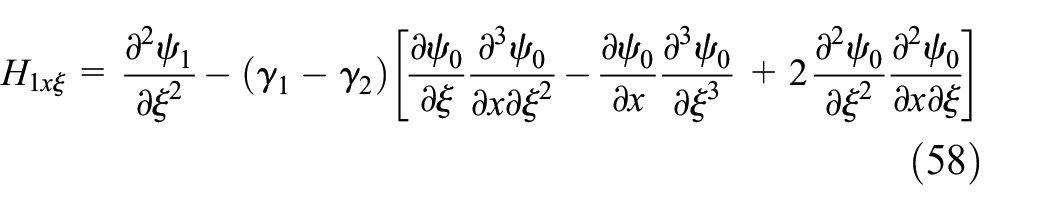

with the boundary conditions


Perturbation solution expressions
In this research article, the zeroth and first order system subject to the boundary conditions (52) and (60) are solved using the Wolfram Mathematica software.
Zeroth-order equations solution



First-order equations solution


where,

The values of


Here the constants
Findings and interpretation
In the subsequent part, the impact of assorted elements (i.e. Reynolds number


(a–e) Pressure gradient variation for parameter

(a–d) Tangential component of stress tensor variation for parameter

Electric potential variation for electroosmotic parameter.

(a–d) Stream distribution for parameter
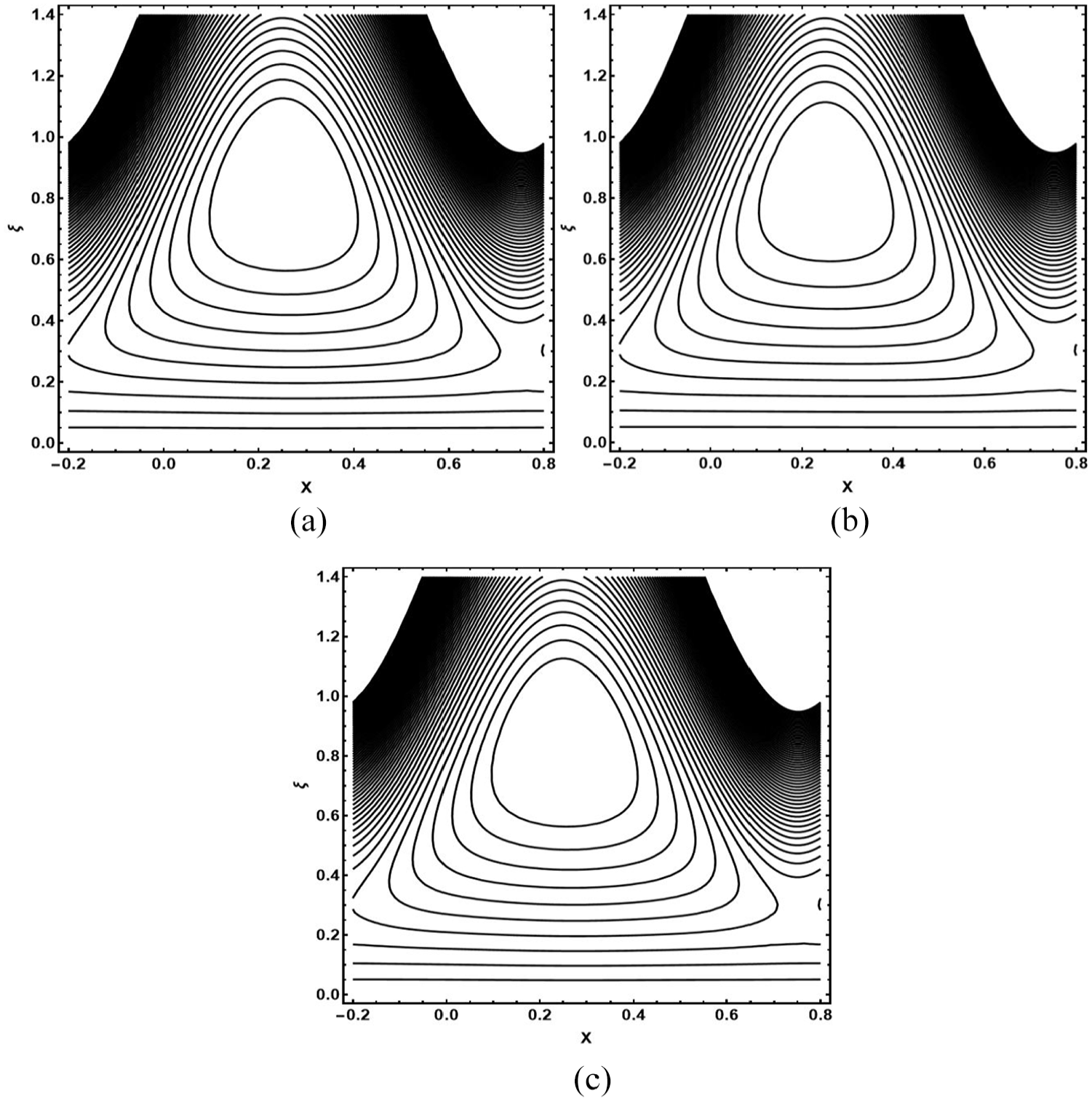
(a–c) Stream distribution for parameter
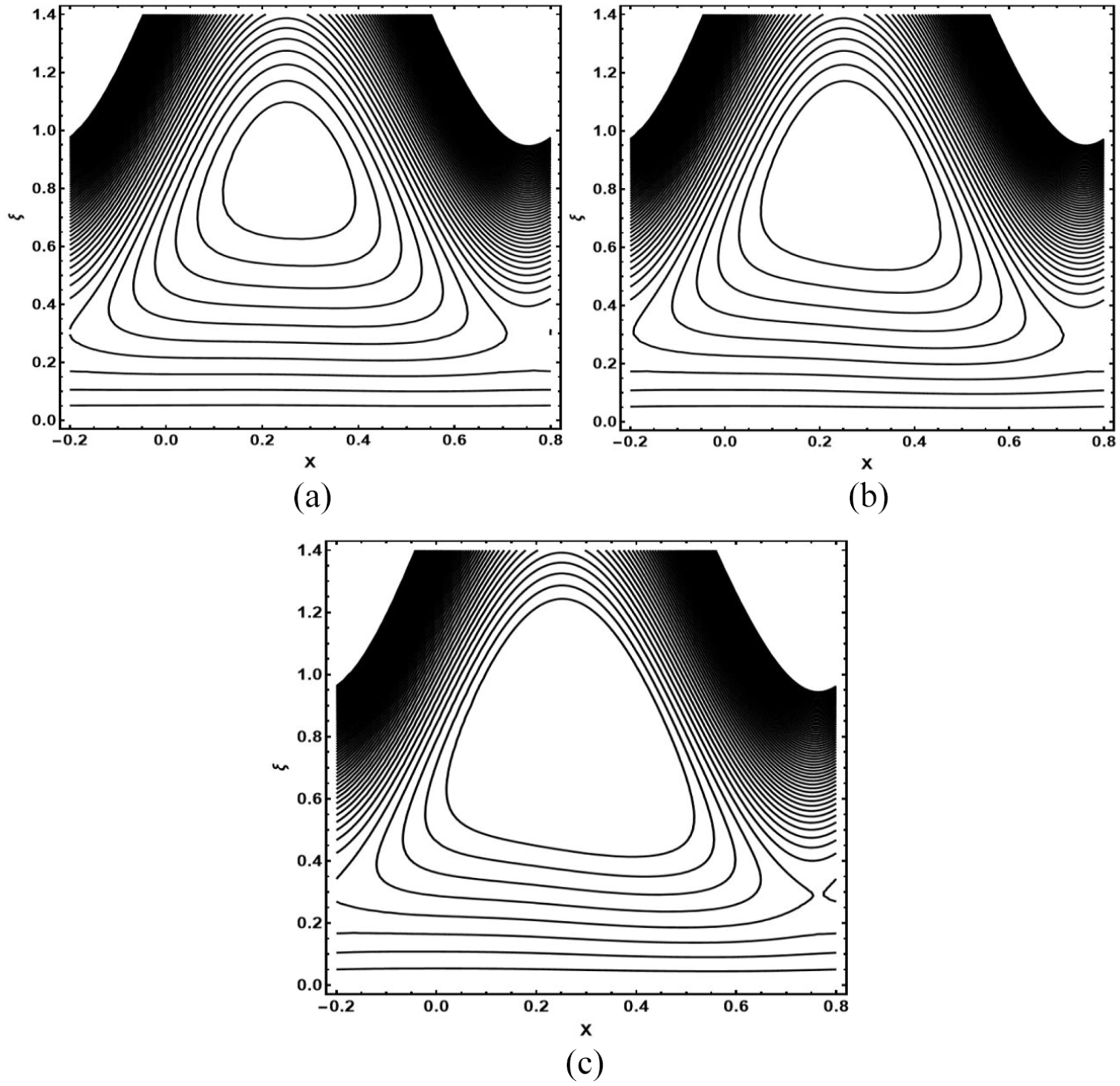
(a–c) Stream distribution for parameter
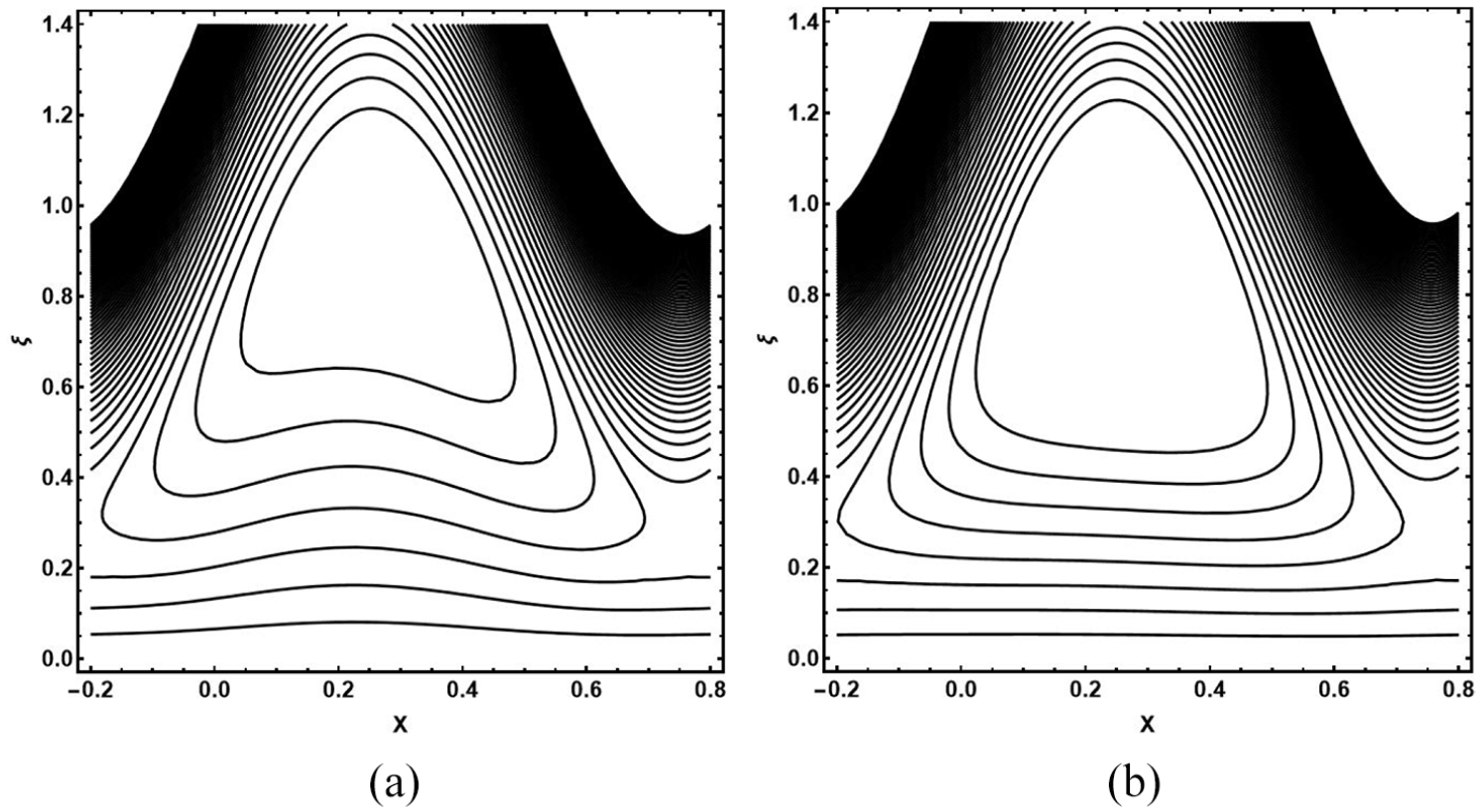
(a and b) Stream distribution for parameter

(a and b) Stream distribution for parameter
Velocity distribution
Figure 2(a) and (b) demonstrate that as the
Figure 2(c) and (d) portrays that with an elevated
Electroosmotic peristaltic velocity of Oldroyd-B fluid.

Peristaltic velocity of Oldroyd-B fluid.

It is being noted from the above observations that for
Pressure gradient
Figure 3(a) and (b) depict a trend wherein the magnitude of the pressure gradient initially decreases as the Reynolds number increases. However, once it reaches its peak value, it subsequently exhibits an upward trend with further increases in the Reynolds number. In contrast, the behavior concerning the wave number is the opposite. The pressure gradient initially decreases with rising Reynolds number in laminar flow due to dominant viscous effects. However, beyond a certain threshold, further increases in Reynolds number leading to enhanced mixing, and greater energy transfer. In this regime, the pressure gradient rises due to the increased flow dynamics. Conversely, as the wave number increases, peristaltic waves become more prominent, introducing a dynamic flow pattern that disrupts laminar flow. This disruption leads to an elevation in the pressure gradient with increasing wave number. It is evident from Figure 3(c) that the magnitude of the pressure gradient amplifies as the electroosmotic parameter increases. As the electroosmotic parameter increases, the electric field exerts a more potent force on the fluid, enhancing its movement. Consequently, the pressure gradient, responsible for driving fluid flow, increases to accommodate the heightened fluid motion resulting from the stronger electroosmotic effect. Figure 3(d) and (e) reveal that the pressure gradient responds to variations in the dimensionless relaxation time and dimensionless retardation time parameters. Before reaching the peak value, an increase in the dimensionless relaxation time parameter is associated with a rising pressure gradient, while an elevation in the dimensionless retardation time parameter leads to a pressure gradient reduction. Post-peak value, the trends reverse: the dimensionless relaxation time parameter causes a pressure gradient decrease, while the dimensionless retardation time parameter results in an increase.
Tangential extra stress
Figure 4(a) and (b) demonstrates that with an upward shift in both the Reynolds number and wave number, the tangential extra stress component diminishes in magnitude. Figure 4(c) illustrates that the tangential extra stress component exhibits a positive correlation with the electroosmotic parameter
Electric potential
Figure 5 shows that for the limiting value of electroosmotic parameter
Trapping behavior
Within the Figure 6, streamlines are depicted across a range of electroosmotic parameter values. It is apparent that as the electroosmotic parameter increases, there is a distinct decrease in both the count of streamlines and the dimensions of the bolus. With the rise in the electroosmotic parameter, a more pronounced electric field-induced flow occurs. This heightened electric field exerts a stronger force on the fluid, driving it with increased vigor. Consequently, the fluid undergoes improved mixing, resulting in a decrease in the number of separate streamlines, as the flow attains greater uniformity. Furthermore, the elevated flow velocity, driven by the intensified electroosmotic effect, plays a role in reducing the dimensions of the bolus, as it facilitates the rapid and efficient transport of fluid elements within the channel. Figure 7, shows that the size of bolus increases with increasing Heltmholtz-Smoluchowski velocity but with a minor difference. Figure 8 depicts that the size of bolus enhances with the increasing wave number. It is noted from the Figure 9 that as the relaxation time parameter
By controlling the relaxation time parameter we can enhance the bolus size in the human gut for better nutrients absorption. This concept will provide aid in the advancement of treating gastrointestinal diseases such as inflammatory bowl disease (IBD), gastroparesis, and intestinal dysmotility. For the treatment of these diseases, a drug delivery system that incorporates the increased relaxation time could enhance the contact time with the inflamed region, increasing the effectiveness of medication. The medical device such as Gastric Electrical Stimulation (GES) can be advanced in such a manner that it will increase the relaxation time, helping the patients to enhance nutrient absorption.
Verification of result
To verify our results, we have taken the special for
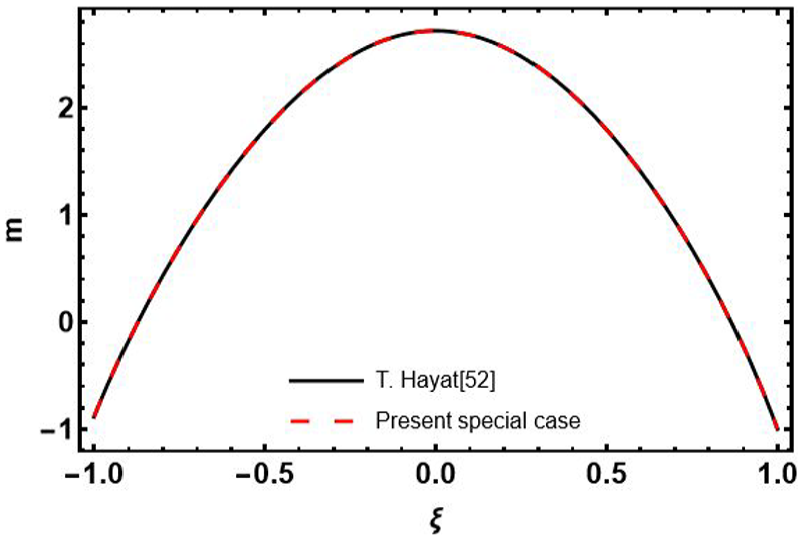
Verification of result by comparing with Hayat et al. 51
Concluding remarks
This study examines the effects of electrokinetics and peristaltic flow of Oldroyd-B fluid within a symmetric channel. The approximate series solution for velocity, electroosmotic function, pressure gradient, and stream function are computed using the Mathematica software. In accordance to the obtained analysis of the given regime model, the following results are obtained:
The axial velocity of Oldroyd-B elevates with the increasing Reynolds number, wave number, and dimensionless relaxation time parameter and decreases with electroosmotic parameter, Heltmholtz-Smoluchowski velocity, and dimensionless retardation time parameter.
The magnitude of pressure gradient profile enhances for the higher value of electroosmotic parameter. Pressure gradient is more enhanced for the parameters such as Reynolds number, wave number, relaxation and retardation time parameter for electroosmotic flow of Oldroyd-B fluid as compared to its peristaltic flow.
The viscoelastic behavior of Oldroyd-B fluid possesses a positive correlation with electroosmotic parameter and Heltmholtz-Smoluchowski velocity, but this relation is inverted for
With the increase in electroosmotic parameter, there is a distinct decrease in both the count of streamlines and the dimensions of the bolus. And opposite behavior is shown for wave number.
Both the biological and engineering domains can benefit from this research. By enhancing fluid control, eliminating waste, and simulating natural fluid flow, it can improve biomedical equipment such as organ-on-a-chip systems, dialysis machines, and electrokinetic cell sorters. In engineering, it can improve fluid mixing, heat dissipation, and circulation, particularly for high-viscosity fluids, which can enhance heat exchangers, cooling systems, and geothermal heat pumps. The model does not account for potential variations in gastrointestinal properties, including pH, ion concentration, and mucus composition, which is a limitation of the study.
