



Abstract
Based on the spectral geometry method, the analytical model of laminated double-layer rectangular plate including elastic floating raft damping system is established. The artificial virtual technology is used to simulate the elastic boundary conditions of the laminated deck, and the three-dimensional damping isolator and elastic raft plate are used to simulate the floating raft damping system. Based on energy principle, the solution equation of vibration characteristics of laminated double-layer rectangular plate system is obtained by Rayleigh Ritz method. Compared these results with finite element method, the reliability of the model is verified. Then the effects of different parameters on the dynamic characteristics of double plate structure are further discussed.
Introduction
There is a type of flat plate floating raft vibration reduction system which is commonly used on ship decks.1,2 In this system, the deck and floating raft are connected by uniformly distributed damping isolation device, forming a damping elastic structure layer, which has good shock absorption and isolation performance and impact resistance.3–5 When carrying out the research on the vibration isolation performance of flat plate floating raft damping system, the flat plate floating raft damping system can be simplified as the dynamics model of double-layer laminate plate structure, including elastic floating raft plate, vibration isolator, and composite material foundation support deck structure. Scholars have carried out a lot of research work on the vibration modeling and characteristics analysis of beam and plate structures, especially in recent decades, the research object of plate structure tends to be complex, and the research focus has expanded to double-layer system.
Li et al. 6 proposed an analytical method to study the free and forced vibration characteristics of a two-beam system with arbitrary beam mass, bending stiffness, and boundary conditions. The two beams are connected by a viscoelastic layer, taking into account both the presence and absence of a Winkler elastic layer at the bottom of the lower beam in the structural system. Based on the Kirchhoff-Love plate theory, Oniszczuk7–13 conducted an analysis on the characteristics of free vibration frequencies and forced vibration responses in the double-layer plate system connected by Winkler elastic layers. Furthermore, he established an analytical model for the vibration characteristics of the double-layer structure connected by viscoelastic layers, studied the lateral free vibration and forced vibration characteristics of the system under arbitrary viscous damping, and determined the precise analytical solutions for both free and response vibrations of the system. However, the boundary conditions of this model are mainly limited to simply supported boundary conditions. Later on, Kukla 14 carried out a study on the free vibration of rectangular plates elastically connected with beams using the Green’s function method. Based on the method of solving partial differential equations, Hedrih15–17 provided analytical solutions for the transverse vibration of double-layer plate structures with both continuous and discontinuous Winkler-type elastic layer connections. He also discussed the in-plane and out-of-plane vibration characteristics of double-layer plate systems with viscoelastic interlayer connections. Furthermore, Hedrih analyzed and studied the energy transfer laws between the double-layer plates using the energy principle. However, these studies have primarily focused on the transverse vibration of double-layer thin plates, and the calculation process is relatively complex. Additionally, they have all been limited to isotropic materials, making them inapplicable to the study of general boundary conditions or composite materials. Xu and Zhu 18 conducted modal analysis of a double-layer plate system with springs/damping elements in the middle and multiple simple supports at the bottom using finite element software. They obtained an optimized layout scheme for the simple supports and vibration isolators. Kim et al. 19 proposed an analysis model for the free vibration characteristics of composite laminated double-plate systems using the mesh-free method. In this model, all displacement functions, including boundary conditions, are approximated using mesh-free shape functions. By employing the artificial virtual spring technique, a parametric study on the natural frequencies of the double-plate system under elastic boundary conditions was conducted. Cao et al. 20 proposed a multi-layer moving plate method for the dynamic analysis of an infinitely long double-plate system connected by viscoelastic materials under moving loads. Based on verifying the effectiveness of the model, a parametric study on the dynamic response of the double-plate system was conducted. Chen et al. 21 investigated a composite laminated rectangular plate by considering the effect of interval uncertainty in the intrinsic parameters and load on its stochastic vibration characteristics. Xue et al. 22 utilized an improved Fourier series method, where the vibration displacements were represented as a linear combination of a double Fourier cosine series and auxiliary series functions. This approach enabled them to conduct vibration modeling and analysis on moderately thick laminated composite plates with arbitrary boundary conditions. Sinha et al. 23 has conducted a parametric study on the dynamic response characteristics of laminated composite stiffened plates using the finite element method (FEM) by appropriately combining a nine-noded isoparametric plate element with five degrees of freedom and a three-noded isoparametric beam element with four degrees of freedom as the stiffener element. Based on the first-order shear deformation theory and von Kármán geometric nonlinearity theory, Guo et al. 24 have established the linear and nonlinear vibration characteristics of graphene platelet-reinforced composite (GPLRC) laminated plates. Their work provides valuable insights into the vibrational behavior of GPLRC laminated plates, and demonstrates the control effects of parameter configurations on their vibration characteristics. Zhong et al. 25 established a meshless analysis model for studying laminated composite plate structures, considering the thermal effects of the laminated plates based on the theory of thermoelasticity, and obtained the modal behavior and stochastic dynamic solutions of the laminated composite plates under thermal loading. Based on Donnell’s shell theory, Avey et al. 26 established an analysis model for the fundamental frequencies of laminated double-curved nanocomposite structures, considering the effects of transverse shear stresses (TSS) and rotary inertia (RI). Wang et al. 27 proposed a bearing dynamics analysis method, which utilizes displacement coordinate relations to approximate the contact deformation between the rolling elements and raceways, and then calculates the response characteristics of the rolling bearing based on this deformation. Han and Chu 28 established a nonlinear dynamic model for the skidding behavior of angular contact ball bearings, and discussed the ball skidding speeds within the bearing under combined load conditions. Gao et al. 29 proposed a bottom-up multi-step analytical framework that predicts the impact on the in-plane mechanical properties of a rectangular plate, including the effective Young’s modulus and Poisson’s ratio in two directions. A correction coefficient is introduced to improve the model by addressing the errors resulting from the simplification of boundary conditions. Such research is widely conducted in the design of earthquake-resistant structures. Ali et al. 30 designed a seismic isolation system featuring a reinforced cut wall (RCW) with an appropriate recentering mechanism, which has been verified as an effective isolation strategy for low-rise masonry buildings in high-intensity seismic zones. Yao et al. 31 proposed a novel form known as the steel-PEC spliced frame beam (SPSFB) to maintain the advantages of the PEC beam while reducing the consumption of steel. Huang et al. 32 designed a structure that includes the intact strengthened columns (ISCs), earthquake-damaged strengthened columns (EDSCs), corrosion-damaged strengthened columns (CSCs), and coupled-predamaged strengthened columns (CPSCs). This structure was tested to investigate the effect of loading case, strengthening method, and the predamage level. Liu et al. 33 conducted a study on the structural deformation mechanism of U-shaped corrugated core sandwich panels under static compression loads, which are utilized in ship structures. Tian et al. 34 proposed a concave X-shaped structure (CXSS) using custom-designed variable pitch springs (VPS) in order to achieve better low-frequency vibration isolation performance.
The above literature introduces various research methods, experimental techniques, and data analysis tools, as well as a wealth of experimental data, theoretical derivations, model constructions, and conclusion analyses, providing invaluable references for the research in this paper. However, research on the characteristics of laminated double-layer plate structures incorporating laminated elastic raft structures, vibration isolators, and laminated elastic support bases is still relatively limited. Conducting research on such dual rectangular plate structures holds significant engineering value.
In this paper, an analytical model of laminated double-layer rectangular plate with an elastic raft vibration reduction system is established based on the spectral geometry method. Artificial virtual technology is employed to equivalently simulate the elastic boundary conditions of the laminated foundation support deck. The raft vibration reduction system is equivalently simulated using three-dimensional damping isolators with damping effects, as well as elastic raft plates. The Rayleigh-Ritz method is adopted to obtain the solution equation for the vibration characteristics of the double-layer laminated plate. The obtained calculation results are then verified, and the influence of different parameters on the dynamic characteristics of the double-layer rectangular plate is discussed.
The physical model of a structure
The mathematical abstraction of the floating raft vibration isolation system can be formulated as a dynamics model of a composite material double-layer rectangular plate structure, which encompasses the elastic floating raft structure, vibration isolators, and the elastic foundation. As shown in Figure 1, orthogonal coordinate systems (o-x1, y1, z1), (o-x2, y2, z2) are established on the neutral layers of two plates. The dimensions a, b, c, and h represent the length, width, height, and thickness of the plates, respectively. Plate 2 is connected to Plate 1 at its four corners through point connections, while the intermediate connection relationship is simulated using a six-degree-of-freedom spring-damper system. Plate 2 represents the upper rectangular plate, and its boundaries are completely free. Plate 1 serves as the support plate, and its boundary conditions are simulated using three sets of linear springs {

Schematic diagram of the double-layer rectangular plate structure model: (a) floating raft isolator and (b) simplified physical model.
Spring stiffness value corresponding to boundary conditions.

Kinematic relationships and displacement expressions of the structure
Based on the first-order shear deformation theory, the displacement of any point within a laminated composite rectangular plate can be expressed as:

in the formula, u0, v0, and w0 represent the displacements along the x, y, and z axes on the middle surface of the rectangular plate, respectively. ψx and ψy represent the angular displacement rotations around the x-z plane and y-z plane at any point within the plate.
Based on the theory of small deformation linear elasticity, the strain-displacement relationship of the rectangular plate is defined as follows:


Taking into account the different fiber orientations of each layer in laminated materials, which results in varying directions of anisotropy, it is necessary to unify the material coordinates of each layer to establish physical equations that reflect the overall material properties. The specific transformation process is detailed in reference, and will not be repeated here. According to the generalized Hooke’s law, the constitutive relationship of laminated materials can be expressed as:

in the formula, σx and σy represent the normal stress in the direction of the normal, τxy, τxy, and τxy are the shear stresses, and

in the formula,
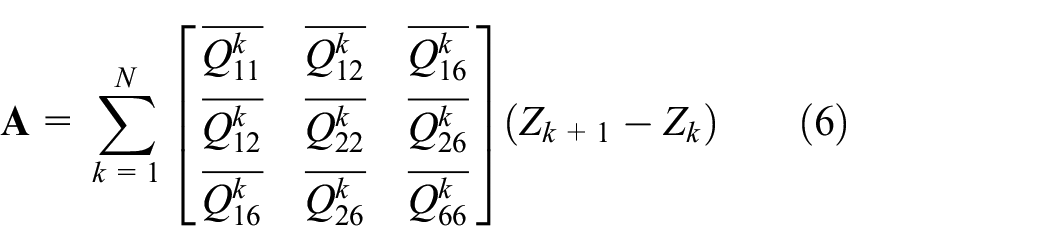


in the formula, N represents the number of material layers in the laminated material, and Ks is the shear correction factor, which is taken as 5/6 in this paper.
In selecting the displacement function for spectral geometry methods, it is crucial to consider whether it will exhibit jumps or discontinuities at the boundaries during the solution process. Additionally, the precision of the solution and the speed of convergence must be factored in to ensure that the method is suitable for various complex boundary conditions while maintaining a desired level of accuracy. 35 In this study, a standard Fourier cosine series is adopted as the primary function, and auxiliary functions are incorporated to accommodate the complexities of diverse boundary conditions. Through analysis from the perspectives of satisfying boundary conditions, computational convergence, and computational precision, the authors have found that the sine function, when utilized as an auxiliary function, demonstrates exceptional performance. Furthermore, its form is consistent with the Fourier series of the primary function, which simplifies the computation of the auxiliary function to a certain extent, thereby highlighting the superiority of spectral geometry methods.
Given that the rectangular plate structure discussed in this paper is two-dimensional, the displacement admissibility functions in both the x and y directions are jointly constructed using one-dimensional Fourier series and auxiliary functions. Therefore, in this section, the displacement admissibility functions for the displacement variables u0(x, y, t), v0(x, y, t), and w0(x, y, t), and the rotation variables ψx(x, y, t) and ψy(x, y, t) of the rectangular plate can be expressed as follows:

In the formula, ω represents the natural frequency of the structure; t represents time; j is the imaginary unit;



λm = mπ/a and λn = nπ/b; w1,2(

In the above formula,

The energy equation of the double-layer rectangular plate structure
Based on the previous section, the Lagrangian energy functional of the double-layer rectangular plate structure can be expressed as:

Uvi represents the strain energy of the ith layer plate; Usp1 represents the spring potential energy stored in the boundary springs of the rectangular plate; Vcp1 is the potential energy of the coupling springs between the two plates; Wf1represents the work done by external forces; and Tpi is the kinetic energy of the ith layer plate. Where:

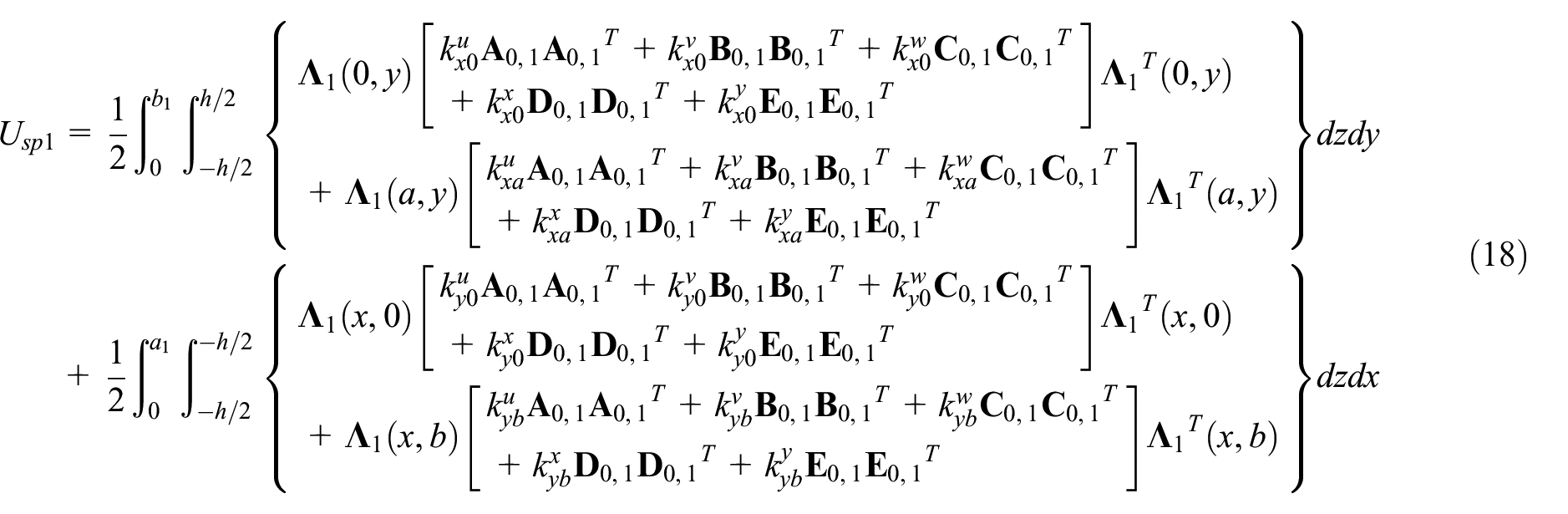


in the formula, f0 represents the amplitude of the excitation force, and (xF, yF) represents the position of the excitation point. The four corners of the upper rectangular plate are connected to the lower rectangular plate through a six-degree-freedom spring system and damper, so the coupling potential energy can be expressed as:


in the above formula, {kcu, kcv, kcw, kcx, kcy} represent the stiffness values of the coupling springs in various directions, and c represents the viscous damping.
By substituting the displacement expression (15) into equation (21) and using the Ritz method to find the extreme value, the specific expression for solving the forced vibration of the double-layer rectangular plate structure can be obtained.

in the formula,
Study on vibration response characteristics of double-layer rectangular plate structures
As an effective vibration and noise reduction system, the study of forced vibration characteristics of elastic floating raft structures is particularly meaningful. In this section, the validity of the established vibration analysis model is first verified, followed by a parametric study to analyze the influence of relevant parameters on the forced vibration characteristics of the system. In the subsequent parametric study, unless otherwise stated, the geometric parameters of plate 1 are set as: a1 = 2 m, b1 = 1 m, h1 = 0.05 m, and the geometric parameters of plate 2 are set as: a2 = b2 = 0.5 m, h2 = 0.05 m. In addition, plate 2, as the upper component of the floating raft vibration isolation system, is generally subject to external force disturbances. The external excitations are all applied to plate 2, while the response points are set on both rectangular plate 1 and rectangular plate 2. The coordinate positions of the excitation points and response points are as follows: excitation point 1: (0.2a2, 0.5b2), excitation point 2: (0.6a2, 0.5b2), response point 1: (0.5a1, 0.5b1), response point 2: (0.5a2, 0.5b2), and the amplitude of the excitation force is 1 N. The specific locations of each point have been marked in the Figure 1.
Firstly, the correctness of the model is verified. The response curves of the double-layer plate are plotted using both the finite element software ANSYS and the analytical model developed in this paper. The material parameters of the upper and support plate structures are consistent and are set as follows: μ = 0.3, ρ = 7850 kg/m3, E1 = E2 = 206 GPa, G12 = G13 =G23 = E2/[2(1 + μ)]. The boundary conditions of plate 1 are set as C-F-C-F. As shown in Figure 2 that the vibration response curves plotted by the two methods agree well for response points at different locations. Although there are some deviations between the finite element results and the method proposed in this paper at some resonance peak positions, their trends are consistent. As the frequency increases, a denser mesh is required in the finite element solution to ensure its accuracy. However, this difference falls within the acceptable error range. This verifies the correctness of the established forced vibration analysis model for the coupled structure of the double-layer rectangular plate structures.

Comparison of steady-state responses at different positions of the double-layer rectangular plate coupling structure: (a) response point 1 and (b) response point 2.
Using the same material parameters as in Figure 2, we investigate the influence of the connection relationship between the upper and lower rectangular plates on the vibration characteristics of the double-layer rectangular plate structure. Under two different boundary conditions, the stiffness value of the middle connecting spring between the upper and lower layers, designated as ki, is varied from 10 to 1016. Meanwhile, the stiffness values of the other four sets of springs are set to 1013. The curve representing the variation of the structure’s natural frequency with the spring stiffness value is plotted in Figure 3. When the spring stiffness value ki varies from 102 to 1011, the natural frequency of the structure increases significantly. However, when the boundary spring stiffness exceeds 1010, the frequency of the structure remains unchanged. Based on these observations, we can categorize the range of ki∈[100, 1011] as the elastic coupling region and ki∈[1011, ∞] as the rigid coupling region.

Influence of coupling spring stiffness on vibration characteristics of double rectangular plate structure: (a) CCCC and (b) CFCF.
Next, we will investigate the dynamic displacement response and vibration isolation mechanism of the coupled double-layer rectangular plate structure. To avoid the coupling effect of spring stiffness and damping with the parameters under discussion, we first set the coupling between the plates as rigid and the viscous damping as 103 when studying the effects of structural size, coupling position, and material properties on vibration isolation. Subsequently, we will investigate the influence of intermediate spring stiffness and viscous damping on vibration isolation of the structure.
In this case, the vibration difference level is adopted as the vibration isolation index. The vibration difference level refers to the 20 times of the common logarithm of the ratio of the effective value of the vibration response of the isolated body in the coupled system to the effective value of the corresponding basic response, which is also the difference in displacement response between the two ends of the coupled system. That means:

in the formula, La represents the vibration difference level, a represents the effective value of the vibration response of the isolated body, and a0 represents the effective value of the fundamental response. If it is observed that the vibration difference level corresponding to the resonant frequency of the structure is greater than 0, it indicates that the vibration reduction at that specific frequency is effective.
Figure 4 investigates the influence of the coupling position between two rectangular plates on the steady-state response of the structure. The material parameters of the rectangular plate are as follows: E2 = 10 GPa, E1 = 40E2, G12 = G13 = 0.6E2, G23 = 0.5E2, ρ =1450 kg/m3,

The fundamental frequency modal diagram of the structure when the upper rectangular plate is in different positions: (a) the exact middle position, (b) middle-lower position, (c) middle-left position, and (d) lower left corner position.
As can be seen from Figure 5, when the upper rectangular plate is located at the exact middle position or the middle-lower position, there are only three resonance peaks within the frequency range. However, when it is positioned at the lower left corner or the middle-left position, there are four resonance peaks. Among the three resonance peaks, only the vibration reduction at the last resonance peak is effective, while at the other resonance peaks, there may even be an increase in the amplitude of the support plate. For the middle-lower position and the lower left corner position, only the vibration reduction at the first and fourth resonance peaks is effective. This indicates that changing the position of the upper plate can only achieve vibration reduction at certain resonant frequencies.
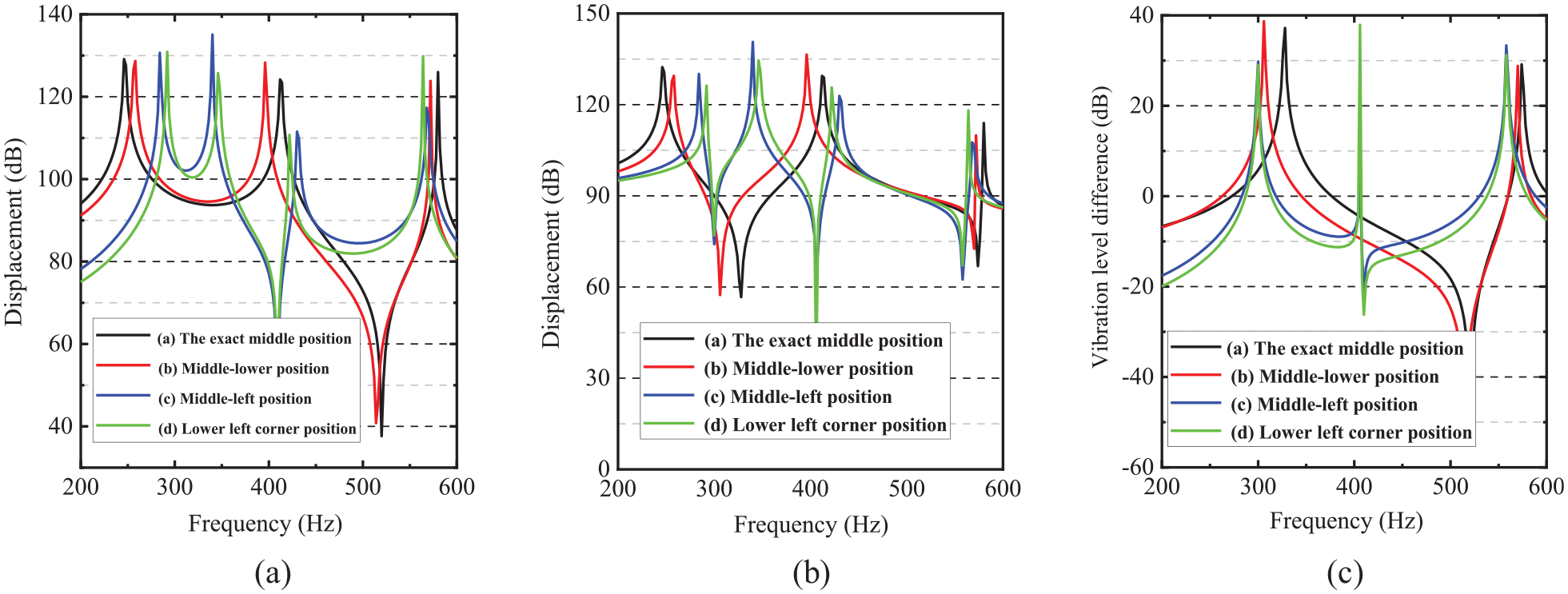
Influence of coupling position of upper rectangular plate on steady response of structure: (a) response point 1, (b) response point 2, and (c) the vibration difference level.
Figure 6 investigates the influence of the thickness of the upper rectangular plate on the steady-state response of the coupled double-layer plate structure. With the upper rectangular plate positioned at the exact middle of the support plate, the thickness of the upper rectangular plate is set to 0.03, 0.04, and 0.05 m, while the thickness of the support plate is fixed at h1 = 0.05 m. The remaining material parameters, geometric parameters, and boundary conditions are the same as those in Figure 5. Through comparison of the three curves, it is found that the increase in thickness can cause a significant shift of the resonance peaks of the displacement response of the structure toward higher frequencies. This indicates that the increase in thickness of Plate 2 simultaneously enhances the stiffness and mass of the structure, but the influence of stiffness increase is greater, resulting in a rightward shift of the resonance frequencies of the structure. Observing the vibration difference level, it is found that the vibration isolation is effective at the last resonance frequency. As the thickness increases, the vibration isolation effect improves. However, there is no improvement in the vibration isolation performance at other resonance frequencies.

Influence of the thickness of the upper rectangular plate on the steady-state response of the structure: (a) response point 1, (b) response point 2, and (c) the vibration difference level.
Next, we analyze the influence of the stiffness ratio of the base plate on the steady-state response of the composite double-layer rectangular plate structure. The material parameters of the support plate are set as follows: E2 = 10 GPa, and E1/E2 is set to 10, 20, 30, and 40, respectively. The remaining parameters are consistent with Figure 5. As can be seen from Figure 7, with the increase in the stiffness ratio of the support plate, the displacement response curves of both plates shift significantly to the right, and the response amplitudes at the peak points decrease. This indicates that as the stiffness ratio increases, the stiffness of the structure is effectively enhanced. Simultaneously, by observing the vibration responses and vibration difference levels of the two rectangular plates, it is found that there are three resonance peaks in the displacement responses of the upper and support plates within the considered frequency range. For the first two resonance peak positions, changing the stiffness ratio does not reduce the vibration response amplitudes of both plates. However, for the third resonance peak, the vibration difference levels exhibit significant peaks at the resonance frequencies, indicating effective vibration reduction at this point. Additionally, when the stiffness ratio of the support plate is 20, the vibration difference level is the largest, indicating the best vibration reduction effect.

Influence of support rectangular plates with different stiffness ratios on steady-state response of coupled structures: (a) response point 1, (b) response point 2, and (c) the vibration difference level.
Next, we further investigate the influence of the cross-sectional dimensions of the upper rectangular plate on the steady-state response of the coupled double-layer rectangular plate structure. In this study, the stiffness ratio E1/E2 of the material parameters of the two rectangular plates is set to 40, and the length-to-width ratio of the upper plate is set to a2/b2 = 1. The remaining parameters are the same as those in Figure 5. As can be seen from Figure 8, within the frequency range of 300–550 Hz, when the length of the upper plate is 0.4 or 0.6 m, there is at least one resonance peak in this frequency range. However, effectively avoiding resonance in this frequency range is possible by using an upper plate with a length of 0.8 m. Within the frequency range of 280–580 Hz, selecting an upper rectangular plate with a length of 0.4 m can effectively avoid resonance in the coupled structures with other lengths. Then, we consider its vibration isolation effect. For the upper plate with a length of 0.8 m, within the discussed frequency range, all resonance peaks correspond to vibration difference levels greater than 0. This indicates that the structure with a length of 0.8 m exhibits better vibration reduction performance compared to structures with other lengths. However, the excellent vibration reduction performance is accompanied by more resonance frequencies.

Influence of the upper rectangular plate with different cross-sectional dimensions on the steady-state response of the coupled structure: (a) response point 1, (b) response point 2, and (c) the vibration difference level.
Figure 9 investigates the influence of coupling stiffness values on the vibration isolation performance of the structure. The research results in Figure 3 previously mentioned indicate that the stiffness values of the linear springs {kcu, kcv, kcw} play a dominant role in affecting the vibration of the structure, and the patterns of their influence are consistent. Therefore, in the example calculation shown in Figure 9, the stiffness values of the torsional springs kcx and kc are set to 1013 N/m. By simultaneously varying the stiffness values of kcu, kcv, and kcw, we observe the vibration response patterns corresponding to different stiffness values. The length of the upper plate is set to 0.5 m, while the remaining parameters and boundary conditions remain the same as in Figure 5. Based on the comparison of displacement response curves, when the stiffness of the linear springs is less than 107 N/m, the vibration response trends are consistent within the frequency range of 200–760 Hz. However, when the stiffness of the linear springs exceeds 108 N/m, the trend of the response curves changes, and an additional resonance peak appears within the same frequency range. As the spring stiffness values continue to increase, the general pattern of the response curves remains unchanged, with only the resonance peaks shifting toward higher frequencies.
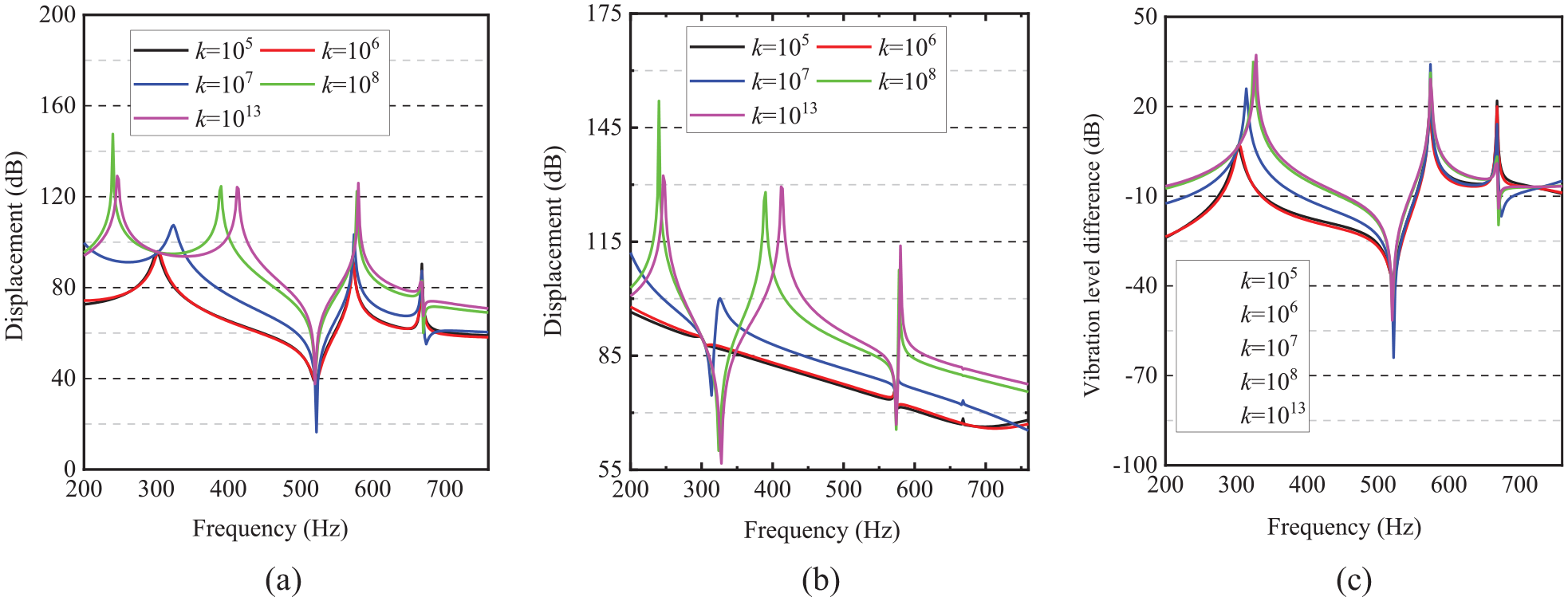
Influence of spring stiffness value on displacement response of double-layer rectangular plate structure: (a) response point 1, (b) response point 2, and (c) the vibration difference level.
Observing the response amplitudes of the upper plate and the support plate, it is evident that when the spring stiffness value k ≤ 107 N/m, the vibration amplitude on the support plate is significantly smaller than that on the upper plate. In the vibration difference level chart, all the maximum points of the vibration difference level correspond one-to-one with the resonance frequencies, indicating effective reduction of vibration across the entire frequency range. However, when the spring stiffness value k ≥ 108 N/m, varying the spring stiffness results in vibration difference levels close to 0 at the first two resonance locations, indicating ineffective vibration reduction. On the other hand, there is a vibration reduction effect at the last two resonance frequencies.
Finally, we investigate the influence of damping on the displacement response and vibration isolation performance of the structure. The material parameters, geometric parameters, and boundary conditions are consistent with those in Figure 9, and rigid coupling is adopted between the two plates. The damping values are selected as 1012, 1014, 5 × 10¹⁴, 1015, 5 × 10¹⁵ for analysis. Figure 10 shows that when the damping is below 1014, the vibration response amplitude of the structure remains unchanged. However, as the damping value exceeds 1014, the vibration response amplitudes at the resonance peaks, except for the first one, begin to decrease with the increase of damping. The main reason for this observation is that the modal deformation corresponding to the first resonance peak primarily occurs in the upper plate, while the subsequent resonance frequencies correspond to coupled modes between the two plates, involving energy exchange between them. Therefore, the application of damping results in a significant reduction in amplitude. Observing the vibration difference level, it can be found that increasing damping effectively dissipates part of the vibration energy generated by certain resonance frequencies.

Influence of damping on the vibration response of a double-layer rectangular plate coupled structure: (a) response point 1, (b) response point 2, and (c) the vibration difference level.
Conclusion
In this study, a vibration analysis model for the coupled double-layer rectangular plate structure is established using a spectral geometric approach for vibration solution. Initially, a convergence analysis of the coupling springs is conducted to determine the stiffness ranges for rigid and elastic connections. Through a comparison of the computational results presented in this paper with the numerical solutions obtained by the Finite Element Method (FEM), the precision and efficiency of solving specific physical or engineering problems are thoroughly explored. It is crucial to note that the analysis presented in the current paper represents a far cry from the conclusion, but rather, an initial exploration and validation of the proposed model. Further advancements and refinements are necessary, which can be achieved through the preparation of experimental components, the design and execution of more in-depth experimental studies. This process will undoubtedly lead to a more comprehensive understanding and improvement of the model.
Footnotes
Handling Editor: Sharmili Pandian
Declaration of conflicting interests
The author(s) declared no potential conflicts of interest with respect to the research, authorship, and/or publication of this article.
Funding
The author(s) disclosed receipt of the following financial support for the research, authorship, and/or publication of this article: The authors gratefully acknowledge the financial support from the Scientific Research Startup Fund Project of Heilongjiang Bayi Agricultural University (Grant Nos. XDB202301).
