




Abstract
When applied to a rotating disk, Maxwell nanofluids have a wide range of applications in various fields. They provide increased heat transfer efficiency in cooling systems, which is essential for preserving the ideal operating temperatures of spinning gears like disk brakes and turbines. Furthermore, Maxwell nanofluids in microfluidic devices provide improved fluid manipulation and control, improving performance in applications such as microscale pumps and lab-on-a-chip systems. This article has numerically examined the magneto-bio-convection flow of Maxwell, which includes nanofluid, past a disk surface based on these applications. We present the model equations in PDE format, then shift them to ODEs using the appropriate variables. We utilize the bvp4c approach to obtain numerical solutions to the modeled equations. We also take into account the effects of thermal radiation, heat sources, Brownian motion, thermophoresis, chemical reactivity, and activation energy. We find that a higher stretching/shrinking variable has enhanced the radial velocity profile, while simultaneously diminishing the axial and angular velocity field. While the velocity profiles in the axial direction and redial direction have reduced with larger magnitude of Maxwell fluid variable. The thermal distributions have risen due to higher magnetic, Brownian motion, thermophoresis, heat sources, and thermal radiation components. Thermophoresis, magnetic and thermal radiation, heat sources, and Brownian motion all contribute to an increase in heat transfer rates.
Keywords
Introduction
A Maxwell fluid is a type of viscoelastic fluid, which means it displays both viscous as well as elastic features. As Maxwell fluid flow, characterized by its behavior governed by the Maxwell model, manifests in a dynamic relationship between elasticity and viscosity, profoundly influencing velocity profiles and heat transfer characteristics. 1 Abdelsalam et al. 2 studied comparatively the rheological features of convective Maxwell flow fluid on a porous sheet. Yasin et al. 3 inspected Maxwell fluid flow on a sheet with slip constraints subject to Hall effects and Darcy’s law. Contrasting to Newtonian fluids, Maxwell fluid exhibits time-dependent responses to applied stresses, transitioning from elastic to viscous behavior over a characteristic relaxation time was explored by Muhammad et al. 4 This transition from elastic to viscous behavior results in unique velocity distributions compared to purely viscous fluids. In regions of high stress or strain rates where deformation occurs rapidly, the elastic component dominates, causing the fluid to resist deformation and store energy. Consequently, the velocity distribution deviates from the parabolic profile typically observed in Newtonian fluids, with higher velocities observed at the center of the flow channel and reduced velocities near solid boundaries. This alteration in velocity distribution arises from the elastic properties of the Maxwell fluid, which resist deformation near boundaries, leading to velocity gradients that differ from those predicted by classical fluid dynamics. 5 Additionally, the time-dependent nature of Maxwell fluid flow introduces complexities in velocity evolution, with the fluid transitioning between elastic and viscous responses. 6 This dynamic behavior can influence flow stability, turbulence characteristics, and the development of velocity profiles over time. Faizan et al. 7 conducted research on the Maxwell nanofluid as it traveled across a stretching/shrinking disc in the direction of a stagnation point. Reddy et al. 8 investigated the flow characteristics of three distinct nanofluids on a stretching surface in the presence of a non-uniform heat source, as well as the influence of thermal radiation.
Magnetohydrodynamics (MHD) is a multidisciplinary field that examines electrically conducted fluids, with magnetic fields effects. In MHD, the fluid’s motion is affected not only by conventional fluid dynamics but also by electromagnetic forces arising from interactions between the fluid’s motion and the magnetic field. 9 These electromagnetic forces significantly impact velocity and temperature distributions within the fluid. For instance, when a conducted fluid flows in a magnetic field, it experiences Lorentz forces, which can alter the fluid’s velocity profile by inducing drag forces and modifying flow patterns. 10 Furthermore, MHD effects can influence temperature distributions through joule heating, where electrical currents induced in the fluid by the magnetic field dissipate energy as heat. 11 This phenomenon can lead to non-uniform temperature distributions within the fluid, with regions experiencing stronger magnetic fields exhibiting higher temperatures due to increased Joule heating as observed by Bilal et al. 12 The impressions of MHD on velocity and thermal distributions are essential in several fields, like astrophysics, 13 plasma physics, 14 and engineering, where accurate characterization of fluid behavior under the influence of magnetic fields is critical for augmenting performance and attaining preferred consequences. 15 Khan et al. 16 conducted a comprehensive study on the production of entropy and thermal flow analysis for MHD fluid flow on a gyrating cylinder, considering the impacts of Joule heating. Their research investigated the multifaceted association among fluid dynamics, electromagnetic forces, and thermal effects in the presence of a magnetic field. Through their analysis, they demonstrated that the velocity profiles exhibited a notable decline, attributed to the influence of electromagnetic forces induced by magnetic field. Li et al. 17 conducted an investigation into the numerical solution for heat transfer near a stagnation point of Maxwell nanofluid flow over a porous rotating disk. Reddy et al. 18 investigated the MHD stagnation point flow of a Williamson hybrid nanofluid over a porous extended sheet.
Heat sources for fluid flow on a surface can arise from various mechanisms, including external heating sources like electrical heaters or solar radiation, as well as internal sources like chemical reactions or frictional heating. These heat sources play a significant role in influencing the thermal transference manner within the fluid. 19 In regions where the heat source is present, the fluid temperature increases due to absorption of thermal energy, leading to the formation of thermal layers at boundaries characterized by higher temperatures near the surface. 20 This temperature gradient drives convective heat transfer, causing the heated fluid to transfer thermal energy to cooler regions through advection and diffusion. Additionally, the existence of a heat source induces changes in flow patterns and velocity distributions, further impacting the heat transfer process.21,22 The influences of heat sources on fluid and thermal flows are crucial for various engineering applications.23,24 Pasha et al. 25 studied the effects of nonlinear radiative magnetized fluid flow with impacts of heat sink, source, and chemical reactivity and observed that thermal distribution have augmented with growth in the strength of source factor. Sajid et al. 26 debated on trihybrid nanofluid flow on a porous sheet using radiation and thermal source factor. Kumar and Sharma 27 studied optimization of entropy for fluid flow on a gyrating disk with impacts of magnetic field and non-uniform thermal source and observed that thermal distribution has augmented with development in thermal source and magnetic factors.
Fluid flow with Brownian motion and thermophoresis encompasses a complex relationship that significantly influence particle dynamics and transport in various systems. Brownian motion, driven by haphazard collisions between suspended particles and surrounding fluid molecules, leads to erratic particle movement that affects dispersion and mixing. At higher temperatures, the kinetic energy of particles increases, intensifying Brownian motion and enhancing particle diffusion rates. 28 Consequently, temperature gradient induces changes in particle distribution and concentration profiles within the fluid. 29 Thermophoresis, meanwhile, involves the directed motion of particles in response to temperature gradients. This phenomenon is influenced by factors like particle mass, temperature gradient magnitude, and fluid properties. 30 In regions of temperature variation, thermophoretic forces act on particles, causing them to migrate toward zones of greater or lesser temperatures depending on their features. 31 Temperature gradients also influence fluid properties like thickness and density, which in turn affect the thermophoretic behavior of particles. Furthermore, concentration gradients play a vital role in both Brownian motion and thermophoresis by influencing the spatial distribution and transport of particles within the fluid. 32 Variations in particles’ concentration impact collision frequencies and thus the extent of Brownian motion, while concentration gradients also affect the thermophoretic mobility of particles. Moreover, interactions between Brownian motion, thermophoresis, and fluid flow leads to complex phenomena like particles’ accumulation, deposition, and dispersion, with implications for various industrial and natural processes ranging from nanoparticle transport in biological systems to aerosol dynamics in atmospheric science. 33 The coupled effects of Brownian motion, thermophoresis, temperature, and concentration gradients is crucial for precisely modeling and calculating particle behavior in complex fluid environments, with implications for fields including environmental engineering, nanotechnology, and biophysics. 34 Shahzad et al. 35 studied impacts of thermophoresis as well as Brownian motion on Darcy-Forchheimer flow of fluid through two disks with Cattaneo-Christov model. Many such study can be seen in References 36–40.
Fluid flow with chemical reaction is a dynamic process where the movement of the fluid medium interacts intimately with chemical kinetics, resulting in distinct concentration profiles within the flow system of fluid. 41 As the fluid flows, it transports reactants and products throughout the domain, influencing the distribution of fluid’s concentrations as noticed by Nasir et al. 42 Convective transport, driven by fluid velocity and turbulence, accelerates the mixing of reactants chemically, facilitating collisions and promoting reaction rates in regions of high flow as observed by Li et al. 43 Chemical reactions occurring within the fluid alter the concentrations of fluid, leading to spatial variations in species concentrations over time. 44 Khan et al. 45 studied fluid flow on a movable needle with impacts of chemical reactivity Hall current and magnetic field. Many applications of fluid flow with impressions of chemical reactivity involve, cooling towers, catalysis and fog dispersion, etc. as discussed by He et al. 46 Factors like reaction rate constants, reactant concentrations, and temperature profoundly impact the extent and rate of chemical reactions, further shaping the concentration profiles. The interaction between fluid flow and chemical reaction dynamics results in augmentation of concentration profiles as observed by Razaq et al. 47 Mathematical modeling combined with physical approaches in case of fluid flow with impacts of chemical reactions, are essential tools to design of efficient and sustainable processes in fields like chemical engineering, environmental science, and materials science. Mishra et al. 48 simulated numerically nanofluid flow with significance of chemical reactions.
Nanofluids flows over a revolving disk have variety of uses. Nanofluids have the potential to upsurge the heat transfer rates in the field of thermal management, which makes them useful for cooling systems in spinning machinery such as industrial disk brakes or computer hard drives. Furthermore, nanofluids can enhance the lubricating qualities of lubrication systems, lowering wear and friction on rotating parts like gears and bearings. Furthermore, nanofluids in aerospace applications can help reduce drag and enhance the aerodynamic performance of propellers or spinning disks in aircraft engines. All things considered, a variety of industries have used nanofluids over spinning disks to improve heat transmission, lubrication, and aerodynamics. The current analysis investigates the laminar, time-independent and incompressible flow of Maxwell nanofluid over a gyratory disk surface. With the help of a rotating and stretching disk, we will study the thermal and solutal energy transport in the Von Kármán swirling flow of Maxwell nanofluids in this effort with various flow effects.
Problem formulation
Assume that the laminar and time-independent flow of Maxwell nanofluid over a spinning disk surface. A cylindrical coordinate system is assumed to analyze the flow analysis by assuming the u, v, w along r-, φ-, z-directions. Here, r, φ, and z are the radial, azimuthal, and axial directions. The stretching velocity of the disk is denoted by


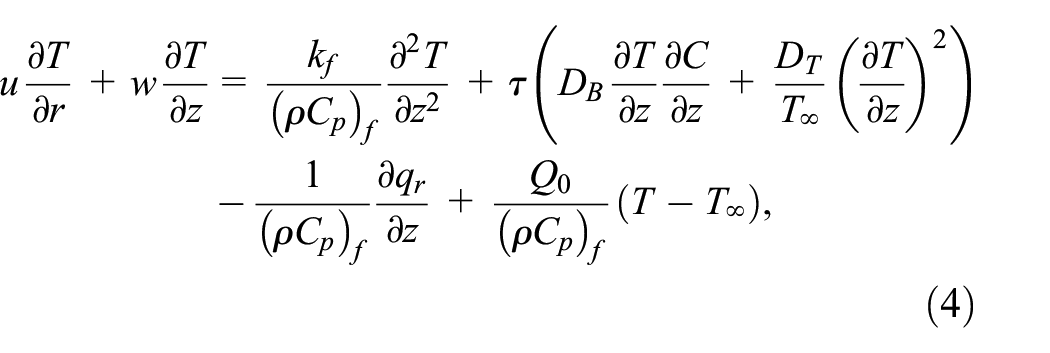
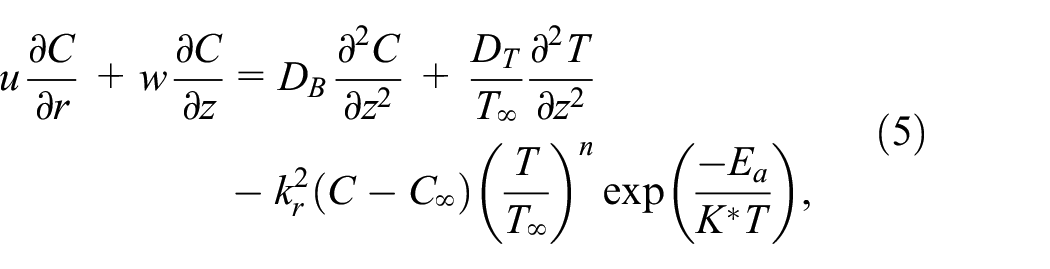
with boundary conditions:

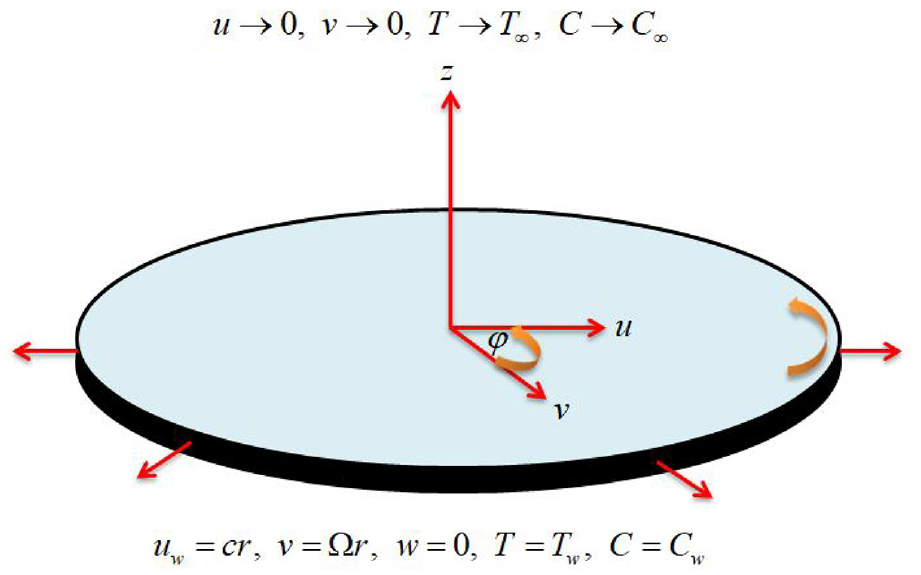
Graphical view of the flow phenomenon.
Above

The similarity transformations are defined as 51 :

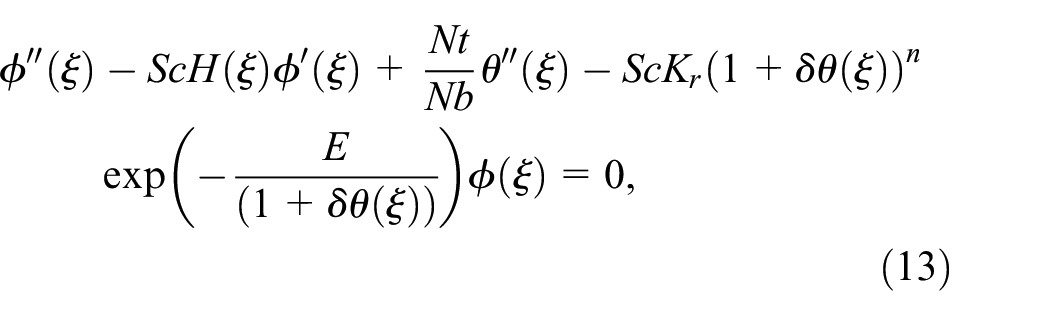
By implementing equation (8) we have from above


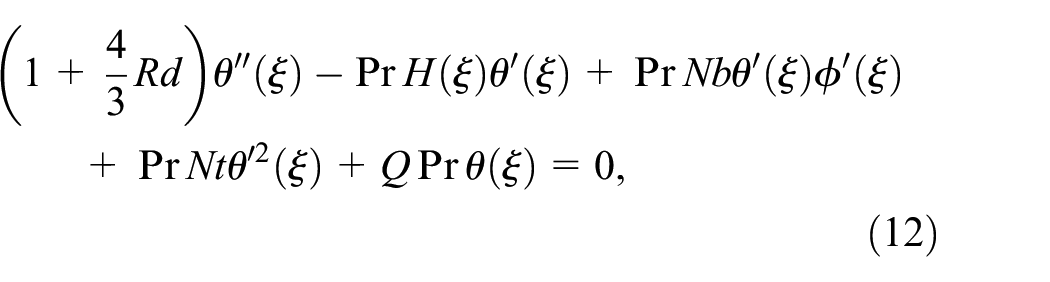
with constraints at boundary:

In above equations,
The Nusselt and Sherwood number are defined as:


Using equation (8), (15) and (16) are reduced as:


Here
Numerical solution
To solve the modeled equations by means of numerical method, we have chosen bvp4c MATLAB built-in function. This method is applicable to solve boundary value problems arising in physical and engineering fields. To ensure the accuracy of the bvp4c, error tolerance of 10−4 is chosen. To apply this method, let us assume that:

Then



with boundary conditions:

The applied numerical technique has the following advantages:
• A variety of BVPs, including stiff and highly nonlinear problems, may be solved using the robust solver bvp4c. It makes use of collocation and adaptive mesh refinement techniques to guarantee precise answers for a variety of issue kinds.
• In comparison to previous approaches, the bvp4c solver requires comparatively few function evaluations to solve BVPs, indicating its computational efficiency. Because of its efficiency, it may be used to solve problems involving a lot of equations or intricate geometries.
• By employing fourth-order collocation techniques, bvp4c offers very accurate solutions to BVPs. It uses error control techniques and automatically modifies the mesh density to make sure the calculated solution satisfies the required accuracy standards.
• bvp4c is a versatile and adaptable tool that can handle mixed boundary conditions, discontinuities, and singularities in systems of nonlinear differential equations.
Validation
To insure the accuracy, the present results are compared with Sparrow and Gregg
52
for varying
Validation of present results with published results by Sparrow and Gregg
52
for varying

Discussion of results
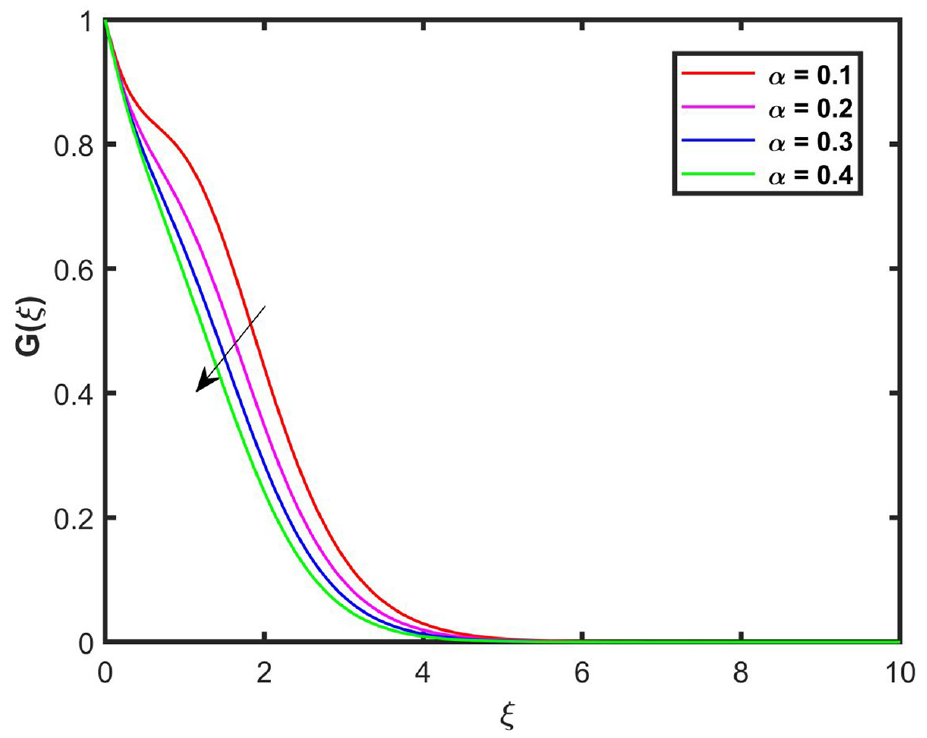
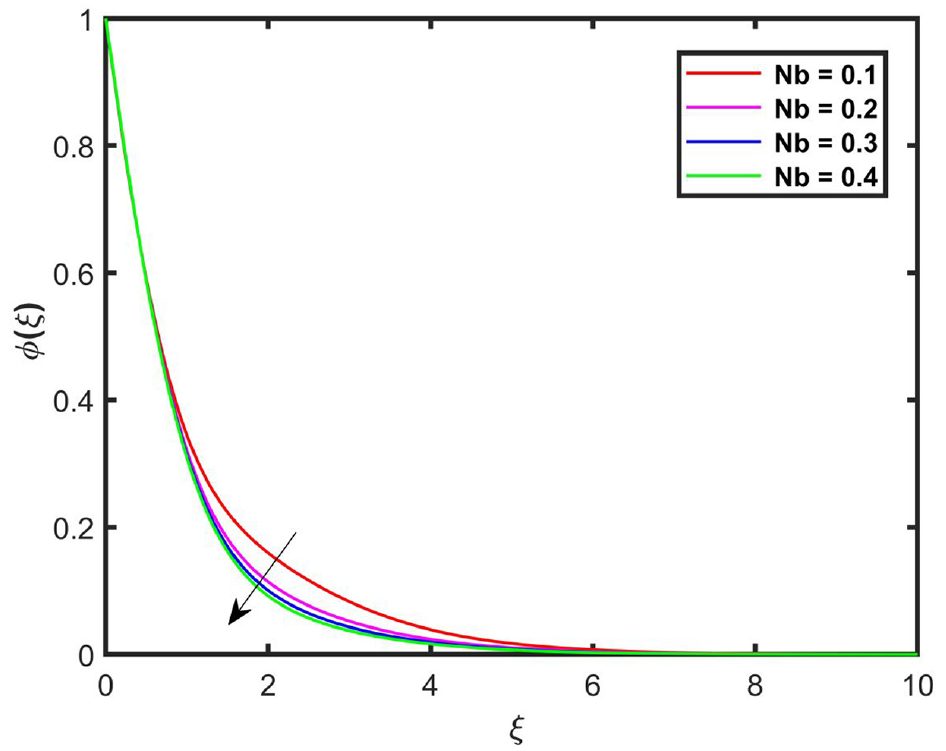
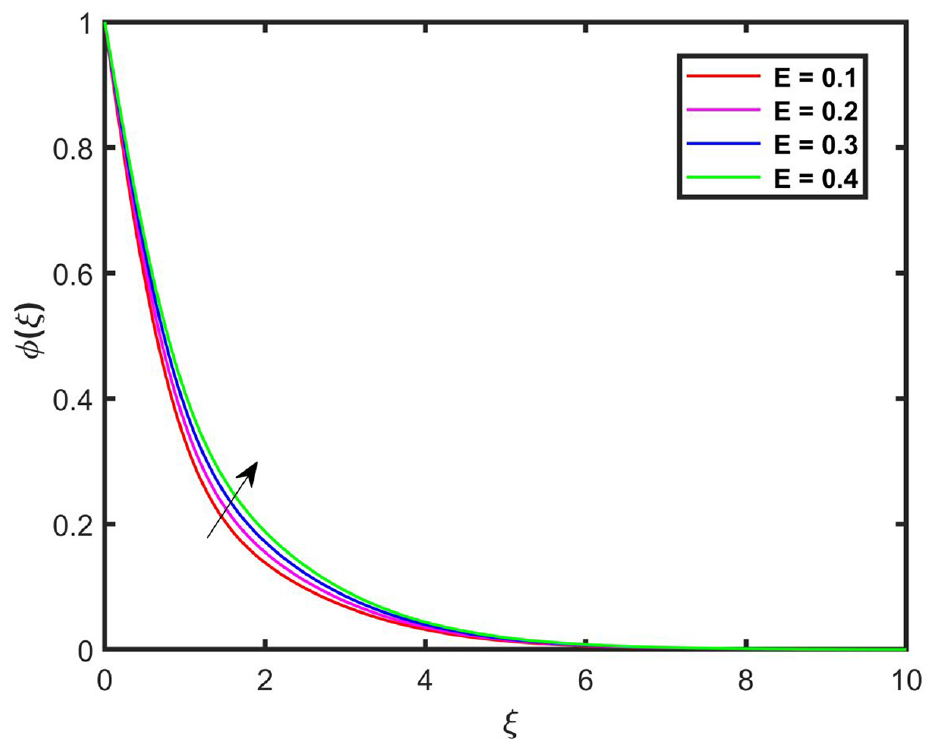
This section shows the obtained results from the present analysis and their physical explanation. The obtained results are presented in Figures 2 to 17 and Tables 2 and 3. The default values of factor used in the study are selected as

Impact of

Impact of

Impact of
Impact of

Impact of

Impact of

Impact of

Impact of

Impact of

Impact of

Impact of

Impact of
Impact of

Impact of
Impact of
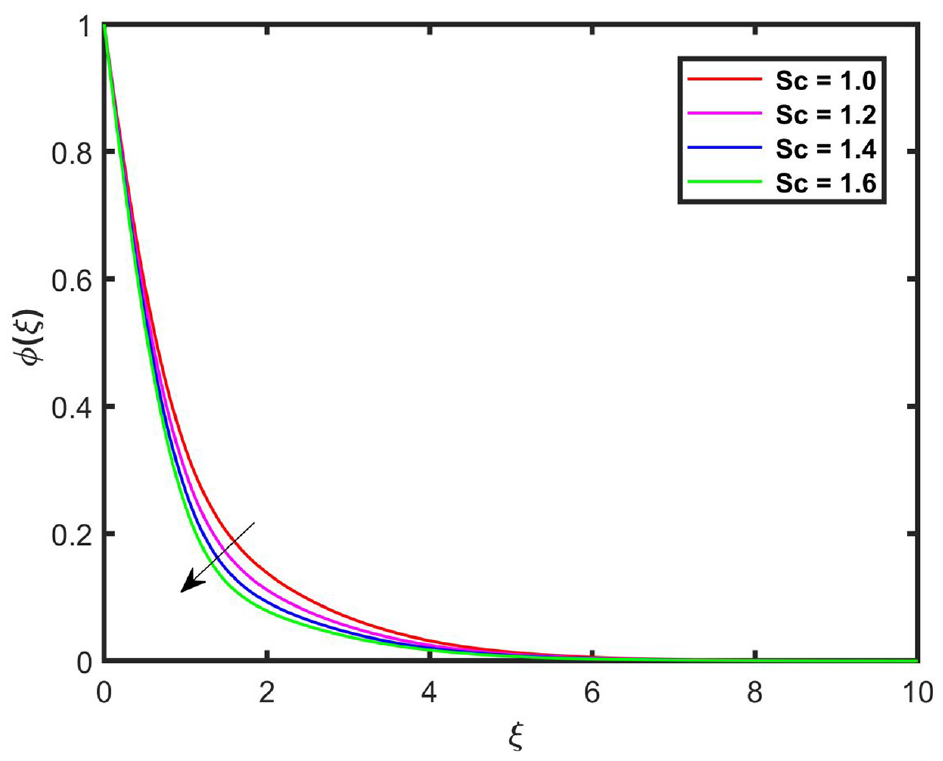
Impact of
Effects of
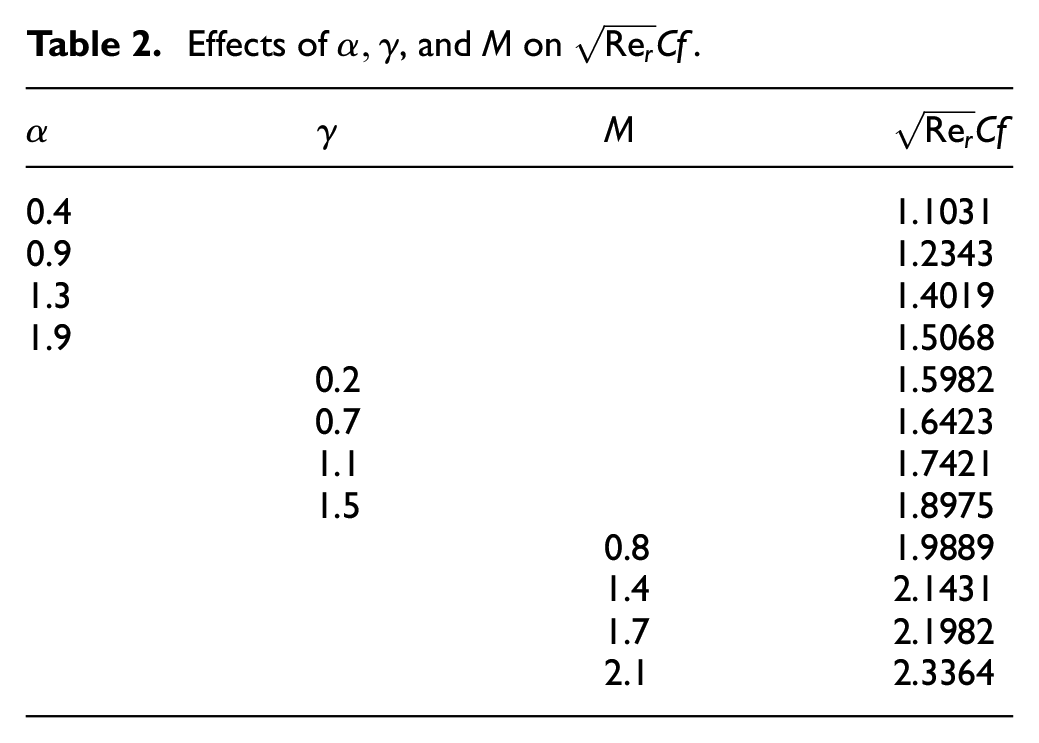
Effects of

Figures 18 to 20 show the surface plot of

Impact of

Impact of

Impact of
Table 2 reveals the role of
Effects of

Conclusions
In this effort, we have examined the laminar, time-independent, and incompressible flow of Maxwell nanofluid over a rotating disk surface. The problem is modeled in a cylindrical coordinate system. The model equations are formed as PDEs which then transformed into ODEs by using suitable similarity variables. The modeled equations are solved numerically by using bvp4c MATLAB built-in function. Furthermore, the effects of thermal radiation, heat source, thermophoresis, Brownian motion, chemical reaction, and Activation energy are taken into consideration. The final remarks are listed as:
• It is found that the greater ratio factor has enhanced the velocity profile in radial direction while decreased the velocity profiles in angular direction.
• The greater Maxwell factor has reduced the velocity profile in radial and angular directions.
• The greater magnetic factor has reduced the velocity profile in radial and angular directions.
• The greater magnetic, Brownian motion, thermophoresis, heat source, and thermal radiation factors have increased the thermal distributions.
• The greater Schmidt number, chemical reaction, and Brownian motion factors have reduced the concentration profiles while the greater thermophoresis factor and activation energy factor have increased the concentration profiles.
• The heat transfer rate is increased by the thermal radiation, heat source, magnetic, Brownian motion, and thermophoresis factors.
• The higher Brownian motion factor has increased the mass transfer rate and the higher thermophoresis factor has reduced the mass transfer rate.
Footnotes
Appendix
Acknowledgements
The authors extend their appreciation to University of Tabuk, Saudi Arabia.
Handling Editor: Aarthy Esakkiappan
Declaration of conflicting interests
The author(s) declared no potential conflicts of interest with respect to the research, authorship, and/or publication of this article.
Funding
The author(s) received no financial support for the research, authorship, and/or publication of this article.

Data availability
All data used in this manuscript have been presented within the article.