



Abstract
The analysis and evaluation of missile handling operation are crucial for ensuring safety and reliability during these processes. This paper proposes a novel assessment method for missile handling motions based on the Fuzzy Analytic Hierarchy Process (FAHP). The methodology comprises several stages: Initially, an analysis of missile handling motions is conducted. Subsequently, joint evaluation indicators influencing operational comfort are selected. Following this, membership functions and a comprehensive evaluation matrix are constructed. Finally, a fuzzy comprehensive evaluation model for the comfort level of carrier-based aircraft ammunition handling operations is established. A typical case study of carrier-based aircraft missile handling operation is presented to illustrate the fuzzy comprehensive evaluation process. The evaluation results are then compared with those obtained from the Rapid Upper Limb Assessment (RULA) and Ovako Working Posture Analysis System (OWAS) models. Comparative analysis indicates that the results derived from the fuzzy comprehensive evaluation model demonstrate high reliability.
Introduction
The replenishment of the missile necessitates reloading after the carrier-based aircraft returns to the carrier. 1 Reducing the time required for this reloading process is crucial for enhancing the sustained attack capability of naval aviation squadrons.
The carrier-based aircraft missile handling operation is a task characterized by high physical demands, significant risk factors, and critical importance. The intensive nature of this operation not only affects the efficiency of missile loading but also increases the likelihood of fatigue and potential injury among personnel. 2 However, current ergonomic research on naval vessel support staff primarily focuses on work-related injuries caused by environmental exposure3,4 and psychological health issues stemming from occupational stress.5–8 There is a paucity of research specifically addressing the ergonomic comfort of ordnance specialists’ operational movements. Therefore, developing a comfort evaluation model for missile handling operation and applying it to assess the movements of ordnance specialists holds significant potential for enabling safer, more efficient, and comfortable task completion, thereby improving the efficiency of aircraft carrier-based ordnance support.
Comfort is an inherently subjective perception, and its evaluation typically employs both subjective qualitative and objective quantitative methodologies. Subjective qualitative assessments often utilize survey instruments to gauge test subjects’ intuitive perceptions. For instance, in 1969, Branton discovered that seat comfort significantly influenced drivers’ work efficiency and elucidated the impact patterns of seat comfort based on drivers’ subjective experiences. 9 However, subjective comfort evaluations are highly susceptible to individual differences, potentially leading to inaccurate results. Consequently, numerous objective comfort evaluation methods have emerged, including physiological parameter measurements (e.g. ECG, EMG, EEG signals, etc.) and the development of biomechanical models.10–12 During manual operations, the human body’s perception of comfort is derived from the sensory feedback generated by changes in bodily forces. 13 As such, many scholars have focused on joint load as a foundation for investigating joint comfort. For example, Piao 14 developed a posture comfort evaluation model based on loss functions, establishing comfort loss functions within the dynamic changes of body postures. This evaluation model assesses operational comfort based on joint loads or body posture angles from biomechanics, using joint force or joint torque as key factors influencing comfort evaluation. This approach aligns more closely with biomechanical principles, thus ensuring a degree of credibility in the evaluation models. However, absolute torque values do not directly and accurately reflect joint comfort levels. Hirao et al. 15 proposed a method using relative joint torques to represent joint comfort levels, a concept that mitigates the effects of torque variations arising from different individuals and postures. Establishing a biomechanical model allows for a clear depiction of the body’s force state and current comfort level.
To quantify postural load during occupational activities, ergonomic experts have developed posture load assessment models. The Ovako Working Posture Analysing System (OWAS) and Rapid Upper Limb Assessment (RULA) are two of the most widely applied posture load assessment models. 16 OWAS, developed by the Finnish steel company Ovako Oy, is a work posture analysis system based on three assessment indicators: work postures (4 for the back, 3 for the arms, and 7 for the legs), weight handled, and force exerted. 17 The RULA method, on the other hand, is designed to identify external loads applied to the upper arms, forearms, wrists, trunk, neck, and legs, as well as grip force and work frequency. 18 Both assessment methods are non-contact observational techniques that do not interfere with ongoing work, leading to their widespread application in ergonomic evaluations across various industries. 19
Although OWAS and RULA have been extensively applied across numerous fields, as qualitative methods requiring professional observers, they still have certain limitations in dynamic posture analysis. Research by Dzeng et al. demonstrates that when analyzing continuous work movements using these methods, it is necessary to extract several static key postures and then manually analyze these static postures individually. When the number of key postures requiring manual analysis is considerable, the efficiency of OWAS and RULA methods decreases.20–22 Furthermore, the loads experienced by various joints during different types of operations are not identical, resulting in varying impacts on overall discomfort. Current OWAS and RULA methods neglect these differences in the degree of influence each joint has on comfort.
Introducing weighted values in comfort analysis can effectively quantify the impact of each joint’s movement on overall comfort. As comfort is a subjective perception, the weights of each joint must consider the subjective judgments of industry experts and operators as decision-makers. In operations, the relative weights of joints and perceived discomfort may vary significantly among decision-makers, reflecting their personal views and preferences. The Analytic Hierarchy Process (AHP), as a multi-criteria decision-making method, provides a structured and systematic framework for integrating these subjective assessments into the decision-making process and has been widely applied across multiple domains.23,24 Manual missile handling operation involves multiple joints of the human body, each with multi-degree-of-freedom characteristics. Applying AHP can construct an indicator system for operational comfort, making the method of ranking joints and selecting alternatives more comprehensive and inclusive. 25
The Analytic Hierarchy Process (AHP) decision evaluation method is primarily used for assessing relatively clear (non-fuzzy) objectives. To evaluate factors that are difficult to quantify, Professor Zadeh, an Azerbaijani expert in cybernetics, introduced the concept of fuzzy sets, using mathematical methods to analyze and study subjective evaluation factors.26–28 Given that comfort factors are inherently fuzzy, numerous scholars have incorporated the concept of fuzzy sets into comfort evaluation processes. For instance, Zhao 29 combined fuzzy comprehensive evaluation methods with RULA rules to establish a comfort evaluation database for assessing typical firefighter operational movements. Yu 30 developed a fuzzy comprehensive evaluation model for CNC machine control actions, evaluating the comfort of operating CNC panels. Van Laarhoven and Pedrycz extended AHP, integrating it with fuzzy sets to establish Fuzzy AHP (FAHP). They employed triangular fuzzy numbers to construct membership functions and determined corresponding weights in pairwise comparisons. 31 The FAHP method utilizes fuzzy numbers to represent human preferences, thereby incorporating fuzzy or imprecise information and considering the inherent fuzziness of human decision-making. 32 FAHP has been widely applied by researchers and practitioners in diverse fields such as cultivation planning, 33 land assessment,34,35 operations management, 36 and patient prioritization. 37
This study employs the Fuzzy Analytic Hierarchy Process to evaluate aircraft carrier-based ammunition handling operations. Hierarchical joint weights can account for the varying degrees of influence each joint has on comfort, while fuzzy evaluation results can mitigate decision biases stemming from individual subjective preferences. By establishing joint comfort evaluation indicators and determining the importance of each indicator’s impact on comfort, a comprehensive evaluation of comfort during ammunition handling operations can be conducted, thus providing a comfort evaluation method for ammunition handling actions. The construction of this evaluation model can also serve as a reference for related ammunition handling motion training.
The second section of this paper provides an introduction to the Fuzzy Analytic Hierarchy Process. The third section constructs an evaluation model for missile handling operation, selecting comfort evaluation indicators through analysis of missile handling operation. In the fourth section, changes in joint motion angles during manual missile handling operation are measured, and the AHP is used to obtain the weight distribution of each joint’s influence on the comfort of manual missile handling operation. The fuzzy comprehensive evaluation results are then calculated. These results are converted into quantifiable outcomes for intuitive comparison and are compared with the evaluation results from RULA and OWAS models for consistency. Finally, the fifth section presents our conclusions and future work.
Methods
Fuzzy analytic hierarchy process
The Fuzzy Analytic Hierarchy Process (FAHP) is a decision-making method that combines fuzzy comprehensive evaluation with the Analytic Hierarchy Process, proposed by Professor Saaty, an Iraqi operations researcher, in the 1970s. The fundamental concept of this evaluation method involves decomposing the problem itself, constructing a bottom-up hierarchical structure, and deriving weights for each evaluation indicator. Simultaneously, it incorporates fuzzy comprehensive evaluation methods to conduct quantitative assessments of the problem, yielding evaluation results. To better model semantic concepts, Professor Zadeh introduced the idea of fuzzy sets. In practical applications, to more appropriately and precisely depict fuzzy uncertainty and indecision in problems, scholars have extended fuzzy sets from various perspectives, proposing forms such as Type-1 fuzzy sets, 38 Type-2 fuzzy sets, 39 intuitionistic fuzzy sets, 40 interval-valued fuzzy sets, 41 and hesitant fuzzy sets. 42 Type-1 fuzzy sets are the classical form of fuzzy sets, using a defined membership function to represent the mapping of elements to the universe of discourse. Type-2 fuzzy sets use a fuzzy set to represent the membership degree of each element. Intuitionistic fuzzy sets describe the uncertainty of problems through membership and non-membership degrees, providing more comprehensive knowledge. Interval-valued fuzzy sets use more easily determinable intervals to represent membership degrees in place of membership functions. Hesitant fuzzy sets allow multiple possible values for the membership degree of each element, more aptly depicting decision-makers’ indecision among several alternatives in real decision-making problems. Compared to other fuzzy set forms, Type-1 fuzzy sets have a relatively concise structure, using only one membership function to describe the degree of element belonging to a set. This makes them easier to understand and apply. Due to their simple structure, calculations with Type-1 fuzzy sets are generally more efficient than with other extended forms, especially when dealing with large-scale motion data in the full process of aircraft carrier-based ammunition handling operations, where expression of more complex uncertainties is not required. In such cases, Type-1 fuzzy sets perform exceptionally well.
To conduct fuzzy comprehensive evaluation using Type-1 fuzzy sets, one must first construct the factor set and comment set of the evaluation object. The factor set is a collection of multiple evaluation factors that affect the evaluation object, generally expressed as equation (1), where n represents the number of evaluation factors. The comment set includes a set of comments on the evaluation object, which is generally expressed as equation (2), where m represents the number of comments, usually an odd number.


Then the membership function is determined by intuition method, binary comparison and sorting method, fuzzy statistical experiment method, and other methods. Based on this membership function, a single-factor evaluation matrix composed of the membership degrees of multiple evaluation factors is established. 43 All evaluation factors are calculated through the constructed membership function, and an evaluation matrix of the evaluation indexes to the evaluation targets can be obtained, as shown in equation (3).

The number of matrix rows is equal to the number of elements in factor set and the number of columns is equal to the number of elements in comment set
To obtain the final evaluation results, each factor corresponds to a weight that indicates the degree of its influence on the evaluation results. The weight coefficients of the evaluation factors are usually determined by methods such as AHP and the entropy weighting method. The row matrix composed of the weight coefficients of these evaluation factors is the weight matrix. Therefore, in each level, it is shown in equation (4).

The above formula needs to satisfy

Quantitatively evaluate the evaluation object through the above comprehensive evaluation matrix to obtain the final evaluation result.
FAHP evaluation model construction
The entire manual missile handling operation process can be divided into four steps, as illustrated in Figure 1(a)–(d).
Step 1: Bend to lift the missile from the ammunition rack (or ammunition cart). Denote it as motion a.
Step 2: Stand upright, holding the missile horizontally against their chest with both arms. Denote it as motion b.
Step 3: Turn, supporting the missile with the same-side shoulder, and transfers it to the area beneath the wing-tip mounting point. Denote it as motion c.
Step 4: Lift the missile to the wing-tip mounting point, 1.92 m above ground level, and secure it to the wing-tip launch device rail to complete the installation. 44 Denote it as motion d.
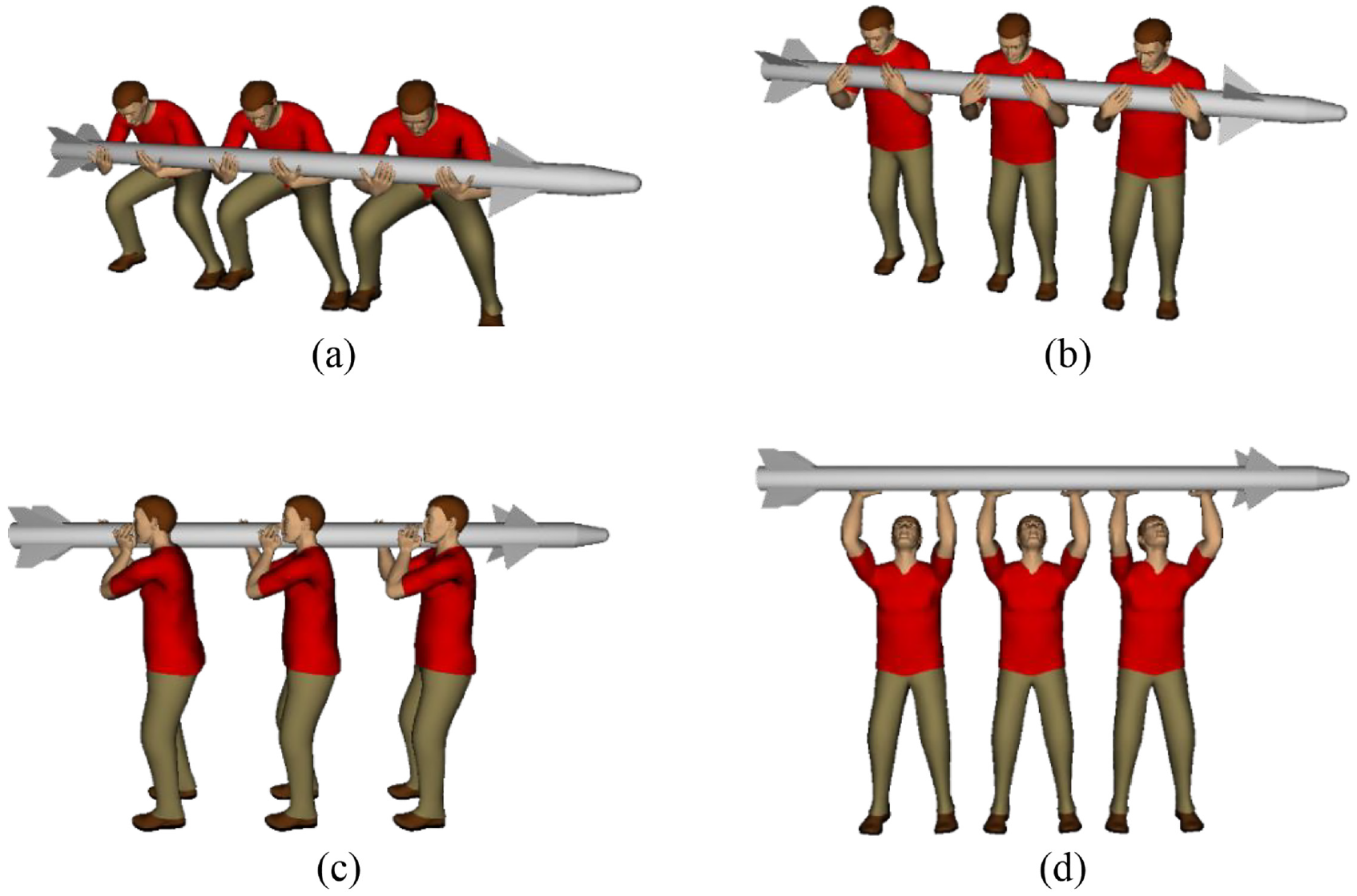
The four steps of manually mounting the missile on the wing-tip of the carrier-based aircraft: (a) lift the missile, (b) hold the missile, (c) transfer the missile, and (d) mount the missile.
The main body parts involved in the ammunition handling motion include the upper arms, forearms, wrists, thighs, lower legs, and ankles on both sides.
Selection of operating comfort evaluation indexes
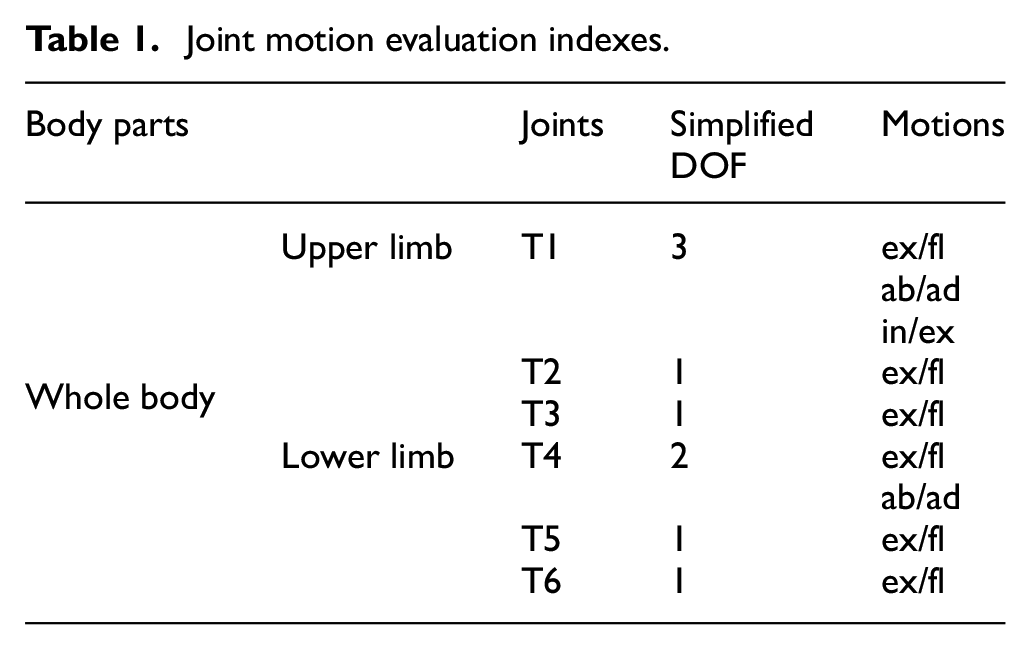
Following the analysis of the aforementioned handling operation process, this study selects six major joints of the body parts involved in the activity (shoulder, elbow, wrist, hip, knee, and ankle joints) as evaluation factors for motion comfort. These joints possess different degrees of freedom and thus exhibit distinct motion characteristics. The movements of each joint can be decomposed into several basic motion types according to their degrees of freedom, namely: shoulder joint flexion/extension, adduction/abduction, internal/external rotation; elbow joint flexion/extension; wrist joint flexion/extension, adduction/abduction, internal/external rotation; hip joint flexion/extension, adduction/abduction, internal/external rotation; knee joint flexion/extension; ankle joint flexion/extension, adduction/abduction, internal/external rotation. Throughout the entire missile handling operation process, some joints exhibit minimal range of motion in basic activities or bear negligible torque from the load (i.e. the mounted missile), and can be considered secondary basic motions. To simplify joint motion evaluation indicators, this study will disregard these secondary basic motions.
Figure 2(a) and (b) illustrate the torques experienced by various joints of the upper limbs during missile handling. The load F generates torques on the shoulder joint O1 in three directions: flexion/extension (T1(ex/fl)), adduction/abduction (T1(ab/ad)), and internal/external rotation (T1(in/ex)), resulting in 3 degrees of freedom for the final evaluation indicator. The elbow joint O2 experiences torque generated by F in the flexion/extension (T2(ex/fl)) direction, resulting in 1 degree of freedom for the final evaluation indicator. The wrist joint O3 does not bear torque generated by F in the adduction/abduction and internal/external rotation directions, which are considered secondary basic motions. The wrist joint can be simplified to only bear torque in the flexion/extension (T3(ex/fl)) direction, resulting in 1 degree of freedom for the final evaluation indicator.

Torque analysis of each joint motion in the handling missile movement: (a) lateral view of upper limb, (b) top view of upper limb, (c) lateral view of lower limb, and (d) top view of lower limb.
The same method can be applied to analyze the torques experienced by the lower limb joints during missile handling, as shown in Figure 2(c) and (d). While both the hip joint and shoulder joint inherently possess three types of basic motions, the difference lies in the fact that during manual missile handling operations, the hip joint O4 does not undergo large-amplitude internal or external rotations around the thigh axis A4. The minimal moment arm between force F and the thigh axis can be neglected, and the hip joint does not bear torque generated by F in the internal/external rotation direction, resulting in 2 degrees of freedom for the final evaluation indicator.
In summary, simplified single-factor evaluation indicators for each joint are obtained. The motion evaluation indicators for each body part are presented in Table 1.
Joint motion evaluation indexes.
Construction of the membership function
The membership function is fundamental to fuzzy comprehensive evaluation. Due to the subjective nature of the analyzed influencing factors, there is no specific unified method for determining membership functions. They are primarily established based on subjective experience and experimental foundations. The established membership functions must adhere to certain principles:
Must possess unimodal characteristics;
The shape should be symmetrical and balanced;
Conform to the normal semantic order;
A single factor must not have two maximum memberships.
Regarding the selection of the number of elements in the comment set, referencing the CP-50 scale, the perceived discomfort in ammunition handling operations is categorized into five levels: “Very Severe Discomfort,”“Severe Discomfort,”“Discomfort,”“Slight Discomfort,” and “Very Slight Discomfort.”
45
According to the division of score intervals for the aforementioned comments in the quantitative measurement of subjective discomfort by CP-50, it can be considered that there exists a linear relationship between the comfort index and the membership degree of various subjective perception comments, and the membership functions of each comment are uniformly distributed in the domain of discourse
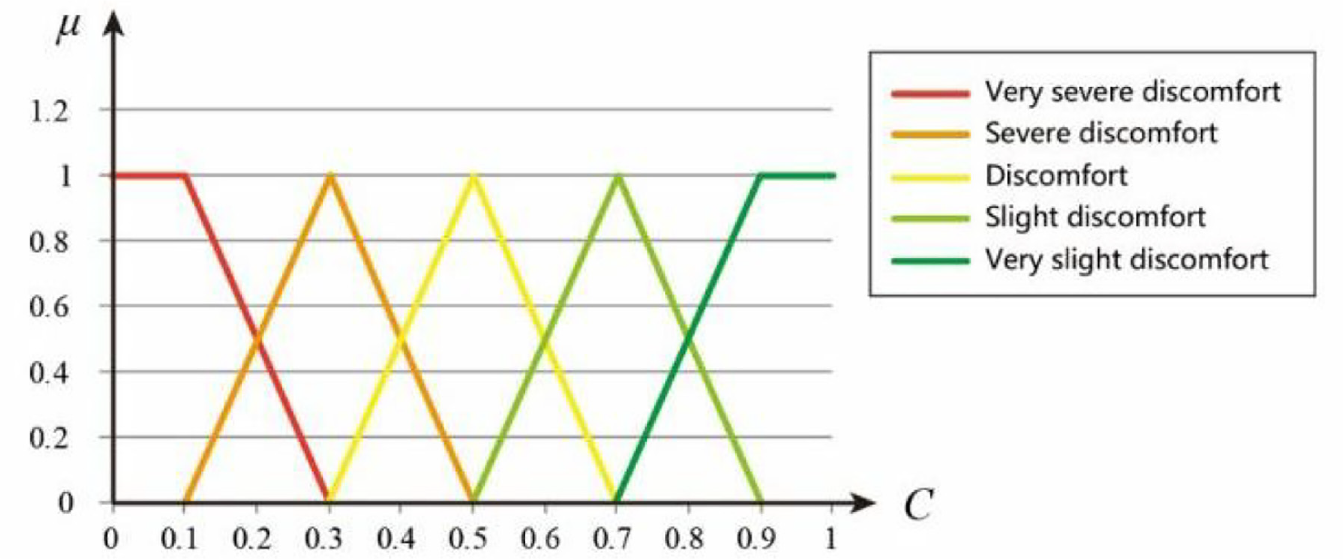
Membership function.
The membership functions of the comfort indexes for the comments of “Very serious discomfort,”“Severe discomfort,”“Discomfort,”“Slight discomfort” and “Very slight discomfort” are shown in equations (6)–(10):


Construction of the evaluation matrix
Through the analysis of missile handling operations, the top factor evaluation set of operation comfort is:
The secondary factor evaluation sets are:
The single factor evaluation sets are:
The comment set for the action evaluation of missile handling operation is:
Concurrently, this study employs the Analytic Hierarchy Process (AHP) to determine the weights of individual evaluation factors, conducting a bottom-up hierarchical evaluation of the factors influencing the comfort of missile handling operation. For the comfort evaluation of missile handling movements, a three-level evaluation is adopted. The calculation formulas for each level of evaluation are shown in equations (11)–(14).
Taking T1 as an example, third-level fuzzy comprehensive evaluation method is shown in equation (11). Second-level fuzzy comprehensive evaluation method are shown in equations (12) and (13). And first-level fuzzy comprehensive evaluation method is shown in equation (14).



Results
The U.S. Naval Aviation mounting AIM-9X air-to-air missile on the wing tips of F/A-18 carrier-based aircraft is chose as a research case. An adult male was selected as the operator of the simulated manual missile handling experiment. The operator’s joint data were recorded by motion capture equipment and combined with Jack, the ergonomics software, to obtain the human joint torque, and the relative joint torque was used to represent the comfort. Subsequently, the comprehensive ranking scoring method combined with AHP method was used to establish the evaluation index weight set, and finally, the numerical calculation of fuzzy comfort was performed.
Acquisition of the comfort of each joint
Kinect was utilized to measure the frame-by-frame angular data of various joints of the test subjects during simulated manual ammunition handling experiments. The images of joint angle variations over time, after curve fitting and mean filtering, are shown in Figure 4. As the experimental equipment collects data frame by frame, to ensure the intuitiveness of the images, the independent variable (time) is expressed in frames [f], with each frame lasting 1/30 second.

The joint angle-time graphs of the simulated manual missile handling operation: (a) shoulder joints ex/fl, ab/ad, and in/ex, (b) elbow joints ex/fl, (c) wrist joints ex/fl, (d) hip joints ex/fl, and ab/ad, (e) knee joints ex/fl, and (f) ankle joints ex/fl.
In the simulation experiment, the test subjects completed all steps in the manual missile handling operation process. To facilitate the study of human body motion changes from a to d, we eliminated intervals where the subjects maintained a static posture for extended periods from the data, ultimately retaining 564 frames specifically describing joint angle changes during motion transitions. The entire process of simulated manual ammunition handling is divided into four parts: motion a to b (0–128 f), motion b to c (128–223 f), motion c to d (223–437 f), and motion d to end (437–564 f). Among these, (223–317f) represent the interval where the subject’s shoulder bears the load.
Taking the first frame as an example, the joint angles are extracted as shown in Table 2.
Joint angles of the first frame.

This study utilizes the ANSUR II database embedded in the Jack ergonomic simulation analysis software to establish a digital human body model at the 50th percentile for males. Within the “Task Analysis Toolkit (TAT),” the grasping state, load, and angles of various joints are adjusted to simulate joint torques. Joint motion indicators and joint torques at different angles within the range of joint motion are obtained, and the changes in joint torques as well as the maximum joint torques are recorded.
Concurrently, the method proposed by Hirao et al. is adopted to represent the comfort level of joints using relative joint torques. 15 The relative joint torque refers to the ratio of the current actual joint torque to the maximum joint torque. The concept of relative joint torque can eliminate the influence of different torques produced by different individuals and postures. This model can be represented by equation (15).

In equation (15),
Determination of the weight of each joint comfort index
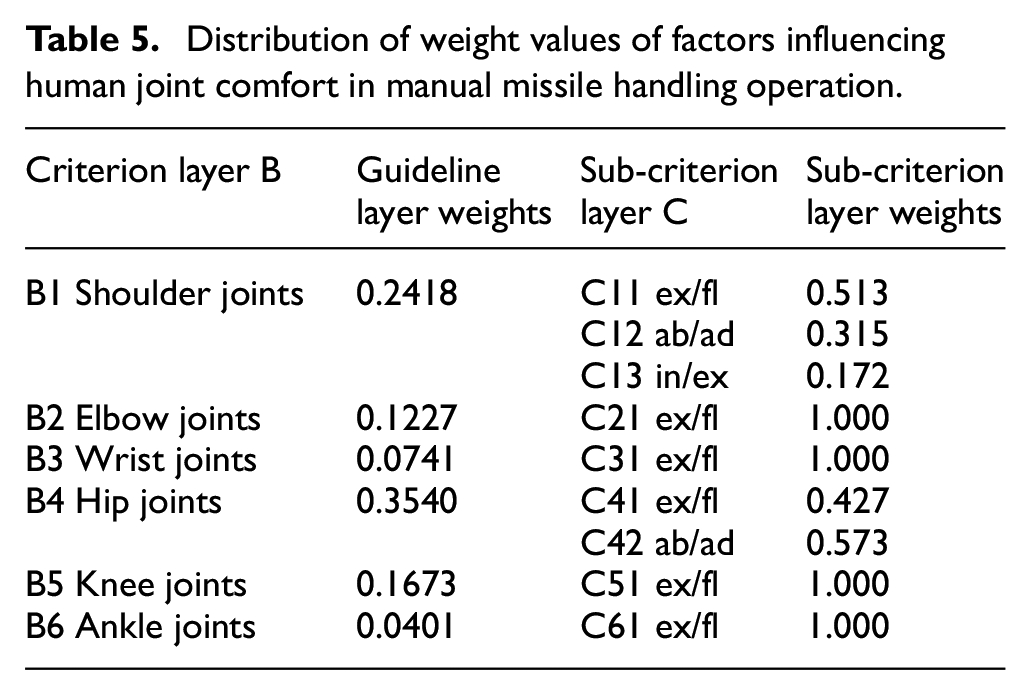
Based on the joint motion evaluation indicators in Table 1, “Joints” are designated as “Criterion Layer B,” and “Motions” are designated as “Sub-criterion Layer C.” The constructed hierarchical structure of manual missile handling operation comfort encompasses 6 criteria and 9 sub-criteria.
To mitigate the impact of individual subjective perceptions on the credibility of evaluation results, this study employs a combination of comprehensive ranking scoring method and AHP to establish the weight set. The procedure is as follows:
Step 1: A 6-member expert scoring panel is formed, comprising six professors specializing in naval ergonomics from the School of Mechanical and Electrical Engineering at Harbin Engineering University. These experts are subjected to a subjective questionnaire survey. Using the ranking scoring method, they rank the importance of criteria at the same level in Table 4 in terms of their impact on the comfort of the higher level. The least important criterion is scored 1, the next least important is scored 2, and so on. The subjective assessment results from the 6 experts are collated, and combined with existing research on joint motion perceived discomfort rankings, to obtain the same-level ranking results for each level.
Step 2: Construct an n×n Saaty judgment matrix (where n is the number of criteria at that level). 47 Based on the same-level ranking results obtained in Step 1, the relative importance between indicators is filled into the judgment matrix using numbers 1–9, where 1 represents “equally important” and 9 represents “extremely important.” The judgment matrix is then normalized to calculate the quantified weights between indicators at the same level. 48
Step 3: Conduct consistency tests for each judgment matrix constructed for indicators at different levels. The purpose of consistency testing is to determine whether the subjective statistics align with the quantitative research results, thereby validating the rationality and effectiveness of the research findings. Taking the criterion layer as an example, Table 3 is obtained by collating the subjective questionnaire results from the expert scoring panel and existing research conclusions. Higher scores for joints indicate a higher ranking in terms of their impact on human perception and a greater influence on human comfort during manual missile handling operation. Among them, number I-VI represents the scoring results of six experts in the field of ship ergonomics, number VII represents the ranking system of perceived discomfort in joint motion proposed by Kee and Karwowski, 49 and number VIII represents the ranking system of perceived discomfort in joint motion based on non-neutral postures proposed by Genaidy and Karwowski. 50 R i represents the sum of scores obtained by the evaluated objects.
Scoring results of subjective surveys at the criterion layer.

The results of Kendall’s coefficient of concordance consistency test show that the overall Kendall’s W value is 0.759. Referring to the “Kendall’s Coefficient of Concordance (W) Significance Critical Value Table,” 51 it is evident that the correlation degree of the eight scoring indicators demonstrates high consistency. In this study, the order of importance in affecting human comfort, from highest to lowest, is: B4 (Hip joints), B5 (Knee joints), B1 (Shoulder joints), B3 (Wrist joints), B6 (Ankle joints), and B2 (Elbow joints).
After ranking the importance of each factor in the criterion layer and filling the relative importance of each factor into the Satty judgment matrix, the pairwise comparison results of the criterion layer are obtained, as shown in Table 4. Similarly, the same method is applied to determine the weights for each degree of freedom of each joint, with the final weight results shown in Table 5.
Pairwise comparison results of criterion layer.

Distribution of weight values of factors influencing human joint comfort in manual missile handling operation.
Calculation of comfort values
To calculate the comfort values of missile handling operation, we first completed the single-joint fuzzy comprehensive evaluation. It can be seen from Section 3.3 that the single-factor evaluation set of shoulder joint is
The single-factor membership degree matrixes of the left and right shoulder joints are shown in equations (16) and (17) respectively:


Comprehensive evaluation matrixes of the left and right shoulder joints are shown in equations (18) and (19) respectively. And the matrix of the bilateral shoulder joints is shown in equation (20).



In the same way, the membership degree matrix Ce2, Ce3, Ce4, Ce5, and Ce6 of B2, B3, B4, B5, and B6 on the comfort of missile handling operations can be obtained. The overall membership degree evaluation matrix is shown in equation (21).
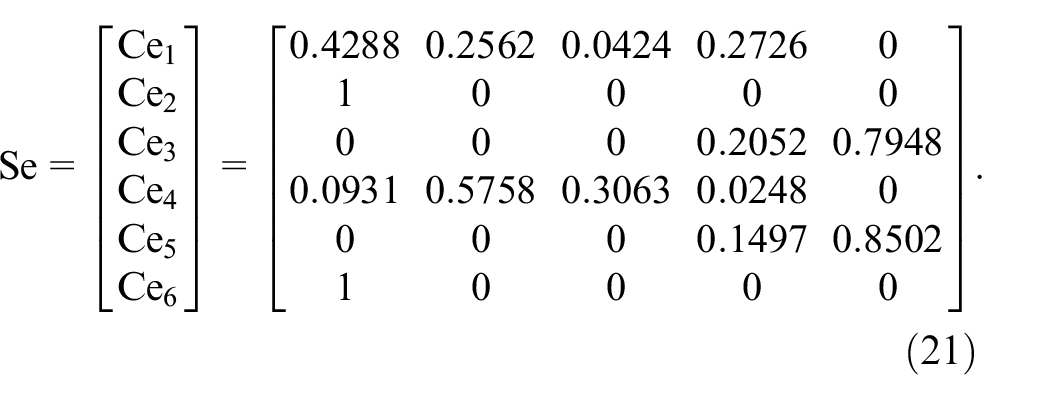
After determining the membership degree evaluation matrix, the second-level comprehensive evaluation is carried out. The upper and lower limb comprehensive evaluation matrixes are shown in equations (22) and (23) respectively, and then carry out the first-level comprehensive evaluation shown in equation (24).


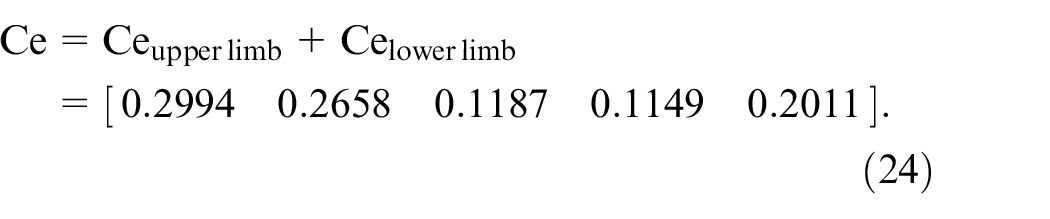
The angle data of each joint in Figure 4 is calculated frame by frame according to the above method, and the graphs of the membership degree of upper and lower limb comfort over time and the membership degree of whole body comfort over time are obtained as shown in Figures 5 and 6.

The fuzzy membership-time graphs of the upper and lower limb comfort: (a) upper limb comfort and (b) lower limb comfort.

The graph of the fuzzy comprehensive evaluation on comfort degree of manual missile handling operation.
As depicted in Figure 5, the “Very severe discomfort” curve exhibits the highest proportion in upper limb comfort assessment, while the “Slight discomfort” curve predominates in lower limb comfort evaluation. This indicates that during the simulated manual missile handling process, the overall level of discomfort in the lower limbs is less pronounced than that in the upper limbs. During the shoulder loading phase, when the force application point transitions from both wrists to a single shoulder, a notable discontinuity in comfort levels is observed for both upper and lower limbs. The upper limbs demonstrate a more significant change, whereas the lower limbs exhibit a comparatively minor shift, suggesting that the alteration in force application point has a limited impact on lower limb comfort. Within the discontinuous interval of shoulder joint loading, the curve values for “Very severe discomfort” and “Severe discomfort” decrease, while those for “Slight discomfort” and “Very slight discomfort” increase.
The fuzzy comprehensive evaluation model of the comfort degree of manual missile handling operation is obtained by adding the weighted curves of the comfort of upper and lower limbs. Figure 6 illustrates the changes in membership degrees of various comfort descriptors across five time periods. The “motion a to b” phase exhibits the most significant fluctuations in comfort membership degrees. From frame 0, the membership degrees of “Very severe discomfort” and “Severe discomfort” decrease, while “Slight discomfort” increases to 0.422. After 74f, the membership degree of “Slight discomfort” declines, and that of “Very slight discomfort” rises. This indicates that the transition of the lower limbs from a flexed to an upright position substantially influences operational comfort during this phase. The “motion b to c” phase continues this trend, with the first two phases generally tending toward increased comfort. From 223f to 317f of the “motion b to c” phase, corresponding to shoulder loading, abrupt changes in comfort membership degrees are observed. The membership degrees of “Slight discomfort” and “Very slight discomfort” increase, while those of “Very severe discomfort,”“Severe discomfort,” and “Discomfort” decrease. After 317f, including the “motion b to end” phase, overall comfort levels stabilize, with comfort membership degrees fluctuating within a narrow range.
To visually represent the distribution of membership degrees for various comfort descriptors across five time periods in the fuzzy comprehensive evaluation results, Figure 7 is constructed, wherein each frame of data serves as an individual observation point. In the “motion a to b” phase, the variable “Slight discomfort” exhibits the highest data variability, with an interquartile range (IQR) of 0.182, a median of 0.338, and upper and lower quartiles of 0.394 and 0.212, respectively. The membership degree of this variable partially exceeds that of other variables. Conversely, the “Very severe discomfort” variable demonstrates the least data variability, with an IQR of 0.006, and its membership degree generally remains around 0.206. During the “motion b to c” phase, the “Very slight discomfort” variable partially surpasses other variables in terms of membership degree, with an IQR of 0.040, a median of 0.294, and upper and lower quartiles of 0.300 and 0.260, respectively. In the “motion c to d (shoulder)” phase, the “Slight discomfort” variable partially exceeds other variables in membership degree, presenting an IQR of 0.035, a median of 0.322, and upper and lower quartiles of 0.328 and 0.292, respectively. For both the “motion c to d (wrists)” and “motion d to end” phases, the “Very severe discomfort” variable generally demonstrates higher membership degrees compared to other variables. In the former phase, it has an IQR of 0.014, a median of 0.317, and upper and lower quartiles of 0.324 and 0.309, respectively. In the latter phase, it presents an IQR of 0.029, a median of 0.290, and upper and lower quartiles of 0.304 and 0.274, respectively. In conclusion, the overall comfort ranking of the five phases, from most comfortable to least, is as follows: “motion b to c” > “motion c to d (shoulder)” > “motion a to b” > “motion d to end” > “motion c to d (wrists).”

Distribution of each comfort rating in the fuzzy comprehensive evaluation results.
Discussion
To validate the applicability of the comfort evaluation model proposed in this study, its consistency with two existing evaluation models (RULA and OWAS) is examined.
Ten measurement points, as shown in Table 6, are randomly selected from the entire simulated manual ammunition handling process. The upper limb comfort evaluation results and whole-body comfort evaluation results for these ten points are compared with the RULA and OWAS evaluation results, respectively.
Random measurement points.

The proposed fuzzy evaluation model yields results in terms of membership degrees for five distinct comfort levels. In contrast, both the RULA upper limb assessment and the OWAS whole-body assessment produce ordinal numerical values with different scoring divisions. To compare the consistency of these three models’ evaluation results, it was necessary to convert the fuzzy comprehensive evaluation results into quantitative comfort evaluation indices.
The conversion of fuzzy evaluation results into numerical values requires the definition of a unified transformation rule. The membership functions constructed in equations (6)–(10) describe the correspondence between the five comfort descriptors and the comfort index. Given that the comfort index exhibits a linear relationship with the membership degrees of various subjective sensation descriptors, and that the membership functions of each descriptor are uniformly distributed within the domain

Quantitative human comprehensive comfort indexes: (a) upper limb comprehensive comfort index and (b) whole-body comprehensive comfort index.
The comfort degree of measurement points.

Comparison of upper limb comfort index and RULA evaluation results
The RULA analysis categorizes evaluation results into seven segments, ranging from “Acceptable” to “Requires further investigation and immediate modification,” using a scoring system from 1 to 7. To align the human comfort index with the RULA evaluation format, we divide the comfort index
Utilizing the Jack ergonomic simulation software, we conduct RULA assessments for the postures at measurement points T0-T9. The assessment results are then compared with the graded upper limb comfort indices, as presented in Table 8. In this table, FCE denotes the evaluation results from our study, while RULA represents the RULA evaluation results.
The comfort of measurement points evaluated by FCE and RULA.

To determine the consistency of the evaluation results, we employ the Kendall coefficient of concordance formula. The consistency test results using Kendall’s coefficient of concordance reveal a W value of 0.69 for the overall data, indicating a high degree of consistency between the two evaluation models. This finding suggests that the evaluation model proposed in this study demonstrates substantial applicability for upper limb comfort assessment.
Comparison of whole-body comfort index and OWAS evaluation results
The OWAS categorizes worker posture evaluation results into four levels, ranging from “No improvements needed” to “Immediate improvements required,” utilizing a scoring system from 1 to 4. To ensure compatibility between the human comfort index and the OWAS evaluation format, we subdivide the comfort index
Employing the Jack ergonomic simulation software, we conduct OWAS assessments for the postures at measurement points T0-T9. The assessment results are subsequently compared with the graded whole-body comfort indices, as presented in Table 9. In this table, FCE denotes the evaluation results from our study, while OWAS represents the OWAS evaluation results.
The comfort of measurement points evaluated by FCE and OWAS.

To ascertain the consistency of the evaluation results, we apply the Kendall coefficient of concordance formula. The consistency test results using Kendall’s coefficient of concordance reveal a W value of 0.723 for the overall data, indicating a high degree of consistency between the two evaluation models. This finding suggests that the evaluation model proposed in this study demonstrates substantial applicability for whole-body comfort assessment.
Summaries of the comparative results
In the preceding section, a comparative analysis is conducted between the FAHP-based evaluation method for manual missile handling operations proposed in this study and the widely adopted RULA and OWAS assessment models. The Kendall’s coefficient of concordance test results for both groups demonstrate that, at the designated measurement points, the evaluation outcomes of this study, subsequent to defuzzification, don’t exhibit statistically significant numerical disparities from those obtained via RULA and OWAS methodologies. This finding suggests that the evaluation framework constructed in this research, which is predicated on expert knowledge, possesses the capacity to accurately reflect the objective comfort conditions associated with the task under investigation.
Compared to RULA and OWAS, the method proposed in this study offers a distinct advantage in presenting fuzzy evaluation results for the entire operational process. This approach more intuitively demonstrates the continuous changes in human comfort and achieves a smooth transition between the five discrete comfort levels, thereby more accurately reflecting the continuous nature of comfort. Furthermore, human perception of comfort is inherently fuzzy, and the fuzzy expression of evaluation results aligns more closely with human cognitive processes. When making decisions based on comfort levels, this fuzzy approach provides more information and options, potentially leading to improved decision outcomes. The continuous nature of the fuzzy results allows for a more nuanced understanding of comfort variations throughout the task, which may be particularly valuable in identifying critical points or phases where ergonomic interventions could be most effective.
Conclusion
A fuzzy evaluation methodology for assessing the comfort level of missile handling operation performed by ordnance personnel is proposed, based on the perspective of relative joint moments. Through comparative analysis with the RULA and OWAS occupational comfort evaluation models, the fuzzy comprehensive evaluation model proposed in this research demonstrates high accuracy and reliability. The results can be fitted into continuous time-series visualizations, providing dynamic motion assessment outcomes.
The proposed evaluation model exhibits potential for improving standard operating procedures, thereby reducing discomfort experienced by ordnance personnel and mitigating the risk of work-related musculoskeletal disorders. This methodology offers a more holistic view of the entire operational process, potentially uncovering subtle comfort trends that might be overlooked by discrete evaluation methods. Furthermore, the methodology developed in this study may be applicable to standardizing training motions for ordnance personnel or in other operational domains. This research contributes to the enrichment of occupational comfort assessment systems and the expansion of their application scope, while also providing theoretical and technical references for other studies in motion analysis and evaluation.
Footnotes
Handling Editor: Sharmili Pandian
Declaration of conflicting interests
The author(s) declared no potential conflicts of interest with respect to the research, authorship, and/or publication of this article.
Funding
The author(s) received no financial support for the research, authorship, and/or publication of this article.
