The study focuses on a vertical Riga surface-induced mixed convective, unsteady stagnation point flow of Casson fluid. This flow exhibits nonlinearity due to thermal radiation, chemical processes, Brownian motion, thermophoresis, Maxwell slip velocity, and Smoluchowski slip temperature conditions. The study’s goal is to improve thermal efficiency. By using suitable similarity variables, the partial differential equations are transformed into ordinary differential equations. Subsequently, these equations are resolved using the bvp4c function in MATLAB. The numerical findings for concentration, shear stress, Nusselt number, Sherwood number, velocity, and temperature distribution are shown graphically. When the values of the Casson parameter increase, the velocity profile was also increased while the concentration and temperature profiles decreased. The unsteadiness parameter increase was followed by a rise in the skin friction and a decrease in the profiles of Nusselt number and Sherwood number. Profiles of skin friction, Nusselt number, and Sherwood number were raised with the increased values of the modified Hartmann number. Increasing parameter values of Brownian motion result in a decrease of the Nusselt number profile, while the Sherwood number profile increases. On the other hand, as the thermophoresis parameter increase, the profiles of the Nusselt number and Sherwood number decrease. This study will aid in the improvement of the understanding of fluid dynamics and nanotechnology and, eventually, the creation of more effective and sustainable engineering-based solutions. When we compared our results to those of other studies in the literature, we discovered that they were quite consistent.
Stagnation point has fascinated scientists for almost a century owing to its numerous practical applications. The analysis of a flow that reaches a solid surface in a fluid that is in motion, known as stagnation point flow, originates from the groundbreaking research conducted by Hiemenz1 in 1911. He pioneered the investigation of stagnation point flow across a stationary surface in a two-dimensional setting. Dash et al.2 enhanced the suggested formulation by integrating the energy equation numerically. They also expanded the investigation to include the movement of stagnation point past a stretching sheet inside the boundary layer. Abbasi et al.3 performed a numerical research to analyze the heat transfer of second-grade liquid flowing over a spiraling rotatory disc near the rotating stagnation point. Stagnation flows are everywhere, showing up in situations like using fans to cool electronics, emergency shutdown cooling in nuclear reactors, submarine and machines aerodynamics, which rocket tip behavior in flight, the effect of atmospheric winds on solar essential recipients, and many hydrodynamic processes essential to many engineering domains. Due to the substantial applications, several researchers have subsequently explored various aspects of stagnation point flow issues.4,5
The interest of modern researchers in non-Newtonian fluids has recently seen a noticeable upsurge. The heightened concentration may primarily be attributed to the wide range of uses of these fluids in both advancements in technology and industrial environments.6 Non-Newtonian fluids have piqued the interest of scientists, who have focused their research efforts on studying their practical and commercial applications and their unique properties.7,8 The unique characteristics shown by melts of polymer and solutions in the global polymer processing sector have significantly contributed to the widespread use of non-Newtonian fluids. These applications include a wide range of industries, including the chemical industry, bioengineering, material processing, agricultural water distribution, oil reservoir engineering, and many more.9 Many non-Newtonian fluids have complicated flow characteristics, which have been studied extensively. Shafiq et al.10 then thoroughly examined the third-grade model’s behavior. The Casson fluid has fascinating and extraordinary characteristics; it is classified as a non-Newtonian fluid. The fluid category has unique qualities that captivate the attention of scholars and add to the complexity of its behavior. When under little tension, this fluid behaves like a solid and is elastic. Nevertheless, when the tension beyond a certain threshold, it undergoes a transition and adopts the typical properties of a fluid. Upon analyzing the present literature, it is evident that several studies have concentrated on the Casson fluid class, mostly due to its numerous significant attributes. Nadeem et al.11 investigated the intricacies of three-dimensional Casson fluid flow modeling, while Bhattacharyya et al.12 looked at how magnetohydrodynamic processes affect the Casson model. Furthermore, Megahed13 examined the effects of Casson thin film flow, including the influences of viscous dissipation and variable heat flux. The impact of viscosity changes and the Cattaneo–Christov heat flow phenomenon on the Casson model was further explored by Malik et al.14. In their study, Ali et al.15 analyze the propagation of a Darcy–Forchheimer Casson fluid boundary layer, which is incompressible, over a stretched sheet. In their study, Shehzad and Farid16 compare Newtonian and non-Newtonian nanofluids. The bidirectional movement of the magnetized surface is responsible for the creation of flow. Madhukesh et al.17 study the effects of a stable, incompressible, magnetised Casson–Maxwell nanofluid between two stationary porous discs.
Mixed convection flows, which are sometimes referred to as mixed free and forced convection flows, have the potential to be used in a wide range of technical and industrial applications. Examples of mixed convection flows include electrical devices cooled by fans, solar receivers exposed to wind, differences in ocean and atmospheric flows, and thermal fluctuations in the atmospheric flow. Ramesh et al.18 investigated the influence of irregular heat sources/sinks on the flow of a viscoelastic liquid over an inclined surface. With the help of added mixed nanofluids, Ali et al.19 examined the heat transport intensification across a nonlinear slender Riga plate accompanied by buoyant forces. The impact of the Soret effect on nanofluids flowing across non-linearly stretched hot surfaces caused by mixed convection was addressed by Bouslimi et al.20 In their study, Qayyum et al.21 investigated the phenomenon of mixed convection and the impact of a heat source-sink in a tangent hyperbolic nano liquid, while considering both Newtonian mass and thermal transfer. Hatami et al.22 investigated the heat transfer caused by both natural and forced convection in a porous cavity in the form of a T, with a lid that is being pushed. This study specifically focused on the use of nanofluids. Jamesahar et al.23 examined the impact of mixed convection on elastic fins.
Several theoretical models were proposed to accurately represent the behaviors of nanofluids. Currently, there are two types of models: dispersion models and homogeneous flow models. According to Buongiorno,24 in a homogeneous model, nanofluid heat transfer coefficients are unanticipated. The impact of dispersion is disregarded as a result of the nanoparticle’s size. To address this limitation, Buongiorno developed an alternative model in which he included seven slide processes, including Brownian diffusion, inertia, thermophoresis, fluid drainage, Magnus effect, diffusion phoresis, and gravity effect. He asserted that thermophoresis and Brownian diffusion are the primary slide processes in nanofluids. Using a modified version of Buongiorno’s Model, Ali et al.25 recently investigated the effects of mixed convective flow over a disc. Rana et al.26 have presented a comprehensive analysis of the theoretical and computational aspects of the movement of water containing alumina and titania particles on a horizontally stretched sheet. Ali et al.27 investigated the dynamic movement of a hybrid nanofluid on an extended surface under the influence of a rotating magnetic field. They used a modified version of Buongiorno’s Model to analyze the phenomenon.
The main ideas behind the anomalous enhancement in thermal conductivity employing binary fluids (base fluid together with nanoparticles) are Brownian motion and thermophoresis diffusions. The Buongiorno model specifically addresses the impact of Brownian motion and thermophoresis. This paradigm assists engineers and academics by being used in the realm of technology and science. Additionally, it is noted that nanoparticles exhibiting thermophoresis effects and Brownian motion lead to an enhancement in thermal conductivity. The notion of Brownian motion, together with thermophoresis particle installation, is used in the fabrication of germanium dioxide optical fibers and in communication engineering for silicon. Anwar et al.28 addressed the subject of Casson nanofluid flow on a stretched sheet and how Brownian motion and thermophoresis diffusion affect it. Casson nanofluid flow with convective boundaries was studied by Afify29 in relation to Brownian motion and thermophoresis. Souayeh et al.30 conducted a study on the effects of radiation on the flow of Casson nanofluid, taking into account the influence of Brownian motion and thermophoresis. When discussing heat transfer and particle motion, Rashidi et al.31 took the discrete phase model (DPM) into account. Considering the thermal radiations effect, Bhatti et al.32 investigated electro-magnetohydrodynamic (MHD) flow involving heat exchange. Ellahi et al.33 examined a shiny thin layer containing metallic tactile nanoparticles by using a revolving disc.
The authors are interested in magnetic hydrodynamics because of its many technical applications and its potential to manipulate heat transfer rates via the use of an external magnetic field. A revolutionary magnetic device, the Riga plate consists of a cluster of alternating electrodes and changeless magnets spread out across a flat surface. This formulation is used to include Lorentz forces into the system in fluid flow models. In several configurations, particularly in submarines, the arrangement is very efficient and beneficial for inhibiting the separation of the boundary layer in fluid flow, hence reducing skin friction. Understanding the effects of joule heating, nanoparticle aggregation, and a heat source on the flow of an ethylene glycol-based nanofluid over a permeable, heated vertical Riga plate and through a porous media is the goal of the study by Otman et al.34 In their study, Abbas et al.35 examined the effects of micropolar fluid flow on the Riga surface. Ali et al.36 employed two parallel Riga plates to squeeze nanofluids, considering chemical reaction and heat source/sink relevance. Recently, many writers have proposed several concepts about the Riga sheet within the context of different fluid models, as referenced in Mahmood et al.37 and Khan et al.38
There are two primary boundary conditions: the no-slip condition and the slip boundary condition. Addressing the slip boundary condition involves assuming a discontinuity in the velocity function between the fluid and the boundary. The significance of slip boundary conditions in fluid flow models, especially for complicated fluid research, has been more acknowledged in recent years. Forecasting movement and transport phenomena becomes more accurate when models that account for slip effects provide a more realistic depiction of fluid flow near boundaries. The primary objective of the work conducted by Khan et al.39 is to assess the impact of varying viscosity, slip conditions, and aggregation on the flow characteristics of nanofluids in three dimensions. A study conducted by Khashi et al.40 examined the effects of slip and convective boundary conditions on the three-dimensional flow of a hybrid nanofluid via a stretchable/shrinkable sheet. In a recent study, Mahmood et al.41 examined the boundary conditions that depend on the Maxwell velocity slip and the Smoluchowski temperature. These circumstances were addressed on a surface that undergoes nonlinear stretching.
According to the existing literature, two separate processes, thermophoresis and Brownian motion, are produced when nanoparticles travel through a nanofluid. Both of these occurrences are significant factors in the heat transfer issue. We analyzed the incompressible, time-dependent flow of Casson fluid across a vertical Riga sheet in the stagnation area, taking into account mixed convection, thermophoresis, and Brownian motion. An investigation was conducted on the vertical Riga sheet to study the effects of nonlinear thermal radiation, solid nanoparticle concentration, chemical reaction, Maxwell slip velocity, and Smoluchowski slip temperature conditions. In this work, we used the Casson fluid model including the elements of Buongiorno’s model. Based on the assumptions mentioned earlier, a mathematical model was developed using differential equations (specifically, partial differential equations) and using BLA (boundary layer approximations). A mathematical model was established using boundary layer approximations in terms of partial differential equations (PDEs) based on the given assumptions. By implementing appropriate transformations, the system of partial differential equations (PDEs) was simplified into ordinary differential equations (ODEs). The system of ordinary differential equations (ODEs) was solved using the bvp4c technique, a numerical methodology. Using the characteristics of Buongiorno’s model under the constraints of Maxwell slip velocity and Smoluchowski slip temperature, the stagnation point flow of an unsteady Casson fluid with nonlinear radiation across a vertical Riga sheet was examined. With the use of graphs and tables, the effects of physical factors on the velocity, temperature, concentration, skin friction, Sherwood number, and Nusselt numbers are highlighted.
Applications: The knowledge acquired by analyzing the flow of time-dependent Casson fluid across a vertical plate with various influencing parameters may be used in a broad range of industrial and biomedical contexts. This can lead to improvements in optimization of processes, design of materials, and medical diagnostics.
Problem formulation
In this work, the mathematical model of the time-dependent incompressible Casson fluid flow on a vertical Riga sheet (Figure 1) was scrutinized. This investigation focused on examining the flow near the stagnation point. The velocity of the surrounding fluid is considered to be , whereas the velocity of the stretching plate is . Let and is also a constant real number. Consider that unsteady stretching plate is denoted by . Moreover, let’s assume that the velocity of the mass flow is denoted as , where represents suction and represents injection. We will assume in the interim that the concentration at the wall, represented by , and the temperature at the wall, designated by , stay the same. , the fluid’s temperature in the immediate vicinity, and , its surrounding concentration, will not change (see Figure 1). The incorporation of Lorentz forces into fluid flow models was accomplished using this approach. The Lorentz forces were generated by assembling magnets in a pattern that spans across, with electrodes placed parallel to the wall surface. The strength of the forces decreases exponentially as the distance from the plate increases. The Riga plate is represented by the Grinberg term , here, is the magnetization of the magnets and is the width of the electrodes and magnets. At the electrodes, the current density is denoted by .
Casson fluid flow pattern over vertical Riga sheet.
In addition, the vertical sheet was subjected to the Maxwell slip velocity, as described in reference Mahmood et al.,41 which has a slip length of , and the Smoluchowski slip temperature, as described in reference Mahmood et al.,41 which has a slip length of . The study focused on investigating the movement of mass and heat, specifically in relation to the effects of nonlinear radiation, Brownian motion, thermophoresis and chemical reaction.
An isotropic flow of a Casson fluid may be mathematically described by the rheological equation of state.42
In a non-Newtonian model, is the critical value of , , where is the product of the component of the deformation rate, is the symbol for the elastic dynamic viscosity of the fluid, is the symbol for the fluid’s yield stress.
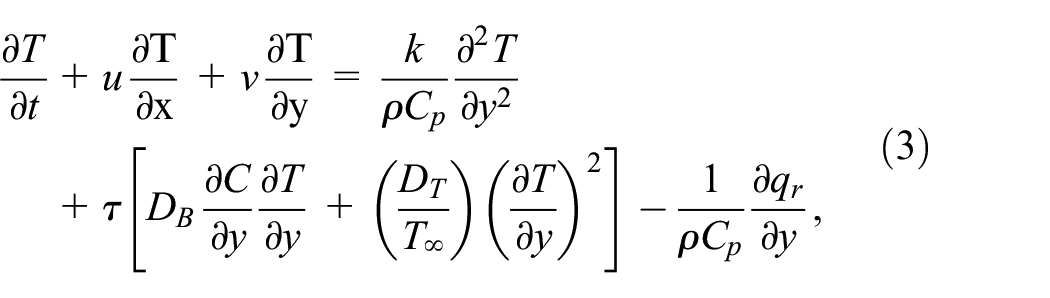
The following is an expression of the governing boundary-layer equations taking these assumptions into account38,42:
When , it indicates suction, and it is used as a constant mass flow measure. The variables shown in the equation are the temperature of the Casson fluid (), the concentration of the nanoparticle (), the coefficients of Brownian diffusion () and thermophoresis diffusion (), and the ratio of the nanoparticles’ heat capacity to the base fluid’s heat capacity ().
Roseland has put up the following formulations to describe the phenomenon of thermal radiation.38
In this case, the Stephen–Boltzmann constant is denoted by , while the average absorption coefficient is represented by Equation (3) may be represented as follows:
The following similarity transformations are developed to simplify equations.38
The dimensionless temperature is restructured into the subsequent formula for nonlinear radiation. where denotes nonlinear radiation and =1 denotes linear radiation, with the temperature ratio parameter, = /.
The continuity equation (1) is immediately fulfilled for the similarity transformation given above. The equations (2), (4), (5), and (7) are transformed into the following form using the similarity transformation stated in (8).
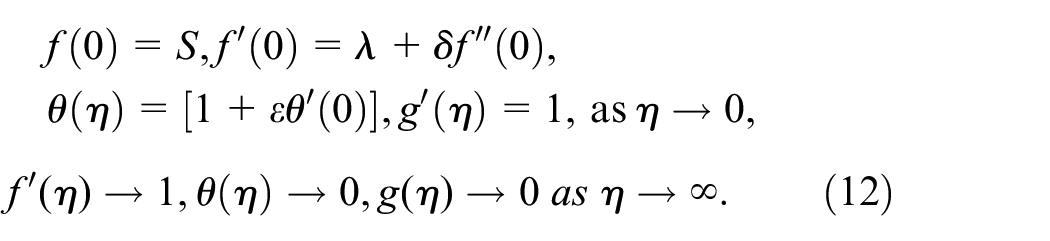
boundary conditions as follows:
The expression signifies the Prandtl number, dimensionless parameter of the magnet and the electrode width is denoted as , modified Hartmann number signifies as . The Casson fluid parameter is symbolized by the . indicates the stretching parameter. denotes the unsteadiness parameter, is Lewis number, is thermophoresis parameters and is Brownian motion for Casson fluid. is the velocity slip parameter, is radiation parameter, is mixed convection parameter, where is called Grashof number, stands for the local Reynold’s number. Note that indicates the opposing and suggests the assisting flows, whereas the forced convection flow is assumed by . is the temperature slip parameter, is local modified Grashof number. is chemical reaction parameter and is Schmidt number.
Engineering quantities of interest
The skin friction coefficient , the Sherwood number , and the local Nusselt number are the physical quantities that are of relevance. They are defined as:
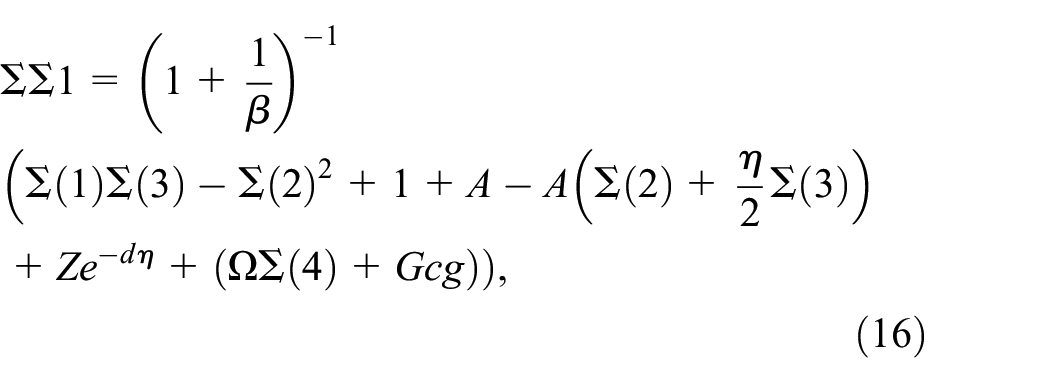
The numerical solution for equations (9) to (11) was obtained using the boundary value problem solver (bvp4c) in MATLAB software. The solver utilizes the 3-stage Lobatto IIIa method. A continuous solution with fourth-order precision is provided by this collocation formula. The efficacy of this solver ultimately depends on our capacity to provide the algorithm with an initial approximation for the solution. Additionally, the parameters’ values dictate the appropriate boundary layer thickness value. In order to solve this boundary value issue, it is essential to first convert the equations into a system of first-order ordinary differential equations. A tolerance error of was recorded. The bvp4c techniques are described in Figure 2. The following steps outline the procedure:
Flow chart depicting the disruptive nature of the numerical bv4c scheme.
In the case when boundary conditions are
The dependability of the findings is assessed using the methodology developed by Gowda et al.44 which can be seen in Table 1. The authors have found that the new results align well with earlier research. Hence, we have full confidence that the proposed conceptual model can proficiently examine the phenomena of heat transfer and fluid movement.
In this part, we analyze the Casson nanofluid by looking at its temperature function, concentration function, stream function, drag force coefficient, Nusselt number, and Sherwood number. The research entails analyzing the behavior of the subjects in relation to the independent variable , while methodically manipulating the values of the controlling variables. This section highlights the distinctive features of many physical factors that have been added, including the updated Hartmann number, radiation parameter, unsteadiness parameter, velocity and thermal slip parameters, Lewis number, and Schmidt number. In this case, the bvp4c technique was used to achieve the numerical solution. To restrict the computing area, the variable is added, which enforces boundary restrictions at a limited value for the similarity variable η in the far field. For the temperature, velocity, and concentration profiles, it is considered that a value of =5 is enough to meet the far-field boundary requirements asymptotically in this work. Figures for the local Nusselt and Sherwood numbers, skin friction coefficient are also included.
Specific constraints are used to ensure the precision of the results, and they are set to the specified limits as follows43,44: , . For assisting flow wheras for opposing flow .
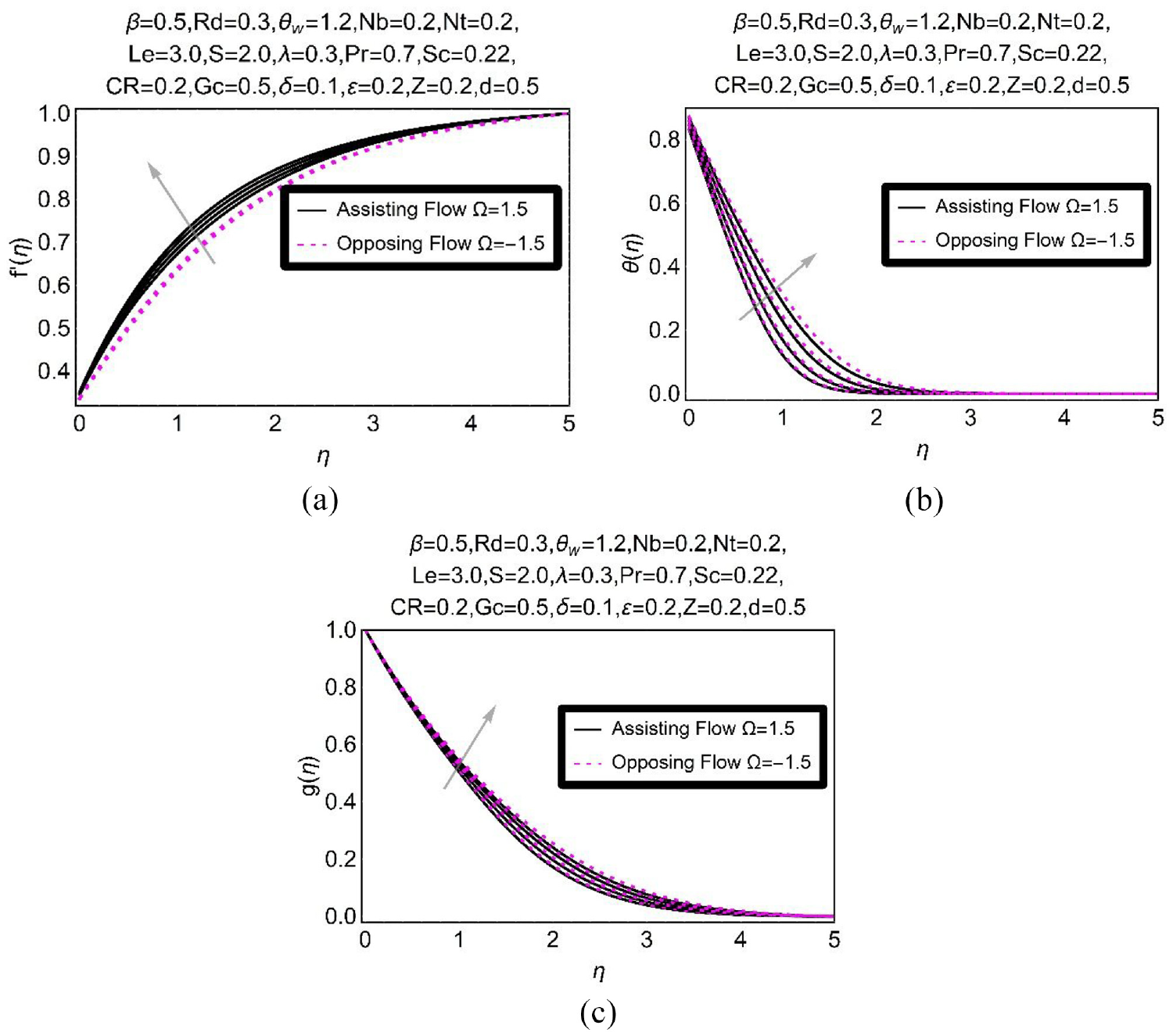
While holding all other parameters constant, Figure 3(a) to (c) shows curves for concentration , temperature , and velocity for different values of the Casson parameter for assisting ) and opposing flow ). The velocity profile in Figure 3(a) exhibits a positive correlation with the , since higher values of the parameter align with fluids with higher yield stress. These fluids need more force to commence flow. Increasing the parameter makes the fluid less permeable and requires a higher shear force to get it to move. To keep the same velocity profile, a greater gradient is required, which in turn causes the velocity profile to grow. In contrast, the temperature and concentration curves shown in Figure 3(a) and (b) exhibit a reduction due to the combined influence of thermal and solutal diffusion. There will be a rise in velocity gradients because the fluid will be stretched and thinned as it passes over the stretching plate. The heightened stretching amplifies the process of thermal and solutal diffusion, resulting in a reduction of temperature and concentration gradients in the flow direction. Consequently, the temperature and concentration profiles both fall when the plate is stretched.
(a)–(c) Impact of on , and .
In Figure 3(a) to (c), a rise in the Casson parameter leads to faster velocity in the case of helping flow, as a result of increased resistance. Conversely, in the case of opposing flow, higher temperature and concentration profiles are seen owing to lower efficiency of convective transfer.
Figure 4(a) and (b) demonstrates the impact of the suction parameter on the flow characteristics and , showing an opposite behavior as the parameter rises for assisting and opposing flow. The velocity profile exhibits a positive correlation with the mass suction parameter (), meaning that as grows, the velocity profile also increases. On the other hand, the temperature profile shows a negative correlation with , indicating that as increases, the temperature profile lowers. This behavior may be explained by physical reasoning. An increase in the parameter () signifies a faster rate of mass extraction from the fluid at the stretched Riga plate. The augmented mass removal generates a suction phenomenon that attracts more fluid towards the plate, hence intensifying the velocity of the fluid in close proximity to the surface. Consequently, the velocity profile is enhanced as a greater amount of fluid is attracted towards the plate, resulting in elevated velocities at close proximity to the surface. As seen in Figure 4(a), mass suction increases velocity profiles for both aiding and opposing flows. The alignment of the external force with the flow direction reduces boundary layer thickness, benefiting the aiding flow more. Thus, the aiding flow has a greater velocity profile than the opposing flow. Nevertheless, the temperature profile in Figure 4(b) falls even if the velocity profile has risen. This phenomenon occurs due to the enhanced mass suction, which leads to a more intense convective heat transfer in the vicinity of the surface. The increased velocity of the fluid amplifies the rate of heat dissipation from the surface, leading to a more effective cooling effect. Thus, while there is greater movement of the fluid, the improved convective heat transfer results in a reduction in the temperature profile. This is because the faster-moving fluid carries away more heat from the surface. As illustrated in Figure 4(b), mass suction decreases the temperature profile for both assisting and opposing flows by lowering the thermal boundary layer thickness. Owing to better convective heat transfer owing to aiding flow’s higher velocity, its temperature profile is lower than opposing flow’s.
(a) and (b) Impact of on .
The evolution of with an increase of the modified Hartmann number across a vertical plate is shown in Figure 5(a) for both assisting and opposing flow. Physical logic dictates that when the value of the parameter () grows, so does the velocity profile. The modified Hartmann number () quantifies the intensity of the magnetic field exerted on the fluid within the framework of a stretched Riga plate setup. A rise in signifies an intensified magnetic field that exerts a more substantial pull on the fluid. In this situation, the magnetic field causes a Lorentz force to occur, which operates at a right angle to both the magnetic field’s direction and the direction of fluid flow. This force acts in the opposite direction of the fluid motion, resulting in a reduction in the velocity profile due to the damping effect. Nevertheless, as the value of grows, the damping effect diminishes. Consequently, the rise in velocity profile as the parameter () increases may be ascribed to the reduction in the inhibiting impact of the magnetic field on the fluid movement, enabling higher fluid velocity.
(a) Impact of on and (b) impact of on .
The impact of Maxwell velocity slip parameter on the velocity profile is seen in Figure 5(b). The physical logic explains why the velocity profile rises with higher values of the parameter (): the parameter () quantifies the difference in velocity between the fluid and the surface of the stretched Riga plate. As the value of grows, it signifies an augmented slip velocity, indicating that the fluid particles in close proximity to the surface are flowing at a higher speed in relation to the plate. A decrease in the frictional drag between the fluid and the plate occurs when the surface has a high slip velocity. This makes the fluid’s movement near the surface easier and less constrained by viscous forces. As a result, as the slip velocity rises with larger values of , the fluid close to the surface may reach greater velocities. As a result, the velocity profile increases overall because the fluid encounters less barrier to movement caused by decreased viscous effects.
Figure 6(a) and (b) illustrates the impact of changes in the Brownian motion parameter on the profiles of temperature and concentration The temperature profile rises as the parameter () grows, whereas the concentration profile falls owing to physical reasons. measures the amplitude of Brownian motion in a fluid, which is the random motion of particles spread in the fluid owing to fluid molecule interactions. A greater suggests more Brownian motion, which improves fluid mixing and spreading. Enhanced mixing leads to better heat transport within the fluid, resulting in a higher temperature profile. The increased Brownian motion enhances heat diffusion and uniformly disperses solute particles in the fluid. The dispersion causes a decrease in the concentration gradient, which subsequently results in a decline in the concentration profile.
(a) and (b) Impact of on and .
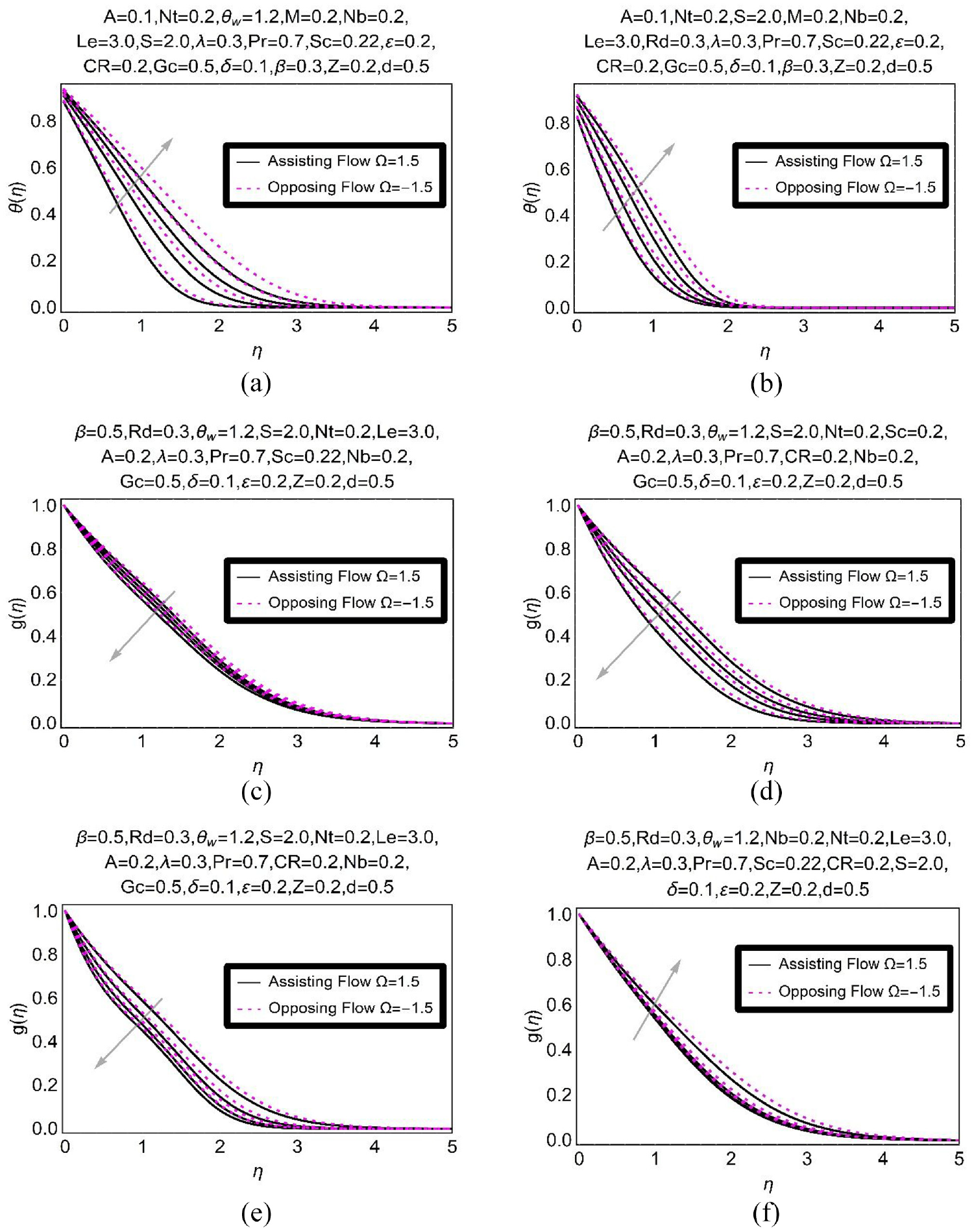
Figure 7(a) to (c) show how the unsteadiness parameter () affects velocity , temperature , and concentration profiles along a vertically extended plate for both assisting and opposing flow. As the parameter () grows, the concentration, temperature, and velocity profiles broaden. The parameter measures fluid flow instability over the vertically stretched Riga plate. A rise with unsteadiness, suggesting faster temporal fluctuations in flow conditions. As flow instability grows, velocity, temperature, and concentration distributions fluctuate. These fluctuations result in a more extensive mixing and dispersion of fluid particles, resulting in increased velocity, temperature, and concentration patterns. The increased unsteadiness improves the velocity profile, making motion more fluid. The temperature profile increases due to rapid changes in flow conditions, leading to enhanced thermal energy mixing. Improved mixing uniformly distributes solute particles, raising the fluid’s concentration profile.
(a)–(c) Impact of on , and .
Figure 8(a) and (b) shows where variations in the thermophoresis parameter correlate with temperature and concentration profiles for both assisting and opposing flow. Physical reasoning leads to temperature and concentration profiles rising with increasing parameter () values. The parameter () measures the intensity of thermophoresis, which is the motion of particles in a fluid caused by temperature differences. A rise in signifies an elevated inclination towards thermophoretic effects. When the fluid moves over the vertically stretched Riga plate, temperature differences occur in the fluid because the plate heats up. The temperature gradients induce thermophoretic mobility in the suspended particles, causing them to move from areas of lower temperature to areas of higher temperature. The thermophoretic effect becomes increasingly noticeable as increases. Particles are more concentrated in areas of greater temperature because this causes them to move more rapidly towards those areas. Therefore, when grows, so does the concentration profile.
(a) and (b) Impact of on and , (c) impact of on , (d) and (e) impact of on and .
Figure 8(c) shows the dimensionless Smoluchowski thermal slip parameter reaction towards temperature profile. The temperature profile lowers as the parameter () increases, based on physical reasons. The parameter () quantifies the relationship between the thermal slip length and the characteristic length scale of the flow. A greater value of signifies a greater thermal slip length in comparison to the characteristic length scale. A rise in indicates a reduction in the thickness of the thermal boundary layer next to the surface of the stretched Riga plate. This phenomenon arises due to the presence of a greater thermal slip length, which facilitates more effective heat transfer over the boundary layer, hence diminishing the temperature difference in close proximity to the surface.
Figure 8(d) and (e) illustrates the impact of changes in the Brownian motion parameter on the profiles of temperature and concentration for both assisting and opposing flow. The temperature profile rises as the parameter () grows, whereas the concentration profile falls owing to physical reasons. measures the amplitude of Brownian motion in a fluid, which is the random motion of particles spread in the fluid owing to fluid molecule interactions. A greater suggests more Brownian motion, which improves fluid mixing and spreading. Enhanced mixing leads to better heat transport within the fluid, resulting in a higher temperature profile. The increased Brownian motion enhances heat diffusion and uniformly disperses solute particles in the fluid. The dispersion causes a decrease in the concentration gradient, which subsequently results in a decline in the concentration profile.
Figure 9(a) measures the effect of thermal radiation on the temperature profile. Physical logic dictates that when the parameter () values rise, so does the temperature profile. The parameter () measures the significance of thermal radiation heat transfer compared to other forms of heat transmission, such as conduction and convection. A rise in signifies a higher proportion of thermal radiation in the total heat transfer mechanism. The stretching and maybe additional heat sources heat the fluid as it runs over the vertically extended Riga plate. Thermal radiation plays a vital role in heat transfer, especially in scenarios with elevated temperatures and significant temperature differences. A higher indicates that thermal radiation plays a greater role in fluid heat transfer. This increased radiative heat transfer results in an increase in the temperature differential within the fluid, resulting to a higher temperature distribution.
(a) Impact of on , (b) impact of on , (c)–(e) impact of on (f) impact of on .
Figure 9(b) illustrates the impact of temperature ratio parameter on temperature profile The temperature profile grows in correlation with the parameter, as dictated by the physical explanation. The parameter measures the ratio of ambient to surface temperature of the expanded Riga plate. A greater suggests a higher surface temperature than the ambient temperature. Heat delivered to a stream running over a hot plate rises proportionately with plate surface temperature. Due to thermal energy growth, plate fluid temperature rises.
Figure 9(c) shows how the chemical reaction parameter () affects the concentration profile The concentration profile decreases as the parameter () rises, based on physical factors. It shows how much chemical reaction is occurring in the fluid. An elevated rate of chemical reactions is denoted by a rise in . When fluid travels across the vertically elongated Riga plate, chemicals may develop or reduce. When the concentration of reactants () is larger, the rate of these chemical reactions increases, leading to a faster consumption or production of species. Figure 9(d) shows how Lewis number () affects concentration. As the parameter value () grows, the concentration profile decreases due to physical explanation. The dimensionless parameter () quantifies a fluid’s thermal-mass diffusivity ratio. Greater means a greater thermal-to-mass diffusivity ratio. When evaluating the non-uniform passage of a fluid over a vertical stretched Riga plate, a rise in () indicates that heat is carried more effectively than species concentration. This implies that heat gradients decay at a faster rate in comparison to concentration gradients within the fluid.
As seen in Figure 9(e), the concentration curve becomes flatter as the Schmidt number parameter increases. The physical logic explains why the concentration profile reduces with increasing parameter (). The () is a dimensionless quantity that quantifies the relationship between the kinematic viscosity and mass diffusivity of a fluid. When the grows, it suggests that the ratio of mass diffusivity to kinematic viscosity is substantially reduced. Species diffusion is outperformed by viscosity effects in the setting of unstable fluid flow over a vertically stretched Riga plate as increases. Thus, momentum diffuses at a faster rate than species concentration diffusion.
Graphs representing the changes in concentration for various values of the modified Grashof number parameter is shown in Figure 9(f). The concentration profile in Figure 9(f) exhibit a positive correlation with the modified Grashof number parameter (which represents the buoyancy ratio caused by concentration). The vertical stretching plate causes the fluid to be stretched and thinned more severely as its buoyancy causes it to accelerate. This stretching enhances the process of solutal diffusion, resulting in an increase in the amplitude of concentration gradients. As a result, the concentration profile show larger values as the increases because of the stronger flow produced by buoyancy.
The graphical data shown in Figures 3 to 9 demonstrate that velocity profiles for different parameters have greater magnitudes for aiding flow as opposed to opposing flow. Conversely, the temperature and concentration profiles exhibit contrasting tendencies.
Figures 10(a) to (c) illustrate how unsteadiness parameter and affect skin friction , Nusselt number , and Sherwood number for both assisting and opposing flow. As the parameter () grows in combination with the stretching parameter, the increases but the profiles of the and drop. This may be explained by physical logic. A greater value for suggests a more unsteady flow, as the flow conditions are changing at a faster rate over time. The fast changes in flow conditions cause variations in velocity gradients close to the plate’s surface, leading to an escalation in skin friction. Variations in flow conditions result in elevated shear stresses at the surface, which in turn causes an escalation in skin friction. In contrast, in Figure 10(b), an increase in flow instability (higher ) results in temperature gradients at the surface of the plate that exhibit fluctuations. The swings in temperature hinder the efficiency of convective heat transfer by causing fast variations in the temperature differential that drive the heat transfer process. As the parameter () increases, the profile drops, indicating a decline in the efficiency of convective heat transmission. Like the , increased values of the parameter () cause oscillations in flow conditions, resulting in changes in concentration gradients near the plate’s surface. The oscillations hinder the efficiency of mass transfer by causing fast changes in the concentration differences that drive mass transfer. As the parameter () increases, the profile in Figure 10(c) drops, indicating a reduction in the efficiency of mass transfer. The effects of mass suction parameter and on skin friction is shown in Figure 10(d). The profile of rise as the parameter () and parameter increase, based on physical rationale. The rate of mass removal from the fluid at the surface is represented by the parameter (). An increasing value suggests a faster mass removal rate, leading to a surface suction effect. Because of this suction effect, fluid velocities are greater close to the surface because more fluid is drawn to it. As a consequence, increases due to increased shear stresses caused by larger velocity gradients.
(a)–(c) Impact of with on , and (d) impact of with on .
Figure 11(a) shows the effect of the Maxwell velocity slip parameter and the stretching parameter on skin friction for assisting and opposing flow. The profile reduces when the parameter () and the parameter increase, based on physical reasons. The fluid’s slip velocity relative to the surface of the stretched Riga plate is represented by the parameter (). The fluid particles close to the surface are moving faster compared to the plate as rises, indicating a larger slip velocity. From a physical standpoint, the heightened slip velocity enables fluid particles to flow with more freedom over the surface, resulting in a decrease in resistance to motion and, therefore, a reduction in shear stress at the surface. The reduction in the skin friction profile is a result of the lower shear stress, which occurs when the parameter () increases along with the stretching parameter. Figure 11(b) illustrates how the Nusselt number is influenced by the Smoluchowski slip parameter and the stretching parameter . The profile reduces when the parameter () increases, along with the , owing to physical logic. As the value of grows, it signifies a greater disparity in temperature slip length compared to the characteristic length scale. The greater slip length at higher temperatures results in reduced efficiency of thermal energy transmission inside the boundary layer. Consequently, the temperature difference at the surface is decreased, resulting in a drop in the rate at which heat is transferred by convection, and hence a fall in the .
(a) Impact of with on (b) impact of with on (c) impact of with on , and (d) impact of with on .
The effect of and on skin friction is shown in Figure 11(c). The physical explanation explains why the profile in Figure 11(c) rise with rising and parameter values. The Casson parameter quantifies the fluid’s yield stress. As the Casson parameter rises, the yield stress of the fluid proportionally increases, indicating an enhanced resistance to flow. When a fluid passes over a Riga plate that is being stretched, the flow encounters more resistance, leading to an elevated shear stress on the surface of the plate. As a result, the in Figure 11(c), which is directly linked to the shear stress at the surface, rises as the Casson parameter increases.
The effects of modified Hartmann number parameter and on skin friction is shown in Figures 11(d). The profile of rise when the parameter () and the parameter increase, owing to physical reasons. Impact of on : The parameter () quantifies the intensity of the magnetic field influencing the fluid flow caused by the Riga plate. As the value of grows, it signifies a more powerful magnetic field. This magnetic field generates Lorentz forces that work to inhibit fluid movement that is perpendicular to the direction of the magnetic field. The inhibition of fluid movement decreases the differences in speed close to the surface, leading to decreased forces that cause deformation, and hence, reduced resistance to motion.
Figures 12(a) and (b) illustrate the influence of the Brownian motion parameter and on the Nusselt number and Sherwood number . As the parameter () and the parameter are increased, the falls and the profile rises, as a result of physical reasoning. Impact of on : As the values of grow, the strength of Brownian motion also increases. As a result, the fluid particles are mixed more effectively, leading to an increase in the fluid’s effective thermal conductivity. As a consequence, the rate at which heat is transferred by convection reduces, leading to a fall in the . Impact of on : On the other hand, when the value of increases, the heightened Brownian motion intensifies the dispersion of species in the fluid. This leads to enhanced mass transfer in close proximity to the surface, resulting in an increased mass transfer coefficient and, therefore, a larger .
(a) and (b) Impact of with on and (c) and (d) impact of with on and .
Figure 12(c) and (d) illustrate the influence of the thermophoresis parameter and on the Nusselt number and Sherwood number . According to the physical logic, the and profiles decrease as the parameter () and the parameter increase. Impact of on : The strength of thermophoresis rises as the values of grow. This results in the movement of suspended particles towards areas with smaller temperature gradients, away from the heated surface. Consequently, the presence of particles at the surface causes a drop in their concentration, resulting in a reduction in the fluid’s effective thermal conductivity. This, in turn, leads to a fall in the convective heat transfer coefficient. As a result, the drops. Impact of on : With an increase in thermophoresis strength as a function of , suspended particles respond to temperature gradients by migrating away from the surface, just as the Nusselt number predicts. Mass transfer rates are hampered as a result of a less concentration gradient close to the surface. As a consequence, the drops as the mass transfer coefficient drops.
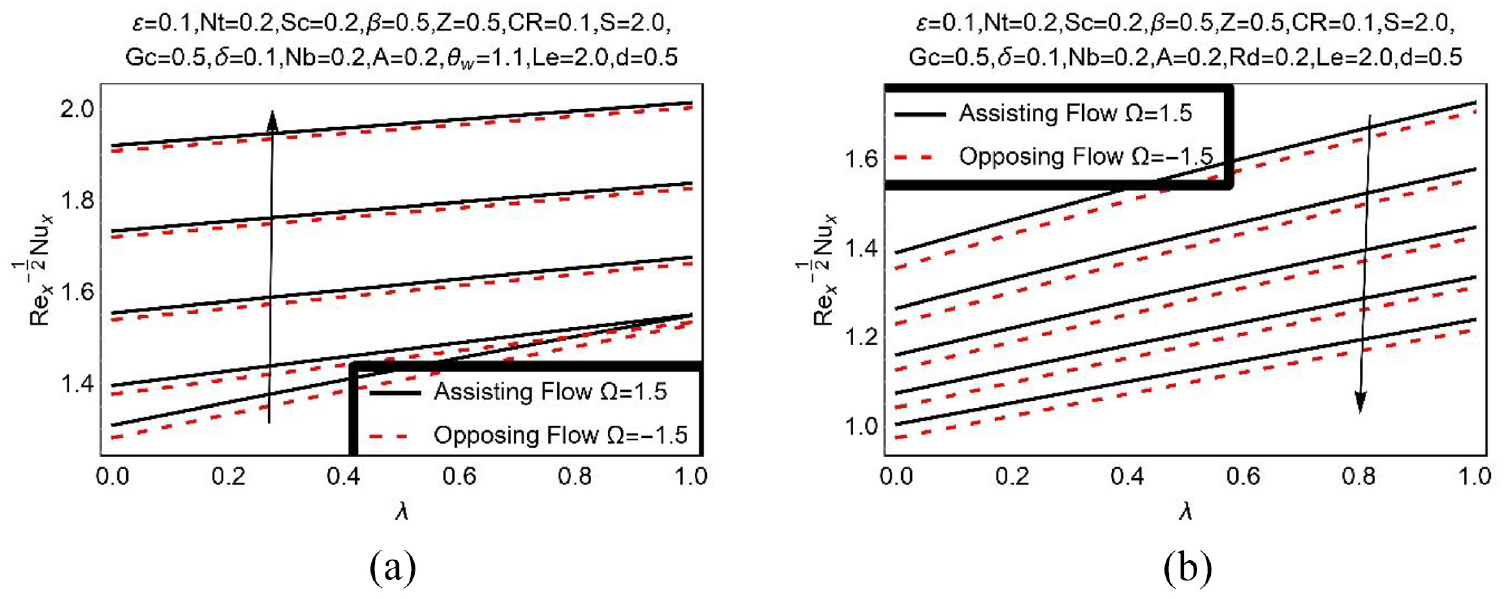
Figure 13(a) and (b) illustrate the influence of the thermal radiation parameter and towards on the Nusselt number . The profile falls when the parameter () and parameter increase, in addition to the parameter, owing to physical reasons. The superiority of thermal radiation over convective heat transfer grows as the values of and increase. This is because higher values of imply more powerful thermal radiation effects, whereas higher values of lead to greater temperature disparities between the wall and the surrounding fluid. The outcome is a lower due to a lower convective heat transfer coefficient in comparison to the higher thermal radiation contribution. The impact is made worse by the higher temperatures at the wall, which intensify the radiation heat transfer from the wall to the fluid around it, caused by greater .
(a) and (b) Impact of and on .
Figure 14(a) to (c) illustrate the influence of the chemical reaction parameter Lewis number parameter and Schmidt number parameter towards on the Sherwood number . The profile has a positive correlation with the parameter () and the parameter, as supported by physical explanation. The surface chemical reaction rate is proportional to the degree of . Since more reaction products are generated or reactants are depleted close to the surface, concentration gradients in the fluid around the surface are amplified. Consequently, the concentration gradient in close proximity to the surface becomes more pronounced, resulting in higher rates of mass transfer. As a consequence, the rate at which mass is transferred rises, leading to a greater value of the as shown in Figure 14(a). Impact of on the Sherwood number profile has a positive correlation with the parameter () when combined with the stretching parameter, as supported by physical explanation. When considering a stretched Riga plate, larger values show that mass diffusion is more efficient than heat transmission. As a result, mass transmission is most rapid close to the plate’s surface. Consequently, the rate at which mass is transferred rises, resulting in a greater in Figure 14(b). The physical rationale also dictates that, when and the parameter grow, the profile does the same. Within the framework of a stretched Riga plate, greater values suggest a slower diffusion of momentum in comparison to mass transfer. As a result, there is an increased rate of mass transfer in close proximity to the surface of the plate. Consequently, the rate at which mass is transferred rises, resulting in an elevated .
(a)–(c) Impact of and on .
The graphical findings shown in Figures 10 to 14 illustrate that the profiles of skin friction, Nusselt number, and Sherwood number for different parameters exhibit larger values for aiding flow in comparison to opposing flow. This is because the alignment of the external force with the flow direction enhances momentum, heat, and mass transfer.
Conclusion
The study focused on the time-dependent flow of an incompressible Casson fluid over a vertical Riga sheet in the stagnation area. The flow was characterized by Maxwell velocity and Smoluchowski slip conditions, and also took into account nonlinear thermal radiation. The many components of the Buongiorno’s model were explored. The system of ordinary differential equations without dimensions was solved using a numerical method. The primary accomplishments were as follows:
The velocity profile is greater in the case of aiding flow, whereas the temperature and concentration profiles are greater in the case of opposing flow.
Velocity profiles are improved with higher values of the parameters Casson, unsteadiness, mass suction, modified Hartmann number and Maxwell velocity slip for both assisting and opposing flow.
Casson, and temperature slip factors slow down the temperature field, augmentation of unsteadiness, thermal radiation, temperature ratio, Brownian motion, and thermophoresis all raise the temperature for both assisting and opposing flow.
The concentration profile shows a decrease with the parameters and , whereas the parameters and have the opposite effect for both assisting and opposing flow.
As the values of grow, skin friction also increases, but it decreases for .
The heat transfer rises for the variable , whereas it decreases for the variables , and for both assisting and opposing flow.
Mass transfer is enhanced for the variables and , whereas it is diminished for the variables and .
In the case of nonlinear thermal radiation, the Nusselt number rises by 19.50% when the mass suction increases from 2 to 2.5 for assisting flow whereas for opposing flow rises by 19.02%.
The Nusselt number for nonlinear thermal radiation scenario is around 2.290% lower at than at for assisting flow and for opposing flow it lowers by 2.01%.
The Sherwood number shows an estimated rise of 100.98% when the Lewis number (Le) is increased from 2.0 to 5 for assisting flow and for opposing flow it increased by 98.15%.
Compared to , the Sherwood number rises by almost 13.927% at for assisting flow and for opposing flow rises by 11.95%.
Future Direction: Expand the study to explore Casson fluid flow over complex geometries other than the vertical Riga plate, such as inclined plates or curved surfaces, to better comprehend actual flow scenarios.
Footnotes
Handling editor: Sharmili Pandian
Declaration of conflicting interests
The author(s) declared no potential conflicts of interest with respect to the research, authorship, and/or publication of this article.
Funding
The author(s) disclosed receipt of the following financial support for the research, authorship, and/or publication of this article: Researchers Supporting Project number (RSPD2024R576), King Saud University, Riyadh, Saudi Arabia.
ORCID iDs
Zafar Mahmood
Khadija Rafique
Umar Khan
References
1.
HiemenzK.Die Grenzschicht an einem in den gleichformigen Flussigkeitsstrom eingetauchten geraden Kreiszylinder. Dinglers Polytech J1911; 326: 321–324, 344–348, 357–362, 372–376, 391–393, 407–410.
2.
DashGCTripathyRSRashidiMM, et al. Numerical approach to boundary layer stagnation-point flow past a stretching/shrinking sheet. J Mol Liq2016; 221: 860–866.
3.
AbbasiAFarooqWMaboodF, et al. Rotational stagnation point non-Newtonian second-grade fluid flowing over spiraling disk. Sci Iran. Epub ahead of print 2024.
4.
IslamAMahmoodZKhanU, et al. Triple-diffusive free convection enhancement at the stagnation point on moving sheet under the influence of Hall effect and mass flux. Adv Mech Eng2024; 16: 1–14.
5.
KhanUZaibABakarSA, et al. Stagnation-point flow of a hybrid nanoliquid over a non-isothermal stretching/shrinking sheet with characteristics of inertial and microstructure. Case Stud Therm Eng2021; 26: 101150.
6.
OmarMRameshGKAbbasU, et al. Viscoelastic nanofluids flow through Darcy–Forchheimer porous media with Newtonian conditions. Proc Inst Mech Eng Part N J Nanomater Nanoeng Nanosyst. Epub ahead of print 2024. DOI: 10.1177/23977914241248550.
7.
MalikMYHussainANadeemS.Flow of a non-Newtonian nanofluid between coaxial cylinders with variable viscosity. Zeitschrift für Naturforsch A2012; 67: 255–261.
8.
AliBLiuSLiuHJ, et al. Magnetohydrodynamics tangent hyperbolic nanofluid flow across a vertical stretching surface using Levengberg-Marquardt back propagation artificial neural networks. Numer Heat Transf Part A Appl. Epub ahead of print 2024.
9.
MegahedAM.Variable viscosity and slip velocity effects on the flow and heat transfer of a power-law fluid over a non-linearly stretching surface with heat flux and thermal radiation. Rheol Acta2012; 51: 841–847.
10.
ShafiqAÇolakABSindhuTN.Analyzing activation energy and binary chemical reaction effects with artificial intelligence approach in axisymmetric flow of third grade nanofluid subject to Soret and Dufour effects. Heat Transf Res2023; 54: 1–23.
11.
NadeemSHaqRUAkbarNS, et al. MHD three-dimensional Casson fluid flow past a porous linearly stretching sheet. Alexandria Eng J2013; 52: 577–582.
12.
BhattacharyyaKHayatTAlsaediA.Analytic solution for magnetohydrodynamic boundary layer flow of Casson fluid over a stretching/shrinking sheet with wall mass transfer. Chinese Phys B2013; 22: 24702.
13.
MegahedAM.Effect of slip velocity on Casson thin film flow and heat transfer due to unsteady stretching sheet in presence of variable heat flux and viscous dissipation. Appl Math Mech2015; 36: 1273–1284.
14.
MalikMYKhanMSalahuddinT, et al. Variable viscosity and MHD flow in Casson fluid with Cattaneo–Christov heat flux model: using Keller box method. Eng Sci Technol Int J2016; 19: 1985–1992.
15.
AliBLiuSJubairS, et al. Exploring the impact of Hall and Ion slip effects on mixed convective flow of Casson fluid model: a stochastic investigation through non-Fourier double diffusion theories using ANNs techniques. Therm Sci Eng Prog2023; 46: 102237.
16.
ShehzadSAFaridR.Comparative analysis of Oldroyd-b and Casson nanofluids flowing through chemically reactive radiative porous medium. Adv Mech Eng2024; 16: 1–12.
17.
MadhukeshJKRameshGKShehzadSA, et al. Thermal transport of MHD Casson–Maxwell nanofluid between two porous disks with Cattaneo–Christov theory. Numer Heat Transf Part A Appl2024; 85: 2008–2023.
18.
RameshGKChamkhaAJGireeshaBJ.MHD mixed convection flow of a viscoelastic fluid over an inclined surface with a nonuniform heat source/sink. Can J Phys2013; 91: 1074–1080.
19.
AliBJubairSMahmoodZ, et al. Electrically conducting mixed convective nanofluid flow past a nonlinearly slender Riga plate subjected to viscous dissipation and activation energy. Mod Phys Lett B. Epub ahead of print 2024. DOI: 10.1142/S0217984924503366.
20.
BouslimiJAbdelhafezMAAbd-AllaAM, et al. MHD mixed convection nanofluid flow over convectively heated nonlinear due to an extending surface with Soret effect. Complexity2021; 2021: 1–20.
21.
QayyumSHayatTShehzadSA, et al. Mixed convection and heat generation/absorption aspects in MHD flow of tangent-hyperbolic nanoliquid with Newtonian heat/mass transfer. Radiat Phys Chem2018; 144: 396–404.
22.
HatamiMZhouJGengJ, et al. Optimization of a lid-driven T-shaped porous cavity to improve the nanofluids mixed convection heat transfer. J Mol Liq2017; 231: 620–631.
23.
JamesaharESabourMShahabadiM, et al. Mixed convection heat transfer by nanofluids in a cavity with two oscillating flexible fins: a fluid–structure interaction approach. Appl Math Model2020; 82: 72–90.
24.
BuongiornoJ.Convective transport in nanofluids. J Heat Transfer2006; 128: 240–250.
25.
AliBMishraNKRafiqueK, et al. Mixed convective flow of hybrid nanofluid over a heated stretching disk with zero-mass flux using the modified Buongiorno model. Alexandria Eng J2023; 72: 83–96.
26.
RanaPShuklaNBégOA, et al. Lie group analysis of nanofluid slip flow with Stefan Blowing effect via modified Buongiorno’s model: entropy generation analysis. Differ Equations Dyn Syst2021; 29: 193–210.
27.
AliBHussainSShafiqueM, et al. Analyzing the interaction of hybrid base liquid C2H6O2–H2O with hybrid nano-material Ag–MoS2 for unsteady rotational flow referred to an elongated surface using modified Buongiorno’s model: FEM simulation. Math Comput Simul2021; 190: 57–74.
28.
AnwarMITanveerNSallehMZ, et al. Diffusive effects on hydrodynamic Casson nanofluid boundary layer flow over a stretching surface. Journal of Physics: Conference Series2017; 890: 12047.
29.
AfifyAA.The influence of slip boundary condition on Casson nanofluid flow over a stretching sheet in the presence of viscous dissipation and chemical reaction. Math Probl Eng ; 2017; 1: 1–12.
30.
SouayehBReddyMGSreenivasuluP, et al. Comparative analysis on non-linear radiative heat transfer on MHD Casson nanofluid past a thin needle. J Mol Liq2019; 284: 163–174.
31.
RashidiSEsfahaniJAEllahiR.Convective heat transfer and particle motion in an obstructed duct with two side by side obstacles by means of DPM model. Appl Sci2017; 7: 431.
32.
BhattiMMZeeshanAEllahiR.Electromagnetohydrodynamic (EMHD) peristaltic flow of solid particles in a third-grade fluid with heat transfer. Mech Ind2017; 18: 314.
33.
EllahiRZeeshanAHussainF, et al. Study of shiny film coating on multi-fluid flows of a rotating disk suspended with nano-sized silver and gold particles: a comparative analysis. Coatings2018; 8: 422.
34.
OtmanHAMahmoodZKhanU, et al. Mathematical analysis of mixed convective stagnation point flow over extendable porous Riga plate with aggregation and joule heating effects. Heliyon2023; 9: 1–28.
35.
AbbasNNadeemSMalikMY.Theoretical study of micropolar hybrid nanofluid over Riga channel with slip conditions. Phys A Stat Mech Appl2020; 551: 124083.
36.
AliBJubairSFoulyA.Heat and mass transmission through the nanofluids flow subject to exponential heat source/sink and thermal convective condition across Riga plates. Chem Eng Res Des2024; 207: 458–465.
37.
MahmoodZRafiqueKKhanU, et al. Investigation of entropy generation in the existence of heat generation and nanoparticle clustering on porous Riga plate during nanofluid flow. Mater Today Commun2024; 38: 108165.
38.
KhanUMahmoodZEldinSM, et al. Mathematical analysis of heat and mass transfer on unsteady stagnation point flow of Riga plate with binary chemical reaction and thermal radiation effects. Heliyon2023; 9: e14472.
39.
KhanURafiqueKMahmoodZ.Significance of unsteady rotating flow of nanofluid with nanoparticles aggregation and impacts of slip conditions and variable viscosity. Numer Heat Transf Part A Appl2023; 1: 1–28.
40.
Khashi’ieNSArifinNMPopI, et al. Three-dimensional hybrid nanofluid flow and heat transfer past a permeable stretching/shrinking sheet with velocity slip and convective condition. Chinese J Phys2020; 66: 157–171.
41.
MahmoodZEldinSMRafiqueK, et al. Numerical analysis of MHD tri-hybrid nanofluid over a nonlinear stretching/shrinking sheet with heat generation/absorption and slip conditions. Alexandria Eng J2023; 76: 799–819.
42.
ShatnawiTAMAbbasNShatanawiW.Mathematical analysis of unsteady stagnation point flow of radiative Casson hybrid nanofluid flow over a vertical Riga sheet. Mathematics2022; 10: 3573.
43.
MahmoodZur RehmanMKhanU, et al. Enhanced transport phenomena in Casson fluid flow over radiative moving surface: influence of velocity and thermal slip conditions with mixed convection and chemical reaction. Mod Phys Lett B. Epub ahead of print 2024.
44.
GowdaRJPMallikarjunaHBPrasannakumaraBC, et al. Dynamics of thermal Marangoni stagnation point flow in dusty Casson nanofluid. Int J Model Simul2022; 42: 707–715.