



Abstract
Two-layer calendering using non-Newtonian fluids is used frequently in different industries to improve the working and the quality of the products. In this article, two-layer calendering of incompressible non-Newtonian fluids, that is, couple stress fluid and viscoplastic fluid in the upper and lower layer respectively is investigated. For the simplified governing equations, Lubrication approximation theory is applied. By the use of no-slip condition and non-dimensional variables, the exact solution for pressure gradient, pressure, and velocity profiles for both layers of fluid is calculated. The parameters are important from an engineering point of view like roll separating force, power delivered by rollers, torque acting by each roller, and adiabatic temperature are also calculated analytically. Additionally, the results of a couple stress parameter, viscoplastic Casson parameter, and viscosity ratios on all the parameters are also discussed and investigated in detail. Moreover, all the effects investigated are also verified with the literature results of single-layer calendering of non-Newtonian fluids by using large numeric values for the couple stress parameter and viscoplastic Casson parameter.
Keywords
Introduction
Calendering is a process of making sheets of different thicknesses on an industrial scale by inserting a flowing material between two or more co-rotating calenders. Nowadays, this process is applied commonly in industries for making paper, leather, textile fabric, plastics, and polyvinyl sheets. Moreover, calendering is also used in foodstuff industries for making shapes of pasta, biscuits and breads, etc. In calendering, rolling calenders work to solidify and compress the induced material into desired thickness which can be uni-layered or multi-layered. The advantage of calendering is that the calendered material is obtained with the demanded surface texture, thickness, and finishing. So, the calendering process is of great importance and a matter of study for researchers due to its advantages.
Osswald and Menges 1 overviewed in their book that Edwin M. Chaffee who worked in the rubber industry and Charles Goodyear were the first engineers who used calendering process for making a rubber sheet in 1836. First of all, Gaskell 2 inspected that the roller’s width is much less than the roller’s radius. He applied this assumption to Newtonian and Bingham plastic fluid models. Many researchers worked on Gaskell’s model for different fluids and non-isothermal effects. Power law fluids in calendering were deeply studied by McKelvey 3 and Brazinsky et al. 4 Middleman 5 collected all the work done on calendering till 1977 in his book. Polymer processing was discussed theoretically by Tadmor and Gogos 6 in their book. The calendering process using slip boundary conditions was discussed by Sofou and Mitsoulis. 7 Moreover, the numerical study of the calendering process for viscoelastic fluid was also studied by Mitsoulis and Sofou. 8 The effect of temperature on different parameters involved in the calendering process was discussed by Arcos et al. 9 Arcos et al. 10 further discussed the Newtonian fluid having viscosity dependent on temperature in the calendering process. Different non-Newtonian fluids in the calendering process were discussed by Ali et al., 11 Sajid et al.,12,13 and Javed et al. 14 For the viscous fluid model, the numerical solution for energy and the effect of temperature in calendering was studied by Abbas and Khaliq. 15 In no-isothermal calendering process, the consequences of heat conduction on third order fluid by applying the finite difference technique were also discussed by Khaliq and Abbas. 16 In non-isothermal calendering, the numerical study of exiting sheet thickness using micropolar Cason fluid was studied Abbas and Khaliq. 17 They discussed the effect of Cason and coupling number on different parameters involved using lubrication approximation theory.
Different types of fluid both Newtonian and non-Newtonian have been used in the calendering process by researchers till now. Non-Newtonian fluids have great importance as compared to Newtonian fluids due to their practical applications in industries. Couple stress fluid and viscoplastic Casson fluid are important non-Newtonian fluids. Casson fluid is a shear-thinning fluid that has a yield stress limit under which flow does not occur. Some real life examples of Casson fluid are human blood, soup, tomato sauces, honey, jellies, etc. The flow of Casson fluid in the calendering process was discussed by Eldabe et al. 18 Casson fluid flow for the oscillatory and steady blood flow was discussed by Boyd et al. 19 The model of Casson fluid is considered more appropriate to fit rheological data as compared to other viscoplastic fluid models.20,21 The slip flow on MHD Casson fluid was discussed by Prasad et al. 22 They discussed the impact of magnetic field on different properties of the fluid. In the roll coating process, the micropolar Casson fluid and the effect of viscoplastic parameter on different variables were discussed by Abbas and Khaliq. 23 Moreover, they 17 extended their work for non-isothermal calendering of micropolar Casson fluid and discussed the effect of micro rotation and viscoplastic parameter on various quantities of interest. Couple stress fluid is a unique kind of non-Newtonian fluid that is used to explain the behavior of different suspension fluids, lubricants and blood, etc. The initial work on a couple stress fluid was done by Stokes and Stokes. 24 He discussed that the couple stress fluid has a couple stresses and body couples. Moreover, it has a large viscosity in general. Stokes stated that a couple stresses effects were significant in liquids with large molecules. The existence of couple stresses causes a decrease in the velocity and other parameters of interest which was discussed by Devakar et al., 25 Ahmad et al., 26 and Jangili et al. 27 The hydromagnetic effect on the two-layer flow of couple stress and viscous fluids in an inclined channel was discussed by Abbas et al. 28 They discussed the MHD and heat transfer effect on velocity and other parameters of interest. Ali et al. 29 investigated the nonisothermal calendering using couple stress fluid. They discussed the effect of a couple stress parameter on velocity, pressure, and other variables. Zafar et al. 30 discussed the roll coating process by using a couple stress fluid. Bitla and Sitotaw 31 discussed the effect of slip and magnetohydrodynamics on the flow of two immiscible fluids, that is, Jeffry fluid and Couple stress fluid in a porous channel.
The multi-layer flow of Newtonian and non-Newtonian fluids using different geometries is of great importance for researchers due to their applications. Multi-layer flow has great importance in process industry and nuclear industry. Specifically, two-layer calendering finds its application in polymer processing, the textile industry, the paper and packaging industry, the medical industry, the food industry, and for making of thin film transistors. It helps to produce high-quality fabrics, paper with smooth finishing, and multi-layer coatings for the packaging of food which can have many properties like waterproof, incombustible and free of moisture, etc. In two-layer calendering, separate extruders are used to extrude different types of fluid into a single sheet which is then used to produce a multi-layer sheet of homogeneous thickness. Then this sheet is inserted among two rotating rollers to produce a sheet of homogeneous thickness. Different studies have been made for two-layer flow in different channels. Hannachi and Mitsoulis 32 were the first researchers who discussed multi-layer flow in the calendering process using LAT. They discussed the different numeric consequences by using various assumptions and arrangements of fluids. The multi-layer calendering process using metal strips for Newtonian and power law models was further discussed by Calcagno et al. 33 Ilyas et al.34,35 discussed the two-layer isothermal calendering using Newtonian and non-Newtonian fluids with different viscosities. The effect of different viscosity ratios of different fluids on different operating parameters was discussed in detail and mathematical expressions were computed analytically.
Despite of these few above-mentioned results, no research is made in two-layered calendering using non-Newtonian fluids. The main aim of this article is to extend the study of the multi-layer calendering process using non-Newtonian fluids, that is, couple stress fluid and viscoplastic Casson fluid in the first and second layers respectively having different viscosities. LAT is applied for simplification and the effects of viscosity ratios, viscoplastic fluid parameter, and couple stress fluid parameter are investigated on different operating variables of engineering importance like pressure gradient, maximum pressure, roll separating force, power input, the torque acting on both rollers and adiabatic temperature, etc.
Governing equations
The fluid flow occurs at extremely low Reynolds numbers in the calendering process. Due to this creeping flow approximation is applied and inertial forces are neglected as compared to viscous forces. The flow is considered as steady. By ignoring body forces and temperature effect, the governing equations for the incompressible fluid with the above assumptions are given by Ilyas et al.34,35 as


where


where
Problem formulation
Suppose a steady, laminar, incompressible, immiscible, and viscous flow of two isothermal non-Newtonian fluids having distinct viscosities moves among two identical rolling cylinders with the same radius to make a multi-layer sheet of uniform thickness (see Figure 1).

Representation of two-layer flow of non-Newtonian fluids in the nip region between the two rolling calenders.
The linear velocity

According to the above suppositions, equations (1) and (2) transformed as follow



where
The creation of pressure and chain orientation in the gap between the rollers has a significant effect on polymer processing and the calendering process. The space between the rollers is known as the nip region. In the nip region and by going to any side of this with a very small distance

By using equation (9), equations (6)–(8) become


So the momentum equations for both fluids take the form


where the boundary conditions involved in this model are given as

It is clear from the first boundary condition that due to no slip condition at the interface, both fluids are moving with same velocity while due to no slip condition at the surface of rollers, both fluids at the boundary move with the same velocity as that of rollers, that is,
By applying integration on equations (12) and (13) and boundary conditions from equation (14), velocity profiles for both layers become

and
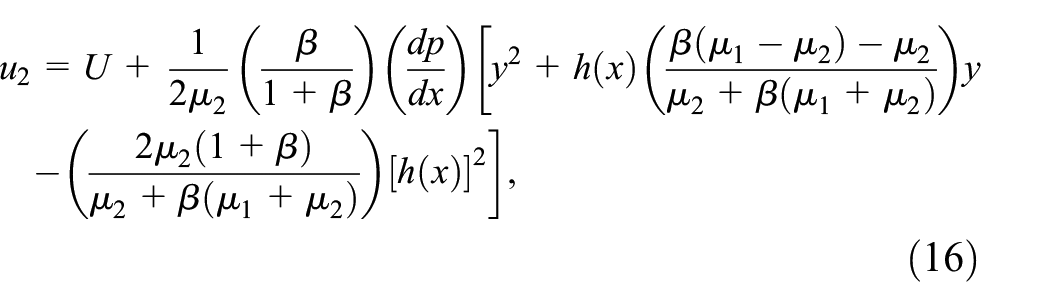
where
For the sake of simplification, the flow is considered to be limited as

Dimensionless variables
Now defining the non-dimensional variables as

Equations (15) and (16) and boundary conditions in dimensionless form by ignoring (’) sign become


and
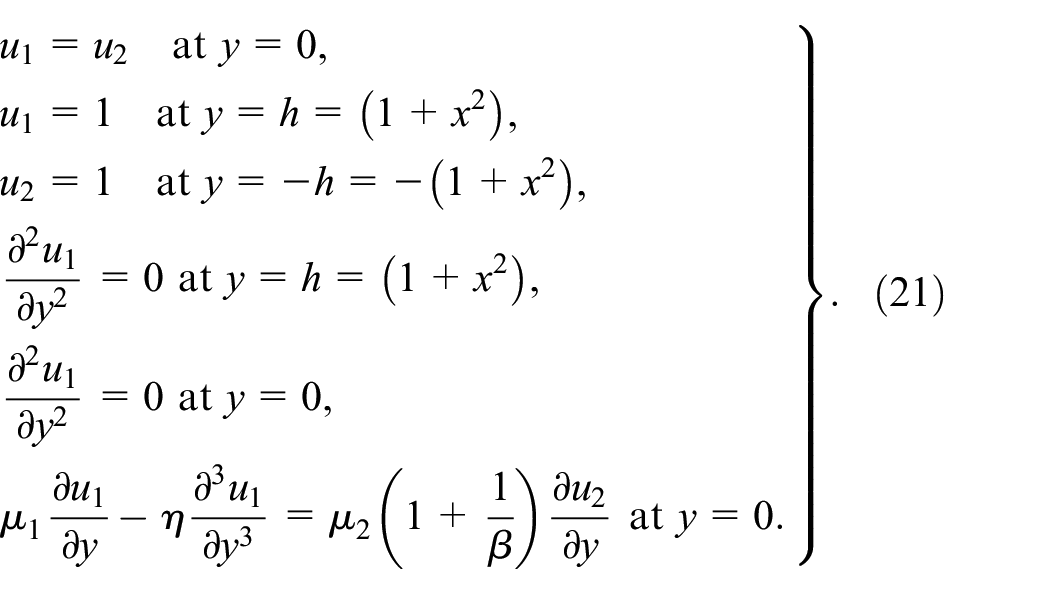
The flow rate

To get the total flow rate, the flow rate for both layers is added. The final expression becomes

Suppose that at the thickness

The dimensionless form of the distance

By putting this value, equation (24) takes the form as

By substituting equations (26) into (23), the expression for pressure gradient becomes

where C is a constant defined as

The non-dimensional forms of the pressure gradient for both layers become

and

Equations (29) and (30) show that the pressure gradient is zero for both the fluid layers at

and

Equations (29) and (30) are integrated and by using the conditions

and

The maximum pressure at

and

The limiting values of both pressures at

and

The

By using the above assumption, equations (37) and (38) give

It is clear that the above expression is non-linear in

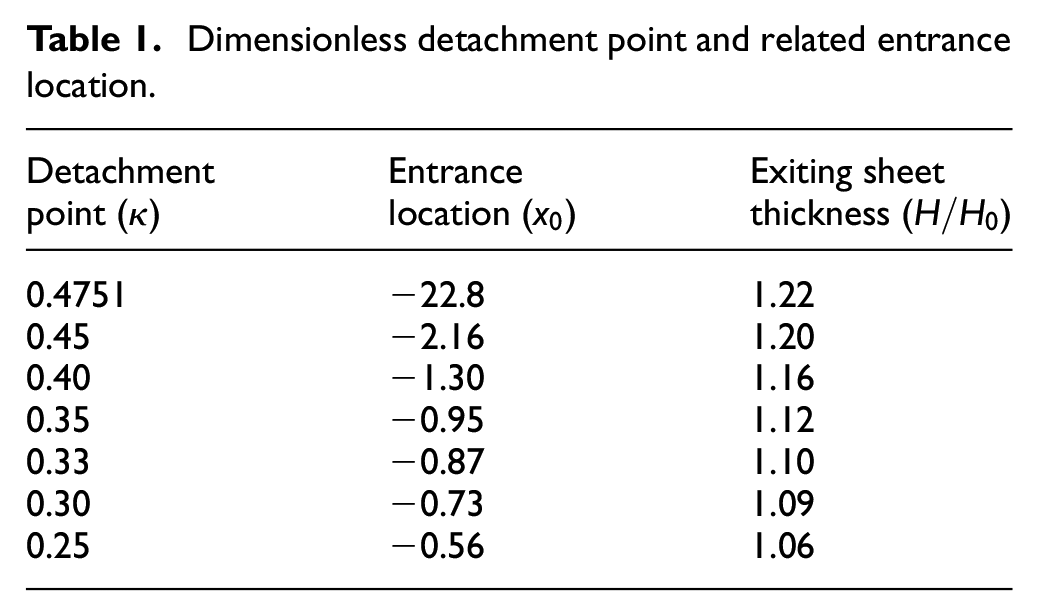
At the entering point
Dimensionless detachment point and related entrance location.
Operating variables
All the important parameters of interest, that is, roll separating force, power input, torque at the upper and lower roller, and adiabatic temperature can be obtained from the expressions of velocities, pressure, and pressure gradient. A numerical Simpson 3/8 method is employed to obtain the following quantities.
Roll-separating force
The expression for roll separating force is obtained by

where W represents the width of the roller.
By solving equations (32) and (33) in dimensionless form, the expression of force is given as

Power input
Power input for both the fluid layers can be calculated by the following expression

where
The final expression of power becomes

Torque
The torque on the upper and lower roller can be calculated as

and

By using the above expressions, the final torque on both rollers is calculated as

and

Adiabatic temperature
The temperature of both fluids is increased by the power which transmitted by both the rollers. This temperature can be calculated as

where
Results and discussion
In this article, the two-layered calendering is explored when both the layers contain non-Newtonian fluid, that is, viscoplastic and couple stress fluids. For the simplification, lubrication approximation theory is applied. The exact solution for velocity and pressure is evaluated. Some other parameters of engineering importance are also evaluated analytically. The impact of some parameters is shown by graphs and some are given in the form of tables.
Velocity profile
Dimensionless velocity profiles for both layers of non-Newtonian fluid at distinct values of viscosity ratios, viscoplastic parameter
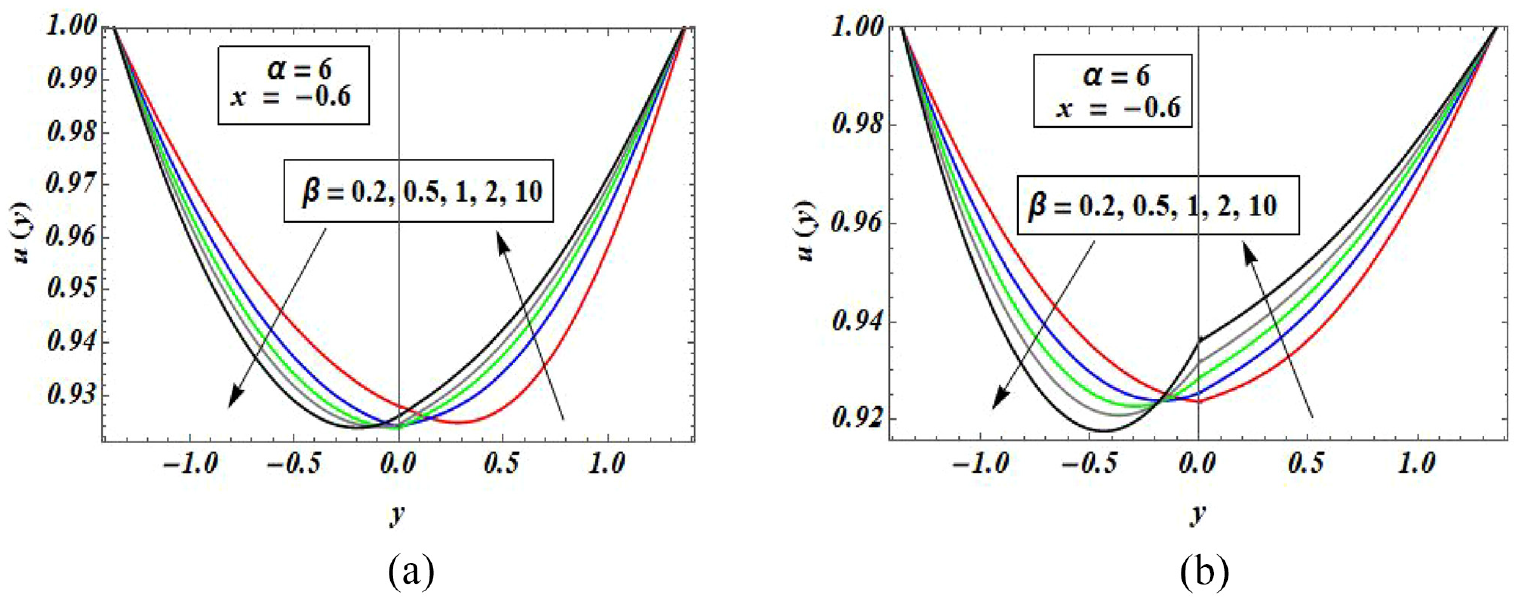
Effect of

Effect of

Effect of

Effect of
Pressure distribution
Figure 6(a) and (b) show the non-dimensional pressure distribution for the couple stress fluid and Figure 7(a) and (b) show viscoplastic fluid depending on non-dimensional axial points

Variation in pressure distribution of couple stress fluid for: (a)
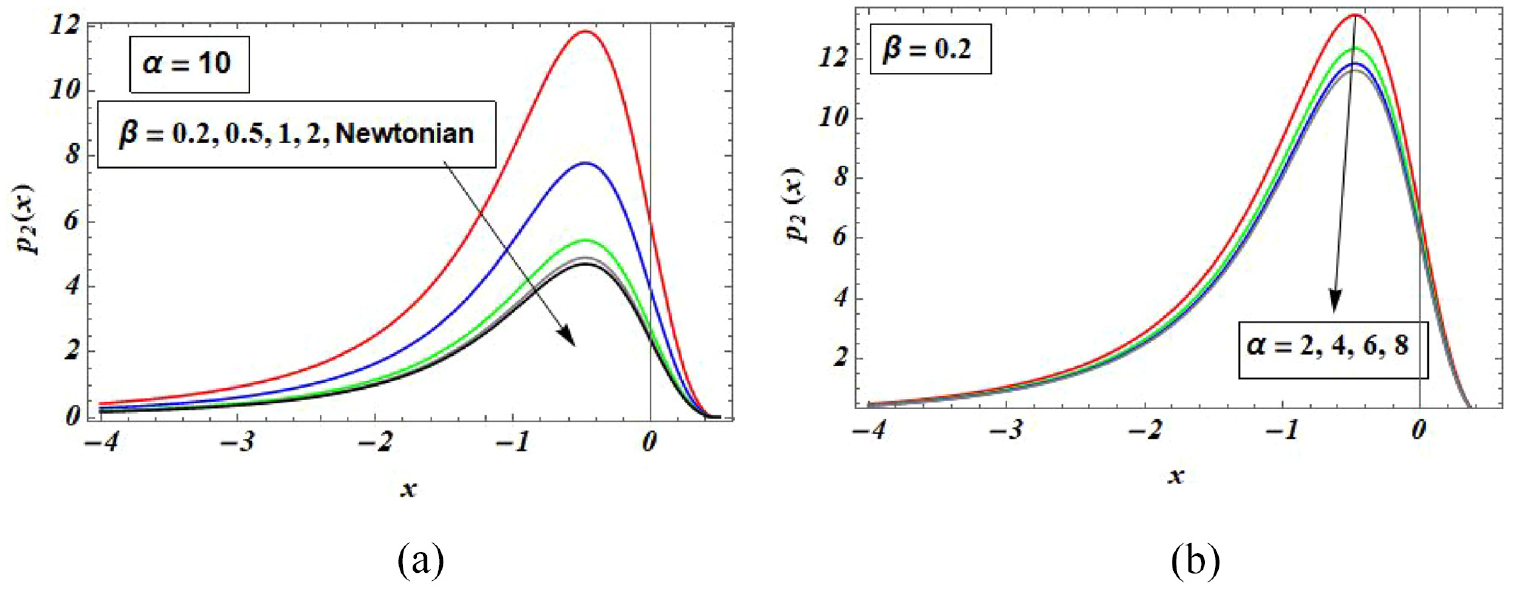
Variation in pressure distribution of viscoplastic fluid at
Roll separating force and power
Figure 8(a) and (b) show the variation in roll separating force and power with the change in viscoplastic Casson parameter and couple stress fluid parameter respectively. Figure 8(a) shows the dimensionless force depending on the viscosity ratios and Figure 8(b) shows the dimensionless power depending on the viscosity ratios. It is noticed from the figures that both increase with the increment in viscosity ratios. Moreover, with the increase in viscoplastic parameter

Effect of couple stress and viscoplastic parameter on: (a) roll-separating force and (b) power delivered by rollers at
Torque and temperature
Figure 9(a) and (b) represent the dimensionless form of torques

Effects of couple stress and viscoplastic parameters on: (a) torque on upper roller and (b) torque on lower roller at

Effects of couple stress and viscoplastic parameters on adiabatic temperature at
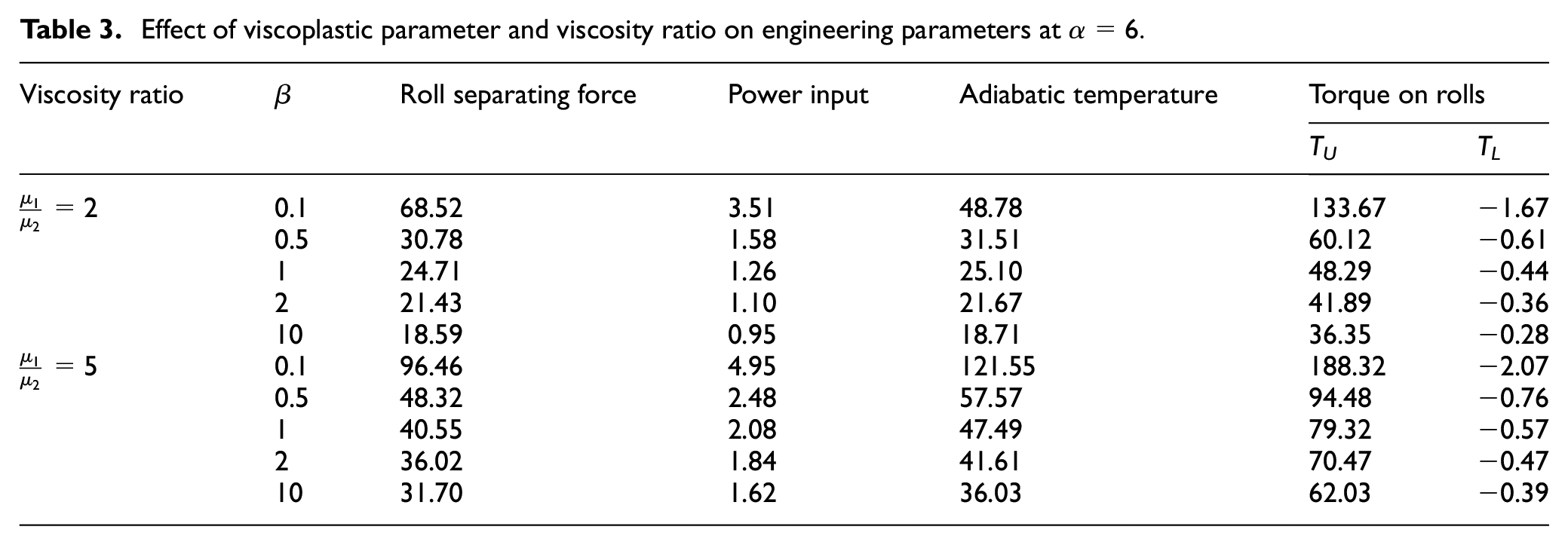
Tables 2 and 3 show the numerical values of different important variables such as roll separating force, power, adiabatic temperature, and torques acting on upper and lower rollers for various values of viscosity ratios, viscoplastic parameter, and couple stress parameter respectively. It is noticed from Table 2 that the value of all the above-mentioned parameters is increased with the increase in viscosity ratio and decreased with the increase in the couple stress parameter. Moreover, it is clear from Table 3 that the effect of the viscoplastic parameter on all the parameters is the same as the effect of a couple stress parameter.
Effect of couple stress parameter and viscosity ratio on engineering parameters at

Effect of viscoplastic parameter and viscosity ratio on engineering parameters at
Conclusions
The problem under consideration deals with the two-layer calendering of incompressible non-Newtonian fluids having different viscosity ratios. The main aim of this study is to discuss the effect of non-Newtonian parameters on flow behavior in detail. The upper layer contains a couple stress fluid while the lower layer contains viscoplastic Casson fluid. Lubrication approximation theory is applied for simplified results. Different results are noticed during the process which are given as follows:
By decreasing the radius of rollers
It is noticed that with the increase in viscosity ratios, the maximum pressure for both fluids decreased.
With the decrease in the speed of the roller, width of the roller
The power input delivered by the rollers decreased with the decrease in speed of the roller and with the increase in the
Power increased with the increase in the width of the roller
The torque acting on both rollers is decreased by decreasing the width of the roller
Adiabatic temperature for both fluid layers based on power, the density of the fluid, flow rate, and heat capacity of the fluid. It is noticed that adiabatic temperature is decreased by decreasing the power delivered by the rollers to the fluid and by increasing all the remaining factors.
It is also noticed that the limit
This research work deals with only theoretical and mathematical formulation of two-layered calendering of non-Newtonian fluids, that is, viscoplastic fluid and couple stress fluid. Experimental verification of the final effects can be done in the future. Additionally, this work can be expanded for non-isothermal cases and other non-Newtonian fluids with slip boundary conditions and so on.
Footnotes
Appendix
Handling Editor: Dr Aarthy Esakkiappan
Declaration of conflicting interests
The author(s) declared no potential conflicts of interest with respect to the research, authorship, and/or publication of this article.
Funding
The author(s) received no financial support for the research, authorship, and/or publication of this article.
