



Abstract
The working temperature is one of the key factors affecting the efficiency and safety performance of automotive power batteries. Current battery pack design primarily focuses on single layout configurations, overlooking the potential impact of mixed arrangements on thermal management performance. This study presents a module-based optimization methodology for comprehensive concept design of Lithium-ion (Li-ion) battery pack. Firstly, the arrangement modules is optimized and performed using particle swarm optimization algorithms considering various arrangement layout (i.e. rectangular, diamond, and staggered arrangements) by taking the intercell spacing and maximum temperature of the modules as design objectives. Secondly, the battery pack configuration design is performed employing a neural network model reflect diverse battery module configurations within the pack, exploring their impact on thermal management performance. The hybrid battery arrangement effectively improves thermal management, and the module spacing helps to enhance heat dissipation. The staggered arrangement has a greater impact on the heat dissipation performance of the battery pack, but the spacing between different modules varies with the position of the modules. When all configuration schemes are staggered modules, the optimal range of the spacing between modules is between 6 and 7 mm. However, the study observes a non-linear relationship between module spacing and the maximum temperature difference within the battery pack. While increasing module spacing initially decreases temperature differences, it eventually reverses, suggesting that spacing alone may not consistently enhance thermal management. Validation with a lithium-ion battery pack case study demonstrates the method’s effectiveness, providing valuable knowledge for future cell and pack designs that employ different battery cell arrangements and diverse cooling strategies.
Keywords
Introduction
As China undertakes a fundamental shift in its energy landscape, characterized by the ambitious 3060 Dual Carbon Policy, the adoption of electric propulsion and electric-hybrid vehicles has emerged as an inexorable trend, driving the advancement of new energy vehicles.1–3 Lithium-ion batteries, renowned for their high-power density, extended lifespan, and minimal self-discharge rates, have become a cornerstone of new energy vehicles. 4 A pivotal factor influencing the efficiency and safety performance of automotive power batteries is the operating temperature. 5 Typically, lithium-ion batteries perform optimally within the temperature range of 20°C–45°C. Given the exigencies of high-power density and extended range in new energy vehicles, battery packs often feature a dense arrangement of cells, generating a large amount of heat during the charge or discharge process. An inadequately designed battery pack can engender disparate cooling effects on individual cells, resulting in significant temperature variations and heightened performance disparities, ultimately undermining the longevity and efficacy of the battery pack. 6 Therefore, it’s necessary to develop a battery thermal management system (BTMS) to prevent overheating of individual cells and non-uniformity of heat distribution within the battery pack.
Motivation
At present, the BTMS cooling methods of battery packs typically employs one of two methods: active cooling or passive cooling. Active cooling encompasses air cooling and liquid cooling, whereas passive cooling integrates phase change cooling and heat pipe cooling.7,8 Among these methods, air cooling is still the highly preferred one due to the simplicity and low cost, parasitic energy loss, simple layout requirement, and superior security. Many researchers have reported their investigations in air cooling strategy from different perspectives, such as air flow rate, channel size, numbers of cooling channel, inlet cooling conditions, battery arrangement, and spacing. 9 Compared to others, battery arrangement and spacing of lithium-ion battery pack are served as the key factors to remove the heat and guarantee a proper battery temperature of an air cooled BTMS. Wang et al. 10 conducted simulations to assess heat dissipation within rectangular arrangements, including 1 × 24, 3 × 8, and 5 × 5 rectangular, 19 cells hexagonal and 28 cells circular arrangement and found that the mutual heating effect of cells depends on the inter-cell distance. Yang et al. 11 performed a comparative analysis of heat dissipation between rectangular and staggered battery arrangements, emphasizing that aligned battery packs provided better cooling performance under specific battery spacing. Lu et al. 9 investigated parameters of staggered arrangements under forced air-cooling strategy to achieve better performance in maximum temperature, space utilization, and energy efficiency. Chen et al. 12 developed a flow resistance network and heat transfer model, optimizing the structure of a parallel air-cooled battery pack by adjusting the spacing between rectangular battery cells, ultimately reducing the maximum temperature difference by 42%. Li et al. 13 studied the effects of parallel topology on lithium-ion battery modules under air-cooling conditions. All the studies suggested that optimizing the arrangement and spacing of batteries can greatly enhance the heat dissipation effectiveness of BTMS.
However, these prior studies are limited to single arrangement modes, overlooking the potential impact of mixed arrangement modes on thermal management within battery packs. Thus, this study addresses such gap by constructing a three-dimensional model of a battery pack with a forced air-cooling system. Following a modular design approach, battery cell modules with rectangular, diamond, and staggered arrangements were created, and the effects of inter-cell spacing on thermal management were analyzed using a particle swarm optimization algorithm. A neural network model was developed to portray the impact of different battery arrangement module configurations on the thermal performance of the battery pack, all while keeping the number and the arrangement space of battery cells constant. Prior to this, there were also many studies that combined neural network models with batteries. Chen et al. 14 developed a battery SOH estimation based on convolutional neural network (CNN). Through optimization analysis, the ideal structural parameters for battery pack arrangements were identified to maximize the thermal management performance of power battery packs. The results show this neural network model can accurately describe the relationship between the battery arrangements and the battery temperature. This optimization process represents an effective and time-saving method to design the battery spacing distribution to improve the cooling performance of battery pack.
Paper structure
The remainder of this article included the following sections: Section “Module-based battery pack design” introduces the module-based lithium-ion battery pack design, including battery cell arrangement modules optimization design and modules configuration design. Section “Results and analysis” describes the collection of training samples of neural network based on COMSOL and discusses the optimized results. Section “Conclusions” includes the conclusions.
Module-based battery pack design
Module-based design is a versatile approach that simplifies the development of complex products and structures. It involves breaking down these entities into self-contained and interchangeable modules. Each module serves a specific function, and they can be easily replaced or extended without disrupting the entire configuration. As a result, modular-based design approach is applied in various fields, making it a popular approach for creating complex and evolving systems. In this study, the concept of modular-based design is implemented to support battery pack design considering different cells arrangements and configurations (As the main focus of this research centers on the design of lithium battery packs rather than delving into module-based design, this article only provides a brief introduction of module-based design methodologies here. For a more extensive exploration of this topic, interested readers can obtain an in-depth insights via the following referenced literature.). Firstly, through a comprehensive analysis and deconstruction of the battery pack’s structure, and functionalities, a range of battery modules featuring various arrangements has been generated. The battery pack, in turn, is assembled by carefully selecting and configuring these battery modules, ensuring they align with the thermal management performance criteria. Figure 1 visually encapsulates the flowchart outlining the configuration design process and the subsequent study of thermal management performance within the battery pack.

Battery pack design considering variable battery arrangements and configurations.
Battery module design considering variable battery cell arrangements
The design of battery modules for different arrangements primarily revolves around the identification of arrangement patterns and their optimal structural layouts. Drawing insights from an extensive literature review, recognized battery arrangements encompass rectangular, diamond, staggered, trapezoidal, circular, and hexagonal layouts. Given the intricate spatial and structural considerations inherent in electric vehicles, this study establishes a module library for battery arrangements, focusing on the commonly employed rectangular, diamond, and staggered arrangements. Figure 2 shows the geometry of each battery module. The critical parameters governing these arrangements include the number of batteries, the spacings between battery cells in both horizontal and vertical directions, as depicted in Figure 3.

Battery module geometry.

(a) Diamond arrangement, (b) rectangular arrangement, and (c) staggered arrangement
Horizontal and vertical spacing are defined as


Where
Upon establishing the quantity of battery cells, the precise specifications of both horizontal and vertical spacings exert considerable influence on the thermal management efficacy of battery modules. To discern the optimal structural parameters for a range of battery modules, this investigation employs a particle swarm optimization algorithm. This design and optimization process systematically refines spacing parameters, thereby guaranteeing the optimization of thermal management performance for each individual battery module.
Battery pack configuration design
The battery pack’s configuration design entails the selection and arrangement of optimized battery modules to constitute a cohesive battery pack, as illustrated in Figure 4. Module 1 may be positioned in any of three arrangement modules, mirroring the flexibility also accorded to modules 2 and 3. The variable denoted as

Battery pack configuration design.
Numerical simulations
The assumption of uniform heat generation is a common simplification method in the study of thermal management of lithium-ion batteries. Many studies have also adopted similar simplified assumptions when conducting thermal management analysis. Many literatures15–17 assume uniform heat generation in their studies and simplify the calculation model in order to pay more attention to the impact of other variables on battery performance. Although the heat generation rate assumption may deviate from the actual situation, this simplified assumption is effective when exploring the relative impact of design variables on thermal management performance. The details are as follows:
During the discharge process, heat generation within the battery is assumed to be uniform across all parts, and internal radiation within the battery is neglected;
Air is considered as an incompressible fluid, and the buoyancy effect is ignored;
The detailed structure of an individual cylindrical battery has minimal impact on the thermal performance of the battery module. Therefore, it is treated as an aggregated model of a single battery.
The technical specifications of the battery cells used in this study are shown in Table 1. Heat transfer occurs primarily through three mechanisms: conduction, convection, and radiation. Conduction within the battery is mainly driven by internal temperature gradients, where

Properties of the battery studied herein.

Convective heat transfer in the battery pack manifests in two aspects: convective heat transfer between the cooling air inside the battery pack and the surface of battery cells, and natural convective heat transfer between the surface of the battery pack and the surrounding air. According to Newton’s cooling law, where

The battery’s interior consists of various liquid and solid materials, making heat transfer difficult to simulate. It is necessary to simplify the analysis by assuming that heat generation within each component is uniform.
19
Here,

Due to the involvement of air cooling in the simulation process, it is necessary to calculate the Reynolds number and select an appropriate turbulence model. 20 This study employs the RANS (Reynolds-Averaged Navier-Stokes) turbulence model, a commonly used method for turbulence simulation, which simplifies the problem by separating the mean flow from the turbulent fluctuations. The expression for calculating the Reynolds number is as follows:


This study conducted numerical simulations using COMSOL Multiphysics software. COMSOL utilizes the finite element method to discretize the governing equations. The mass conservation equation ensures computational stability and rapid convergence, while the momentum conservation equation is discretized using P1 + P1 (linear elements) to balance computational efficiency and accuracy. The energy equation is discretized using linear elements (P1) to accurately simulate heat conduction and temperature field variations. The governing equations can be expressed as follows 21 :


To ensure the stability and convergence of the numerical solution, the under-relaxation factors for velocity, pressure, and temperature are all set to 0.8. This allows for faster convergence to a steady-state solution in both fluid dynamics and heat transfer problems.
Under air-cooling conditions, it is assumed that the heat generation rate of a single lithium-ion battery is constant during discharge. In the initial stage of discharge, heat begins to be generated inside the battery, and since the heat generation rate is constant, the temperature gradually rises. The temperature rises quickly at this stage because the heat has not completely diffused to the outside of the battery. After continuous discharge, the battery temperature turns to rise slowly. After discharge, heat generation stops and the battery temperature begins to drop.
Boundary condition
The computational domain was meshed using COMSOL’s mesh generation tool, which can capture subtle variations in temperature and fluid dynamics characteristics. The mesh type is triangular, with a minimum element size of 0.01 cm and a maximum element size of 1 cm. The battery module mesh consists of approximately 65,000 elements, while the battery pack mesh consists of approximately 300,000 elements. Figure 5(a) shows the grid division diagram of the battery module, and Figure 5(b) shows the grid division diagram of the battery pack.

Grid partitioning: (a) Grid partitioning for battery modules, and (b) Grid partitioning for battery pack.
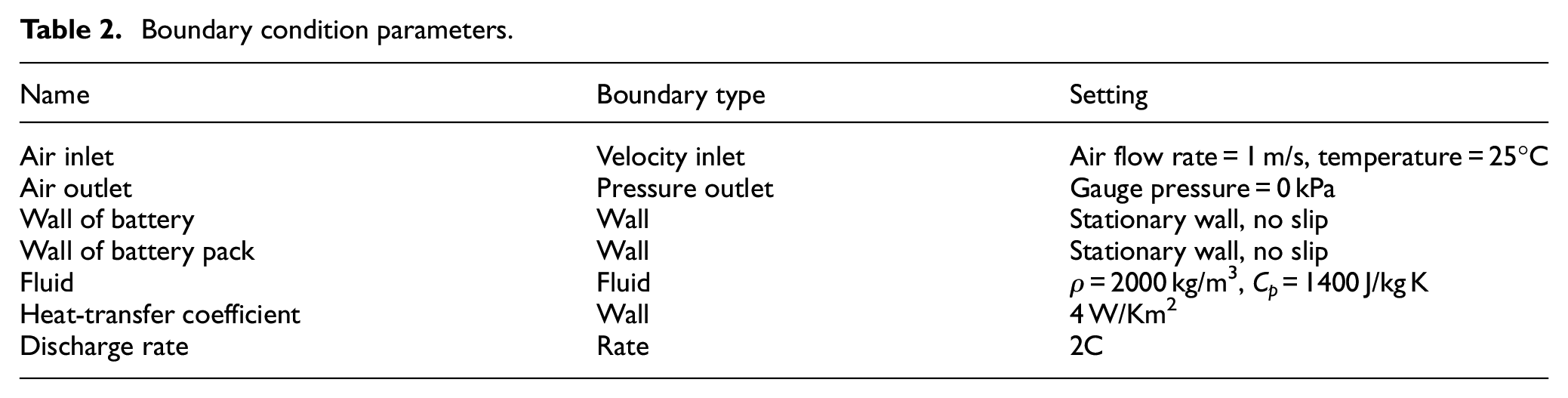
Setting the relevant boundary conditions in COMSOL Multiphysics software, both the battery module and the battery pack have air inlets and outlets. The inlet is located on the left side of the battery pack, while the outlet is on the right side. Based on the research on the thermal performance of lithium-ion battery packs, the experimental conditions for the ambient temperature, ambient pressure, air velocity, fluid density, and specific heat capacity were determined. 22 Based on the research on the optimization experiment of battery spacing based on neural network, the heat transfer coefficient of the battery pack in the vehicle was obtained. 23 Based on the research on the simulation analysis of thermal characteristics of lithium-ion single cell batteries, the discharge rate of the 18650 lithium-ion battery can be obtained. 24 According to relevant literature, the theoretical model of thermal conductivity should be used at discharge rates below 3C, otherwise significant prediction errors may occur. 25 This study decided to use a discharge rate of 2C. C represents the charging or discharging rate of the battery. The specific boundary condition parameters are shown in Table 2. All wall boundaries are modeled using the no-slip boundary condition. The interface between the batteries and the air is set as a fluid-solid coupling boundary. Slip conditions and adiabatic conditions are applied to the module casing.
Boundary condition parameters.
Results and analysis
Within the COMSOL simulation environment, a comprehensive model was devised to replicate the arrangement of batteries and an air-cooling system for a battery pack. The primary emphasis of this model was on the utilization of commercial 18650 lithium-ion batteries. The constructed model facilitated the exploration of thermal behavior within the battery pack and the effectiveness of the air-cooling system. By simulating the heat transfer process, the study sought to provide insights into the temperature distribution, thermal gradients, and overall thermal performance of the 18650 lithium-ion batteries during operation. This simulation-based approach allows for a detailed analysis of the thermal characteristics, aiding in the optimization of the battery pack design for enhanced heat dissipation.
Arrangement modules design and optimization
Battery arrangement modules analysis
Before conducting the simulation, a rectangular arrangement module consisting of 18 lithium-ion batteries, a diamond arrangement module, and a staggered arrangement module were constructed. Although the shapes and spacing of the arrangements are different, the ratio of the volume of each arrangement to the total module volume remains consistent. This avoids deviations in the simulation results caused by different arrangements. The thermal performance of the battery modules with different arrangements was tested under the condition of no cooling. Figure 6 shows the three-dimensional temperature distribution during a 2C discharge rate simulation. It can be observed that during the discharge process, each battery is considered as a heat source, and self-heating and mutual heating lead to an increase in battery temperature, especially the internal battery temperature.
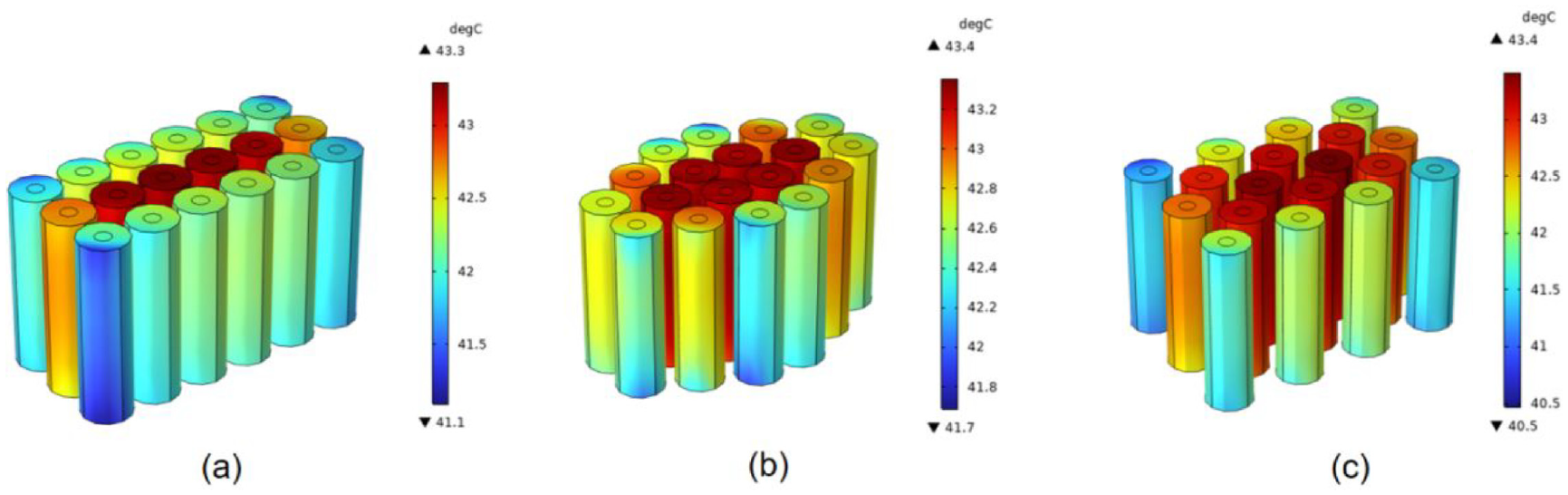
Temperature simulation without air cooling: (a) Three-dimensional temperature distribution of the rectangular arrangement, (b) Three-dimensional temperature distribution of the diamond arrangement, and (c) Three-dimensional temperature distribution of the staggered arrangement.
When the battery module is arranged in a rectangular layout, Figure 7(a) illustrates the three-dimensional temperature distribution of the battery module during a 2C discharge rate at a wind speed of 1 m/s. The average temperature is 27.35°C, with a maximum temperature of 28.90°C and a minimum temperature of 25.43°C. It can be observed that the batteries distributed around the periphery have relatively lower temperatures. This is because these batteries have fewer adjacent batteries. The batteries on the left end also have relatively lower temperatures as the air intake is located on the left side. The airflow near the intake has a lower temperature, which helps dissipate more heat. As the air flows deeper into the battery module toward the right end, the airflow path becomes longer, resulting in higher airflow temperatures and less heat dissipation. Therefore, the batteries located in the middle and right positions of the module have relatively higher temperatures. Figure 7(b) shows the cross-sectional temperature distribution of the batteries, with the ones surrounded in the interior and right end exhibiting the highest heat. It can be observed that the rectangular arrangement easily leads to difficulties in heat dissipation for the batteries surrounded in the middle.
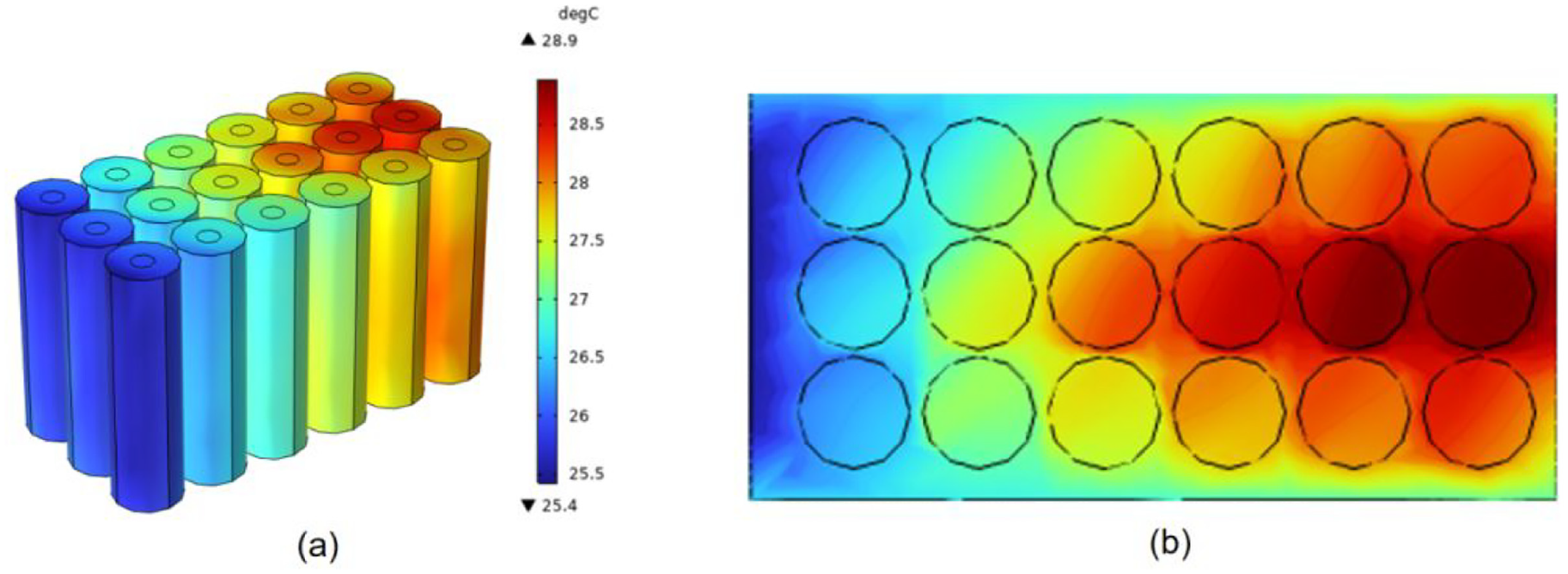
Simulation of rectangle air-cooled temperature: (a) Three-dimensional temperature distribution of the rectangular arrangement, and (b) Cross-sectional temperature distribution of the rectangular arrangement.
When the battery module is arranged in a diamond layout, the three-dimensional temperature distribution at a 2C discharge rate and a wind speed of 1 m/s is shown in Figure 8(a). The average temperature is 27.46°C, with a maximum temperature of 29.95°C and a minimum temperature of 25.50°C. Due to the larger frontal area exposed to airflow resistance in the diamond layout compared to the rectangular layout, more surrounding batteries can be effectively cooled. However, the front-row batteries in the diamond layout block the spacing of the back-row batteries, resulting in an increase in both the average and maximum temperatures of the entire battery module.

Simulation of diamond air-cooled temperature: (a) Three-dimensional temperature distribution of the diamond arrangement, and (b) Cross-sectional temperature distribution of the diamond arrangement.
When the battery module is arranged in a staggered layout, the three-dimensional temperature distribution at a 2C discharge rate and a wind speed of 1 m/s is shown in Figure 9(a). The average temperature is 27.78°C, with a maximum temperature of 28.27°C and a minimum temperature of 25.2°C. Compared to the rectangular and diamond layouts, it can be observed that the staggered layout has relatively better overall thermal performance. This is because this arrangement allows the airflow path to more easily pass through each battery gap, thereby dissipating more heat. The short and wide airflow path in the staggered layout even enhances the cooling effect further.

Simulation of staggered air-cooled temperature: (a) Three-dimensional temperature distribution of the staggered arrangement, and (b) Cross-sectional temperature distribution of the staggered arrangement.
Arrangement modules optimization
To obtain the optimal spacing for each arrangement, this study utilizes the Particle Swarm Optimization (PSO) algorithm for optimization.


The PSO algorithm iterates for 200 iterations. Based on the previous velocity and current fitness, the velocity of each particle is updated to achieve better speed and position. Using the new velocity, the position of each particle is updated, forming a new particle swarm. The process of fitness calculation, velocity update, and position update is repeated iteratively until the stopping criterion is met.
The values of

Particle swarm optimization spacing results.
Table 3 provides a comparison of the average temperature Tave, maximum temperature Tmax, and minimum temperature Tmin for various battery arrangements under a 2C discharge rate. The states before and after optimization are represented by the original state without forced air cooling and the optimized state with optimized spacing, respectively. The results show that for the rectangular arrangement, the average temperature decreases by 2.8%, and the maximum temperature decreases by 5.2%. In the case of the diamond arrangement, the average temperature decreases by 4.0%, and the maximum temperature decreases by 7.5%. For the staggered arrangement, the average temperature decreases by 5.6%, and the maximum temperature decreases by 4.0%.
Temperature comparison after optimization of different arrangement modules.

Battery pack configuration design and optimization
Battery pack configuration design
The grouped design of the battery pack involves the problem of mixed configurations of different battery module arrangements. To better understand this, the rectangular arrangement module, diamond arrangement module, and staggered arrangement module are represented by the numbers 1, 2, and 3, respectively. The positions of the battery modules 1, 2, and 3 are denoted as a, b, and c, respectively. The values of
Figure 11 shows all combinations under the fixed rectangular arrangement. The x-axis represents the combinations of

Rectangular arrangement combination temperature.
The arrangement 133 shows relatively better thermal dissipation, and when bothand
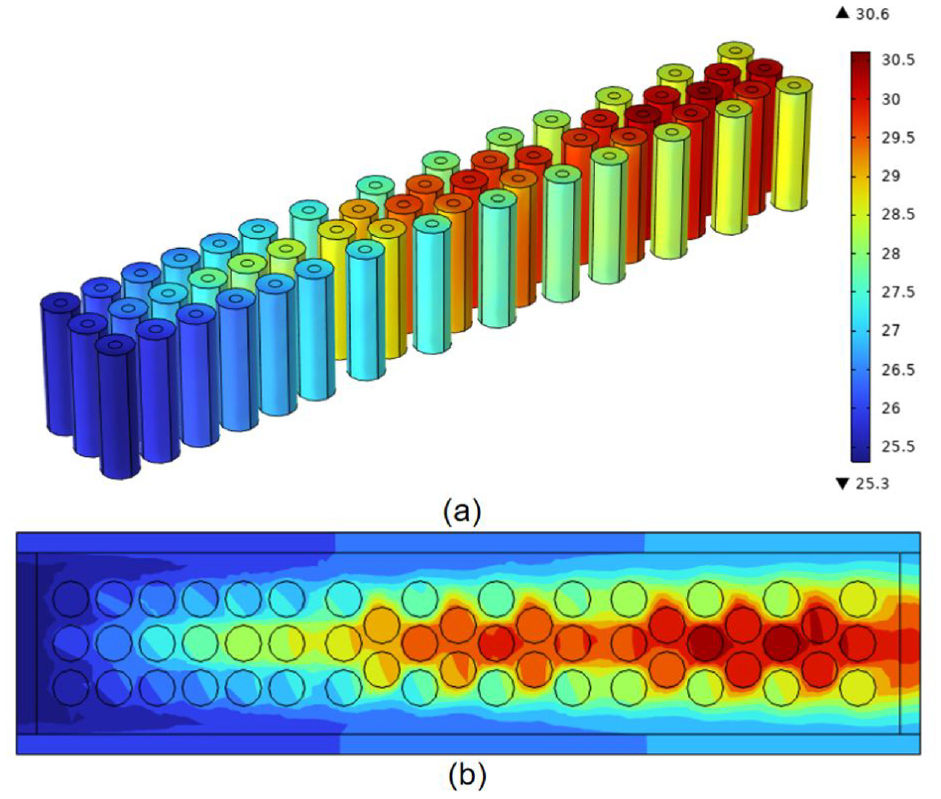
133 arrangement temperature simulation: (a) Three-dimensional temperature distribution of the 133 arrangement, and (b) Cross-sectional temperature distribution of the 133 arrangement.
Figure 13 illustrates all combinations under the fixed diamond arrangement. Meanwhile, Figure 14(a) and (b) depict the three-dimensional temperature distribution and cross-sectional temperature distribution of the 233 arrangement, respectively. From the figure, it can be observed that the arrangement 211 has the highest average temperature, reaching 29.8°C. The maximum temperature difference is 9.61°C. This indicates that when position a is in a diamond arrangement and positions b and c are in a rectangular arrangement, the thermal dissipation is not ideal. On the other hand, the arrangement 233 shows relatively better thermal dissipation, and when both
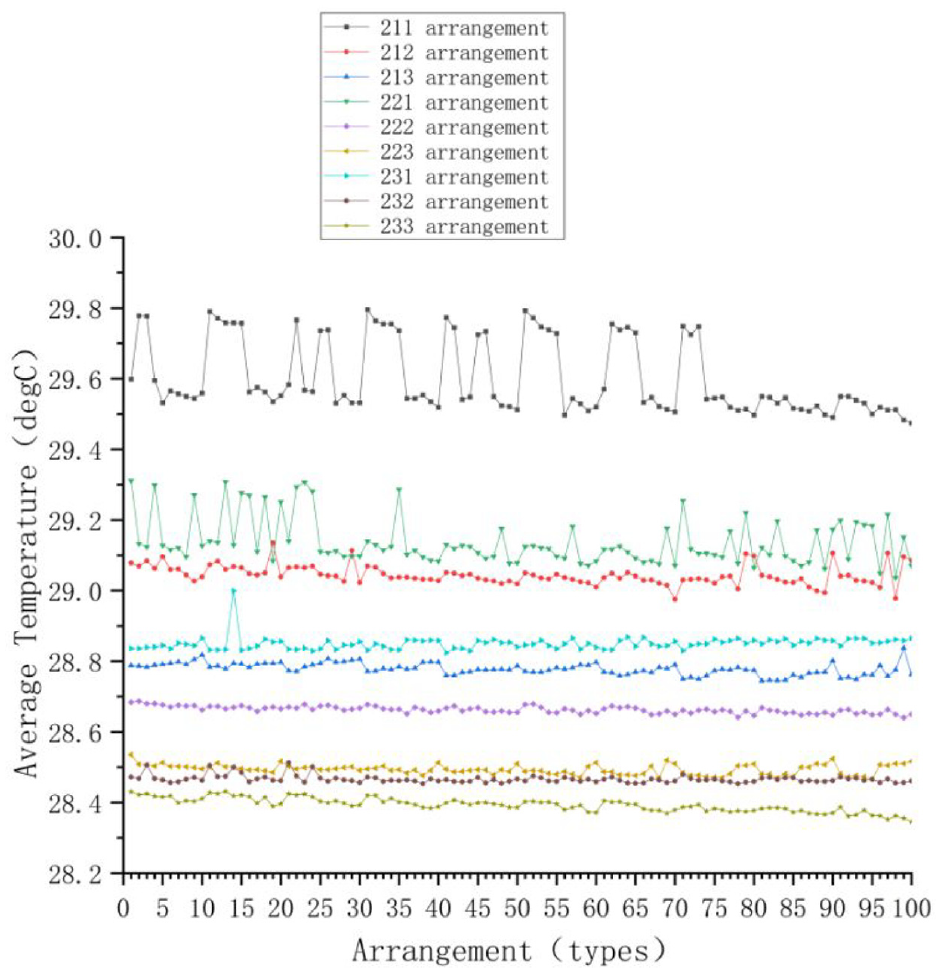
Diamond arrangement combination temperature.

233 arrangement temperature simulation: (a) Three-dimensional temperature distribution of the 233 arrangement, and (b) Cross-sectional temperature distribution of the 233 arrangement.
Figure 15 displays all combinations under the fixed staggered arrangement. Figure 16(a) and (b) depict the three-dimensional temperature distribution and cross-sectional temperature distribution of the 333 arrangement, respectively. It can be observed that the arrangement 311 has the highest average temperature, reaching 29.57°C. The maximum temperature difference is 9.78°C. This indicates that when position a is in a staggered arrangement and positions b and c are in a rectangular arrangement, the thermal dissipation is not ideal. The arrangement 333 shows relatively better thermal dissipation. However, it is worth noting that the best thermal dissipation is not achieved when both

Staggered arrangement combination temperature.

333 arrangement temperature simulation: (a) Three-dimensional temperature distribution of the 333 arrangement, and (b) Cross-sectional temperature distribution of the 333 arrangement.
Finally, we compare the three arrangements with the best thermal dissipation: 133, 233, and 333. Figure 17 illustrates the comparison between these three arrangements. It can be observed that the group with a rectangular arrangement has a significantly higher average temperature compared to the other two groups. Combining the above analysis, it can be concluded that the presence of a rectangular arrangement in the battery pack leads to a decrease in thermal dissipation, while the presence of a staggered arrangement results in better thermal dissipation.

Comparison of three optimal permutations.
Battery pack configuration optimization
To explore better thermal dissipation performance, a neural network model is established to capture the relationship between different positions, arrangements, module spacing, and the average temperature and maximum temperature. The input of the neural network includes [
Figure 18(a) and (b) show the output results of the predicted average temperature and maximum temperature for the optimal layout of 133 with a fixed rectangular arrangement. The optimal combination is [1, 3, 3, 10, 7.9], with the predicted average temperature of 28.87°C and the predicted maximum temperature of 31.8°C. The temperature difference is only 6.55°C, which represents a 28.2% decrease compared to the initial prediction.
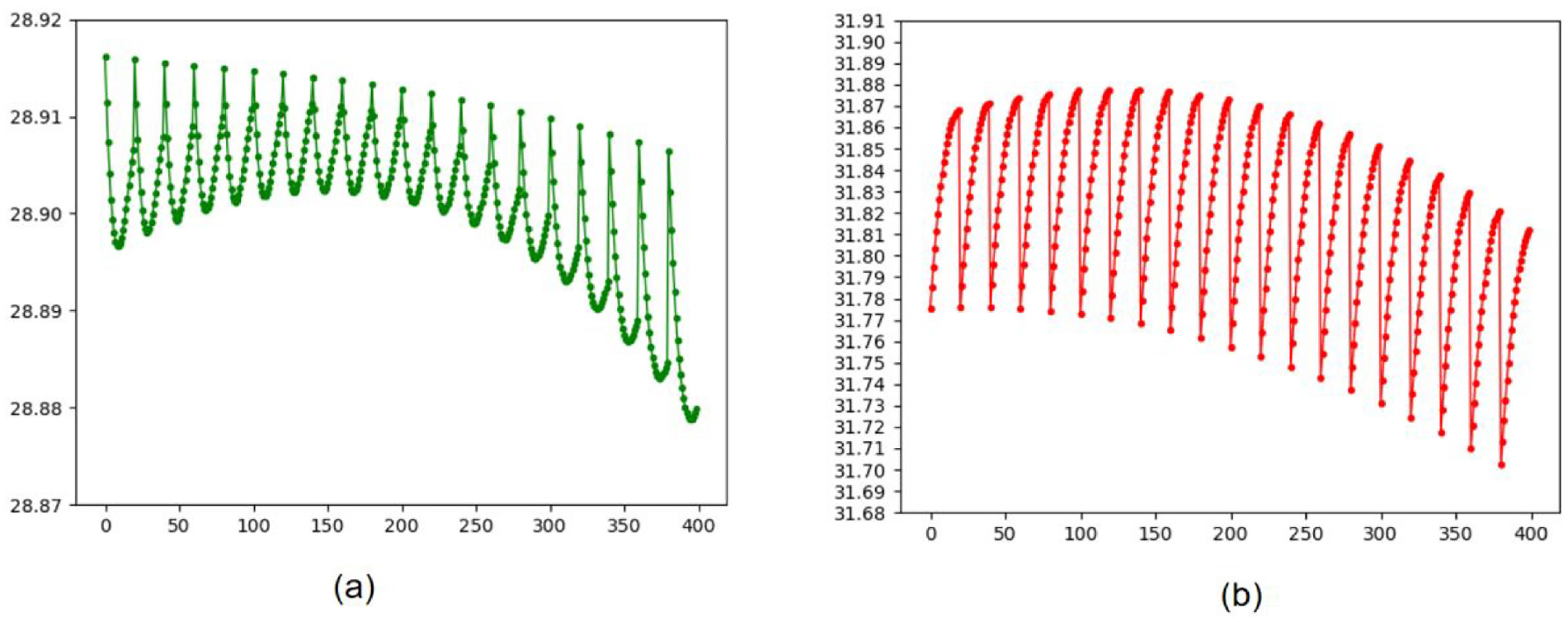
Rectangular arrangement optimization: (a) average temperature and (b) maximum temperature.
Figure 19(a) and (b) show the output results of the predicted average temperature and maximum temperature for the optimal layout of 233 with a fixed diamond arrangement. The optimal combination is [2, 3, 3, 10, 5.8], with the predicted average temperature of 28.58°C and the predicted maximum temperature of 31.8°C. The temperature difference is only 6.6°C, representing a 31.3% decrease compared to the initial prediction.
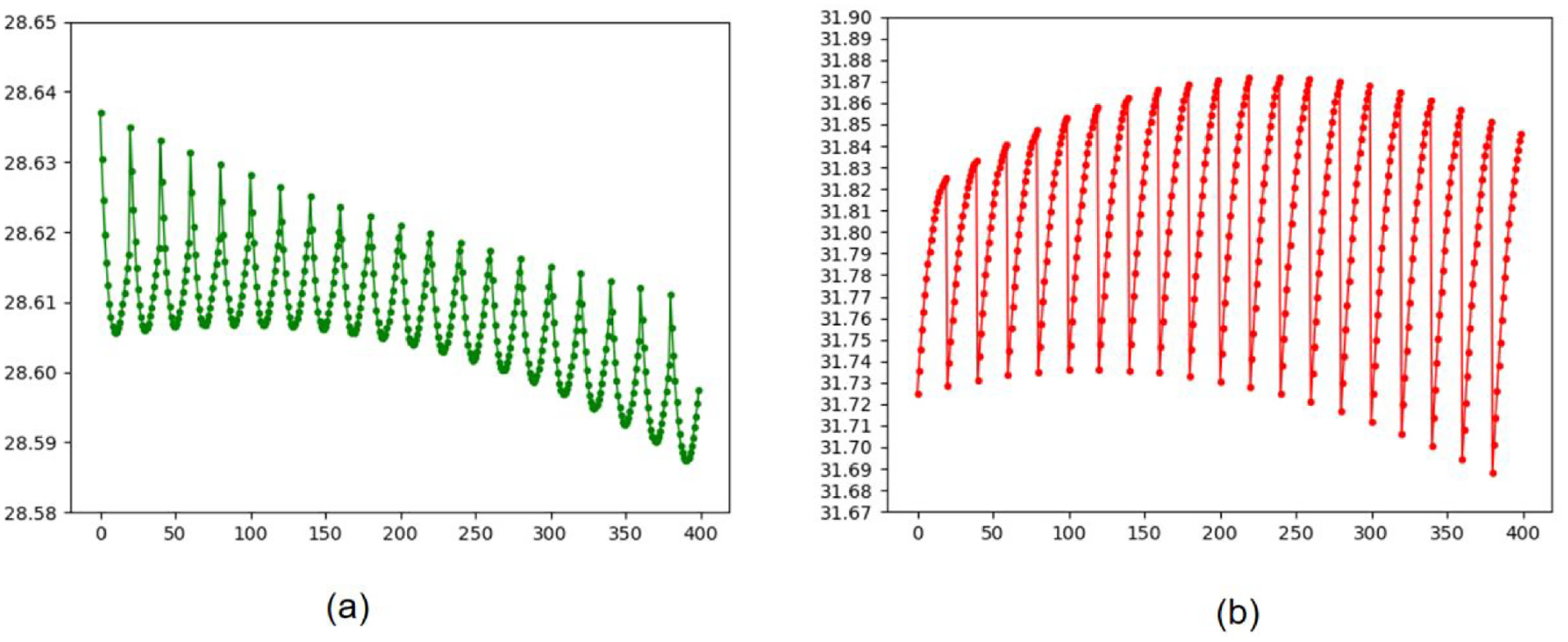
Diamond arrangement optimization: (a) average temperature and (b) maximum temperature.
Figure 20(a) and (b) show the output results of the predicted average temperature and maximum temperature for the optimal layout of 233 with a fixed staggered arrangement. The optimal combination is [3, 3, 3, 10, 6.3], with the predicted average temperature of 28.49°C and the predicted maximum temperature of 31.82°C. The temperature difference is only 6.69°C, representing a 31.6% decrease compared to the initial prediction.

Staggered arrangement optimization: (a) average temperature and (b) maximum temperature.
Conclusions
A module-based approach was developed in this research to investigate the dissipation performance of Li-ion battery pack considering different battery arrangement modules and spacing conditions. Firstly, the cell spacings of all three arrangement modules are optimized, in which the [
Footnotes
Appendix
Notation
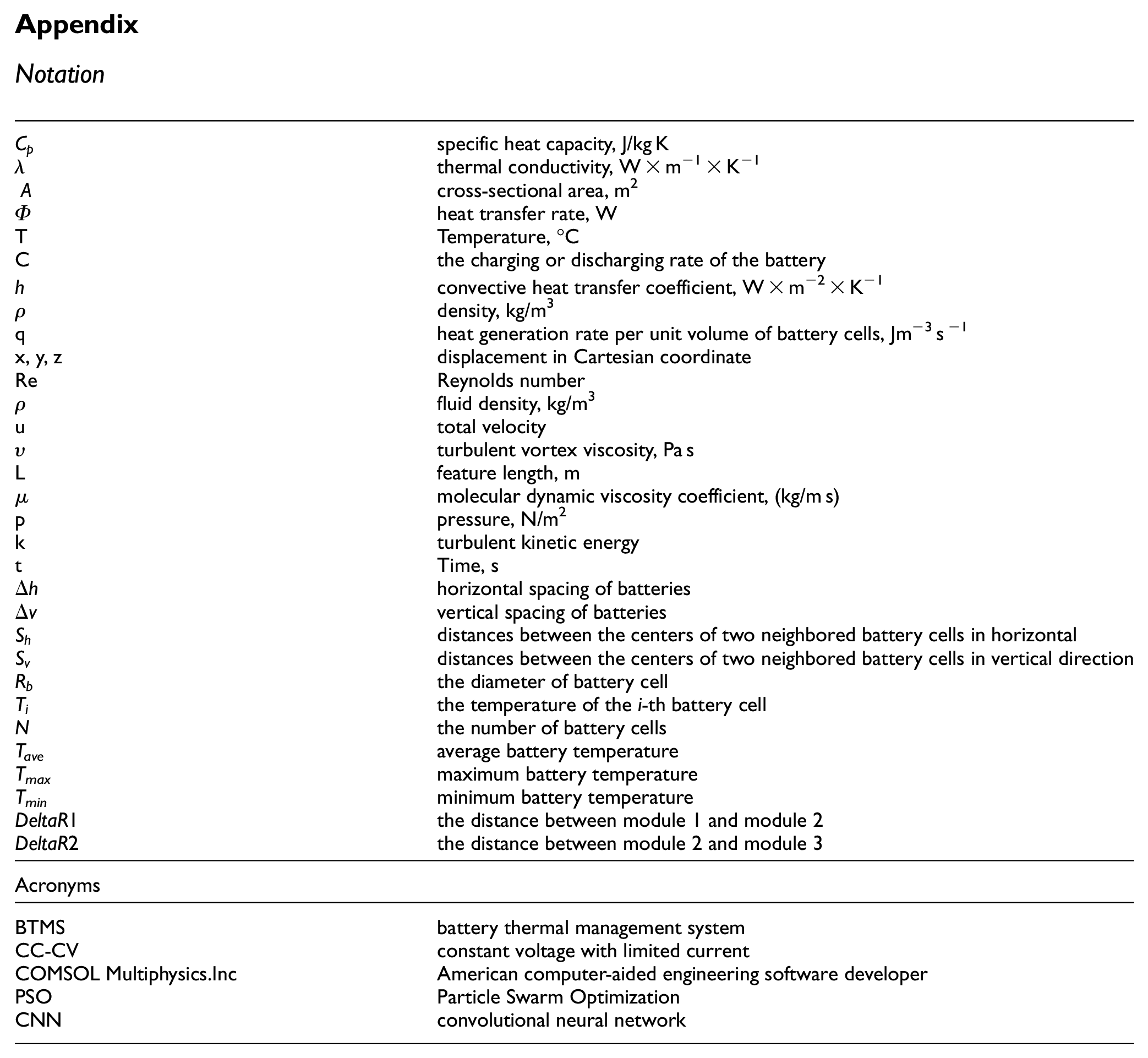
| specific heat capacity, J/kg K | |
| thermal conductivity, W × m−1 × K−1 | |
| cross-sectional area, m2 | |
| heat transfer rate, W | |
| T | Temperature, °C |
| C | the charging or discharging rate of the battery |
| convective heat transfer coefficient, W × m−2 × K−1 | |
| ρ | density, kg/m3 |
| q | heat generation rate per unit volume of battery cells, Jm−3 s −1 |
| x, y, z | displacement in Cartesian coordinate |
| Re | Reynolds number |
| ρ | fluid density, kg/m3 |
| u | total velocity |
| υ | turbulent vortex viscosity, Pa s |
| L | feature length, m |
| μ | molecular dynamic viscosity coefficient, (kg/m s) |
| p | pressure, N/m2 |
| k | turbulent kinetic energy |
| t | Time, s |
| horizontal spacing of batteries | |
| vertical spacing of batteries | |
| distances between the centers of two neighbored battery cells in horizontal | |
| distances between the centers of two neighbored battery cells in vertical direction | |
| the diameter of battery cell | |
| the temperature of the i-th battery cell | |
| the number of battery cells | |
| T ave | average battery temperature |
| T max | maximum battery temperature |
| T min | minimum battery temperature |
| the distance between module 1 and module 2 | |
| the distance between module 2 and module 3 | |
| Acronyms | |
|---|---|
| BTMS | battery thermal management system |
| CC-CV | constant voltage with limited current |
| COMSOL Multiphysics.Inc | American computer-aided engineering software developer |
| PSO | Particle Swarm Optimization |
| CNN | convolutional neural network |
Handling Editor: Aarthy Esakkiappan
Declaration of conflicting interests
The author(s) declared no potential conflicts of interest with respect to the research, authorship, and/or publication of this article.
Funding
The author(s) disclosed receipt of the following financial support for the research, authorship, and/or publication of this article: This work was supported in part by the Guangdong Basic and Applied Basic Research Foundation under Grant No. 2022A1515110187, in part by Scientific Research Project of Education Department of Guangdong Province under Grant No. 2022KCXTD029, in part by Shallow Sea Underwater Small Target Cooperative Search Key Technology Research and Application Demonstration under Grant No. SML2022SP101.
