



Abstract
Rotating disks are used in industries, such as aerospace, automotive, and power plants. These disks are under time-dependent mechanical loading when the machine starts or stops working conditions. Thermal stresses caused by temperature changes with this time-dependent mechanical load create dangerous conditions. Therefore, the estimation of the elastic limit angular velocity and acceleration as a criterion for the initiation of plastic deformations has special importance in the start-stop process. An analytical Homotopy perturbation method is used to solve the heat transfer equation and the governing Navier equations in both radial and tangential directions of functionally graded rotating disks with non-uniform thickness. The Tamura-Tomoto-Ozawa model is implemented to calculate the yield stress at a different radius of the disk. The obtained results will be verified with the higher-order finite difference method. The effect of thickness parameter, type of thermal and boundary conditions on the angular velocity and acceleration, and also the starting radius of the plastic deformations are investigated by numerical examples. It is shown that by defining the appropriate temperature gradient on the outer surface of the disk and the parameters in the time-dependent angular velocity function, the level of stresses can be controlled and optimized in all working processes.
Keywords
Introduction
Rotating disks are mechanical parts that are used in a wide range of mechanical devices and equipment. The angular velocity of the rotating disks is usually constant throughout normal work condition. However, during the start or stop process of the machine, the rotating disks experience angular acceleration due to the change in angular velocity over time. For example, during the starting process of centrifugal compressors, the disks and other rotating parts are under angular acceleration, producing tangential displacement and shear stress, as well as radial and tangential stresses. If the shear stress exceeds permissible limits, it can have damaging effects on the disk and related components. Therefore, it is necessary to study rotating disks with time-dependent angular velocities and accelerations as mechanical loading to achieve optimal design specifications.
Materials of disks are exposed to high temperatures under these conditions. Therefore, materials that have a high ability to withstand both mechanical and thermal stresses should be selected. In a rotating disk with uniform thickness, there is a high difference of stress along the radius. It is better to use disks with non-uniform thickness to improve the stress distribution. For these reasons, it is highly recommended to construct rotating disks with non-uniform thickness profiles, made of functionally graded materials (FGMs).
Functionally graded materials were first used in 1984 in Japan for the construction of space equipment. These materials are non-homogeneous composite materials designed to enhance the efficiency of various components of a structure and control destructive deformations and stresses.
The goal is to achieve desired properties such as high strength, low weight, good conductivity, high resistance to corrosion, and high temperature resistance. In FGMs, the properties at each point are defined by a suitable mixing law based on the properties of the constituent components, typically metal and ceramic. Over the past two decades, extensive research has been conducted on FGM structures, particularly their application in the design of rotating disks. Estimating stress in FGM rotating disks is crucial due to its numerous engineering applications.
Real engineering problems are typically modeled based on nonlinear differential equations. However, these equations are difficult to solve exactly, and attempts to do so often fail. Research in the field of rotating disks has focused on finite element simulations and numerical solutions for disks with uniform or variable thickness and density under constant angular velocity.1–18 However, previous research has shown that numerical methods for solving nonlinear problems are not always highly accurate and can have high error rates. Additionally, finite element solutions require commercial software and can be costly. To address the need for high-precision solutions, this paper uses analytical methods to analyze the mechanical behavior of FGM rotating disks under time-dependent mechanical and thermal loading. Specifically, the Homotopy perturbation method (HPM)19–23 is used to obtain displacement-stress distributions in both radial and tangential directions of the FGM rotating disk under time-dependent mechanical and thermal loading conditions.
Among the first research carried out on rotating disks, the analytical solution of homogeneous elastic-plastic disks by Gamer using the Tersca yield criterion is more referable. 1 Subsequent research has investigated rotating disks from different aspects, assuming homogeneous materials with constant mechanical properties in the radial direction. For example, Eraslan presented a computational model to study the plastic deformation of annular rotating disks with variable thicknesses placed on a rigid shaft as a boundary condition. The model used the von Mises yield criterion and Swift’s law to simulate the nonlinear strain-hardening behavior of the material and calculated the angular velocity of the plastic limit for this selected model at different values of geometric parameters. 2 Eraslan and Orcan showed that depending on the shape of the disk thickness profile, the radial stress in the central area of the disk can exceed tangential stress. They also presented the expansion of plastic areas resulting from increasing angular velocity with displacement and stress distribution. 3 In another study, Eraslan and Orcan investigated the elastic-plastic deformation of rotating disks with variable thickness under three types of boundary conditions: free, under pressure, and constraint on the inner surface and free on the outer surface. They found that depending on the type of boundary condition, the plastic zone can include one, two, or three regions, which are presented by different forms of the yield criterion. 4
In the field of functionally graded rotating disks, several researchers have proposed different approaches to study their mechanical and thermal properties. You et al. were the first to propose the use of composite fibers to make rotating disks, assuming that the elastic modulus, thermal expansion coefficient, and density change based on a power function along the radial direction of the disk under constant angular velocity and uniform temperature distribution. 5 Kordkheili and Naghdabadi presented a semi-analytical thermo-elastic solution for solid and hollow symmetric rotating disks made of graded materials under plane stress conditions. 6 Bayat et al. studied the elastic deformation of FGM disks using the theory of first-order shear deformation. 7 Hojjat et al. performed several works on rotating disks,8–11 studying their elastic behavior using variational iteration method (VIM), 8 variable material property method (VMP), 9 Adomian’s decomposition method (ADM), 10 and homotopy perturbation method (HPM). 11 The thickness and density function are considered non-uniform and parametric studies for different values of thickness and density parameters are carried out after the verification process.8–11 Nayak et al. used a VIM to evaluate the elastic-plastic behavior of thermo-mechanically loaded FGM disks. 12
In the field of optimization, Jafari et al. introduced classical and modern optimization methods in the minimal weight configuration of an elastic rotating disk with variable thickness and density. They used Karush-Kuhn-Tucker (KKT), simulated annealing (SA), and particle swarm methods (PSO) and found that the performance of PSO and SA methods is simpler and provides greater flexibility. The constraint of optimization is defined in such a way that the von Mises equivalent stress in the disk remains lower than the yield strength of the disk material. 13 Recently, Alashti and Jafari investigated the effect of ductile damage models on the plastic deformation behavior of rotating disks with variable thickness. They showed that by considering these models in the simulations, more realistic predictions of the full plastic limit angular velocities in rotating disks can be predicted. 14
In the case of time-dependent angular velocity, most research is done using numerical methods. Zheng et al. provided stress analysis for non-uniform thickness and time-dependent angular velocity in functionally graded rotating disks using the ordinary finite difference method (FDM). 15 Salehian et al. performed a thermo-elastic analysis of functionally graded rotating hollow circular disks with variable thickness and angular velocity using the Galerkin method. 16 Recently, Jafari used the homotopy perturbation method (HPM) and the finite difference method (FDM) for the elastic analysis of a rotating annular disk with non-uniform thickness and density under time-dependent angular velocity. The results show that HPM is easier, more practical, with no restrictions in use, and more convenient than FDM. Boundary conditions have a significant effect on reducing the displacement-stress levels in non-uniform disks compared to uniform disks. 17 In the next research, Jafari used HPM and FDM for the elastic analysis of a rotating annular disk with non-uniform thickness and density under time-dependent angular velocity, considering tangential displacement. 18 This research shows that HPM successfully handled the solutions of the equilibrium equation of a rotating disk in both radial and tangential directions simultaneously. Their results show that shear stress has an important influence on the distribution of equivalent von Mises stress in the elastic region and must be considered in general rotating disk analysis. 18 However, no complete analytical solution has been provided for functionally graded rotating disks with time-dependent angular velocities and accelerations.
At the end of the introduction, it is often assumed in the literature on rotating disks that the angular velocity as mechanical loading is constant over time. However, considering the importance of time-dependent mechanical load, change of thickness profile along the radial direction, the advantage of FGM in the manufacture of a rotating disk, temperature changes in the radial direction and the need for high accuracy of analytical, it is essential to conduct a realistic analysis of rotating disks. In this paper, the displacement-stress distributions in both radial and tangential directions of FGM rotating disks under time-dependent mechanical and thermal loading conditions are studied using HPM and higher-order FDM for different boundary conditions that occur in real work environments. The elastic-linear hardening behavior is considered for the FGM stress-strain curve. The values of equivalent von Mises stress are implemented as a criterion for estimating the elastic limit of angular velocity and acceleration. The effect of shear stress on the values of equivalent von Mises stress is also considered. The results are compared to the higher-order FDM. After verifying the results, the values of critical parameters in the start-stop process of a rotating disk are determined in such a way that plastic deformations do not occur. A parametric study is carried out in the form of numerical examples for different values of the thickness parameter, the type of thermal loading, the values of parameters in angular velocity function, and the disk boundary conditions. The elastic limits and the radius of the beginning of plastic deformation in each case are computed. It shows that the presented model can calculate the displacement-stress in disks under time-dependent mechanical-thermal loads for all types of boundary conditions corresponding to real working environments. In addition, this model based on the HPM solution can be used for FGM rotating disks with any form of geometrical and mechanical properties function and combined loading conditions.
In this paper, we analyze the actual working conditions of rotating disks and present the results using analytical modeling. The study focuses on two different types of boundary conditions applied to the internal and external surfaces of the rotating disk, as shown in Figure 1. In each of these boundary conditions, the angular acceleration is transmitted from the rigid shaft to the annular disk.
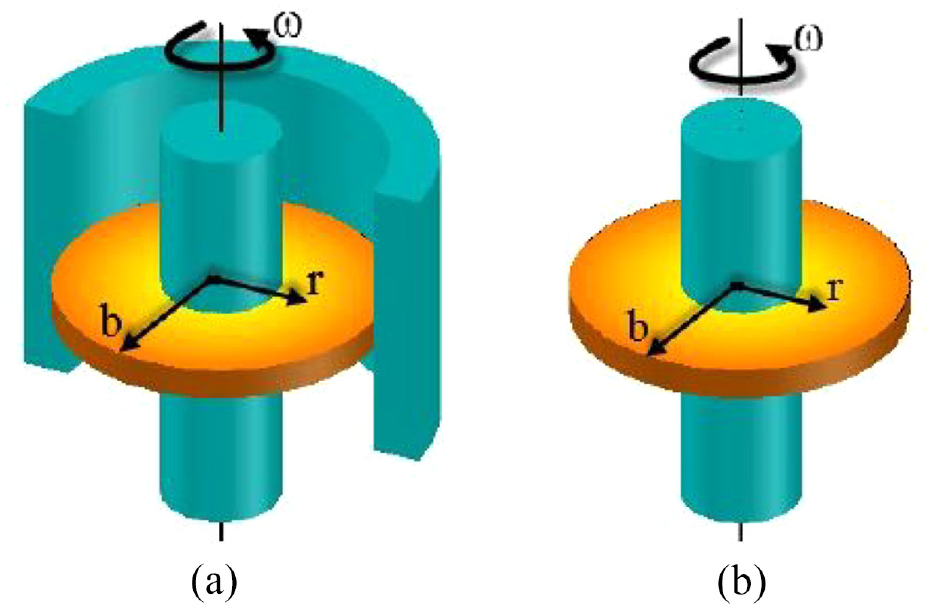
(a) constrained-guided and (b) constrained-free.
Geometrical-mechanical-thermal properties of rotating disk
Geometrical properties
An annular rotating disk with a variable thickness profile in the radial direction is being considered. The radius of the disk on the inner and outer surfaces is indicated by

where

An example of a disk profile with variable thickness in a cylindrical coordinate system.

Disk profile for different thickness parameter
Dimensional parameters of annular rotating disk.

Mechanical properties
In FGM rotating disks, the inner surface is typically made of a metal material, such as aluminum, while the outer surface is made of a ceramic material. This choice is made because the outer surface is exposed to high working temperatures, and ceramics have properties that make them suitable for such conditions. By using an appropriate mixing rule, the mechanical properties of the disk can be varied based on the volume fraction of metal to ceramic, transitioning from the inner to the outer surfaces. In this particular study, the inner surface of the disk is made of aluminum, and the outer surface is made of zirconia. The mechanical properties of these materials are provided in Table 2. It is worth noting that zirconia, being a ceramic material, does not have a specific yield stress value due to the inherent brittleness of ceramics.
Mechanical properties of metal and ceramic in the FGM rotating disk. 18

The mechanical property

The volume fraction function

The mechanical properties of the inner and outer surface of the disk are denoted by

where
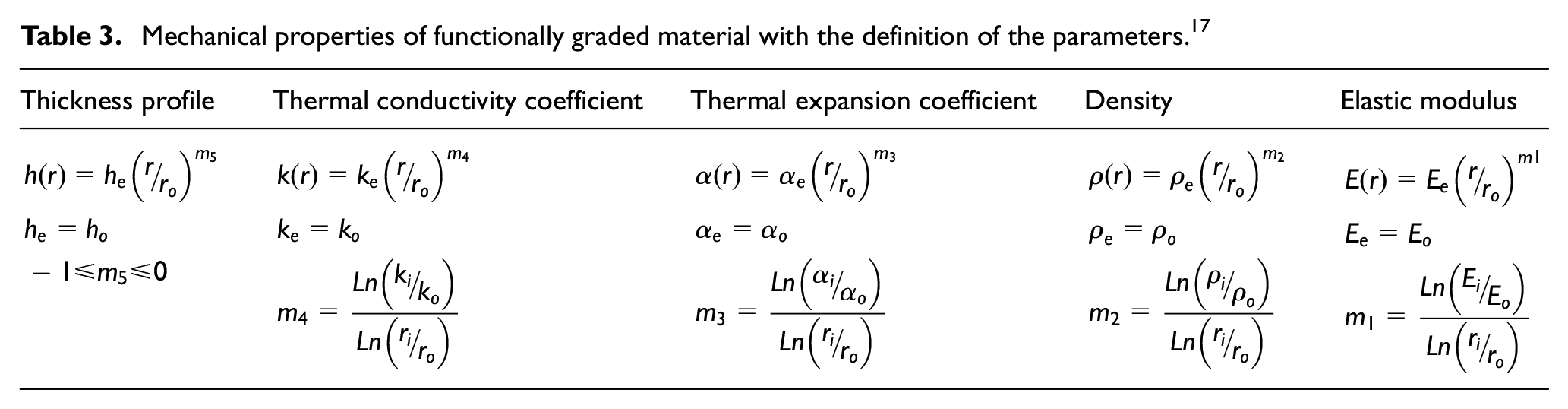
Mechanical properties of functionally graded material with the definition of the parameters. 17
Thermal properties
In this paper, the rotating disk is subjected to a thermal field along the radial direction. The temperature distribution is approximated as one-dimensional, and the governing equation for heat transfer in the rotating disk, without considering the heat source, is expressed as follows 17 :

In this relation


where
I. Type A: the temperature on the inner surface


II. Type B: the temperature on the inner surface


Equivalent stress in FGM disk
One of the applications of studying rotating disks under time-dependent mechanical loading is to correctly predict the equivalent von Mises stress. The analysis of yield conditions in graded materials differs from that of homogeneous materials. In functionally graded materials (FGMs), the yield stress in different parts of the material has various values. According to Figure 4, the stress-strain diagram for FGMs is placed between the diagrams related to metal and ceramics. In this case, the yield stress in the rotating disk can be calculated using an experimental parameter called


Stress-strain diagram for metals, ceramics, and functionally graded materials. 17
The value of

In this equation,

In this relation,
Time-dependent mechanical load
In this paper, we assume that the angular velocity and acceleration as mechanical loading are a function of time (


These relations focus on the accelerating or decelerating process on the rotating disk. In these relations,
In Figure 5, the angular velocity and acceleration variations based on the parameters in Table 2 are plotted for various time values (

(a) Angular velocity and (b) angular acceleration, for different value of
Theoretical background
Governing equations of rotating disk
According to Figure 2, the FGM annular rotating disk is under symmetrical mechanical and thermal loads (

In this relation,


where


The stress-strain relationship for this analysis are 2 :



In this relations

Strain-displacement relationships can be defined as:



In the Navier method, the governing equilibrium equations in the term of radial (
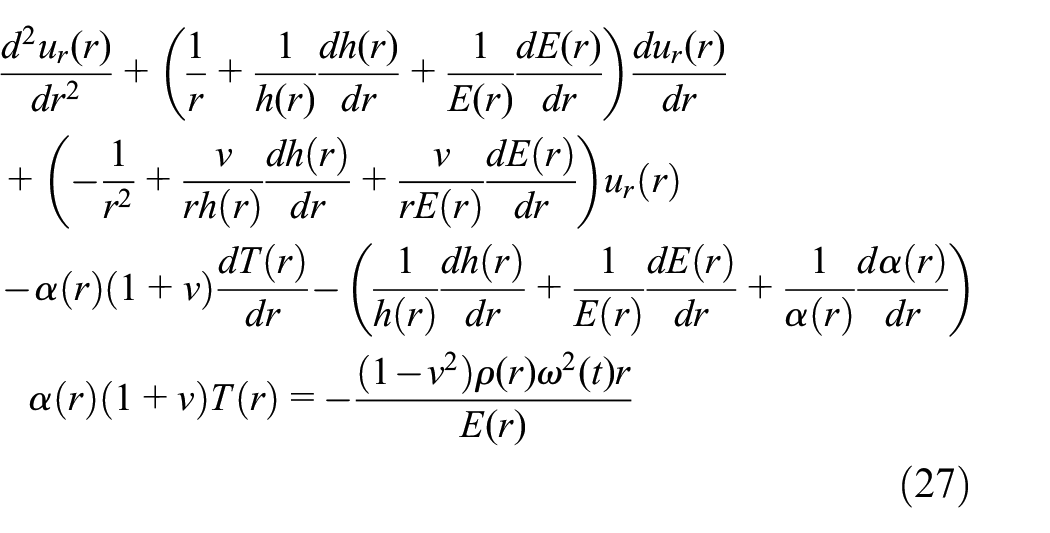

These are non-linear and in-homogeneous second-order differential equations with different degrees of derivatives of unknown displacements. The analytical solution of equations (27) and (28) for constant angular velocity and only density change along the radius of disk without thermal effect is investigated in Hojjati and Jafari.10,11 However, this study assumes a graded material with thermal effect, and the Homotopy Perturbation Method (HPM) is implemented to solve these equilibrium equations for time-dependent angular velocity and acceleration.
Homotopy perturbation method (HPM)
To present HPM,19–23 we consider the following differential equation and boundary condition:


In this relation,
One of the most important steps in solving the differential equations by HPM is to find the linear and nonlinear parts of the function

The Homotopy perturbation structure is established as the following equation:

where

At equation (32),

This relation shows that

Following, equation (32) is arranged according to the various powers of

The above convergence is discussed in (Refs. 19–23).
Higher-order finite difference method (HFDM)
One of the effective methods for solving difficult or impossible differential equations is HFDM (26, 27) as a numerical method. In HFDM, the approximation of derivatives plays a key role in the numerical solutions. To solve differential equations with specified boundary conditions, a set of grid points must be identified within the variable interval. The precision of the solution depends on the number of grid points. Increasing the number of these points can improve the precision of the solution to the desired degree. Central difference equations are often used to approximate the derivatives of a function
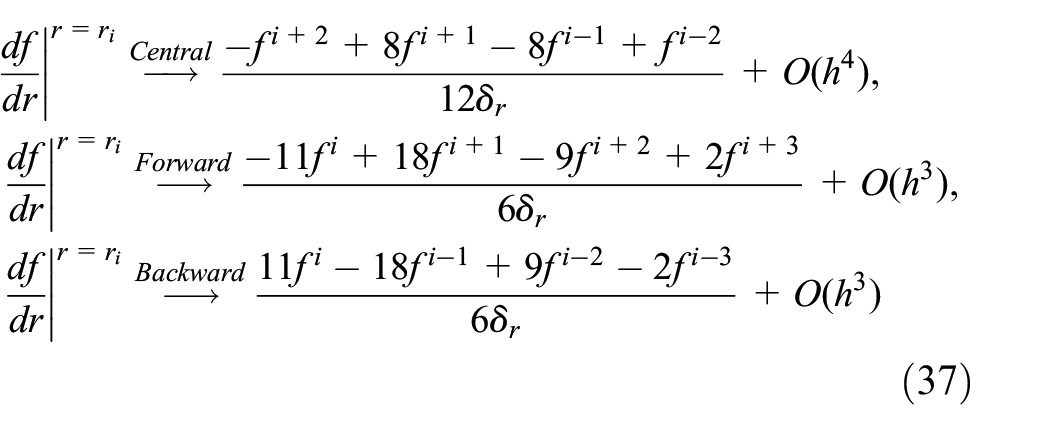
The second derivative of a function

To obtain a correct and effective solution, this higher-order formulation in one dimension is used to solve the governing differential equations of the rotating disk. The Navier equations in both radial and tangential direction are written in the finite difference form for each grid point in the interval


Gridding point of finite differences for disk in radial direction.
Analytical solution: Application of HPM
In this section, the governing Navier equations of FGM rotating disks with variable thickness in both the radial and tangential directions under time-dependent mechanical and thermal loading conditions are simultaneously solved by HPM as an analytical method to achieve the goals of this paper.
Heat transfer equation
The final form of the governing differential equation of heat transfer in an FGM disk is obtained by substituting the thermal conductivity coefficient and the disk thickness profiles from Table 3 in equation (5) as follows:

The linear and non-linear parts of equation (40) are defined in a way that ensures convergence of the solution:



The homotopy function is then constructed as:

Where, an unknown function


Equation (47) defines the next step in the process

By substituting equations (45)–(47) in the homotopy equation (44) and rearranging the resulting relationship according to



To calculate the unknown functions, these differential equations must be solved. Equation (48) is solved by assuming a certain value for

Substituting equation (51) into equation (48) and solving for yields

Similarly, equation (53) is obtained for equation (50):

Since the disk is not under an external heat source,

In this relation,
Navier equation: Radial direction
In this section, the equilibrium equation in a radial direction is solved using the HPM. The material properties function as Table 3, angular velocity function as equation (13) and temperature distribution function along the radius of the disk as equation (54) are substituted into equation (27), resulting in the Navier equation in terms of the unknown radial displacement (
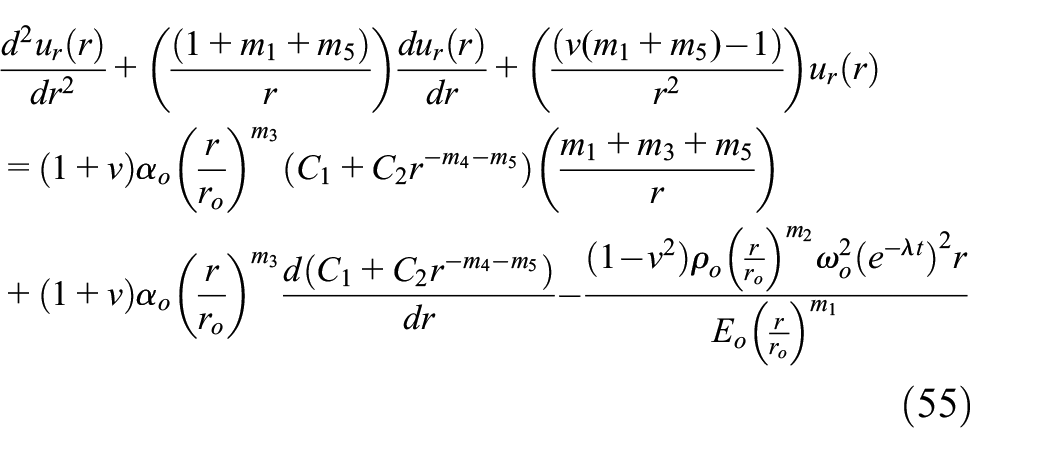
The linear and non-linear parts of the equation (55) are defined separately:


The homotopy function is constructed as follows:

In equation (59), an unknown function


We considered

Next, equations (60)–(62) are replaced into equation (59) and the results are rearranged based on the powers of
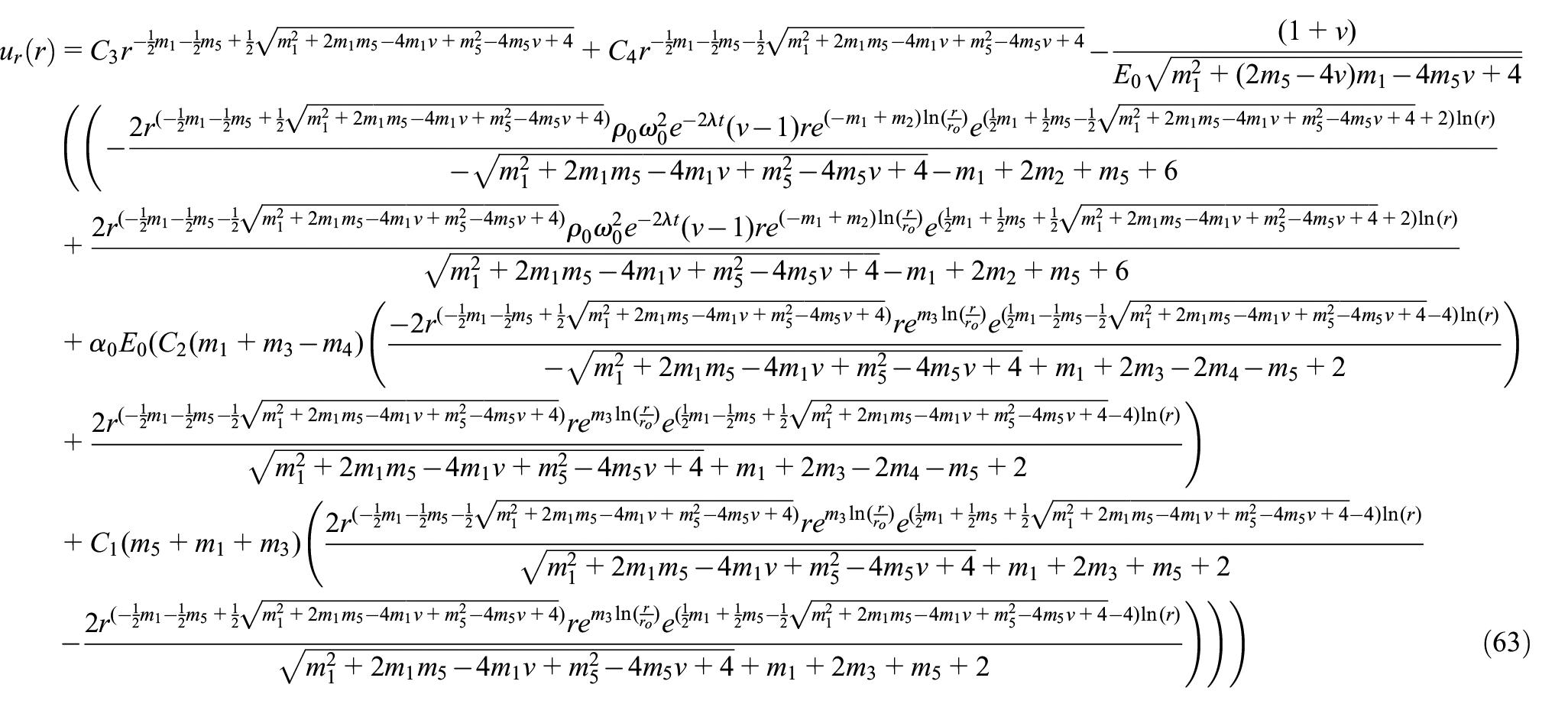
In this relation,
Navier equation: Tangential direction
In this section, the governing equilibrium equation in the tangential direction is solved by HPM. This equation is obtained with by substituting the material properties function as Table 3 and the angular acceleration function as equation (14) in to equation (28) as shown in equation (64):
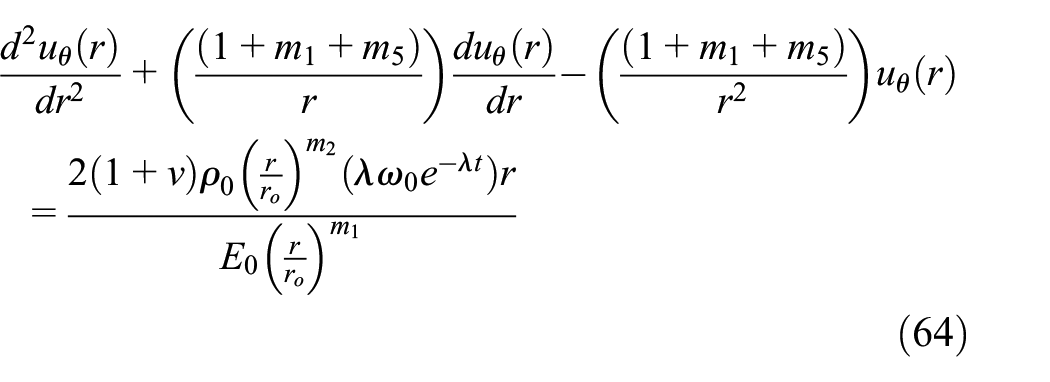
The linear and non-linear parts of equation (64) are defined as equations (65)–(67):


The homotopy function is constructed as follows:

Where,
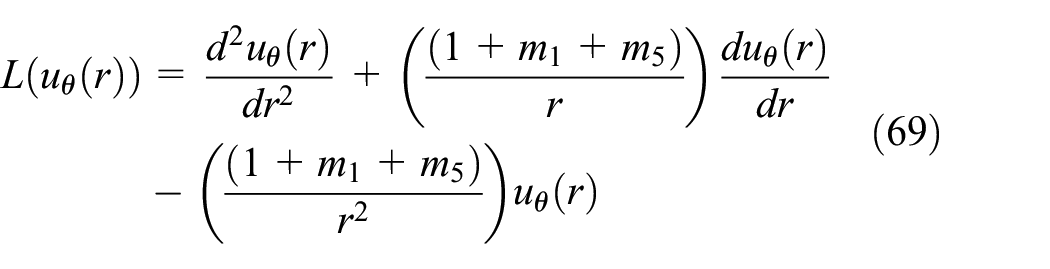

We considered

Next, equations (69)–(71) be replaced into equation (68) and the results rearrangement based on the powers of

Tangential displacement in equation (72) is a function of the thickness parameter (
Numerical solution: Application of HFDM
Heat transfer equation
In this section, the governing equation for heat transfer of the FGM disk is solved by the HFDM. The process involves several steps:
I. Rewriting Derivatives: the derivatives in equation (5) are rewritten using difference relations (equations (37) and (38)):

II. Grid Points: the radial direction of the disk (
III. Boundary Conditions: the boundary conditions of the heat transfer equation are also written in the finite difference form. There are two thermal boundary conditions, A and B, represented by equations (74) and (75) respectively.
Thermal boundary conditions A:

Thermal boundary conditions B:

IV. Solving Linear Algebraic Equations: By solving a final system of linear algebraic equations, the temperature value is calculated for each points in the disk grid.
Navier equations: Radial and tangential direction
Next, the Navier equations for the radial and tangential directions are considered. In equations (27) and (28), the derivatives of displacement are replaced by equations (37) and (38). This results in the differential equations being expressed in finite difference form as equations (76) and (77):

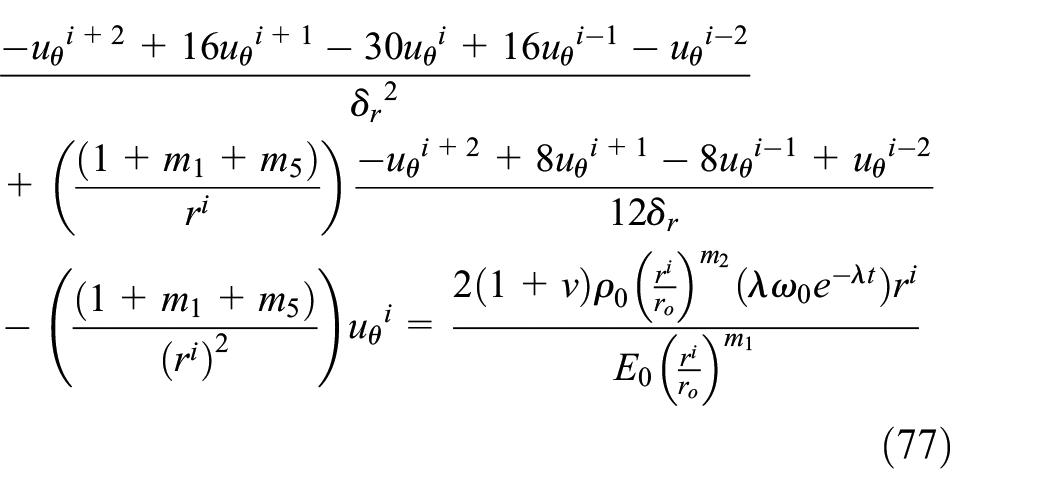
The finite difference form of these differential equations is written for internal grid points. The boundary condition for rotating disk at the inner and outer surfaces in the radial and tangential direction are represented in the finite difference form as shown in Table 4.
Boundary conditions of the disk in finite difference form.

The radial and tangential displacement of the rotating disk for each grid point is determined by solving the system of equations. Using these displacements, the strain and stress values in each of these points can be calculated.
Numerical analysis
In this section, we verify the results of both heat transfer and Navier equations in radial and tangential directions using analytical HPM. We then provide numerical analysis examples based on the parameters of the problem. The values of the parameters in Table 3 are listed in Table 5, based on the geometric and mechanical properties of aluminum and zirconia corresponding to the inner and outer surfaces of the disk.
The grading index of FGM rotating disk made of aluminum-zirconia.

Rotating disks are mechanical parts that are used in a wide range of mechanical devices and equipment such as gears, turbine rotors, flywheels, shrink fits, etc. In this equipment, the inner surface of the disk is at environment temperature (
Verification of HPM
The main objective of this section is to demonstrate the ability of the HPM to manage non-uniform FGM rotating disks under time-dependent mechanical and thermal loading conditions. The results obtained from solving the heat transfer equation (equation (54)) and the Navier equations (equations (63) and (72)) by HPM are verified with the help of HFDM. In HFDM, a mesh sensitivity analysis was performed to ensure that the results are independent of the meshing size. The number of points in the finite difference gridding of the disk was determined
Convergence test of for HFDM along the radial direction of the rotating disk.

The results of solving the steady-state heat transfer equation at different radius of the disk for the thickness parameter
Comparison of the results for the heat transfer equation by HPM and HFDM:

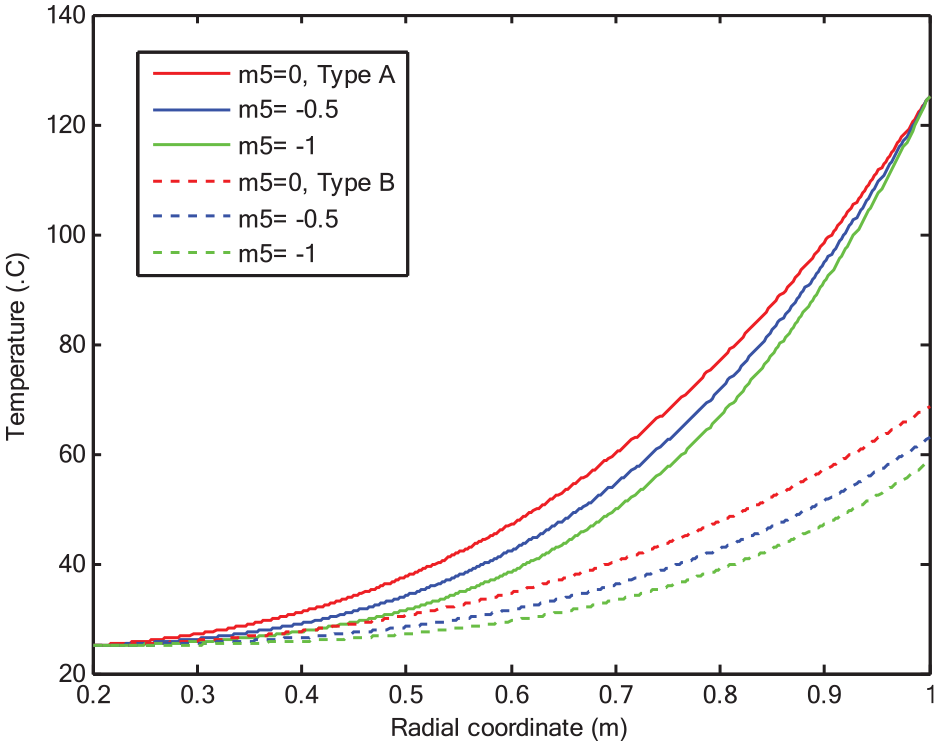
Temperature distribution for two types of thermal boundary conditions and different thickness parameter
Table 8 presents the results obtained from two methods, HPM and HFDM, for Navier equations in radial and tangential directions at different radius of the disk. It is important to note that there is no exact solution for rotating disks with variable specifications. The disk is subjected to two different boundary conditions on the inner and outer surfaces, and two thermal boundary conditions can be considered separately for each type. For verification, it is assumed that the disk has constrained-free boundary conditions on the inner and outer surfaces. The angular velocity and acceleration are considered time-dependent, and the rotating disk is in the start process. Hence, parameters in equations (13) and (14) is considered as:
Comparison of the results for the Navier equations in the rotating disk by two methods of HPM and HFDM for the thickness parameter (

Example 1
By confirming the results of solving the governing equations using HPM, a parametric analysis was conducted in Figure 9 to study the distributions of radial, tangential, and shear stress for various thickness parameters

Distribution of stresses for two types of thermal boundary conditions and different thickness parameter
The maximum location of radial stress is at the inner surface of the disk, and as the thickness parameter increases, it moves toward the middle radius of the disk. For tangential stress, the middle radius of the disk has the maximum values of stress. In the thermal condition
Example 2
In this example, the distribution of equivalent von Mises stress for a rotating FGM disk is demonstrated for various thickness parameters

Distribution of von Mises stress for two types of thermal boundary conditions and different thickness parameter
Constrained-free boundary condition: The maximum values of von Mises stress for different thickness parameters
Constrained-guided boundary condition: The maximum values of equivalent stress for all thickness parameters
Approximately, for all disk radius, the equivalent von Mises stress for the thermal condition
Example 3
In this example, the yield stress function for the FGM rotating disk is calculated. The elastic limit occurs when the yield stress in the disk reaches the equivalent von Mises stress according to equation (11). Considering the ceramic volume fraction function as (
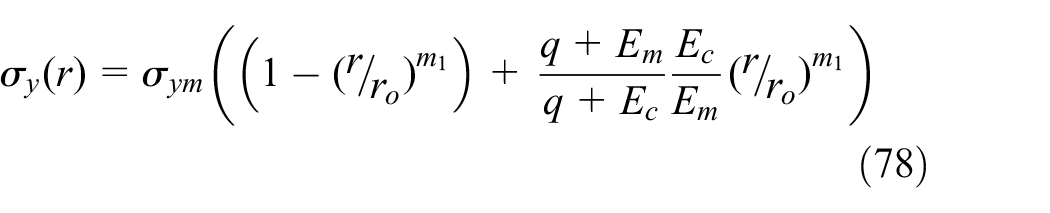
In this relation, the elastic modulus of aluminum

For better understanding, the distribution of the ratio (

Distribution of von Mises stress to yeild stress for two types of thermal boundary conditions and different thickness parameter
Example 4
The example investigates the effect of the thickness parameter
Results for elastic limit angular velocity and acceleration for different values of thickness parameter

Results for elastic limit angular velocity and acceleration for different values of thickness parameter

Results for elastic limit angular velocity and acceleration for different values of thickness parameter
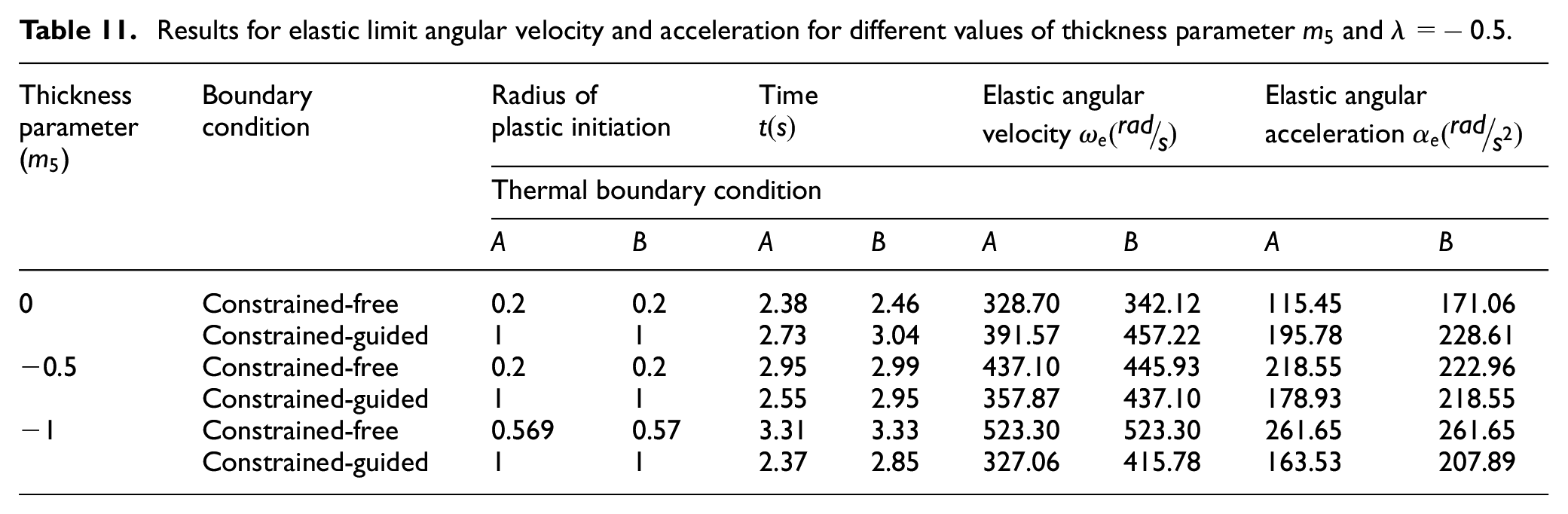
The values of elastic limit angular velocity and acceleration increase by increasing the thickness parameter
Example 5
The example investigates the effect of boundary thermal conditions of a rotating disk on the values of angular velocity (
Results for angular velocity and acceleration over time for thickness parameter
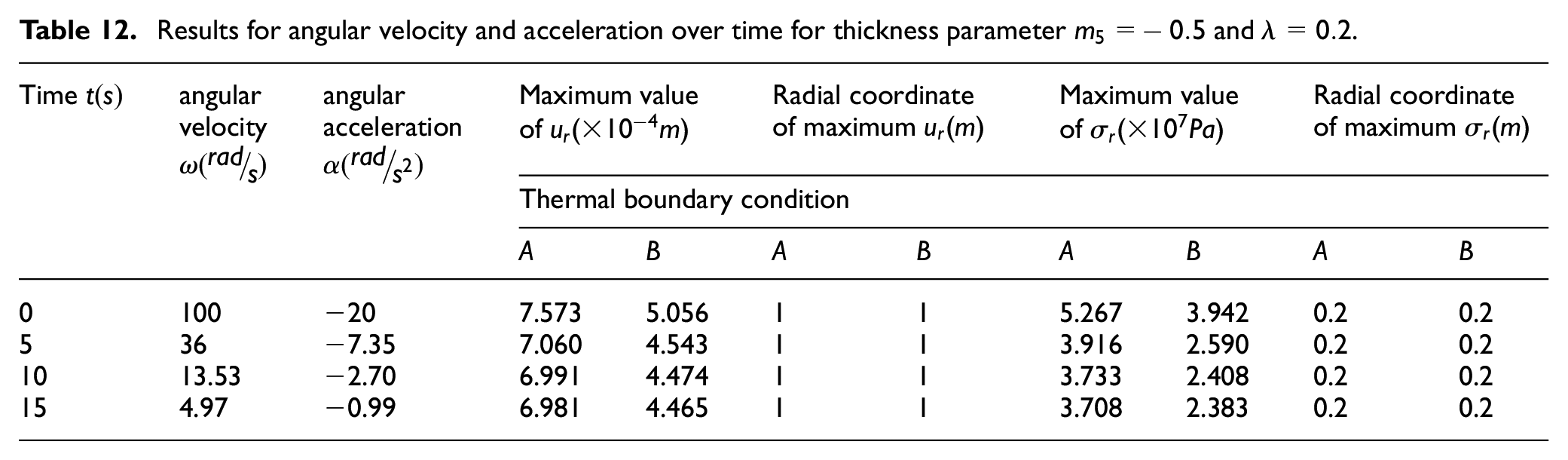
Results for angular velocity and acceleration over time for thickness parameter
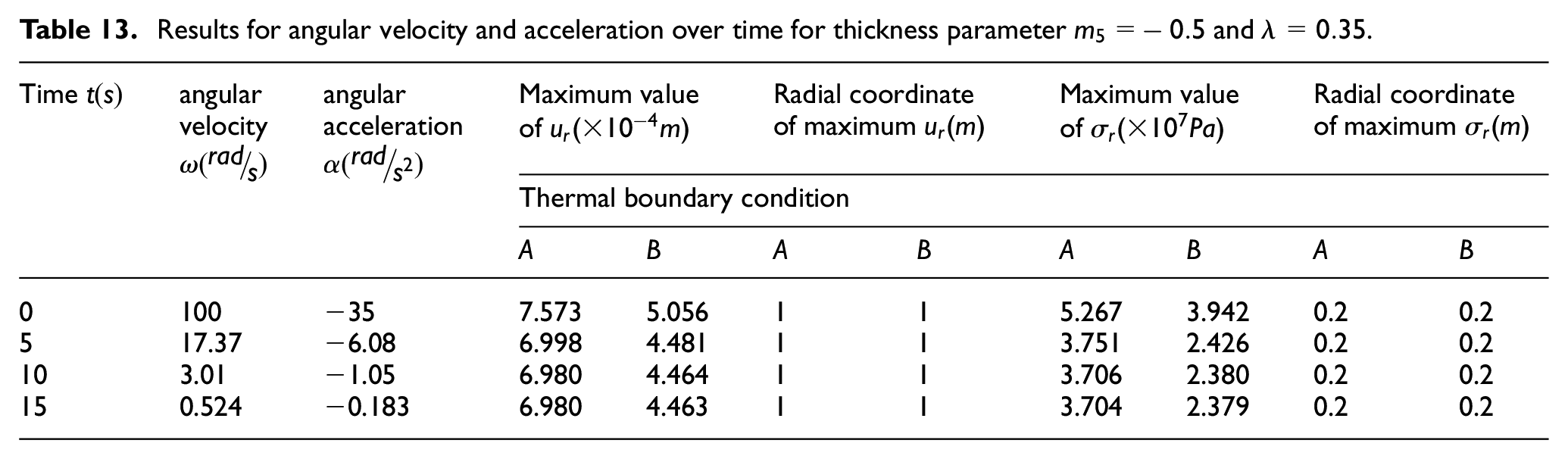
Results for angular velocity and acceleration over time for thickness parameter

The tables show that more time is required to stop the rotating disk as the constant
Conclusion
In this paper, an analytical model is presented to investigate the deformation-stress distribution in FGM rotating disks under time-dependent mechanical and thermal loading conditions. The model considers all the geometrical and mechanical properties of the rotating disk as variable in the radial direction. The heat transfer equation and the governing Navier equations in the radial and tangential direction of the rotating disk are solved using the HPM as the analytical method and verified using the HFDM as the numerical method. The results provided by HPM have good accuracy for both heat and stress analysis, and successfully handle the solutions of these equations simultaneously, as shown in Tables 7 and 8. Since the results of the two analytical and numerical methods are in good agreement, it can be predicted that the results are in good agreement with the experimental data regardless of laboratory errors.
The numerical analysis showed that the disk with a thermal boundary condition
The type of boundary conditions affects the distribution of equivalent von Mises stress. It was shown that the yielding along the radial direction of the rotating disk is not a fixed function, and the ratio of
In the start process of the disk, the time in which plastic deformation is introduced can be improved by considering the smaller value for the constant
As the future works, this model could be expanded to examine more complicated problems of combined loading cases of rotating disk in gears, turbine rotors, flywheels. In this equipment, any form of functions for variable parameters along with creep analysis can be considered. Laboratory tests and the use of experimental data are also the future part of research in this topic.
Footnotes
Appendix
Notation

| r | Radius of disk |
| r i | Inner radius of disk |
| r o | Outer radius of disk |
| h 0 | Thickness of disk at r=ro |
| E | Young’s modulus (GPa) |
| ν | Poisson coefficient |
| ρ | Density, |
| α | Thermal expansion coefficient, |
| k | Thermal conductivity coefficient, |
| σ0 | Yield stress (MPa) |
| E t | Tangent modulus (GPa) |
| q | Constant (GPa) |
| ω 0 | Angular velocity constant (rad/s) |
| λ | Angular velocity constant (1/s) |
| E e | Reference values for elastic modulus |
| ρ e | Reference values for density |
| α e | Reference values for thermal expansion coefficient |
| k e | Reference values for thermal conductivity coefficient |
| m 1 | Grading index of elastic modulus |
| m 2 | Grading index of density |
| m 3 | Grading index of thermal expansion coefficient |
| m 4 | Grading index of thermal conductivity coefficient |
| m 5 | Grading index of thickness function |
| C ij (i,j=1,2) | Constant related to heat transfer function |
| ξ ij (i,j=1,2) | Constant related to heat transfer function |
| T i | Temperature on the inner surface |
| T 0 | Temperature on the outer surface |
| σ ym | Yield stress in the metal |
| V c (r) | Volume fraction function |
| ω | Angular velocity |
| ω e | Elastic limit angular velocity |
| α | Angular acceleration |
| α e | Elastic limit angular acceleration |
| σ r | Radial stress |
| σ θ | Tangential stress |
| τ rθ | Shear stress |
| σ eq | Equivalent von Mises stress |
| t | Time (s) |
| ε r | Radial strain |
| ε θ | Tangential strain |
| γrθ | Shear strain |
| εT | Thermal strain |
| u r | Radial displacement |
| u θ | Tangential displacement |
| u | Unknown function in HPM |
Handling Editor: Sharmili Pandian
Declaration of conflicting interests
The author declared no potential conflicts of interest with respect to the research, authorship, and/or publication of this article.
Funding
The author received no financial support for the research, authorship, and/or publication of this article.
