



Abstract
This article shows the solution of nonlinear differential equations by a new analytical technique called modified optimal homotopy perturbation method. Daftardar-Gejji and Jafari polynomials are used in the proposed method for the expansion of nonlinear term in the equation. Four nonlinear boundary value problems of fourth, fifth, sixth, and eighth orders are solved by modified optimal homotopy perturbation method as well as optimal homotopy perturbation method. The achieved consequences are authenticated by comparison with the results gained by the existing method—optimal homotopy perturbation method. The method consists of few steps and gives better results. The easy applicability and fast convergence are goals of the applied technique. The applied technique has fewer limitations and can be used for the phenomena containing ordinary differential equation, partial differential equation, integro-differential equation, and their systems.
Keywords
Introduction
Various physical phenomena can be formulated in terms of differential equations. These equations are used in different fields of science and engineering. Differential equations of different orders have their own importance and applications. Here, fourth-, fifth-, sixth-, and eighth-order differential equations are taken forming different phenomena.1,2
Particular attention has been given to solve nonlinear differential equations of different forms. Many analytical and numerical techniques are applied to solve such problems, but still some improvement is needed.
Homotopy asymptotic method (HAM) was first introduced by S Liao,3,4 keeping the homotopy concept in topology. Similarly, Ji-Huan He5,6,7,8 used homotopy perturbation method (HPM)9,10 by taking the idea of perturbation process and homotopy concept. These techniques are applied by many other researchers also, but need to be improved. V Marinca et al.11,12,13,14 used a combined idea from the above-mentioned methods and created a new method called optimal homotopy asymptotic method (OHAM).15,16 Similarly, the same authors used the concept of He’s homotopy perturbation technique and produced optimal homotopy perturbation method (OHPM) mentioned in Marinca and Herisanu,17,18 Jajarmi et al., 19 and Alolhasani et al. 20 Both of the above methods consist of homotopy, auxiliary functions, and optimal convergence control parameters. The nonlinear term in the equation is expanded in a series, and the parameters are found by the use of least square method or Galerekin’s method, but further struggles are needed to improve the results. Different researchers used variational iteration techniques to solve boundary value problems.21–25 The new and most important task can be seen in previous studies.26–33
The aim is achieved after many struggles, and it is found that the results can be improved by introducing new polynomials called Daftardar-Gejji and Jafari polynomials26,27 in OHPM. These polynomials have a great role in rapid convergence and improving the results. Here, the nonlinear term in the equation is expanded in terms of Daftardar-Gejji and Jafari polynomials. The auxiliary parameters found in the auxiliary functions can be calculated using different methods. Here, least square and Galerekin’s methods are more suitable. The applied method has no limitations and can be used for the solution of ordinary differential equations (ODEs), partial differential equations (PDEs), integro-differential equations (IDEs), and their systems. Fourth-, fifth-, sixth-, and eighth-order nonlinear differential equations are solved by standard OHPM and modified optimal homotopy perturbation method (MOHPM) to authenticate the code. The achieved outcomes are also compared with the established outcomes of OHAM to check the potential of the used technique.
Sections “Introduction” and “Explanation of the polynomials used in OHPM and MOHPM” consist of introduction and explanation of the polynomials used in OHPM and MOHPM. The proposed method has been explained in section “Proposed method and materials.” Section “Application of MOHPM” is devoted to the application of OHPM and MOHPM to nonlinear differential equations. Finally, in section “Conclusion,” some conclusions are given.
Explanation of the polynomials used in OHPM and MOHPM
Explanation about the polynomials of OHPM and MOHPM
Suppose we have a nonlinear term

If this function is expanded in Taylor series about

Relating to the power of

We notice that these polynomials took only six terms of the series while the series equation (1) consists 10 terms. Relating to the power of

From the above, we notice that these polynomials took all the terms of the expansion equation (1). It clearly indicates the superiority of MOHPM polynomials (Daftardar-Gejji and Jafari polynomials) over the OHPM polynomials.
Convergence
Here the convergence of Daftardar-Gejji and Jafari polynomials is determined. The nonlinear function

Let

for
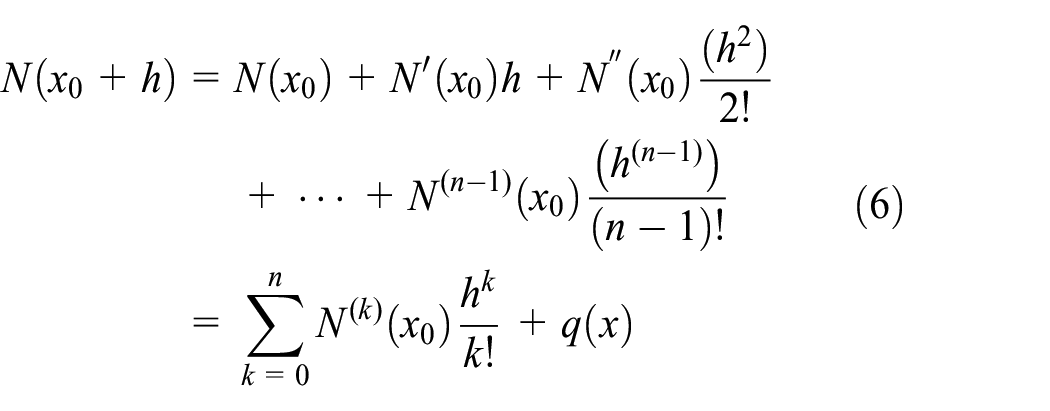
Also, using Taylor’s theorem given below:
Taylor’s theorem: suppose that
where
we get as


In general

Theorem 1
If

For any

Proof
Consider equation (10)
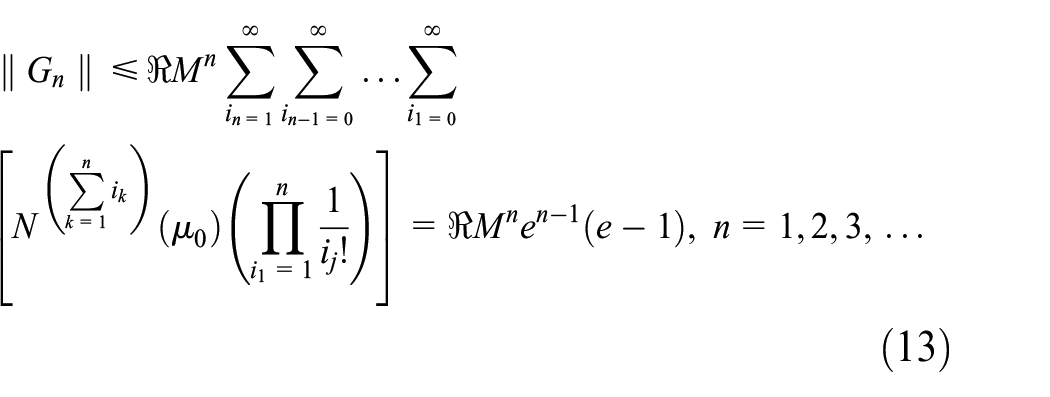
Thus, by the convergent series,
Theorem 2
When
Proof
Let the relation

for
where

Let

Note that

Generally,
Proposed method and materials
Consider the problem


where

where


The paths

When
Now, for MOHPM, the nonlinear function

The expressions

We can now express

Substituting equation (25) into equation (20), and also by introducing a number of unknown auxiliary functions,

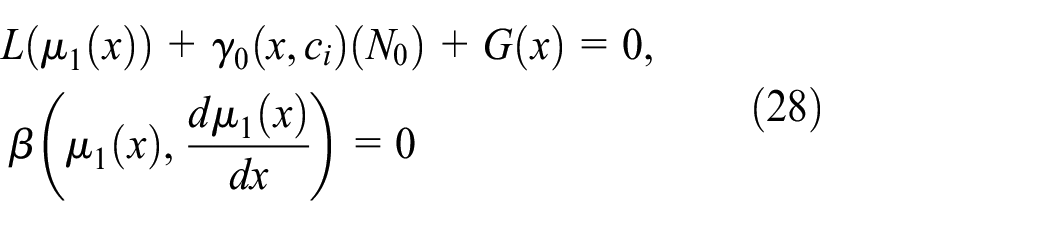
Now, comparing the coefficients of similar powers of
Zeroth-order problem

First-order problem
Second-order problem

Third-order problem

where
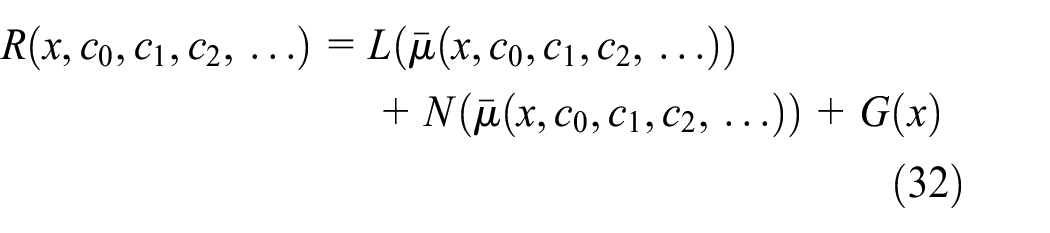
Let

This depends upon the auxiliary functions
If
Defined the function as

and then by minimizing it, we have

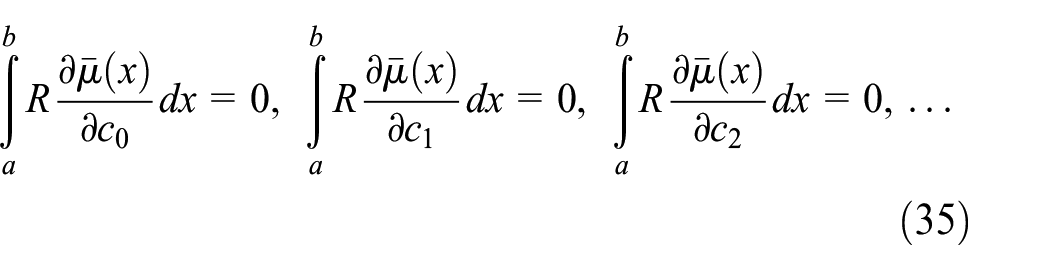
In Galerekin’s method, the following system is used for finding the auxiliary constants as
Application of MOHPM
In this section, high accuracy of MOHPM is shown over the existing methods in the literature. The proposed method is applied to some nonlinear differential equations of different orders. As a result, we see that MOHPM gives best approximation and takes very less time to produce better results.
Example 1
Fourth-order nonlinear boundary value problem 28


This problem has the following exact solution

Applying MOHPM, we obtained the approximate solution of zeroth-order problem for

In OHPM, use the following second-order approximate solution

Applying Galerekin’s method to obtain the following values of c’s for

and the solution in this case is given as

Results of solutions MOHPM and OHPM are shown in Figure 1 and Table 1.

Comparison of MOHPM solution and exact solution for Example 1 (Table 1).
Comparison of the errors obtained by MOHPM, OHPM, and OHAM 28 solutions with the exact solution. We observe that the results of our modified method are better and accurate than the other methods in practice.

MOHPM: modified optimal homotopy perturbation method; OHPM: optimal homotopy perturbation method; OHAM: optimal homotopy asymptotic method.
Example 2
Fifth-order nonlinear boundary value problem 15


For this problem, the exact solution is

Assume the following second-order approximation, to solve this problem

Applying Galerkin’s technique to get the values of ci’s for

Applying MOHPM, the solution is given as

Applying OHPM, we obtained

In this case, solution is

The results of solutions MOHPM and OHPM are shown in Table 2 and Figure 2.
Comparison of the errors obtained by MOHPM, OHPM, and OHAM 15 solutions with the exact solution. We observe that the results of our modified method are better and accurate than the other methods in practice.

MOHPM: modified optimal homotopy perturbation method; OHPM: optimal homotopy perturbation method; OHAM: optimal homotopy asymptotic method.

Comparison of MOHPM solution and exact solution for Example 2 (Table 2).
Example 3
Sixth-order nonlinear boundary value problem: 15
Consider a nonlinear problem of order six

with boundary conditions

The exact solution is

Consider the second-order approximation

Applying Galerkin’s method, we get the following values of ci’s for

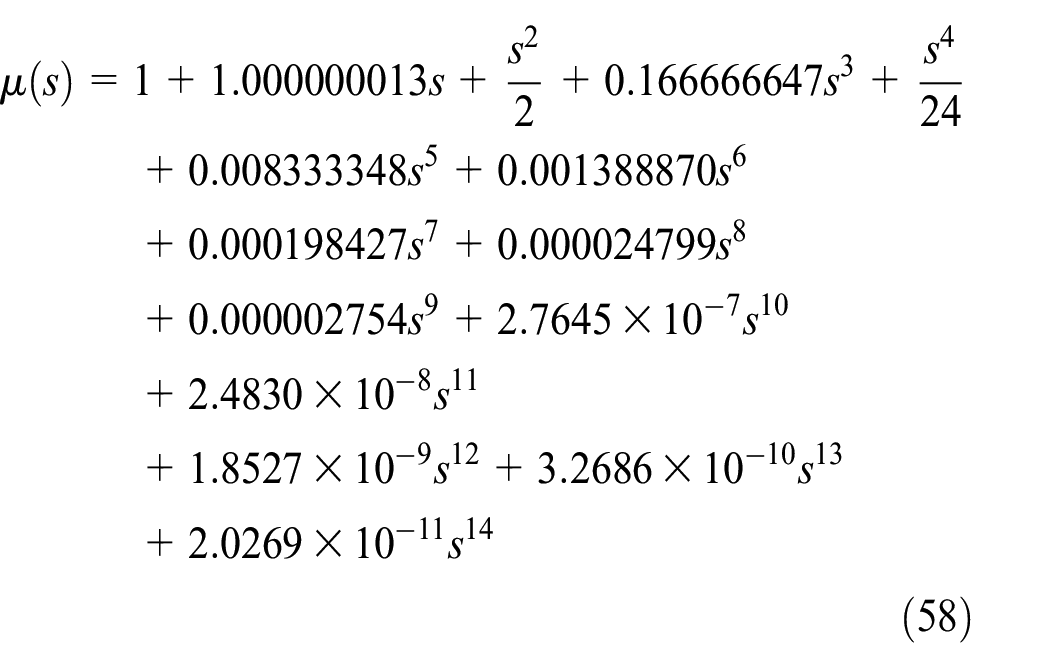
The MOHPM solution in this case becomes

Applying OHPM, we obtained

Approximate solution is given by
Results of solutions MOHPM and OHPM are given in Table 3 and Figure 3.
Comparison of the errors obtained by MOHPM, OHPM, and OHAM 15 solutions with the exact solution. We observe that the results of our modified method are better and accurate than the other methods in practice.

MOHPM: modified optimal homotopy perturbation method; OHPM: optimal homotopy perturbation method; OHAM: optimal homotopy asymptotic method.

Comparison of MOHPM solution and exact solution for Example 3 (Table 3).
Example 4
Eighth-order nonlinear boundary value problem: 16
Consider nonlinear problem

with boundary conditions

The exact solution is

Consider

By Galerkin’s method, we get the following values of ci’s for

The MOHPM solution becomes

Applying OHPM and Galerkin’s method, we obtained

In this case, the solution is

The results of solutions MOHPM and OHPM are shown in Table 4 and Figure 4.
Comparison of the errors obtained by MOHPM, OHPM, and OHAM 16 solutions with the exact solution. We observe that the results of our modified method are better and accurate than the other methods in practice.

MOHPM: modified optimal homotopy perturbation method; OHPM: optimal homotopy perturbation method; OHAM: optimal homotopy asymptotic method.

Comparison of MOHPM solution and exact solution for Example 4 (Table 4).
Results and discussion
Here, a new analytical method is created, which gives better results as compared to the results obtained by the existing methods like OHPM and OHAM. Here, Daftardar-Gejji and Jafari polynomials are used in the proposed method for the expansion of nonlinear term in the differential equation. It is economical in terms of computer power/memory and does not involve tedious calculations This method has less limitations and can be applied to every type of differential equation like ODEs, PDEs, IDEs, and their systems. Here, the proposed method is applied to four nonlinear boundary value problems of fourth, fifth, sixth, and eighth orders, and the results are authenticated by comparing with the results obtained by the other methods mentioned in this article. Table 1 and Figures 1 and 2 indicate the solution of fourth-order differential equation. Also, comparison of the errors obtained by MOHPM, OHPM, and OHAM with the exact solution is given in this table. It is observed that the results of the modified method are better. The solution of different boundary value problems of fifth and sixth orders as well as the comparison of the errors with other mentioned methods are explained in Tables 2 and 3, and Figures 3 and 4, which claim the potential of the suggested method. Table 4 shows the solution of nonlinear boundary value problem of eighth order. The achieved errors are also compared with the errors gained by other methods mentioned in Table 4. It is observed that the proposed method is more powerful for the solution of nonlinear boundary value problems of any order.
Conclusion
Here, a new idea (Daftardar-Gejji and Jafari polynomials) has been established and successfully applied this to four nonlinear boundary value problems of fourth, fifth, sixth, and eighth order which provide more accurate results than the standard OHPM and OHAM. The solutions of the MOHPM show outstanding consensus with the exact solution. The quality of MOHPM is that it needs only few steps to achieve good results. It has less limitation. Auxiliary functions, initial guess, optimal convergence control parameters, Galerkin’s method, and least square have great effect on the solution and increase the accuracy. Various ODEs of any order can be solved by this technique. It can also solve PDEs, IDEs, and their systems. This technique has found to be more beneficial for engineers, scientists, and researchers of every field to use.
Footnotes
Handling Editor: James Baldwin
Author contributions
L.A. conceived and designed the analysis; analyzed and interpreted the data; contributed to analysis of tools or data; and solved the problems. S.I. and T.G. analyzed and interpreted the data. L.A. and I.S.A. contributed to analysis of tools and wrote the paper.
Declaration of conflicting interests
The author(s) declared no potential conflicts of interest with respect to the research, authorship, and/or publication of this article.
Funding
The author(s) received no financial support for the research, authorship, and/or publication of this article.
