



Abstract
During the operation of an active clearance control (ACC) system of a turbine, the aerodynamic performance of the intake grille indirectly influences its control. To improve the performance, an aerodynamic optimization method is proposed, consisting of parameterization, an optimization algorithm, and a fitness evaluation. During parameterization, its geometry is represented by seven geometric variables. A modified social spider algorithm is used as the optimization algorithm. To evaluate the aerodynamic performance of the grille, a special fitness function is adopted, obtained using an adaptive topological multi-layer feedforward artificial neural network. To verify the feasibility of this method, experiments and numerical calculations are carried out on the original and optimized intake grilles. The results show that the average intake flow rate and average total pressure recovery coefficient of the optimized grille have increased by 17.3% and 4.9%, respectively.
Introduction
The gas-turbine is a core component of civil aero engines, converting the energy of a high-temperature high-pressure gas into mechanical energy. However, its efficiency, performance, and service life are easily affected by its blade-tip clearance.1,2 Active clearance control (ACC) technology tightly controls blade-tip clearance during engine operation, so as to improve engine performance, reduce fuel consumption, and increase service life. 3 Among all feasible ACC methods, the thermal control ACC method is the most widely used. The working principle of the ACC of a high-pressure turbine (HPT) is to control the thermal deformation of the turbine casing.4,5 Turbine casing is usually cooled or heated by intake airflow at various temperatures under the action of a high-pressure compressor or external bypass, resulting in radial deformation of the casing. 6
Generally, the character of a thermal control ACC system exists in two main aspects: the outlet cooling character and the inlet intake character.7,8 Various studies have focused on the outlet cooling characters of the ACC. The numerical simulations have been validated to be available, 9 for example, have been used to examine the outflow characteristics and heat transfer characteristics of impinging holes of a cooling pipe with circular section for the ACC of a low-pressure turbine. 10 The insulating coverage effect of a perforated impact-jet on the surface of casing with circular cross-section flat cooling air pipe has been explored. 11 Work has also been conducted on the influence of flow mode on the internal heat transfer characteristics of ACC casing in a high-pressure turbine. 12 However, very little research has been conducted on the inlet intake character of an ACC.
With the fast development of computational technology, various optimization theories have been investigated and some applied to the aerodynamic performance and stability optimization of machines.13,14 Optimization is usually divided into three procedures: shape parameterization, deriving the optimization algorithm, and fitness value evaluation. 15 Honing these procedures should result in the effectiveness and efficiency of optimization. 16 During optimization, the dimensions of its design variables are completely determined using parameterization methods. 17 Good parameterization methods have things in common, such as enough flexibility to cover the whole search space, few design parameters, and the ability to avoid curvature discontinuities at a junction. 18
Among all the optimization theories, intelligent algorithms are the most popular. These are divided into two main categories: evolution algorithms and population algorithms. 19 Population algorithms have a smaller control coefficient but a faster search speed. The particle swarm optimization algorithm (PSO), a traditional swarm algorithm, is widely used in the optimization of machines. However, when dealing with multidimensional optimization problems, the algorithm readily produces unwanted, local extreme values and does not converge, therefore, to a global optimal value. 20 To mitigate this problem, the social spider algorithm (SSA), a new population algorithm, was proposed by Yu and Li. 19 Yu and Li 21 showed that the SSA could deal with various high-dimension optimization problems. Unlike other population intelligence algorithms, the SSA could move toward the target using the current position of other spiders on the spider web and its own previous position. Although it exhibited a considerable searching ability for multiple extreme optimization problems, the convergence velocity and precision of the algorithm were weakened.
As well as the parameterization and the optimization algorithm, the fitness value evaluation is also very important. The fitness value is usually calculated using the aerodynamic performance parameters of the flow field. However, the computational consumption of the flow field calculation could not be stood in every case. 22 To overcome this problem, a surrogate model has been proposed, in which the complex nonlinear relationship between the geometric parameters and aerodynamic performance are taken into account.23–25 Owing to its significant approximation capability, a multilayer feedforward artificial neural network (MLFANN) 26 is often used as a surrogate model. An MLFANN’s approximation capability is mainly influenced by its topology structure. 27 To optimize the topology structure of an MLFANN, various global intelligent optimization methods have been adopted, such as genetic algorithms (GAs), 28 simulated annealing (SA), 29 and particle swarm optimization (PSO). 30 Although these methods can improve the approximation capability of an MLFANN by optimizing parts of its topology structure, there is still no way to determine a high-efficiency topology.
The intake grille is an effective solution for better aerodynamic performance. 31 To improve the intake performance of an ACC intake grille, an improved aerodynamic performance optimization method is proposed in this work. This method is divided into three parts: parameterization, the optimization algorithm, and fitness value evaluation. Using the commercial software NX 12.0, the intake grille is parameterized using seven key variables. To improve the convergence velocity and precision of the original SSA, a modified SSA is proposed. In this modified algorithm, an adaptive factor and an adaptive mutation operator are added to the original SSA to increase its search velocity and decrease its loss in population diversity. In order to calculate the fitness value of the grille quickly, an MLFANN is used as a surrogate model. The topology structure of the MLFANN can be determined adaptively using an improved hybrid intelligent optimization method. To verify the feasibility of the aerodynamic optimization method, a practical intake grille is optimized.
Aerodynamic optimization methodology
Parameterization of intake grille
The intake airflow of the ACC is shown in Figure 1. The bypass bottom is arc-shaped, and the top surface of the intake grille is coplanar with the inner bottom surface. Figure 1(a) shows that a proportion of the cooling airflow in the bypass is imported to the ACC by the intake grille. Figure 1(b) shows a geometric model of the intake grille, which has four arc-shaped blades. The intake performance of grille is affected by its geometry. 32 To realize the geometric deformation of the grille, it is parameterized using key geometrical parameters with the commercial software NX 12.0. Figure 2 shows the seven geometric parameters selected to describe the geometry of the intake grille: the inlet angle, outlet angle, chord, interval 1, interval 2, interval 3, and interval 4.
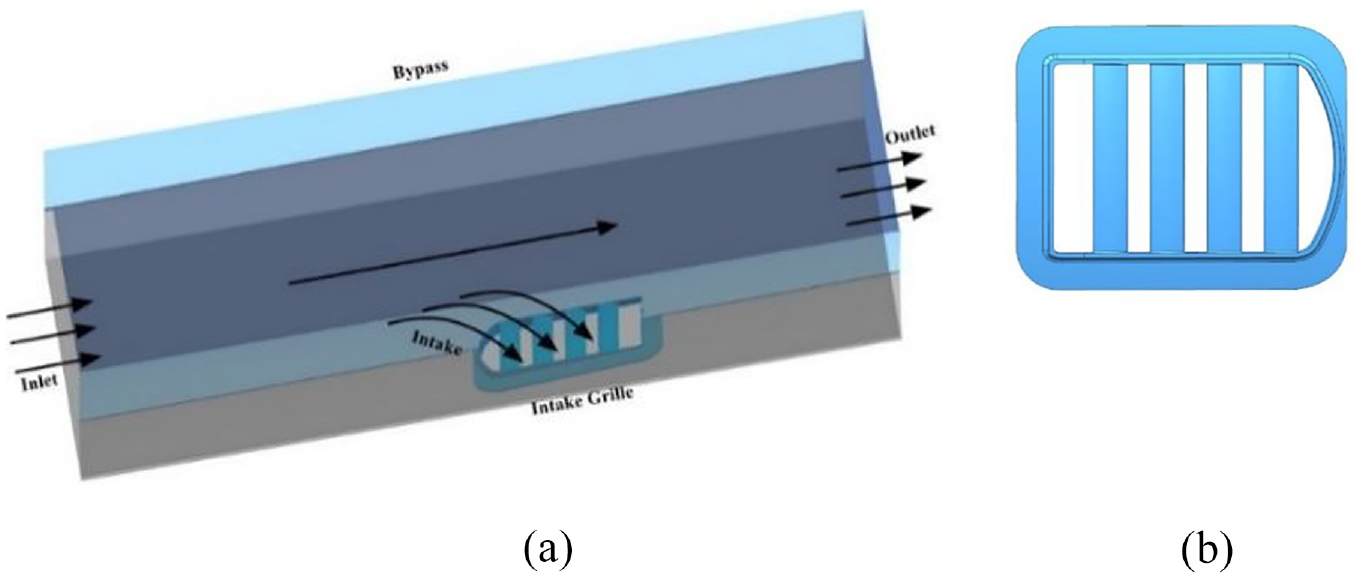
ACC intake: (a) intake process and (b) intake grille model.

Parameterization of the intake grille.
Modified social spider algorithm (MSSA)
For high-dimension problems, the SSA,19,21 a swarm intelligent algorithm, has been proposed. The spider web is the solution space of the optimization problem, and each spider on the web represents a feasible solution. To find the position of a food source, spiders share the information through vibration. Then, using its own historical vibration intensity and other spiders’ current vibration intensities, a spider can choose its direction of movement to perform a random walk. The algorithm is divided into four main parts: initialization, vibration generation, random walk, and constraints control. The first is to set up control parameters and randomly assign positions to spiders. Then, their fitness values are evaluated. During the vibration generation, its intensity of vibration in its current position is defined using equation (1), and its vibration attenuation is calculated using equation (2). Based on the vibration, the random walk of a spider is described by equation (3). Before a spider’s random walk, the constraint in equation (4) is used to prevent spiders from moving out of the search space.




where
However, in the original SSA, there are two disadvantages that affect global optimization. One is that, during optimization, an individual spider uses its own information to randomly move toward the position of maximal vibration, where it can feel. This movement reduces the convergence speed of the algorithm, limits its global optimization ability, and reduces the adaptability of the iterative process. The other disadvantage is that individuals aggregate in multiple regions and in multiple solution spaces after combining their own experiences and information from the population. To provide solutions to these two problems, an adaptive factor and an adaptive mutation operator are adopted in the SSA. The equation for the adaptive factor


where
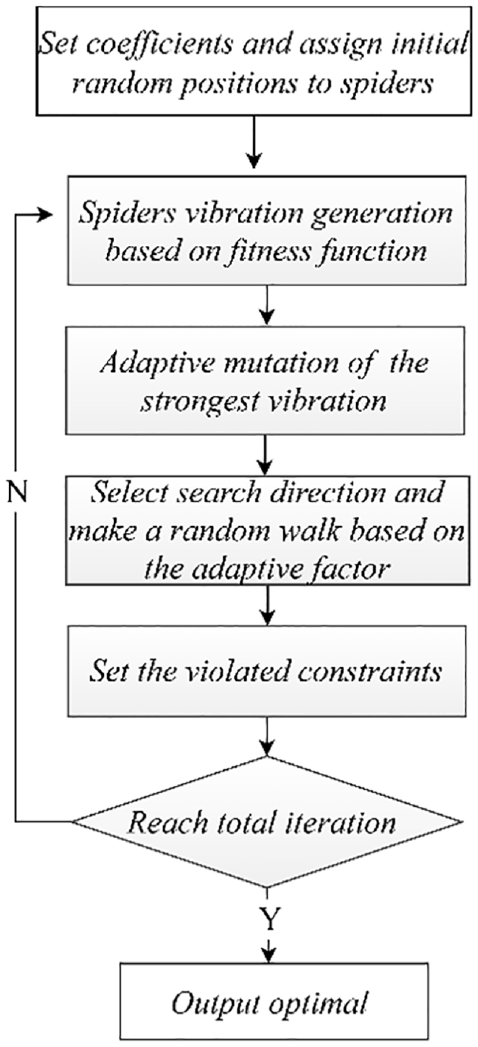
The process of MSSA.
Surrogate model
Fitness function
In this work, aerodynamic optimization searches the intake grille with optimal aerodynamic performance. Two coefficients are used in the assessment of the aerodynamic performance of the intake grille, the total pressure recovery coefficient
The law of conservation of energy must be satisfied in a flow system involving heat exchange. The law can be expressed as the increase rate of energy in the microelements, which is equal to the net heat flow into the microelements plus the work done by physical and surface forces on the microelements. In other words, the first law of thermodynamics is obtained:

where
Surrogate model
In this work, an MLFANN is adopted as a surrogate model to approximate the complex nonlinear relations of practical problems. In the MLFANN, the data are trained using the back propagation method, 35 the dataflow is controlled by equation (8), the linear function as the activation function for the input and output layers, the sigmoid function (shown in equation (9)) is used for the hidden layer, and the error between the practical output value and the ideal output value is calculated using equation (10).


where
The approximation precision of the MLFANN is easily affected by its topology structure. However, no solid theory exists that determines MLFANN topology accurately and effectively. To obtain MLFANN topology automatically, a hybrid intelligent algorithm is proposed. This algorithm combines the high-dimensional optimization of the MSSA, the quick-search capability of discrete particle swarm optimization (DPSO), and the ability to quickly jump out the local optimum of a modified very fast simulated annealing algorithm (MVFSA).
36
The MSSA was discussed above. The update velocity and the location of DPSO are given by equations (11) and (12), respectively. In the MVFSA, the initial particle is distributed by equation (13), and the random probability of acceptance


where
Aerodynamic optimization of intake grille
Based on the optimization order, the whole aerodynamic optimization of the intake grille is further divided into three parts (shown in Figure 4): the sample database, the surrogate model, and the aerodynamic optimization. During the construction of the sample database, the geometry of the intake grille is parameterized using the commercial software NX 12.0. In order to make the samples distributed in the whole search space uniformly, the Latin hypercube sampling design method 39 is adopted. To calculate the aerodynamic performance of a sample, the commercial meshing software ICEM and the commercial CFD software CFX are used. Using the sample database and the back propagation method, the MLFANN is trained. During training, weights and biases are optimized using MSSA, and the number of hidden layers and the number of neurons are optimized using DPSO-MVFSA. The trained MLFANN is selected as the surrogate model. In aerodynamic optimization, the sample database is as the initial position of spiders, and the fitness values of the moving spiders are calculated quickly using the surrogate model. The optimization is stopped until the maximum iteration is reached.
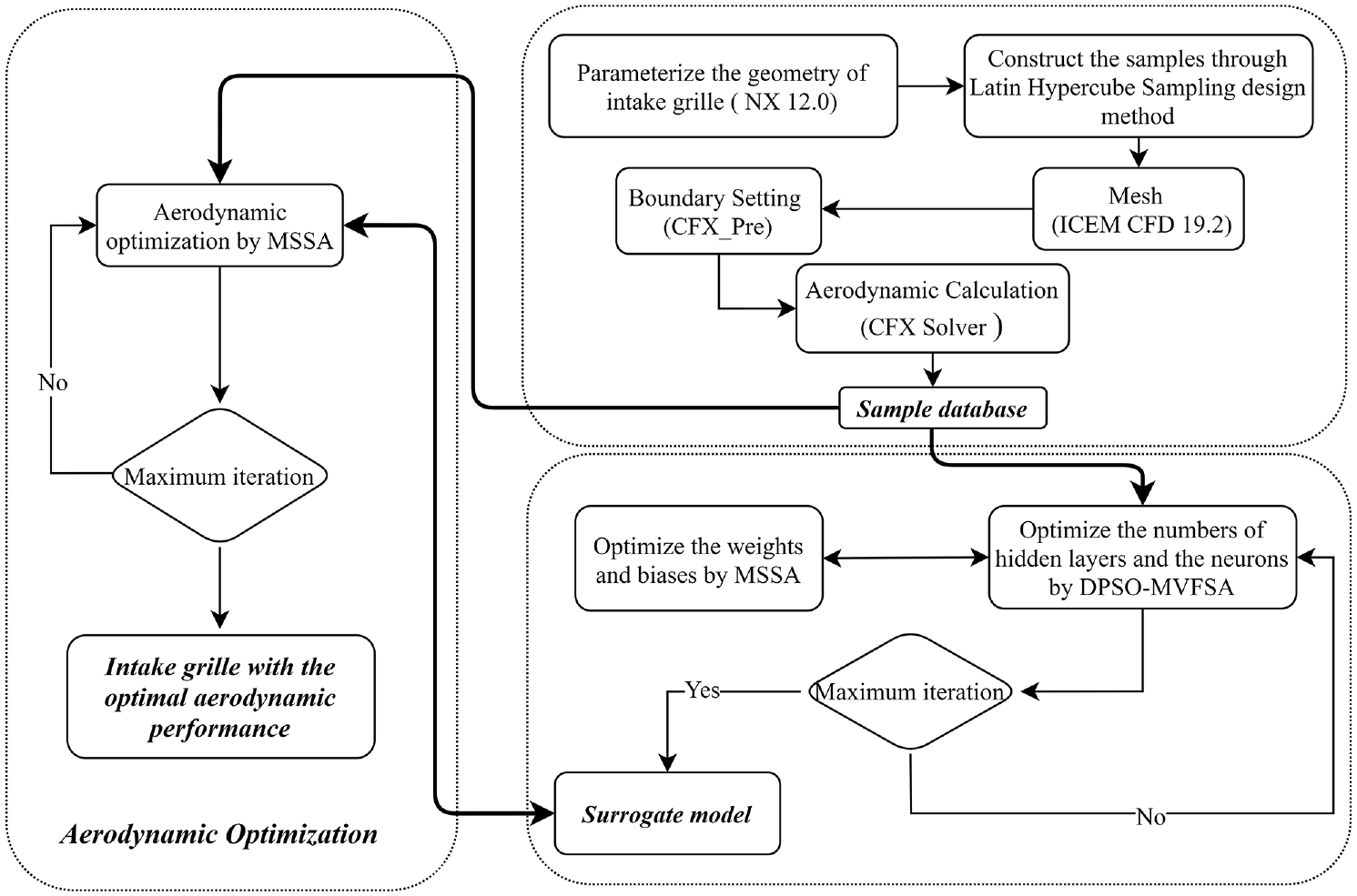
Illustration of aerodynamic optimization.
MSSA validation
To validate the improvement of the MSSA and the feasibility of the surrogate model, two multimodal functions are used as test functions, the Griewank function (equation (16)) and the Rastrigin function (equation (17)).


Figure 5 shows two-dimensional forms of these two functions, with many local minima but only one global minimum [0, 0]. These are usually used as benchmark functions to verify optimization methods. They are also used to describe the complex nonlinear relations. In this work, the dimensions of these two functions are set to 10, and the value ranges are set to [−10, 10].

Two multimodal functions in two-dimensional form: (a) Griewank function and (b) Rastrigin function.
To verify the performance of our MSSA, two other social spider algorithms are selected as benchmark algorithms: the original SSA and an improved SSA (ISSA). Using convergence curves, optimal convergence results, and average convergence results, the optimization performances of the three algorithms are compared.
Figure 6 shows convergence curves for the three algorithms. It is seen that for the optimization of two functions, the iteration number of MSSA is the minimal among these three algorithms. Which means that the iteration velocity of MSSA is the fastest. The convergence velocity of the MSSA is significantly better than that of the SSA and ISSA in the early stage. This indicates that the adaptive factor increases the convergence velocity in the early stage of iteration and balances the global and local convergence capabilities during optimization. Table 1 shows that the MSSA is better than the SSA and ISSA in terms of convergence accuracy for both the optimal convergence results and the average convergence results. This means that the algorithm proposed in this paper delivers a good performance, which makes the algorithm jump out of the local optimal value effectively and approach the global optimal value, so as to obtain more accurate optimization results.
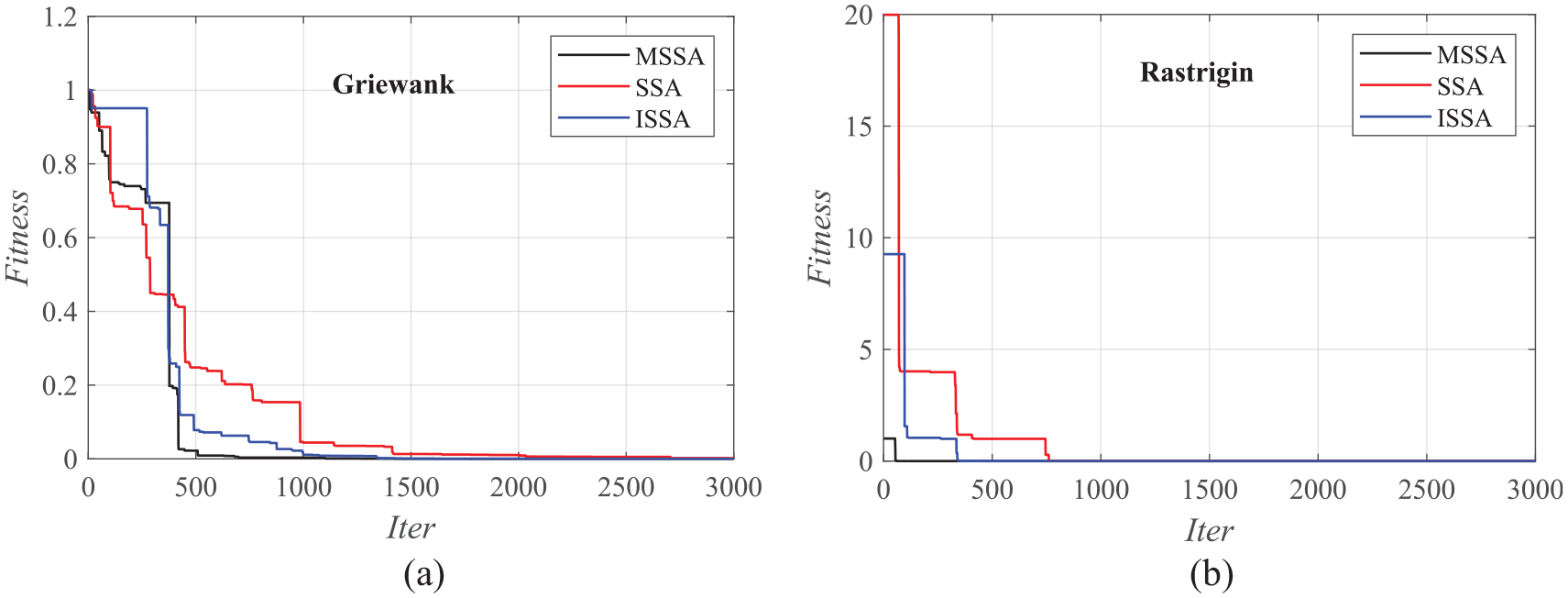
Convergence maps of the three SSA algorithms using the (a) Griewank function and (b) Rastrigin function.
Comparison of results for the three optimization algorithms.

To prove the feasibility of the surrogate model in approximating nonlinear relations, these two functions are approximated by this model. Firstly, two groups of the sample database are constructed using the Latin hypercube sampling design method, and the number of samples for both groups is set at 500. The MLFANN is then trained and optimized using the sample database. The final MLFANN constitutes the surrogate model. During training, four evaluation parameters,
Evaluation results.

Aerodynamic optimization of intake grille
Experiment
The intake grille of the ACC of a particular type of turbine has been designed. However, its aerodynamic performance is not up to design requirements. Therefore, an aerodynamic optimization method for the intake grille is proposed. Aerodynamic performance experiments on the original intake grille and on an optimized intake grille were done in Key Lab. for Power Machinery and Engineering of SJTU. Figure 7 shows the test apparatus, in which three total pressure probes and two static pressure probes are mounted. One flow sensor is mounted at the inlet and another at the outlet of the main pipe. Using these measured values, the total pressure recovery and the intake airflow coefficients can be calculated.

Test apparatus of the intake grille: (a) practical test apparatus and (b) simple test model.
In assessing the aerodynamic performance of the two grilles, five special inlet operating conditions were selected, 0.1, 0.25, 0.3, 0.4, and 0.5 Ma. The opening static pressure was used as the outlet condition of the main pipe and the intake device. For each operating condition, the outlet Reynolds number of the intake device was adopted as the collection criterion, and the numbers were, respectively, 4.14e+04, 71.52e+05, 1.49e+05, 1.7e+05, 5.32e+04. Before the experiments, the inlet and outlet boundaries were required to be converted to mass flow. In each experiment, adjustments in the static pressure of the outlet were realized by controlling the outlet sections of the main pipe and the intake device. When the mass flow of the outlet of the intake device reached the mass flow corresponding to the special Reynolds number, the pressure at each measuring point was collected. Using these collected data, the intake airflow coefficient and the total pressure recovery coefficient were calculated.
Simulation and validation
During the aerodynamic optimization of the intake grille, a simulation calculation and validation were necessary for the construction of a sample database. Using the geometry of the original intake grille, a test apparatus model was built using NX 12.0 software. The model was meshed using unstructured grids in ICEM 19.2 software (Figure 8). Before calculation of the airflow field using CFX, the boundary was set such as the flow model is steady, mass flow selected as the inlet condition, opening pressure as the outlet condition, and the turbulence model,

Mesh model: (a) mesh of test apparatus and (b) mesh of intake grille.
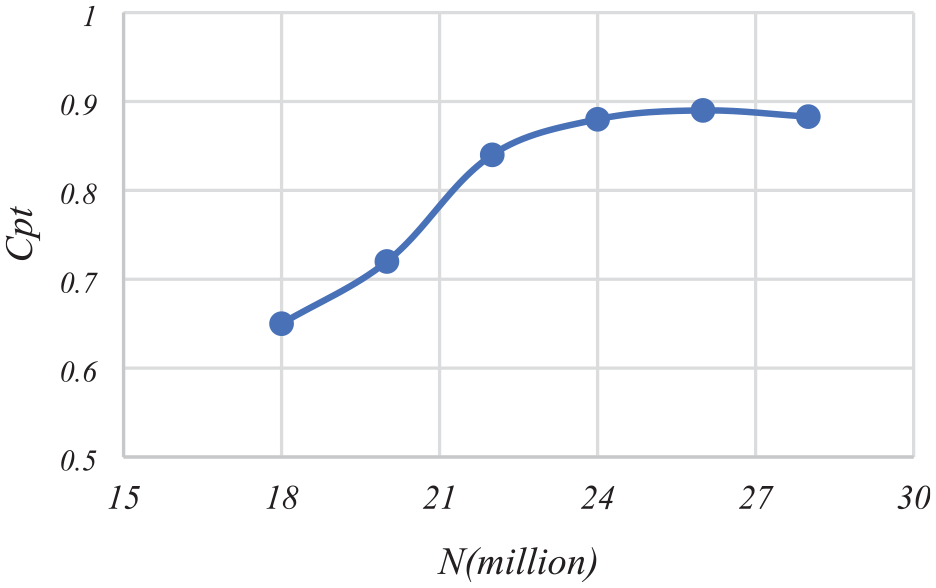
Total pressure recovery coefficient curve.
To compare the differences in aerodynamic performance between the experiment on and simulation of the intake grille, two coefficients, the intake airflow and the total pressure recovery coefficients, were used. Five working conditions were chosen to be analyzed.
Figure 10 shows small gaps between the two groups of coefficients obtained from experiment and CFD: the maximum relative error of the intake airflow efficiency is 3.4%, and the maximum relative error of the total pressure recovery coefficient 1.5%. The curve trends of these two coefficients obtained from CFD are similar to those of the experiment. Thus, the CFX simulation predicts the aerodynamic performance of the intake grille.
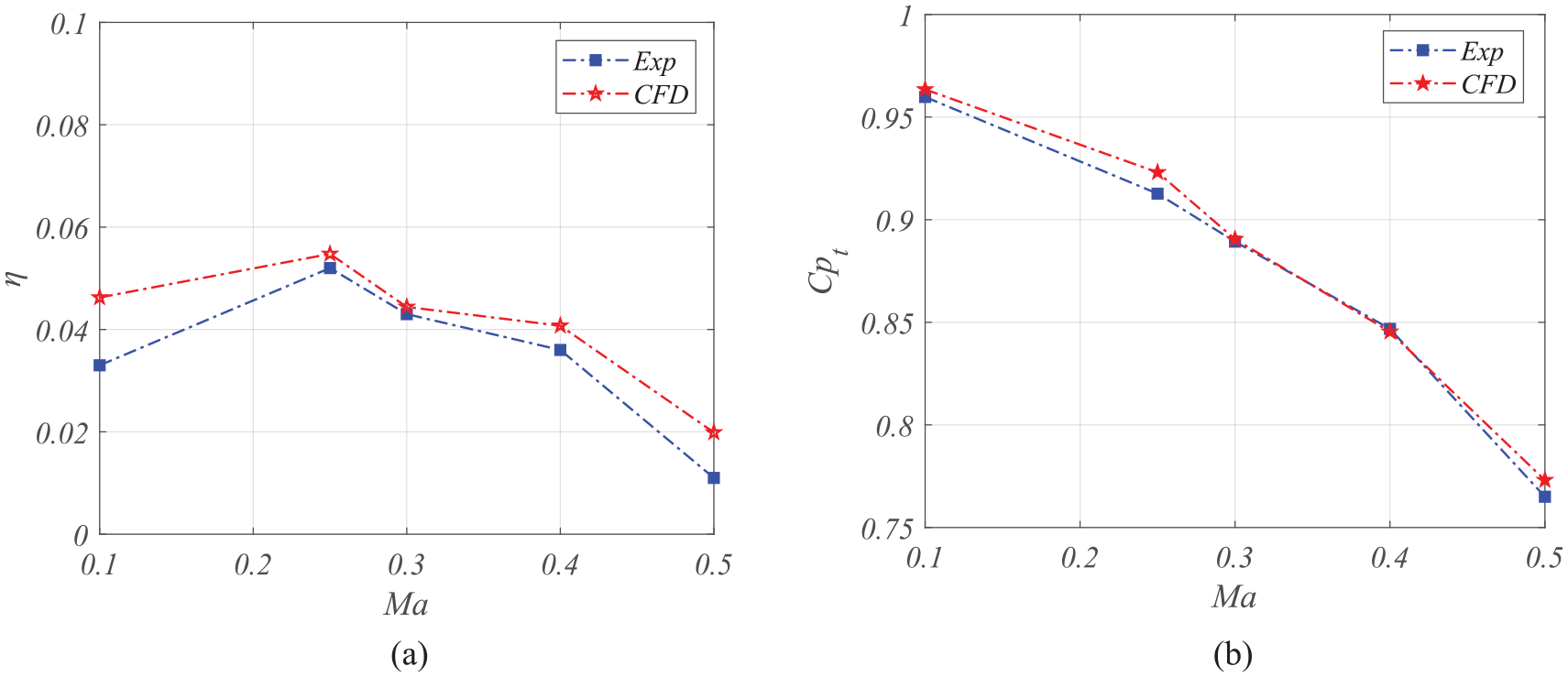
Aerodynamic performance validation: (a) intake airflow coefficient and (b) total pressure recovery coefficient.
Aerodynamic optimization
Aerodynamic optimization process
Using the geometry of the initial intake grille, parameterization is conducted. Seven geometric control parameters,

Aerodynamic performance analysis
By running the iterative optimization many times, the grille with the best aerodynamic performance was found. The geometries of the original and the optimal grilles are shown in Figure 11. Using the geometric structure of the original grille as a baseline, the inlet and the outlet angles of the optimized grille have increased, the chord length has decreased, and the interval has increased.
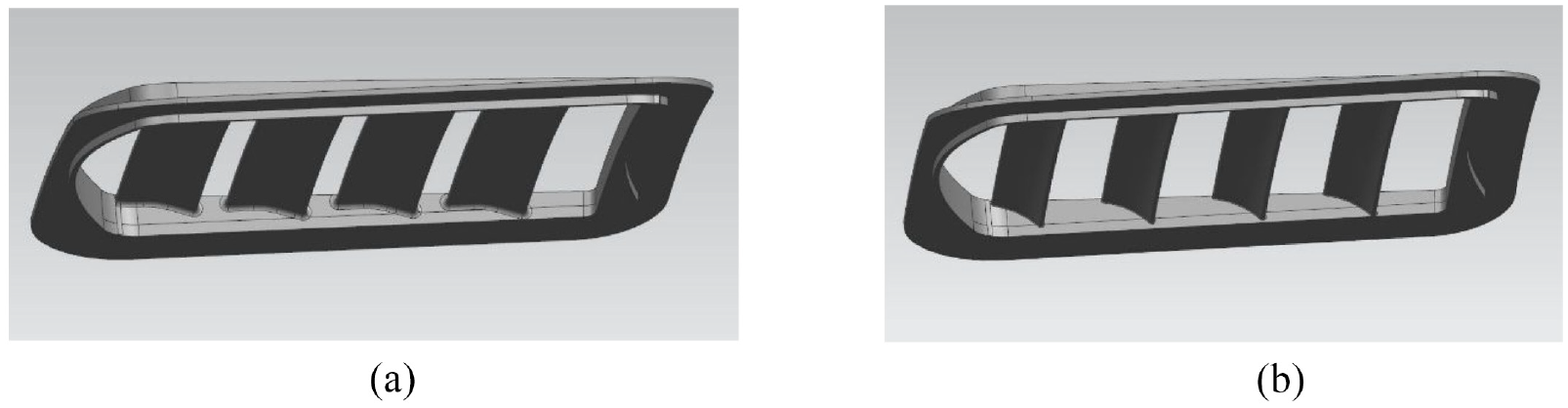
Geometry of a grille: (a) original grille and (b) optimal grille.
To compare the practical differences in aerodynamic performance, we used the above mentioned five operating conditions for the two kinds of grilles. Two aerodynamic performance coefficients for an optimized grille were calculated. The coefficients of the two grilles are displayed in Figure 12. The average intake airflow and the average total pressure recovery coefficients of the optimized grille have, respectively, increased by 17.3% and 4.9%, using the initial grille as a baseline.
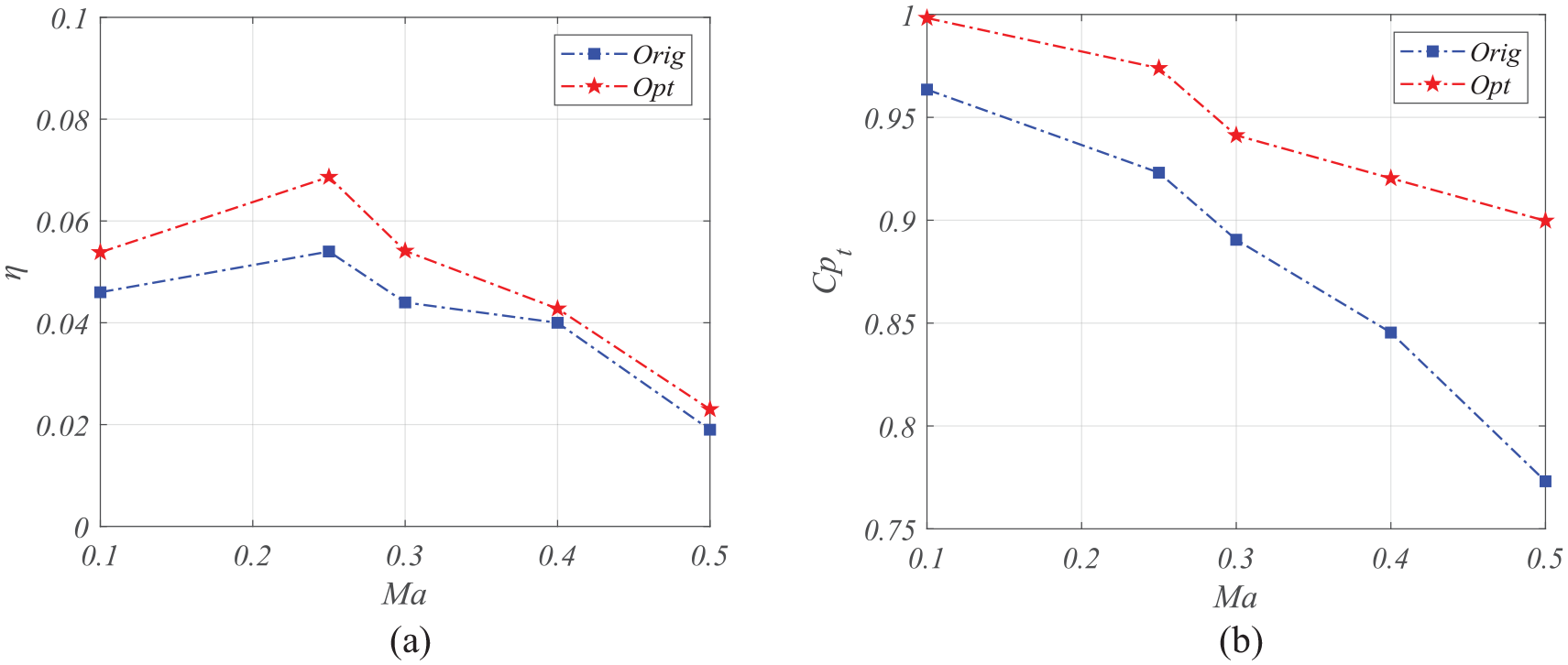
Aerodynamic performance coefficient comparisons: (a) intake airflow coefficient and (b) total pressure recovery coefficient.
To analyze the effect of geometry on the airflow field of the intake grille, two operating conditions, 0.3 and 0.4 Ma, were adopted and simulated using the validated CFD method. In this work, the velocity contours are used as an analytical tool (Figure 13). The separation loss of the initial grille is bigger than that of the optimized grille. Combined with Figures 11 and 12 shows that the increase in inlet angle and outlet angle results in a decrease in the airflow separation of the lower surface of each blade. There is a concomitant decrease in chord length and increase in, all resulting in the interval can enhance the intake airflow. Therefore, the aerodynamic performance of the intake grille can be improved by this aerodynamic optimization method.

Velocity contours: (a) original grille (0.3 Ma), (b) optimized grille (0.3 Ma), (c) original grille (0.4 Ma), and (d) optimized grille (0.4 Ma).
Conclusions
In this work, an improved aerodynamic optimization method for an intake grille was proposed. The geometry of the intake grille was parameterized using NX 12.0. A special fitness function was proposed related to its geometric parameters and aerodynamic performance. An MSSA was used as the aerodynamic optimization algorithm. To evaluate the fitness value quickly, an MLFANN was selected as a surrogate model. Two multimodal functions were used to verify improvements in the SSA and the feasibility of the surrogate model. Lastly, a practical intake grille was optimized using this method. This paper ran as follows.
The geometry of the intake grille was parameterized using seven geometrical parameters, and the shape transformation can be achieved by fewer control parameters in comparison of the traditional repetitive design. This method had enough flexibility to cover the important search space.
An MSSA was proposed and used as the optimization algorithm. Compared with other SSA methods, an adaptive factor and an adaptive mutation operator were added to the MSSA. The former not only increased the convergence velocity at an early stage, but also balanced the global and the local convergence capabilities during optimization. The latter can make the strongest vibration jump out of the local extremum.
To obtain the fitness value of the intake grille quickly during optimization, an improved MLFANN was used as a surrogate model. Its topology structure was optimized using an adaptive intelligent algorithm. Using this model, the effect of human factors on the training of an MLFANN was decreased, and the approximation capability of the surrogate model was increased.
Analyzing the results for the practical intake grille showed that the average intake airflow and the average total pressure recovery coefficients of the optimized grille increased, respectively, by 17.3% and 4.9%, in comparisons of those of the initial grille and the separation loss of the optimized grille is smaller than that of the original. Thus, this aerodynamic optimization could be used to optimize the aerodynamic performance of an intake grille.
Future research will focus on the applicability of this model, including further increasing optimization scenarios, such as how to further validate and enhance the accuracy of the proxy model after increasing control parameters.
Footnotes
Handling Editor: Sharmili Pandian
Author contributions
Hong Xie: conceptualization (equal), data curation (equal), and writing (original draft). Shuyi Zhang: formal analysis (equal), investigation (equal), and methodology (equal). Xiangfeng Shi: software (equal) and validation (equal). Bo Yang: writing (review and editing (equal)), Chunrong Wang: data curation (equal).
Declaration of conflicting interests
The author(s) declared no potential conflicts of interest with respect to the research, authorship, and/or publication of this article.
Funding
The author(s) disclosed receipt of the following financial support for the research, authorship, and/or publication of this article: The authors are grateful for the financial support from the National Fund Cultivation Program of Sanming University (Grant No. PYT2203), the funding for the Sanming University’s Introduction of High Level Talents Research Initiation Project (Grant No. 22YG08), the Special Project of Central Government Guiding Local Science and Technology Development (Grant No. 2021L3029), and the Fujian Natural Science Foundation (Grant No. 2023J011033).
