



Abstract
Studying the combination of convection and chemical processes in blood flow can have significant applications like understanding physiological processes, drug delivery, biomedical devices, and cardiovascular diseases, and implications for various fields can lead to developing new treatments, devices, and models. This research paper investigates the combined effect of convection, heterogeneous-homogeneous chemical processes, and shear rate on the flow behavior of a ternary hybrid Carreau bio-nanofluid passing through a stenosed artery. The ternary hybrid Carreau bio-nanofluid consists of three different types of nanoparticles dispersed in a Carreau fluid model, miming the non-Newtonian behavior of blood. This assumed study generates a system of PDEs that are processed with similarity transformation and converted into ODEs. Furthermore, these ODEs are solved with bvp4c. The results show that the convection, heterogeneous-homogeneous chemical processes, and shear rate significantly impact the bio-nano fluid’s flow behavior and the stenosed artery’s heat transfer characteristics.
Keywords
Introduction
A chemical mechanism including both homogeneous and heterogeneous chemical reactions leads to the development of atherosclerotic plaques in arteries. Homogeneous chemical processes occur within a single phase, such as the bloodstream oxidizing low-density lipoprotein (LDL). These reactions involve the adhesion, migration, and transformation of monocytes into macrophages, the uptake and oxidation of LDL, and the release of pro-inflammatory cytokines. So, it’s essential to know how different types of chemical reactions work together to make suitable atherosclerosis treatments. The articles1–3 are helpful to understand these concepts in this regard. Vaidya et al. 4 presented the theory of how blood flows through small arteries using a mixture called MHD Bingham fluid. It looks at how the fluid moves due to peristalsis, a natural squeezing motion. The article also examines how several chemical reactions occur in this process. Tanveer et al. 5 made a theoretical exploration of peristaltic activity within a magnetohydrodynamics (MHD) based blood flow system comprising non-Newtonian fluid behavior. Later on, some practical, theoretical investigation of peristaltic mechanism is the Sutterby fluid model concerning thermal transport involving chemical reaction was discussed by Imran et al. 6 Keeping in focus subjected to cubic autocatalysis, Shah et al. 7 elucidated the intricacies of temporal variations in cross-nanofluid behavior on a melting surface. Khan et al. 8 investigated activation energy and thermal performance in the presence of Nano lubricants. In this study, a chemical reaction is added to check the mass transport of fluid. Zafar et al. 9 revealed the impact of an irreversible chemical reaction with Prandtl nanofluid attached to the stretched surface. Some of the latest studies10–12 are related to the chemical process in the stagnation point flow of a water-based graphene-oxide, the significance of thermophoresis in particle deposition, and cross-liquid flow past a moving wedge.
The property of infinite shear rate viscosity is a crucial and fundamental rheological attribute that is define the fluidic behavior. The high shear rate that approaches infinity signifies the apparent viscosity of a substance, as it operates at a pace significantly greater than the ordinary range of shear rates encountered within practical applications. Infinite shear rate viscosity is significant in understanding the flow properties of complex fluids such as polymers, colloids, and biological fluids, which can exhibit non-Newtonian behavior at high shear rates. Multiple studies in this regard were conducted over time which are listed in References 13–16. The infinite shear rate viscosity and heat transport properties of magnetized Carreau nanofluid are examined by Ayub et al. 17 The Carreau nanofluid model, characterized by infinite shear rate viscosity, has several noteworthy energy transportation features, including its inclination and magnetization properties. These features are particularly studied by Shah et al. 18 He also listed many advantages of the proposed model when applied to a wedge geometry. Later on, Khan and Sardar 19 talked about how a certain type of fluid flows over a wedge shape. The fluid has “infinite shear rate viscosity,” affecting how it moves over the wedge. He concluded that it was steady and happening in two dimensions. Wahab et al. 20 researched the infinite shear rate viscosity of Carreau fluid with dual aspects. This research aimed at the homogeneous or heterogeneous and inclined magnetic characteristics of an infinite shear rate viscosity model of Carreau fluid in conjunction with nanoscale heat transport.
Ternary hybrid nanofluids has demonstrated significant potential in enhancing fundamental fluids’ thermal transport characteristics in numerous heat transfer contexts. In Ternary hybrid nanofluids, mixing three types of nanoparticles with liquid could improve blood flow in terms of thickness and force. Ternary hybrid nanofluids can potentially increase the base fluid’s thermal conductivity and heat transfer rate, which can help regulate blood flow in areas of the body affected by ischemia. Adding nanoparticles made of carbon to three different fluids could help blood carry more oxygen. This may help people who have anemia feel better. However, the synthesis and characterization of Ternary hybrid nanofluids for biomedical applications are still in the early stages of research. The following research articles21–24 tell give more knowledge and show great significance. Ahmed et al. 25 made exploration about the heat transfer enhancement of a novel mixed metal oxide ZnO-Al2O3-TiO2 nanofluid in a square flow conduit. Thirumalaisamy et al. 26 conducted an analysis of fluid flow and heat transfer in an inclined rectangular porous cavity using a ternary aqueous Fe3O4-MWCNT-Cu nanofluid. Ramesh et al. 27 made study related to the effects of heat source/sink and porous medium in a stretchable convergent/divergent channel with a ternary nanofluid. Alharbi et al. 28 investigated the flow pattern and heat transportation of a Darcy ternary-hybrid nanofluid over an extending cylinder. In this study they used induction effects and numerical solution is fetched using computational methods. Mumtaz et al. 29 used unique approach to examine the radiative ternary nanofluid flow on curved geometry with second-order velocity slip constraints and cross-diffusion. Additionally, many there are latest studies30–32 which are related to thermosolutal performance, entropy generation, effects of temperature and particle volume concentration and magnetic flux density and heat source/sink of a ternary hybrid nanofluid in a different geometries.
Motivation
Heart diseases are a significant reason why many people die or get sick all around the world. Even doctors and scientists still have difficulty finding ways to deal with these health problems. Atherosclerosis, the build-up of plaque in the arteries, is a common cardiovascular disease that can cause stenosis, the narrowing of the arteries, and reduce blood flow. This research paper aims to study how different things affect the way a special fluid flows through a narrow part of the body called an artery. We’re interested in the fluid’s movement, the chemical reactions that happen inside it, and how fast the fluid is moving.
Novelty
This research presents an exceptional aspect of blood flow because it looks at how flow rate and chemical processes influence the posited blood velocity in arteries. This is a unique or novel avenue for enhancing blood flow in stenotic arteries and, which could help make it easier for blood to flow through clogged-up arteries. Furthermore, analysis of the effects of various factors and especially the inclusion of the heterogeneous-homogeneous chemical processes within the blood flow behavior and heat transfer characteristics of the bio-nanofluid provide a comprehensive understanding of the complex fluid dynamics in stenosed arteries.
Mathematical formulation of the flow problem
It is assumed that blood is moving in a straight, flat path inside an artery having length
Moreover, assuming that E and F act as autocatalysts, isothermal reactions will exhibit autocatalysis.

The reaction taking place on the catalytic surface follows a single-order isothermal process, expressed as.

It’s important to remember that away from the field, the

Geometry of blood flow via arteries.
Therefore, equation of continuity, momentum and heat is given34–39 as under:




The appropriate boundary conditions are (see References 40–42):

In above equations, the correlations of the thermo-physical characteristics for ternary hybrid nanofluid are given by43–46:





Electrical conductivity

Moreover, the numerical data of the thermophysical characteristics of the three distinct nanoparticles such as

According to Roseland approximation, the thermal radiative heat flux is mathematically expressed as:

where

Overview of the study mechanism.
Solution procedure of the similarity equations
For conversion of PDEs into ODEs, the following similarities41,48,49 are introduced as:

By giving inputs of above equation into equations (4)–(7), following results appeared in the form of ODEs are as follows:

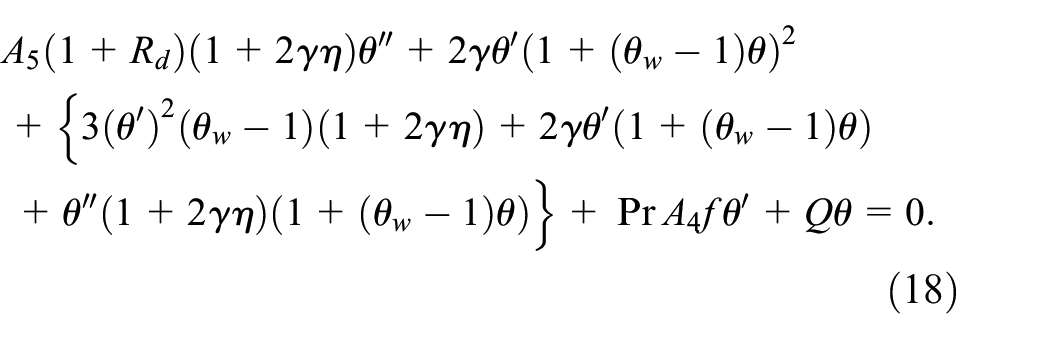


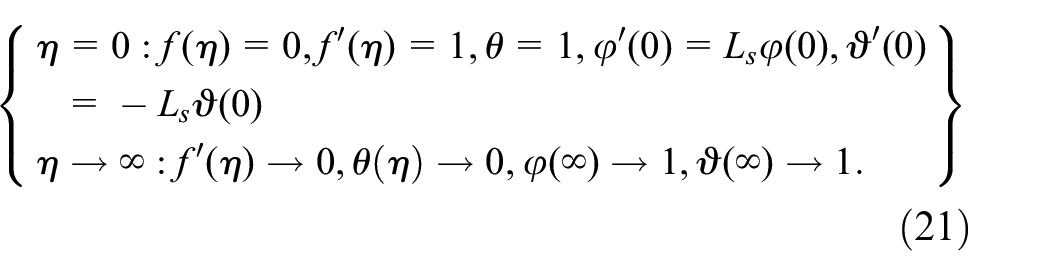
The associated transformed BCs are:
In addition, the above equations comprised distinct influential parameters which are mathematically defined as:

The important component of the engineering physical quantities are the skin friction coefficient and local Nusselt number which are defined as follows 50 :

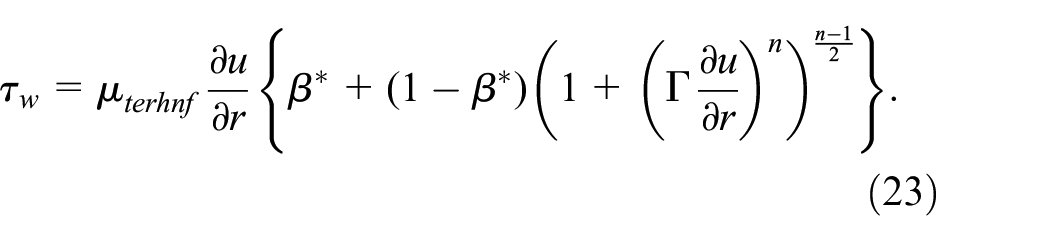
where the wall shear stress is defined as:
The wall heat flux is given by

Substituting the similarity variables and the equations (23) and (24) in equation (22), the reduce form of the skin friction and local Nusselt number can take place the form as:


In which,


Numerical scheme
Several numerical techniques51–61 exist in the literature which are useful for solving ODEs and fractional ODEs. The Runge-Kutta fifth order technique, commonly abbreviated as RK-5, is a computational approach/numerical approach. RK-5 (Runge-Kutta 5th order) is commonly employed to solve differential equations. The method in question constitutes a fourth-order Runge-Kutta enhancement at the higher-order level, thereby rendering it capable of greater precision than its counterpart for a given step size. This denotes an advancement in accuracy concerning numerical methods in mathematical computing. The RK-5 methodology is employed to evaluate the solution of a differential equation by performing an iterative process of intermediary value computations. The intermediate values are derived from the slope of the solution at multiple points within the domain and are subsequently integrated to yield the ensuing approximation of the solution. The RK-5 technique is extensively utilized to resolve differential equations, particularly in situations requiring heightened precision.
To use the RK-5 method in MATLAB for solving a differential equation, we need to do the following steps:

Validation of the numerical scheme
In this portion of the work, we have shown the authentication of the given scheme for the limiting cases. Therefore, the present study outcomes of the heat transfer rate with available prior work of Sarwar and Hussain
62
for the various values of
Comparison of the heat transfer rate for the several values of

Analysis of the results
The Runge-Kutta fifth order technique, commonly abbreviated as RK-5, is a computational approach/numerical approach. RK-5 (Runge-Kutta 5th order) is widely employed to solve differential equations. The method in question constitutes a fourth-order Runge-Kutta enhancement at the higher-order level, thereby rendering it capable of greater precision compared to its counterpart for a given step size. This denotes an advancement in accuracy with respect to numerical methods in mathematical computing. The RK-5 methodology is employed to evaluate the solution of a differential equation by performing an iterative process of intermediary value computations. The intermediate values are derived from the slope of the solution at multiple points within the domain and are subsequently integrated to yield the ensuing approximation of the solution. The RK-5 technique is extensively utilized to resolve differential equations, particularly in situations requiring heightened precision.
The Weissenberg coefficient is elevated, the viscoelastic characteristics of blood can cause it to display non-Newtonian behavior. The flow conditions of the blood may bring about varying viscosity, thus resulting in intricate flow patterns comprising of turbulence and the forming of vortices. Intricate flow patterns can create heightened resistance to blood flow, ultimately leading to a decrease in the flow rate. This information is shown in Figure 3(a) and (b). Regarding the velocity profile, the elicitation of

(a and b) Velocity profiles

(a and b) Velocity profiles

(a and b) Velocity profiles

(a and b) Temperature profiles
Figures 7(a) and (b) and 8(a) and (b) illustrate the regulation of

(a and b) Results of k2 on

(a and b) Results of Lb on
A statistical representation of the heat transportation rate during the analysis of blood flow with varying
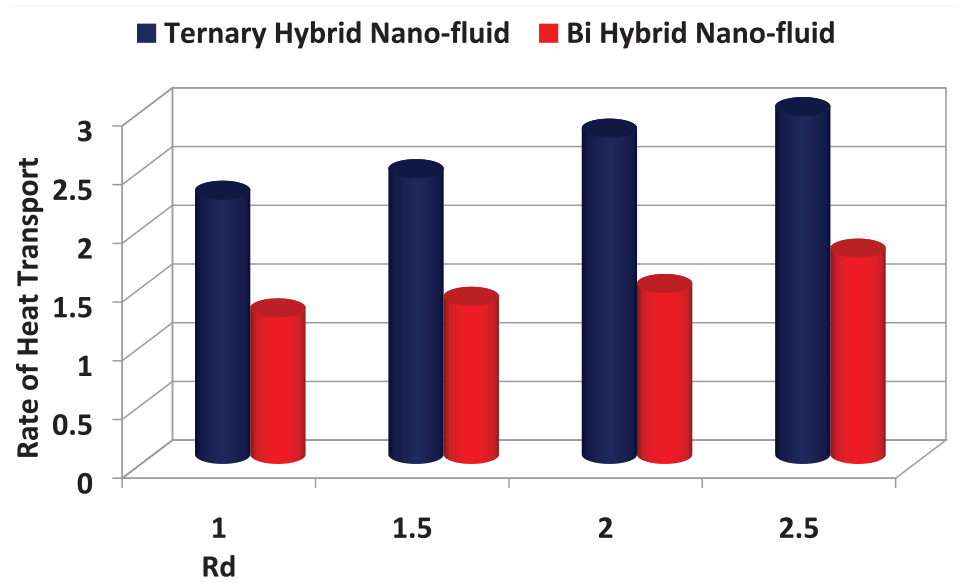
Rate of heat transport in blood flow analysis with variation of
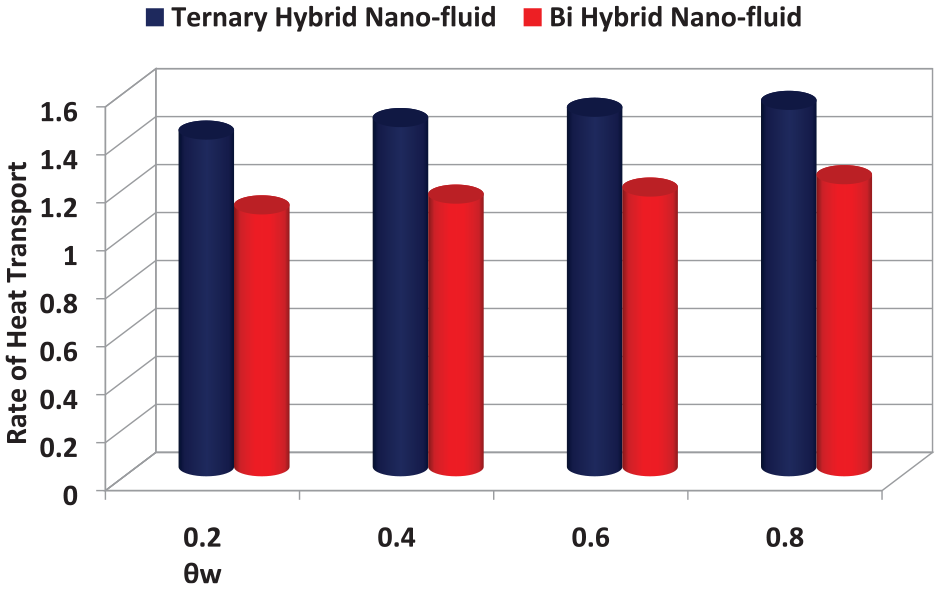
Rate of heat transport in blood flow analysis with variation of
Physical parameter, symbol, and range in intervals.

Tabular results for parameter impact on profiles with explanations for their behavior.

Numerical assessment of attached physical parameters on Local Nusselt Number and Local Skin Friction of Ternary hybrid/Ternary Hybrid Carreau nanofluid (blood).

Final remarks
In this research paper, we have delved into the intricate mechanisms of heat transport and synergistic integration of convective chemical processes within a cutting-edge Ternary Hybrid Carreau Bio-Nanofluid, specifically focusing on its application in blood. This research attempt gave us valuable insights into the unique thermal behavior and chemical interactions occurring in this innovative fluid system. This study contributes to understanding heat transport in complex fluids and paves the way for future advancements in bio-nanofluid dynamics. The wise conclusion is listed as below;
Lorentz force reduces the flow rate.
The curved path of the blood reduces rubbing against the vessel walls.
High We values make blood more elastic, which increases resistance and decreases blood flow.
As the strength of a homogeneous reaction parameter increases, the reaction rate increases.
A stronger heterogeneous reaction can speed up chemical reactions, potentially impacting blood flow.
The strength of a heterogeneous reaction parameter rises, and the rate of the chemical reaction increases, which can have both positive and negative effects on blood flow.
Limitation of study
This study may encounter several limitations that could affect the findings’ scope, reliability, and generalizability. Some potential limitations are included;
The model may involve simplifying assumptions, such as assuming steady-state conditions or neglecting certain physical phenomena, which might limit the realism of the study.
The numerical methods employed to solve the governing equations may have limitations, such as convergence issues, which can impact the accuracy and stability of the simulations.
Assumptions about the Thermophysical properties of the bio-nanofluid may not accurately represent real-world conditions where these properties can vary with temperature and concentration.
The study may make assumptions about the kinetics of chemical reactions, and the chosen reaction mechanisms may not fully capture the complexity of real chemical processes.
Modeling homogeneous and heterogeneous chemical reactions simultaneously could be challenging, and the assumptions about the interplay between these reactions may introduce uncertainties.
The lack of experimental data for validation could limit the verification of the model’s accuracy and applicability to real-world situations.
The study may assume specific boundary conditions that might not be entirely realistic for certain practical scenarios, leading to potential discrepancies between the model and actual experimental setups.
Future work
Here are some potential future work suggestions for the current research.
Exploration may be made to find the numerical solution of a multi-phase system.
The influence of a magnetic field can be judged with Cross fluid model.
The optimal parameters for enhancing heat transfer and chemical reactions can be identified.
Validation with the theoretical findings through experimental studies may be taken place in future studies.
Investigating the impact of different nanoparticle shapes on the heat transfer and chemical reactions within the hybrid Carreau bio-nanofluid may also be considered.
Artificial neural network technique may be utilized to solve the mathematical model.
Footnotes
Acknowledgements
The authors are thankful for the support of Researchers Supporting Project number (RSP2024R33), King Saud University, Riyadh, Saudi Arabia.
Handling Editor: Dr Sharmili Pandian
Declaration of conflicting interests
The author(s) declared no potential conflicts of interest with respect to the research, authorship, and/or publication of this article.
Funding
The author(s) disclosed receipt of the following financial support for the research, authorship, and/or publication of this article: This work was funded by the Researchers Supporting Project number (RSP2024R33), King Saud University, Riyadh, Saudi Arabia.
