



Abstract
This study investigates flow of non-Newtonian fluid containing nano particles and gyrotactic micro-organisms on stretching surface considering magnetic factor and thermal radiations. Cattaneo-Christov model is employed to analyze flow characteristics. The governing Partial Differential Equations (PDEs) along with associated boundary conditions describing the model are converted into Ordinary Differential Equations (ODEs) by suitable transformations. Homotopy Analysis Method (HAM), a semi-analytic solution technique is employed to obtain the solutions. The inspiration of important embedding variables on velocity, temperature, and concentration profiles are presented in tabular and graphical form to elaborate flow properties. It is deduced that the convective parameter and Weissenberg number, both have positive effect on dimensionless velocity whereas buoyancy ratio factor, bio-convective Rayleigh number, and magnetic force have inverse relationship with velocity profile. The presence of radiations and Brownian motion parameter boost energy transfer while it diminishes for higher Prandtl number values and mixed convection factor. Concentration intensifies for larger Prandtl number, activation energy, and thermophoresis parameters whereas it decreases for increasing temperature difference, Brownian motion, Schmidt number, and mixed convection factor. Bio-convective Peclet number, Lewis number, and microorganism concentration gradient factor, all depreciate microorganism concentration panel.
Introduction
Non-Newtonian fluids are the fluids that deviates from the Newtonian laws of viscosity. Such fluids have innumerous applications in many engineering and technological fields. These fluids also have an important role in our daily life as most of our daily use fluids like several salt solutions, polymeric liquids, Salvia, synovial fluids, paints, glues, tomato sauce, grease, shampoo, toothpaste, cosmetic products and many eatables like honey, jams, custard, butter, ketchup, apple sauce, jellies, and mayonnaise, etc. are examples of these fluids.
Nanofluids are a novel class of fluids that are prepared by adding nanometer sized particles in common fluids. The nanoparticles suspended in the base fluids are generally made from metals, carbon graphites, oxides, carbides, nitrides, or nanotubes. Such fluids have dynamic thermophysical properties and are being extensively studied by scientists for their uses in diverse fields including industry, engineering, and medical. The cooling of microelectronic systems and tools has been a challenge due to poor heat conductivity of available fluids. Nanofluids possess better heat conducting characteristics as compared to normal fluids. Since decades, investigators have been exploring the thermophysical properties of nanofluids and various techniques to improve thermal conduction of nanofluids are being studied by researchers including nanoparticle thermal diffusion and Brownian motion.
The mass and heat transfer mechanisms has massive application in various industrial and engineering fields. Various classical theories are available in literature on energy and mass transport. Fourier 1 and Fick are considered pioneers to explain the concept of heat and mass transfer. They asserted that distribution of heat and mass is parabolic. Fourier law was modified by Cattaneo 2 keeping in view the thermal relaxation. An equation of energy in the hyperbolic form is present in Cattaneo’s expression. Christov 3 further improved it by adding thermal-relaxation time with Oldroy’s upper convection derivative to get material invariant formula. The heat and mass transfer in non-Newtonian fluids have been investigated by many researchers using various geometries due to its wide range engineering and industrial applications. Ali et al. 4 investigated mass flow and temperature distribution of MHD nanofluid past a stretching plate. Shah et al. 5 visualized electrically conducted micropolar ferrofluid flow on stretching/shrinking sheet. Mahmoud and Megahed 6 examined mass flow and temperature distribution of non-Newtonian fluid over an unsteady moving surface under magnetic and electric forces. Khan et al. 7 articulated 3-D Williamson nanofluid flow to investigate heat and mass transfer on moving surface with connective boundary conditions. Shah et al. 8 studied MHD micropolar nanofluid flow with thermal radiations over a porous sheet. Some related studies on mass and heat transfer are given at references.9–12
The flow on an extending surface have been studied vigorously due to its tremendous uses in several engineering procedures, for example, stretching of plastic sheets, artificial fiber, polymer extrusion, the drying of plastic films, and many more. Sakiadis 13 is considered among pioneers who studied the boundary layer flows on a stretching plate in his innovative work in 1960s. Malvandi et el. 14 studied the 2-D unsteady flow along with Navier slip conditions on a stretch sheet. Ijaz and Ayub 15 analyzed the flow of Maxwell nano-fluid with activation energy driven by stretched inclined cylinder. Dawar et al. 16 studied the mixed convection flow of a non-Newtonian third grade fluid over an extending sheet in the presence of gyrotatic microorganisms and activation energy. Shah et al. 17 explained the flow of radiative MHD Williamson fluid over time dependent moving surface. Gupta et al. 18 deliberated flow of second grade non Newtonian fluid over stretching plane. Salah and Elhafian 19 studied flow of non-Newtonian second grade fluid on an extending surface using a numerical technique. Hayat et al. 20 explored Maxwell fluid flow on moving sheet of unequal thickness. Hayat et al. 21 also analyzed the encouragement of thermally conducting fluid flow on nonlinear moving surface. Khan and Alzahrani 22 deliberated MHD non-Newtonian fluid flow on nonlinear extending plate. Dawar et al. 23 explored the MHD micropolar boundary layer flow on moving plate taking into consideration magnetic force and thermal radiations. Gireesha et al. 24 studied three dimensional nonlinear Oldroyd-B nanofluid flow on moving sheet. Ghadikolaei et al. 25 deliberated Casson nanofluids flow on inclined porous stretching surface. Investigations of various scholars on nanofluids flow on extending surface are given in references.26–28
Bioconvection has captured significant attention of researchers in recent years for its increasing importance in biotechnological fields. Bioconvection occurs due to directional self-driven movement of microorganisms. The up-swimming of large number of microorganisms causes density gradient, which leads to generation of spatially periodic apparent fluid circulation. Dawar et al. 29 explored bioconvective binary flow on moving sheet with magnetic and electric fields effects and activation energy. Uddin et al. 30 studied bio-convective flow on horizontal wavy sheet to explore heat transport enhancement in fluid containing gyrotactic microorganisms. Alzahrani et al. 31 determined MHD flow of third grade nanofluids containing microorganisms over horizontal sheet considering magnetic force and thermal radiations.
Mixed convection flows occur in many industrial and technological processes and also in nature. The most important characteristic of the mixed convection phenomenon is the buoyancy force caused by the difference in temperature and density. Daniel et al. 32 examined the MHD mixed convective flow of nanofluids on moving surface subjected to electric and magnetic fields. Abdal et al. 33 investigated MHD flow of incompressible micropolar nanofluids with thermal radiations over an electrically stretching/shrinking surface. Qasim et al. 34 investigated convective flow on a non-linear slandering moving sheet of different breadth. Gupta et al. 18 examined effects of chemical reaction and thermally developed zigzag motion in laminar convective on an inclined moving sheet. Ibrahim and Gamachu 35 studied electrically conducted flow of an incompressible Williamson fluid on moving surface. Ahmed et al. 36 explored the mixed convective buoyancy driven 3-D flow of Maxwell nanofluid generated by vertical elastic stretching surface using the Buongiorno model for nanofluids. Nagasantoshi et al. 37 explained MHD flow of non-Newtonian fluid of variable viscosity on stretching plate. Machireddy et al. 38 evaluated mixed convective non-Newtonian fluid flow filled with Darcy-Forchheimer porous medium considering thermal effects across a vertical sheet. Waqas et al. 39 evaluated non-Newtonian nanofluid flow with motile micro-organisms and activation energy on extending surface. Khan et al. 40 determined the transient flow of Maxwell fluid with variable heat conduction using Cattaneo-Christov model on moving cylindrical surface.
The thermal radiations have great impact on flows encompassing space technology and many other fields that involve high temperatures processes. Radiative heat transfer has multifarious important applications in power plants, nuclear reactors, solar ponds, and photochemical reactors, etc. Khan et al. 41 presented 3-D analysis of Oldroyd-B fluid on moving surface. Khan et al. 42 illustrated unsteady Maxwell nanofluid flow on stretching sheet with thermal radiations. Shah et al. 43 addressed electrically conducted Casson flow with activation energy on a nonlinear stretching sheet. Dawar et al. 44 explored MHD Maxwell fluid flow with heat radiation and magnetic force over an exponentially stretching sheet. An analysis of radiative heat transfer is reported by many others researchers in their scholarly work.45–47
Keeping in view the aforementioned comprehensive literature review, and to the best knowledge of authors, the mixed convective non-Newtonian flow of nanofluid having gyrotactic microorganisms using Cattaneo-Christov model on a linearly stretching sheet have not been studied by any researcher so far. To fill this research gap, this pragmatic study aims at exploring the thermal and rheological behavior of nanofluid flow generated by a linear stretching sheet using Cattaneo-Christov model.
Physical model of problem
We have considered 2-D flow of an incompressible non-Newtonian nanofluid driven by linear movement of a stretching sheet. The x-axis lies in direction of movement of surface, which is moving vertically with a uniform velocity

Schematic diagram of the physical model.
The governing PDEs of the flow are formulated as equations (1)–(5).



We can express

Considering

Using equations (6) and (7) in (3),

associated boundary conditions of the problem are as follows

To transform PDEs into ODEs, following transformations are applied. 22

The continuity equation is identically satisfied, while using equations (9) into (2), (4) and (7), we get the ODEs as follows.


The corresponding boundary conditions after transformations becomes:

Here, prime notation represents derivative with respect to

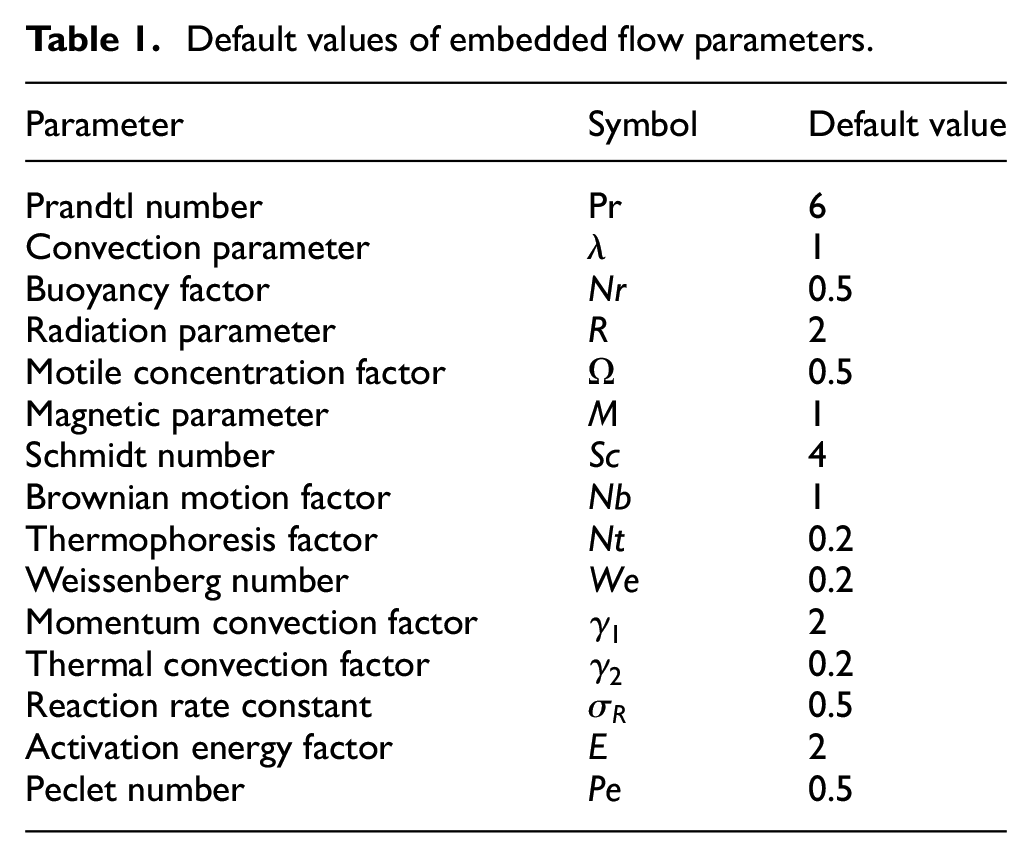
The default values of abovementioned embedded parameters controlling the flow properties are mentioned in Table 1 below and these are used in all subsequent illustrations.
Default values of embedded flow parameters.
Physical quantities
Physical factors of importance are coefficient of skin friction (

Here
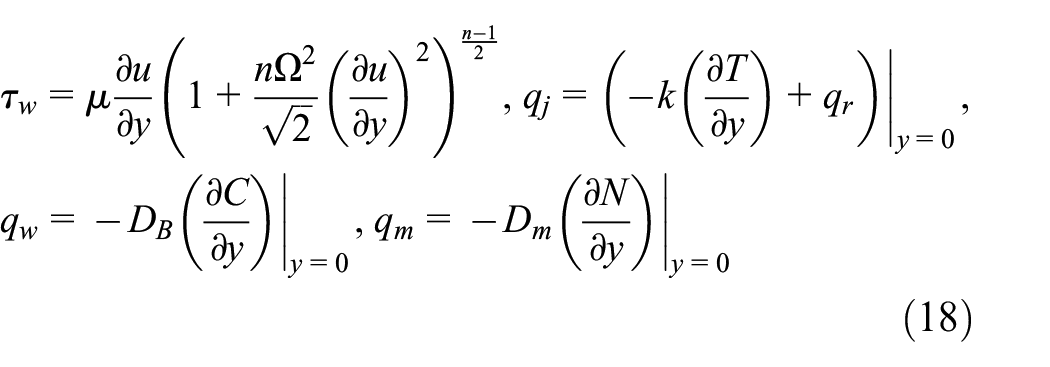
Using similarity variables, dimensionless form becomes,




In above,
Solution of the problem
The equations of the problem consisting of PDEs and associated boundary conditions are converted to ODEs using an appropriate transformation. The resulting ODEs are highly nonlinear and analytical solutions are not possible. A semi-analytical approach based on HAM is applied to obtain the convergent series approximations of this problem. HAM solution technique has numerous advantages over other solution methods as it is free of large or small physical features and it controls the precision and convergence of solution efficiently. This technique is very useful in solving non-linear ODEs. The initial guess


The linear operators defined by equation (24) satisfy the following conditions.

Where

(a) h-curves for
Result and discussions
Consequent to the successful implementation of semi-analytical solution scheme in preceding section, here we explain the physical aspects of pertinent outcomes of this important study. Graphical results shown in Figures 1 to 5 elucidate the impact of various dimensionless parameters; Richardson number (λ), Buoyancy ratio constant (Nr), Weissenberg number (We), Bio-convection Rayleigh Number (Nc), and Magnetic factor (M) on velocity gradient, where as other involved parameters are kept constant.
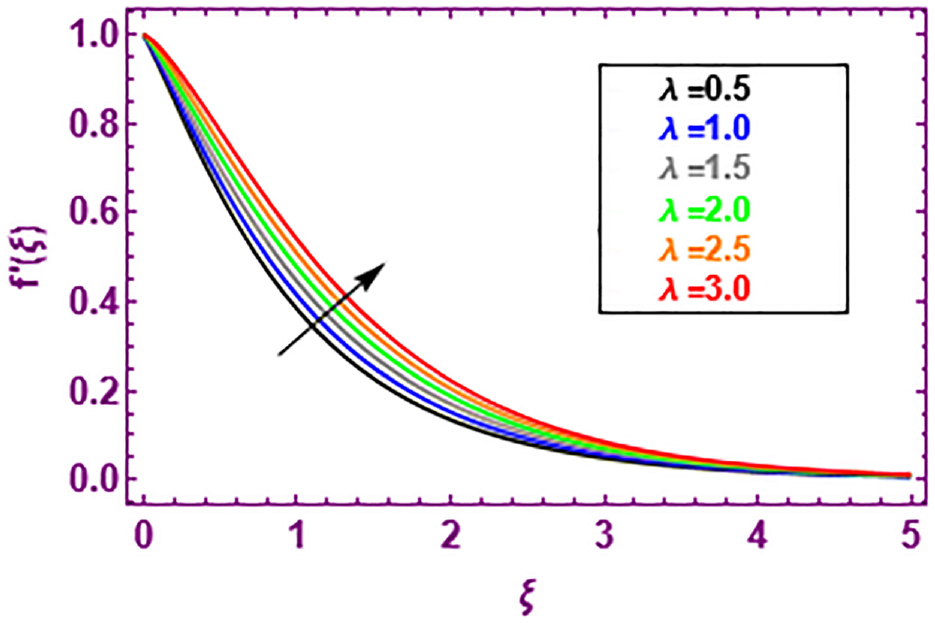
Variation of

Variation of
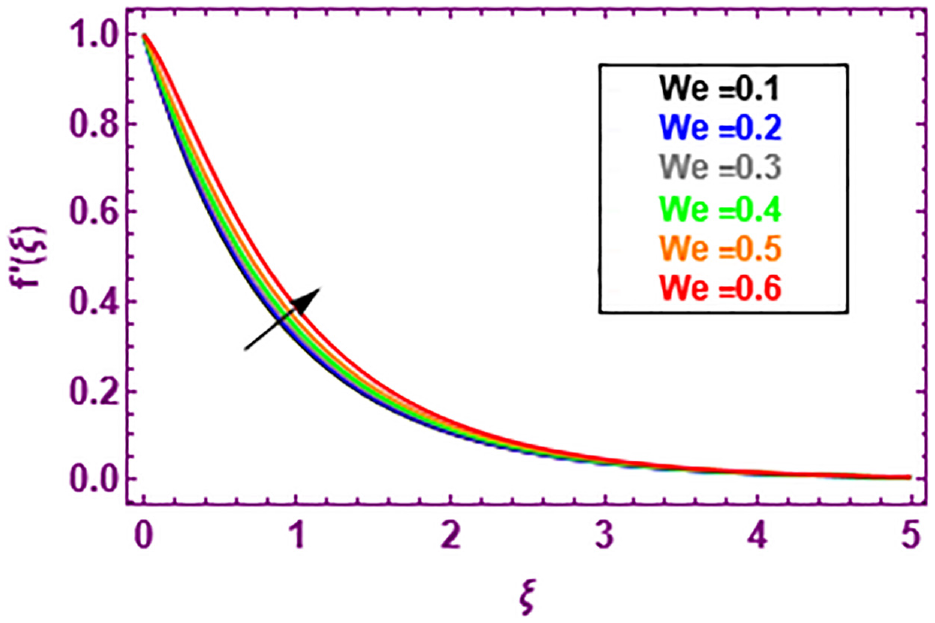
Variation of
Velocity profiles
Figure 3 shows impression of

Variation of

Variation of
Temperature profiles
The influence of radiations on temperature profile shows an increasing trend as presented in Figure 8. Physically, when more energy is added to system, it increases temperature function causing the thermal panel to increase. The impact of

Variation of

Variation of

Variation of

Variation of
Concentration profiles
Figure 12 expresses the graphical result for different values of
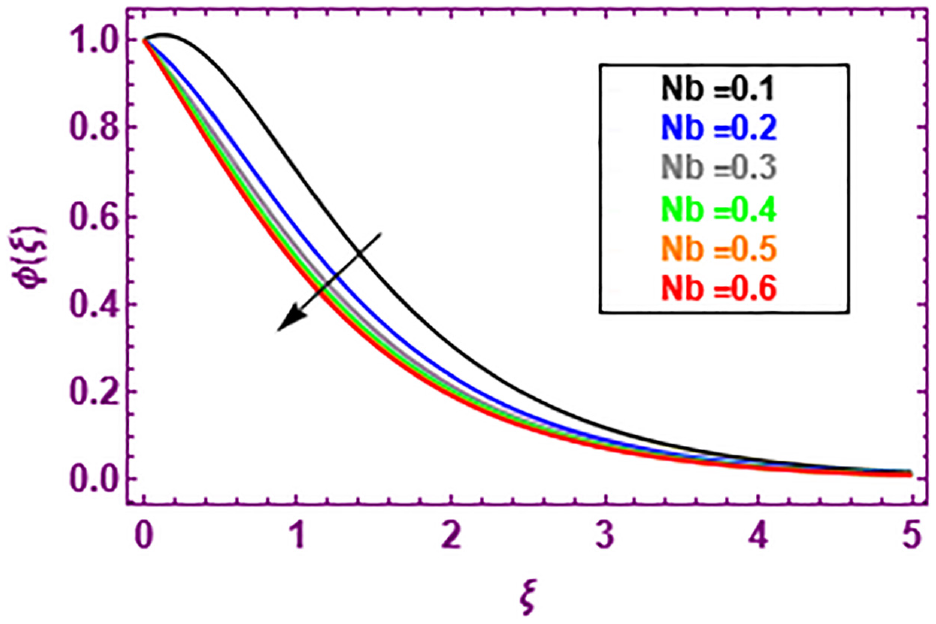
Variation of

Variation of

Variation of

Variation of

Variation of

Variation of

Variation of
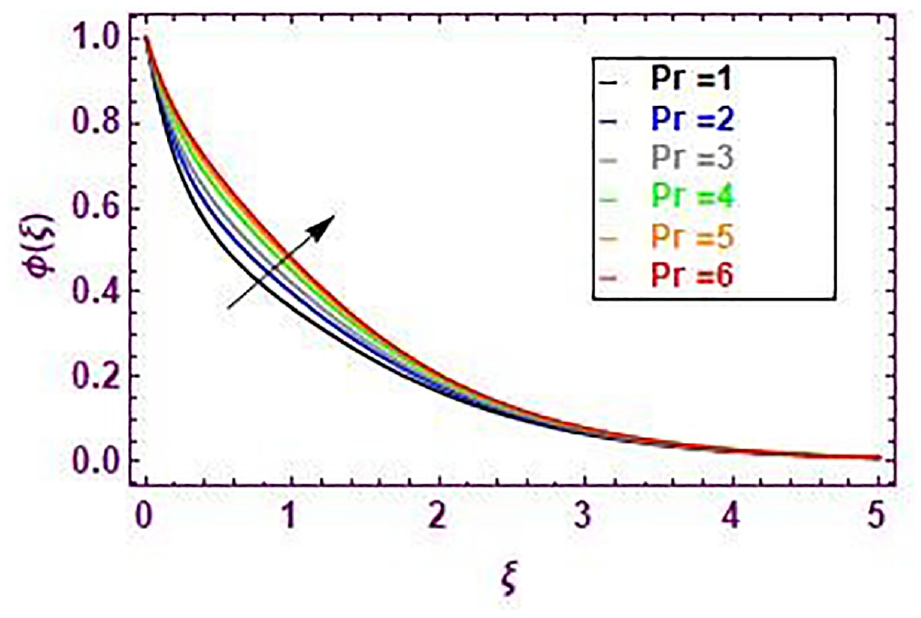
Variation of
Motility profiles
Figures 20 and 21 demonstrate the graph of χ (ξ) for different

Variation of

Variation of

Variation of
The numerical results for
Results for skin friction coefficient.

Results for local Nusselt number.

Results for local Shrewed number.

Results for local Motile number.

Conclusion
This research analyzed non-Newtonian nanofluids flow with gyrotactic organisms using Cattaneo-Christov model on a moving sheet. To solve the problem, we employed an analytical scheme called the HAM solution technique. The rheological behavior of significant controlling factors on velocity, temperature, concentration, and motility are presented and analyzed in graphical and tabular forms. Salient are as follows:
(a) The increase in mixed convection factor and Weissenberg number has positive impact on dimensionless velocity whereas buoyancy ratio parameter, Bio-convection Rayleigh number, and magnetic force have inverse relationship with the velocity panel.
(b) The rise of radiation and Brownian motion increase thermal transport rate, while converse trend is noted for increasing Prandtl number and mixed convection parameter.
(c) The Prandtl number, activation energy, and thermophoresis parameter act as growing functions of concentration, while an augmentation in Schmidt number, Brownian factor, mixed convection, temperature difference parameters, and reaction rate constant decline mass transfer rate.
(d) The microorganism concentration depreciates for enhancing bio-convection Lewis number, the Peclet number, and microorganism concentration difference factor,
Footnotes
Appendix
Handling Editor: Chenhui Liang
Declaration of conflicting interests
The author(s) declared no potential conflicts of interest with respect to the research, authorship, and/or publication of this article.
Funding
The author(s) received no financial support for the research, authorship, and/or publication of this article.
