




Abstract
Recent progress in nanotechnology and nanoscience has attended the researchers’ interest due to its inspiring industrial and technological applications. This contribution investigates the bioconvection flow of Carreau fluid over a periodically moving stretched surface with important feature of magnetic field and thermal radiation. Bioconvection in non-Newtonian nanofluid is utilized with sustaining the joint features of buoyancy and magnetic forces. In addition, thermal radiation consequences are summarized in the energy equation while further computations have been operated under “one parametric approach.” The attended problem is contested with a famous convergent technique having excellent accuracy. A comprehensive graphical approach is constituted to describe the thermo-physical features of interesting physical parameters. The reported results may use in enhancement of extrusion system, bio-fuels, and biotechnology.
Introduction
In the current century, the worldwide development in the nanotechnology has introduced new fluids type aimed to improve thermo-physically properties. Nanofluids bring global advances in the era of fluid dynamics and are amalgamated by merging nanoparticles with conservative base liquids. The doping results enhanced thermal conductivity and improved the viscosity features. 1 The interaction of such nanoparticles constitute an attractive attention in various industrial processes, engineering science, bio-engineering, diagnoses of diseases, treatment and damage of cancer tissues, chemical reactors, automobile engine cooling, solar collectors, cooling agents, and many more. Recently, nanofluid mechanics problems are successfully presented, which configured two- and three-dimensional flows, steady and unsteady flow, and laminar flow. For instance, Sandeep et al. 2 explored the magnetized nanoparticles Fe3O4 characteristics which are influenced by magnetic force. In their analysis, two familiar non-Newtonian fluids namely Jeffrey fluid and Oldroyd B fluid were supposed, and the desired solution has been constituted via Runge–Kutta numerical procedure. Sheikholeslami and Bhatti 3 determined the interesting thermo-physical features in convective flow of nanoparticles with different shape aspects. Turkyilmazoglu 4 described the flow of nanoparticles in channel, where relevant particle flux near the surface is imagined to be zero. In this continuation, the slip mechanism perspectives were explained by employing familiar Buongiorno nanofluid model. The features of ferrofluid suspended in Williamson and Casson fluids in addition to Joule heating and thermal radiation impacts were justified by Reddy et al., 5 and Khan et al. 6 used the activation energy and entropy-generation consequences in the Prandtl–Eyring nanofluid flow over a moving configuration. Abbasi and colleagues7,8 described the energy optimization and Hall impacts in peristaltic nanofluids flows. Reddy and Chamkha 9 claimed that an excellent enhancement in heat transportation has been noted upon interaction of Al2O3 and TiO2 nanoparticles in base liquid. The phenomenon of natural convection in the transportation of Al2O3 nanoparticles with base liquid in presence of variable thermal conductivity configured by a vertical cone has been numerically simulated by Ghalambaz et al. 10 Reddy et al. 11 investigated the slip flow of Cu-water and Ag-water nanoparticles over a rotating disk along with the utilization of thermal radiation and chemical reaction. Another contribution suggested by Ahmad and Khan 12 directed the flow of Sisko fluid with nanoparticles in existence of activation energy over a curved surface. The numerical results have been reported via shooting technique. In another work, Ahmad et al. 13 settled the Joule heating effects in Sisko nanofluid. They executed the numerical solutions of this problem.
Bioconvection is a sub-branch of thermofluid sciences and is considered as a convective transport of nanoparticles induced by the movement of motile microorganisms in the primary fluid. The appearance of bioconvection resulted from hydrodynamic instability due to upward motion of microorganism in relatively upper fluid surface. Microorganisms can impel themselves in various surrounding consequences like gravity, magnetic force, or chemical reactions. The nanoparticles fail to sustain the mechanisms of self-repulsion as they are signified by the features of thermophoresis and Brownian motion. Therefore, the utilization of motile microorganisms in nanoparticles suspension covers joint effeteness like control of microorganisms as well as improving the microscopic thermo-physical nanofluid features. The designing of ecological fuels, fuel cells, and photo bio-reactors promised the prestigious applications of this phenomenon. In the recent years, the bio-convective fluid dynamics is conquering a determining attention by imposing diverse mathematical models. Kuznetsov 14 determined a shallow nanoparticles layer in utilization of oxytactic microorganisms, where bioconvection is of oscillatory nature. Uddin et al. 15 carried out their attention in exploring the bioconvection of non-Newtonian fluid in addition to saturated porous media. Uddin et al. 16 also contributed to the physical consequences of slip and blowing effects in the bioconvection of nanoparticles configured over a horizontal plate. They interestingly simulated the numerical solution via finite difference procedure before explaining the graphical explanation of involved parameters. Basir et al. 17 reported the Peclet number effects flow of nanofluid over a stretching cylinder. Rashad and Nabwey 18 implemented convective conditions in order to evaluate the mixed convection flow of nanofluid with the addition of motile microorganism. Xun et al. 19 thrashed out the involvement of dependent viscosity in bioconvection of nanoparticles in a rotating system. Mosayebidorcheh et al. 20 operated a modified least square technique in order to examine the bioconvection utilization in nanoparticles configured in a horizontal channel. Sk et al. 21 examined the various slip trends in nanofluid flow under the impulsion of gyrotactic microorganisms. Khan et al. 22 indorsed rheology of Oldroyd B nanofluid in the presence of gyrotactic microorganisms over a stretched surface which moves with sinusoidal velocity. Recently, Waqas et al. 23 numerically inspected the bioconvection of rate-type fluid (Maxwell fluid) flow with the assistance of shooting procedure. Sivaraj et al. 24 investigated the interesting features of thermoelectric effects in bioconvection flow of Cuo-water nanoparticles subjected to paraboloid configuration. Some more scientific contribution based on bioconvection of nanoparticles can be seen in few previous studies.25–28
The non-Newtonian fluid flow is fundamental to a variety of chemical, mechanical, environmental, and bio-medical engineering operations. It brings forth miscellaneous applications like ketch up, medicine, mining industries, blood, slurries, motor oils, lubricants, corn starch, and hydraulic fluids. Among such nonlinear fluid models, Carreau fluid is one which successfully exhibited the rheology of viscoelastic materials which are nonlinear in nature like polymer solutions. The inventive idea of Carreau fluid was intended by Carreau, 29 which was further worked out by numerous investigators.30–34
In the current contribution, we attempt, for the first time, a bioconvection of Carreau nanofluid over an unsteady and periodically oscillatory stretched surface. Furthermore, linearized thermal radiation effects are also attributed in the current analysis, which are preceded via “one parametric approach.” The formulated equations are rendered in dimensionless forms which are objected with homotopy analysis procedure using the Mathematica software. The physical interpretations are documented for each physical parameter.
Physical problem
Here, we assumed the stretching flow of viscoelastic fluid which is characterized by Carreau nanofluid with utilization of gyrotactic microorganisms. The confined source of flow is the periodic motion of a stretched surface which moved with uniform velocity

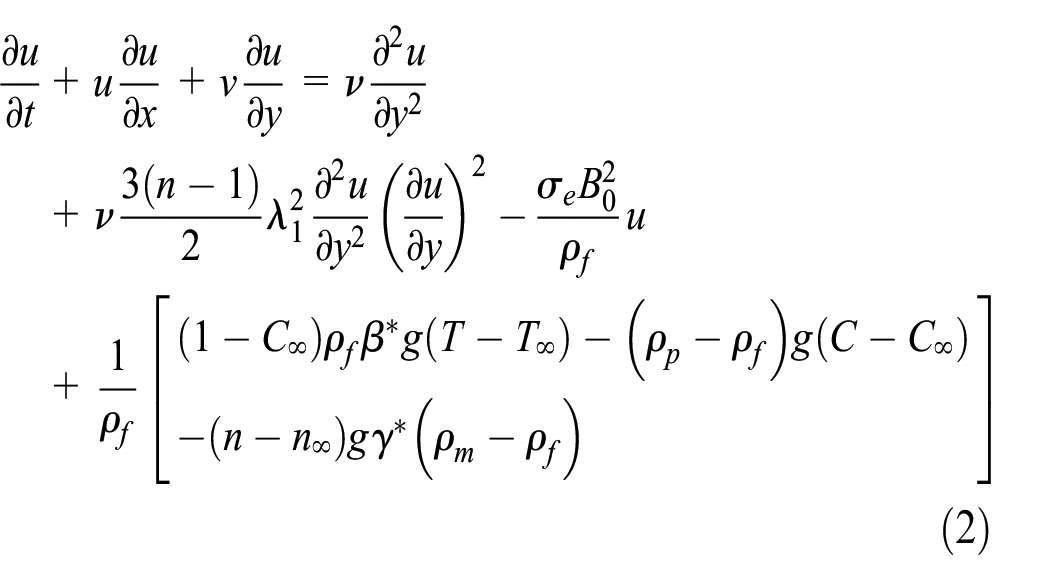


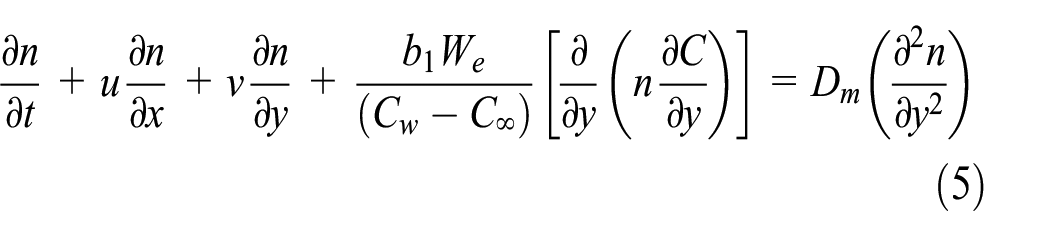
where


In order to require the dimensionless form of the comprised flow problem, following apposite variable have been advised 22

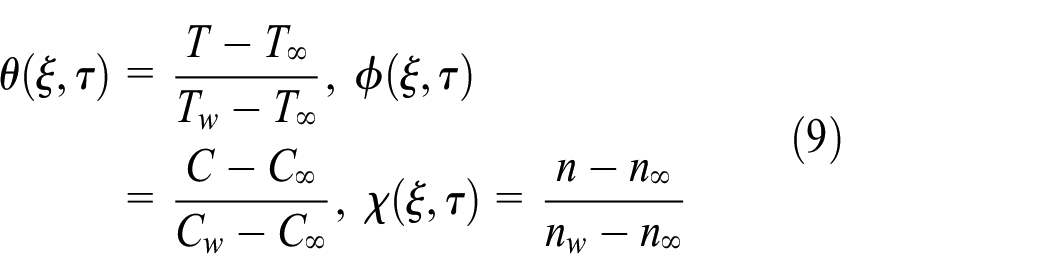
Substituting equations (8) and (9) in equations (2)–(4), we have


Similarly, the boundary conditions in non-dimensional forms are


The dimensionless parameters material constant

It is remarked that parameters material constant

where
The material quantities for heat transfer, mass transfer of nanoparticles, and mass transfer of gyrotactic microorganisms which are subsequent to local Nusselt number, local Sherwood number, and motile density number are articulated with following mathematical forms
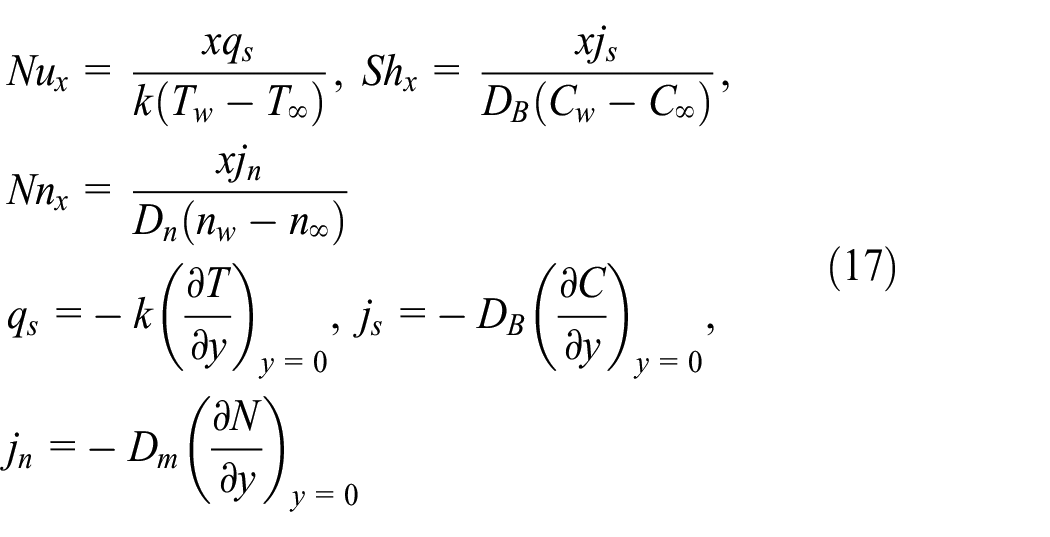

where
Solution methodology
This section intends to scrutinize the adopted procedure for solution of set of partial differential equations (PDEs) (10)–(13) with boundary constraints (14) and (15). In order to achieve the analytical solution, we have employed the homotopy analysis technique which was primarily established in 1995 by Liao 35 and later on, many problems are treated via this approach.36–41 The recommend initial guesses are

In order to precede the simulations, the auxiliary linear operators are assessed as

satisfying


where
Convergence analysis and physical interpretation
The convergence of homotopy solutions can be efficiently regulated with the proper enrollment of auxiliary parameters
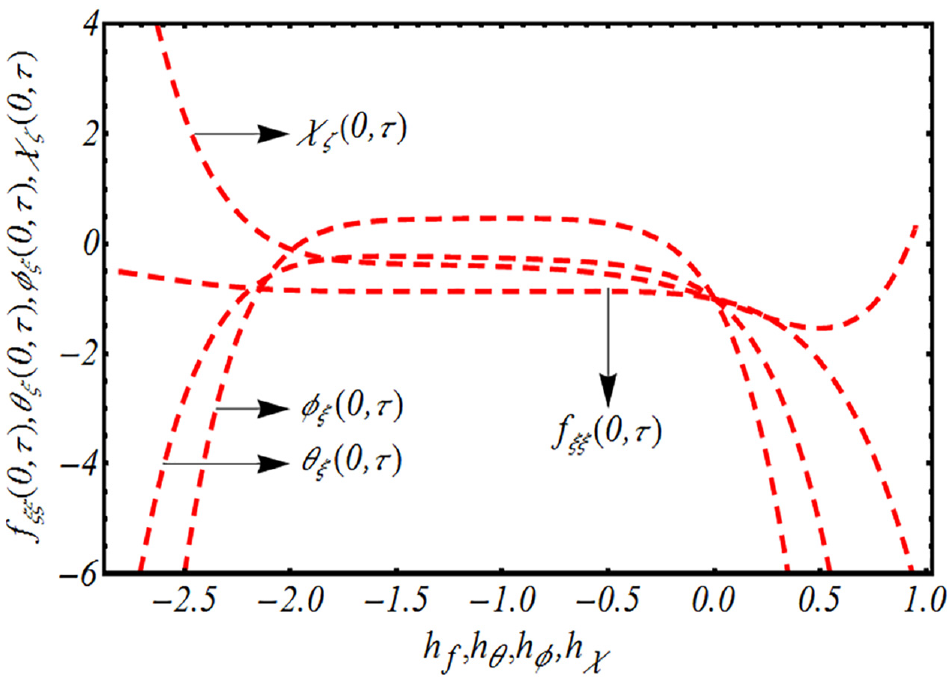
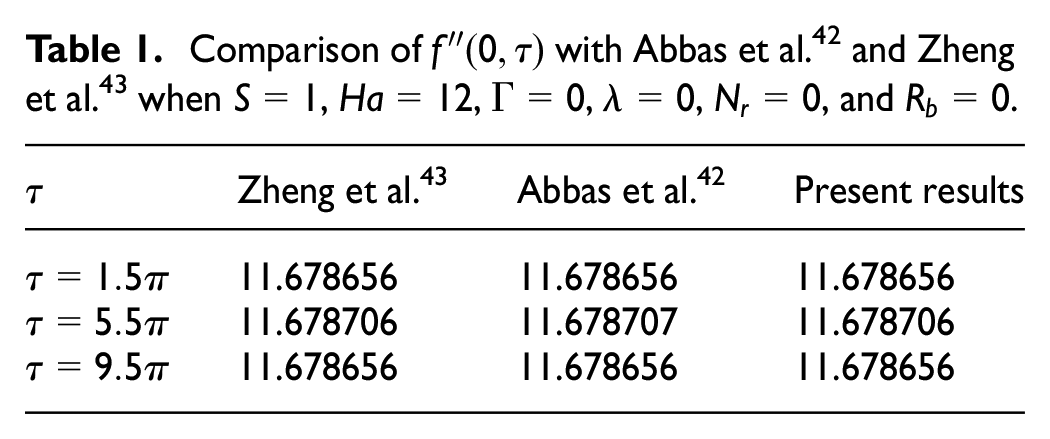
Before proceeding with the graphical significance of the involved parameters, first we validate our results with already presented numerical data presented by Abbas et al. 42 and Zheng et al. 43 For this purpose, Table 1 is prepared which shows that present results have a convincible agreement with the numerical computations of Abbas et al. 42 and Zheng et al. 43
Now, in order to perform extensive physical visualization of involved parameters for non-dimensional velocity distribution
Figure 2(a)–(c) determined the relative effeteness of velocity

Velocity variation with time for (a)
The temperature distribution

Temperature distribution for (a)
Figure 4(a)–(e) addresses the consequences of dimensionless Schmidt number

Concentration distribution for: (a)
In order to specify the enrollment of various parameters like Peclet number
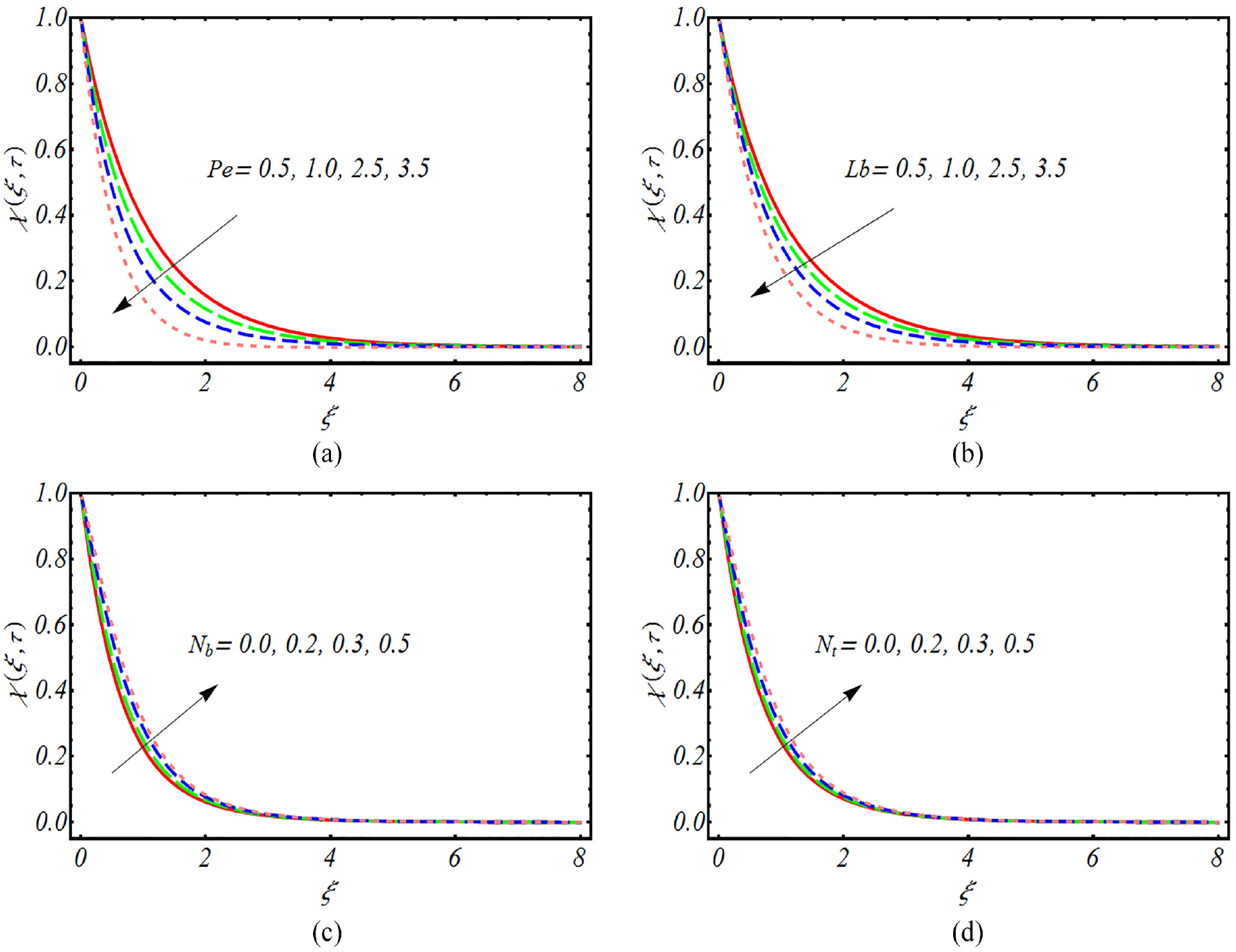
Motile density distribution for (a)
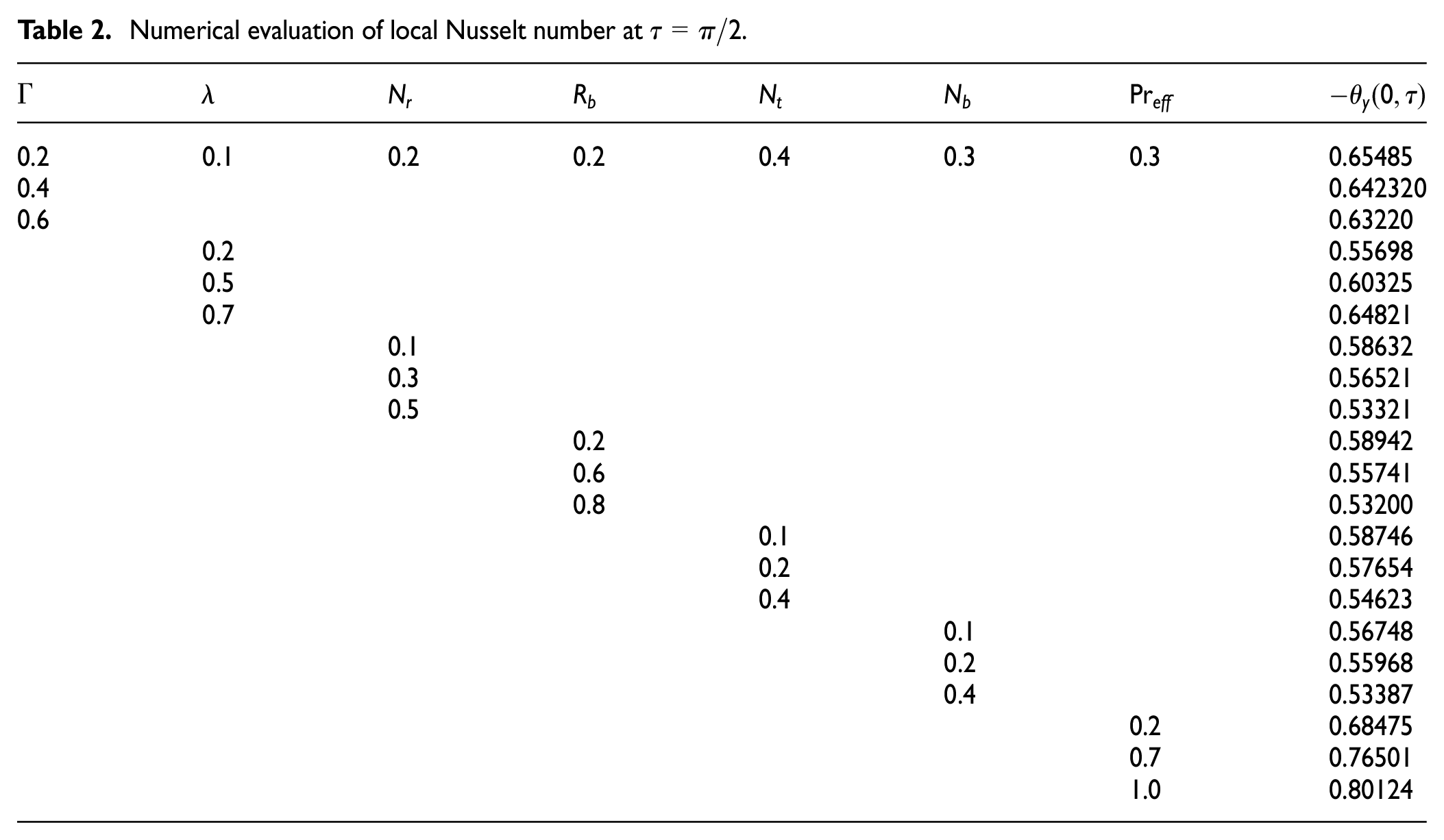
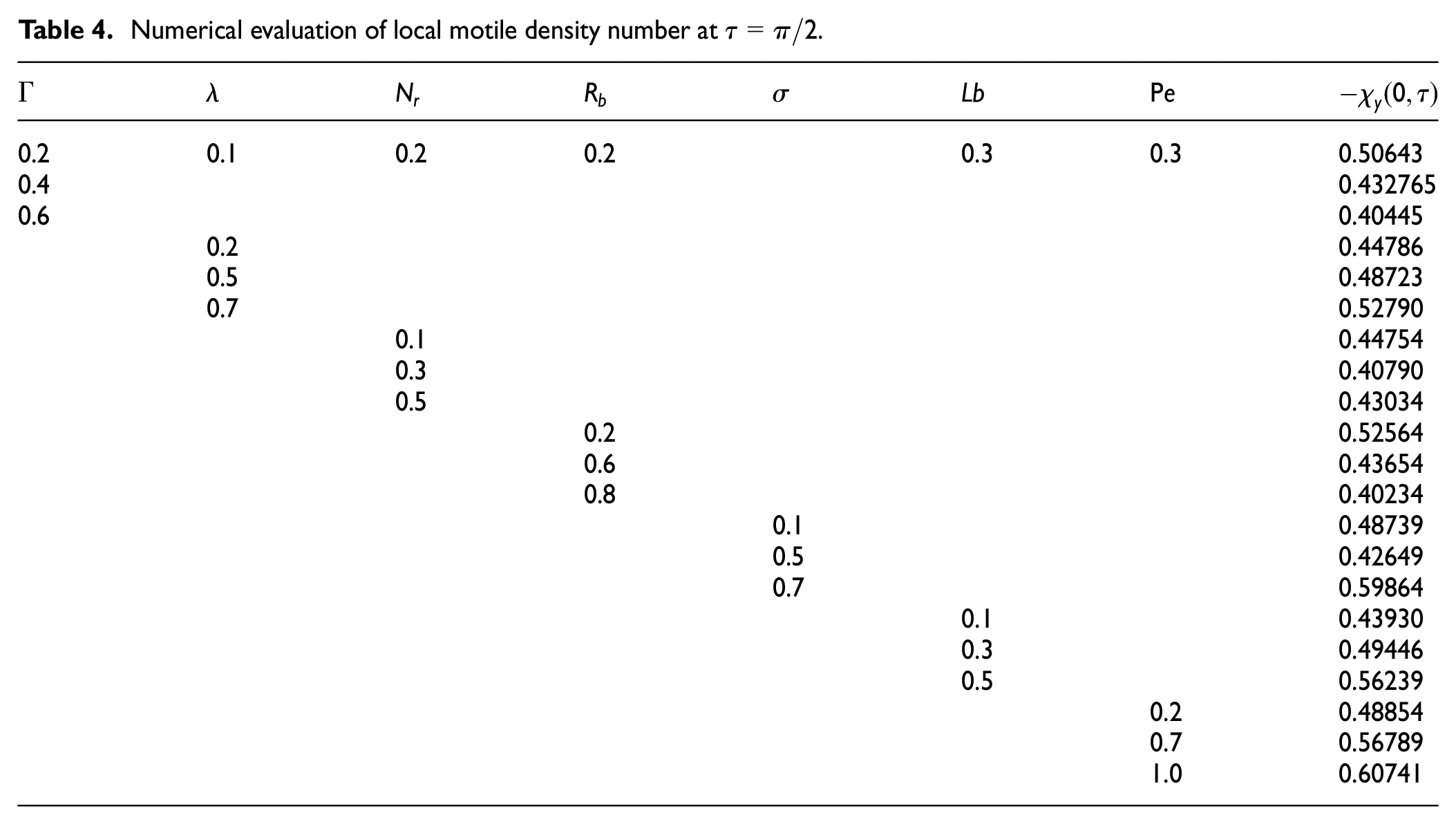
The numerical illustration of local Nusselt number against various parameter like
Numerical evaluation of local Nusselt number at
Numerical evaluation of local Sherwood number at

Numerical evaluation of local motile density number at
Conclusion
We have analyzed the flow of non-Newtonian Carreau nanofluid comprising the effects of microorganisms over an oscillating and periodically moving configuration. The desired flow problem is constituted in terms of PDEs which are solved analytically. A variety of interesting observations were obtained for variation of dimensionless parameters like material constant, buoyancy ratio constant, bioconvection Rayleigh number, thermal radiation constant, Brownian motion parameter, thermophoresis parameter, effective Prandtl number, Schmidt number, Peclet number, and biconvection Lewis number.
The velocity distribution can be alerted with variation of material constant, buoyancy ratio constant, and bioconvection Rayleigh number.
The nanoparticles temperature can be enhanced with bioconvection Rayleigh number, Brownian motion parameter, and thermophoresis parameter.
The non-Newtonian parameter involvement is more useful to improve the nanoparticles temperature and concentration profile.
The variation in motile density can be enhanced by involving Brownian motion parameter and thermophoresis parameter.
The physical quantities like local Nusselt number, local Sherwood number and motile density number decreases with variation of non-Newtonian parameter.
Finally, the proposed scientific results can provide attractive advances in the solar systems, energy consumptions, and improvement in thermal extrusion systems. The bioconvection based on interaction of nanoparticles can also be utilized in transpiration of heat for various industrial and engineering processes.
Footnotes
Handling Editor: James Baldwin
Declaration of conflicting interests
The author(s) declared no potential conflicts of interest with respect to the research, authorship, and/or publication of this article.
Funding
The author(s) received no financial support for the research, authorship, and/or publication of this article.
