



Abstract
With regards to the Cattaneo-Christoph (CCS) speculation, the thermal and mass transfer of a MHD Williamson-Casson ferrofluid flow through a permeable medium obeying the Darcy-Forchmeier law through an extended chamber or slab is carefully considered. The chemical reaction and Buongiorno nanofluid model were modified in the model to describe the nanoscale properties of liquid particles. Heat sources can be divided into two categories: linear and exponential space-dependent convection heat sources. The entire governing equations are changed to common differential terms, using a reasonable similarity change. These equations and their associated boundary conditions are calculated numerically via the fourth-order Runge-Kutta method. Comparison was made with the analytical solution in a special case, and very good agreement was reached. Economic success with deeper water purification can be attained by developing models for wastewater treatment facilities, conducting experiments and calculations on them, and making predictions for their nature in order to improve their cleaning efficiency, Prevent issues from arising during construction, operation, and reconstruction. The structural parameters of the quencher were physically modeled using mathematical modeling; It is possible to establish a cost-effective and effective filter model for industry and small settlements using the calculations and vertical filter model created in the article. Furthermore, it will be feasible to produce. Our mathematical procedure assure that: the deposit’s mass will be diminished through treated water under attractive field impacts; The magnetic field openness with nanometer-sized particles modifies the physical and synthetic properties of water particles bringing about exceptional characteristics; the water concentration will be decreased with the increase in the bending modulus; This means that in wastewater treatment the sediment mass will decrease.
Keywords
Introduction
The science of fluid dynamics has been and continues to be a pioneer in understanding the rheology of fluids, which is critical for improving industrial, engineering, biomedical and nanotechnology processes and products,1–4 especially non-Newtonian fluids. Non-Newtonian fluids have emerged in many diverse industries such as the petroleum and chemical industries. It has a wide range of applications, from understanding blood flow in the human body to improving the flow of oil in pipelines. Among the problems that researchers and engineers face is wastewater treatment. Modern wastewater may contain unsafe mixtures such as heavy metals, microorganisms, natural organisms, microplastics, oil, and infections. 5 The rheological properties of non-Newtonian fluids differ from those of Newtonian fluids. This difference led to the diversity of these fluids, including Casson fluid. Casson fluid 6 is mentioned as a non-Newtonian viscous substance that has multiple uses. It is characterized by yield stress, and its viscosity approaches zero at very high shear rates. Due to the many benefits of this liquid, a large number of studies have appeared that dealt with the study of this liquid, such as the study of Rasool et al., 7 Jamshid et al., 8 Dawlat et al.9,10 Among these non-Newtonian fluids is Williamson fluid, 11 which has elastic and viscous properties. In this research, researchers believe that combining Casson fluid with another non-Newtonian fluid such as Williamson fluid has the ability to effectively characterize dusty water, especially in wastewater treatment processes. In addition, studying the flow of Williamson-Casson fluids containing solid particles is crucial to understanding fluid behavior in wastewater treatment, especially when applying MHD magneto-hydrodynamics.12–14 MHD is the most capable strategy for recovering spent water and producing energy by using wastewater, sewage and slurry as a compressible conductive fluid. Many specialists and researchers have focused on the effect of MHD on non-Newtonian fluids. Ullah Awan et al. 15 proposed the use of Williamson nanofluids on rubber sheets to study radiation with sink and thermal effects. Patil et al. 16 have presented a study on the heat and mass exchange of magnetic-Williamson nanofluid flow across a stretched permeable surface. The study includes the effects of thermal radiation and chemical reactions. The effects of thermal radiation, electromagnetic force, and chemical interactions on heat and mass transfer of a Williamson nanofluid on a cylinder moving at a specified speed through a permeable medium were studied by Rao and Deka. 17
An electrical MHD flow of a Williamson Nano Casson fluid toward the expansion plate implemented with mass flow is performed using Jawad et al. 18 Affected by sliding speed, Patil et al. 19 demonstrated MHD radiative flux with microorganisms for a non-Newtonian Casson-Williamson mixture nanofluid on a greatly extended permeability surface. Eswara Rao et al. 20 explored the effects of thermal and mass diffusion and magnetic field under Brownian effects and thermophoresis effects on a Casson–Williamson mixture on a stretched plate. The modern value of Casson’s fluid can be expanded when combined with Williamson’s fluid, so a few scientists have led these tests, and research papers can be traced in the references.21–27
Abbas et al. 28 highlighted the Williamson nanofluid flow over a non-linear extending sheet cultivated in a permeable medium. Previous studies have focused on examining the flow of Williamson nanofluid over a non-linear extending sheet embedded in a permeable medium. One commonly used modification to account for inertia effects in Darcian flow is the Darcy-Forchheimer model, which includes a term proportional to the square of velocity in the energy equation to consider the impact of inertia. 29 Several researchers have30–32 investigated the Darcy-Forchheimer model for non-Newtonian fluid flow, including Casson-Williamson nanofluid flow with nonlinear heat radiation, suction, and heat usage. 33 Other studies have explored the Darcy-Forchheimer flow of Williamson liquid over a Riga plate. 34 Ur Rehman et al. gathered the energy conditions with unsteady non-Newtonian Williamson constitutive equations for nan- particles and tackle them mathematically. 35 Additionally, the Darcy-Forchheimer Williamson nanofluid model over an extended surface under convective conditions has been investigated using intelligent backpropagated brain networks and the Levenberg-Marquardt approach. 36 Influences of MHD on mass-heat transfer in the fluid of kind a third-grade over an exponentially slanted extending sheet fixed in a permeable medium with Darcy-Forchheimer regulation impact have also been proposed by Abbas et al. 37
Building upon previous research, the goal of the current investigation is to better understand the unsteady two-dimensional magnetohydrodynamic Darcy-Forchheimer flow of Williamson and Casson nanofluids. The effects of thermophoresis/Brownian motion are considered, and the Cattaneo-Christov heat-mass flux speculation (CCS) is employed to model the energy and mass equations. Based on heat absorption, an exponential heat source, and heat-generating properties, the thermal transport of the nanofluid is examined. Utilizing activation energy relations, the concentration equation is adjusted. The study examines the influence of various governing model parameters, such as velocity
Problem formulation
Formulation of mathematical model for cooling system which can be considered as a circular cylinder electromagnetic device installed to recycle and treat hard water from wastewater. This gadget can be displayed as an unsteady Darcy-Forchheimer two-layered MHD flow of Williamson-Casson nanofluids under the CCS of intensity and mass transition over an extending cylinder, as displayed in Figure 1.

Graphic summary of the flow of the problem.
The assumption is made that the cylinder, having a specific radius, undergoes movement with a constant linear velocity


where pressure is denoted

Where

If we consider that the value of

The type of Casson fluid is listed as6–8

When

since the kinematic viscosity is dependent on the plastic dynamic viscosity, Casson number, and fluid density. Where, respectively,
The Cattaneo-Christov stove speculation is used to explain the use of a modified version of Fourier’s law, where


Equations (8) and (9) represent the expressions for heat and mass flux, where the relaxation time is associated with thermal and solute levels. By setting (


With the application of the assumptions of the boundary layer orders
Hence, the equations that govern the problem are given below 38 :


The corresponding boundary conditions for the given problem are 39

Here,

Equation (12) is satisfied automatically and equations (13)–(16) yield

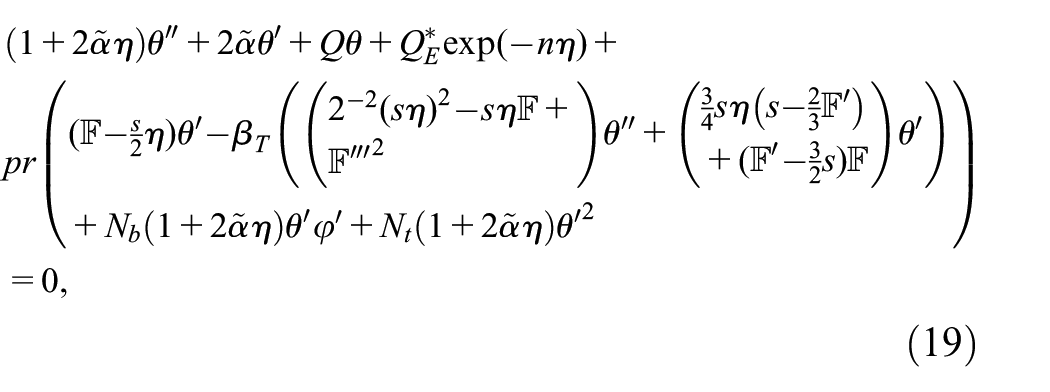
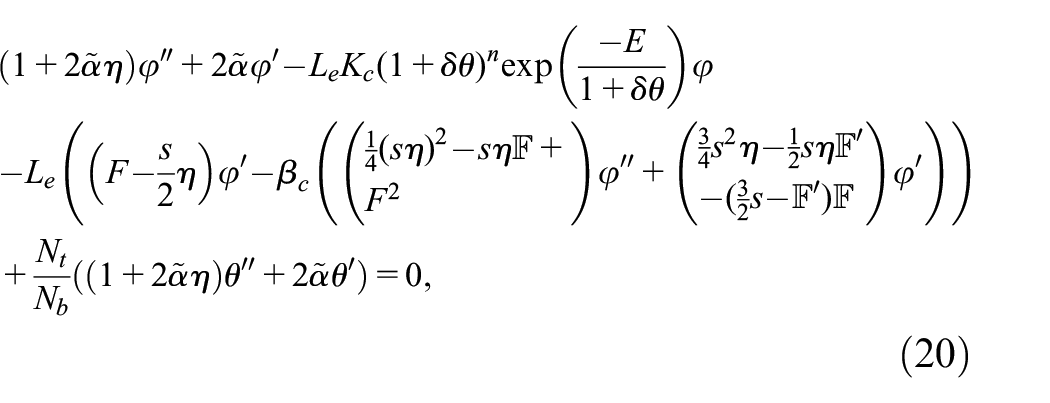
with

Where the curvature parameter is denoted by
Physical quantities

where


Applying equation (17) to the physical quantities, we get

Numerical approach
The dimensionless problems (18–20) and boundary conditions (21) are solved for their numerical solutions using the shooting technique with the fourth-order Runge-Kutta method. This numerical technique can easily handle many kinds of problems. Also, its convergence is easy to achieve. For the computer program, the Mathematica software is running on a PC. The numerical procedure consists of these steps as follow40–44:
1- The boundary value problem is transformed into an initial value problem because the system consisting of equations (18)–(20) contains one-third-order equation and two second-order equations. Therefore, to obtain the solution, seven initial conditions are required. However, in equation (21), only three initial conditions are provided. As a result, three suitable initial conditions are incorporated.
2- The numerical solution is obtained using the Runge-Kutta method.
3- The calculated solution is iteratively refined until it satisfies the convergence criterion with a computational tolerance of
4- If the computed solution fails to meet the convergence criterion, new initial guesses are introduced
Equation (18) in a special case

in this special case, a very good agreement was obtained when comparing the numerical results with the analytical solution as shown in Table 1.
The amount of agreement between numerical and analytical values for

Where,
Results and discussion
In ongoing years, mathematical modeling of wastewater treatment processes has turned into an acknowledged apparatus in designing practice and is broadly utilized by counseling organizations and managing organizations. Utilization of numerical models goes from examination to treatment plant plan, activity, control, and investigating. Mathematical displaying of the wastewater treatment process assumes a significant part in the administration of a compelling treatment strategy for existing plants. Mathematical reproduction can be utilized to upgrade comprehension of the perplexing connections between physical, chemical in environmental engineering. According to mathematical demonstrating, a mockup can be made through actual displaying of the primary boundaries of the quencher, and the results of tests did in lab depend on the mathematical results. 46 Magnetic water treatment (MWT) is a generally new method in environmental administration. Magnetic field openness with nanometer-sized particles modifies the physical and synthetic properties of water particles bringing about exceptional characteristics. Magnetized water has shown different properties with potential applications in various fields of ecological administration. Scale avoidance/end, soil upgrade, plant development, crop yield, water saving, and wastewater treatment is a portion of these applications. Attractive treatment of water rebuilds the water atoms into little, uniform, and hexagonally organized bunch facilitating their movement through the ways in plant and creature cell films. What’s more, harmful specialists can’t enter the MW structure. The viability of magnetic fields for water treatment applications is as yet a dubious inquiry, and the important peculiarities can’t be made sense of, so mathematical description will help in more explanation of nanofluid behavior. The Circular cylinder electromagnetic device can be introduced in a framework to reuse and treat hard water from water and wastewater which can be demonstrated as unsteady Darcy-Forchheimer two-dimensional MHD flow of Williamson-Casson nanofluids under CCS over an extending cylinder.
There is a difference between the flow and heat transfer processes of pure water and wastewater treated by electromagnetic device cooling system. Examination results show that the temperature of pure water and saline wastewater arrived at 373.15 K at 226.3 mm. Compared with pure water; saline wastewater has somewhat lower speed, and higher fluid film temperature under similar circumstances.
47
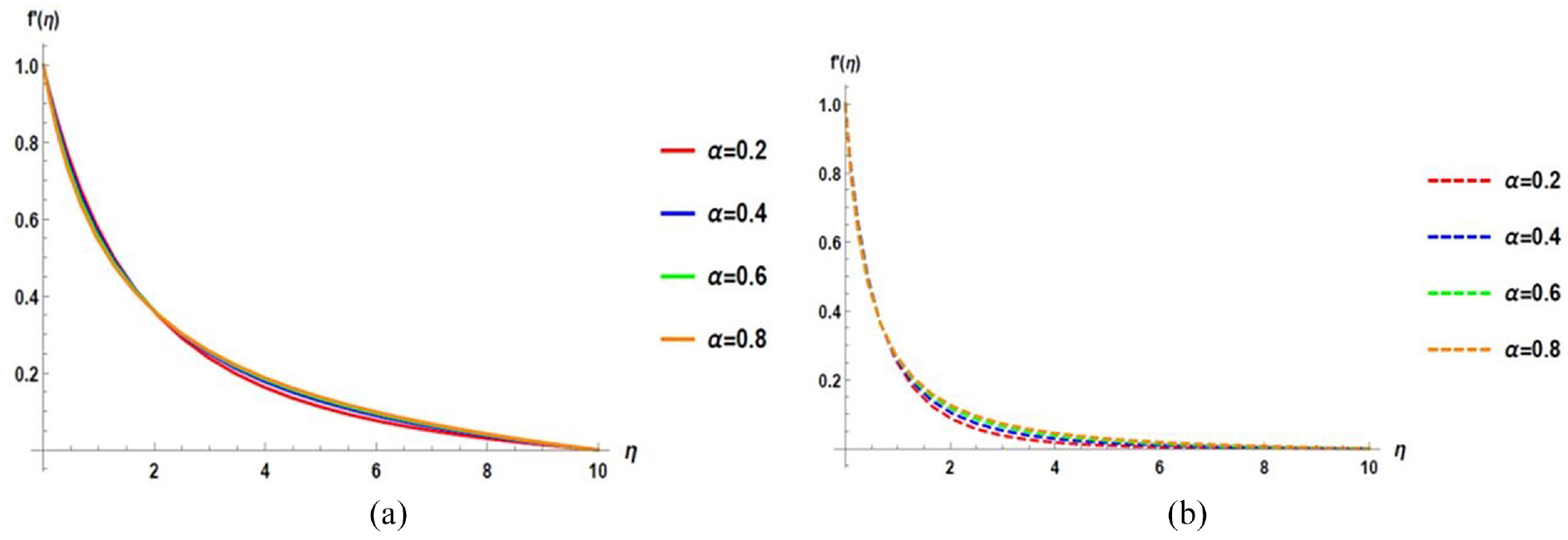
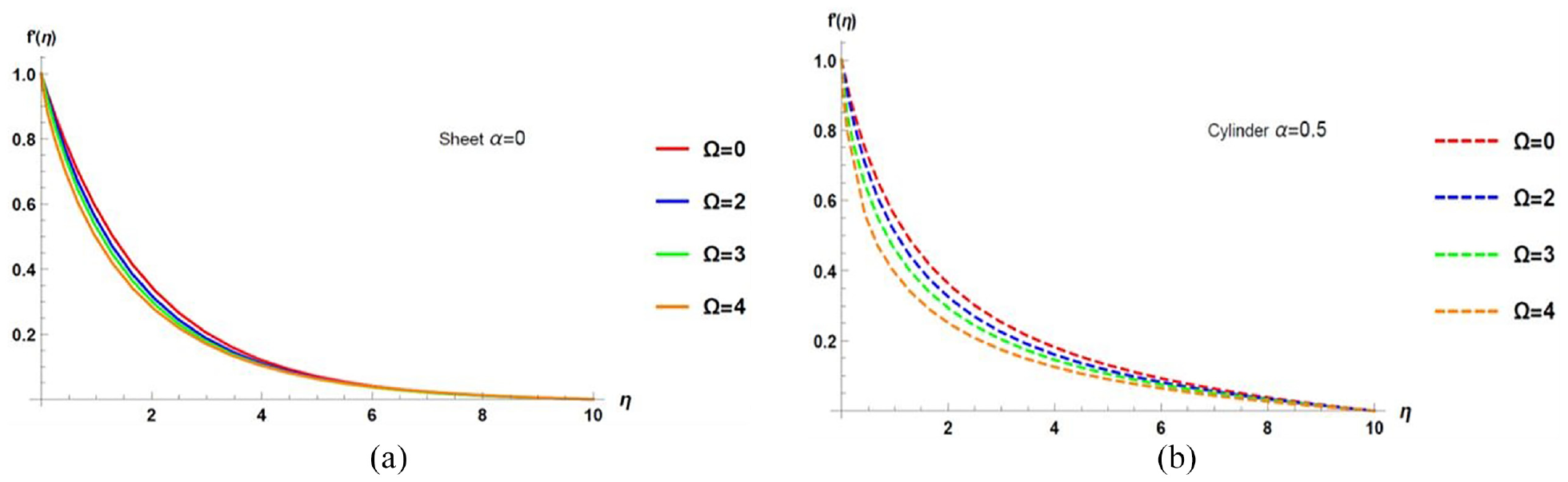
Figure 2 depicts the relationship between velocity and the modulus of curvature
Variation of

Variation of

Variation of
Variation of

Variation of

Variation of

Variation of

Variation of

Variation of
Figure 9 depicts the effect of the exponential heat sink coefficient

Variation of
Skin friction coefficient values expressed in numbers (*refers to Newtonian case and **refers to the case of sheet).

Values of

Values of

Values of

Conclusions
The influence of a magnetic field on Williamson-Casson nanofluids flow in a Darcy-Forchheimer porous medium has been presented. The imaging technique method using the fourth-order Runge-Kutta method was used to solve the nonlinear system of equations governing the problem. In a special case, a comparison with an analytic solution was obtained, and very good agreement was found. This research gives an important expansion of the mathematical analysis of wastewater treatment under magnetic effects. We concluded that:
1- The mass of the deposit will be decreased through treated water and magnetic field effects.
2- The magnetic field openness with nanometer-sized particles modifies the physical and synthetic properties of water particles bringing about exceptional characteristics.
3- The water concentration will be decreased with the increase in the bending modulus. This means that in wastewater treatment the sediment mass will decrease.
4- In order to enhance the treatment of wastewater, it’s much better to depend on small unsteadiness parameter to enhance the flow velocity to get pure water.
5- The efficiency of the wastewater treatments will be improved by applying small values of magnetic parameter
Future research
In present mathematical simulation emphasis the interactions between physical, chemical controlled parameters, we ignored the biological processes in environmental engineering such as variation of the bacterial density growth, hence in future research, we will focus on mathematical model of bacterial density and nutrient concentration during wastewater treatment as proposed by Rahimi et al. 49
Footnotes
Appendix
Handling Editor: Chenhui Liang
Declaration of conflicting interests
The author(s) declared no potential conflicts of interest with respect to the research, authorship, and/or publication of this article.
Funding
The author(s) received no financial support for the research, authorship, and/or publication of this article.
