



Abstract
Peristalsis has gained significant attention due to its numerous applications in the medical field, engineering, and manufacturing industries. Therefore, the current work intends to look into the effects of variable liquid properties on the magnetohydrodynamics of peristaltic flow exhibited by viscous fluid through a tapered channel. The viscosity of the liquid differs over the thickness of the channel, and temperature-dependent thermal conductivity is considered. The constitutive relation for energy is formulated with the addition of viscous dissipation and heat generation/absorption. The assumption of velocity slip along with the convective boundary condition energizes the thermal system as well as the flow phenomena. The mathematical formulation is established on the grounds of low Reynolds number and long wavelength approximations. Perturbation solution were obtained for the resulting non-linear differential equations of momentum and energy for small values of variable viscosity and variable thermal conductivity. The effects of various relevant parameters on flow properties were investigated through graphical analysis. The results show that the maximum velocity does not occur in the middle of the tapered channel, but moves toward the upper wall with the increase in the variable viscosity difference between the walls. The application of viscosity is essential in many engineering and industrial processes.
Keywords
Introduction
Due to its extensive applications in biological sciences, engineering, and biomedical sectors in recent years, the study of peristalsis motion has received considerable attention from researchers. The biomedical sciences, which are recognized in the esophagus, food transit in the digestive system, and the motion of cilia and vasomotor in blood vessels, are where these processes are most frequently used. The movement of larvae, the transportation of spermatozoa, the moment of ovulation in the female tube, the roller, artificial pumps, and dialysis are all significantly inhibited by this activity. The mechanism of peristalsis has become a subject of scientific research since the preliminary discoveries by Latham. 1 Several experimental and mathematical models were subsequently developed to understand peristaltic transportation. To examine certain crucial aspects of peristaltic motion, Shapiro et al. 2 approximated the lubrication theory in peristaltic pumping. In their study of the peristaltic blood flow in a flexible artery with a sinusoidal pattern, Abdelsalam and Vafai 3 concluded that hemoconcentration increases the breadth of closed plasma streamlines while only slightly reducing their number. The peristaltic process was used by Kavitha et al. 4 to study the flow of Jeffrey liquid while assuming that the inertial forces and wave number were tiny and unimportant, respectively. In this study, authors observed that the variation of the interface shape gives rise to thinner peripheral region with increasing Jeffrey parameter. Abbas and Rafiq 5 scrutinized the transfer of heat in conjunction with viscous dissipation in the flow of hyperbolic tangent liquid through tapered channel under lubrication theory and scrutinized that Weissenberg number and Brinkman number are the increasing function of the thermal profile. The dual impact of Hall and ion-slip currents on a peristaltic transport of water-based nanofluid in an asymmetric channel under the influence of a strong magnetic field was investigated by Das et al. 6 The current research articles that emphasize the prime biological submissions of the peristaltic phenomenon are provided.7–11
Through multiple studies conducted by considering animal physiology, it was found that biological fluids exhibit variable viscosity. This is a reasonable observation, considering that the average human or animal of similar dimensions consumes up to 2 l of water, resulting in a change in concentration of physiological fluids over time. Hence variable viscosity is an important consideration to be made while studying peristaltic mechanism. 12 The influence of variable viscosity on peristaltic transport of tangent hyperbolic fluid with heat and mass transfer under lubrication approximation theory was analyzed by Hayat et al. 13 In this study, authors observed that the velocity profile is reduced with the enhancement in the magnetic parameter. Prakash et al. 14 reported the peristaltic flow of a viscoelastic fluid in the tapered microchannel with variable viscosity under lubrication approximation theory. This study exposed that the axial velocity increases in near the tapered microchannel walls while the reverse situation is observed in the hub part of the trapped channel. According to the effects of slip boundary conditions, Kumari et al. 15 looked into the effects of changing viscosity on the peristaltic transport of bile in an inclined conduit. In this article, a comparison of linear and nonlinear variation of viscosity of bile has been made. Also, authors concluded that velocity and pressure rise is more in case linear variation of viscosity, whereas more pressure gradient is required in case of nonlinear variation of viscosity. Bibi et al. 16 analyzed Sisko material’s curved configuration-based peristaltic flow with varying heat conductivity and viscosity properties. It has also been demonstrated that the characteristics of the physiological fluid under investigation alter as the temperature varies. So, while studying peristalsis for physiological fluid flows, fluctuating thermal conductivity is also crucial. The impact of variable thermal conductivity on the peristaltic motion of an electrically conducting liquid in an asymmetric channel was explored by Misra et al. 17 This study reveals that the volume of the trapped bolus diminishes with an increase in Hartmann number, Reynolds number, and fluid viscosity parameter. The impact of the radial magnetic field on the peristaltic motion of Casson fluid through a non-uniform channel with temperature-dependent viscosity was investigated by Divya et al. 18 The entropy generation analysis for a peristaltic motion of fourth-grade fluid in a symmetric channel in the presence of an induced magnetic field and variable thermal conductivity was analyzed by Rafiq and Abbas. 19 Outcomes of this study divulge that entropy generation enhances with an escalation of thermal conductivity parameter, however it diminutions with an enhancement of magnetic parameter.
Magnetohydrodynamics (MHD) is the study of the flow of highly conducting fluids in the presence of a magnetic field. Magnetohydrodynamic flows are important in a variety of useful applications such as biomedical flow control, MHD energy generators, MHD drug targeting, magnetofluid rotary blood pumping, MHD bio-micro-fluidic devices, cancer treatment, materials processing, and separation devices. Kothandapani et al. 20 debated the peristaltic transport of an incompressible non-Newtonian fluid in a tapered asymmetric channel under long-wavelength and low-Reynolds number assumptions. The interesting fact of this study is that an increase in non-uniform parameter causes an increase in the magnitude of velocity at the boundaries. However, at the center of the channel the magnitude of velocity gets decreased. An analysis of entropy generation due to the peristaltic induced flow of viscous incompressible electrically conducting nanofluid in a tube containing a porous medium under the influence of a uniform transverse magnetic field and Hall currents was developed by Das et al. 21 The magneto-hydrodynamic peristaltic flow of a non-Newtonian fluid through a tapered asymmetric channel with variable transport properties was discussed by Vaidya et al. 22 Thermal transport subject to heat dissipation effect on the electrically conducting elastic-viscous fluid flow triggered by sinusoidal waves progressing across the walls of the symmetric channel was analyzed by Rani et al. 23 The electric double layer (EDL) aspect in a cilia-attenuated peristaltic transit of viscoelastic blood diffused with hybridized nanoparticles inside a microtube in attendance of stronger magnetic influence is presented by Ali et al. 24 In this study, the electro-osmotic body force assists the blood flow in the core area of the micro-vessel and resists it in the peripheral region of the micro-vessel. The influence of heat and mass transfer on the hydro-magnetic peristaltic flow of a Casson fluid in a rotating inclined system through an asymmetric channel was reported by Hafez et al. 25 A few recent research inquiries that deal with the magnetohydrodynamics (MHD) peristaltic flow in different geometries are provided.26–32
The works found in the literature fail to address the MHD peristalsis of viscous fluid with variable transport properties through a tapered asymmetric channel. This flow is suitable for myometrial contractions of the uterus with the intrauterine fluid exhibiting peristaltic-type motion and the contractions being symmetric or asymmetric. Moreover, a longitudinal cross-section of the uterus shows that the intrauterine fluid flow occurs between parallel walls with the wave trains possessing phase differences and different amplitudes. Thus, building upon the works of the aforementioned researchers, the authors have put forward their attempt to explain the peristaltic mechanism for a viscous fluid through the length of a tapered asymmetric channel. Considerations pertinent to MHD fluid flow have also been taken into account to expound upon the impact of magnetic fields. The constitutive relation for energy is formulated with the addition of viscous dissipation and heat generation/absorption. Furthermore, convective boundary conditions and velocity slip have been employed in the analysis. The fluid under examination is also considered to display variations in transport properties, like viscosity and thermal conductivity. The obtained perturbed solution to the system is graphed and the impact of relevant parameters has been discussed. The findings of this investigation can be beneficial in improving gastrointestinal movements and pumping in various engineering devices. Such analysis also provides a provision for to flow of physiological fluids within vessels and arteries for the transportation of food nutrients, blood circulation, carrying oxygen, waste excretion, heat, and other nutrients in the human body. The motivated work aims to answer the following research questions:
What is the impact of the variable viscosity and velocity slip parameters on the fluid velocity?
How does pressure rise per wavelength in a channel fluctuate with variable viscosity parameter?
What is the impact of variable thermal conductivity, Brinkmann number, heat source/sink, and convective slip parameters on heat transfer?
The pattern of streamlines in channel path due to variation of various parameters is important. How do the streamlines fluctuate with the magnetic parameter, variable viscosity parameter, and velocity slip parameter?
Problem statement
Consider the peristaltic flow of an incompressible viscous fluid in a tapered channel having sinusoidal walls. Following the Cartesian coordinate system


where

Geometrical configuration.
The aforesaid assumption leads to the description of the governing equations given in the following form5,20:

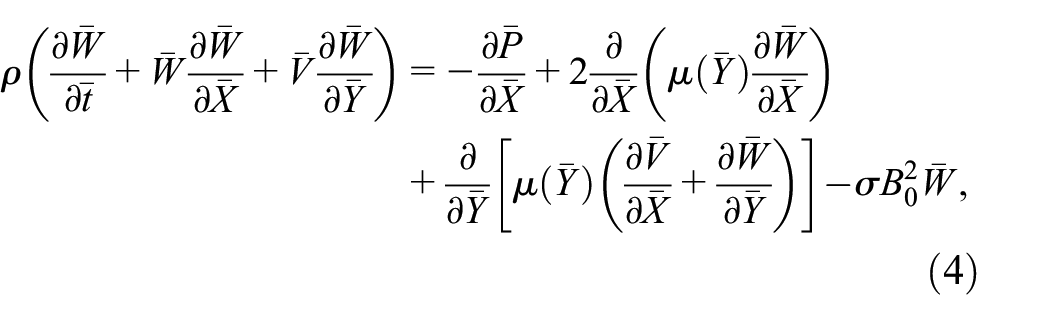

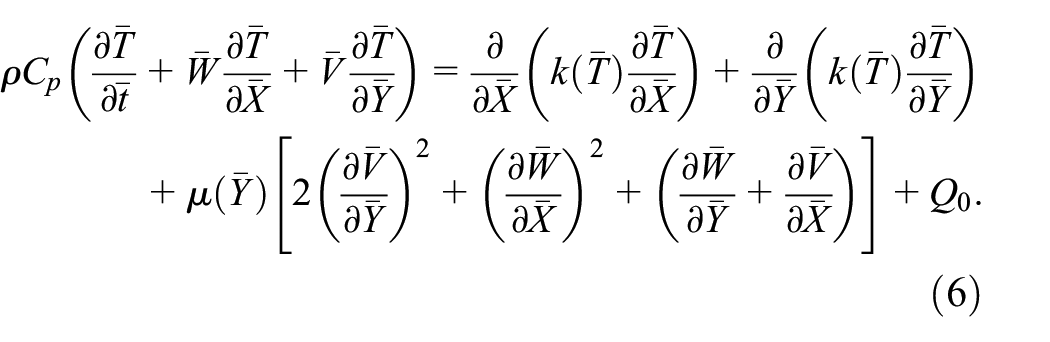
Here
The dimensionless quantities for the current problem are given as

Here,
Utilizing quantities as given in equation (7) and employing the theory of lubrication approximation, equations (3)–(6) become as follows:



Eliminating the pressure term from equations (8) to (9) yields

The change in viscosity


The surface conditions in the dimensionless form are 23 :

The dimensionless form of the wall expressions is given as

The flow rate

in which
The rise in pressure

The expressions for skin friction and Nusselt number at the channel’s lower and upper walls are defined as


Solution methodology
The non-linearity in equations (8)–(11) makes it necessary for us to resort to the perturbation technique to obtain the solution for momentum, pressure gradient, and energy equations. Accordingly, in this section, we find the perturbation solution up to the first order for velocity, pressure gradient, and temperature fields. For this purpose, we expand the flow quantities (for small values of
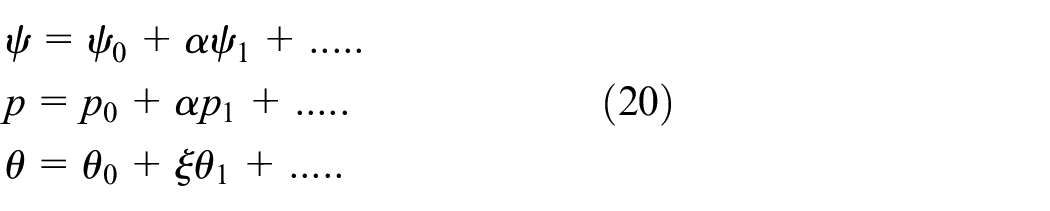
Inserting the above equation in equations (8)–(11) and the boundary equations given by equation (14), we obtain the following zeroth and first-order systems.
Zeroth order system


with boundary conditions

First-order system


with boundary conditions

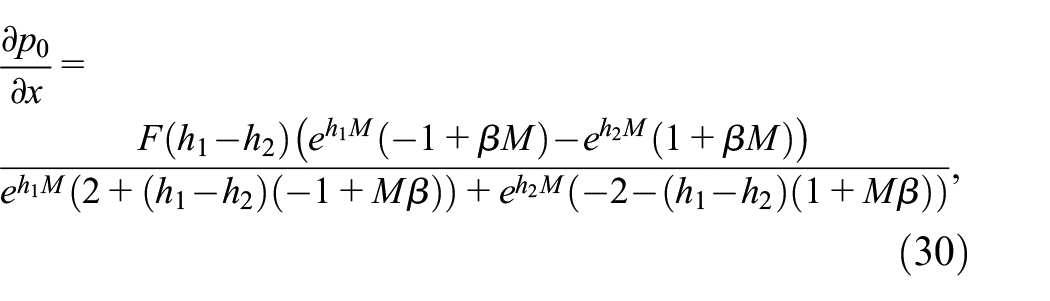
Outcomes for the zeroth-order system
The zeroth-order outcomes are


Outcomes for the first-order system
The first-order outcomes are
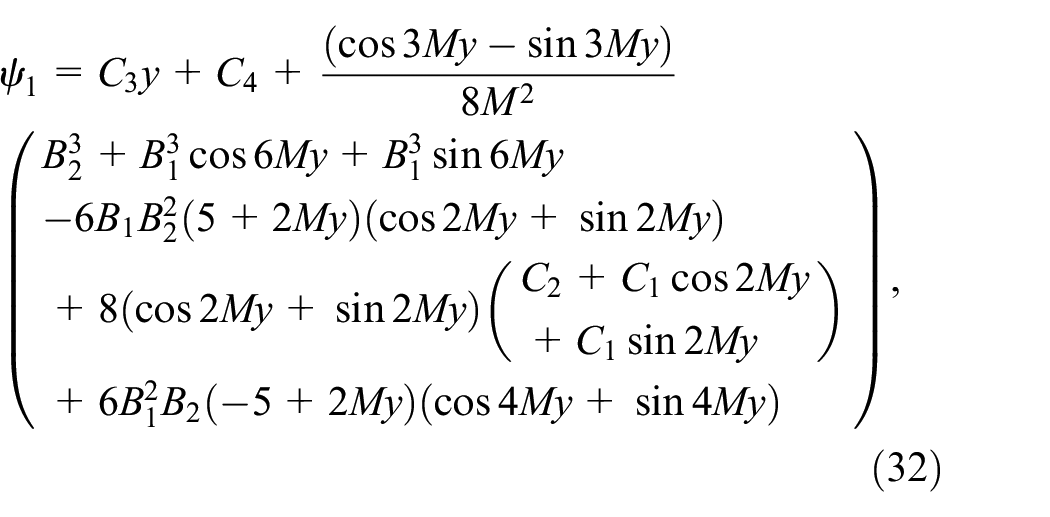


The constants
Results and discussion
The effects of pertinent parameters are studied in this section through the graphical representations of streamlines as well as velocity, pressure rise, and temperature fields. Integral specified in equation (17) cannot be resolved analytically so a numerical solution based on a suitable algorithm is required. Therefore, this integral is calculated numerically by employing the composite Simpson’s rule with spatial discretization number for the numerical process taken at 200. The computed convergence criterion was 10−10. In this analysis, the following default parameter values are adopted for computations:
The influence of numerous important parameters on skin friction coefficient.

The influence of numerous important parameters on Nusselt number.

Analysis of results
The deviations in skin friction at the channel’s walls for dissimilar parameters are given in Table 1. It can be scrutinized that skin friction upsurges at the lower wall and diminishes at the upper wall with enhancing values of variable viscosity parameter
The impact of imperative parameters on the velocity profile

Impact of velocity slip parameter

Impact of magnetic parameter

Impact of variable viscosity parameter

Impact of slip parameter
The various pumping zones exhibit complex interactions between peristaltic motion and pressure variations that affect fluid flow in channels, which may be utilized to analyze pressure rise patterns. The groups into which the pumping areas are divided are as follows: (a) the region of augmented exists when

Impact of magnetic parameter

Impact of variable viscosity parameter
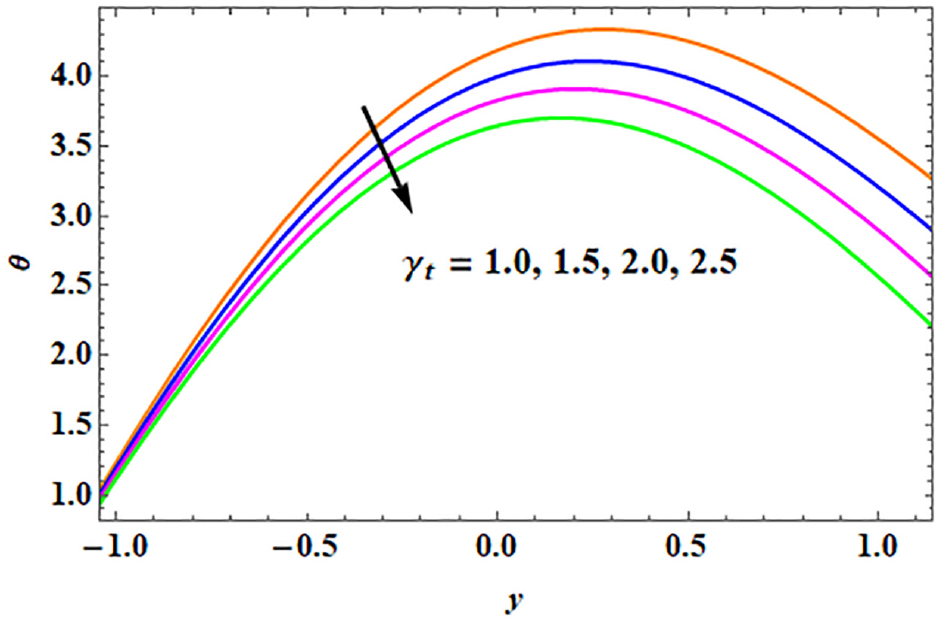
Figures 8 to 10 show the impacts of imperative parameters on the temperature profile

Impact of variable thermal conductivity
Impact of convective parameter

Impact of Brinkman number
The key focus of the transport of liquid in sinusoidal walls is the trapping mechanism. This mechanism involves the close molding of liquid boluses along streamlines that circulate inward and forward due to peristaltic waves. The trapping phenomenon of the streamlines has been presented in Figures 11 to 13. Figure 11 is designed to perceive the deviations in stream plots for slip parameter. This graph reveals a decline in the number of trapped bolus for increment values of the slip parameter. Figure 12 is plotted for streamlines to see the impact of magnetic parameter. This graph ensures that the number of trapped boluses reduces to enhance the values of a magnetic parameter. The same result is observed in Rafiq et al.
29
Figure 13 specifies that the trapped bolus size is enhanced in the upper part of the channel by enhancing the values of

Impact of magnetic parameter

Impact of slip parameter

Impact of variable viscosity
Discussion of results
Figure 2 represents that when slip impacts are increased, the minimum resistance given to the liquid by walls in return axial velocity accelerates near the walls and diminishes at the channel center. Figure 3 represents that when the magnetic field is applied in the transverse direction, it leads to the development of a resistive force which can be compared to a drag force in the direction opposite to the fluid motion, thus resulting in the slowing down of fluid. This concept is of great significance in the field of medicine where the presence of a regulated external magnetic field increases the local heat which helps in destroying the tumor cells. In Figure 4, increasing the value of plastic dynamic viscosity facilitates the increase in the kinetic energy of the fluid molecules, and hence the velocity of the fluid is increased.
Figure 5 presents that the pressure rise decreases in the free and retrograde pumping regions while increasing in the augmented zone as the slip parameter rises. In Figure 6, a diminution in the pressure rise is observed in the augmented pumping area and pressure rise increases in the free and retrograde pumping region as the magnetic parameter increases. Figure 7 exposes that the pressure rise decreases in the augmented pumping region with an increment in the values of variable viscosity.
Figure 8 depicts that the heat absorption of the fluid can be improved by taking variable thermal conductivity. Thus, when the temperature of the fluid is higher than the temperature at the surface, as a consequence, the temperature of the fluid decreases due to the improved thermal conductivity parameter. Figure 9 indicates that the thermal conductivity of the fluid reduces with the increase in convective parameter and thus temperature decreases. In Figure 10, the Brinkman number exhibits an inverse relationship with the thermal conductivity of the liquid. Therefore, an escalation in the Brinkman number results in a rise in the liquid temperature.
Figure 11 is designed that the number of trapped bolus decreases by increasing the values of the slip parameter. Figure 12 represented that the decrease in the size of the bolus is attributed to the Lorentz forces which act as a retarding force. Figure 13 specifies that the trapped bolus size is enhanced in the upper part of the channel by enhancing the values of
Validation
The purpose of this section is to check the accuracy of our outcomes. To verify the obtained results, a comparison of the limiting case of the present investigation for the velocity profile in the absence of variable viscosity and velocity slip parameter with the results reported by Kothandapani et al. 20 (see Figure 14). This graph indicates that both findings are in good agreement.
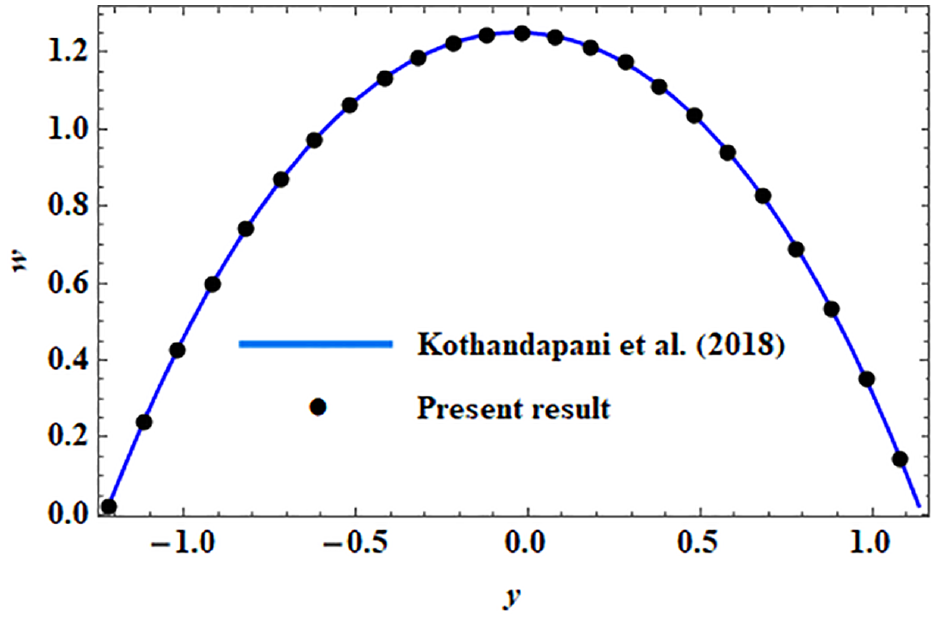
Comparison of the limiting case of the present study with the results of Kothandapani et al. 20
Conclusions
This article intends to analyze the magneto-hydrodynamic peristaltic flow of a viscous fluid through an asymmetric tapered channel with velocity and convective conditions. The fluid under examination is also considered to display variations in transport properties, like viscosity and thermal conductivity. The constitutive relation for energy is formulated with the addition of viscous dissipation and heat generation/absorption. The perturbation system is built for axial velocity and temperature for small values of variable liquid properties. The perturbed temperature solution is used to obtain the closed-form concentration solution. The obtained solution is graphically analyzed through plots plotted by using MATLAB. The geometry of the tapered asymmetric channel is the most generalized form of a channel, from which the results for a symmetric/asymmetric channel can also be obtained. The current work is among the first of this type which helps in understanding the role of variable liquid properties and external magnetic field on the heat transfer characteristics of a viscous fluid through a tapered channel. The results of the present model have potential applications in the field of medicine such as drug transport, controlling excessive bleeding during surgeries, and treating tumor/cancerous cells among others. Future works can be carried out in this direction by adding various models like the Casson fluid model, the Jeffrey model, and the Buongiorno fluid model with more effects like mixed convection, bioconvection, etc. The key observations can be summarized as follows:
The fluid velocity decreases in the central part of the channel and enhances toward the channel walls as the slip parameter enhances. The impacts of slip parameter is useful in various applications such as the shining of artificial heart valves and internal cavities.
The pressure rise decreases in the free and retrograde pumping regions while increasing in the augmented zone as the slip parameter rises.
The fluid temperature is enhanced by enhancing the values of the Brinkman number
The trapped bolus size is enhanced in the upper part of the channel by enhancing the values of variable viscosity, and the opposite situation occurs near the lower wall of the channel.
Footnotes
Appendix
Acknowledgements
We are thankful to the reviewers for their encouraging comments and constructive suggestions to improve the quality of the manuscript.
Handling Editor: Chenhui Liang
Declaration of conflicting interests
The author(s) declared no potential conflicts of interest with respect to the research, authorship, and/or publication of this article.
Funding
The author(s) received no financial support for the research, authorship, and/or publication of this article.
