



Abstract
Automotive bumper beam is a vital component that shields passenger and vehicle from harm and damage generated by catastrophic collapse. Previous investigations on its bending behavior have largely concentrated on multi-cell tubes with the same length, whereas stepped multi-cell structures have received less attention. In this paper, a novel stepped multi-cell configuration is proposed to improve the energy absorption characteristics of thin-walled structures under transverse loading. The finite element method is employed to analyze the crushing behaviors of the stepped multi-cell tubes. The numerical results reveal that the stepped multi-cell structures (SM2 to SM5) can reduce the initial peak force by 23.44–45.91% while increasing the energy absorption capacity, crush load efficiency, and specific energy absorption by 5.87–29.51, 38.29–139.45, and 5.87–29.51%, respectively, when compared to a conventional square tube (M1). In addition, the effects of wall thickness, section width, load angle, punch radius, and punch shape on the bending behaviors and energy absorption characteristics are examined. The results indicate that these factors have a considerable influence on the deformation features of M1 and SM2, which leads to a significant reduction in their bending energy absorption characteristics. These variables have no influence on the deformation modes of SM3, SM4, and SM5, and they present local indentation deformation with a high energy absorption efficiency. Increasing the number of layers improves the comprehensive performance of stepped multi-cell tubes, with SM5 exhibiting the best energy absorption characteristics under transverse loading.
Keywords
Introduction
Because of their excellent energy absorption capacity, thin-walled structures have been widely used in aerospace, rail transportation, automobiles, and other fields.1–3 Thin-walled structures are divided into single-tube, multi-tube, and multi-cell structures depending on their cross-sectional forms.4–6 According to the research,7,8 multi-cell tubes have more angular cells and a higher energy absorption efficiency than single-tube and multi-tube structures. As a consequence, multi-cell tubes have received a lot of interest as possible absorbing-energy devices. This article examines the bending response characteristics of multi-cell square tubes to provide a reference for designing thin-walled structures that are loaded transversely.
Extensive research has been conducted on the bending behaviors of multi-cell thin-walled structures under transverse loading. Wang et al. 9 investigated the transverse bending properties of multi-cell tubes using the finite element method, examining the influence of partition plates, cell number, load position, and other geometrical configurations on their bending behaviors under transverse loading. Huang et al. 10 employed numerical simulation techniques to investigate the bending collapse of three kinds of multi-cell structures. Section shape has a significant impact on the bending deformation modes and crushing force responses. Based on the global energy equilibrium theory, Bai et al. 11 and Li et al. 12 derived the theoretical formulations of the bending collapse characteristics for rectangular double-cell and triple-cell tube structures, which are validated by comparing the experimental and calculated results. Xie 13 constructed four kinds of multi-cell square tubes and evaluated their bending response characteristics when subjected to three-point bending loads. The reinforcing plate of multi-cell structures may restrict the movement of the compressed area in the upper portion, substantially boosting the bending resistance of multi-cell tubes. He et al. 14 devised four different types of partition-reinforced multi-cell circular tubes to address the tendency of the circular tubes to flatten under bending loads. The addition of reinforcing plates to circular tubes may enhance their bending performance. Studies have shown that multi-cell tubes offer superior bending performance compared to single-tube structures. Nevertheless, only the local region in the middle of multi-cell structures deforms and absorbs energy under transverse loading. The remaining portion does not participate in energy absorption, leading to a comparatively poor material utilization rate for multi-cell structures.
Therefore, in order to improve the energy absorption characteristics of multi-cell thin-walled structures under transverse loading, this article proposes a novel stepped multi-cell square tube, which may enhance the energy absorption performance and material utilization of multi-cell thin-walled structures.
Geometric descriptions
The multi-cell tubes are made of the AL6063-T4 material, which has a Young’s modulus of 70 GPa, a yield stress of 133 MPa, and a Poisson’s ratio of 0.3. Figure 1 displays the cross-sectional shapes of several multi-cell tubes. “SM” represents the stepped multi-cell tube. According to the number of internal square tubes, the stepped multi-cell structures are denoted as SM2, SM3, SM4, and SM5, respectively. The length, width, and wall thickness of the conventional square tube (M1) are 550, 55, and 3 mm, respectively. The length and width of the stepped multi-cell structures are the same as those of M1. The multi-cell structures all have the same mass but different wall thicknesses and numbers of internal square tubes, as presented in Table 1. Figure 2 shows the geometric configuration of the stepped multi-cell structure (SM5). The internal structural feature of SM5 is described using a 1/4 sectional view. Different lengths are allocated to each tube inside multi-cell structures. For SM5, their lengths are 550, 4 × 550/5, 3 × 550/5, 2 × 550/5, and 550/5 mm, respectively, from the outside to the interior.

Cross-sectional shapes of square tube and stepped multi-cell structures. (a) M1. (b) SM2. (c) SM3. (d) SM4. (e) SM5.
Thicknesses of square tube (M1) and stepped multi-cell structures.


Geometrical configuration of stepped multi-cell tube (SM5).
Numerical model
Finite element model
Figure 3 shows a schematic diagram of the stepped multi-cell square tubes under transverse loading. The structures are placed on two cylindrical supports and compressed by a cylindrical punch. The supports and punch have a radius of 50 mm. The structures are rested on two supports with a span of 430 mm, and their lengths are 550 mm. The initial speed of the punch is 4 m/s when it hits the structures.

Three-point bending loading of multi-cell square tubes.
Figure 4 presents a finite element model of a stepped multi-cell square tube under transverse loading. The model is developed on the LS-DYNA platform. The stepped multi-cell tube is modeled with Belytschko-Tsay shell elements. The punch and supports are set as rigid body without any deformation. The element sizes with 1.5 × 1.5 mm are adopted in the FE model for all the thin-walled tubes. Stiffness-based hourglass control was employed to avoid spurious zero energy deformation mode and reduced integration was used to avoid volumetric locking. The material of the stepped structure is AL6063-T4 with mechanical properties of density 7.8 × 10³ kg/m3, Young’s modulus 70 GPa, yield stress 71 MPa, and Poisson’s ratio 0.3. Its mechanical behavior is modeled using the MAT 24 material model.
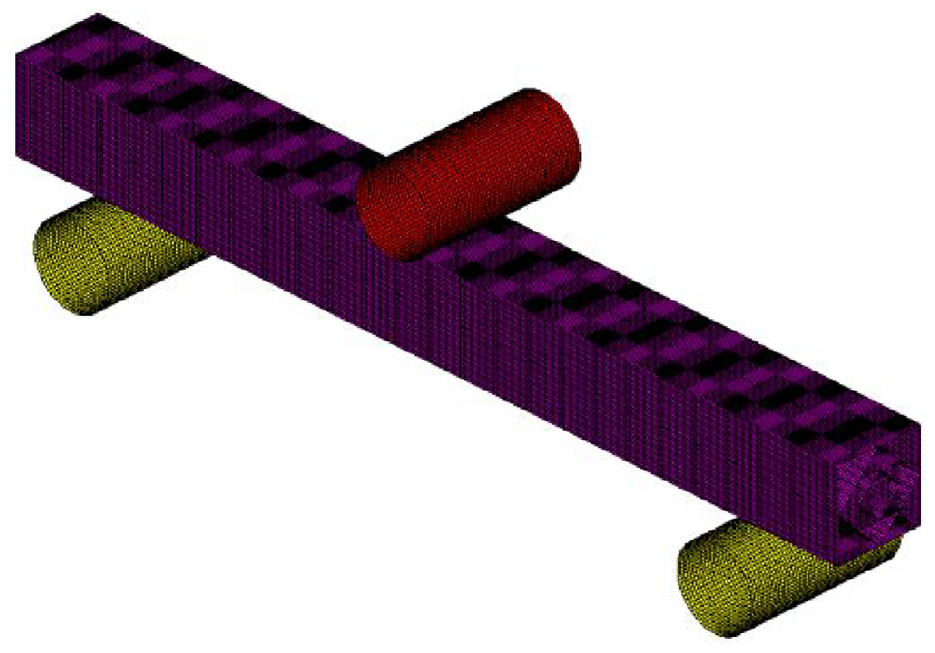
Finite element model of multi-cell square tubes.
The single-surface contact is used to account for the contact of the thin-walled structures themselves, and the node-to-surface contact is adapted to simulate the contact behaviors between the thin-walled structures and supports or punches. The dynamic and static friction coefficients for all the contacts are assumed to be 0.2 and 0.3. 15 The sensitivity of the aluminum material to strain rate is ignored in the numerical simulation calculation. 9
Model validation
A three-point bending test is performed using a 100 kN load capacity testing equipment to evaluate the bending behaviors of a square tube under transverse loading, as illustrated in Figure 5(a). A square tube with dimensions of 300 mm long, 30 mm wide, and 1.0 mm wall thickness is employed in the test. The square tube is positioned on the semi-circular supports that are bolted to the testing machines. The distance between the supports is 230 mm. A semi-circular punch attached to the testing device applies the loading to the square tube. The loading speed is kept constant of 10 mm/s. Figure 5(b) present the deformation patterns obtained from the FE model. The simulation and experiment deformation pattern exhibit reasonably good agreements.

Three-point bending test and deformation mode of square tube. (a) Test. (b) Simulation.
Figure 6 shows the force-displacement curves of the thin-walled square tube acquired from experiment and simulation. The total energy absorbed by the thin-walled square tube is calculated by integrating the crushing force of the punch over the applied displacement, and the average force is determined by dividing the total energy by displacement. Figure 6 displays a comparison between experimental and simulated findings, revealing a high degree of agreement between the two sets of data. The magnitudes of the initial peak force and mean force acquired from experiment and simulation for the thin-walled square tube under transverse loading are summarized in Table 2. The results show very good agreements in the initial peak force and the mean force. The relative errors in the initial peak and mean forces are in the order of 3 and 5%, respectively. From the comparisons shown in Figure 6 and Table 2, it is deduced that the finite element model is capable of providing a reasonably accurate estimation of the bending responses of the thin-walled structures under transverse loading.

Force-displacement curves of square tube.
Comparison of results acquired from experiment and numerical calculation.

Bending responses of stepped multi-cell structures
Figure 7 shows the bending deformation pattern of a traditional square tube under transverse loading. A significant local indentation is formed in the region beneath the circular punch, and its shape is the same as the surface of the cylindrical punch. In addition to the local indentation in the middle part of the square tube, there is one protruding wrinkle outward on each side of the indentation deformation on the upper flange of the square tube. The square tube mainly depends on the local indentation in the middle region and the wrinkling deformation on both sides to absorb impact energy under transverse loading, whereas the remaining parts just experience rigid body motion and do not actually participate in energy absorption.

Deformation mode of square tube (M1) under transverse loading.
The middle region of the square tube bears the maximum bending load under transverse loading, and the load progressively reduces from the middle section to the two support ends. Their strengths are the same along the length direction for the square tube. As shown in Figure 2, a stepped multi-cell square tube based on the equal-strength beam principle is proposed to involve more structural materials in energy absorption and enhance the bending strength of thin-walled structures.
Figure 8 depicts the bending deformation mode of the stepped multi-cell square tube (SM5) under transverse loading, which is the same as the crushing pattern of the square tube. A considerable local indentation is formed in the middle region for SM5. Moreover, in addition to the local region deformation in the middle part, there are also wrinkles outward on both sides of the upper flange local indentation. Compared to the square tube, the plastic deformation in the middle region of SM5 is more pronounced, particularly its wrinkle deformation.

Deformation mode of stepped multi-cell tube (SM5) under transverse loading.
Figure 9 shows the variations in absorbed energy with the displacement of the loading punch for the square tube (M1) and stepped multi-cell structures (SM2 to SM5) under transverse loading. The stepped multi-cell structures offer a larger energy absorption capacity than the square tube. The primary reason is that, for a given mass, the stepped structures rationally assign more material to the middle area to participate in energy absorption, boosting the capacity of thin-walled structures to absorb impact energy. Moreover, as the number of layers increases, so does the amount of impact energy absorbed by the stepped multi-cell structures.

Energy-displacement curves of square tube and stepped multi-cell structures under transverse loading.
Figure 10 shows the force-displacement curves of the square tube (M1) and the stepped multi-cell structures (SM2 to SM5) under transverse loading. The crushing force rapidly declines after the initial peak force and then progressively rises. The stepped multi-cell structures have a lower initial peak force than M1, and their initial peak forces gradually decrease as the number of layers increases. Moreover, when the number of layers rises, the response forces of the stepped multi-cell structures are further enhanced under transverse loading and remain larger than M1 throughout the impacting process. Therefore, adapting the stepped multi-cell structures can not only improve the energy absorption capacity but also reduce the load fluctuations and enhance the load consistency under transverse loading.

Force-displacement curves of square tube and stepped multi-cell structures under transverse loading.
Figure 11 illustrates the energy absorption characteristics of the square tube (M1) and the stepped multi-cell structures (SM2 to SM5) under transverse loading. The stepped multi-cell tubes have a higher energy absorption capacity (E), crushing force efficiency (CFE), and specific energy absorption (SAE) while having a lower initial peak force (Fmax) than the square tube. Furthermore, as the number of layers increases, the initial peak forces of the stepped multi-cell tubes decrease while their energy absorption capacities, crushing force efficiencies, and specific energy absorptions notably increase, resulting in significantly improved comprehensive bending performance. As compared to the square tube, the energy absorption capacities, crushing load efficiencies, and specific energy absorption of the stepped multi-cell tubes increase by 5.87–29.51, 38.29–139.45, and 5.87–29.51%, respectively, while their initial peak forces decrease by 23.44–45.91%.

Energy absorption characteristics of square tube and stepped multi-cell structures under transverse loading: (a) initial peak force, (b) crushing force efficiency, (c) energy absorption capacity, and (d) specific energy absorption.
Parametric study
In the actual impacts, many factors affect the bending behaviors of thin-walled structures under transverse loading, such as wall thickness, section width, load angle, punch radius, and punch shape. The aim in this section explores the influences of these factors on the deformation features and energy absorption characteristics of the square tube and stepped multi-cell structures subjected to transverse loading. When the influence of one factor is explored, other parameters derived from the benchmark model are maintained unvaried.
Wall thickness
For thin-walled structures, wall thickness is an important factor affecting their bending responses under transverse loading. In order to investigate the influence, three different wall thicknesses (2, 3, and 4 mm) are analyzed. Table 3 displays the deformation modes of the square tube and the stepped multi-cell structure (SM5) with various wall thicknesses under transverse loading. The crushing pattern in the middle region of the square tube changes from local indentation to pure bending collapse as the wall thickness grows from 2 to 4 mm. Wall thickness has no effect on the deformation mode of SM5, and local indentation is created for three wall thicknesses.
Deformation modes of square tube and SM5 with different wall thicknesses under transverse loading.

Figure 12 plots the force-displacement curves of the square tube and the stepped multi-cell structures with varied wall thicknesses under transverse loading. As compared to the square tube, the stepped multi-cell tubes for three wall thicknesses have larger crushing forces, smaller initial peak forces, and a narrower range of load fluctuations. Moreover, the response forces of the stepped multi-cell tubes increase, their initial peak forces decrease, and their load consistencies improve as the number of layers rises. In addition, increasing the wall thickness of square tube and stepped multi-cell structures significantly improve their response loads and initial peak forces. When the thickness is increased from 3 to 4 mm, the square tube (M1) and SM2 undergo pure bending collapse deformation, which causes their response forces to noticeably decrease after forming bending collapse. The difference in crushing forces between the square tube and stepped multi-cell structures (SM3 to SM5) gradually increases after bending collapse, indicating that bending collapse deformation is a kind of crushing mode with lower energy absorption efficiency than indentation deformation.

Force-displacement curves of square tube and stepped multi-cell structures with different wall thicknesses under bending loading: (a) 2 mm, (b) 3 mm, and (c) 4 mm.
Figure 13 describes the energy absorption characteristics of the square tube (M1) and stepped multi-cell structures (SM2 to SM5) with various thicknesses. It is observed that the initial peak forces and energy absorption capacities of square tube and stepped multi-cell structures rise dramatically with the increase in the wall thickness. The crushing force efficiency of M1 and SM2 declines as wall thickness rises, but the crushing force efficiency of SM3, SM4, and SM5 first increases and subsequently drops.

Energy absorption characteristics of square tube and stepped multi-cell structures with different wall thicknesses under bending loading: (a) Fmax, (b) CFE, (c) E, and (d) SEA.
The specific energy absorption of M1 and SM2 increases by 18.87 and 17.36%, respectively, as the thickness grows from 3 to 4 mm. Nevertheless, M1 and SM2 form bending collapse deformation when the thickness increases to 4 mm from 3 mm, which significantly reduces their ability to absorb energy. For the stepped multi-cell tubes (SM3 to SM5), their deformation patterns are unaffected by the thickness. Their energy absorption capacities enhance substantially as the thickness increases. When the thickness of stepped multi-cell structures (SM3 to SM5) is raised from 2 to 4 mm, their specific energy absorption increases by 39.52, 35.35, and 29.42%, respectively.
For three wall thicknesses, the stepped multi-cell tubes all have lower initial peak forces and higher crushing force efficiencies, energy absorption capacities, and specific energy absorption than the square tubes. Moreover, as the layers of the stepped tubes grow, their comprehensive energy absorption performances are further improved. Under transverse loading, SM5s of various thicknesses all exhibit the best crashworthiness performance. When compared to the square tubes, the initial peak forces of SM5s are reduced by 27.75, 45.91, and 39.07%, respectively, for three wall thicknesses; while their crushing force efficiencies are increased by 77.75, 139.45, and 157.08%, respectively; and their energy absorption capacities or specific energy absorption are increased by 28.43, 29.51, and 56.64%, respectively.
Section width
The section width of thin-walled tubes is another important aspect affecting their energy absorption characteristics under transverse loading. In order to analyze the influence, three different section widths (45, 55, and 65 mm) are examined. Table 4 shows the deformation modes of the square tube and the stepped multi-cell structure (SM5) with different section widths under transverse loading. When the section width of the square tube is increased from 45 to 55 mm, its crushing pattern changes from pure bending collapse to local indentation. The deformation mode of SM5 is unaffected by the section width, and SM5s with various section widths form local indentation.
Deformation modes of square tube and SM5 with different section widths.

Figure 14 shows the force-displacement curves of the square tube and stepped multi-cell structures with different section widths under transverse loading. In comparison to the square tubes with various section widths, the stepped multi-cell tubes exhibit larger crushing response forces and smaller initial peak forces. Moreover, when the number of layers increases, the crushing forces of the stepped multi-cell structures grow while their initial peak forces and load fluctuation ranges diminish. Additionally, when the section width is reduced from 65 to 55 mm, the contact area between the punch and the thin-walled structures declines, leading to a smaller plastic deformation region and lower initial peaks and crushing response forces. When the section width is further reduced to 45 mm, the square tube and SM2 form a pure bending collapse deformation, and their crushing forces gradually decline after the initial peak load. The difference in response forces between indentation deformation and pure bending collapse grows gradually.

Force-displacement curves of square tube and stepped multi-cell structures with different section widths under different load angles: (a) 45 mm, (b) 55 mm, and (c) 65 mm.
For various section widths, the stepped multi-cell structures all have smaller initial peak forces and greater crushing load efficiencies, energy absorption capacities, and specific energy absorption than the square tubes, as plotted in Figure 15. The number of layers has an important effect on the bending performances of the stepped multi-cell structures. The more the number of layers there are in the stepped tubes, the greater their comprehensive bending performances. Furthermore, with the increase in the section width, their initial peak forces, crushing load efficiencies, and total energy absorption improve for the square tube and stepped structures due to forming a larger plastic deformation region. Under transverse loading, SM5s of various section widths all exhibit the best crashworthiness performance. When compared to the square tubes with different section widths, the initial peak forces of SM5s are reduced by 38.92, 45.91, and 41.04%, respectively; while their crushing force efficiencies are increased by 171.10, 139.45, and 127.49%, respectively; and their energy absorption capacities or specific energy absorption are increased by 65.59, 29.51, and 34.12%, respectively.

Energy absorption characteristics of square tube and stepped multi-cell structures with different section sizes under different load angles: (a) Fmax, (b) CFE, (c) E, and (d) SEA.
Load angle
As shown in Figure 16, in the actual transverse crashes, the punch probably collides with the thin-walled beam structures at any angle. Load angles may have a significant effect on the crushing behaviors of the square tube and stepped multi-cell structures. In order to investigate the influence, five kinds of load angles (30°, 45°, 60°, 75°, and 90°) are discussed.

Schematic diagram of load angle definition.
Table 5 lists the deformation modes of the square tube (M1) and the stepped multi-cell structure (SM5) under transverse loadings at various load angles. The load angle has a massive influence on the M1 and SM5. When the load angle equals 90°, symmetrical indentation deformation patterns are formed for the M1 and SM5. When the load angles are less than 90°, however, asymmetric twist deformation modes are observed as a consequence of the asymmetric punch load, which results in an unbalanced stress distribution on the M1 and SM5. In addition, the twist plastic deformation region expands as the load angles decrease. Especially when the load angle is lowered to 30°, the twist deformation of the M1 and SM5 is notably aggravated.
Deformation modes of square tube and stepped multi-cell structure (SM5) at different load angles.

Figure 17 plots the force-displacement curves of the square tube and stepped multi-cell structures under transverse loading at different load angles. The larger the load angle, the smaller the local plastic region formed by bending deformation, resulting in a decrease in the crushing response loads and initial peak forces. As the load angles rise from 30 to 90°, the initial peak forces of the square tube and stepped multi-cell structures are reduced by 31.27, 35.08, 37.28, 37.64, and 35.57%, respectively, and their average crushing forces are decreased by 15.03, 19.77, 18.44, 18.54, and 16.20%, respectively. The load angle has a substantial impact on the initial peaks and average crushing forces. The stepped multi-cell tubes exhibit higher crushing forces and lower initial peaks and load fluctuation ranges under transverse loading at five load angles than the square tube. Moreover, as the number of layers rises, so do the crushing loads and initial peak forces of the stepped structures.

Force-displacement curves of square tube and stepped multi-cell structures under transverse loading at different load angles: (a) 30°, (b) 45°, (c) 60°, (d) 75°, and (e) 90°.
Figure 18 presents the energy absorption characteristics of the square tube and stepped multi-cell structures under transverse loading at five load angles. For the square tube and stepped structures, their initial peak forces, energy absorption capacities, and specific energy absorption drop and their crushing force efficiencies rise as the load angle increases. When the load angle is less than 60°, the load angle has a substantial influence on the initial peak forces, energy absorption capacities, and crushing force efficiencies. This is due to the fact that a smaller load angle produces a larger plastic deformation area. When the load angle exceeds 60°, the magnitude of the plastic deformation region is less affected by the load angle, resulting in a minor change in the above-mentioned indicators.
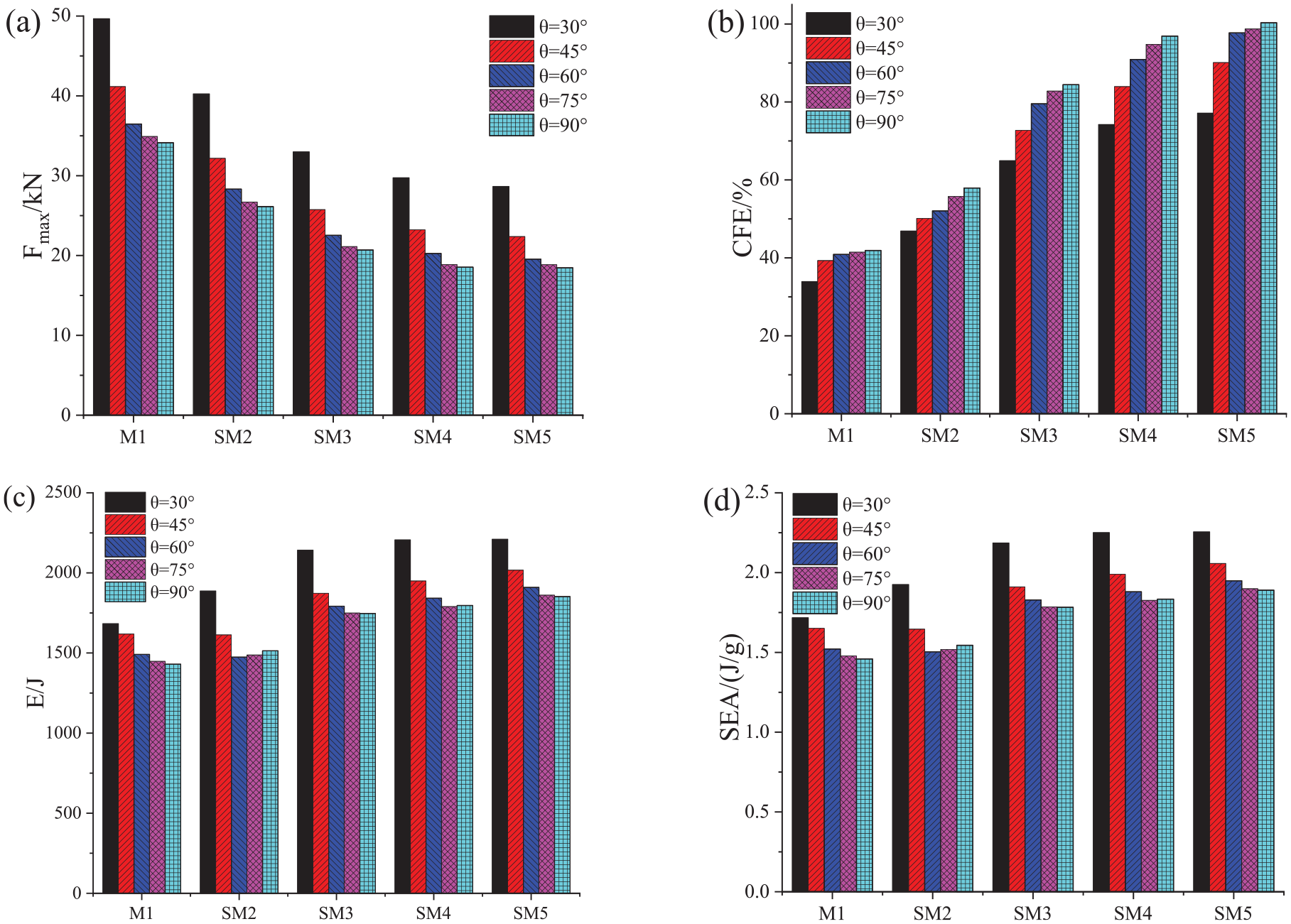
Energy absorption characteristics of square tube and stepped multi-cell structures under transverse loading at different load angles: (a) Fmax, (b) CFE, (c) E, and (d) SEA.
The stepped multi-cell tubes outperform the square tube regarding crushing force efficiencies, energy absorption capacities, and specific energy absorption under transverse loadings at five different load angles. Moreover, as the number of layers increases, the initial peak forces of the stepped tubes reduce gradually while their crushing force efficiencies, energy absorption capacities, and specific energy absorption improve progressively. Under transverse loading at different load angles, SM5s all exhibit the best crashworthiness performance. When compared to the square tubes loaded by five load angles, the initial peak forces of SM5s are decreased by 42.31, 45.64, 46.42, 46.02, and 45.91%, respectively; while their crushing force efficiencies are increased by 127.61, 129.32, 139.09, 138.09, and 139.45%, respectively; and their energy absorption capacities or specific energy absorption are enhanced by 31.31, 24.66, 28.10, 28.52, and 29.51%, respectively.
Punch radius
In the actual crashes, the punch radius is unknown, although it has a significant influence on the crushing behaviors of thin-walled structures under transverse loading. In order to investigate the influence, four different punch radii (15, 25, 35, and 45 mm) are explored in the analyses.
As indicated in Table 6, the square tube undergoes local indentation deformation as the punch radii are 15 and 25 mm. When the punch radius is raised to 35 mm, pure bending collapse deformation for the square tube is presented. The punch radius influences the deformation mode of the square tube. However, the punch radius has no effect on the deformation mode of SM5, and SM5s loaded by the punches of varying radii all produce indentation deformation with excellent energy absorption capacity. Moreover, when the punch radius grows, the magnitude of the local plastic deformation region increases for SM5, whereas it first increases and subsequently decreases for the square tube due to the switch in deformation mode.
Deformation modes of square tube and stepped multi-cell structure (SM5) compressed by a punch with different radii.

Compared to the square tubes compressed by the punches of various radii, the stepped multi-cell structures have larger crushing forces and smaller initial peak forces and load fluctuation ranges, as illustrated in Figure 19. As the number of layers increases, the crushing forces of the stepped tubes climb, but their initial peak forces and variation ranges of response loads further decrease. Also, when the punch radius rises, so does the magnitude of the plastic deformation area, resulting in an increase in the crushing response loads and initial peak forces of the stepped tubes (SM3 to SM5). As the punch radius increases to 35 and 45 mm, the crushing response forces of the square tube (M1) and SM2 reduce considerably due to their deformation modes shifting from local indentation to pure bending collapse.

Force-displacement curves of square tube and stepped multi-cell structures under different punch radii: (a) 15 mm, (b) 25 mm, (c) 35 mm, and (d) 45 mm.
Figure 20 presents the energy absorption characteristics of the square tube and stepped multi-cell structures compressed by the punch with varied radii under transverse loading. The stepped tubes exhibit lower initial peak forces and higher crushing force efficiencies, energy absorption capacities, and specific energy absorption compared to the square tube. Increasing the number of layers can decrease the initial peak force of the stepped tubes while improving their crushing force efficiency, energy absorption capacity, and specific energy absorption.

Energy absorption characteristics of square tube and stepped multi-cell structures under different load angles: (a) Fmax, (b) CFE, (d) E, and (d) SEA.
SM5s all exhibit the best crashworthiness performance when the square tube and stepped structures are compressed by the punches of different radii. When compared to the square tubes crushed by four kinds of punches, the initial peak forces of SM5s loaded by the punches with various radii are reduced by 43.55, 45.91, 46.76, and 46.18%, respectively; while their crushing force efficiencies are increased by 137.66, 139.45, 237.61, and 237.95%, respectively; and their energy absorption capacities are enhanced by 34.17, 29.51, 79.76, and 81.90%, respectively. Adapting SM5 can make the comprehensive energy absorption performance of the thin-walled structures significantly improve.
Punch shape
In actual crashes, the thin-walled structures may be impacted by a punch with different shapes. The punch shapes have a significant influence on the crushing behavior of thin-walled tubes. As shown in Figure 21, the section area of the punch remains constant while its shape is altered by varying the lengths of two semi-axis: a and b of the ellipse section. In order to evaluate the influence of punch shape on the collapse behaviors of square tube and stepped multi-cell structures, seven punch shapes are analyzed here, as listed in Table 7. The b/a is the ratio of two semi-axis: a and b.

Shape and structural parameters of punch.
Structural parameters of a punch with different shapes.

For the case where b/a is less than or equal to 1, Table 8 presents the deformation modes of the square tube (M1) and stepped multi-cell structure (SM5) compressed by the punch with different shapes. The local indentation deformation is formed for M1 and SM5, and the b/a ratio has no influence on their deformation modes. In addition, with the increase in the ratio, the magnitude of the plastic deformation region increases for M1 and SM5.
Deformation modes of square tube and stepped multi-cell structure (SM5) compressed by a punch with various shapes.

Figure 22 plots the force-displacement curves of the square tube and stepped multi-cell structures compressed by different-shaped punches. The curves for different b/a ratios exhibit similar tendencies. The response forces drop rapidly after the initial peak force and then rise gradually. As compared to the square tube, the stepped structures all have higher crushing forces, lower initial peak forces, and narrower load fluctuation ranges. As the number of layers grows, the crushing forces of the stepped tubes increase, but their initial peak forces and load fluctuation ranges reduce. In addition, when the b/a ratio rises, the crushing loads and initial peak forces of the square tube and stepped structures increase due to the formation of a larger region of plastic deformation.

Force-displacement curves of square tube and stepped multi-cell structures compressed by a punch with different sizes: (a) b/a = 0.39, (b) b/a = 0.51, (c) b/a = 0.69, and (d) b/a = 1.
Figure 23 presents the energy absorption characteristics of the square tube and stepped multi-cell structures under transverse loading. When the b/a ratio is less than or equal to 1, the stepped structures exhibit lower initial peak forces and higher crushing force efficiencies, energy absorption capacities, and specific energy absorption than the square tube. Increasing the number of layers can decrease the initial peak forces and enhance the crushing force efficiencies, energy absorption capacities, and specific energy absorption for the stepped tubes. In addition, when the b/a ratio grows, the initial peak forces, energy absorption capacities, and specific energy absorption of the square tube and stepped structures increase.

Energy absorption characteristics of square tube and stepped multi-cell structures compressed by a punch with different sizes: (a) Fmax, (b) CFE, (c) E, and (d) SEA.
For the case where the b/a ratio is less than or equal to 1, the stepped multi-cell tube (SM5) has the best crashworthiness performance under transverse loading. For the b/a ratio to be equal to 0.39, 0.51, 0.69, and 1, the initial peak forces of SM5s are decreased by 35.92, 39.94, 42.66, and 45.91%, respectively; while their crushing force efficiencies are increased by 109.44, 121.17, 129.99, and 139.45%, respectively; and their energy absorption capacities or specific energy absorption are enhanced by 34.21, 32.84, 31.89, and 29.51%, respectively, compared with those of the square tube.
Table 9 shows the deformation modes of the square tube and stepped multi-cell structure (SM5) under transverse loading when the b/a ratio is greater than or equal to 1. The crushing mode of the square tube shifts from local indentation deformation with a high energy-absorbing efficiency to pure bending collapse with a poor energy-absorbing efficiency as the b/a ratio grows. The b/a ratio does not influence the deformation mode of SM5, and when SM5 is impacted by the punches with different b/a ratios, a local indentation is generated. Moreover, when the b/a ratio increases, the punch flattens, resulting in a flat local indentation deformation with a greater breadth and shallower depth for SM5.
Deformation modes of square tube and stepped multi-cell structures compressed by a punch with different shapes.
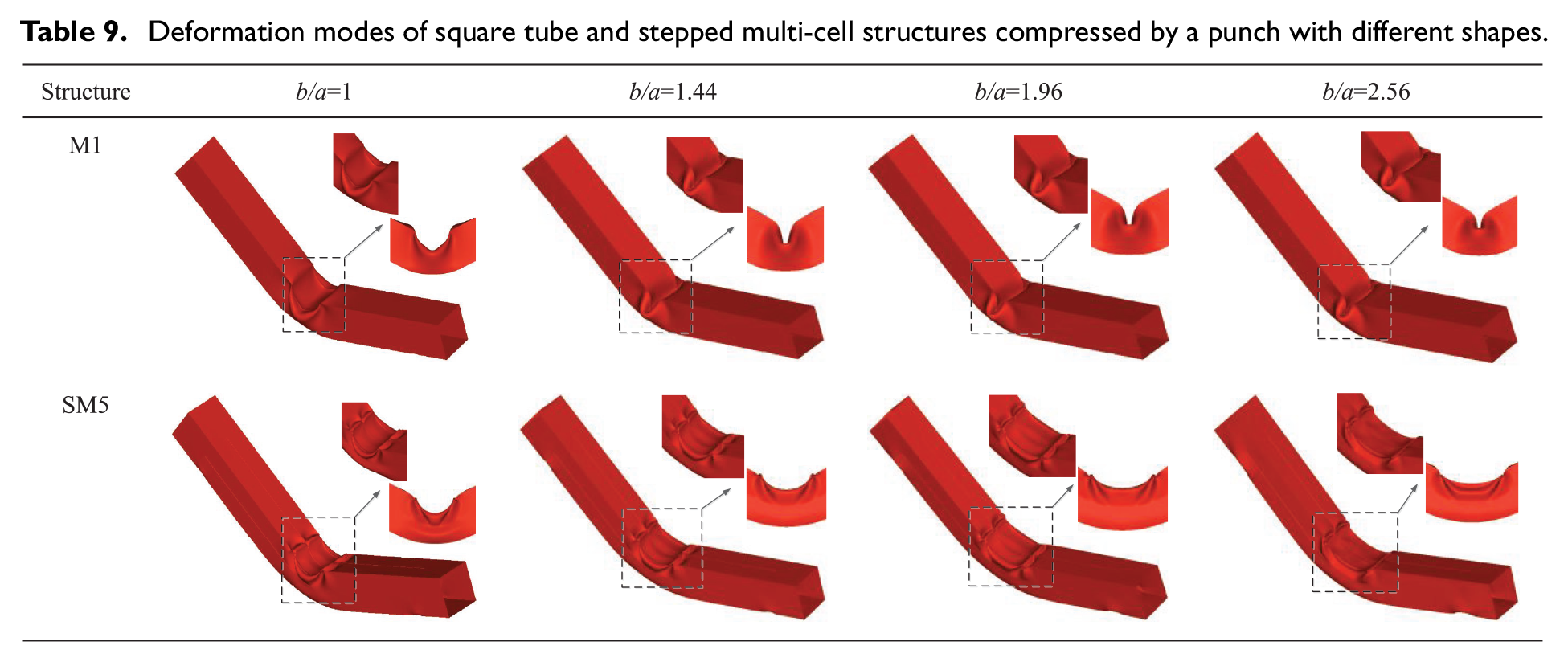
Figure 24 plots the force-displacement curves of the square tube and stepped multi-cell structures under transverse loading. The stepped structures have larger crushing forces and smaller initial peak forces and load fluctuation ranges than the square tube. The crushing forces of the stepped tubes rise as the number of layers increases, but their initial peak forces and load fluctuation ranges decrease. The switch of deformation modes has a considerable impact on the crushing response forces, and those forces keep declining after reaching their initial peak forces for M1 and SM2.

Force-displacement curves of square tube and stepped multi-cell structures compressed by the punch with different shapes: (a) 1, (b) 1.44, (c) 1.96, and (d) 2.56.
Figure 25 shows the energy absorption characteristics of the square tube and stepped multi-cell structures compressed by the punches with various b/a ratios. For different b/a ratios, the stepped structures have lower initial peak forces, greater crushing force efficiencies, and higher energy absorption capacities than the square tube. The initial peak forces of the stepped tubes decrease as the number of layers increases, but their crushing force efficiencies and energy absorption capacities improve. In addition, as the b/a ratio increases, the initial peak forces of the square tube and stepped structures rise, and their crushing force efficiencies drop, while the variation of the energy absorption capacities is complicated for the square tube (M1) and stepped structure (SM2) due to the switch of deformation mode. When b/a is greater than 1, M1 and SM2 undergo pure bending collapse, resulting in an enormous drop in their energy absorption capacity. The b/a ratio has no effect on the deformation modes of SM3, SM4, and SM5. Their energy absorption capacities and specific energy absorption both improve as the b/a ratio increases.

Energy absorption characteristics of square tube and stepped multi-cell structures compressed by the punch with different shapes: (a) Fmax, (b) CFE, (c) E, and (d) SEA.
At various b/a ratios, the stepped tube (SM5) has the best crashworthiness performance under transverse loading. For the b/a ratio to be equal to 1, 1.44, 1.96, and 2.56, the initial peak forces of SM5s are decreased by 45.91, 42.42, 40.03, and 39.34%, respectively, while their crushing force efficiencies are increased by 139.45, 214.96, 205.40, and 191.49%, respectively, and their energy absorption capacities are enhanced by 29.51, 81.35, 83.17, and 76.82%, respectively, compared with those of the square tubes.
Conclusions
(1) Compared to the square tube, the stepped multi-cell structures have smaller initial peak forces and larger energy absorption capacities, crushing force efficiencies, and specific energy absorption under transverse loading. Furthermore, with the increase in the number of layers, the initial peak forces of the stepped tubes decrease while their energy absorption capacities, crushing force efficiencies, and specific energy absorption increase.
(2) The variations of wall thickness impact the crushing responses of the square tube and stepped multi-cell structures under transverse loading. As the thickness grows, their initial peak forces, energy absorption capacities, and specific energy absorption improve. The thickness has an influence on the deformation mode of the square tube. With the increase in thickness, the deformation mode of the square tube changes from local indentation to pure bending collapse, which results in a considerable reduction in crushing performance. The deformation mode of the stepped structures is not affected by the wall thickness.
(3) The section width affects the deformation mode of the square tube, thereby affecting its energy absorption characteristics under transverse loading. The section width has no effect on the deformation mode of the stepped structures. With an increase in the section width, the magnitude of the plastic deformation region increases, resulting in an increase in the initial peak forces, energy absorption capacities, and crushing response loads of the stepped tubes.
(4) The deformation features and crushing response forces of the square tube and stepped multi-cell structures under transverse loading are greatly affected by the load angle. When the load angle is less than 90°, local indentation deformations with severe twists are formed in the square tube and stepped structures under transverse loading due to the asymmetric punch load. In addition, when the load angle decreases, the twist deformation becomes aggravated, and the plastic deformation area expands, which results in an increase in the initial peak force, energy absorption capacity, and crushing response load.
(5) The variation of punch radius results in a change in the deformation mode of the square tube from local indentation to pure bending collapse with a lower energy absorption efficiency. The variation of punch radius has no influence on the deformation modes of the stepped multi-cell tubes. Also, as the punch radius increases, the plastic deformation area that forms in the stepped tubes expands, improving their energy absorption efficiency.
(6) The deformation feature of the square tube is affected by the b/a ratio. When the b/a ratio is less than or equal to 1, a local indentation is formed in the square tube under transverse loading. When the b/a ratio exceeds 1, the deformation mode of the square tube switches to pure bending collapse, leading to a considerable decrease in its energy absorption capacity. The b/a ratio has no effect on the deformation features of the stepped multi-cell tubes. As the b/a ratio increases, the plastic deformation area that forms in the stepped tubes expands, and their energy absorption capacities enhance.
Footnotes
Handling Editor: Chenhui Liang
Declaration of conflicting interests
The author(s) declared no potential conflicts of interest with respect to the research, authorship, and/or publication of this article.
Funding
The author(s) received no financial support for the research, authorship, and/or publication of this article.
