



Abstract
This paper proposed and implemented the Teager-Kaiser energy operator (TKEO) and envelope spectral analysis techniques for the fault detection of discharge valves of a reciprocating compressor. Based on the extraction of fault features, the instantaneous frequency and amplitude of the signals due to the discharged valve based on energy identification can be effectively characterized by the TKEO that was used to identify the characteristic fault signals accurately. The synthesized signal is processed by envelope spectral analysis and TKEO, which can extract the characteristic signal and eliminate the noise. The experimental design is verified experimentally through different reciprocating compressor gas valve conditions. The simulation results verify the feasibility of the proposed method. The experimental verification is carried out through the measurement signals of the six-cylinder reciprocating compressor under different valve operating conditions. TKEO can remove background noise to obtain reciprocating compressor fault feature signals. Feature extraction is based on TKEO and envelope spectra for fault detection of reciprocating compressors. It is expected to reduce the errors produced by traditional manual fault diagnosis methods and improve the accuracy and efficiency of fault diagnosis. The research results of vibration fault feature extraction using TKEO can be used as the basis for fault diagnosis of the reciprocating compressor system.
1. Introduction
Reciprocating compressors (RCs) are one of the most widely used industrial equipment in petrochemical plants, oil refinery factories, refrigerated air-conditioning systems, etc. The unexpected breakage of RCs probably leads to factory downtime, production interruption, and revenue loss. Further, it may cause industrial safety accidents if the failure is not detected and handled in time. According to the working principle of the compressor, the forms and corresponding causes of the main parts’ failure were analyzed.1,2 The cost of the compressor accounts for 50% of the overall maintenance expenditure. 3 According to the statistics, 60% of compressor failures were caused by valve faults. 4 Varied methods were proposed to detect and diagnose valve faults of RCs.5–9 Sharma and Parey 10 applied the empirical mode decomposition and variational mode decomposition to process acquired vibration signals to diagnose faults in a reciprocating compressor under varying speed conditions. Tran et al. 11 proposed using wavelet transformation to eliminate random noise, and applied the TKEO to estimate signal amplitude envelopes. Further, the statistical analysis were used to extract features of varied valve conditions, and the deep belief networks architecture was employed to classify compressor valve failures. Several papers were investigated in the field of fault diagnosis on RC.12–16 The performance evaluation of signal decomposition techniques was implemented to detect valve conditions in a RC under limited speed variation.17,18 Some studies investigated varied fault diagnosis issues on rotating machinery and components such as induction motors, gear sets, and bearings.19–27
The reciprocating compressor with complex structure operates in a complicated motion. Its mechanism converts rotary motion into linear reciprocating motion. It is a great challenge to correctly diagnose the vibration caused by the cylinder valve plate hitting the lift limiter and falling back to the valve seat, coupling and interfering with each other when the number of cylinders is large. The movement of components with linear and rotary motions during operation causes vibration signals to be non-stationary and accompanied by noise. In the study to diagnose the valves of a six-cylinder RC of the refrigeration system equipped in a temperature screening cabinet was coped with. The probability and severity of the valve faults are summarized and focus on valve failure of reciprocating compressor. To avoid faults resulting in significant accidents is crucial to develop effective condition monitoring and fault diagnosis techniques for reciprocating compressors. Therefore, we present the non-destructive related feature extraction technologies for crucial equipment. The fault diagnosis of RC based on vibration signals by various signal processing techniques and multi-source signals are collected and analyzed for fault diagnosis has been studied. 28 Reciprocating compressor operation produces a response signal from the valve excitation source. The shock and vibration of the reciprocating compressor during normal operation and failure vary depending on the situation. The main purpose of this study is to extract the valve signal characteristics of a reciprocating compressor in extraction operation. Concerning the characteristics, there are two characteristics of impact and periodicity in related research. The paper proposed a computation scheme consisting of Teager–Kaiser energy operator (TKEO)28,29 and Hilbert transform (HT) for diagnosing the faults of RC valves. TKEO can measure instantaneous energy changes of signals composed of a single time-varying frequency. Compared with other methods, the calculated energy is derived from the signal’s instantaneous amplitude and frequency.
This paper presents the fault diagnosis of a reciprocating compressor scheme using the TKEO to extract features. It enables to address the computation complexity and be applied in online and real-time. Feature extraction based on TKEO for fault detection of a reciprocating compressor is realized. Synthetic signals are designed and applied to evaluate the developed schemes, which separate and extract characteristic features. The work explored the significant fault features of a reciprocating compressor, especially for comparing the TKEO and envelope spectral analysis techniques and developing new fault diagnosis schemes for reciprocating compressors. The results illustrate superior characteristics of the developed techniques.
The paper is organized as below. The theoretical basis of the Hilbert envelope denoising method and TKEO method are briefly described in Section 2. Numerical simulations were carried out to validate the effectiveness of the proposed method in Section 3. In Section 4, experimental investigations are performed to detect the faults in the reciprocating compressor of valve. Finally, the conclusion was provided in Section 5.
2. Theoretical basis
The study takes the valve of a reciprocating compressor as the object to be diagnosed. The impact vibration generated by the operation of the valve in a normal and fault state is put into practice. A feature extraction method based on the envelope spectral and TKEO analysis is proposed.
The Hilbert envelope h(t) of a signal x(t) is the magnitude function of the analytic signal Zx(t) composed of the real part x(t) and the imaginary part the Hilbert transform of x(t). 30 The Hilbert envelope is evidently a positive function, and thus always unipolar. By using the unipolar nature it is utilized in the detection of valve faults in the work.
The energy of a signal
Simple harmonic motion applies Newton’s law of action to the movement of a mass m suspended by a spring of force constant k, a second-order differential equation.

Simple Harmonic Motion of Continuous Time Signals x(t) = A cos (
The total energy E of the system is the sum of the potential energy in the spring and the kinetic energy of the mass and is

Substituting for x and solving, we obtain

Let xn be the samples of the signal representing the motion of the oscillatory body. Therefore

where Ω is the digital frequency in radians/sample and is given by Ω = 2πf/fs where f is the analog frequency and fs is the sampling frequency.





when enough small values of Ω, then sin (Ω)≈Ω

Thus the above expression forms a simple algorithm to obtain a measure of the energy in any single component signal.

Teager-Kaiser energy operator
Teager-Kaiser energy operator, which Kaiser has developed. The TKEO is nonlinear. The envelope spectrum is obtained by Fourier Transforming the instantaneous amplitude envelope. It can track the modulation energy at any time to estimate and identify the instantaneous frequency and amplitude of the single-component signal. Therefore, it is possible to effectively extract the characteristic frequency related to the valve defect according to the characteristics identified by the envelope spectrum.
An essential feature of TKEO is that it can analyze the instantaneous amplitude and frequency. It is because only three samples are needed for energy calculation at each moment, and having good time resolution provides the ability to obtain energy fluctuations. Energy operators are very easy and rapid to implement efficiently. The TKEO equation28,29 in the continuous form is denoted by the symbol ψc[.] Here we have



and

where

The energy operator’s signal analysis of the time-varying amplitude and frequency can approximate the square of the product of the signal amplitude and the instantaneous frequency.


An essential aspect of TKEO is that it is nearly instantaneous. This is because only three samples are required for the energy computation at each time instant. The Energy separation algorithm developed by Maragos et al.28,29 uses the TKEO to separate x(t) into its instantaneous amplitude envelope |A| and instantaneous frequency ωc.


The TKEO,

where A,


and

can solve the system of equations to get

When enough small values of Ω, then sin (Ω)≈Ω. The above equation becomes

In the discrete case, the time derivatives may be approximated by time differences. Therefore, the discrete-time signal corresponds to the equation of ψ [.] of TKEO, and its TKEO energy operator is defined as

The Discrete energy separation method DESA-1 takes two samples backward or forward substitution derivative as the difference


then the above equation becomes

Hypothesis T = 1 where

Defined in discrete time, the backward-difference approximation is the first derivative.




Therefore, the absolute value of frequency and amplitude can be obtained as follows:


where
3. Signal simulation design and analysis
The reciprocating compressor has the behavior of rotating machinery and linear motion. The rotation of the crankshaft drives the piston to reciprocate through the connecting rod. The crankshaft causes one revolution, and the piston reciprocates once. Periodic changes in the closed volume of the cylinder and irregular piston movement. Therefore, the signal has absolute relevancy with the system structure and operation composition. The operation is to include rotation and straight line, and the opening and closing of the valve. The measured vibration signal may consist of the rotor, crankshaft imbalance, low frequency caused by improper parts components, random vibration caused by friction, etc. The primary vibration energy source signal is the crankshaft running and valve opening and closing. The numerical simulation uses square waves, random noise, and pulse to synthesize the simulation signal of the reciprocating compressor. Therefore, the above considerations are adopted in the numerical simulation design of the researched reciprocating compressor. (a) Simulate vibration signals caused by unbalanced crankshaft imbalance or improper assembly. (b) Random noise: simulates background vibration when rotating machinery is running. (c) Pulse signal sequence: to simulate the pulse signal of cylinder valve opening and closing. The fundamental frequency of the simulated operation signal is 30 Hz. When the crankshaft of a Six-cylinder reciprocating compressor rotates one at 30 Hz, and per cylinder reciprocates one time. The crankshaft rotates once; its six-cylinder piston reciprocates once simultaneously, and the suction and discharge valves open and close once again. Synthesize the above three functions to generate the simulated vibration signal for the operation of the defective valve of the reciprocating compressor.
Signal simulation design
The vibrations measured on the reciprocating compressors are administrated by high-level imbalance and misalignment components, including random vibrations associated with friction and other sources. Imbalance vibration occurs at the crankshaft rate of rotation (referred to as the 1×); misalignment shows up at the fundamental (1×) and its harmonics. The spectral components associated with the discharge valve pulse sequence. In a traditional spectrum, these components’ signals are submerged in the spectral noise floor generated by random vibrations and leakage from the high-level harmonic.
Square wave
A square wave contains only odd harmonics. Thus this approximation includes only the fundamental (1×), 3×, 5×, 7×, 9×, and 11× harmonics. An imbalance generates a high 1× level, and a misalignment causes peaks. Still, the absence of even harmonics in the square wave does not affect the instructive value of the synthetic waveform. The square wave is used to design and simulate the vibration caused by the operation of the unbalanced crank in an unbalanced state. A six-term approximation to a 0.025 amplitude 30 Hz square wave. It simulates a square wave signal with a peak amplitude of 0.025 of the waveform, and the RMS amplitude is 0.0193 in Figure 1.

Synthesized square wave.
Random noise
The design includes a random noise function generated using Gaussian amplitude distribution characteristics and simulates that the vibration measurement signal contains random noise. The noise source may be background environmental vibration interference, friction, electrical noise, motor noise, etc. The maximum amplitude is 0.349, and the RMS amplitude is 0.114 in Figure 2.

Synthesized random noise.
Pulse signal
Assuming the monitoring measurement is a six-cylinder reciprocating compressor, the six-cylinder valves are opened and closed once when the crankshaft makes one revolution. The abnormal pulse signal sequence is to simulate one of the six-cylinder reciprocating compressors’ discharge valves. A ringing pulse sequence with a repetition rate of 30 Hz, an RMS amplitude is 0.084, and a 0.2 peak amplitude in Figure 3.

Synthesized pulse signal.
Synthetic signal
This signal is synthesized by based on the above assumption, the RMS value of the Gaussian random noise in the analog composite signal is 0.114; the SNR value of the pulse sequence and random noise is −2.62 dB and the signals of (1)−(3) are synthesized as analog the synthesized signal is shown in Figure 4. The pulse sequence signal generated by the valve defect is completely flooded in the analog signal. Feature judgment valve defects are not feasible.

Synthetic signal.
Signal simulation analysis
Fourier analysis
In the frequency spectrum of Figure 5, the time-domain waveform, the frequency characteristic of the valve defect, is also flooded by the square wave signal and random noise energy. If the influence of Gaussian random noise on the defect pulse sequence is considered separately, the effect of the square wave signal is not considered, as shown in Figure 6. It is impossible to directly judge the state of the valve between the time-domain waveforms. In the frequency domain in Figure 5, even though the peak amplitude of the pulse sequence is more significant than that of the square wave, the pulse sequence and the associated spectral peaks are minor. The composite signal noise and pulse sequence have no apparent amplitude of 30 Hz frequency in Figure 6.

Synthetic-1.

Synthetic-2.
The random noise is so large that it completely covers the harmonics of the pulse sequence in a traditional spectrum. Yet, the envelope analysis can extract the fundamental frequency associated with this waveform from the composite signal.
Envelope analysis
The analysis results of the synthesized analog signal through the envelope spectrum can be distinctly observed in Figure 7. One of the valve defects of the six-cylinder reciprocating compressor cylinder has the characteristic frequency 30 Hz on the abnormal pulse signal for opening and closing during operation.

Synthetic envelope analysis.
TKEO analysis
The analysis results of the synthesized analog signal through the energy operator TKEO can be observed in Figure 8. One of the six-valve cylinders of the reciprocating compressor cylinder is faulty. It has the characteristic frequency of the opening and closing abnormal pulse signal during the operation of 30 Hz.

Synthetic TKEO analysis.
Based on the above results, it is known that the synthetic analog signal simulates the abnormal valve fault frequency of the six-cylinder valve to be 30 Hz. In actual operation equipment, due to the modulation phenomenon, most of the energy is concentrated around the resonance frequency, which is modulated by the frequency. If the spectrum analysis is performed directly on the signal, the defect pulse frequency cannot be directly observed through the spectrum analysis method. Therefore, after the structural resonance frequency modulates the valve resonance signal, it is challenging to execute the reciprocating compressor through simple time-domain signal observation or spectrum analysis signal to determine the failure of the reciprocating compressor. Therefore, the sequence of pulses models the periodic response of a reciprocating compressor housing to valve pulse over a flaw. It must be used to remove the modulated signal from the carrier effect and restore the callback variable signal of the amplitude demodulation method and energy amplitude demodulation method. In this study, the original signal envelope is obtained by HT and TKEO in different ways to achieve demodulation and Fourier conversion. After analysis and comparison, it is verified that other methods of HT and TKEO can indeed extract the characteristic frequency of the abnormal signal.
4. Experimental studies: Apparatus
A data modeling study on the compressor system is developed to monitor the dynamic characteristics while operating under three different conditions. This section explains in detail the experimental setup and the procedure adopted for the effective conduct of the experiment.
The temperature environmental stress screening chamber two-stage refrigeration system mainly comprises a six-cylinder reciprocating compressor for the second stage compression. The system specifications are as in Table 1.
DWM Copeland compressor Specifications.

Test setup and signal acquisition system
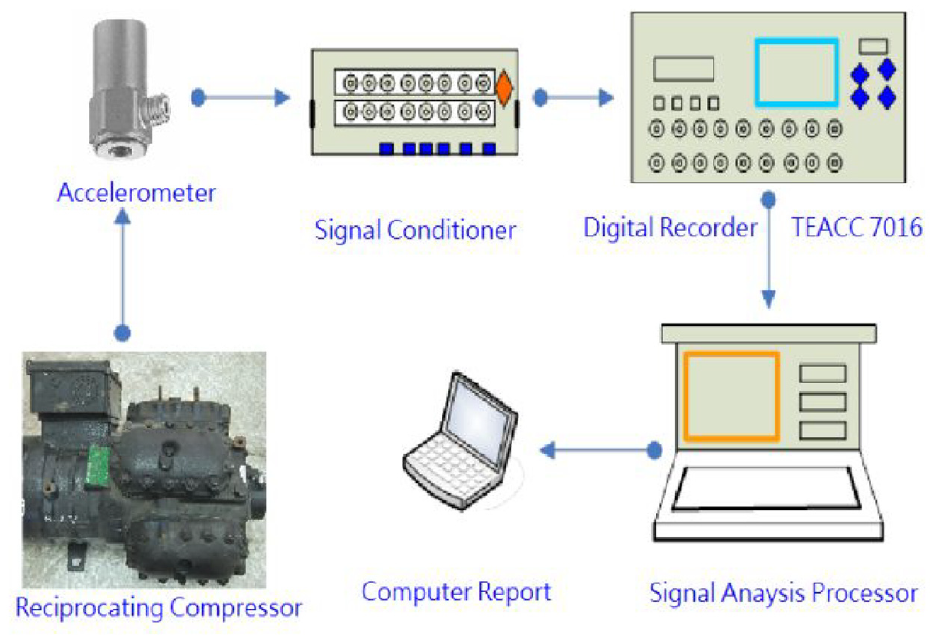
The signal acquisition measurement system specifications for this experiment are shown in Table 2. The cylinder of reciprocating compressor experimental measurement discharge valve setup accelerometer site, as shown in Figure 9. It consists of an accelerometer, signal conditioner, TEAC digital recorder, and signal analysis, as shown in Figure 10.
Measurement apparatus specification.


Accelerometer mounting to diagnose valve faults.
Signal acquisition system.
Experimental scenario design
The envelope analysis needs to find out the resonance frequency of the reciprocating compressor structure and analyze it, so the structure will be swept to find the resonance frequency. This study design uses the frequency converter to control the speed of the induction motor to carry out the resonant compressor structural resonance frequency sweep and control the rotation speed linear increase from 0 to 2400 rpm for 10 s as shown in Figure 11.

RC structural sweep.
Designing three scenarios for the reciprocating compressor test plan and the corresponding discharge valve, developing three scenarios of standard, loose discharge valve fixing screw, and leakage.
(i) Scenario-1: normal operation.
(ii) Scenario-2: loose fixing screw on the valve.
(iii) Scenario-3: the discharge valve is worn and leaking. The signal measurement is performed during the operation. The experimental design drills a 0.7 mm aperture to simulate the valve leakage of the discharge valve close to the sensor, as shown in Figure 12.

ϕ 0.7-mm leakage on the valve of RC.
A comparison of selected measurement techniques for the fault diagnosis of reciprocating compressors is summarized in Table 3. The paper priority selected the vibration analysis of measurement technique.
A comparison of measurement techniques of fault diagnosis of reciprocating compressors.

Experimental setup Measurement dynamic signal analysis
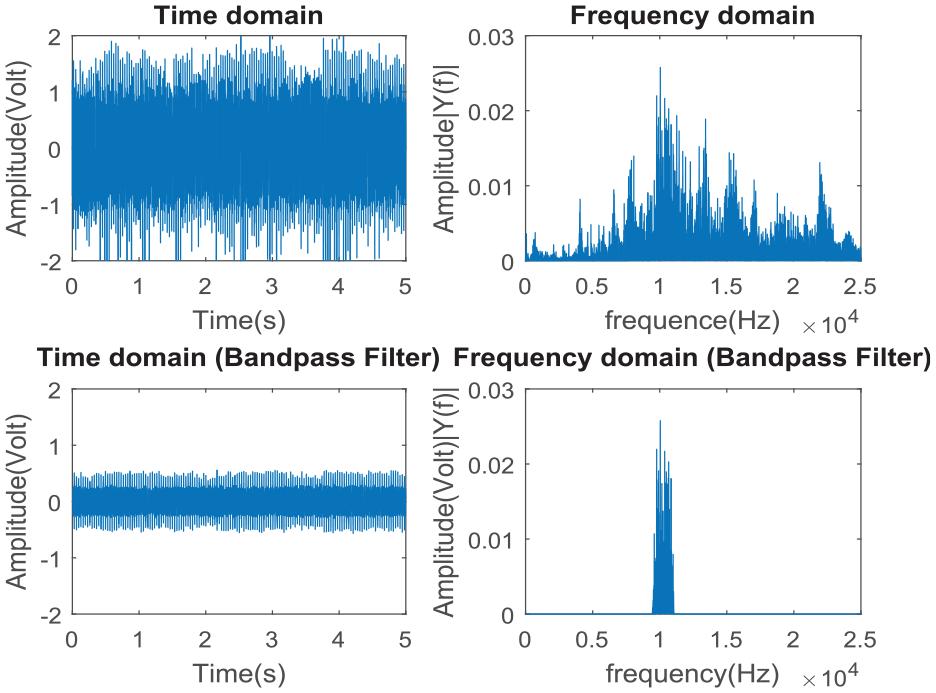
Before performing the envelope spectral analysis, the resonance frequency of the compressor needs to be discussed to determine the carrier frequency of the valve defect modulation signal. In this experimental design, the motor of the reciprocating compressor is controlled by a frequency converter. The speed is increased from 0 to 2400 rpm for 10 s, and 2400 rpm is reduced to 0 rpm for 10 s. The vibration transmission of the discharge valve of the reciprocating compressor is measured and the shortest distance is above the cover plate. Time domain and frequency domain diagrams of vibration signals from 0 to 2400 rpm to 0 rpm measured by the accelerometer on the cylinder head of the compressor. The structural resonance frequency signal measured on the cylinder head is selected with the appropriate band-pass settings as 9.5−11.0 kHz. The purpose of band-pass filtering (BPF) is to eliminate random noise outside the passband. After BPF and rectification using the Hilbert transform in the envelope, the analysis process is a calculation of the spectrum of the rectified band-pass signal, as shown in Figure 13.
Bandpass filtering.
Experimental verification
Because the vibration signal of RC is non-stationary and noisy. Three scenarios RC operation vibration measurement signal of time domain, as shown in Figure 14. Traditional vibration signal analysis like Fourier transform (FT) can be applied to other rotating machines, but the vibration signal cannot be handled well at RC. When performing spectrum analysis with FT, the implied weak valve pulse characteristic signal cannot be extracted because Characteristic signs are submerged in noise and background signals. We use envelope analysis and energy operator TKEO method to extract features by simulation analysis signal, and the results can effectively process the fault feature signal and verify its feasibility. The actual measurement of vibration signals during the essential RC operation was processed by the above two methods for feature extraction, in Figure 15. Due to the complex processing process and the setting of the resonance band-pass frequency range cannot be distinguished and objectively selected in envelope analysis. The BPF range is chosen. If the range is not its resonance frequency range, the modulation signal cannot be demodulated to restore the sign. This study specifies lower cutoff and upper cutoff frequencies in the BPF range of 9.5−11.0 kHz. Three scenarios of RC operation vibration measurement signal analysis by envelope spectra, as shown in Figure 16.

Time waveforms of the three scenarios.

Envelope spectra of the three scenarios.

Block diagram of feature extraction procedure.
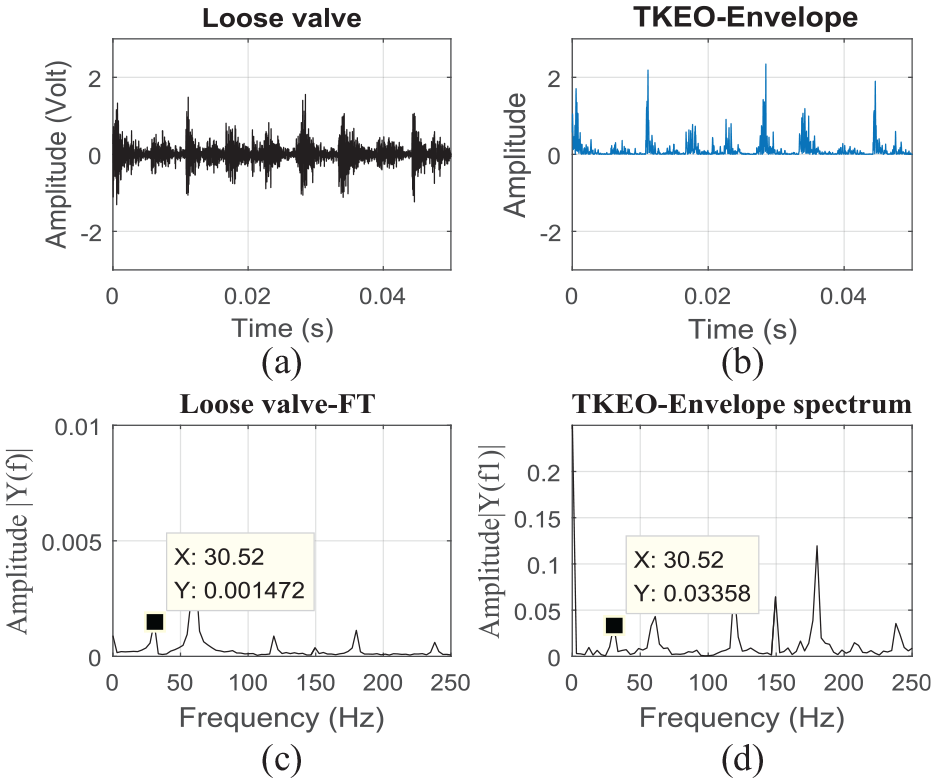
When the valve is standard, the valve reed opens so that the pressure difference between the inside and outside of the cylinder reaches the maximum critical pressure. The valve reed strikes and the mechanical impact of the seating after the ventilation. Therefore, the impact energy is also the largest. When the valve reed wears, leaks the pressure difference between the inside and outside of the cylinder cannot be accumulated. The relative impact is minor when the valve reed is opened. The result of the normal amplitude of the discharge valve reed is the largest. Leakage amplitude is the smallest when the valve reed is leaked. Under the same conditions, the original time-domain signal is extracted with TKEO, the characteristic pulse is evident, and most noise is eliminated. TKEO extracts the vibration signal of the initial time waveform and is then processed by the spectral analysis, as shown in Figures 17 to 19.

Normal TKEO spectra: (a) normal valve, (b) TKEO-envelope, (c) normal valve-FT, and (d) TKEO-envelope spectrum.
Loose TKEO spectra: (a) loose valve, (b) TKEO-envelope, (c) loose valve-FT, and (d) TKEO-envelope spectrum.

Leaked TKEO spectra: (a) leaked valve, (b) TKEO-envelope, (c) leaked valve-FT, and (d) TKEO-envelope spectrum.
A comparison between TKEO and envelope spectrum analysis shows that the accuracy of traditional envelope spectral analysis fault diagnosis depends on the setting of the appropriate BPF range. TKEO can achieve the same effect without complicated procedures, and extracting feature signals is easy. In this study, three different condition scenarios were designed. Feature extracted with envelope spectra and TKEO.
The FT spectrum analysis to observe the amplitude of the primary frequency at 30 Hz for comparison and judgment. Based on the study of the TKEO energy operation element, during regular operation, when the cylinder piston compresses the gas to critical pressure, the high-pressure gas pushes the valve reed. It knocks on the upper positioning plate to cause an impact, so the amplitude at 30 Hz is 0.08, the largest amplitude. The gap between the unfixed gasket and the valve plate increases when the fixing screw loosens.
The valve plate will be opened when the fixed pressure is not reached, and the minor impact will produce 0.034 at 30 Hz. In state of valve wear and leakage, due to valve wear and leakage, when the cylinder is in reciprocating operation, the compressed gas of the cylinder piston cannot accumulate the pressure in the cylinder, resulting in a small valve opening amplitude and impact energy, and the amplitude at 30 Hz is 0.015, the smallest amplitude.
An additional case study to justify the method
To justify the proposed method in the application of the machine fault diagnosis, an additional case study was conducted on bearing faults. The vibration data using the test bench bearings (SKF 6205-2RS JEM) from Case Western Reserve University (CWRU) 31 were examined, including normal and faulty inner rings of the ball bearings. Table 4 shows the operating conditions of the test bench for the bearing data acquisition.
Operation conditions of bearing test bench.

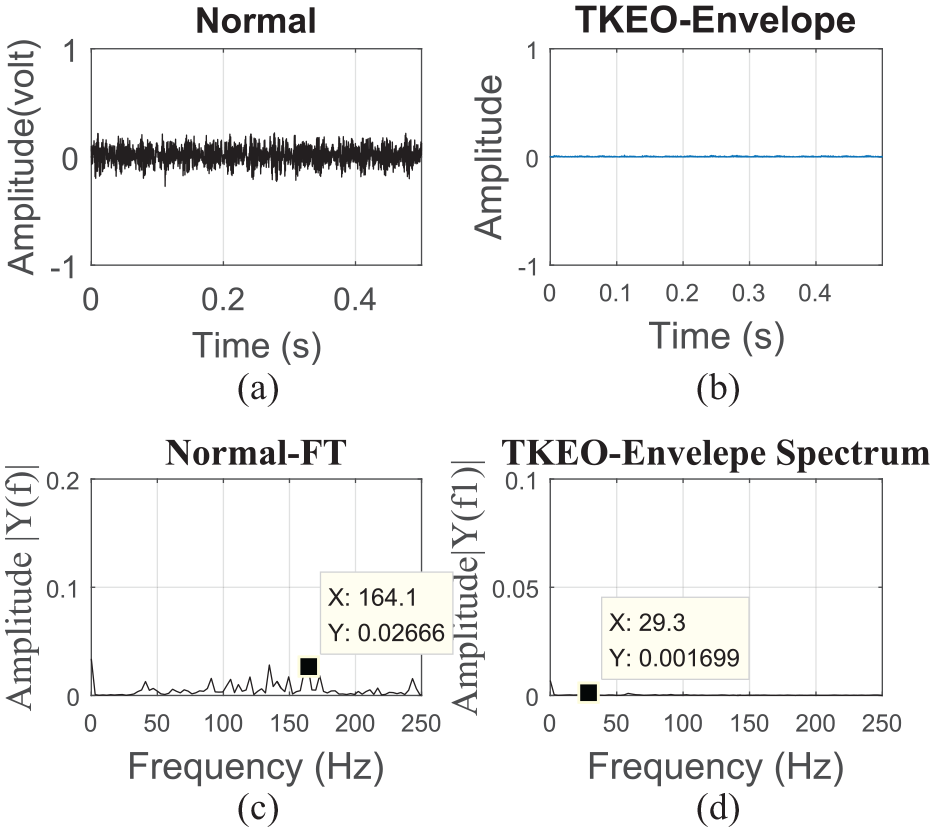
All the vibration data for normal and inner-race fault bearings were acquired with a sampling frequency of 12 kHz. The running speed of motor were 1797 and 1730 rpm, respectively, thus the corresponding shaft rotating frequency (Fr) 29.65 and 28.83 Hz. The feature frequency of inner race fault can be expressed as FBPI = (NB/2)Fr(1 + (Db cosθ/Dc)), where NB (=9) denotes the number of rolling elements, Db (8 mm) and Dc (39 mm) are the ball and pitch diameter, respectively, θ (0°) is the contact angle. Thus, the feature frequency of inner race fault can be calculated FBPI1(1797rpm) = 161.15 Hz and FBPI2(1730rpm) = 156.69 Hz, respectively. Both FT and TKEO envelope spectra of vibration signals were processed and compared. Figures 20 and 21 characterize the spectra (FT and TKEO envelope) of normal and inner-race fault bearings, respectively, for the operation conditions of motor speed 1797 rpm and motor load 0 hp. As to the operation conditions of motor speed 1730 rpm and motor load 3 hp, Figures 22 and 23 show their results. It is noted that the TKEO envelope spectrum enable to characterize feature frequency that corresponds to the bearing fault. For the inner-race fault conditions compared with the FT spectra, the TKEO spectra (Figures 21(d) and 23(d)) apparently characterize bearing fault frequencies, 161.1 and 155.3 Hz, corresponding to varied operation conditions. Conversely, for the normal-bearing condition the TKEO spectra (Figures 20(d) and 22(d)) illustrate rather clean spectra.
FT and TKEO spectra of normal bearings (1797 rpm, motor load 0 hp): (a) normal, (b) TKEO-envelope, (c) normal-FT, and (d) TKEO-envelope spectrum.

FT and TKEO spectra of inner-race fault bearings (1797 rpm, motor load 0 hp): (a) inner raceway fault, (b) TKEO-envelope, (c) inner raceway fault-FT, and (d) TKEO-envelope spectrum.

FT and TKEO spectra of normal bearings (1730 rpm, motor load 3 hp): (a) normal, (b) TKEO-envelope, (c) normal-FT, and (d) TKEO-envelope spectrum.

FT and TKEO spectra of inner-race fault bearings (1730 rpm, motor load 3 hp): (a) inner raceway fault, (b) TKEO-envelope, (c) inner raceway fault-FT, and (d) TKEO-envelope spectrum.
5. Conclusion
The proposed technique, TKEO, to analyze vibration signals can extract significant features of machine faults. It enables to identify the characteristic signals of a machine fault and improve the accuracy and efficiency of fault diagnosis. Within the study the TKEO can be applied in setting precautions to reciprocating compressors that belong to one of the most widely used equipment in industry. This paper proposed and implemented the envelope spectra analysis and the TKEO energy operator to process vibration signals measured on the reciprocating compressor for the diagnosis of valve faults including loose fixing screw and discharge of the valve. The results show the early detection of faults on the reciprocating compressor. The discussion of experimental results verifies the effectiveness of using the TKEO energy operator for the purpose. It shows that the use of TKEO energy operator to process signals can significantly suppress measured noise and characterize characteristic pulses. The simulation and experimentation prove the effectiveness and superiority of the proposed method. In future work, we are exploring and extending the proposed method to the fault diagnosis of other types of mechanical or electrical devices and equipment, such as varied types of motors, engines, and machine elements. Further, a combination of current, acoustic, and thermal signals besides vibration is investigated and applied in the fault diagnosis.
Footnotes
Appendix
Notation
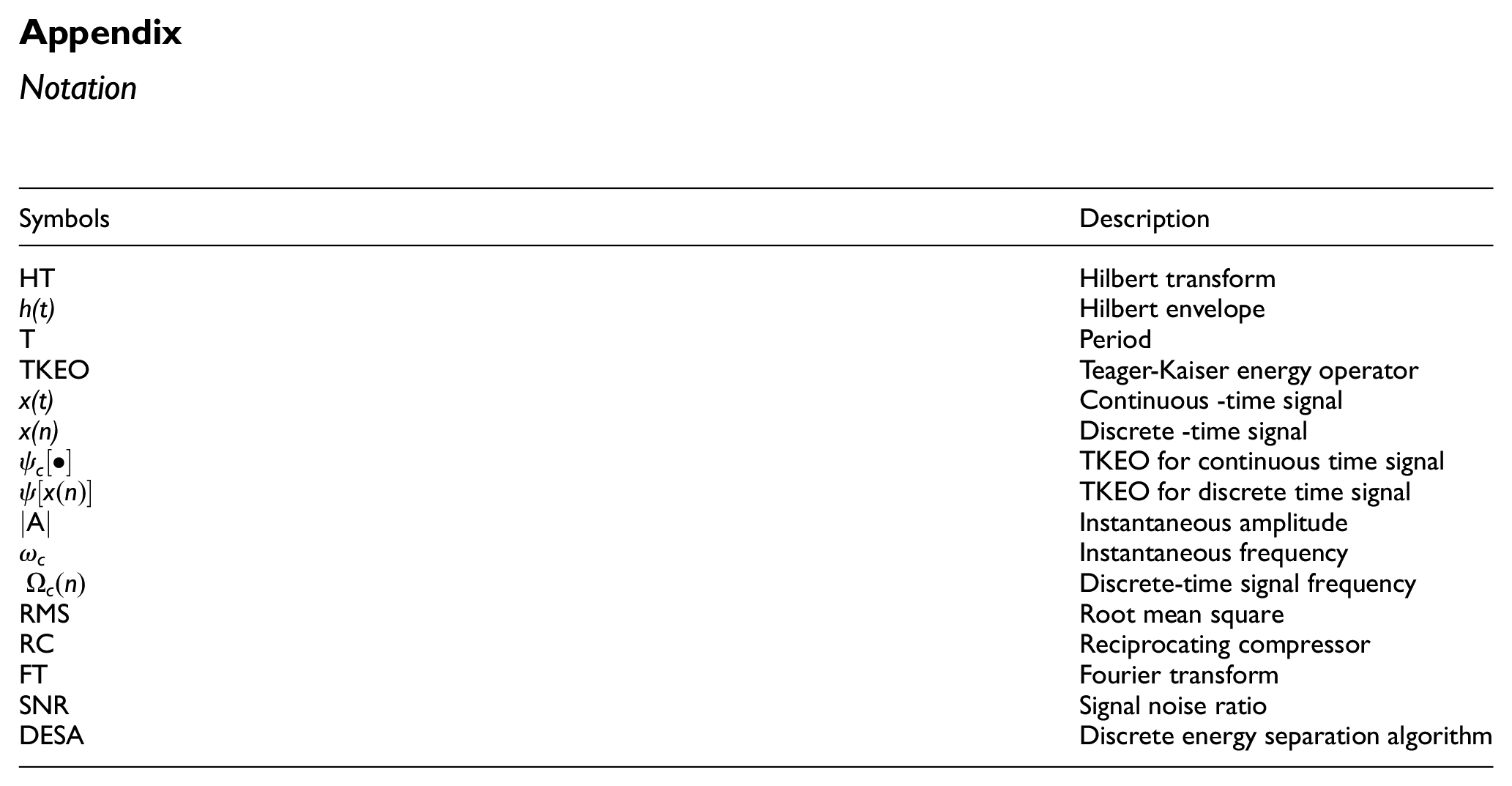
| Symbols | Description |
|---|---|
| HT | Hilbert transform |
| h(t) | Hilbert envelope |
| T | Period |
| TKEO | Teager-Kaiser energy operator |
| x(t) | Continuous -time signal |
| x(n) | Discrete -time signal |
| TKEO for continuous time signal | |
| TKEO for discrete time signal | |
| Instantaneous amplitude | |
| Instantaneous frequency | |
| Discrete-time signal frequency | |
| RMS | Root mean square |
| RC | Reciprocating compressor |
| FT | Fourier transform |
| SNR | Signal noise ratio |
| DESA | Discrete energy separation algorithm |
Handling Editor: Chenhui Liang
Declaration of conflicting interests
The author(s) declared no potential conflicts of interest with respect to the research, authorship, and/or publication of this article.
Funding
The author(s) disclosed receipt of the following financial support for the research, authorship, and/or publication of this article: The authorship and publication of this article were financially supported by the National Science and Technology Committee (Taiwan) with the grant number NSTC 111-2622-E-008 -020.
