



Abstract
Eccentric ball piston pump is a high power density hydraulic component. In this paper, a low lateral force design method for an eccentric ball-piston pump is proposed to reduce the lateral force between the ball and the cylinder by slightly inclination of the cylinder, and a mathematical model of the method is established. An experimental platform of eccentric ball-piston pump for evaluating the performance of cylinder block slightly inclination was established to verify the effect of slightly inclined cylinder block on the volumetric efficiency and mechanical efficiency of the pump. According to the experimental results of the prototype, the tilting angle from 0° to 3°, the lateral force between the ball piston and the cylinder decreases and then increases, the volumetric efficiency of the pump increases and then decreases, and the mechanical efficiency improves continuously. 3° of cylinder tilting angle reduces the friction torque by 2.63 Nm compared with the un-tilted cylinder, and the mechanical efficiency improves by 7.12%. 2° of cylinder tilting angle reduces the leakage volume by 0.475 L/min compared with the un-tilted cylinder, and the volumetric efficiency improves by 3.67%. This study is instructive for the study of high efficiency of eccentric ball piston pumps.
Introduction
The pursuit of carbon neutrality makes the lightweight and high power density of hydraulic transmission system will be paid more attention in the next few decades. High power density hydraulic components are great significance to improve the energy saving of hydraulic transmission system. Eccentric ball piston pump is a kind of hydraulic power component with high power density ratio, which is small in size and light in weight.
The schematic diagram of the structure principle of the eccentric ball piston pump is shown in Figure 1. It consists of a cylinder block driven by a shaft. The cylinder body has seven radial cylinders with ball piston fitted unit. Due to the eccentricity of the floating ring center and the cylinder block center, the cylinder block rotates and the ball piston reciprocating in their respective cylinders. As the ball piston rotates back it sucks the oil in and when the ball piston moves toward the center it delivers back the oil. Thus the pump takes suction from the suction ports and at the discharge ports the pump discharges. The ball-cylinder clearance and the cylinder-shaft clearance are exaggerated in the schematic diagram.

Eccentric ball piston pump.
Davis 1 proposed an efficient ball-piston engine. The design concept of the ball piston pump uses a different approach that has many advantages, including low part count and simplicity of design, very low friction, low heat loss, high power to weight ratio, perfect dynamic balance, and cycle thermodynamic tailoring capability. In the past few years, the eccentric ball piston pump has been widely used in the field of high-power transmission, and a lot of theoretical and experimental studies have been carried out on the eccentric ball piston pump. The Eaton Corporation has successfully commercialized the ball-piston architecture for the Light Duty Hydrostatic Transmission (Eaton). 2 Jamzadeh 3 were the earliest to provide a theoretical analysis of ball plug pumps, focusing on the numerical simulation of the ball-piston cylinder interface under steady-state operating conditions and the hydrodynamics around the ball piston. Hu et al. 4 made a theoretical analysis of the leakage volume of the ball piston-cylinder interface in the eccentric ball piston pump. And the fluid flow of the ball piston and the cylinder without eccentricity was obtained. Meanwhile, they also studied the influence of the viscosity-temperature characteristics, viscosity-pressure characteristics, and the density of the oil on the interface leakage of the ball piston-cylinder interface in another study. 5 Fu and You6,7 analyzed the kinematics and dynamics of a double-acting radial ball piston pump with elliptical orbit in seawater medium, and established the kinematics and dynamics model of ball piston pump under elliptical curve. Ke et al. 8 conducted an experimental study on the frictional components of elliptical orbital radial ball piston pumps in seawater or fresh water lubrication conditions, and introduced the material pairing properties of important frictional components in the elliptical radial ball piston pumps. You et al. 9 derived the equations of motion and trajectory curves of the ball piston based on the kinematic and kinetic models of the elliptical track radial ball piston pump, and got the stress distribution patterns between the ball piston and the elliptical track. Gao et al. 10 deduced the relationship between the number of ball pistons and pump flow pulsation based on the structure of eccentric ball piston pump, and analyzed the influence of ball piston number on outlet flow fluctuation and noise when the eccentricity is a constant. Zhao et al. 11 studied the lubrication characteristics of the ball-cylinder pair in eccentric ball piston pump, and the modified point contact elasto-hydrodynamic lubrication (EHL) model of the ball-cylinder pair was developed. The friction and lubrication characteristics of the ball-cylinder pair are calculated and analyzed, and some experimental verification was given out. Xu et al. 12 studied the dynamic and lubrication characteristics of the ball piston in eccentric ball piston pump. A frictional dynamics model of the ball piston was proposed, the influence of the ball piston friction dynamic characteristics was obtained. Bohach et al. 13 proposed to apply a radial ball piston pump to an optimized design solution for the integration of an electric motor and a hydraulic pump, which has a high power density, is more compact, and allows high speed operation. Also they established a single cylinder model to evaluate the potential of efficiently operation the hydraulic pump at the high speeds desired for a compact machine. The mathematical expression of the leakage around the ball piston was given out. Interestingly, they pointed out that the self-spinning of the ball piston has little effect on the leakage of the ball-cylinder pair when the ball is in the center of the cylinder. In another paper, Bohach et al. 14 focused on the effect of dynamics on the interface loss of the ball piston pumps, and clearly pointed out that the leakage and shearing effect of the ball-cylinder interface is closely related to the position of the ball piston in the cylinder, the larger the eccentricity of the ball and the cylinder, the larger the leakage and the more obvious the shear effect. Reducing the leakage between the ball and cylinder could improve the volumetric efficiency and improve the energy-saving characteristics. Zhou et al. 15 proposed a new type of conical distribution shaft structure, and developed the lubrication model of conical distribution shaft under steady working conditions by numerical method. Samorodov and Avrunin 16 take the GOP-900 hydraulic fluid transmission device as the research object, derive the analytical expression of fluid leakage between the ball piston and cylinder, considered the influence of structural parameters, application conditions, and oil viscosity, and solved the calculation problem of clearance leakage in ball piston pump. Kundu and Upadhyay 17 presented a technical overview of the rotary ball piston engine, describing its working principle and the benefits achieved in practical applications. The machine has only a small number of moving parts. Although the small parts count an important advantages, other than the ball piston engine will give future engineers new-found freedom in tailoring the combustion processes. Tkachuk et al. 18 studied the contact interaction between the ball piston and the floating ring, taking into account the flexibility of the orbit surface layer, and analyzed the variation of the contact area and pressure distribution with the material properties of the intermediate layer for nonlinear material properties. Pandey et al. 19 analyzed and studied the effect of bent-axis hydro-motors leakage experimentally, the effect of pressure and temperature on the amount of leakage was analyzed through some experiments. Li et al.20,21 experimentally investigated the trajectory of tip leakage vortex and predicted the energy conversion of its transient processes. Although the problems of leakage and lateral force between the ball piston and cylinder are crucial to the performance of eccentric ball-piston pumps, few scholars have carried out systematic theoretical and experimental studies on the improvement of the lateral force between the ball piston and cylinder in ball-piston pumps.
In the eccentric ball piston pump, the ball-cylinder pair is one of the key friction pairs, and the performance of the friction pair is of key significance to the pump performance. The ball piston reciprocates at high speed in the cylinder. Because of the eccentricity, the ball piston always deviates to one side of the cylinder, which has a large contact stress on the cylinder wall and aggravates the friction between the ball and cylinder. The large lateral force will also cause the deformation of the cylinder, and the wear between the ball and cylinder will be intensified, which is not conducive to lubrication and is easy to cause large leakage.
The purpose of this design is to optimize and reduce the lateral force between the ball-cylinder interface. A mathematical model of the ball piston pump is developed for this design structure, which takes into account the kinematic and mechanical properties of the ball piston. Once the model is developed, the periodic lateral forces on the ball-cylinder interface can be solved by numerical calculations. Then we will analyze the variation pattern of lateral force with the slightly-tilted angle of the cylinder. The corresponding experimental platform and eccentric ball piston pump are designed and built, and the cylinder blocks with different tilting angle cylinder are manufactured and studied experimentally.
An eccentric ball piston pump with slightly inclined cylinder
During pump operation, special eccentric arrangement of the floating ring and the cylinder block creates a periodic lateral force between the ball and the cylinder. As shown in Figure 2, the lateral force causes the ball piston to remain in a fully eccentric position in the cylinder and causes deformation of the cylinder, which increases the leakage losses at the ball-cylinder interface in the discharge area and may also generate a large resistance torque. In this section, an eccentric ball piston pump with a slightly inclined cylinder is proposed. This method is implemented by tilting the cylinder axis at an angle
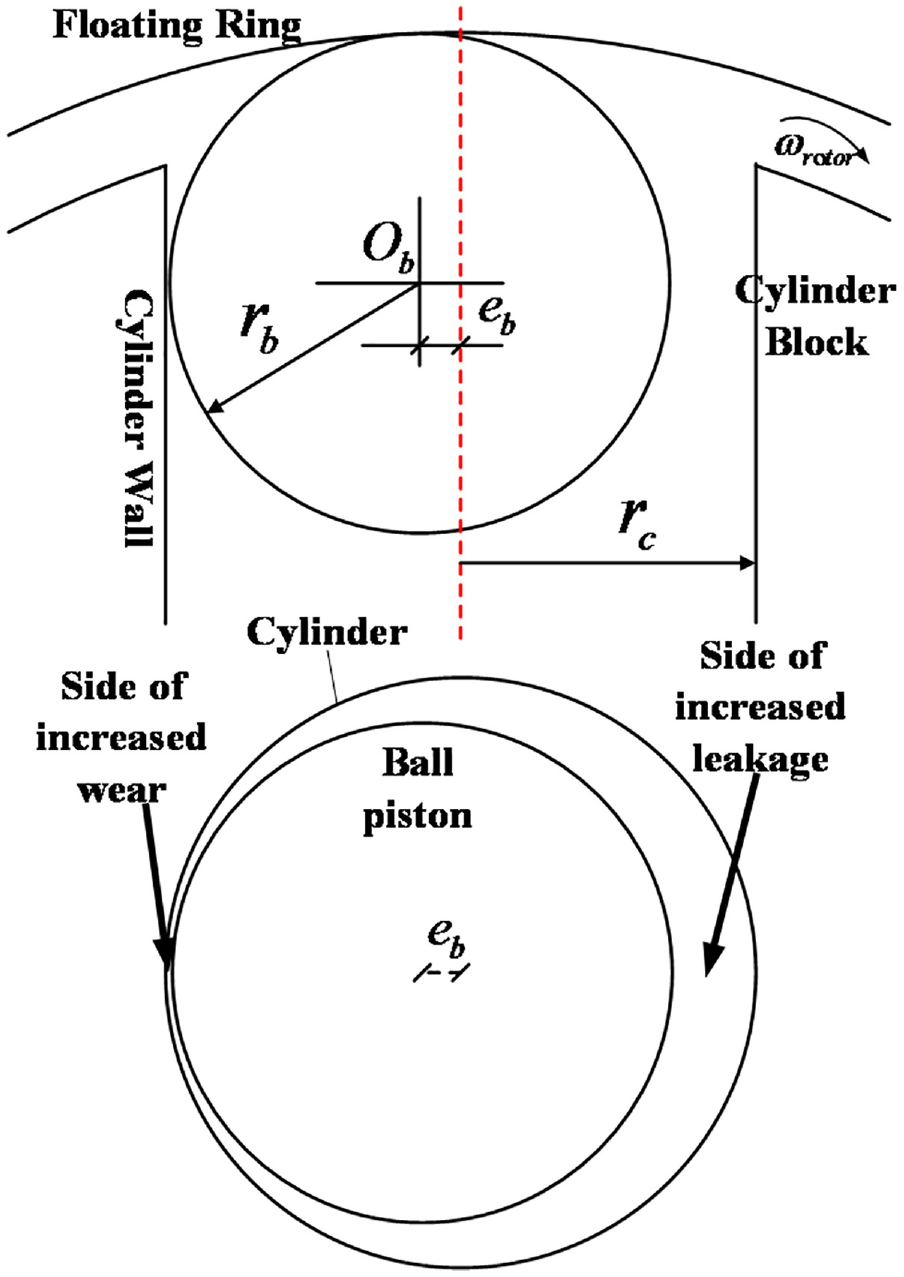
Schematic diagram of the position of the ball piston in the cylinder.

Eccentric ball piston pump with slightly inclined cylinder.
Mathematical model of pump with tilting cylinder
The movement of the ball piston along the cylinder and floating ring movement and the force analysis assembly principle schematic diagram is shown in Figure 4. The analysis diagram focuses on the discharge stroke because the force conditions between the ball and cylinder in this stroke is worse than the suction stroke due to the high pressure conditions.

Force analysis of ball piston in an inclination cylinder.
Take the cylinder block center as the origin point and the rotation direction as the

Where

And


To simplify the model, assumption can be made that the (

Where


where
Numerical calculation of the lateral force
Similarly, assumption can be make that the ball piston is purely rolling on the floating ring, so that the value of
Structural parameters of the eccentric ball piston pump.


Periodic lateral forces for inclination angles 0° and 2°.

Cylinder inclination angle and maximum lateral force.
Experiments
An eccentric ball piston pump is designed as shown in Figure 7, also in order to verify the effect of cylinder tilting angle on the performance of the eccentric ball piston pump, cylinder blocks with different inclination angles were designed and precision manufactured separately. Figure 8 shows the photograph of cylinder blocks with different inclination angles. The clearance between the cylinder and the ball piston of each cylinder block is ensured to be 8 µm with an error of 2 µm by the morphological inspection. Also make sure that the clearance between the cylinder block and the valve shaft is at the same level. Equivalent oil temperature was also guaranteed in the experiment.

Eccentric ball piston pump structure schematic.

Cylinder blocks with different cylinder inclination angles.
The test platform of eccentric ball piston pump is established and show in Figure 9, which include eccentric ball piston pump, pressure valve for loading, flow rate meter, rotation and torque meter, pressure sensor, signal generation device, data acquisition, and recording systems. The pressure sensor using MPM type high frequency pressure sensor for measuring ball piston pump outlet pressure, test accuracy can reach 0.2%. Volumetric flow meter is used to measure the flow rate of oil in the pipeline, VSE flow meter is selected, the test accuracy is 0.1%. Speed and torque transducer for measuring pump input speed and torque with 0.25% accuracy. Self-developed data acquisition system for the acquisition and processing of all data collected by the sensors. The outlet pressure, outlet flow rate, input torque, and rotation speed of the pump are measured simultaneously. Figure 10 shows the outlet flow rate and the input torque characteristic at different cylinder tilting angles. The test was conducted at a pressure of 8 MPa and a rotation speed of 1500 r/min. The eccentricity of the floating ring and the cylinder block was kept at 2.2 mm.

Principle and installation of test platform.
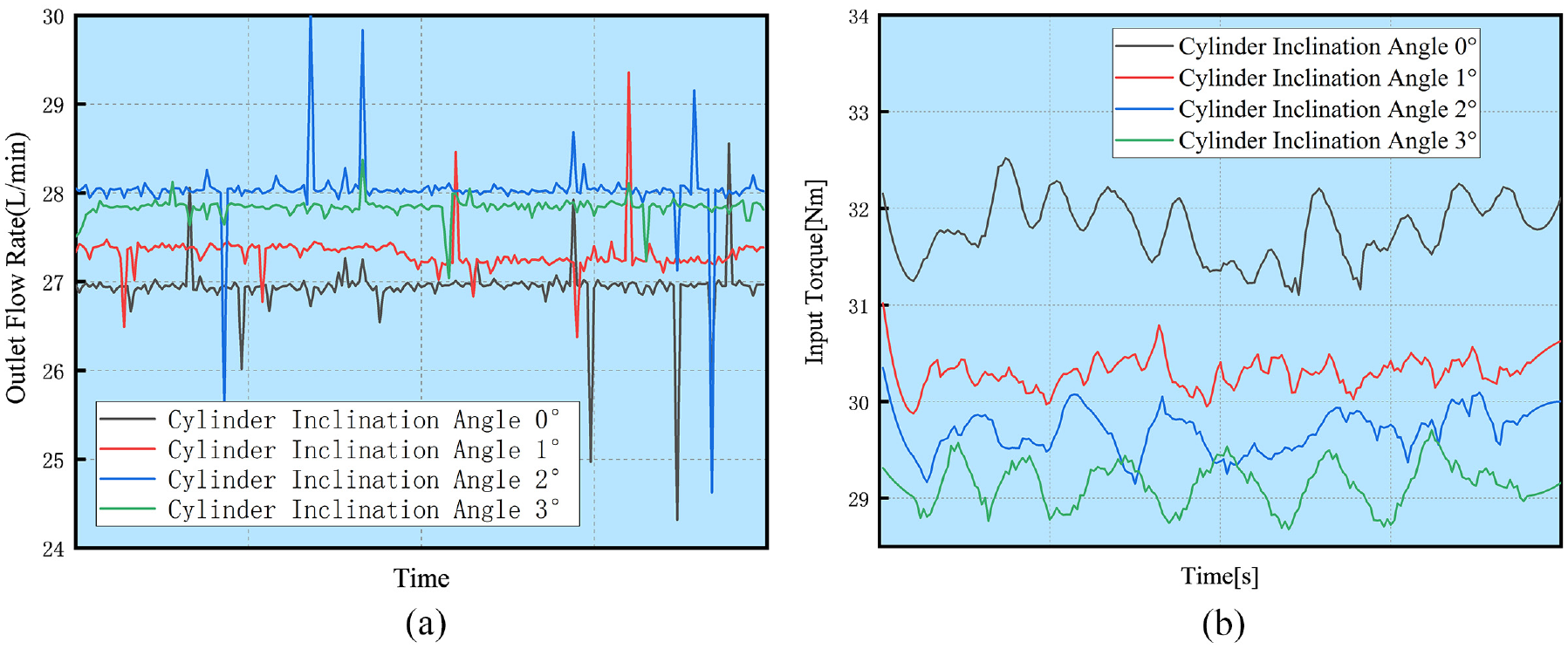
(a) Outlet flow rate and (b) input torque.
Discussion
Torque characteristics
The torque model of an eccentric ball piston pump can be expressed as:

Where


Through the experiment, we can easily get the actual input torque of the eccentric ball piston pump. The effect of cylinder inclination is analyzed according to the change of input torque, so as to verify the effect of cylinder tilting on the lateral force. To ensure the reasonableness of the torque verification, the following assumptions were retained:
The ball piston does pure rolling on the floating ring track without any slippage.
The gyroscopic motion between the ball piston and the floating ring is neglected.
Full oil film lubrication and uniform clearance between the cylinder block and valve shaft.
The viscosity of the oil in the pump casing always remains the same.
Assumption 1 ensures that the resistance torque generated at the ball-floating ring interface is approximately equal under purely rolling elasto-hydrodynamic lubrication conditions. Thus, in the torque model of eccentric ball piston pump,
With the above reasonable assumptions, we can approximate the effect of cylinder tilting on the lateral force from the variation of the actual input torque. Figure 11 shows the torque of the eccentric ball piston pump at different cylinder inclination angles. It is expected in Figure 11 that under the same working conditions the increase of cylinder tilting angles could obviously decrease the input torque. The torque characteristics of the prototype are given in Table 2, and it can be obtained that the mechanical efficiency of the eccentric ball-piston pump is increasing with the increase of the cylinder inclination, and the friction torque of the cylinder with 3° inclination is reduced by 2.63 N m compared to that of the un-tilted cylinder, and the mechanical efficiency is increased by 7.12%. Combining the above torque model and assumptions, it can be indirectly proved that the inclined cylinder weakens the interaction force between the ball piston and the cylinder.

Torque characteristics of eccentric ball piston pump.
Prototype torque characteristics.

Flow rate characteristics
The seal between the ball piston and the cylinder is a line contact annular gap seal, and the leakage loss at this interface is particularly significant at high pressures, which limits the high pressure capability of eccentric ball piston pumps and affects their application range. In a specific working condition, the leakage of the ball-cylinder interface depends on the position of the ball piston in the cylinder, the larger the eccentricity, the more serious the leakage. Samorodov and Avrunin 16 developed an analytical expression for calculating leakage between the ball piston and cylinder. Therefore, by analyzing the change in flow rate characteristics, it is possible to speculate on the change in the position of the ball piston in the cylinder during operation and thus verify the improvement in the force effect of the cylinder inclination on the ball-cylinder interface. The eccentric ball piston flow rate characteristics can be given by:

Where

Where

Where

The average outlet flow rate for different tilting angle is shown in Figure 12(a). As the inclination angle of the cylinder increases from 0° to 3°, it shows a trend of increasing and then decreasing, and the outlet flow rate has the maximum at the angle 2°. The leakage flow was also tested by collecting the leaking oil. As is shown in Figure 12(b), Leakage has a minimum value at 2° of inclination. Similarly, the flow characteristics can also indirectly prove that the slight inclination of the cylinder can improve the interaction force between the ball piston and the cylinder. Table 3 shows the flow characteristics of the prototype and gives the variation of leakage as well as volumetric efficiency, the results show that the prototype has the best volumetric efficiency at a cylinder tilt angle of 2°, the leakage flow rate is reduced by 0.475 L/min and the volumetric efficiency is increased by 3.67% as compared to the un-tilted cylinder. It is shown that improving the force characteristics between the ball piston and the cylinder by tilting the cylinder is conducive to the improvement of the volumetric efficiency of the eccentric ball-piston pump.
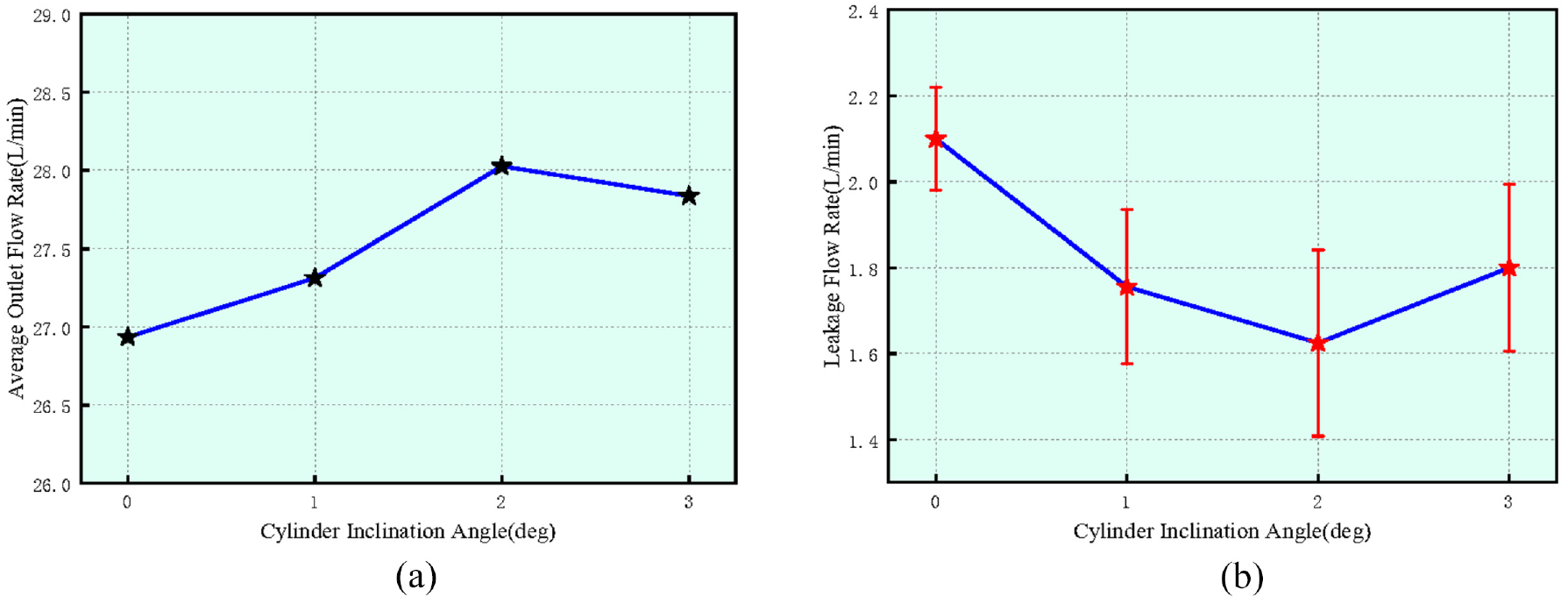
(a) Average outlet flow rate and (b) leakage flow rate.
Prototype flow characteristics.

Conclusion
In this paper, an eccentric ball piston pump with slightly inclined cylinder is designed and machined. Reasonable cylinder micro-tilt angle design reduces the interaction force at the ball-cylinder interface. And an experimental study was carried out for different inclination angles of the cylinder. The following conclusions can be drawn:
The mechanical model of the eccentric ball piston pump with a slightly inclined cylinder is developed, and the periodic lateral force at the ball-cylinder interface with defined parameters is solved by numerical analysis, and the variation pattern of the lateral force with the angle of the slight tilt is given out. The lateral force between the ball piston and the cylinder shows a periodic change law. With the increase of the tilt angle, the lateral force first decreases and then increases. Parameter calculations of the prototype show that a cylinder tilting angle of 2° has the best lateral force characteristics.
For different cylinder inclination angles, this study was carried out to experimentally investigate the input torque and outlet flow rate of the pump. With the increase of the tilting angles, the resistance torque shows a continuous decreasing trend, while the outlet flow rate increases and then decreases in value with the increase of cylinder tilting angles. This might be due to the resistance moment between the ball piston and the cylinder continues to decrease with increasing tilt angle because the force of the ball piston on the rotor changes from resistance to thrust.
By reasonably setting the tilt angle of the rotor cylinder, the force of the ball piston on the cylinder bore can be reduced, meanwhile, the volumetric efficiency and mechanical efficiency of the eccentric ball-piston pump can be improved. Experimental and theoretical analyses show that the improvement of mechanical efficiency is realized by changing the direction of the force of the ball piston on the rotor, and the improvement of the volumetric efficiency is due to the reduction of the magnitude of the force between the ball piston and the cylinder bore. It shows crucial for the design work.
Footnotes
Handling Editor: Chenhui Liang
Declaration of conflicting interests
The author(s) declared no potential conflicts of interest with respect to the research, authorship, and/or publication of this article.
Funding
The author(s) disclosed receipt of the following financial support for the research, authorship, and/or publication of this article: Supported by Technological Innovation Talent Team Special Plan of Shanxi Province (202204051002002).
