



Abstract
This study explores heat transfer in a system involving Jeffery fluid of MHD flow and a porous stretching sheet. The mathematical representation of this system is initially described using a partial differential equation (PDE), which is then converted into an ordinary differential equation (ODE) through numerical techniques such as Lie similarity and transformation methods, along with the shooting approach. The results indicate that altering the variables of Jeffery fluid, heat source, porosity on a stretching sheet, and the physical characteristics of the magnetic field within the system leads to an upward trend. Implementing this enhanced heat transfer system can yield benefits across various domains, including industrial machinery, mass data storage units, electronic device cooling, etc., thereby enhancing heating and cooling processes. Furthermore, the study also utilized Akbari-Ganji’s Method, a new semi-analytical method designed to solve nonlinear differential equations of heat and mass transfer. The results obtained from this method were compared with those from the finite element method for accuracy, efficiency, and simplicity. This research provides valuable insights into heat transfer dynamics in complex systems and offers potential applications in various industrial settings. It also contributes to developing more efficient and effective heat transfer techniques.
Introduction
Heat emitter and absorber describe how objects interact with heat radiation, a form of electromagnetic radiation emitted by a heated surface. Heat radiation can travel through a vacuum or a medium, such as air, and transfer energy from one place to another. Studying magnetohydrodynamics (MHD) in fluid dynamics is vital for simulating heat transfer systems. The need for enhanced heating and cooling systems extends to various areas, including industrial mass machinery, reservoirs, and microfabrication. Due to its heat resistance, the convective heat transfer system is limited in operating pressure and temperature and prone to leakages. Heat can result in corrosion, decreased reliability, and obstructions caused by particles in suspension. Advanced techniques in fluid dynamics allow for the analysis and assessment of heat transfer systems through different means, such as classification, computation, modeling, and parameter adjustment, to improve the convection performance. An advantage of analyzing heat and mass convection systems in fluid dynamics is the successful transformation of nonlinear equations, made possible using the Lie similarity technique to obtain FEM for solving nonlinear coupled differential equations. Also, this paper used the AGM solution to examine the governing equations and compare results to previous related work. Jeffrey fluid is shown to be remarkable in the heat transfer system due to its stress relaxation effects. The system’s mathematical analysis, incorporating MHD flow, takes the form of a Partial Differential Equation (PDE) and is examined using machine learning. Machine learning cannot solve PDEs, so the equation is transformed into an Ordinary Differential Equation (ODE) using FEM and the Lie similarity transformation technique.
The initial application of boundary layer theory to the motion of dynamic fluid on constant, flat-solid plates, using fundamental differential boundary layer equations, was first documented by Sakiadis.
1
The letter contains accounts of research into MHD and dynamic Jeffrey fluid models on expanding surfaces, coupled with the perks of using Lie-similarity and methods of transformation and shooting approach. The study by Agrawal et al.
2
explored MHD flow with expanding surface and permeable medium, utilizing lie similarity and transformation approaches to ascertain that the Prandtl number can increase heat transfer. Unsteady MHD heat and mass transfer is the study of how fluid, heat, and mass move under the influence of magnetic fields that change over time. Nazeer et al.
3
utilized shooting and pseudo-spectral techniques to analyze Eyring-Powell fluid in an infinite cylindrical pipe, attaining precise results in the fourth and fifth orders of velocity and temperature measurements. According to His-similar,
4
an analysis of Eyring-Powell fluid was performed using a perturbation method, showing that Brownian motion and thermophoretic force vary at particular concentrations and that viscous dissipation is observable. Jalili et al.
5
examined the accuracy of three methods that simulate the thermal diffusivity profile in an artery with oblique stenosis and a hybrid nanofluid. The hybrid nanofluid consists of
The study of the Jeffrey fluid on MHD flow with stretching in porous sheets of a heat transfer system has been conducted by Jena et al. 16 Another study conducted by Bouslimi et al. 17 analyzed the effect of electromagnetic force and thermal radiation on the Williamson nanofluid on a stretching surface through a porous medium while considering heat generation/absorption and Joule heating. Thermal radiation and a heat source are two factors that influence the flow and heat transfer of a non-compressible Jeffrey fluid that deviates from Newton’s law of viscosity. Babu et al. 18 examine how these factors interact with the fluid when it flows over a surface that can stretch or shrink. Agarwal et al. 19 examined how a magnetic field affected the flow of a micropolar Jeffrey fluid, which had both fluid and solid-like properties when it flowed through a porous medium over a plate that could stretch. Yasmin et al. 20 investigated the mass and heat transfer in the flow of an electrically conducting non-Newtonian micropolar fluid. This flow has MHD effects and is caused by a curved stretching plate. The effects of power-law heat flux and heat source on the flow of a MHD fluid over a porous stretching sheet were investigated in detail by Ibrahim et al. 21 The flow of a nanofluid over an inclined stretching sheet is unsteady and has MHD effects. The fluid properties in thermal conductivity and diffusion coefficient vary, and the flow is affected by thermal radiation and chemical reactions. Mjankwi et al. 22 studied this flow. Jabeen et al. 23 compared the boundary layer fluid flow around a linearly stretching sheet with MHD effects. The surface had permeability, and the flow had radiative heat flux, heat generation/absorption, thermophoresis velocity, and chemical reaction effects. The MHD flow of a micropolar fluid over a stretched surface was investigated by Goud and Nandeppanavar. 24 They considered the effects of Ohmic heating and chemical reactions on the fluid.
Kumar et al.
25
investigated how a non-Newtonian Casson fluid flowed through a porous vertical plate in an unsteady MHD natural convective situation, considering the heat and mass transfer properties and chemical reaction. Ahmed et al.
26
examined the convective transport features of a fluid of the third grade with thermo-diffusion effects. The effects of multi-slip conditions on the steady-state flow of a fluid in a magnetic field with Soret and Dufour effects were investigated by Reddy et al.
27
over a stretching surface with variable temperature. The effect of a heat source on a fluid of Casson type in a magnetic field through a porous plate with oscillations was studied by Goud et al.
28
Srinivasulu and Goud
29
used numerical methods to study how a magnetic field aligned with a stretching surface affected the flow of a nanofluid of Williamson type with convective boundary conditions. Bafakeeh et al.
30
examined the unsteady flow of a porous medium with a vertical plate, where the fluid was viscous, incompressible, and electrically conductive, and where chemical reactions and thermal radiation affected the heat and mass transfer. A fluid with difficulty to flow and does not change its size when pressure is applied is called a viscous incompressible fluid. Chen
31
investigated how ohmic heating and viscous dissipation influenced the fluid’s momentum, heat, and mass transfer in MHD natural convection flow over a porous, slanted surface with variable wall temperature and concentration. The effects of heat and mass transfer on an MHD flow in the presence of a chemical reaction over a porous, inclined plate were investigated by Sandhya et al.
32
Using free convection flow analysis, Noor et al.
33
investigated how a heat source/sink effect and a radiating isothermal slanted plate influenced the thermophoresis and magnetism of the fluid. Systems involving unsteady free convection oscillation involve fluid motion due to the temperature and density difference between the fluid and its environment and the regular movement of a boundary or an external force. The heat and MHD flow characteristics of a generalized Maxwell fluid over a porous, canted plate under a tilted magnetic field were explored by Li et al.
34
Raptis et al.
35
examined the asymmetric flow of a fluid that can conduct electricity in a magnetic field over a stationary plate that extends infinitely, considering the effects of radiation. Ali examined how the second law of thermodynamics affected the flow of a nanofluid that can conduct electricity over a rotating disk with pores, considering the influence of a vertical magnetic field applied externally. The effects of an external vertical magnetic field on the flow of an electrically conducting nanofluid over a porous rotating disk were studied by Rashidi et al.
36
using the second law of thermodynamics. Moreover, we can also consider more related works such as A ternary hybrid nanofluid (Al–Cu –
The utilization of a magnetohydrodynamics system with a Jeffrey fluid for heat transfer is discussed in this paper. Nonlinear equations with an expanding surface are restructured using lie similarity and transformations, and superior solutions are obtained using the shooting approach. The influence of the heat source and expanding surface on the dynamic characteristic of the Jeffrey fluid model is explored and shown in graphs.
Mathematical analysis
In the region where y is greater than or equal to zero, a symmetrical magnetic field can be created when a two-dimensional sheet with permeable material is heated or cooled. The sheet is stretched by applying two forces in opposite directions along the x-axis, as shown in Figure 1.

Physical concepts depicted in a graphical format.
A magnetic field



When
Boundary conditions become as follows:


In this context,

Batchelor 41 defined the temperature as a function of linear temperature.
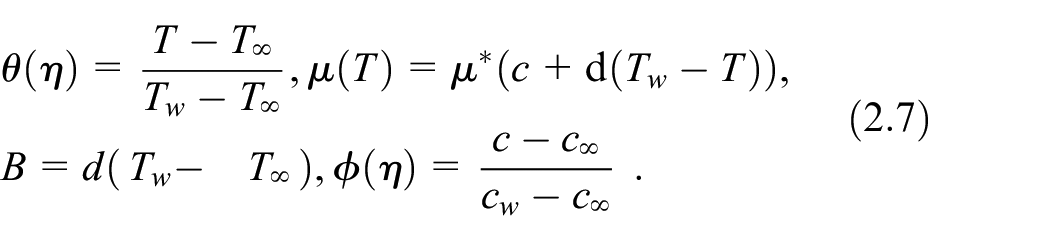
The fixed viscosity factor is




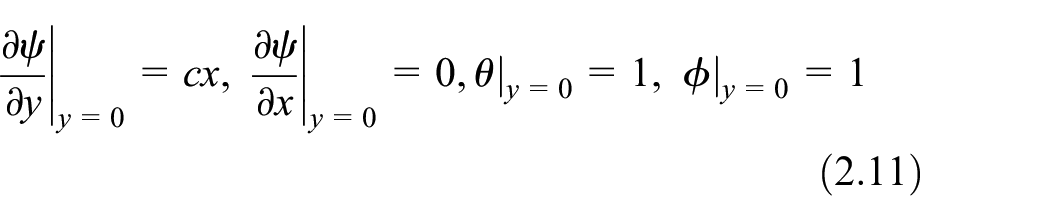
The conditions at the boundaries are as follows:

Examination of similarity through the Lie group method
The Lie group similarity transformation can be defined and introduced in the following manner 42 :


Using the Lie group transformation (2.12), the coordinates (

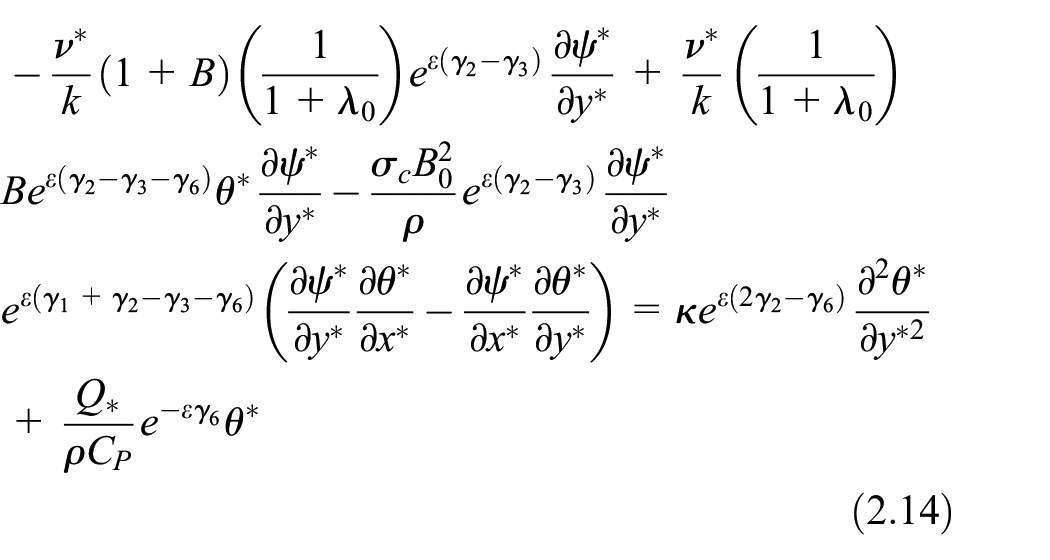

When the Lie transformation group



Solving the relations (2.16)–(2.18) yields the following:

The boundary conditions yield the following results:

By inserting the results above into the Lie group transformation, the value of

When the relation mentioned above is expanded using Taylor’s series and terms of second and higher order are neglected, the result is as follows:


By reducing the previous relations, we can obtain differential equations,

Integrating the equations as mentioned above yields the following terms:


The adjusted boundary conditions are converted into the following:


The connections between

From the previous connections, we obtained the following results:


When the aforementioned relation is inserted into (2.24)–(2.27), the equations are simplified to the following:


About the boundary constraints:


To solve (2.30)–(2.32), we have to apply the boundary conditions (2.33) when
The Prandtl number, which is a dimensionless number that measures the relative importance of momentum and heat diffusion in fluid flow, denoted by
The default values of the following are considered according to Thenmozhi et al.
42
Analysis of FEM
The FEM breaks down the problem domain into smaller finite elements, each with distinct mathematical equations that describe its shape and system behavior. This technique makes it easier to solve complex governing equations that would otherwise be difficult to solve by hand. FEM uses shape functions to interpolate nodal values and calculate element-level solutions. In this study, FEM is employed as a numerical method for solving flow and heat transfer equations on a permeable vertical flat plate using finite elements. The general steps of FEM include the following:
Discretization: The problem domain is broken down into smaller sections, known as finite elements, which can be triangles or rectangles.
Formulation: Each finite element is associated with a series of linear algebraic equations that illustrate the fluctuation of unknown variables over that specific element.
Assembly: A universal system of equations is established by integrating the separate linear algebraic equations from all finite elements, depicting the system’s complete domain.
Solution: The unknown variables at all finite elements, for instance, velocity and temperature, are derived by finding a solution to the global equation system.
Post-processing: The flow and temperature distribution over the permeable vertical flat plate can be comprehended by analyzing and depicting the solution using graphical methods such as contour plots.
This study employs FEM to validate the results obtained from a semi-analytical technique used to simplify equations into ordinary differential equations. By applying FEM, a more accurate and detailed solution for the flow and heat transfer within the permeable vertical flat plate can be attained, enabling the optimization and design of thermal systems using the hybrid nanofluid. Additionally, the precision and consistency of FEM outcomes can be contrasted with those derived from the AGM to confirm the findings.
Application of Akbari-Ganji’s method (AGM)
Considering the approach and the interconnected nonlinear differential equations within the system, we can restructure equations (2.30)–(2.32) in this order:


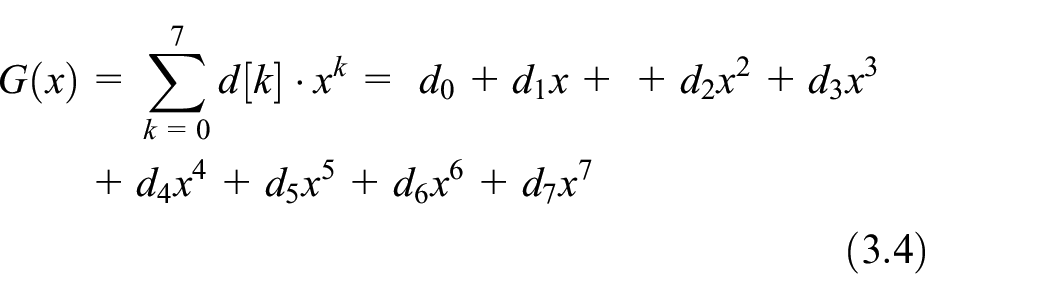
A finite series with unvarying coefficients of polynomials was utilized as a solution for the differential equation examined in this research, founded on the essential principle of AGM in the following manner:


Applying boundary condition
The constant coefficients of equations (3.4)–(3.6) are calculated in AGM. by implementing boundary conditions derived from these techniques.
(a) By applying the boundary condition to equations (3.4)–(3.6), they can be expressed in the following manner:

Based on the above clarifications, the boundary conditions are applied to equations (3.4)–(3.6) in this manner, with BC being the abbreviation for boundary condition.








(b) Following the substitution of equations (3.4)–(3.6) into the primary differential equations, the boundary conditions are imposed on the main differential equations (equations (3.1)–(3.3)) and their derivatives in this manner:



Utilizing the above equations, we enforce the boundary conditions on the differential equation. In finding a solution, the AGM involves obtaining a series of polynomials by utilizing a certain quantity of constant coefficients in trial functions. Basic arithmetic allows us to acquire these polynomials. In this issue, we have three trial functions that contain 19 constant coefficients and eight equations according to equations (3.7)–(3.14). We need to create 11 additional equations from equations (3.15)–(3.17) to achieve a set of polynomials that contains 19 equations and 19 constants.
By the above clarifications, we generated supplementary equations, equations (3.15)–(3.17), in this order:
I. Four equations are the result of calculating obtained equations:
II. Four equations are the result of calculating obtained equations:
III. Three equations are the result of calculating obtained equations:
The equations in subsections (I) through (III) are too big for visual display. Using the procedures above, we got a group of polynomial expressions with 19 equations and 19 constants. After resolving these polynomials, equations (3.4)–(3.6) were attainable and can be effortlessly obtained in the following manner:


Results and discussions
The FEM calculations are presented using various parameters such as viscosity, porosity, magnetic field, Prandtl number, and heat source with temperature. Figures 2 and 3 illustrate that modifications to viscosity cause corresponding changes in the convection system’s fluid velocity and temperature with different values of (

The velocity profile versus variable viscosity characteristic

The temperature profile versus variable viscosity characteristic
Figure 4 illustrates that the temperature profile (

The temperature profile versus variable viscosity characteristic
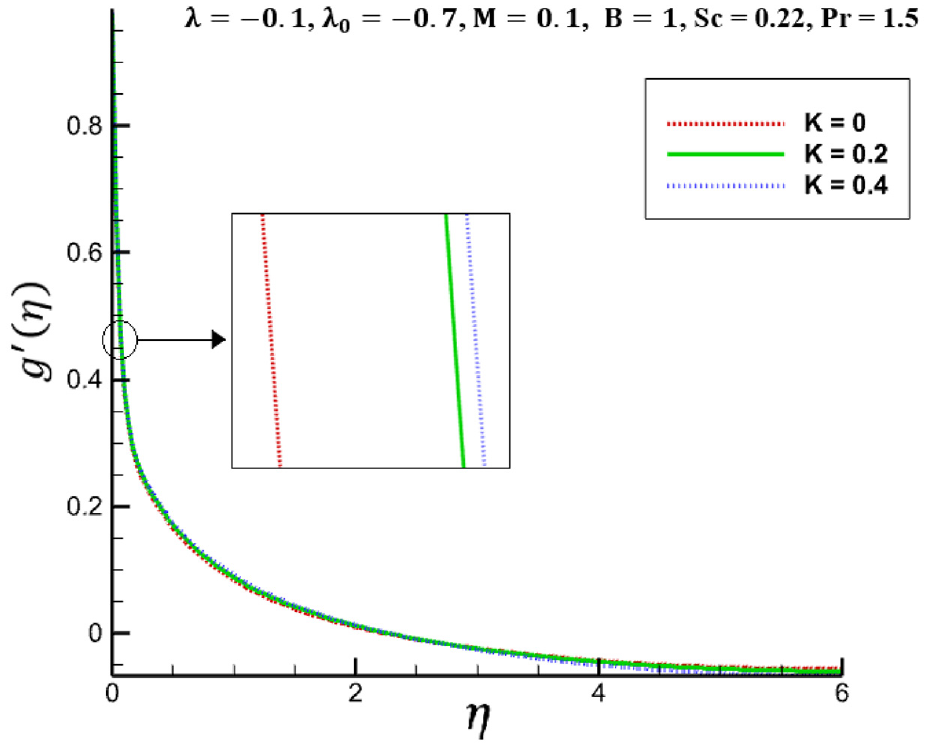
The velocity profile versus variable porosity characteristic

The temperature profile versus variable porosity characteristic
Figures 7 and 8 illustrate that an increase in the

The velocity profile versus variable Jeffrey characteristic

The temperature versus variable Jeffrey characteristic

The velocity profile versus variable magnetic field characteristic

The temperature profile versus variable magnetic field characteristic
Figure 11 shows that the temperature lineation decreases as the Prandtl number increases. Temperature lineation refers to the alignment of temperature gradients in a particular direction, which means that the heat transfer by convection is more dominant than the heat transfer by conduction in the fluid.

The temperature profile versus variable Prandtl
Figure 12 visually represents the relationship between the Sc number and the concentration curve. The Sc number, also known as the Schmidt number, is a dimensionless quantity used in fluid dynamics to represent the ratio of momentum diffusivity to mass diffusivity, which is a measure of how much of a substance is dissolved or dispersed in a fluid.

The concentration versus variable Schmidt
Validation
The following compares the temperature profiles with FEM in this study and the analysis of Thenmozhi et al. 42 did. The graphs show a good agreement between the results obtained with previous research and the validation that has been done (Figure 13).
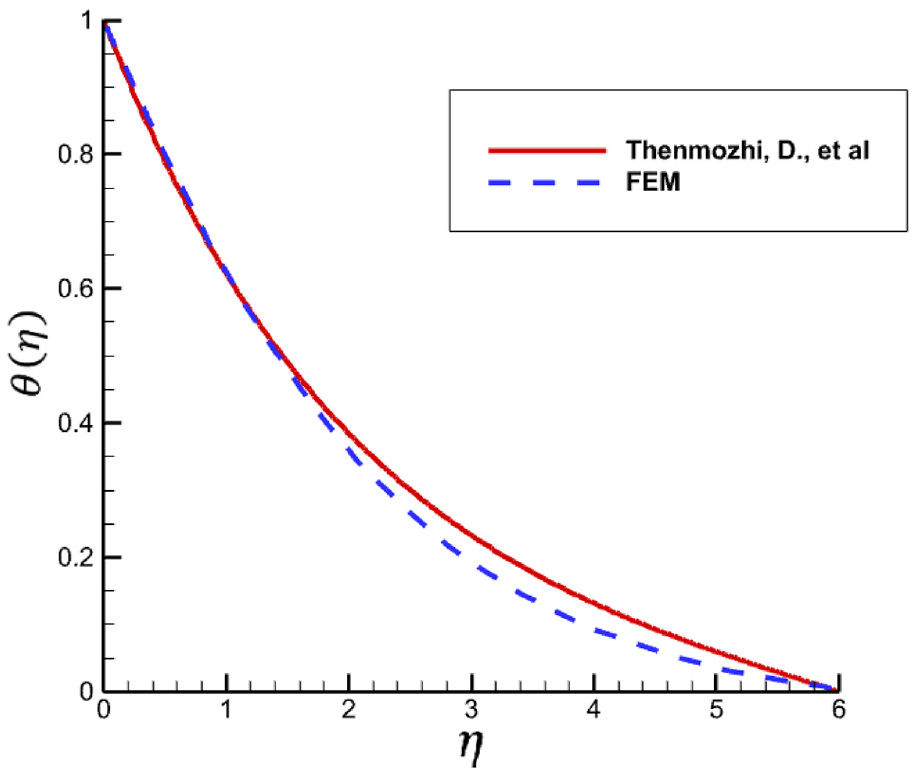
Comparison of temperature profile between FEM and Thenmozhi et al. 42
In Figures 14 to 16, the following comparison is made between the accuracy of the AGM and the FEM:

FEM and AGM solution results for

FEM and AGM solution results for

FEM and AGM solution results for
The optimizations of

Optimization results for
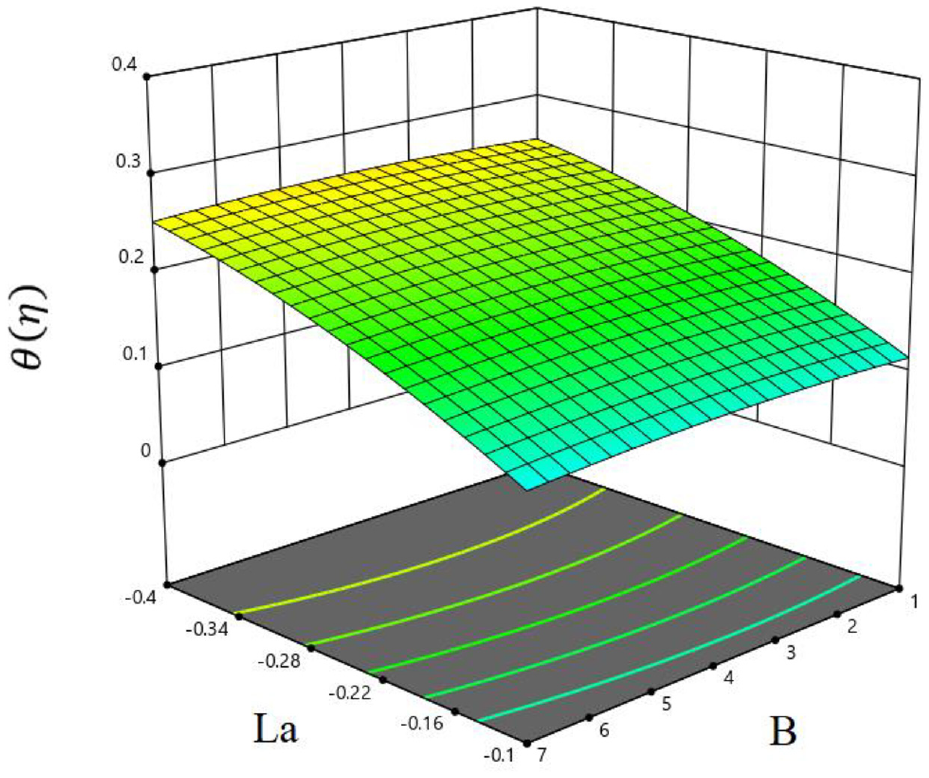
Optimization results for

Optimization results for
Conclusions
A partial differential equation represents the mathematical model of the heat transfer system with Jeffery fluid MHD flow on a permeable stretching plate. Since machine learning methods cannot solve PDEs, the FEM is employed to solve the equations. A better solution for the ODE and an analysis of the heat transfer system are achieved through the AGM. The mathematical model considers various parameters, such as fluid, heat source, velocity, concentration, and boundary layer. The Jeffery fluid dynamic model is used to analyze the heat transfer system, considering how these parameters impact the heat transfer rate. The following cases and observations are reported:
The temperature in the heat transfer system drops with the flow velocity when the input parameters of Jeffery fluid and heat source are increased. This implies that increasing Jeffery fluid improves the heat transfer rate in the system and leads to more convection.
Increasing both the magnetic field’s input parameter and the stretching plate’s porosity reduces the temperature in the heat-transferring system with dynamic fluid velocity.
The convection system’s temperature drops as the Prandtl number’s value increases. The Prandtl number is a ratio of momentum, thermal diffusivity, and a coefficient.
The magnetic field (
The heat lineation increment range also decreases, which implies that the thermal layer’s stiffness also reduces.
An increase in permeability, magnetic field, and Prandtl number is characteristic of the boundary layer stiffness, as deduced from the data.
A higher heat flux and a higher temperature gradient are achieved by increasing the thermal boundary layer thickness and decreasing the fluid velocity near the plate. This can be done by increasing the magnetic field parameter, the heat source/sink parameter, or the Prandtl number. These parameters enhance the heat transfer rate from the plate to the fluid.
The thermal convection in the heat transfer system is mathematically improved through the use of Jeffery fluid, porosity, and a stretching plate. When AGM and the FEM are compared using various parameter values, the error figure data indicates a slight difference between the solutions from AGM and the exact solutions. The convergence figure implies that increasing the number of terms of AGM can lead to more accurate solutions.
Footnotes
Appendix
Handling Editor: Chenhui Liang
Declaration of conflicting interests
The author(s) declared no potential conflicts of interest with respect to the research, authorship, and/or publication of this article.
Funding
The author(s) received no financial support for the research, authorship, and/or publication of this article.
