



Abstract
For the multi-objective flow shop scheduling problem in the supply chain environment, this paper proposes the Fuzzy Relevance Entropy method (FREM) to solve the adaptive value assignment problem in the multi-objective optimization process of the supply chain environment by combining Fuzzy Information Entropy Theory (FIET) and Degree of Membership Function (DMF). Firstly, the uncertainty of each sub-objective of the ideal solution and Pareto solution of the objective is extracted using the Degree of Membership Function. Secondly, each solution is mapped into an affiliation degree fuzzy set and the information contained in the fuzzy set is reprocessed using Fuzzy Information Entropy Theory. Finally, the amount of information contained in the ideal solution solved by the Pareto method is used to guide the evolution of the Particle Swarm Optimization (PSO) algorithm, thus avoiding the traditional multi-objective optimization process of assigning weights to solve the fitness link. This paper combines both the Fuzzy Relevance Entropy method and the Stochastic Weight method with Particle Swarm Optimization (PSO) and Differential Evolution (DE) algorithms to address the five-objective flow shop scheduling problem in the supply chain environment. Experimental results demonstrate that the proposed Fuzzy Relevance Entropy method effectively solves the multi-objective flow shop scheduling problem in the supply chain environment and achieves better optimization results compared to the Stochastic Weight method.
Keywords
Introduction
Flow shop scheduling is a highly attractive research area in manufacturing in the supply chain environment, 1 where companies often confront multi-objective scheduling problems in real manufacturing. Multi-objective optimization is an optimization of a vector function. The difference between multiple objectives in the search direction and the mutual interference between them lead to a large gap between the solution and the ideal solution in terms of optimization degree and distribution range, and the obtained are non-inferior solutions. Currently, many kinds of algorithms have been implemented for multi-objective workshop scheduling, and the more used ones are heuristic algorithms and meta-heuristic algorithms.2,3 For heuristic algorithms, the choice of fitness assignment strategy has a crucial impact on the performance of the algorithm. 4 Currently, there are three common fitness allocation strategies: allocation strategies based on Pareto priority relationship ranking, assignment strategies based on random weight summation, and assignment strategies based on selective weights.5–7 Among them, the Pareto ranking method cannot effectively reflect the density information around the individuals in its fitness assignment, so that it is difficult to ensure the diversity of the population and the fast convergence of the algorithm. Therefore, this method cannot achieve better results in solving high-dimensional multi-objectives. 8 In addition, the fitness assignment methods based on selective weights and random weights are susceptible to some external uncertainties and thus have a high degree of chance. The existence of such chance affects the convergence and diversity of the algorithms, and thus these two algorithms cannot objectively achieve multi-objective optimal scheduling. In addition, some researchers have proposed a relatively novel treatment, which is to convert a multi-objective optimization problem into a single-objective optimization problem by assigning weights to each objective. Although this approach has achieved some success, this type of weight-based adaptation policy may lead to confusion in the meaning of the superiority ranking among Pareto solutions because the above approach ignores the property that there is no absolute optimal solution to the multi-objective optimization problem and the size of each objective and its order of magnitude differ greatly.
Fuzzy Information Entropy is a measure of a fuzzy set of fuzzy information. 9 The uncertainty of Fuzzy Information Entropy mainly derives from internal rather than other disturbing external factors. Currently, the concept of fuzzy sets has been introduced to shop floor scheduling. Li et al. 10 treated the uncertainty of processing time and delivery time with fuzzy sets and established a multi-objective model that maximizes customer satisfaction and minimizes the maximum completion time. Jin and Ye 11 used fuzzy sets to handle the uncertainty of processing time, delivery time, and objective function and established a single-objective model for maximizing overall satisfaction. Li and Pan 12 addressed the uncertainty in processing time and completion time using fuzzy sets and developed a single-objective model for minimizing completion time. Li et al. 13 proposed a discrete artificial bee colony (DABC) algorithm based on similarity and non-dominated solution ordering to cope with the fuzzy hybrid green shop scheduling problem with fuzzy processing time. This fuzziness was mainly used to tackle the uncertainty of the factors in the modeling period and did not involve Fuzzy Information Entropy Theory, which was not used to process the fuzzy sets to obtain more useful information, and the optimization was done with a single or two objectives with a small number of objectives. 14
To address the shortcomings of the above methods, this paper combines the Fuzzy Information Entropy Theory (FIET) and Degree of Membership Function (DMF), and proposes the Fuzzy Relevance Entropy Method (FREM). The method first maps the multi-objective scheme into the form of a fuzzy set through the membership function degree. Then the theory of fuzzy correlation entropy method is applied to the multi-objective workshop scheduling scheme.
Unlike other methods, the FREM calculates the fitness value of the Pareto scheme from the overall relationship between the Pareto scheme and the ideal scheme, and the relationship between the two is only related to itself, so the influence of external uncertainties can be effectively avoided. Besides, the FREM avoids the process of assigning weights to calculate the fitness degree by considering the overall relationship between sub-objectives, and has no effect on the number, given order, magnitude, and its order of magnitude of sub-objectives, which is a more objective algorithm for fitness degree assignment. At the same time, the method also has the advantages of high credibility and easy operation.
The study’s main contributions are as follows: (1) The FREM is proposed to effectively solve the adaptive value allocation problem in the multi-objective optimization process in the supply chain environment. (2) The five objectives flow shop scheduling model in the supply chain environment is established by analyzing the characteristics of flow shop scheduling in the supply chain environment, considering the processing process and production cost constraints of manufacturers and transporters for the collaborative operation between manufacturers and transporters. (3) By solving the five-objective flow shop scheduling problem in a supply chain environment, we compare the advantages and disadvantages of the Fuzzy Relevance Entropy Method and the Random Weighting Method (RWM) fitness assignment strategy.
The rest of this paper is arranged as follows. Section “Fuzzy Relevance Entropy Method” focuses on the partial theory and derivation of key formulas of the FREM. Section “Mathematical modeling of multi-objective flow shop scheduling in a supply chain environment” presents a mathematical model study of multi-objective flow shop scheduling in a supply chain environment. Section “PSO algorithm flow based on the Fuzzy Relevance Entropy Method” unfolds the PSO algorithm process based on the FREM. Section “Experiments and analysis” is the experimental and analytical part. Section “Conclusion” provides a summary of the paper and an outlook for the future.
Fuzzy Relevance Entropy Method
The principle of FREM
The proposed in this paper the FREM is based on the Fuzzy Information Entropy Theory 15 and Degree of Membership Function. 16 It analyzes the problem by determining the amount of information that the Pareto solution contains about the ideal solution. The Degree of Membership Function is used to map the ideal solution and the Pareto solution into a fuzzy set of affiliation degrees containing all the information of each, and the affiliation degree of each sub-objectives is calculated only with respect to itself, independent of the other sub-objectives. Fuzzy Information Entropy Theory is used to process the information contained in the fuzzy set. Unlike the existing Pareto priority ranking method fitness assignment strategy and random weight method fitness assignment strategy, the FREM is used to judge the merit of the optimized solution by using the Fuzzy Relevance Entropy Method coefficients as the fitness value of the Pareto solution and guide the algorithm to evolve in the direction of greater fitness. Suppose the coefficient of the FREM is larger. In that case, this Pareto solution contains more information about the ideal solution and is closer to the ideal solution, so this solution is classified as an ideal solution. On the contrary, it cannot be classified as a class. This method uses the Degree of Membership Function to map multi-objective solutions to fuzzy sets in the optimization process, which effectively connects multi-objective solutions to fuzzy sets, thus solving the basic problem of applying Fuzzy Information Entropy Theory to multi-objective optimization. The method considers the overall properties of the objective function and emphasizes the relationship between the sub-objectives, which has no influence on the given order of the sub-objectives. It avoids the link of the heuristic algorithm to calculate the degree of adaptation by assigning weights to each sub-objective in the process of implementing multi-objective optimization, overcomes the disadvantage that it is difficult to determine the weights in the solution process, and facilitates the handling of problems of different magnitudes and orders of magnitude. The preferences of sub-objectives are not considered, enabling the algorithm to obtain the complete Pareto set, which is a global optimization method. The FREM is able to obtain better and more objective solutions when dealing with the multi-objective flow shop scheduling problem in the supply chain environment.
The calculation process
During the multi-objective optimization, the optimal solution is first obtained separately for each objective as a single objective to form the ideal solution. The solution generated in the algorithm is the Pareto solution. Transform the ideal solution and the Pareto solution into a fuzzy set of affiliation degrees containing all their uncertainties by using the triangular Degree of Membership Function, and calculate the uncertainty of the fuzzy set by applying Fuzzy Information Entropy Theory to fully exploit the information of the Pareto solution about the similarity of the ideal solution. With the Degree of Membership Function as a tool, the theory of the Fuzzy Relevance Entropy Method is applied to multi-objective flow shop scheduling in a supply chain environment. This method solves the problem of difficulty in assigning weights in the process of multi-objective optimization. It proposes a new fitness assignment strategy, avoiding the influence of external uncertainties on the optimization algorithm and having no effect on the number of sub-objectives and their given order. The specific implementation of the FREM is as follows:
(1) Determine the ideal solution
There is a multi-objective flow shop scheduling problem in a supply chain environment, which contains sub-objectives. The optimal solution function value of the objective is by single objective optimization, let
(2) Calculate the affiliation degree of each sub-objective and build the fuzzy affiliation set.
Fuzzy sets are a tool for studying the processing of fuzzy information. 17 The degree of affiliation is a measure of an element’s belonging to a set, and the degree of affiliation is fuzzy in nature. The uncertainty of each sub-objective is extracted by the Degree of Membership Function, the higher the fuzzy entropy value, the greater the uncertainty of the fuzzy set. Conversely, the lower the fuzzy entropy, the higher the certainty of the fuzzy set. The each solution in (1) is mapped to an affiliation fuzzy set to eliminate the influence of each sub-objective magnitude and order of magnitude on the algorithm, solving the fundamental problem of Fuzzy Information Entropy Theory applied to multi-objective optimization. In this paper, we use the triangular Degree of Membership Function to calculate the affiliation of each sub-objective:

The above equation is the triangular degree of membership function,
By combining the affiliation degrees of each sub-objective of the ideal solution
(3) Calculate the uncertainty of the fuzzy set.
Based on the fuzzy affiliation set, the fuzzy entropy

Where
The bias entropy

Both fuzzy entropy and fuzzy bias entropy are a measure to characterize the uncertainty of fuzzy sets and fully exploit the useful information.
(4) Determine the similarity between the Pareto solution

Where equation (2) takes into account the interaction between the sub-objectives of the Pareto solution, equation (3) takes into account the relationship between the sub-objectives of the Pareto solution and the ideal solution, and equation (4) takes into account the relationship between the Pareto solution and the ideal solution as a whole, making full use of various information.
The FREM coefficient
Mathematical modeling of multi-objective flow shop scheduling in a supply chain environment
Supply chain multi-objective optimization problem description
In this paper, the flow shop scheduling problem in the supply chain environment is a collaborative scheduling system for the supply chain that includes manufacturers, transporters, and sellers. There are
Each piece has an independent delivery date, storage costs, and transportation costs. There are penalties for early or late completion of machining production. The order in which the workpieces are processed affects the start time of the carrier, incurring carrier delay costs and manufacturer inventory costs. It is assumed that workpieces are transported in no particular order as soon as the number of processed workpieces sent to the seller reaches the number of shipments per carrier (except for the last shipment of the production cycle). This method determines the appropriate processing process and transportation time to optimize the scheduling of each target in the supply chain environment while meeting the production permit.
Mathematical model and objective function
Shop floor scheduling in the supply chain environment has changed the form of its production organization. It has to meet its own production and processing permission, but also to ensure that on-time delivery, but also to ensure that the processing cannot be completed in advance of the entire supply chain production costs increase in order to achieve the purpose of flexible scheduling. The research hotspots about multi-objective flexible scheduling problems still take optimal time performance as the main index. 18 In this paper, we introduce the scheduling factor outside the shop floor, take into account the rationality of production scheduling within the enterprise as well as the production connection and benefit distribution among the nodal enterprises in the supply chain, and mainly minimize the following five sub-objectives, namely, minimizing the maximum latetime (Maxlate) in delayed workpieces, the total flowtime of workpiece processing (Flowtime), the manufacturer’s store cost (Storecost), late cost of transporters (Latecost), and maximum makespan of workpiece processing(Maxmakespan).The time sub-objective is in minutes, and the cost sub-objective is in RMB, based on which the five-objective mathematical model of the problem is:

Where
(1) Maximum latetime in the delayed workpiece

Where,
(2) Total flow time for all workpieces to complete each process

(3) Manufacturer inventory costs

After the workpiece is processed and stored in the factory warehouse, it will incur inventory costs until it is transported away by means of transportation.
(4) Delay costs for transporters

Each workpiece will be penalized if the delivery date is exceeded after it is machined and before it is transported away by the carrier.
(5) Maximum completion time of workpiece processing

Where:
The processing time of the workpiece and the starting time of the means of transport is calculated as:

The n is used to described the workpiece completion time sequencing:

Where,
PSO algorithm flow based on the Fuzzy Relevance Entropy Method
Particle Swarm Optimization (PSO) is an evolutionary computational technique proposed by Eberhart and Kennedy to simulate the foraging behavior of organisms19,20 and is a population-based parallel search algorithm. The PSO algorithm has better robustness and implied parallelism, and many scholars have applied it to production scheduling with better results.21,22 In this paper, we propose a PSO algorithm based on the FREM, which uses the Fuzzy Relevance Entropy Method coefficients as the fitness value to characterize the goodness of Pareto solutions, and guides the Particle Swarm optimization to evolve in the direction of large fitness to obtain a better set of Pareto optimal solutions in the dynamic search process. The initial population is randomly generated. In order to avoid the effect of random initial values on the results, this paper uses multiple initial population generation, and the average of the results is used to conduct the study. The flowchart of the proposed method is shown in Figure 1.The specific implementation process is as follows:
Step 1: The optimal solutions of the five sub-objectives are found using PSO as a single-objective optimization algorithm to form the ideal solution
Step 2:
Step 3: Determine the degree of similarity between the Pareto solution and the ideal solution. The Pareto solution is transformed into the fuzzy affiliation set
Step 4: The population update operation. The PSO algorithm particle positions and velocities are updated in the following way:

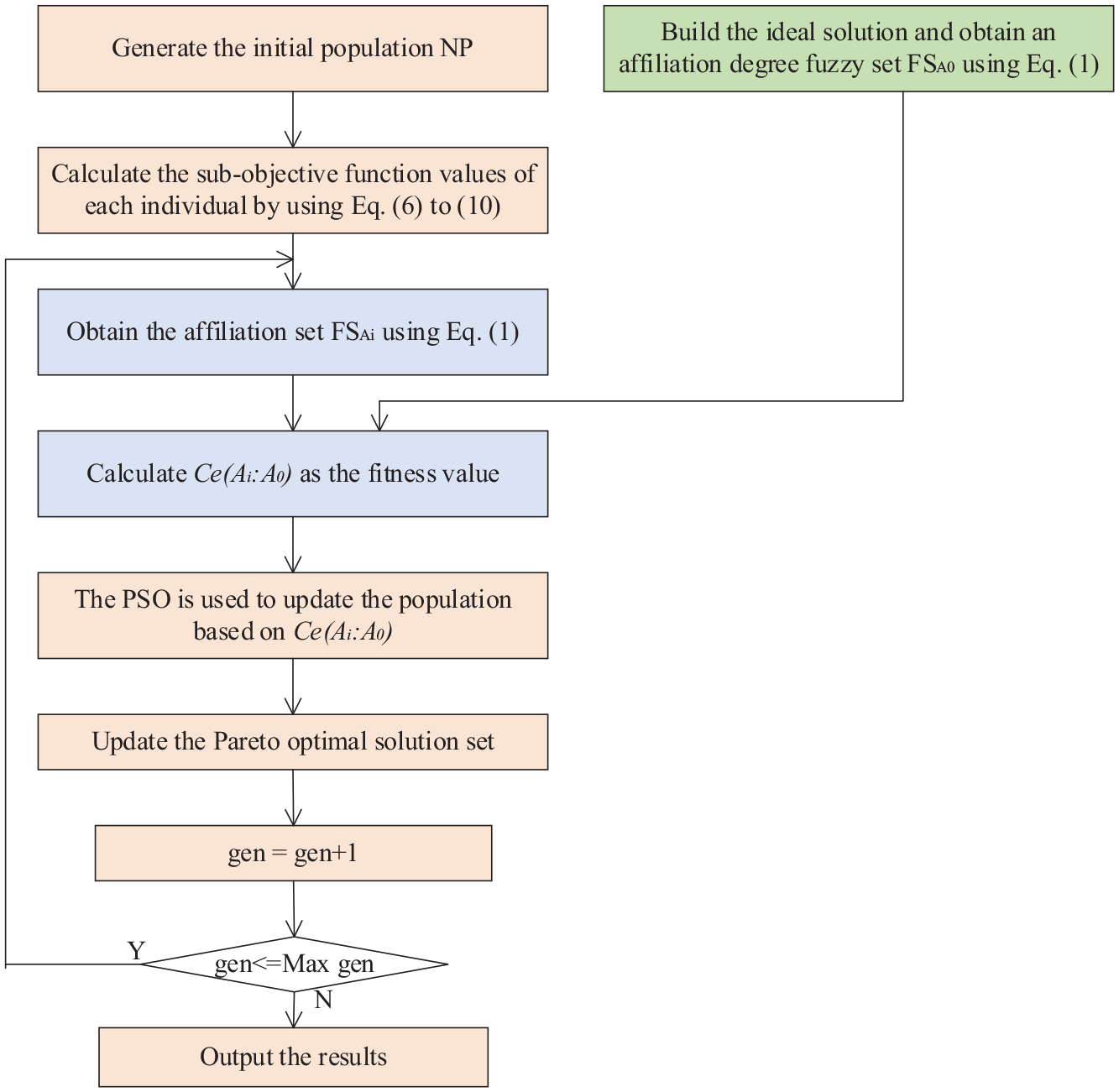
The flowchart of the proposed method.
The flight speed and position of the particle
Step 5: Dynamic update of the Pareto optimal solution set. The FREM coefficients of the Pareto solutions generated during the iterative process are compared with the FREM coefficients of each individual in the Pareto optimal solution set. If the coefficients of the newly generated Pareto solution are larger, the new solution enters the Pareto optimal solution set, and vice versa, the new solution is eliminated. The Pareto optimal solution set keeps the individuals containing more information about the ideal solution, improves the quality of the Pareto optimal solution set, and completes the dynamic update operation of the Pareto optimal solution set in the direction of large adaptability.
Step 6: Determine the iteration termination condition. When the number of iterations reaches the specified maximum number of iterations
Experiments and analysis
Experimental parameter setting
In addition to improving self-productivity, it is also necessary to achieve optimization throughout the supply chain for shop scheduling in a supply chain. This thesis introduces the influence of transporters and sellers on shop scheduling to realize the flexible scheduling of the production workshop and enable supply chain scheduling to respond to environmental changes rapidly in addition to factors within the production workshop. Among the existing fitness allocation strategies based on weight, the research in the literature
23
shows that the fitness allocation strategy based on random weight is better than that based on selective weight. In this paper, the FREM and random weight method (RWM) are combined with the PSO algorithm and the differential evolution (DE) algorithm respectively to solve the five-objective flow shop scheduling problem in the supply chain environment. Twelve scheduling examples of different scales were generated for the experiments according to the method of literature.
23
In the algorithm, the carrying capacity
PSO algorithm results for 12 scheduling examples.

DE algorithm results for 12 scheduling examples.

Algorithmic evaluation criteria
Three evaluation indicators are used to analyze the Pareto optimal solution set in this thesis to reflect the performance of this algorithm.
(1) Interval distance (Spacing, SP):
(2) Contemporary distance (GD):
(3) Average percentage deviation (ARPD): it indicates the average quality of the Pareto optimal solution set obtained by the algorithm.
Analysis of simulation results
The experimental results are shown in Tables 1 and 2. In the PSO algorithm, for examples 3, 5, and 11, five sub-objectives of the fuzzy associative entropy (FREM) method are better than the random weight method (RWM) allocation strategy, and four of the other nine examples are better. In the DE algorithm, for examples 6, 8, and 12, five sub-objectives of the fuzzy associative entropy (FREM) method are better than the random weight method (RWM) allocation strategy, and four of the other nine examples are better. It shows that the PSO algorithm and DE algorithm based on the FREM method can obtain a higher quality solution than the PSO algorithm based on the RWM allocation strategy. Although it does not work well for one of other sub-targets, it embodies the interaction among the sub-goals in the multi-goal optimization process, resulting in a semi-orderly and non-inferior solution.
Three evaluation indicators obtained by the experiment are shown in Tables 3 and 4. Among the 12 simulations, in the PSO algorithm, examples 1, 9, and 10, and in the DE algorithm, examples 3 and 4, the FREM method better than the RWM allocation strategy in two indicators, and all the three indicators of the remaining other cases are good, indicating that a higher quality Pareto optimal solution set can be obtained by the FREM method.
PSO algorithm performance evaluation results for two methods.

DE algorithm performance evaluation results for two methods.

The contemporary distance (GD) of the Pareto optimal solution set obtained by the FREM method is smaller than that of the RWM allocation strategy, which indicates that the convergence is more significant than that of the RWM allocation strategy; for the interval distance (SP), the SP of the other cases of the FREM method is smaller than that of the RWM allocation strategy, except for the cases 1, 9, 10 in the PSO algorithm, and the cases 3, 4 in the DE algorithm, which indicates that the Pareto optimal solution set obtained by the FREM method has better distribution uniformity; for the average percentage deviation (ARPD) of the five sub-targets in the PSO algorithm, all the five sub-targets of the ARPD obtained by the FREM method in Examples 1, 2, 3, 5, 6, 8, 9, 11 are smaller than that of the RWM allocation strategy; and four of the ARPD obtained in Examples 4, 7, 10, 12 are smaller, in the DE algorithm, all the five sub-targets of the ARPD obtained by the FREM method are smaller than that of the RWM allocation strategy, indicating that the deviation fluctuation of Pareto optimal solution set obtained by the FREM method is smaller and the reliability is higher.
Figures 2 and 3 are the curves of the changes between the target values and fuzzy correlation entropy coefficients of each sub-target after normalization of their target values and iterations under the fuzzy correlation entropy method of Examples 7 and 9. The evolution of the PSO algorithm was guided by the fuzzy correlation entropy coefficient as the adaptation value of the Pareto solution. It can be found in the Figure that the fuzzy correlation entropy coefficient gradually increases with the increase of iteration and is eventually in a stable state, which indicates that the FREM method leads the evolution of the PSO algorithm in the direction of large fuzzy correlation entropy coefficient and many information containing the ideal solution, and the obtained Pareto solution is close to the ideal solution. As the number of iterations and the fuzzy correlation entropy coefficients increase, each sub-target shows a down trend overall and is eventually in a stable state, achieving the optimization effect. However, some sub-targets show slight ups and downs during the decline process, while the fuzzy correlation entropy coefficient also changes at this time, each change indicates that a more optimal historical optimal solution and the solution with the most information about the ideal solution is found, which is the embodiment of the optimization process. Every time there is a rise in the value of a sub-objective function, there is a decrease in the value of other sub-objective functions, which is also in line with the different search directions of each sub-objective and the contradiction of each sub-objective in the multi-goal optimization process. The subtle changes of the values of each sub-objective function and the fuzzy correlation entropy coefficient at the beginning of the iteration indicate that the algorithm evolves rapidly at the beginning of the iteration and the values of each sub-objective function and the fuzzy correlation entropy coefficient change little but also in the later iteration stage, indicating that the fuzzy correlation entropy method has some development capability in the later iteration stage. In sum, the PSO algorithm based on the FREM method optimizes the scheduling of assembly workshops in a supply chain environment.
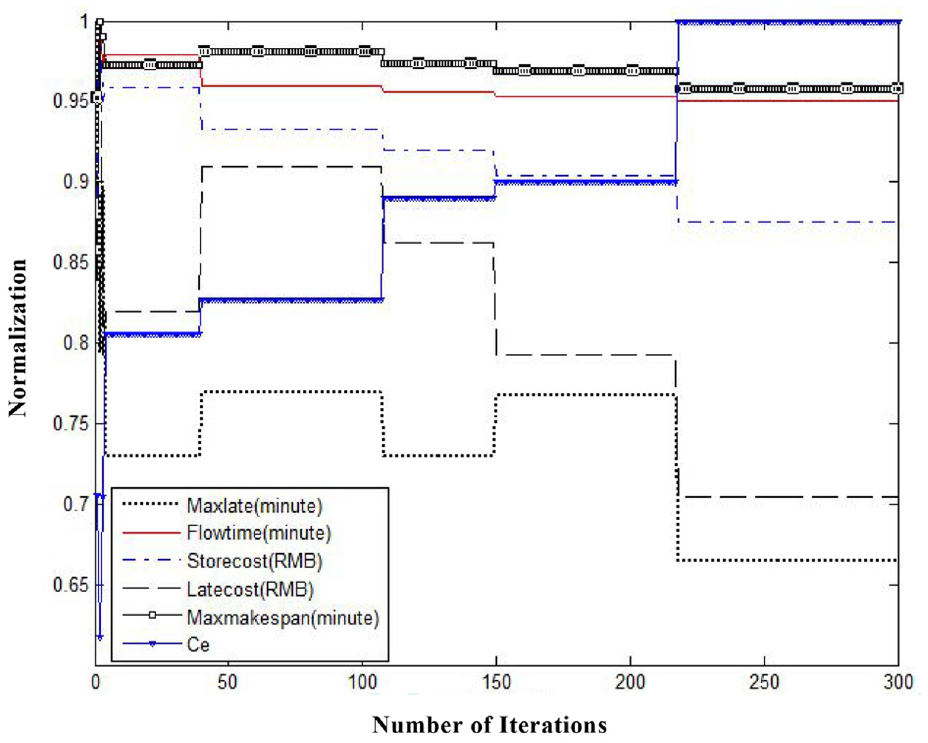
Sub-target value and Ce value variations in example 7.

Sub-target value and Ce value variations in example 9.
Conclusion
A study is conducted on the shortcomings of adaptation allocation strategies of heuristic algorithms in achieving multi-target shop scheduling optimization in a supply chain environment. The work can come down to three aspects:
(1) A fuzzy associative entropy method is proposed using the fuzzy information entropy theory and the triangular membership function. The fuzzy correlation entropy coefficient is used as the adaptation value of the Pareto solution, which leads the algorithm to evolve in the direction of a large fuzzy correlation entropy coefficient. The process of assigning weight to adaptation in the process of multi-goal optimization is avoided by the traditional heuristic algorithm, so as to avoid the influence of external uncertain factors on the algorithm, which has no effect on the number of sub-objectives and the given order and their quantity scale; a complete Pareto set can be obtained regardless of the slight preferences of the sub-targets, which is a global optimization strategy, which makes the method more reasonable and effective.
(2) Analyze the characteristics of assembly shop scheduling in a supply chain environment, consider a supply chain system consisting of manufacturers, transporters, and sellers, and establish a scheduling model for five target assembly shops in a supply chain environment. It takes the concept of system, cooperation, and integration as the scheduling idea of the flow shop in the supply chain environment, and the interests of multiple enterprises as their own interests. The introduction of external production scheduling factors in the workshop enables the model to be more practical.
(3) Simulation experiments are carried out by combining the fuzzy correlation entropy method and the random weight method with the PSO algorithm and DE algorithm, respectively. The calculation and comparative analysis show that the PSO algorithm and DE algorithm based on the fuzzy correlation method gets ideal results when solving the scheduling problem of five target assembly workshops in a supply chain environment, which realizes the flexible scheduling of assembly workshops.
In summary, the fuzzy correlation entropy method and the established multi-goal model proposed in this thesis are viable and effective in a supply chain environment, addressing the shortcomings that the existing heuristic optimization algorithms for multi-target assembly workshops are very sensitive to weight and order given by goals. In the future, it is possible to consider selecting more objectives to better align with the actual production conditions and guide the production processes more effectively.
Supplemental Material
sj-docx-1-ade-10.1177_16878132231218517 – Supplemental material for Research on multi-objective flow shop scheduling optimization in supply chain environment based on Fuzzy Relevance Entropy Method
Supplemental material, sj-docx-1-ade-10.1177_16878132231218517 for Research on multi-objective flow shop scheduling optimization in supply chain environment based on Fuzzy Relevance Entropy Method by Zhe Luo, Yonghong Tan, Guangyu Zhu, Yuping Xia and Xinyu Wang in Advances in Mechanical Engineering
Footnotes
Handling Editor: Chenhui Liang
Declaration of conflicting interests
The author(s) declared no potential conflicts of interest with respect to the research, authorship, and/or publication of this article.
Funding
The author(s) disclosed receipt of the following financial support for the research, authorship, and/or publication of this article: The project is supported by the Scientific Research Project of Hunan Provincial Education Department (Grant No.23B0757) and the Hunan Provincial Social Science Achievement Review Committee Subjects (Grant No. XSP2023JJC024) and the Natural Science Foundation of Hunan Province (Grant No. 2023JJ50071) and the Natural Science Foundation of Fujian Province (Grant No.2023J01256) and the Youth Foundation of Fujian Educational Committee (Grant No. JAT220301).
Supplemental material
Supplemental material for this article is available online.
References
Supplementary Material
Please find the following supplemental material available below.
For Open Access articles published under a Creative Commons License, all supplemental material carries the same license as the article it is associated with.
For non-Open Access articles published, all supplemental material carries a non-exclusive license, and permission requests for re-use of supplemental material or any part of supplemental material shall be sent directly to the copyright owner as specified in the copyright notice associated with the article.
