



Abstract
The determination of the radiative properties of porous media has become a critical issue in various industrial and engineering applications. The aim of this paper is to characterize the radiative heat transfer process through porous media, assumed to be spherical packed beds. A prediction model was developed using the software COMSOL Multiphysics to simulate the interaction of each of the three proposed structures with a plane-heating surface. The distribution of normalized fluxes was assessed allowing the computation of effective radiative properties, namely the transmissivity, reflectivity, and absorptivity for diffusely and specularly reflecting particles. The results show that the arrangement of the particles has a noticeable influence on the media properties. Two layers of the third model were enough to obtain an opaque surface. Correlations have been developed to allow effective reflectivity, transmissivity, and absorptivity coefficients to be easily and accurately defined as a function of emissivity in future models. The suitability of the proposed models was discussed through a comparative study of the results found using numerical simulations with analytical calculations, with a good agreement obtained.
Keywords
Introduction
For decades, the radiative heat transfer in porous media has been attracting significant interest due to its dominance in high temperature applications such as selective laser melting 1 and sintering, 2 fuel cells, 3 catalytic combustion,4,5 and solar power systems.6,7 Therefore, an accurate prediction of this phenomenon is of fundamental importance to design and optimize numerous engineering systems.
A porous medium is a solid material containing void spaces, known as pores. It presents a complicated structure, especially when the pores have random and irregular shapes, sizes, and connections with each other. On that basis, identifying its radiative properties has turned out to be a complex and difficult task. For that, in many thermal designs, such as powder-insulation systems, 8 high-temperature catalytic reactors, 9 pebble-bed type nuclear reactors 10 etc., the porous medium can be viewed as a spherical packed bed with a special and regular structure. Several studies have been conducted to model the radiative transfer in packed beds of spherical particles including the works of Mohammadnejad and Hossainpour, 11 Randrianalisoa and Baillis, 12 Wu et al. 13 etc. and varying between numerical calculations14,15 and experimental measurements.7,8
Considering the complex character of radiative transfer in spherical packed bed porous media, the most commonly adopted approach has been to assume the medium as statistically continuous and homogeneous and to consider effective radiative properties using the radiative transfer equation (RTE). This approach was initially suggested by Tien and co-workers16,17 and then by Singh and Kaviany. 18 Since then, considerable progress has been made and many studies have been performed using this technique.12,19,20
Determining and understanding the radiative characteristics within packed beds of spherical porous media are required for the design and the safety evaluation of numerous energy systems and technologies. These radiative properties hold a pivotal significance across a spectrum of applications, exerting a profound influence on heat transfer efficiency, energy conservation, and overall system efficacy. 21 Researchers have traditionally regarded direct experiments as the most reliable means for the measure of the radiative properties of such a complex medium.20,22–24 Unfortunately, this method is expensive and extremely challenging. A number of researchers have addressed analytical solutions derived from extensive measurements and validations.12,25–27 With the significant progress in computational tools over the last decades, numerical methods have been developed for the prediction of the radiative properties of porous media. Many numerical simulations have been performed for spherical packed bed porous media by using different methods, alone or combined, 28 such as Monte Carlo ray-tracing (MCRT),29,30 the radiative distribution function identification (RDFI), 31 discrete ordinate, 32 two-flux methods, 24 Finite Volume Method (FVM),33,34 Finite Element Method (FEM), 35 the Mie theory and the discrete dipole approximation (DDA) 36 etc. Coquard and Baillis suggested a Monte Carlo method for the determination of the radiative characteristics of opaque and spherical, 28 and later, absorbing and scattering particles beds. 37 The results showed good agreement with those obtained by correlations developed by different authors. Randrianalisoa and Baillis 38 developed a numerical approach based on the Ray-tracing (RT) method to directly calculate effective radiative properties of spherical packed bed in non-absorbing or semitransparent host medium. For that, a mean free path and scattering distribution calculation was used. The radiative transfer calculations obtained from the standard Radiative transfer equation (RTE) were in good agreement with the direct Monte Carlo (MC) simulation proposed by Singh and Kaviany. 18 The proposed method predicts satisfactorily results for beds of opaque and semi-transparent spheres, 38 foams, 39 honeycomb structures, 15 and others. However, it comes with a high computational cost. Subsequently, Randrianalisoa and Baillis 12 presented an analytical solution enabling rapid calculation of radiative properties of homogeneous and statistically isotropic packed bed of spheres. Wang et al. 40 determined the reflection and transmission characteristics of radiative transfer of collimated and diffused beams in a 1D densely packed bed of absorbing–scattering spherical particles. The Monte Carlo ray tracing technique was employed and the influence of the albedo, thickness, porosity, refractive index, and incident angle on the radiative transfer process were investigated. Gusarov 41 developed a ray tracing method to compute the effective radiative of regular structures within a wide range of packing density of laser powder beds.
The most accurate and satisfactory results have been obtained using Monte Carlo ray-tracing (MCRT) simulations. This method has been the subject of long-term investigations as reported in the research studies of Randrianalisoa and Baillis, 12 Wang et al., 40 and more recently, Hajimirza and Sharadga. 42 However, the iterative simulation process used in this method and the complexity of porous media require intense and time consuming computational resources, which come at a high cost. 43 To address this problem, Reddy and Murty 44 proposed the finite element method (FEM). Due to its simplicity and its ability to handle complex porous media, FEM has emerged over the past two decades as a robust and reliable tool for solving the radiative transfer equations (RTE). In their work, Rubiolo and Gatt 45 affirmed that traditional finite element calculations can be expensive, especially in the case of optical studies. An attractive alternative to reduce its cost is the use of COMSOL Multiphysics, a FEM-based software. Wheeler et al. 46 employed this software to predict the radiative properties of spherical heterogeneous ceria particles in the spectral range 290–10,000 nm. The discrete dipole approximation (DDA) was also considered for these calculations. The particles were assumed to be homogeneous spheres with properties obtained from an effective medium theory. The results obtained by both adopted approaches (FEM and DDA) were compared to those obtained using the Lorenz–Mie theory showing similarities. It was also shown that, in the spectral range 560–1000 nm, the absorption and scattering efficiency factors have a significant dependence on the particle orientation. Gonome 35 calculated the radiative properties and the scaling factor of spherical plasmonic nanoparticle clusters in 3D assemblies using COMSOL Multiphysics. He concluded that these radiative properties are affected by the particle number, diameter, material, clearance distance, and background refractive index due to localized surface plasmon resonance (LSPR). All of these findings would have been more interesting if the effect of the arrangement of spherical particles in a porous medium had been investigated.
In this context, the present paper proposes to determine and analyze the radiative properties of three regular structures of spherical packed bed porous media using the FEM. Correlations of these properties as a function of emissivity were developed. Notably, the influence of the arrangement of the particles has been evaluated. Such a study holds practical applications and significant implications in various fields. For instance, in the realm of Heat Transfer Engineering, it can contribute to the design and optimization of reactors 47 and heat exchangers, 48 resulting more effective and efficient heat systems. In Environmental Engineering, the findings can improve the efficiency of radiative cooling systems and solar receivers 49 for eco-friendly cooling and heating. Materials Science can also benefit from the results by developing advanced materials with specific radiative characteristics for insulation 8 and energy storage. Moreover, the relevance of this study extends to Biomedical Engineering, 50 Aerospace Engineering, 51 and Manufacturing Processes 52 etc.
Calculation methodology
Physical model
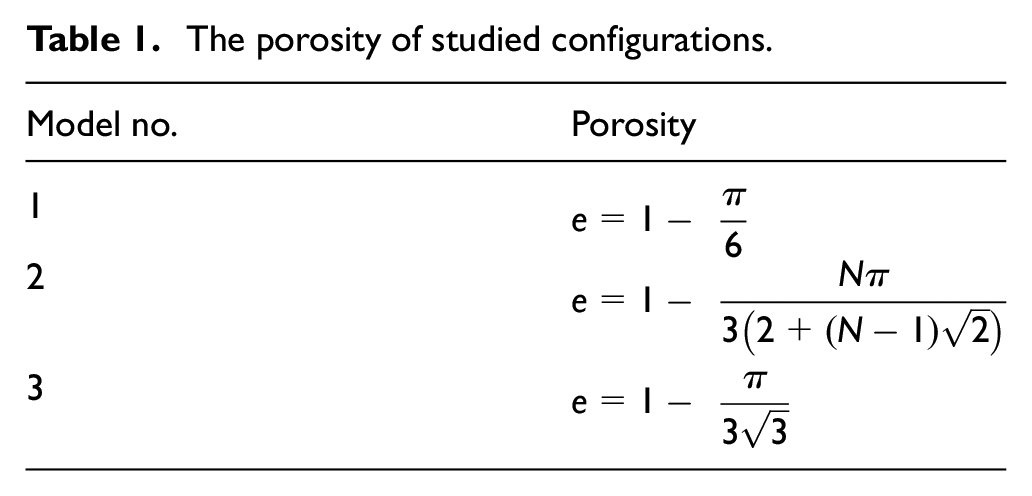
As mentioned in the introduction, the studied porous medium is considered to be a packed bed of equally sized spheres. The size of these spherical particles is assumed to be much larger than the wavelength of radiation. Three configurations are proposed in which the spherical particles are arranged and stacked upon one another differently. The porosity of these structures is determined by calculating the ratio between the void volume (Vv) and the total volume (Vt) of the material. The results of this calculation are mentioned in Table 1. The close-to-reality arrangement of particles can result a stable configuration and yield logical and reliable outcomes.
The porosity of studied configurations.
The symmetry of the geometry enables the characterization of the whole bed from the determination of the radiative properties of a single cell. Table 2 lists the proposed structures and the studied cells with their dimensions which are related to the sphere’s radius.
The configuration details.

The present calculations are based on the assumption that any porous medium can be modeled by an equivalent homogeneous and continuous one. The standard RTE is, then, used with “effective radiative properties” that should be obtained in advance. Numerical computations have thus been performed using the finite element software COMSOL Multiphysics.
Computational domain grid system
The computational domains of the three studied configurations were generated and meshed. A triangular mesh was thus created.
The effect of both the grid size and the number of directions on the mean effective reflectivity and transmissivity of the porous media was examined. The resolution of the mesh was varied from coarse to extra fine. Three directions were also considered: 16, 32, and 64 directions. The obtained results are listed in Table 3 showing significantly similar results. The choice of the grid size was set to 32 directions with an extra fine mesh, having 18,410 boundary elements and 642 edge elements, as it gives good accuracy. Figure 1 presents the adopted grid distribution for Model 1 after the grid sensitivity study was carried out.
Impact of the mesh and the number of directions on the results obtained for model 1 in the case of a diffuse reflection, N = 1 and ε = 0.5.


Mesh grid used for Model 1.
Mathematical formulation
Assumptions
Both the porous medium and the heating surface are assumed to be infinite. The radiation exchange between these two surfaces is calculated and the radiative properties of a surface of an equivalent non-porous medium can, thus, be determined.
As shown in Figure 2, the radiant hot surface (S1) is represented by a black surface at the temperature Trad. The output (S2), representing the surrounding environment, is also modeled by a black surface at a temperature of T = 0 K, thus neglecting its emission. The emissivity of the particles, which constitute the porous medium, was also described as negligible.
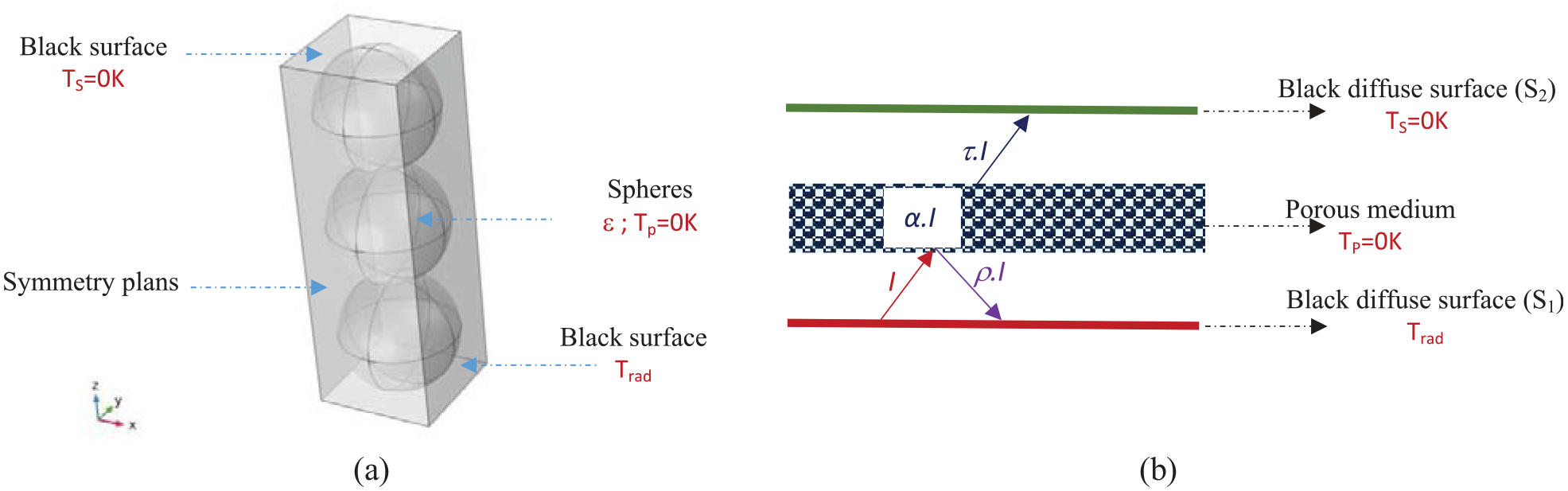
The adopted assumption shown in a (a) 3D model and in (b) its equivalent representation on a diffuse surface.
Equations and boundary conditions
The boundary condition considered for the diffusely reflected particles is the outgoing radiance in a specific direction

As concerns the boundary condition for the case of the specularly reflected particles, it is expressed as 53 :

In fact, for both diffuse and specular reflections, the outgoing radiance is determined by two components. The first term on the right side of equations (1) and (2) represents reflected radiance. For specularly reflected particles and, as presented by equation (2), this term is obviously the incoming radiation I (
The expressions of the calculated parameters such as:
The radiative intensity of a black body at the temperature T is given by 54 :

The radiative flux density is calculated by 54 :

The normalized radiative flux density is equal to 54 :

The local effective reflectivity is calculated using the radiative flux density at the hot black wall (S1) as follows:

The mean effective reflectivity of the porous media is formulated as:

The local effective transmissivity is calculated using the radiative flux density at the cold black wall (S2) as follows:

The mean effective transmissivity of the porous media is given by:

The local and the mean effective absorptivity of the porous media are then determined using the relations bellow:


Results and discussions
In this section, the reflection, transmission, and absorption characteristics of radiative transfer in the spherical packed bed porous media for diffuse and specular reflections are examined. The influence of the spheres’ emissivity and the layers’ number is also investigated.
The procedure for determining our radiative properties begins with the calculation and the presentation of the radiative flux. Since the proposed models present different dispositions of particles, a normalization of flux has been carried out.
Figures 3 to 5 provide the distribution of normalized fluxes at the inlet, the outlet, and on the spheres of each model. The results were evaluated for diffusely and specularly reflected spherical particles and an emissivity of ε = 0.5. The results cast a light on the influence of the spheres’ disposition on the flux distribution. At the inlet and outlet of the three models, a circular profile of the flux that expands concentrically was observed as the rays penetrate and leave the sphere. However, the distribution of the flux intensity varies from one model to another. In fact, Figure 3(a) and (b) reports that, at the inner surface of model 1’s particle, the flux intensity increases gradually as one approaches the particle’s periphery. This is due to the radiation coming from reflected rays by adjacent particles. That is what is called the phenomenon of particle-to-particle interaction, where particles interact with each other. At the outer surface of this model’s particle, the flux is low at the center where the particles are attached to each other. High flux intensity was registered at the holes generated by the particle disposition owing to radiation coming from all adjacent particles. For model 2 and as presented in Figure 4(a), the inner surface of the particle is characterized by a high flux intensity at its center, as a result of radiation coming from the four adjacent particles, and lower values at its corners where the adjacent particles are attached to it. Unlike what is happening at the outer surface of the particle, where the flux intensity at its center is lower than that elsewhere. Concerning the flux distribution in model 3, shown in Figure 5(a) and (b), low flux intensity is registered at the center of the inner and outer particle’s surfaces and increases gradually as one approaches the particle’s periphery with low values at its corners where the particles are bounded. This distribution can be explained by the arrangement of particles within the medium.

The distribution of normalized fluxes at (a) the inlet, (b) the outlet, and (c) on the spheres obtained for: Model 1, (i) diffuse and (ii) specular reflection, N = 1 and ε = 0.5.

The distribution of normalized fluxes at (a) the inlet, (b) the outlet, and (c) on the spheres obtained for: Model 2, (i) diffuse and (ii) specular reflection, N = 2 and ε = 0.5.
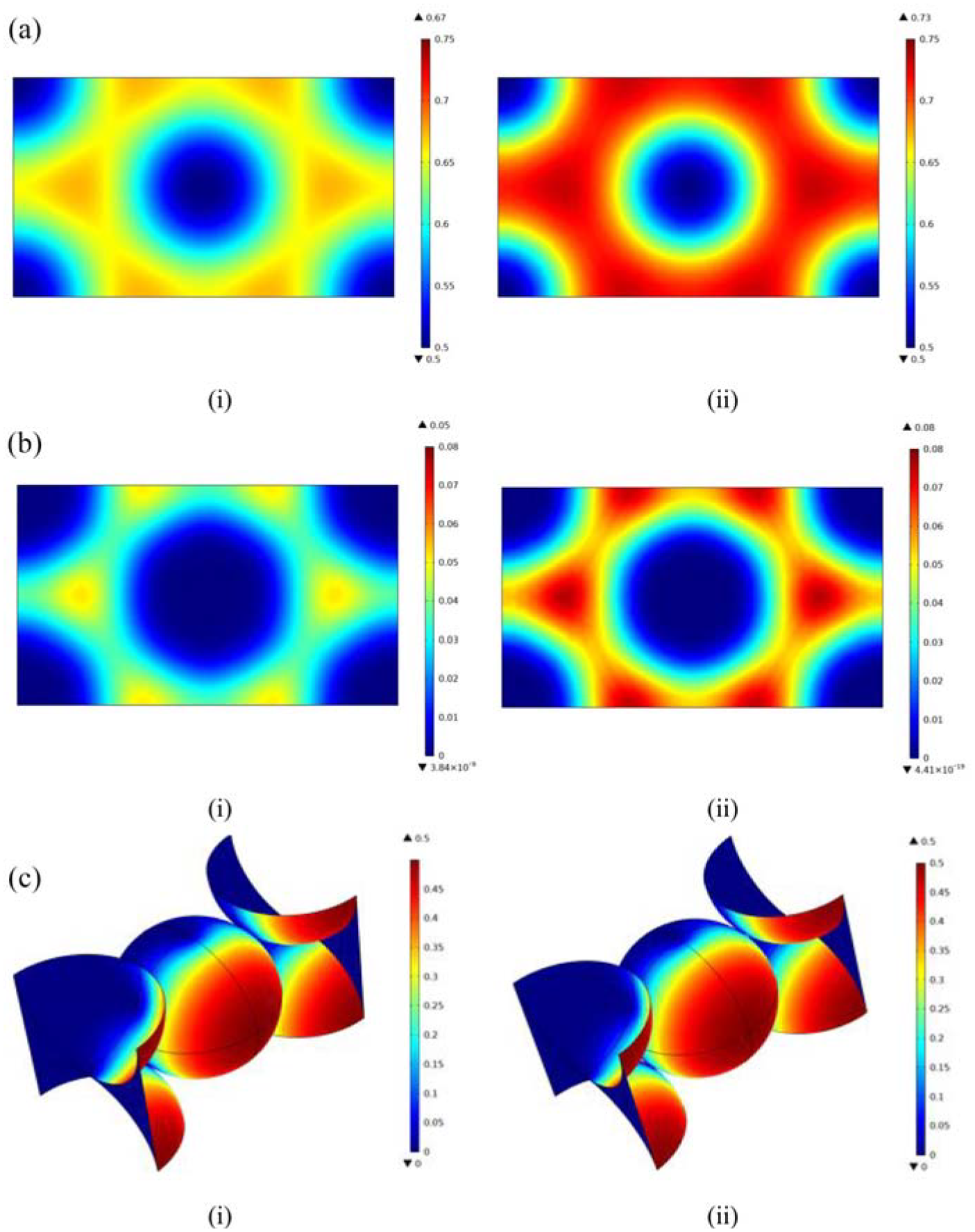
The distribution of normalized fluxes at (a) the inlet, (b) the outlet, and (c) on the spheres obtained for: Model 3, (i) diffuse and (ii) specular reflection, N = 1 and ε = 0.5.
It can also be seen that the flux distribution is almost similar for both diffusely and specularly reflecting particles, but with lower intensity in the case of diffusely reflecting ones. This can be explained by the fact that when radiation encounters specularly reflecting particles, it behaves like a mirror, reflecting at a consistent angle. In contrast, when it encounters diffusely reflecting particles, it scatters in many directions, causing the heat flux to be less concentrated. This scattering effect leads to a reduction in the intensity of the heat flux.
The global distribution of the normalized flux, presented in Figures 3(c), 4(c), and 5(c), reveals that the flux received by the outer surface of the particles of the three models is higher than that received by the inner surface. This is due to the radiation coming from the adjacent particles of the second layer. As a result, the arrangement of particles and, consequently, the porosity of the medium have a direct impact on the heat flux. These findings corroborate the results previously reported by Duraihem et al. 55
All these results have significance in understanding how radiation or energy flows within the proposed configurations, which can be relevant in different areas like materials science, radiative heat transfer, and engineering, where controlling energy distribution is fundamental for optimizing system performance.
Assuming that the radiating surface uniformly transmits radiation to the porous medium, the transmissivity was thus calculated and plotted against the emissivity for both studied cases of reflection in the three models and depicted in Figures 6 to 8. In each figure, four layers are considered. The results show that the transmissivity decreases when the emissivity increases. As the number of layers increases, the transmissivity curves tend more rapidly toward zero. In fact, the opacity of the medium can be noticed from the first layers, even in the extreme case of specularly reflected particles. Comparing Figures 6 to 8 reveals that the model structure has a great influence on the transmissivity. Indeed, it can be seen in Figure 8 that the structure of model 3 makes it possible to obtain a completely opaque medium from the second layer. In contrast, according to Figure 7, model 2 becomes opaque starting from the third layer and for emissivities higher than 0.1. As for the transmissivity of model 1, presented in Figure 6, it becomes nearly opaque starting from the fourth layer and for emissivities higher than 0.3 for diffusely reflecting spherical particles and 0.5 for specularly reflecting ones. This is attributed to the presence of numerous voids between its particles.

Effective transmissivity for (i) diffusely and (ii) specularly reflecting spherical particles of the Model 1 as a function of emissivity for different layer number.

Effective transmissivity for (i) diffusely and (ii) specularly reflecting spherical particles of the Model 2 as a function of emissivity for different layer number.

Effective transmissivity for (i) diffusely and (ii) specularly reflecting spherical particles of the Model 3 as a function of emissivity for different layer number.
In this work, the studied media were assumed as equivalent to opaque surfaces. To this end, the use of effective radiative properties is justified.
The effective reflectivity was then computed for different emissivities. The effective reflectivity curves are depicted in Figures 9 to 11 for the diffuse and specular reflection and for the three proposed models. It is clear that reflectivity varies inversely with emissivity. Actually, a surface that is highly reflective, like a polished metal, tends to be a poor emitter of thermal energy. When heat is applied to such a surface, it reflects most of the heat energy back rather than emitting it as infrared radiation. This can explain why polished metal surfaces often feel cool to the touch even when they are heated. Obviously, the highest reflectivity values were corresponded to an emissivity to zero, while a reflectivity of zero was observed for a surface with an emissivity equal to 1, characteristic of a black body. Moreover, in all three models, higher reflectivity values were registered, particularly at the first layer of diffusely reflecting particles, as opposed to those of specularly reflecting ones. This can be attributed to the scattering of rays in different directions in the case of diffusely reflecting particles.

Effective reflectivity for (i) diffusely and (ii) specularly reflecting spherical particles of the Model 1 as a function of emissivity for different layer number.

Effective reflectivity for (i) diffusely and (ii) specularly reflecting spherical particles of the Model 2 as a function of emissivity for different layer number.

Effective reflectivity for (i) diffusely and (ii) specularly reflecting spherical particles of the Model 3 as a function of emissivity for different layer number.
It is also noteworthy that the presence of multiple layers results in increased reflectivity compared to a single layer. This phenomenon can be attributed to the greater quantity of reflected rays emanating from each surface within the multi-layer configuration. In essence, when multiple layers are involved, each layer contributes to the overall reflectivity, leading to a cumulative effect. This contrasts with a single layer, where only one surface participates in reflection. Consequently, the multi-layered setup exhibits a higher degree of reflectivity.
Another intriguing finding from our study pertains to the reflectivity of different model structures. Notably, we observed that the structure of model 3 exhibits a higher level of reflectivity compared to the configurations of models 1 and 2. This variation can be elucidated by examining the intricate arrangement of layers within these models. In the case of model 3, the even layers exhibit a substantial degree of overlap with the openings or holes present in the odd layers, and vice versa. This structural feature results in a greater number of rays being reflected and redirected within the medium. Consequently, the increased interaction between adjacent layers in model 3 contributes to its enhanced reflectivity when compared to the less densely packed structures of models 1 and 2. This finding underscores the profound influence of structural geometry on the reflection of radiation within porous media.
In the three studied models and for a diffuse or a specular reflection, the first and second layers are the main reflecting surfaces. The contribution of the third and fourth layers is much less important and even insignificant. In addition, for an emissivity equal to zero, two layers in model 3 were sufficient to obtain a perfect reflector with a reflectivity equal to 1 which is not reached even with four layers of models 1 and 2.
The plotted effective reflectivity curves were used to determine the correlations between effective reflectivity and emissivity under the diffuse and specular reflection for the three models, as illustrated in Table 4. Establishing such a relationship is crucial in different fields, especially in designing surfaces or coatings for applications such as energy-efficient buildings. Engineers and scientists can use this knowledge to select materials with the desired combination of reflectivity and emissivity to control heat transfer and energy efficiency in various contexts such as building materials, thermal insulation, reflective coating of solar panels etc.
The effective reflectivity correlations obtained from the three studied models for diffuse and specular reflection.

The effective absorptivity is also determined using equation (11) and plotted as a function of an emissivity in the range from 0 to 1 for the three models and for both cases of reflection, as presented in Figures 12 to 14. These figures demonstrated that when the emissivity of the proposed configurations increases, they become more effective at both absorbing and emitting thermal radiation, leading to an increase in its absorptivity. As a result, when the emissivity increases, the material tends to absorb more of the thermal radiation it encounters, leaving less of it to be transmitted through the material. This can justify the decrease in transmissivity with increasing emissivity shown in Figures 6 to 8.

Effective absorptivity for (i) diffusely and (ii) specularly reflecting spherical particles of the Model 1 as a function of emissivity for different layer number.

Effective absorptivity for (i) diffusely and (ii) specularly reflecting spherical particles of the Model 2 as a function of emissivity for different layer number.

Effective absorptivity for (i) diffusely and (ii) specularly reflecting spherical particles of the Model 3 as a function of emissivity for different layer number.
Furthermore, it can be noted that most of the radiation was absorbed by the first hemispheres, which assumes that the absorption takes place mainly at the outer surface of the medium. It is crucial to also note that a small amount of radiation was absorbed by the particles of the medium’s second layer that appears higher in the case of models 1 and 2 compared to model 3. Figure 12 reveals that model 1 is more absorptive than the two other models. Actually, in this model, even the third and fourth layers of the medium contribute to the absorption process even if with a very small amount.
Another point is that the absorbed radiation for a diffuse reflection in the three models was less than in a specular one. This can be explained by the fact that, in diffuse reflection, a higher amount of radiation is scattered at many angles and thus less radiation penetrated the medium.
Further results on the absorption percentages are found for the two hemispheres of Model 1’s sphere in the case of one, and then two layers and summarized in Table 5. These findings lend support to what we already mentioned in a previous paragraph. As it can be noted, the highest percentages of absorbed radiation were registered at the first hemisphere with about 94.3% and 94% respectively for diffusely and specularly reflected particles of a one-layered medium and 83.8% and 82.8% respectively for a diffusely and specularly reflected particles of a two-layered medium. Low absorption percentages were found for the inner surfaces. For instance, only 0.5% and 0.7% were absorbed from the fourth hemisphere respectively for diffusely and specularly reflected particles of a two-layered medium. These values confirm well that the incident radiation was mostly absorbed from the top surface and penetrated to little depths. Besides, the absorption percentage on the first hemispheres of a diffusely reflected particles is higher than that on the other hemispheres of a specularly reflected particles. Furthermore, a slightly better flux distribution can be noticed by using a two-layered medium instead of a one-layered medium.
The distribution of the absorption on two hemispheres of the sphere: the case of Model 1 and ε = 0.5.

The correlations between effective absorptivity and emissivity under the diffuse and specular reflection for the three models were established using the absorptivity curves and summarized in Table 6. It should be noted that these correlations are applicable on the layers from which the medium can be considered as opaque.
The effective absorptivity correlations obtained from the three studied models for diffuse and specular reflection.

All these findings reveal that, for the proposed configurations, examining the first layers of the porous medium is sufficient to form an understanding of its overall radiative characteristics. For instance, the radiative characteristics of a fixed bed reactor, as studied by Mami et al., 56 can be explored by concentrating solely on the initial layers of the reactor, without the necessity to analyze every single layer.
Verification of the results
In order to test the validity of our calculations, a porous media with three levels of disposition, according to Model 2, was considered. The radiant surface is assumed to be gray with an emissivity equal to εrad = 0.8 and at a temperature Trad whereas the outlet is presented as a black surface at Ts. The spherical particles are at the temperature Tp.
Four emissivities were examined in the case of a diffuse reflection. For these emissivities, the normalized average flux densities at the inlet and at the outlet of the flat surfaces were computed using our model and compared with those calculated with the analytical expressions below, which are valid for surface exchanges between parallel, infinite, and opaque planes (view factor = 1).


The obtained results are summarized in Table 7. In all cases, the results are in remarkable agreement, showing the suitability of the correlations defined by our model.
Verification test applied for Model 2, N = 3 and εrad = 0.8.

Conclusions
Numerical calculations of the radiative properties of three structures of spherical packed bed porous media were reported. The study was conducted for both specularly and diffusely reflecting particles. For that, a COMSOL Multiphysics model has been used. The obtained normalized flux showed that high-temperature values were reached at the center of the sphere when the radiation was penetrating. Once this flux was calculated, reflectivity, transmissivity, and absorptivity were determined and correlations between these coefficients and emissivity were established. The results also provide a better insight into the influence of the structure on the radiative properties of the medium. The structure of model 3 permits to get rapidly a completely opaque medium (from the second layer) compared to models 1, and 2 (from respectively the fourth and the third layers). Also, model 3 seems to be more reflective than the two other models. At low emissivity, its structure enables it to function as a reflective insulator, widely used in thermal insulation. Thus, it can reflect heat efficiently and minimize heat loss, making it valuable for maintaining temperature control in buildings, protective gear, and packaging. As concerns the absorption phenomenon, most of the radiation was absorbed by the first hemispheres, which proves that the absorption takes place mainly at the outer surface of the medium.
The validity of the present method was verified using a comparison between obtained results and those found by analytical calculations for an opaque medium.
On this basis, theoretical prediction based on numerical simulation calculations may be considered as an alternative less time and money-consuming method to analytical calculations and experimental measurements. Thus, it opens paths toward understanding and disentangling the complexity of the radiative heat transfer process through porous media.
Footnotes
Appendix

| Notation | Greek symbols | |||
|---|---|---|---|---|
| E | Porosity | local effective absorptivity | ||
| FEM | Finite Element Method | mean effective absorptivity | ||
| I | radiative intensity W sr−1 | local effective reflectivity | ||
| L | characteristic length, m | The mean effective reflectivity | ||
| N | layer number | local effective transmissivity | ||
| normal vector | mean effective transmissivity | |||
| normalized radiant flux density, W m−2 | ε | Emissivity | ||
| radiant flux density, W m−2 | εrad | emissivity of the radiant surface | ||
| RTE | Radiative Transfer Equation | εeq | mean effective emissivity | |
| S1 | radiant hot surface (m2) | Ω | solid angle, sr | |
| S2 | radiant cold surface (m2) | Subscripts | ||
| T | temperature, K | b | black body | |
| Tp | Temperature of the particles, K | x, y, z | Cartesian coordinates | |
| Trad | temperature of the surface S1, K | Physical constants | ||
| Ts | temperature of the surface S2, K | σ | Stefan-Boltzmann Constant, 5.67040 × 10⁻⁸ W m−2 K−4 | |
Handling Editor: Chenhui Liang
Declaration of conflicting interests
The author(s) declared no potential conflicts of interest with respect to the research, authorship, and/or publication of this article.
Funding
The author(s) received no financial support for the research, authorship, and/or publication of this article.
