



Abstract
To investigate the effects of the non-Newtonian properties of solvents on particle suspension rheology (non-Newtonian property and viscosity), we analyzed suspension flows with different solvent characteristics. We used the power-law model to express the non-Newtonian properties of solvents. The power-law index of the suspension was denoted as nsus. and that of the solvent as
Introduction
Rheology deals with the deformation and flow of materials and is an interdisciplinary science that covers a wide range of disciplines, including physics, chemistry, engineering, medicine, biology, agriculture, pharmacy, food science, and domestic science. A dispersed system of solid particles in a liquid is called a suspension, and many suspensions are found in our daily lives (e.g. paint, ink, coating, cosmetics, and blood) because the rheology of suspensions (viscous properties) can be adjusted easily in response to many requirements by changing the content of suspended particles. The rheology of such suspensions is determined primarily by the interactions between particles and fluids. The most important factors are particle concentration (volume fraction), shape, particle–particle interaction, microstructure – which is generally defined by the relative position of the suspended particles – and solvent properties. Thus, the rheology of suspensions is complex, as it is determined by many factors. However, understanding these properties is important to solve various problems because it may improve the quality of industrial products.
Viscous fluids are classified into Newtonian and non-Newtonian fluids. Newtonian fluids exhibit constant viscosity independent of the shear rate, whereas the viscosity of non-Newtonian fluids depends on the shear rate. Shear-thinning fluids are characterized by decreasing apparent viscosity with increasing shear rate, and this phenomenon is called thixotropy. On the other hand, shear-thickening fluids have the opposite properties of shear-thinning fluids; they are characterized by increasing apparent viscosity with increasing shear rate. Such non-Newtonian fluids are frequently treated in the fields of chemical engineering and bioengineering. Blood is a non-Newtonian fluid, which is a suspension of blood cells (e.g. erythrocytes, leukocytes, and platelets) suspended in plasma. Erythrocytes are the majority of blood cell components, and their movement, deformation, and aggregation are thought to contribute to the non-Newtonian properties of blood. In a previous study, Mueller et al. 1 demonstrated that the dispersion of solid particles affected the non-Newtonian properties of the suspension even though the solvent was a Newtonian fluid. In addition, although plasma, the solvent of blood, is generally treated as a Newtonian fluid, plasma exhibits non-Newtonian properties depending on the content of plasma proteins. 1 However, it is still unclear how the solid particles in the suspension affect the non-Newtonian characteristics of the suspension when a non-Newtonian fluid is used as the solvent of the particle suspension.
In addition, intrinsic viscosity has been recognized as an important factor when discussing the rheology of suspensions. In studies on suspension viscosity, many viscosity equations have been proposed, and Einstein presented Einstein’s viscosity equation for dilute suspensions, which is given by equation (1) 2 :

where
Regarding the study on the inertial migration of particles, Segré and Silberberg 3 showed that particles were concentrated at equilibrium positions in an inertial flow in a pipe. Fukui and Kawaguchi 4 considered particles’ behavior in an inertial field and their effects on the microscopic particle arrangement and macroscopic suspension rheology. Hu et al. 5 also found that the solvent properties of a suspension affected the equilibrium position of particles. However, the trajectory and equilibrium position of particles in an inertial flow field are governed by the lift force of the particles, and the relationship between the non-Newtonian properties of the solvent and the lift force of the particles has not yet been clarified.
Regarding the effect of the non-Newtonian properties of the solvent on the viscosity of the suspension, Trofa and D’Avino 6 showed that power-law index affected intrinsic viscosity using fractal-shape aggregates in shear flow. Tanaka et al. 7 found that the non-Newtonian properties of the solvent affected the relative and intrinsic viscosity of the suspension in a flow field in which the particles are homogeneously distributed. Hu et al. 8 also found that the way particle train was formed depended on power-law index, Reynolds number and particle spacing. However, assuming an inertial flow field, the effect of the non-Newtonian property of the solvent on the viscosity of the suspension is unclear.
Based on the above background, the purpose of this study is to investigate the effects of the non-Newtonian property of the solvent on the rheology (non-Newtonian property and viscosity) of the suspension in a flow field with inertia. Then, we focused on relative viscosity and power-law index ratio
Method
Computational model
In this analysis, we introduced a two-way coupling scheme and performed a pressure-driven flow simulation in a 2D Poiseuille flow. Figure 1 depicts the numerical model used in this study. The initial positions of particles were randomly arranged, and the particles were non-homogeneously dispersed. The power-law model
9
was used to represent the non-Newtonian properties of the solvent, and the power-law indices

Schematic view of computational model. The rigid buoyant circular particles are suspended in a pressure-driven flow through a 2D channel. The particles are randomly distributed in the channel.
Purpose and conditions of the simulation.

2l: channel width; D: channel length; C: confinement;
Governing equation for fluids
In this study, incompressible fluid was used as the working fluid. The governing equations were the normalized lattice Boltzmann method
13
(2D9V model) with the incompressible formulation. The normalized lattice Boltzmann method maintains the algorithmic simplicity and high efficiency of the original lattice Boltzmann method while providing computational stability in higher Reynolds number regions and reducing the amount of memory used in the analysis. In the normalized lattice Boltzmann method, the pressure distribution function

where


where
Power-law model
In this study, the power-law model
9
was used to represent the non-Newtonian property of the solvent. The power-law model is frequently used in industry because of its ease of analytical treatment and its ability to represent a wide range of fluid flow properties. In the power-law model, apparent viscosity

where

Equation (5) is calculated using


The theoretical equation for the velocity profile in a 2D channel used in this study is obtained by the following equation:

Governing equations for suspended particles
The force acting on a particle is obtained by the following equation:


where


where
Suspended particles receive fluid force, so we used two-way-coupling scheme. Then we considered Newton’s second law for translation and the angular equation of motion for rotation as follows:


where

where
Relative viscosity
The mass flow rate

where

where

Results and discussion
Validation: Homogeneous flow (Case 1)
In this section, to validate the viscosity estimation using the pressure drop ratio expressed in equation (19) and the power-law fluid properties, we analyzed an ideal suspension flow with homogeneously dispersed particles.
As initial conditions, the velocity distribution and particle positions for each area fraction at
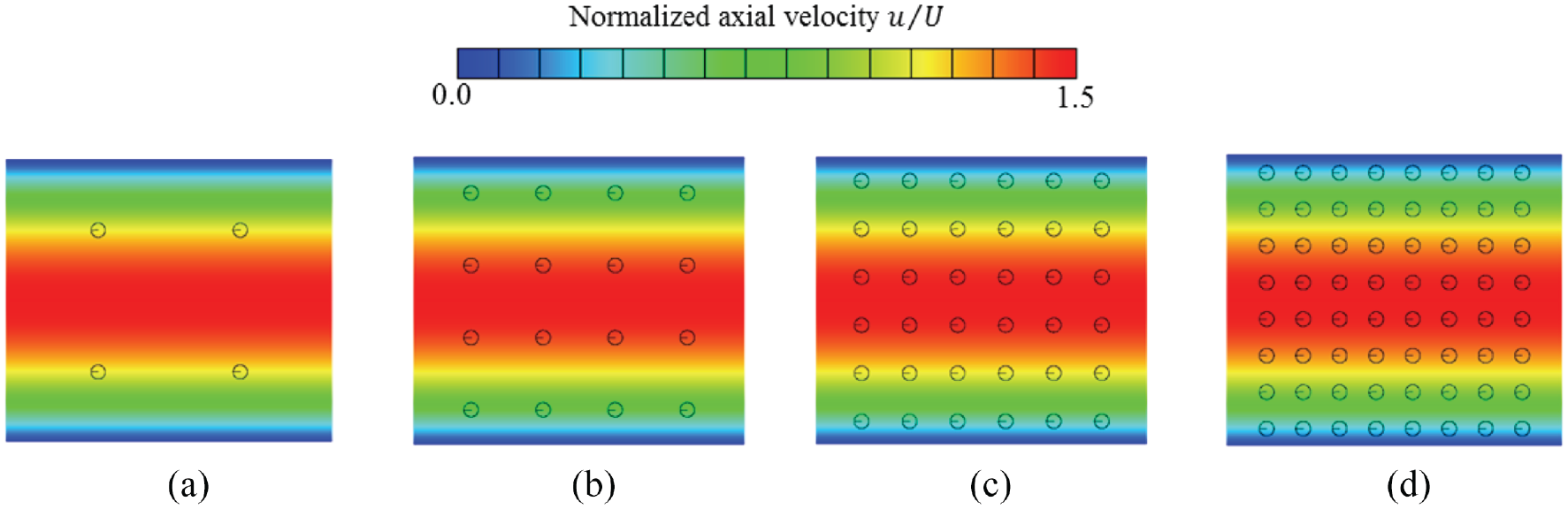
Normalized axial velocity distribution and particle position for different area fractions
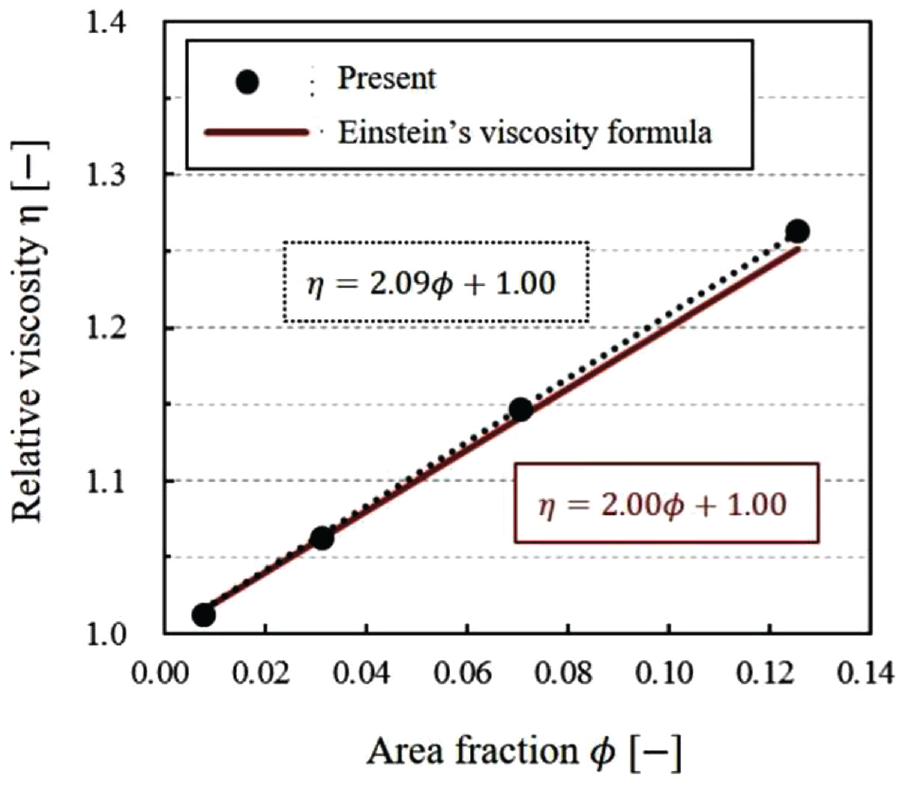
Relationship between relative viscosity
Comparison of relative viscosity. Relative viscosity obtained from our simulation

Figure 4 shows the relationship between relative viscosity and the area fraction for each power-law fluid (

Relationship between relative viscosity
Effect of solvent property on lift coefficient: Single particle (Case 2)
In this section, to clarify the effect of the non-Newtonian property of the solvent on the microstructure – generally defined by the relative position of the suspended particles – of the suspension, we first focused on a single particle and investigated the lift force acting on the particle. A particle was allowed to flow downstream while keeping its y-position fixed, and the initial y-position varied from 0.0 to 0.6. Figure 5 depicts the relationship between the lift coefficient and normalized y-axis position. Note that the center of the channel and the channel wall correspond to

Lift coefficients for different power-law indices (
To examine the effects of the power-law index on the lift force attributed to the shear rate, we focused on the velocity distribution of each power-law fluid. Figure 6 displays the theoretical values of the velocity distributions for each power-law index obtained from equation (9). Note that the center of the channel and channel wall correspond to

Theoretical velocity profiles of power-law fluid in a channel.
Effect of solvent properties on the microstructure of suspensions: Non-homogeneous flow (Case 3)
To investigate the effects of the non-Newtonian property of the solvent on the microstructure, viscosity, and non-Newtonian properties of the suspension, we analyzed suspension flows with different solvent properties. Note that the initial positions of particles were randomly placed as in Figure 1. Generally, initial random positions affect particle flow patterns and the resultant particle arrangement, and these simulations were performed and repeated 10 times.
To evaluate the microstructure of the suspension, Figure 7 shows the PDF

Probability density function (PDF) for different power-law indices (
The heights of the two peaks decreased as the power-law index decreased. To investigate the cause of this phenomenon, we focused on the PDF value at the channel centerline. Figure 8 shows the relationship between the PDF and power-law index at the channel centerline. The PDF value at the channel centerline was derived from the average of the PDF values at

Relationship between PDF at channel centerline and power-law indices (
Regarding the effect of the particle position on the viscosity of the suspension, relative viscosity increases when the particle is close to the channel walls.17,18 From Figure 5, we confirmed that the equilibrium position, where the lift coefficient becomes zero, shifted toward the channel walls as the power-law index decreased. Therefore, the particles may increase the relative viscosity when the power-law index decreases. On the other hand, for a homogeneous dispersion state (an equal distance between particles and walls for each power-law index), relative viscosity decreases as the power-law index decreases, as depicted in Figure 4. From the above, when the power-law index of the solvent decreases, the non-Newtonian property of the solvent decreases relative viscosity, whereas the aggregation position of the particles increases relative viscosity. In this analysis, we calculated 100 non-dimensional time, and took the average of relative viscosity from 90 to 100 non-dimensional time. Figure 9 shows the relationship between relative viscosity and the area fraction. The data are the mean

Relationship between relative viscosity
Figure 10 shows the time history of relative viscosity for each area fractions. The data are the mean
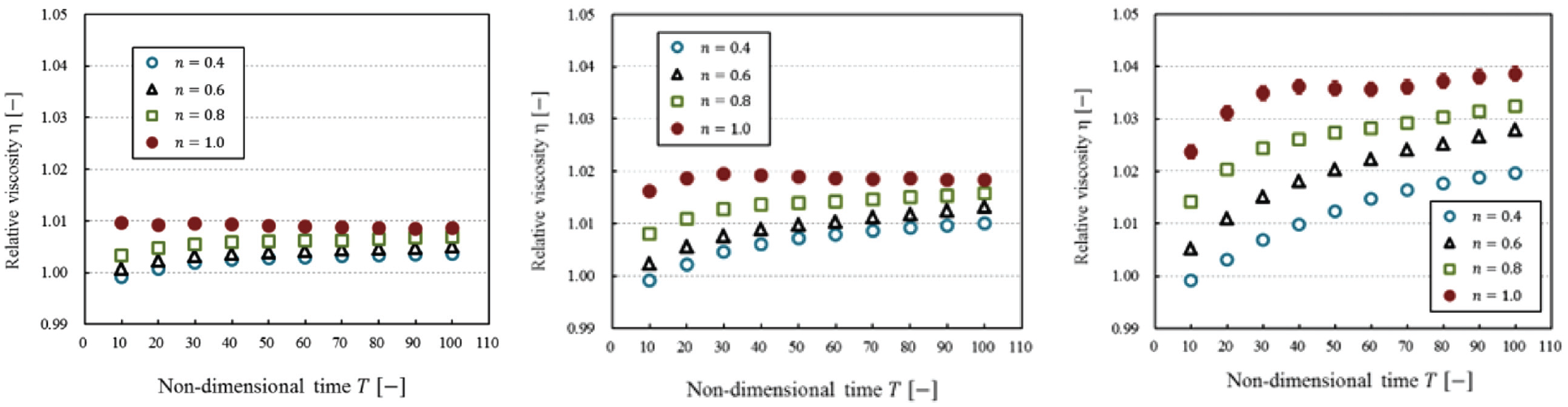
Relationship between relative viscosity
When a non-Newtonian fluid is used as the solvent of a suspension, we investigated the effects of solid particles in the suspension on the non-Newtonian property of the whole suspension. Figure 11 shows the relationship between the power-law index ratio of the whole suspension

where

Relationship between power-law index ratio
Power-law index ratio of the whole suspension

Conclusion
In this study, we assumed an inertial flow field and investigated the effects of the non-Newtonian properties of solvents on the rheology (non-Newtonian property and viscosity) of suspensions with non-homogeneously dispersed solid particles. Based on the analysis results of the microstructures of the suspensions, we confirmed that the particles of the suspension with
Footnotes
Appendix
Acknowledgements
The authors would like to thank Mr. K. Tomioka for his review assistance.
Handling Editor: Chenhui Liang
Declaration of conflicting interests
The author(s) declared no potential conflicts of interest with respect to the research, authorship, and/or publication of this article.
Funding
The author(s) disclosed receipt of the following financial support for the research, authorship, and/or publication of this article: This work was supported in part by JSPS KAKENHI Grant Number JP20K04266.
