



Abstract
In order to be able to make a good decision, we need to evaluate the uncertainty information of multiple attributes of different alternatives that obey the normal distribution, and the interrelationship among multiple attributes should be considered in the process of evaluating. This paper aims to propose a new multiple attribute decision-making (MADM) method, which uses a new aggregation operator to evaluate the uncertainty information that obey normal distribution comprehensively. We firstly extended Schweizer-Sklar (SS) t-norm (TN) and t-conorm (TCN) to q-rung orthopair normal fuzzy number (q-RONFN) and defined the Schweizer-Skla operational laws of q-rung orthopair normal fuzzy set (q-RONFs). Secondly, we developed q-rung orthopair normal fuzzy Maclaurin symmetric mean aggregation operators based on SS operations considering that the Maclaurin symmetric mean operator can reflect the interrelationship among multiple input variables. Furthermore, we discussed some desirable properties of the above operators, such as monotonicity, commutativity, and idempotency. Lastly, we proposed a novel MADM method based on developed aggregation operators. A numerical example on enterprise partner selection is given to testify the effectiveness of the developed method. The results of analysis indicated that our proposed aggregation operators have stronger information aggregation ability and are more general and flexible for MADM problems.
Keywords
Introduction
In our everyday life, most people are regularly confronted with multi-attribute decision-making (MADM) problems, which may include various other options and numerous assessment components. 1 The key purpose of MADM is to obtain the optimal alternative solution by integrating different attribute information. 2 The current decision-making methods show that the various types of uncertainty have been extended into different contexts. 3 Fuzzy set theory, which viably portrayed the fuzzy data and dubious condition, and hence the advantage to suggest a superior choice, has been extended to MADM problems due to its ability to capture uncertainty. 4 Multi-attribute decision-making (MADM) based on fuzzy set theory is an important decision theory. 5 However, the fuzzy sets (FSs) cannot capture more evaluation information as its single membership function. Therefore, the expression of uncertain information is much more desirable to be capable of capturing more information, which depends on membership functions representing experts’ opinions. The intuitionistic fuzzy sets (IFSs) 6 is described as membership and non-membership functions. IFS has been broadly considered, and various scholars have extended into different kinds of notions, such as Atanassov proposed the interval valued intuitionistic fuzzy sets, 9 Seker 7 proposed combinative Distance-based ASsessment (CODAS) method and Interval-Valued Intuitionistic Trapezoidal Fuzzy Set (IVITrFS), Demircioğlu and Ulukan 8 proposed a hybrid multi criteria group-decision making (MCDM) method, Wan et al. 10 developed a new method for solving MAGDM problems considered Atanassov’s interval-valued intuitionistic fuzzy values (AIVIFVs) and incomplete attribute weight information. It is worth noting that the membership function of IFS is limited to a specific range, which brings limitations to the solution of practical problems. Pythagorean fuzzy sets (PFSs)11,12 are extended from IFS whose square of the membership plus square of non-membership functions is less than 1. Although PFSs relax their usage conditions, there are still constraints, which pose limitations on solving practical problems. A-rung orthopair fuzzy sets (q-ROFSs) 13 which satisfy the conditions that the q-power sum of its supporting grade and supporting against grade is not exceeded from unit interval. Due to the advantages of q-ROFS, it has been applied in multiple fields: the selection of supplier, 14 enterprise resource planning (ERP) system, 15 stock investment evaluation 16 ; capture the risk attitudes of decision makers 17 ; Corporate investment decision, 18 etc. The validity and advancement of the theory has been verified by an example. In reality, many uncertain phenomena obey normal distribution. In order to express the uncertain information of those phenomena in MADM effectively, Yang and Ko 19 proposed normal fuzzy number (NFN). Wang et al.20,21 defined intuitionistic normal fuzzy (INF) number. On this basis, the concept of interval-valued INF was defined, 22 Yang et al. 40 proposed q-rung orthopair normal fuzzy number (q-RONFN).
It is well known that, information aggregation is the procedure of aggregating the decision-making information provided by DMs, so many aggregation operators have been proposed. For example, the arithmetic mean operator focuses more on the overall equilibrium of decision information, and each operator is proposed for the integration of evaluation information. 6 Due to the complexity of practical problems, many scholars have paid attention to considering the interrelationships between input variables. Heronian mean 23 and Bonferroni mean 24 operators reflect this situation and have been expanded in other fuzzy setting, such as Ali et al. 25 proposed complex linear diophantine uncertain linguistic variables, Awang et al. 26 considered hesitant bipolar-valued neutrosophic set environment, Hu et al. 27 proposed a new three-parameter linguistic generalized weighted Heronian mean. But Hronian mean 23 and Bonferroni mean 24 operators only focus on the correlation between two decision attributes. Due to the complexity of practical decision-making problems, there is not only a correlation between two decision attributes. Therefore, Maclaurin symmetric mean, which can reflect the interrelationship among all decision attributes through parameters in the formula, is proposed to solve the above issue, 28 including multi-attributes or multi-experts in the multi-attribute group decision making (MAGDM). 29 It was initially widely used in the field of real number. In recent years, many scholars have applied it in the field of fuzzy information integration. For example, Qin and Liu 30 proposed intuitionistic fuzzy multiple attribute decision making method based on Maclaurin symmetric average operator. Wei and Lu 31 proposed Pythagorean fuzzy Maclaurin symmetric average operator. Liu and Wang 32 and Wang et al. 42 proposed q-rung orthogonal fuzzy Maclaurin symmetric average operator and its application. In order to further embody the advantages of MSM operators, many scholars have combined it with fuzzy set theory to solve practical multiple attribute decision-making problems. For instance, Ju et al. 33 combined intuitionistic linguistic fuzzy set and MSM operator and applied them to solve actual decision making. Ali and Mahmood 34 extended MSM operator to complex q-rung orthopair fuzzy sets. Ullah 35 combined picture fuzzy sets and MSM operator and applied new operator to decision problem. However, we have not seen relevant literature applying MSM operators to q-rung orthogonal normal fuzzy set although Yang et al. 40 extended weighted operators, and ordered weighted operators to q-RONFs.
From the above stated operators, most of these operators for fuzzy sets are based on algebraic, Hamacher, Frank, and Dombi operations, which are special cases of Archimedean t-norm (ATN) and t-conorm (ATCN). 36 However, the rigid operations may lead to unreasonable results. The Schweizer-Sklar (SS) operations are special cases of ATN and ATCN with a variable parameter, which are probably more flexible and superior. 37 Therefore, the SS operations is extended to fuzzy sets to enhance flexibility. Liu and Wang 38 combined the SS operations and interval-valued IFS (IVIFS) to solve a supplier selection problem. Zhang 39 combined IFS and IVIFS with SS operators to proposed some novel operators. However, we have not seen relevant literature applying SS operations to q-rung orthogonal normal fuzzy set.
Based on the above analysis, how to effectively aggregate uncertain information that obey normal distribution to make decisions is very challenging research. The main motivation and aim are to propose a novel MADM method, which overcomes the drawbacks of Yang et al.’s 40 decision-making method. This paper combines the advantages of generalized orthogonal normal fuzzy sets, Schweizer Sklar operations and Maclaurin symmetric mean operator, and proposes q-rung orthopair normal fuzzy Maclaurin symmetric mean aggregation operators based on SS operations. The operators mentioned above can evaluate the uncertainty information that obey normal distribution comprehensively. The main contributions of this paper are as follows:
(1) The Schweizer-Sklar operations of q-RONFNs are defined;
(2) Q-rung orthopair normal fuzzy Schweizer-Sklar Maclaurin symmetric mean operator (q-RONFSSMSM) and q-rung orthopair normal fuzzy Schweizer-Sklar weighted Maclaurin symmetric mean operator (q-RONFSSWMSM) are developed based on the Schweizer-Sklar operations of q-RONFNs;
(3) The desirable properties of q-RONFSSMSM operator and q-RONFSSWMSM operator are studied, such as commutativity, idempotency, and boundedness;
(4) A novel MADM method based on developed aggregation operators is proposed. And a numerical example is given to show the validity and rationality of the developed methods and to demonstrate the effectiveness and a comparison analysis is also given to verify the developed method.
The rest of this paper is shown as follows: Section “Preliminaries” reviews some basic concepts and proposes some new concepts. In Section “Q-rung orthopair normal fuzzy Maclaurin symmetric mean aggregation operators based on Schweizer-Sklar operations,” the q-RONFSSMSM and q-RONFSSWMSM operators are proposed and their properties are also proved. In Section “A novel approach to MAGDM based on the proposed operators,” a novel MADM approach based on proposed operators is proposed. Section “Numerical instance and comparative analysis” conducts a numerical experiment and some comparative analyses to illustrate the validity of the proposed MADM approach, and Section “Conclusion” summarizes this paper.
Preliminaries
In this section, some concepts are reviewed, such as Schweizer-Sklar T-norm, T-conorm, Q-rung orthopair Fuzzy Set, Q-rung orthopair Normal Fuzzy Set, and Maclaurin Symmetric Mean Operator. In addition, some new operator rules of q-RONFNs under Schweizer–Sklar operation are proposed.
Schweizer-Sklar t-norm and t-conorm
The use Schweizer–Sklar t-conorm and t-norm involves the Schweizer–Sklar product and Schweizer–Sklar sum, which are special cases of ATT, respectively. The Schweizer-Sklar T-norm (TN) and T-conorm (TCN) 18 are defined as follows:


where r < 0, x, y∈[0,1].
When r = 0, SS TN and TCN reduce to algebraic TN and TCN, shown as follows:


The normal fuzzy number set (NFNS) is denoted by
(1)
(2)
Q-rung orthopair fuzzy set and q-rung orthopair normal fuzzy set

where,
(1)
(2)
(3)
(4)

non-membership function is shown as follow:

where
(1)
(2)
(3)
(4)

And its accuracy function is defined as

Let
(1) if
(2) if
(3) if
if
if
if
The Schweizer–Sklar operations of q-RONFNs
(1)
(2)
(3)
(4)
(1)
(2)
(3)
(4)
(5)
(6)
Q-rung orthopair normal fuzzy Maclaurin symmetric mean aggregation operators based on Schweizer-Sklar operations
In this section, some new aggregation operators are developed, which are the q-rung orthopair normal fuzzy Schweizer-Sklar Maclaurin symmetric mean operator and the q-rung orthopair normal fuzzy Schweizer-Sklar weighted Maclaurin symmetric mean operator based on Schweizer–Sklar operations of q-RONFNs. The properties of these new operators are presented and proved.
Maclaurin symmetric mean operator
The Maclaurin symmetric mean operator, introduced by Maclaurin, 41 is an aggregation operator that can reflect the interrelationships between multiple input variables. The Maclaurin symmetric mean operator was proposed by Maclaurin as follows:

where
The Maclaurin symmetric mean operator is very effective in reflecting the correlation between multiple input variables.
The q-rung orthopair normal fuzzy Schweizer-Sklar Maclaurin symmetric mean operator

Based on Definition and Schweizer–Sklar operations of q-RONFN, the aggregation result is shown as:

The proof of
The q-RONFSSMSM has properties of monotonicity, boundedness, and idempotency. The proof is also provided in


where



The q-rung orthopair normal fuzzy Schweizer-Sklar weighted Maclaurin symmetric mean operator

Based on Definition and Schweizer–Sklar operations of q-RONFN, the aggregation result is shown as:

The q-RONFSSWMSM also has properties of monotonicity, boundedness, and idempotency.

then


if

A novel approach to MAGDM based on the proposed operators
Based on the proposed operator, a MAGDM method under q-RONF environment is provided in this section.
A MAGDM problem with q-RONFNs can be described as follows. Let
In order to eliminate the influence of different dimensions on decision results, it’s very important to normalize the decision matrix
for benefit attributes:

for cost attributes:

Let

Computing the score values
Ranking alternative schemes based on sorting rules (
Numerical instance and comparative analysis
In this section, the proposed method is applied to solve a MADM problem to obtain the optimal alternative. In order to illustrate and verify the advantages and correctness of the method proposed in this paper, other existing methods have also been used to solve this MADM problem. In addition, the sensitivity of the proposed method was analyzed in detail by changing different parameters to obtain the ranking results of alternative solutions.
Numerical instance
In this section, the numerical example in Yang et al.
40
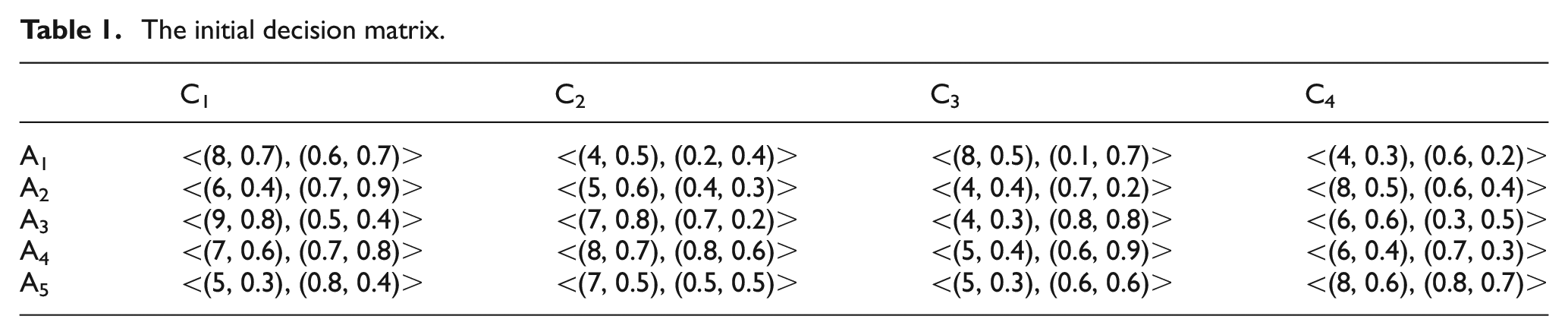
is used for availability verification of the proposed operator. In order to select a suitable global partner, an enterprise which wants to maintain their competitiveness has selected five candidate enterprises in the global scope. The alternative enterprises are A1, A2, A3, A4, A5. Four attributes are C1 (R&D capability), C2 (business operation level), C3 (international cooperation level), C4 (credit level). The corresponding weight is
(1) q-RONFSSMSM operator is used to aggregate the information in Table 2 (suppose k = 2, q = 3, r = −10), the result is shown as:
A1 = <(0.7104, 0.0553), (0.4511, 0.3680)>;
A2 = <(0.6898, 0.0695), (0.6216, 0.2797)>;
A3 = <(0.7739, 0.0885), (0.6233, 0.3679)>;
A4 = <(0.7844, 0.0576), (0.6854, 0.5959)>;
A5 = <(0.7568, 0.0598), (0.7402, 0.5000)>;
The initial decision matrix.
The standardized matrix.

The score values and accuracy values are shown as Table 3.
The score values and accuracy value.
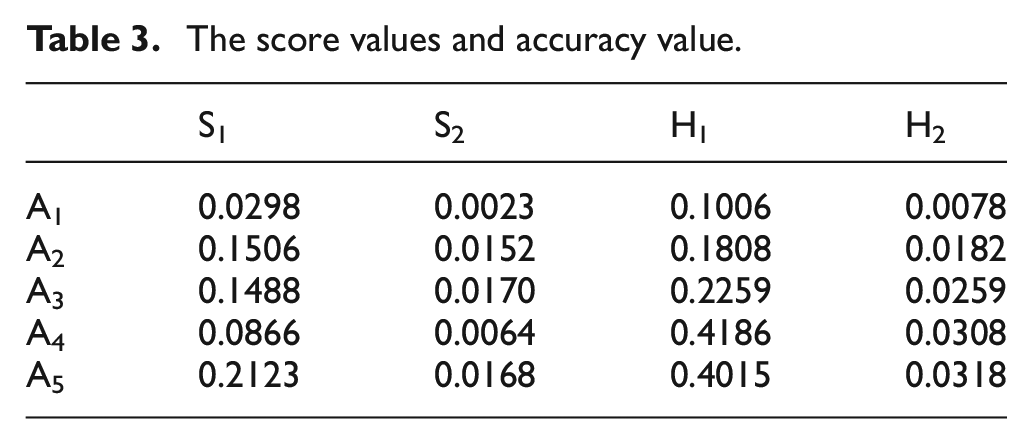
According to the score value of each alternative, the ranking of five alternative is A5>A2>A3>A4>A1, so the optimal alternative is A5.
(2) q-RONFSSWMSM operator is used to aggregate the information in Table 2 (suppose k = 2, q = 3, r = −10), the result is shown as:
A1 = <(0.1756, 0.0133), (0.1831, 0.4663)>;
A2 = <(0.1756, 0.0168), (0.4379, 0.3665)>;
A3 = <(0.1955, 0.0227), (0.4144, 0.4610)>;
A4 = <(0.1943, 0.0140), (0.5461, 0.6890)>;
A5 = <(0.1880, 0.0155), (0.6386, 0.5945)>;
The score values and accuracy values are shown as Table 4.
The score values and accuracy value.

According to the score value of each scheme, the ranking of five alternative is A5>A2>A3>A1>A4, so the optimal alternative is also A5.
Comparative analysis
In order to show the validity and rationality of the proposed method in this paper, the method based on q-RONFWA and q-RONFWG aggregation operators proposed by Yang et al. 40 and the method based on q-ROFWMSM aggregation operator proposed by Wang et al. 42 were compared. The score values and ranking order are given in Table 5.
Schemes sorting results based on different aggregation operators.
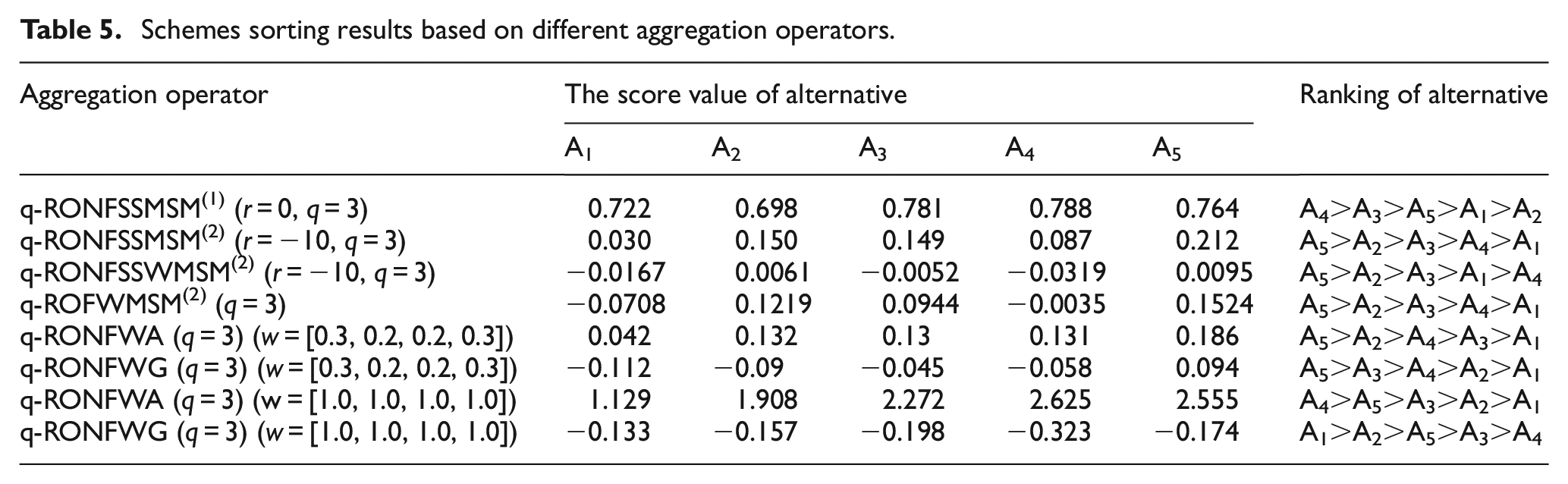
From Table 5, it can be seen that (1) the sorting result of q-RONFSSMSM(1) (set r = 0) is different to those of q-RONFWA and q-RONFWG (set w = [0.3, 0.2, 0.2, 0.3]), because the weights of attributes are considered in q-RONFWA and q-RONFWG operator; (2) Setting w = [1.0, 1.0, 1.0, 1.0], the optimal schemes of q-RONFWA and q-RONFSSMSM(1) are the same. (3) The sorting results using the MAGDM method based on q-ROFWMSM(2) aggregation operator and q-RONFSSMSM(2) and q-RONFSSWMSM(2) aggregation operator are the same. This shows that our method is valid and rational.
The method based on q-RONFWA and q-RONFWG aggregation operators doesn’t consider the interrelationship among attributes since it supposes that the attributes of schemes are all independent. On the contrary, the proposed method based on q-RONFSSMSM and q-RONFSSWMSM operator can capture the interrelationships of any attributes combination, so decision-makers can obtain a more accurately result.
Meanwhile, the sorting result of q-RONFSSMSM(1) (set r = 0) is different to those of q-RONFSSMSM(2) (set r = −10) indicates that the method proposed in this paper is more flexible than the methods based on q-RONFWA, q-RONFWG, and q-ROFWMSM aggregation operators, because it has a variable parameter r that can be regarded as decision makers’ risk attitude. In general, the decision-makers can set different parameter r on the basis of their preferences.
In a word, the methods proposed in this paper are more general and flexible than the method based on q-RONFWA and q-RONFWG aggregation operators, and are more advanced to deal with practical decision-making problems where the relationship between the various attributes cannot be ignored.
Sensitivity analysis
In this section, we conduct a sensitivity analysis of the proposed new MADM method, which is described in detail as follows.
Parameter q and k
The impact of changes in q and k on the optimal alternative is obtained under r = −10, and the results are shown in Figures 1 to 3. As shown in Figure 1, when k = 1, the sorting results are different with diferent q. When q < 4, A3 is the best alternative while A5 is the best alternative when q ≥ 4. At the same time, when q ≥ 4, the optimal alternative is always A5 which remains stable. In Figure 2, when k = 2, the ranking results is also different with diferent q. When q = 1 and 2, q-RONFNs will degenerate into intuitionistic fuzzy numbers and Pythagorean fuzzy numbers, respectively. It can be seen that the optimal alternative is A2. When q ≥ 5, the optimal alternative is always A5 which remains stable. Figure 3 shows the impact of the change in parameter q on ranking results under the condition of k = 3. As shown in Figure 3, the best alternative is always A2.

The influence of q-value change based on q-RONFSSMSM and q-RONFSSWMSM operators on the sorting result (k = 1, r = −10): (a) q-RONFSSMSM operator and (b) q-RONFSSWMSM operator.
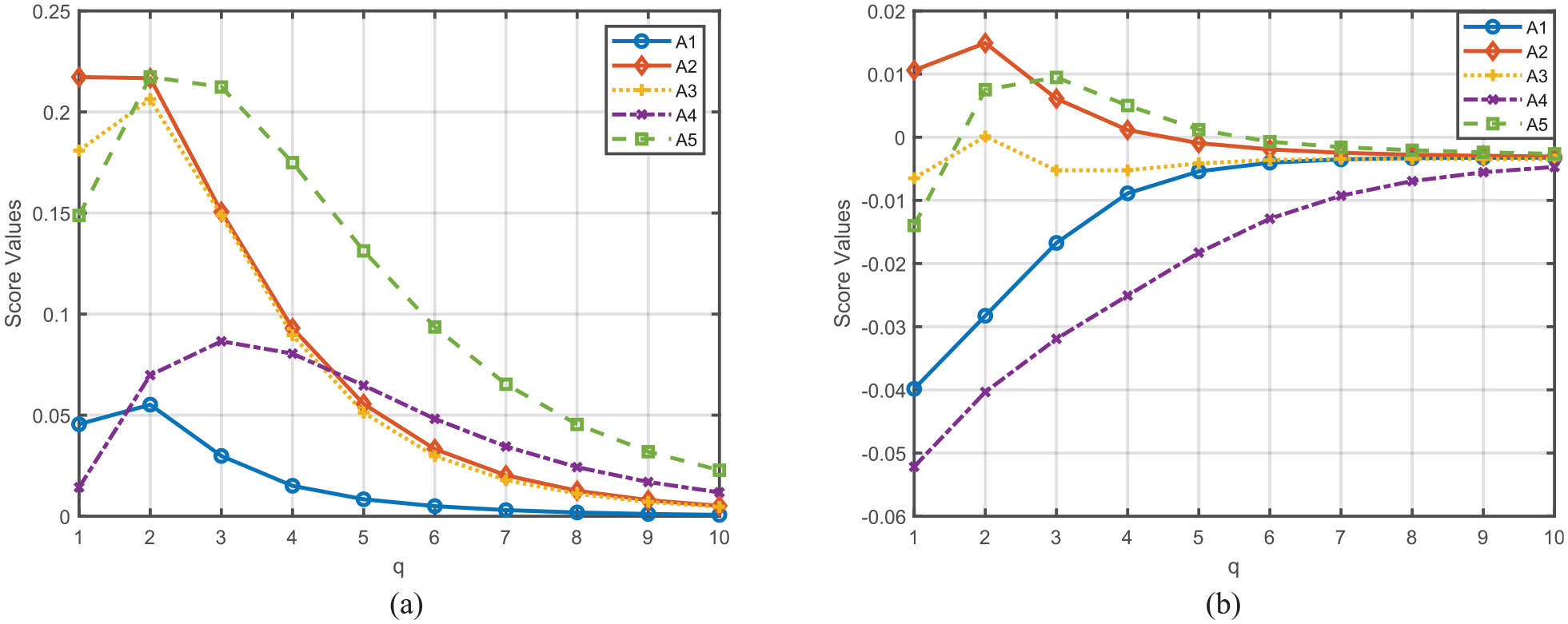
The influence of q-value change based on q-RONFSSMSM and q-RONFSSWMSM operators on the sorting result (k = 2, r = −10): (a) q-RONFSSMSM operator and (b) q-RONFSSWMSM operator.
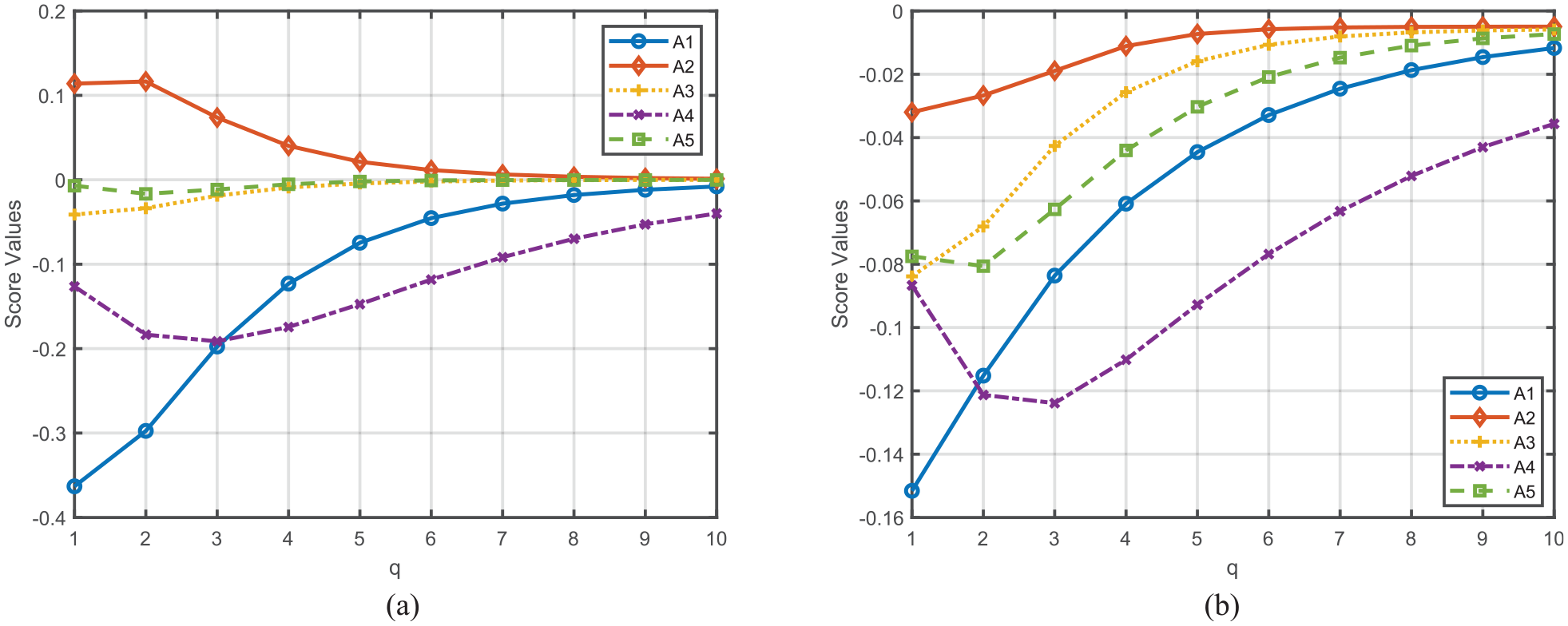
The influence of q-value change based on q-RONFSSMSM and q-RONFSSWMSM operators on the sorting result (k = 3, r = −10): (a) q-RONFSSMSM operator and (b) q-RONFSSWMSM operator.
Above all, it can be seen that when q ≥ 5, the sorting results are same. These indicates that the change of parameter q has a certain impact on the sorting result. Decision-makers can set parameter q ≥ 5 to obtain more reliable result. In addition, keeping q ≥ 5, when k < 3, the optimal alternative is A5, but when k = 3, the optimal alternative changes to A2. These indicates that the change of parameter k also has a certain impact on the sorting result. Generally, decision-makers can set different parameter q according to interrelationships of attributes.
Parameter r and k
By analyzing the impact of changes in parameters q and k on the sorting results, it can be seen that when q = 2, the sorting results will remain stable. Therefore, we set q = 5 to observe the impact of changes in parameters r and k on the ranking results, as shown in Figures 4 to 6. As shown in Figure 4(a), when r = −1, the sorting result is A4>A5>A3>A2>A1, when r < −1, the sorting result A5>A4>A3>A2>A1. As shown in Figure 4(b), the optimal changes from A5 to A3 when parameter r changes from −10 to −50. These indicate that the change of parameter r has impact on the sorting result. As shown in Figure 2, the best alternative is A5 when the interrelationships between two aggregated attributes are considered (k = 2). In addition, when considering the relationship between multiple input variables (k = 3), the optimal alternative is A2.

The influence of r-value change based on q-RONFSSMSM and q-RONFSSWMSM operators on the sorting result (k = 1, q = 5): (a) rϵ[−10, −1] and (b) rϵ[−50, −10].

The influence of r-value change based on q-RONFSSMSM and q-RONFSSWMSM operators on the sorting result (k = 2, q = 5): (a) rϵ[−10, −1] and (b) rϵ[−50, −10].

The influence of r-value change based on q-RONFSSMSM operator on the sorting result (k = 3, q = 5): (a) rϵ[−10, −1] and (b) rϵ[−50, −10].
In summary, the following conclusions can be obtained. (1) When k = 1, all attributes are independent. when k = 2, the interrelationships between two aggregated attributes are considered. In these two cases, the sorting results are slightly different when the parameter r takes different values. (2) When k = 3, the interrelationships among any three aggregated attributes are considered. The sorting results are all the same and the optimal scheme always is A2 no matter how parameter r changes. Thus, it is concluded that the decision-makers consider more interrelationships of aggregated attributes, the more stable sorting results can be obtained.
Conclusion
In this article, we propose a new MADM method by combining q-rung orthopair normal fuzzy set and Schweizer-Sklar Maclaurin symmetric mean operator. To this end, firstly we introduced new operations namely the Schweizer-Sklar operation of q-RONFSs. Then, based on the new operations we extended the MSM operators to q-RONFSs, and developed two new aggregation operators named q-RONFSSMSM q-RONFSSWMSM to deal with realistic and complex decision problems. Meanwhile, the desirable properties of q-RONFSSMSM operator and q-RONFSSWMSM operator are studied, such as commutativity, idempotency, and boundedness. Moreover, a MADM method based on developed aggregation operators is proposed. Further, a numerical example is given to show the validity and rationality of the developed method and to demonstrate the effectiveness, and a comparison analysis is also given to verify the developed method. The numerical example and comparison analysis shows that the new proposed MADM method based on developed aggregation operator has several advantages as follows. First, it is based on the powerful from Schweizer-Sklar operations, making the uncertain information process more flexible by the parameter r. Second, it utilizes the MSM operators to fuse DMs’ evaluation information, so that the interrelationship among multiple attributes can be effectively captured. Thus, the proposed method is more suitable to solve the practical and complex MADM problems and enriches the research of q-rung orthopair normal fuzzy (q-RONF) set.
In the future, the new method can be applied to solve supply of chain management, failure mode and effect analysis, system control, etc. In addition, considering that the superiority of Schweizer-Sklar operations and MSM operator, it can be extended to other fuzzy sets, such as interval q-RONFS, spherical fuzzy sets, 43 complex spherical fuzzy sets, 44 and bipolar complex fuzzy sets. 45 Concurrently, combining with the latest research results, the research content of this article can also be extended to scope of studies on bipolar complex fuzzy sets 46 and on three-way decision making. 47
Footnotes
Appendix
Handling Editor: Chenhui Liang
Declaration of conflicting interests
The author(s) declared no potential conflicts of interest with respect to the research, authorship, and/or publication of this article.
Funding
The author(s) received no financial support for the research, authorship, and/or publication of this article.
