




Abstract
Due to the unbalanced effect of force and torque on the axial piston pump cylinder block, a wedge angle of oil film exists between the valve plate and the cylinder block. The cylinder block tilt seriously affects the oil film and the distributing pair lubrication state, leading to boundary lubrication appears in some cases. To reduce the impact of the tilt on the cylinder block of axial piston pump, the magnetic auxiliary support (MAS) for the pair is proposed. The MAS reduces the overturning torque on the cylinder block by the auxiliary magnetic support. Then the tilt characteristics of the cylinder block are improved. In this paper, the cylinder block overturning torque equations under the support of MAS are established, and the improvement of overturning torque is analyzed. An experimental platform was constructed to measure the thickness of the oil film of the pair and test the tilt of the cylinder block. The experimental results showed that the MAS can effectively improve the tilt of the cylinder block and the performance of the axial piston pump. This method has certain reference significance for the research of axial piston pumps.
Keywords
Introduction
As a core component of the hydraulic system, the axial piston pump is widely applied in aviation, aerospace, and industrial equipments. With the development of technology, the performance requirements of the piston pump are gradually increasing. When the piston pump is working, the surface of the distributing pair bears a high pressure as well as a high relative sliding velocity. In this case, an oil film should exist in the distributing pair to prevent direct contact, which is between the cylinder block and cylinder block-valve plate. Meanwhile, the thickness of the oil film should be within a range that reaches the lowest energy consumption. However, due to the unbalanced effect of the force and torque on the cylinder block, the oil film between the cylinder block-valve plate and the cylinder block is an imperfect parallel film. It is the oil film with a wedge angle, that is, the cylinder block has a certain tilt. 1 When the tilt is too large, the lubrication capacity of the oil film will be affected. Then the direct mental friction will occur in a local area between the plate and cylinder block, which will generate a lot of heat. If the heat cannot be dissipated in time, the phenomenon of “plate burning” will happen. The cylinder block tilt will not only affect the life of the piston pump but also break the piston pump down in severe cases. Therefore, the tilt of the axial piston pump cylinder block is of great importance in the studying of the piston pumps.
One of the factors that influence the tilt of the cylinder block is the pair surface microstructure. Koç and Hooke 2 proposed that a certain degree of surface unevenness of the friction pair is beneficial to oil film lubrication, and the overturning torque will affect the minimum oil film thickness of a friction pair. They measured the oil film thickness under low-speed conditions. 3 It indicates that the friction pair begins to present a state of full fluid lubrication when the rotational speed is higher than 600 r/min. 4 Jung-Hun Shin and Kyung-Woong Kim studied the influence of an uneven cylinder block-valve plate surface on the lubrication characteristics of oil film. They pointed out that large surface unevenness may lead to cylinder block tilt failure. 5 The IFAS Institute found that machining different shapes of microstructure on the cylinder block-valve plate surface can reduce frictional consumption under low-pressure conditions and improve the bearing capacity under high pressure as well as high-speed conditions.6–10
Another research highlight that affects the tilt of the cylinder block is focused on the oil film. Yamaguchi et al.11,12 considered the influence of the wedge-shaped clearance oil film and the spindle support force on the dynamics of the cylinder block, which results in direct contact between the cylinder block and valve plate. They found from the experiment results that the inlet pressure increase will lead to an increase in oil film thickness and thickness variation range. 13 Zloto 14 proposed that the unbalance of the pressing torque and oil film support torque results in the tilt of the cylinder block. The experiments of Richardson et al. 15 showed that the minimum oil film thickness appeared on the oil suction side. Based on the approximate function of the piston cavity pressure, 16 the dynamic model of the floating cylinder block-valve plate was established and solved to obtain the dynamic changes of the floating plate. 17 They found that the constructed theoretical model can accurately predict the minimum as well as the average thickness of the oil film within a certain range, 18 and indicated that the highest temperature is the location where the oil film is minimum. 19 The researches above provide a good basis for the study of cylinder block tilt.
Moreover, Bergadà et al. proposed the pressure distribution model of oil film, which takes the buffer groove into account. They analyzed the effects of different wedge angles, average clearance, and cylinder block rotating speed on the cylinder block at great length. 20 Concluding that the change in the number of pistons on the side of the oil drain and the contact between the plate and cylinder block will affect the dynamic performance of the cylinder block.21,22 Manring et al. 23 analyzed the influence on the balance of the cylinder block under the conditions of low pressure, large displacement, and high rotating speed. Wegner et al. 24 concluded that the tilt of the cylinder block is mainly affected by the pressure, and the oscillation amplitude is mainly related to the speed.
In terms of the research on the reduction of cylinder block tilt, Manring 25 confirmed that increasing the rotational speed is conducive to the form of the oil film and realizes the full-fluid lubrication. They proposed that the tilt of the cylinder block of the axial piston pump will affect the formation of the oil film, which will cause the failure of the piston pump to a certain extent. 26 Hong and Kwon 27 proposed that corresponding measures, such as suppressing the tilting torque of the rotating components, can reduce the loss of power. Kim et al.28,29 pointed out that the cylinder block-valve plate with a support pad can effectively reduce the cylinder block tilt angle.
In order to reduce the influence of the tilt on the cylinder block of the axial piston pump, we proposed a new distributing pair in this paper using the magnetic auxiliary support (MAS). Based on the dynamic analysis of the compound support, we verified by experiments that the pair with the MAS has a positive effect on reducing the tilt of the axial piston pump cylinder block. The method has some reference value to the research of the axial piston pump.
Principle and structure
The MAS for the distributing pair of the axial piston pump uses the magnetic support fixed inside the pump shell to impose magnetic torque to the magnetic cylinder block. It aims to reduce the tilting torque of the cylinder block under low-speed conditions, and then, balance the residual pressing torque acting on the plate surface to prevent the plate from eccentric wear.
The structure of the axial piston pump assembled with MAS is shown in Figure 1. The magnetic support is embedded in the pump and immersed in hydraulic oil, forming an axial and radial magnetic pole gap with the magnetic cylinder block. The magnetic support consists of permanent magnet, radial stator, axial stator, magnetic isolation ring, and other magneto resistive materials. The axial stator and the radial stator respectively form a pair of magnetic poles with the circular iron core located on the magnetic cylinder block. All of the magnetic poles are lying in the high-pressure region of the distributing pair. Among them, the shape of the magnetic pole surface for the permanent magnet, the axial stator, and the radial stator are all arc sector-shaped. The magnetic support is a mid-pass structure, which wraps the circular iron core. The preload spring makes the axial stator, the permanent magnet, and the radial stator tightly connected in the z-axis direction. The pins are used for circumferential positioning of the core assembly of the magnetic support.

Structure of axial piston pump with MAS.
The magnetic cylinder block contains a cylinder block and an annular iron core. The annular iron core and the cylinder block rotate synchronously. The annular iron core is installed on the cylindrical surface of the cylinder block to form a magnetic pole surface. The axial stator exerts a magnetic attraction force on the annular iron core along the z-axis direction, which is then transmitted to the cylinder block. The magnetic attraction force of the radial stator to the annular iron core is balanced by the bearing. It means that the magnetic attraction force will not affect the main force balance in the z-axis direction, and will not generate additional torque that affects the balance of the cylinder block. The magnetic field line starts from the N pole of the permanent magnet, enters the rotor core through the axial stator and axial magnetic pole gap, then enters the radial stator through the radial magnetic pole gap, and finally returns to the S pole of the permanent magnet, forming a closed magnetic circuit. There has the detailed description of the MAS in the previous research paper. 30
Analysis of the cylinder block tilting torque
Theoretical modeling of MAS
Generally, the number of pistons is odd. In discharge section the piston number is determined by the rotation angle φ and half the piston interval angle α. Therefore, the hydraulic pressing force of the magnetic cylinder block to the valve plate changes periodically. The expressions of the torque
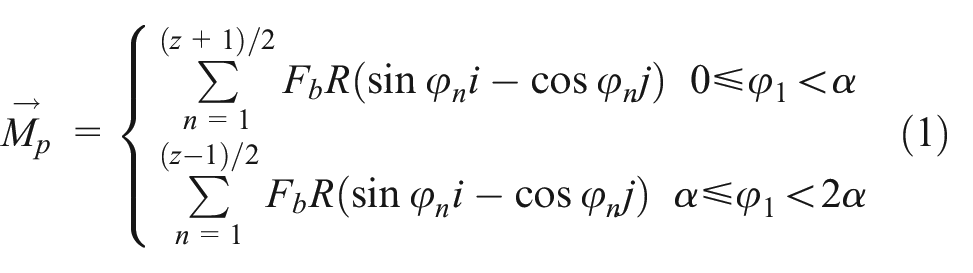
In addition to the hydraulic pressing force, the force of the magnetic cylinder block is shown in Figure 2. The force generated by the high-pressure oil on the piston-slipper assemblies is finally transmitted to the swash plate, resulting in a swash plate support force FS. Its component FR and Fp along the z-axis form a pair of interaction forces. Because of the contact between the piston and the cylinder block hole, the support force component FSN which is perpendicular to the axis of the piston generates the contact torque Ms and the friction torque Mf.

Force diagram of magnetic cylinder block.
The supporting force of the oil film of the distributing pair to the magnetic cylinder block is obtained as follows.30,31

Thus the oil film support torque is:

where
By substituting equation (2) into equation (3), the oil film support torque can be obtained by integration as follows.

Analysis of the magnetic cylinder block tilting torque
Compared with the traditional cylinder block, the pressing force and pressing torque of the magnetic cylinder block is smaller, which results in the change of the tilting torque. The involved structural parameters of the distributing pair are shown in Table 1.
Structural parameters of cylinder block-valve plate.

Figure 3 is the curve of the cylinder block tilting torque ΔM without the magnetic support, and under the conditions of different rotation angles φn, rotational speed n, and pressure ps. It can be seen from the figure that ΔM gradually increased with the pressure. The lower the pressure ps, the smoother the change in ΔM.

Tilting torque of normal cylinder block: (a) n = 200 r/min, (b) n = 400 r/min, (c) n = 600 r/min, and (d) n = 800 r/min.
In order to maintain the balance of the cylinder block, the extra torque generated by the oil film dynamic pressure is needed. If the oil film torque is insufficient, the contact force of the materials is required to compensate. However, the increase of the rotational speed did not change the ΔM greatly, which is enough to prove that at low speed the inertia torque has little effect to balance the cylinder block.
With the rotation of the cylinder block, ΔM in the first half cycle angle decreases and then increases. There is an extreme point. When the piston moves to the second half cycle, ΔM changes in a step-like manner, and is generally higher than in the first half cycle. In fact, in the process of the piston pump rising from low pressure to high, the cylinder block tilting torque ΔM always exists. The oil film support capacity is weak under low-speed conditions, and the distributing pair of the piston pump is more prone to eccentric wear, which is the limitation of the traditional distributing pairs.
Figure 4 is a graph showing the variation of the magnetic cylinder block tilting torque ΔM′ under the conditions of different rotation angles φn, rotational speed n, and pressure ps after the magnetic support is assembled.

Tilting torque of magnetic cylinder block: (a) n = 200 r/min, (b) n = 400 r/min, (c) n = 600 r/min, and (d) n = 800 r/min.
It can be seen that the fixed value magnetic torque, does not influence the original dynamic characteristics of the cylinder block except reducing the tilting torque. The variation of ΔM′ within a period angle is almost the same as that of the traditional cylinder block. Under the condition of low pressure and rotational speed increasing, the magnetic cylinder block tilting torque has a negative value, indicating that the magnetic support completely balances the tilting torque ΔM′ at this torque. With the increase of pressure, the cylinder block tilting torque ΔM′ increases but always remains within a range because the magnetic torque MB can reduce the cylinder block tilt. It is worth noting that the increase in the rotational speed makes ΔM′ higher than the real value, which is mainly due to the increase in the dynamic pressure generated by the oil film. Although the increase of the rotational speed can slightly improve the peak value of ΔM′, the low-speed condition has little effect on the cylinder block balance under the condition of constant pressure, which is consistent with the conclusion in Figure 3.
From the above analysis, it can be seen that when the MAS is assembled, the tilting torque acting on the cylinder block is significantly reduced. It can reduce the tilt of the cylinder block and improve the performance of axial piston pump.
Experimental research
The experiments are carried out to study the effectiveness of the MAS in improving the tilt characteristics of the cylinder block. By measuring the thickness of the oil film at three points in the pair under different working conditions, the tilt of the cylinder block is obtained. The effectiveness of the new method is verified by comparing the tilt of the traditional cylinder block with the cylinder block assembled the MAS.
Experimental equipment
The experimental platform is shown in Figure 5. The experimental pump is a quantitative pump reformed on the basis of the A10VSO45 which is produced by Rexroth, Germany. The displacement signal firstly transmitted by the eddy current sensor to the eddy current control system (eddyNCDT3300) and displayed on the screen in real-time, then converted into a voltage signal and transmitted to the data acquisition board (Advantech PCI-1716), and finally transmitted to the computer through the PCI bus. The parameters of torque-speed sensor are as follows. The nominal torque is 50 Nm, the limit speed is 6000 r/min, and the accuracy is 0.2% of full scale.
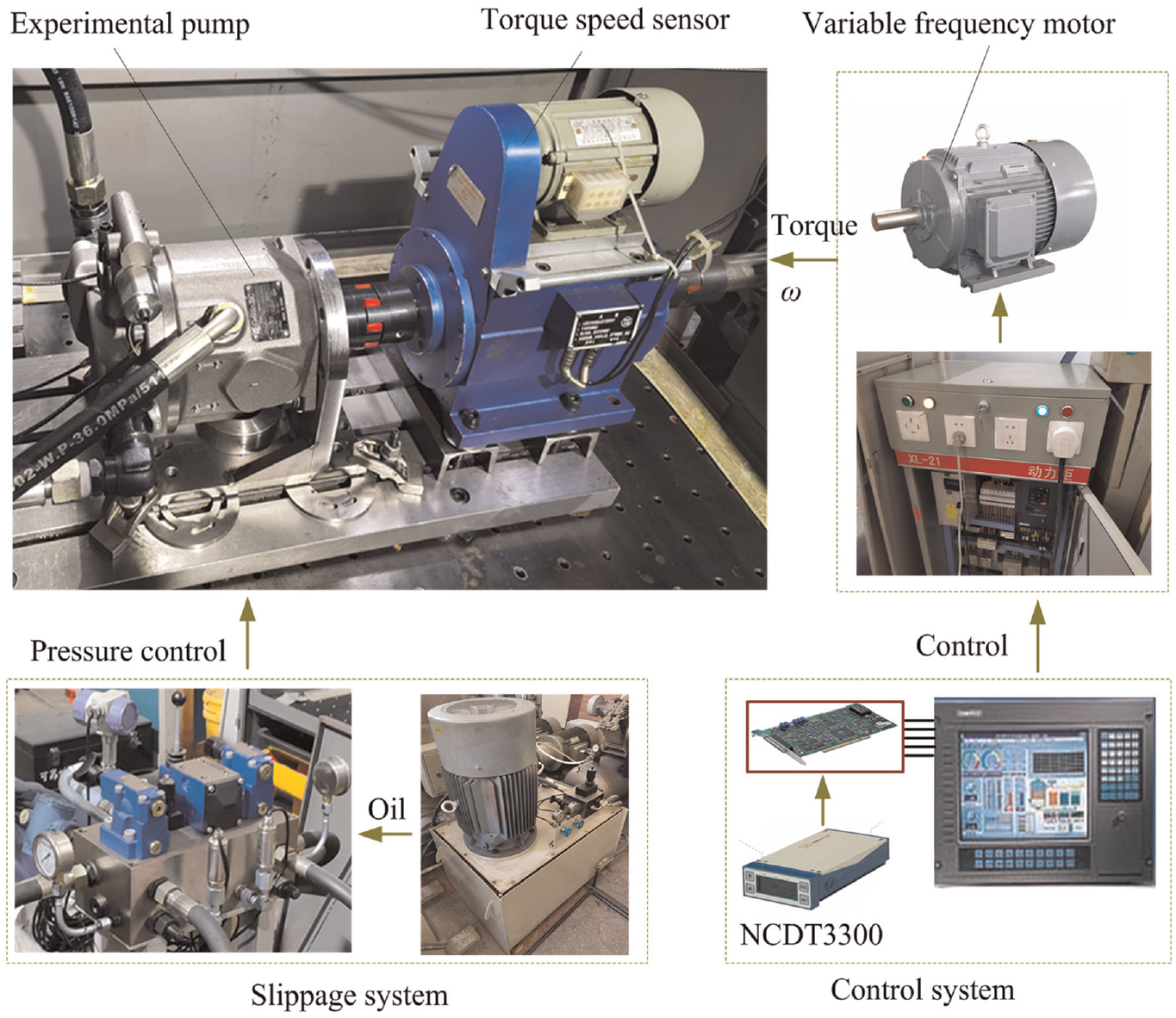
Test rig and related equipment.
The assembled magnetic cylinder block is shown in Figure 6. Before the experiment, magnetic support should be embedded into the piston pump and connected with the pump shell by screws, and then assembling the magnetic cylinder block. According to the calculation results in section II and III, the pole gap should be adjusted to 0.2 mm by shims to ensure the biggest load bearing capacity. The pressing plate fixes the circular iron core on the magnetic cylinder block using screws. The aluminum circular gasket and the pressing plate ensure the magnetic insulation of the circular iron core.

Schematic diagram of magnetic cylinder block assembly: (a) schematic diagram of magnetic support installation and (b) magnetic cylinder block.
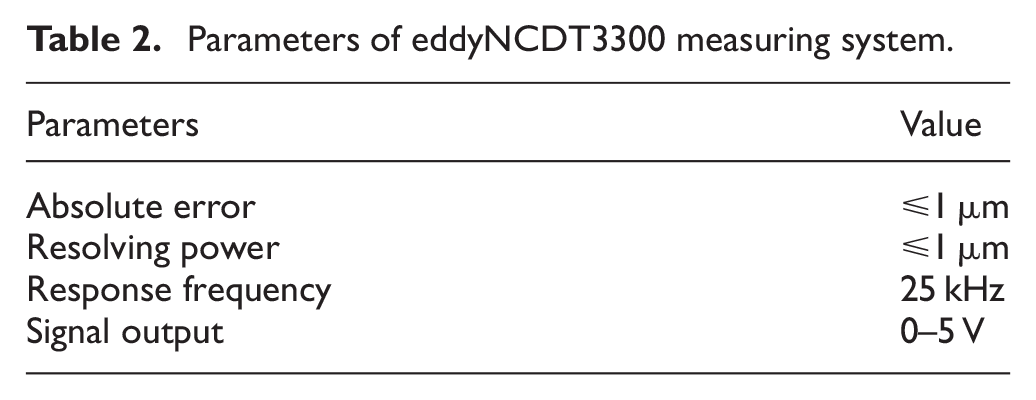
The experiment uses the eddyNCDT3300 high-performance eddy current measurement system produced by German Micro-Epsilon Measurement Company, which is equipped with EU05 high-precision displacement sensor. The relevant parameters are shown in Tables 2 and 3.
Parameters of eddyNCDT3300 measuring system.
Parameters of EU05 eddy current sensor.

The principle for the oil film thickness measuring is shown in Figure 7. Several threaded holes are processed on the back of the plate for sensors installation. The frocks of eddy current sensor include probe and connection. The eddy current sensors are installed in the connection and fixed on the plate by screws. Holes are processed at the end cover of the piston pump for the passage of the signal line. According to the user specification of the eddy current sensor, the probe is made of polytetrafluoroethylene to prevent the signal from disturbing of surrounded metals.

Oil film measuring principle and devices: (a) principle of oil film measurement and (b) valve plate.
In order to obtain the complete structure of oil film, the eddy current sensors are used for measuring, and the position parameters for installation are shown in Table 4.
Parameters for the installation position of eddy current sensors.

Results of the experiment
According to the oil film thickness measured at three measuring points, the structural parameters of the oil film can be obtained, and then the inclined state of the cylinder block is obtained. The slope of the cylinder block tilt at 2 MPa is shown in Figure 8.

Cylinder block tilt slope when ps = 2 MPa.
It can be seen from Figure 8 that tilt slope of the traditional cylinder block at the ps of 2 MPa increases with the rotation speed, the upward trend is almost the same as the cylinder block with MAS. The balance of cylinder block is greatly improved by the assembling of MAS. At the speed of 600 r/min, the cylinder block tilt slope reaches the peak. Then the traditional cylinder block is basically stable, while the tilt slope of the magnetic cylinder block decreases slowly with the speed increasing. It can be seen that the magnetic support can increase the balance of the cylinder block by a minimum of more than one time, in addition to the rotation speed at 200 r/min.
The slope of the cylinder block tilt at 7 MPa is shown in Figure 9.

Cylinder block tilt slope when ps = 7 MPa.
It can be seen from Figure 9 that when the pressure rises to 7 MPa, the traditional cylinder block tilt increases significantly under the low-speed condition, but the final stable value does not change much. After the magnetic support is assembled, the balance of the cylinder block improved significantly with the increase of pressure and is basically stable when the rotation speed is higher than 400 r/min. The balance of the cylinder block improved by nearly four times at the highest. It can be seen that after the magnetic support is installed, increasing the pressure is conducive to further reducing the tilt of the cylinder block.
When the pressure rises to 12 MPa, the result is shown in Figure 10.

Cylinder block tilt slope when ps = 12 MPa.
It can be seen from Figure 10 that with the increase of rotation speed, the traditional cylinder block tilts and the magnetic cylinder block are basically constant. The magnetic support can stably improve the balance of cylinder block by more than 4.5 times, which also verifies the conclusion obtained by analyzing the slope of the cylinder tilt at 7 MPa. It can be concluded that after the magnetic auxiliary support is assembled, the cylinder block balance characteristics can be greatly improved when the pressure is high. The minimum oil film thickness gradually approaches the average with the rotational speed increases, and the overall oil film thickness gradually homogenizes. The performance of the pump has been improved greatly.
Conclusion
In this paper, the problem of axial piston pump cylinder block tilting was studied. The MAS for the distributing pair was proposed, and its structure were introduced. The cylinder block tilting torque equation with the MAS was established. Compared with the tilting torque of the traditional cylinder block, it can be concluded that the cylinder block tilting torque of the cylinder block with MAS is reduced to a certain extent. The cylinder block tilt test platform was established, and experiments were carried out on it. The experiment results showed that the MAS can effectively reduce the cylinder block tilt and improve the performance of the piston pump.
Footnotes
Handling Editor: Chenhui Liang
Declaration of conflicting interests
The author(s) declared no potential conflicts of interest with respect to the research, authorship, and/or publication of this article.
Funding
The author(s) disclosed receipt of the following financial support for the research, authorship, and/or publication of this article: The authors would like to give their acknowledgment to the National Key Research and Development Plan (2018YFB2000902) for the financial support to this study.
