




Abstract
In this work, the usual Euler–Bernoulli nanobeam has been modeled in the context of the Lord-Shulman thermoelastic theorem which contains the non-Fourier heat conduction law. The nanobeam has been subjected to a constant magnetic field and ramp-type thermal loading. The Laplace transform definition has been applied to the governing equations and the solutions have been obtained by using a direct approach. The inversions of the Laplace transform have been calculated numerically by using the Tzou approximation method. The solutions have been applied to a nanobeam made of silicon nitride. The distributions of the temperature increment, lateral deflection, strain, stress, and strain-energy density have been represented in figures with different values of the magnetic field intensity and ramp-time heat parameter. The value of the magnetic field intensity and ramp-time heat parameter have significant effects on all the studied functions, and they could be used as tuners to control the energy which has been generated through the nanobeam.
Introduction
It has been shown that the theory of coupled thermoelasticity, a kind of heat conduction, solves a number of problems.1,2 It is consisting of two partial differential equations based on Fourier’s law of heat conduction, the equation of motion and the rule of conservation of energy.3–6 The propagation velocity of heat waves is infinitely increased by this kind of heat conduction. A extended theory of thermoelasticity mechanical theory with the relaxation time of isotropic objects was presented out by Lord and Shulman. 7 According to this theory, Fourier’s law is replaced with Cattaneo’s law or a non-law Fourier’s of heat conduction. The heat equation removes the paradox of infinite propagation velocity since it is a hyperbola. 8
Several scientists have worked on micro/nano electric devices in recent years. Micro/nanoelectromechanical beam resonators have a wide range of uses, including actuators, beams, sensors, pumps, resonators, and motors. They are also important for physical applications.9–12
Studying the vibration of micro/nano-beam resonators is important. Alghamdi 3 used the generalization theory of thermoelasticity with a dual-phase lag to study vibration damping caused by the cavity of thermoelastic beam resonators (DPL). Thin, homogeneous, isotropic, thermoelastic micro/nanoscale beam cavity resonators’ lateral oscillations were investigated by Sharma and Grover. 13 Sun and Saka 14 investigated thermoelastic disk resonators’ vibration dampening outside the plane of the microplate. They changed Lifshitz and Roukes’ 15 formula for thermoelastic damping by introducing a new coefficient. Several scientists have looked at heat transfer techniques and nanobeam vibration.16–20 Al-Lehaibi and Youssef 16 examined the gold nanobeam’s thermoelastic vibration due to thermal shock. Kidawa-Kukla 17 studied the internal and external damping effects on the lateral oscillations of the beam caused by the mobile heat source using the characteristics of Green’s function. On the vibration of a rectangular, simply supported nanobeam, Boley 18 examined the effects of thermal shock spread along the span. Manolis and Beskos 19 studied the thermoelastic dynamic response of the nanobeam exposed to thermal loads using the numerical technique. Using the Laplace transform method, Al-Huniti et al. 20 examined the displacements, stresses, and dynamic behavior of a rod heated by a moving laser beam. Alghamdi 21 examined the thermoelastic vibration of a micro/nano-beam that was exposed to a moving heat source.
The standard Euler-Bernoulli nanobeam has been modeled in this study within the framework of the non-Fourier heat conduction law found in the Lord-Shulman thermoelastic theorem. A ramp-type thermal loading and a constant magnetic field will both be applied to the nanobeam. The governing equations will be subjected to the Laplace transform definition, and a direct technique will be used to arrive at the solutions. Using the Tzou approximation approach, the inversions of the Laplace transform will be numerically determined.
It must be noted that applying a constant magnetic field to a nanobeam is a novel application which has not been executed before, thus the results of this work will be new results.
Formulation of the problem
Although challenging but creating a beam with a rectangular cross-section is the simplest when compared to other cross-sections. Consider small flexural deflections of a thin elastic beam of length
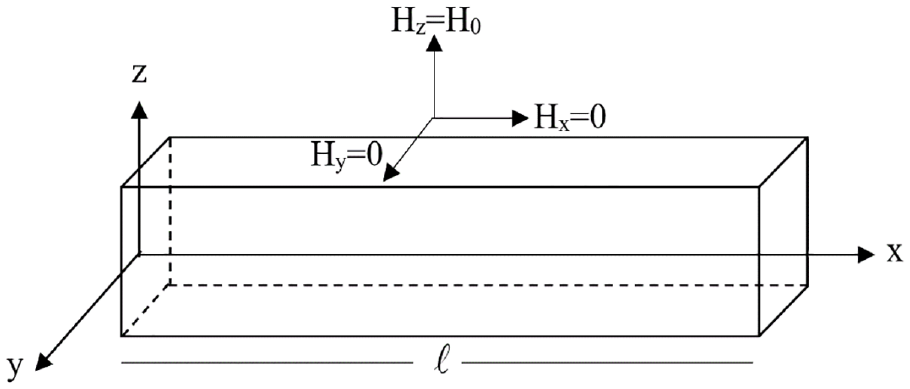
Nanobeam subjected to constant magnetic field.
In the present study, the usual Euler–Bernoulli assumption is adopted, that is, any plane cross-section, initially perpendicular to the axis of the beam remains plane and perpendicular to the neutral surface during bending. Thus, the displacement components

and the volumetric strain is given by:

Hence, the differential equation of thermally induced lateral vibration of the beam may be expressed in the form4,6,9,13,21–24:

where

and the stress-strain relation is given by:

where
According to the Lord-Shulman model (L-S) with one-relaxation time, the non-Fourier heat conduction equation has the following form4,6,9,13,21–24:

where
A constant magnetic field with components
The external force is given by:

where

where
and

where
The components of the electromagnetic induction vector are given by:

Hence, the components

Then, we have:

and

where there is no heat flow across the upper and lower surfaces of the beam, so that

Then, we have
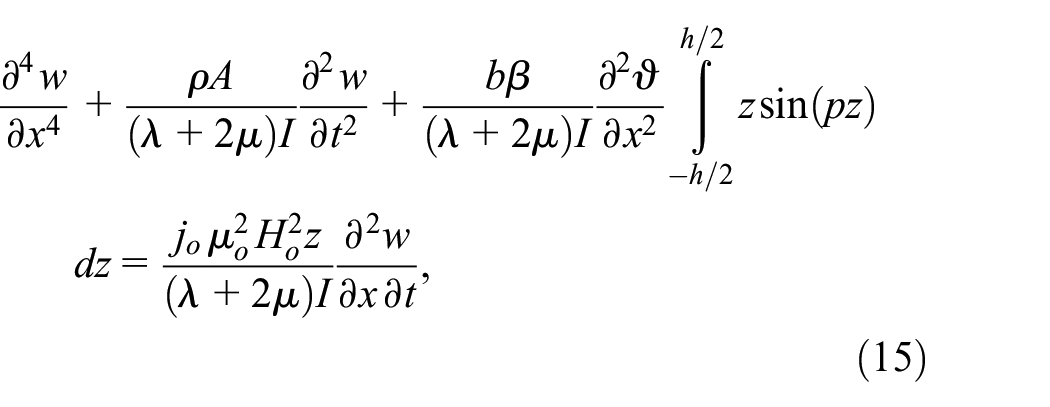
which gives after executing the integration the following form:

Hence, we have
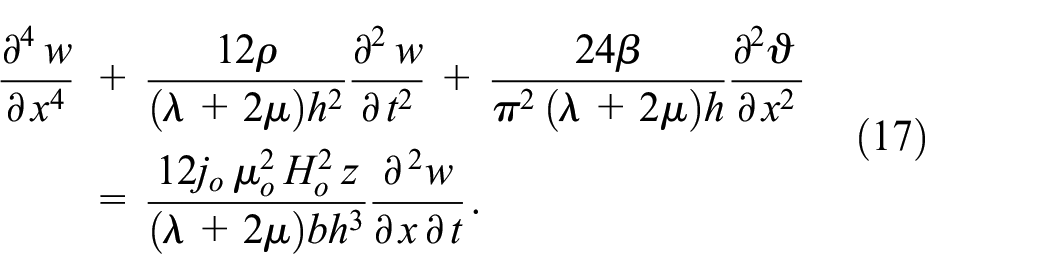
For simplicity, we will consider that

and the heat conduction equation as:

Hence, we have:

The following non-dimensional variables will be applied to the above governing equations4,6,22,24–27:
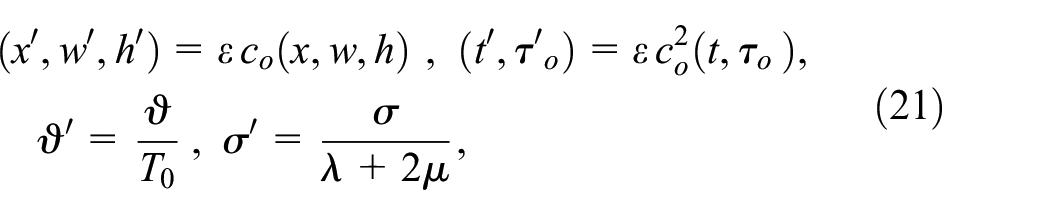
where
Hence, we have:


and

where
Problem formulation in the Laplace transform domain
The Laplace transform will be applied which is defined as follows:

where the inversion of the Laplace transform may be calculated numerically by the following iteration:

where “Re” denotes the real part, while “i” defines the unit imaginary number. Numerous numerical tests have been conducted to determine if the value of “
Then, we obtain:


and

While applying the Laplace transforms, we used the following initial conditions:

After re-writing the equations (27) and (28), we have the following system of ordinary differential equations:

and

where
The above system gives the following characteristic equation:

where
The general solutions of the equation (33) when the second end of the nanobeam

and

where

To obtain

Then, we obtain:


To obtain
Hence, we have:

where
Applying the Laplace transform gives that:

and

Hence, the following system of linear equations has been obtained:


and

After solving the above system, we get:
Thus, the solutions in the Laplace transform domain have the following forms:
The temperature increment function as:

The lateral deflection (vibration) function as:

The volumetric deformation function as:

Numerical results and discussion
To obtain the computational results, silicon nitride has been taken as the thermoelastic material for which we take the following values of the different physical constants4,6,16,21,22,27:

where
The aspect ratios of the beam are fixed as
Discussion
Two groups of figures show the numerical results of the problem; the first group represents the distributions of the temperature increment, vibration (lateral deflection), cubical deformation, stress, and strain-energy density with various values of the magnetic field when (
While the second group represents the distributions of the same functions when
Figures 2 and 7 represent the temperature increment with respect to x due to the various values of the magnetic field when (

The temperature increment distribution with various values of the magnetic field when
Figures 3 and 8 represent the vibration (lateral deflection) with respect to x due to the various values of the magnetic field when (
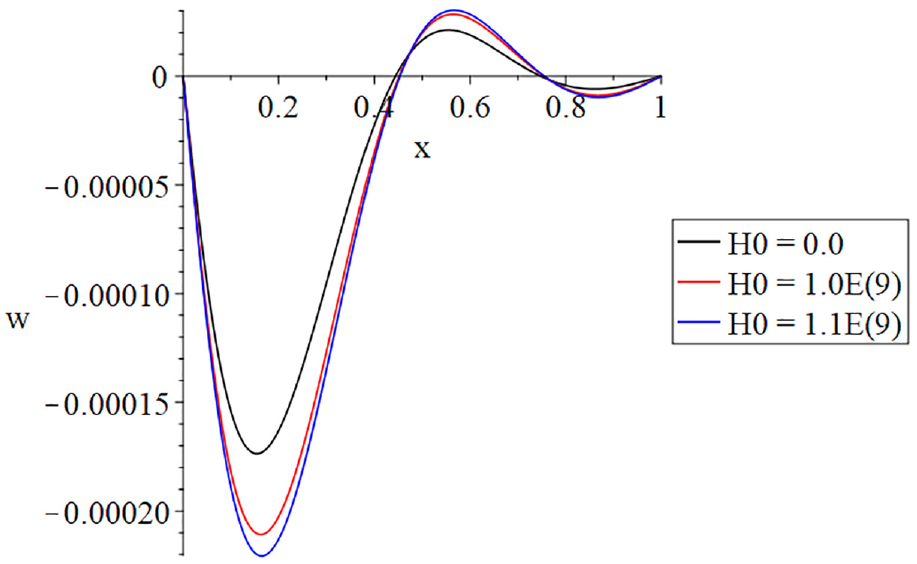
The lateral deflection distribution with various values of the magnetic field when
Figures 4 and 9 represent cubical deformation (strain) with respect to x due to the various values of the magnetic field when (

The deformation distribution with various values of the magnetic field when
Figures 5 and 10 represent stress with respect to x due to the various values of the magnetic field when (

The stress distribution with various values of the magnetic field when
Figures 6 and 11 represent strain energy density with respect to x due to the various values of the magnetic field when (

The strain-energy density distribution with various values of the magnetic field when

The temperature increment distribution with various values of the magnetic field when
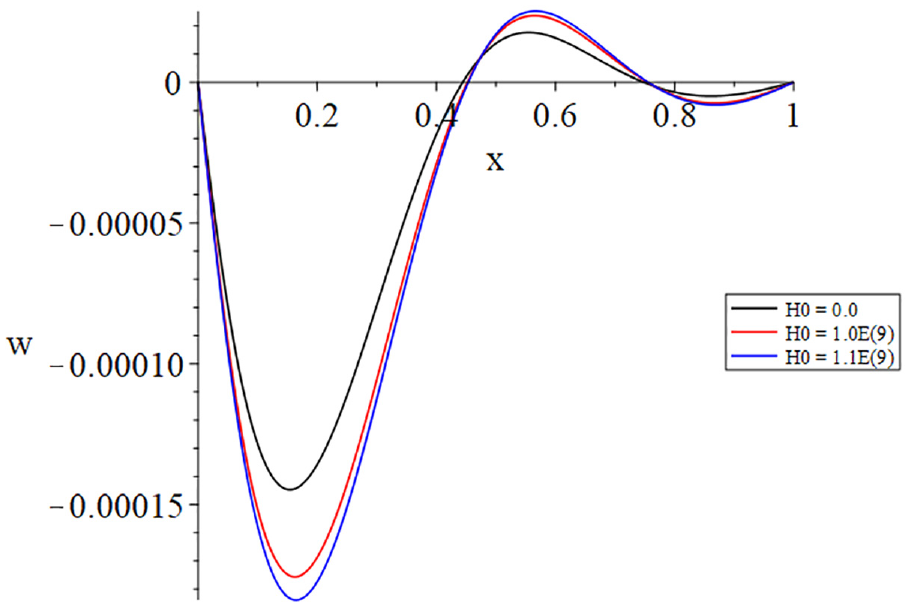
The lateral deflection distribution with various values of the magnetic field when

The deformation distribution with various values of the magnetic field when

The stress distribution with various values of the magnetic field when

The strain-energy density distribution with various values of the magnetic field when
Figure 12 represents the temperature increment with respect to x due to the various values of z when
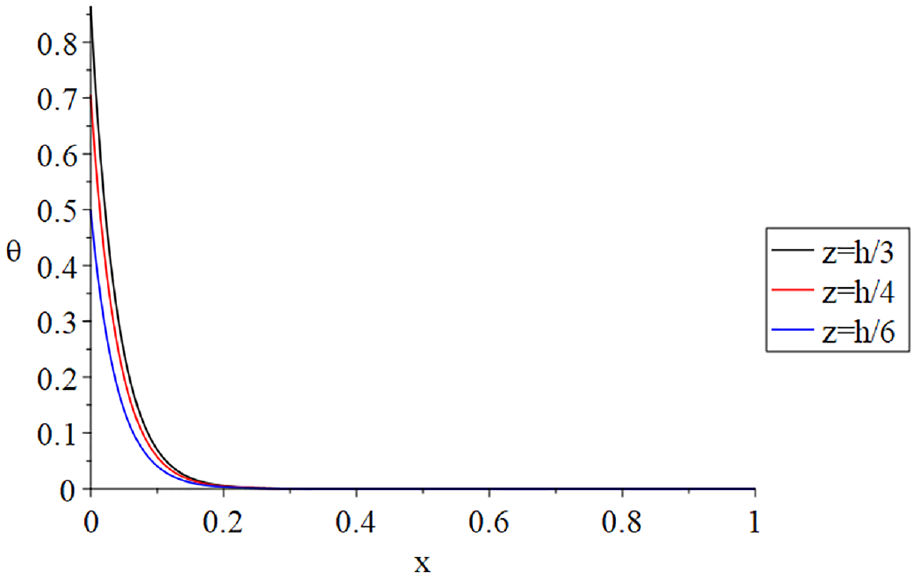
The temperature increment distribution with various values of z when
Figure 13, represent the vibration (lateral deflection) concerning × due to the various values of z when

The lateral deflection distribution with various values of z when
Figure 14, represent strain with respect to x due to the various values of z when
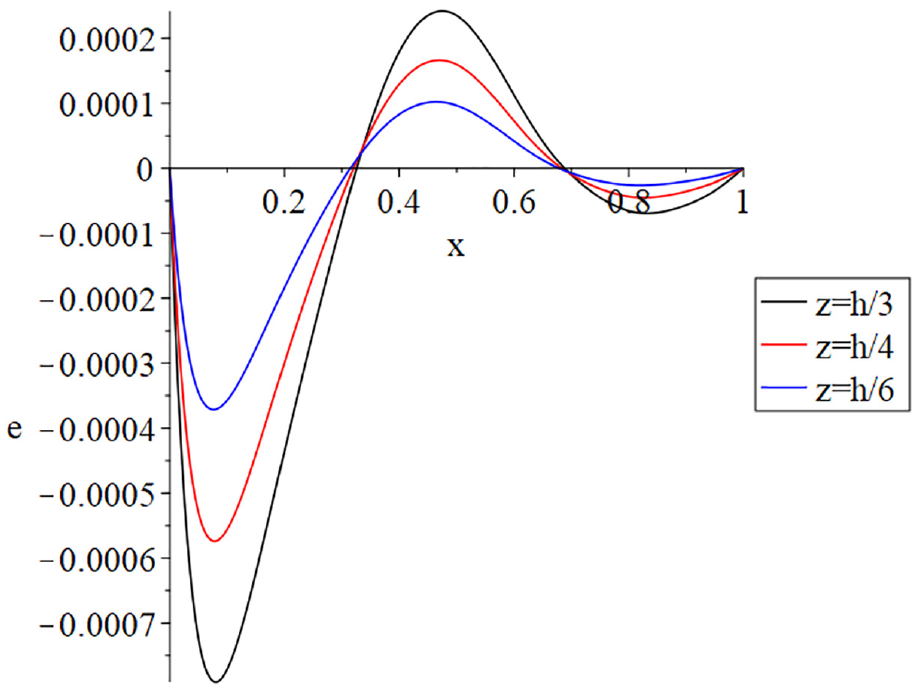
The deformation distribution with various values of z when
Figure 15, represent stress with respect to x due to the various values of z when

The stress distribution with various values of z when
Figure 16, represent strain energy density function concerning x due to the various values of z when

The strain-energy density distribution with various values of z when
Conclusion
The distributions of the temperature increment, vibration (lateral deflection), cubical deformation, stress, and strain-energy density are significantly affected by the ramp-time heat parameter and the magnitude of the magnetic field, and these parameters might be utilized as tuners to regulate the energy produced by the nanobeam.
The effect of the magnetic field is very limited on the temperature increment. While increasing the value of the magnetic field causes an increase in the values of the absolute vibration (lateral deflection), cubical deformation, stress, and strain-energy density functions for all the values of the ramp-time heat parameter.
Moreover, the ramp-time heat parameter and the thickness of the beam have significant impacts on the temperature increment, vibration (lateral deflection), cubical deformation, stress, and strain-energy density functions.
Footnotes
Handling Editor: Chenhui Liang
Declaration of conflicting interests
The author(s) declared no potential conflicts of interest with respect to the research, authorship, and/or publication of this article.
Funding
The author(s) received no financial support for the research, authorship, and/or publication of this article.

Data availability
Since no new data were generated or examined in this study, data sharing does not apply to this article.