




Abstract
The main object of this work is to analyze viscothermoelastic homogeneous and isotropic nanobeams under the effect of mechanical damage. A Green-Naghdi type-II model of thermoelasticity has been constructed under simply supported conditions. Moreover, the Laplace transforms have been applied for the governing differential equations. Tzou iteration method with approximation has been applied to calculate the Laplace inverse transforms. The numerical results are presented and validated for use in a viscothermoelastic rectangular nanobeam of silicon nitride when it has been thermally loaded by ramp-type heating and simple support. The numerical results have been demonstrated in different figures to stand on the effects of the mechanical damage variable, mechanical relaxation times parameters, and ramp-time heat parameter on all the studied functions. We conclude that the effect of the mechanical damage variable, ramp-time heating parameter, and mechanical relaxation times parameters are highly influential on all the studied functions and thermomechanical waves.
Introduction
Heat conduction has been described in a variety of mathematical and engineering models, such as dual-phase lag (DPL) assumed by Tzou and Transfer.1,2 This model is common in the study of heat transfer problems and applications.3–8 The linked thermoelasticity hypothesis is an additional theory. This theory analyses the classical Fourier law for heat conduction in two partial differential equations: the energy conservation equation and the motion equation.9–12 By including the relaxation period on an isotropic substance, Lord and Shulman (L-S) modified the conventional Fourier law of heat conduction. 13 As such, the law is modified in a way that includes both the heat flux and time derivative (We may refer to this as Cattaneo’s heat conduction). If we situate our claims in this theory, we may classify the heat equation as the hyperbolic type, where the paradox of infinite propagation speeds is omitted.14–18
The most crucial aspect of micro/nanomechanics is the vibration of the nanobeams and resonators. By using dual-phase-lag (DPL), Alghamdi addressed the thermal damping vibration with voids of nanobeam resonators based on the theory of generalized thermoelasticity. 9 Sharma and Grover investigated the transverse vibrations produced by a narrow beam resonator that has voids and is isotropic, homogeneous, and thermoelastic. 19 The heat-damping vibration on a microplate and circular plate resonators was also studied by Sun and Saka. 20 They modified their formula by including a new and distinct component that depends on Poisson’s ratio and differs from the one presented in Lifshitz and Roukes. 21 Numerous writers have researched and written on the vibration and heat-transfer process of nanoresonators.22–30 Youssef and Al-Lehaibi, for instance, looked at the vibration of a gold nanobeam that had experienced a thermal shock. 23 Kidawa, on the other hand, was interested in the effects of internal and external damping on a beam’s transverse vibrations induced by a moving heat source, and he addresses this issue using the properties of the Green functions. 25 Boley talked about the vibrations that are dispersed over a rectangular nanobeam’s span when it experiences a thermal shock. 24 Additionally, Manolis and Beskos used a computational technique to examine the thermal characteristics of the elastic dynamic response of beam structure to thermal loading while dealing with vibrations that are thermally caused in nanobeam structures. 26 Al-Huniti et al. used a moving laser beam and high power to evaluate the strains and displacements that are thermally caused by a heated rod. Then, using Laplace’s transformation technique, they looked at the rod’s dynamic behavior. 22
Generalized thermoelasticity was approached differently by Green and Naghdi. They referred to it as thermoelasticity without dissipation of energy. 31 By utilizing the broad definition of entropy balancing, they put out the central argument. They created three different response function types as a result. Type I employs a linear theoretical structure and is the same as conventional heat conduction (or conventional Fourier’s law). Thermoelastic disturbances can propagate with a limited speed in type-II and type-III systems. Type-II is the only type that prevents energy loss, even if type-III and type-II are utilized to flow heat in inflexible solids with limited wave speed. 32
A nonlinear large-amplitude free vibration response of nano-shells prepared from functionally graded porous materials has been investigated by considering the surface stress size effects and vibrational mode interactions. 33 To investigate the thermal post-buckling properties of porous composite nanoplates formed of a functionally graded material with a central cutout of various shapes, a surface elastic-based three-dimensional nonlinear formulation has been developed. 34 Thermomechanical vibration of bi-directional functionally graded non-uniform Timoshenko nanobeam has been studied through many applications.35,36
In the earliest phases of actual materials, flaws like microcracks and voids are frequently present. Internal voids or gaps may widen and merge with deformation. Additionally, total separation happens when the arrangement of fresh micro-changes at the stress concentrators. Damage, the last step, results in a total loss of material integrity and the formation of microscopic fissures. According to macroscopic phenomena, a material’s damage can be categorized as brittle, ductile, creep, and fatigue damage.30,37 In continuum mechanics, conclusions from the description of the macroscopic behavior of a damaged material are still pending. For us, damage may unite fracture mechanics with conventional continuum mechanics.
Damage variables can be introduced in a variety of methods. Assessing any injured body’s cross-section, we observe an element’s area

The case
We cannot describe the effects of the cross-section microcracks in the same way. Otherwise, our conclusions would be fallacious. On the other hand, if we use the isotropic damage, then, D is independent of n, thus, the effective stresses become30,37:

Therefore, the primary goal of this work is to analyze homogeneous, isotropic viscothermoelastic nanobeam of silicon nitride under the influence of mechanical damage. Under simply supported conditions, a thermoelasticity Green-Naghdi type-II model will be developed.
The impacts of the mechanical damage variable, mechanical relaxation times parameters, and ramp-time heat parameter on all the analyzed functions will be supported by the numerical results in various figures.
Basic equations
A material that adheres to the Kelvin-Voigt viscothermoelastic type in the well-known Cartesian coordinate, is homogeneous, isotropic, thermally conducting, and undeformed at a constant temperature
The displacement components are given by
Create the governing equations as follows if forces and heat sources are not present 43 :
The equations of motion take the form:

The stress-strain constitutive equations, taking into consideration damage mechanics, take the following form 44 :

The Green-Naghdi type-II of heat conduction equation under the effect of the mechanical damage takes the following form 44 :

The deformation-displacement relations can take the following form:

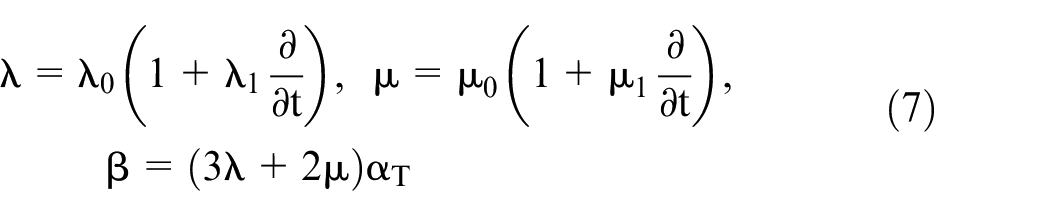
Lamè’s parameters for viscothermoelastic materials have the following forms:
Problem formulation
We take that there are small deflections in a thin thermoelastic nanobeam of length
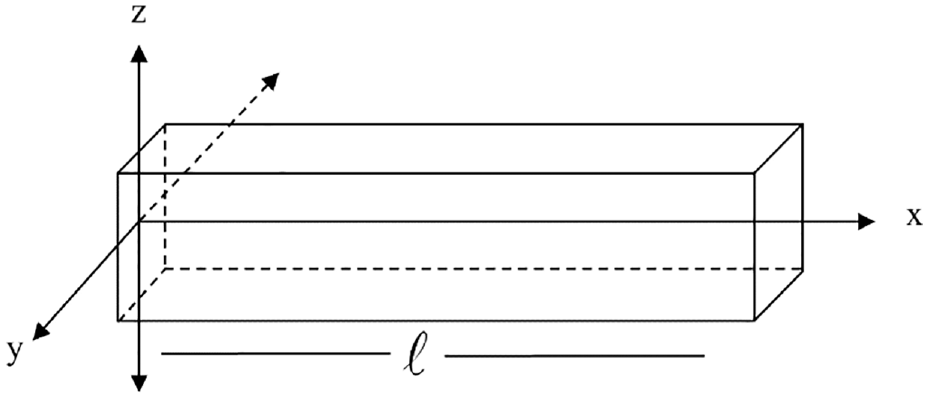
Isotropic rectangular thermoelastic nanobeam.
In a state of equilibrium, the beam is not strained, not stressed, and free of mechanical damping, and the temperature is
The Euler-Bernoulli equation is considered in this study. While a result, we start with a plane’s cross-section that is initially perpendicular to the x-axis and stays level and perpendicular to the neutral surface as bending occurs. 45
Then, the displacement components can be formed as:

The equation of motion is given as:

where
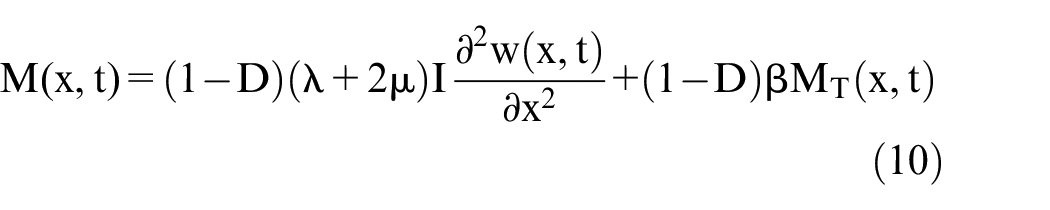
Moreover,
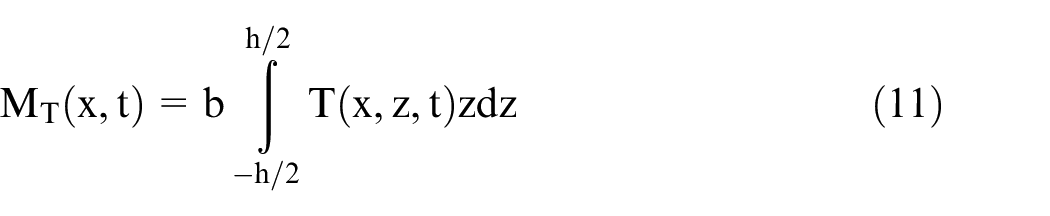
Where
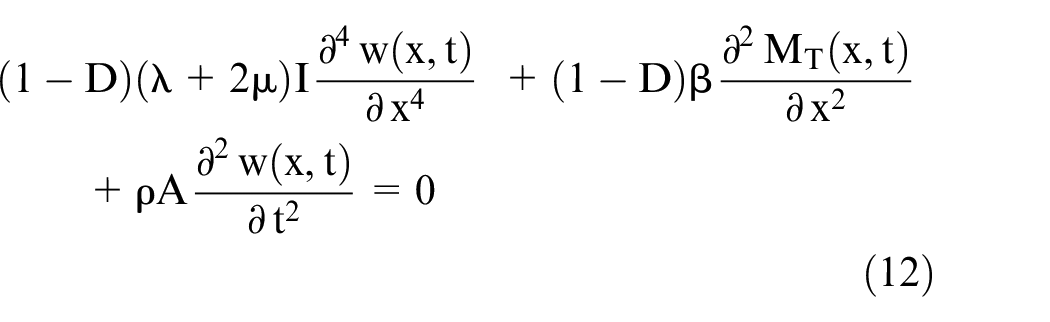
Therefore, we may put the beam’s differential equation of lateral vibration that was induced thermally as 45 :
Where
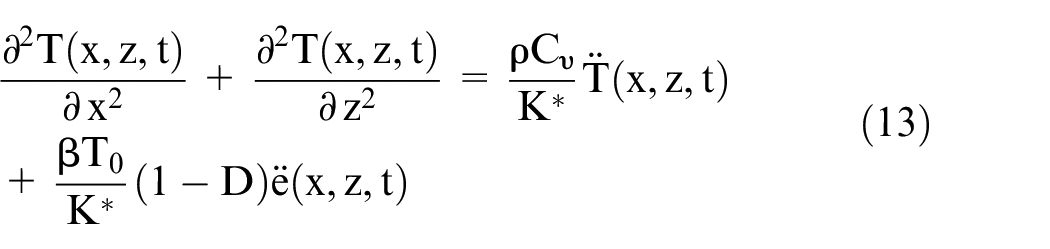
The heat conduction equation based on non-Fourier law can be formed as 45 :
and
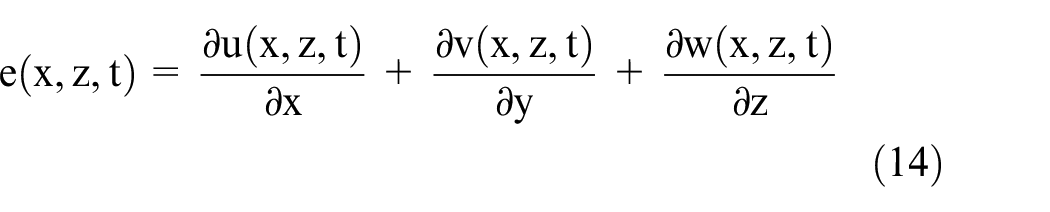
This volumetric strain is given as:

Based on the relation (7), we get:
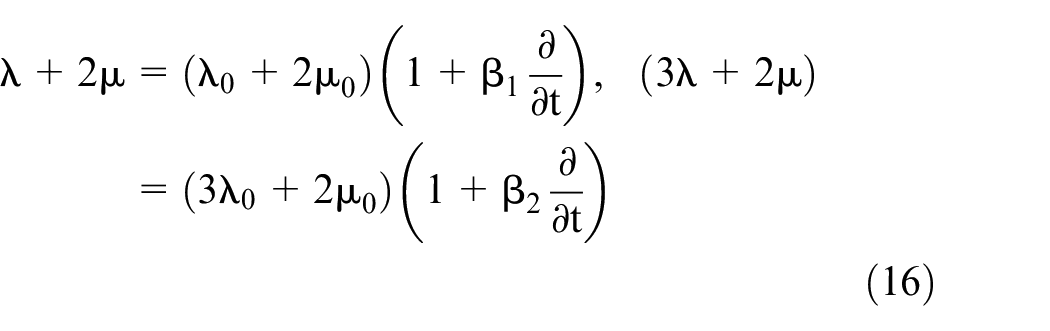
where
Since heat does not transfer across the beam’s bottom and upper surfaces, we conclude that
If a thin beam is considered, we set variable temperature in terms of a

Thus, we obtain:
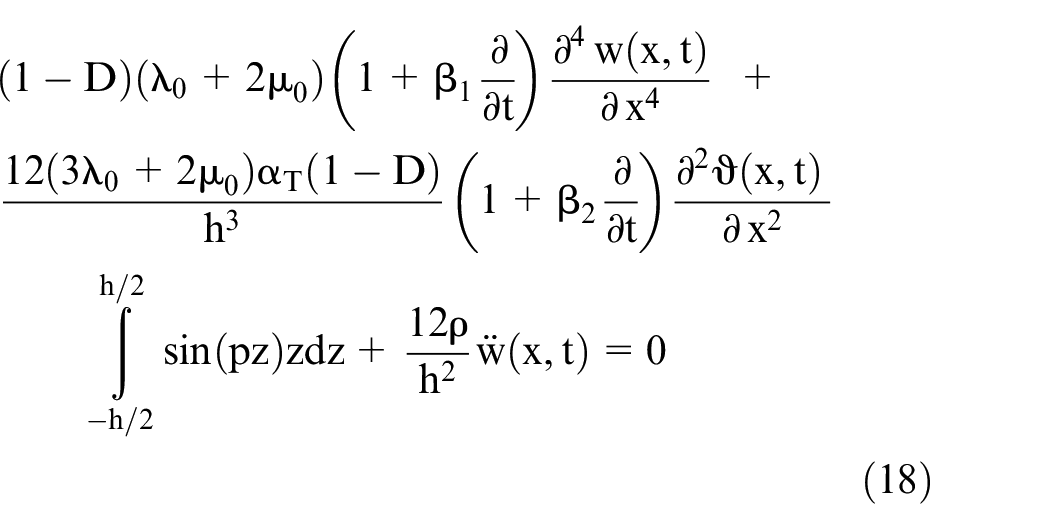
Moreover, we obtain:
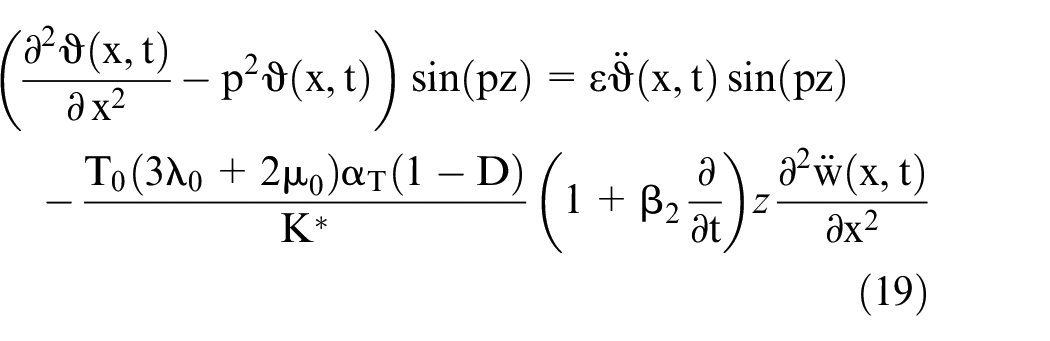
and
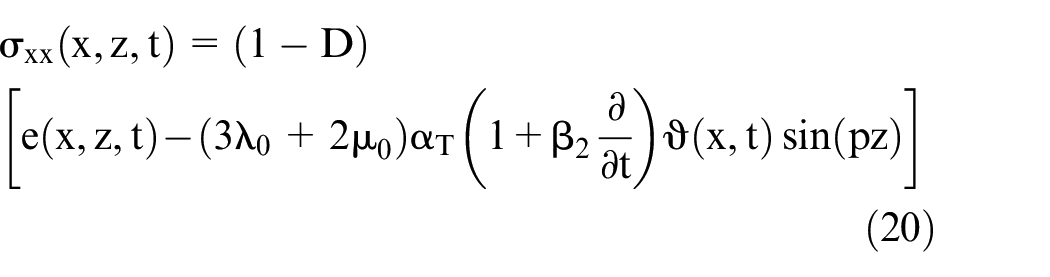
where
Upon integrating the equations, we get:
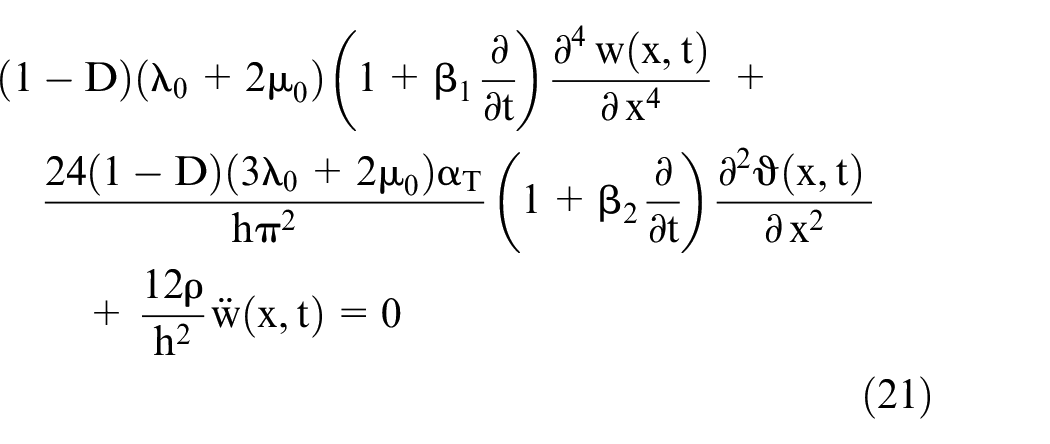
We multiply both sides of the equation (19) by z and integrate with respect to z from
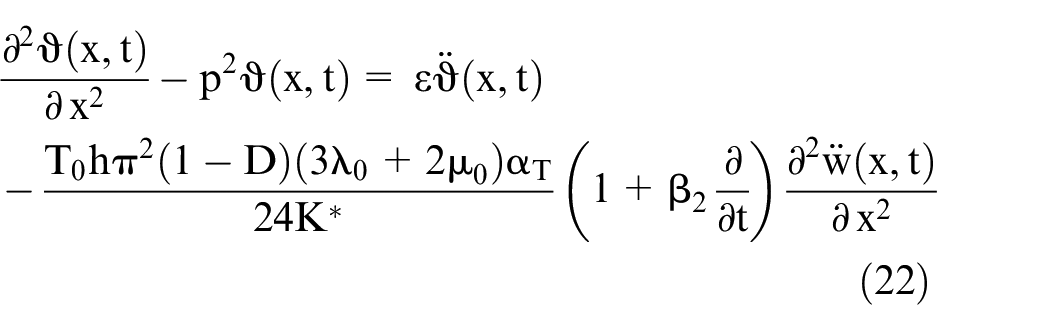
Then, the equation (18) becomes:
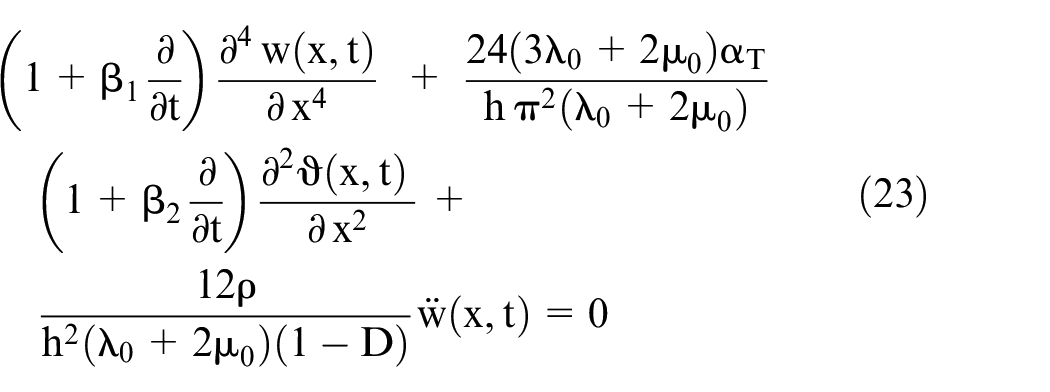
To keep matters simple, we use the following dimensionless variables 19 :
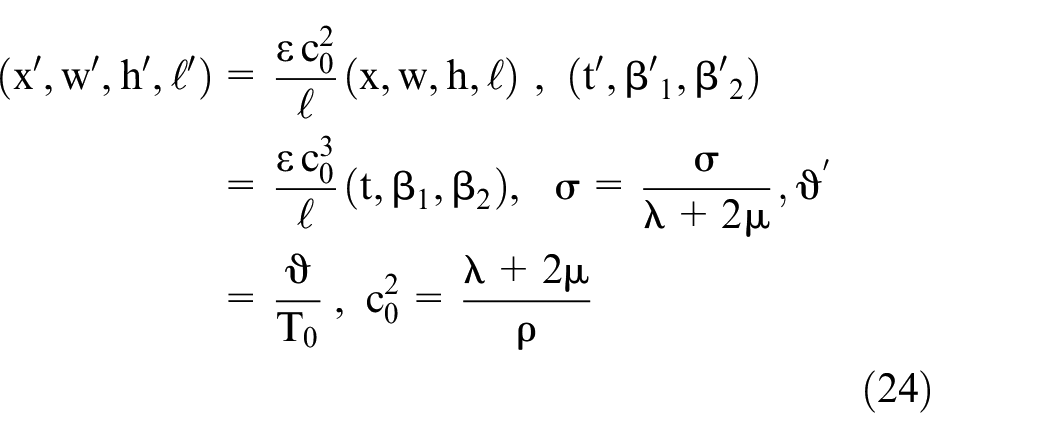
Then:
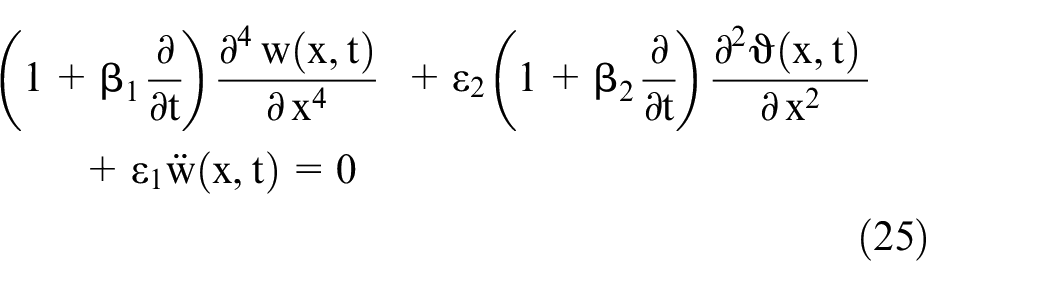
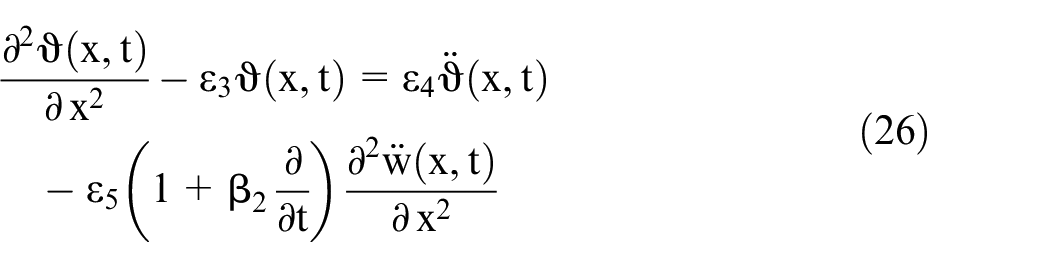
and
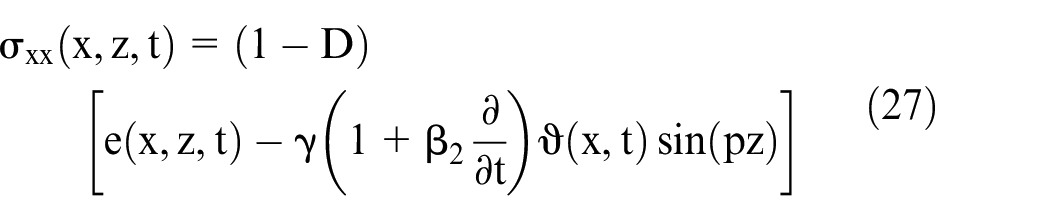
where
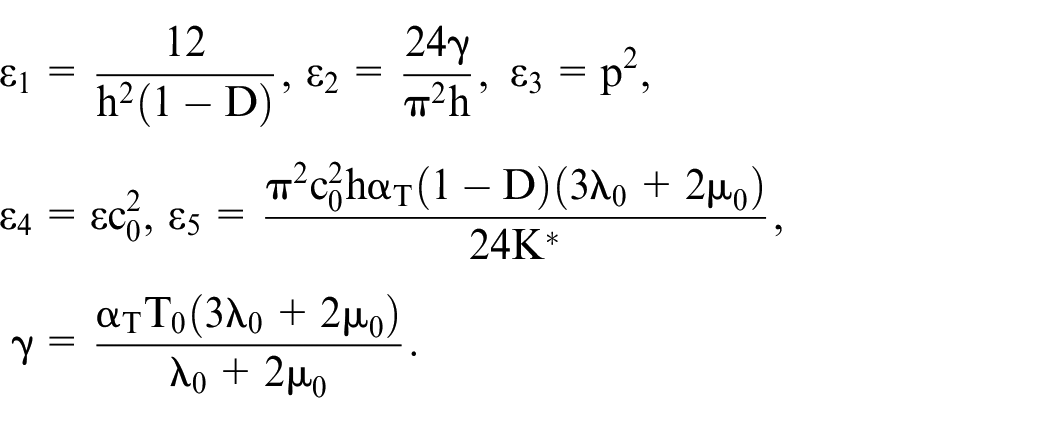
(The prime has been omitted here just for convenience)
We apply Laplace transform for both sides of the equations (25)–(27) and (15), which is defined by:

Where the inversion of the Laplace transform takes the following form 1 :
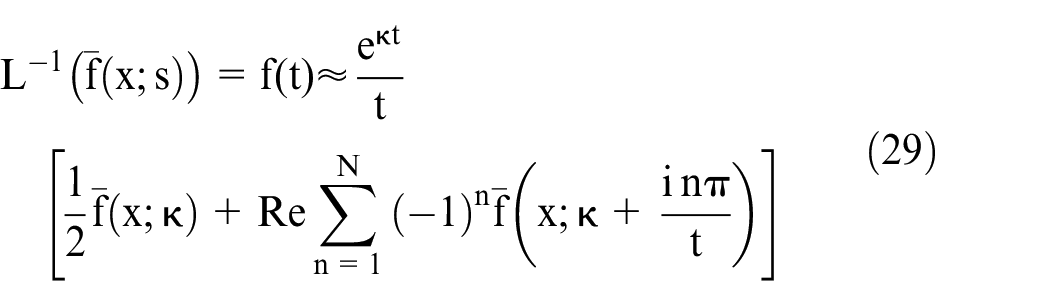
where “Re” is the real part and “i” is the imaginary unit.
To make convergence faster, numerous numerical experiments demonstrate that
As a result, the following system of ordinary differential equations is obtained:
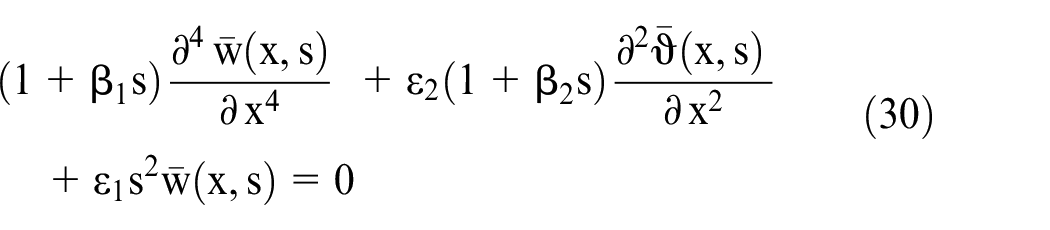
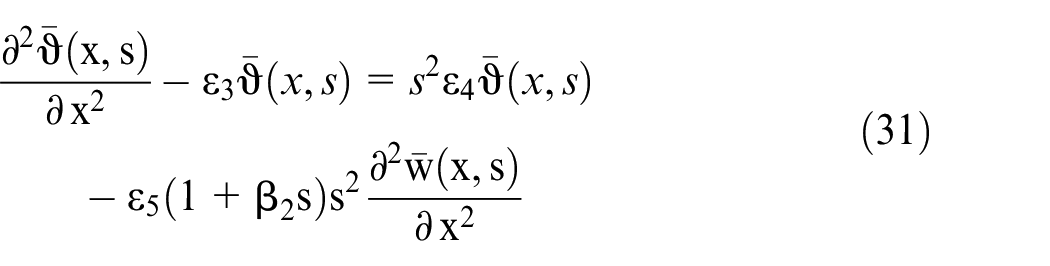

and

Among applying the Laplace transforms these initial conditions have been used:

Hence, we obtain:


where
The system (35) and (36) gives us the following equation:
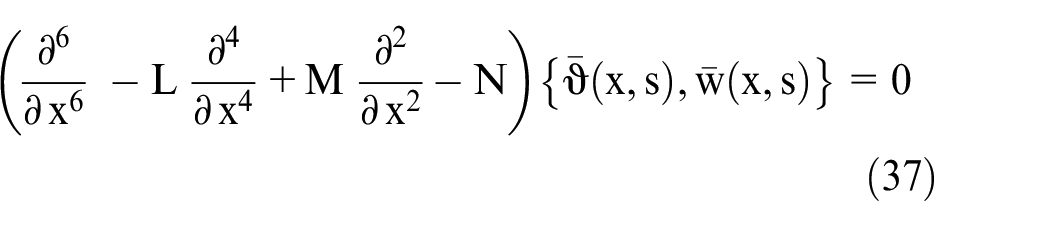
where

and

We take

The constants

and

where
Equations (17) and (41) produce:

Then, by using the Laplace transform, we obtain:


and

Therefore, we get a system of linear equations:


and

Upon solving the above, we can obtain the solutions in the domain of the Laplace transform:
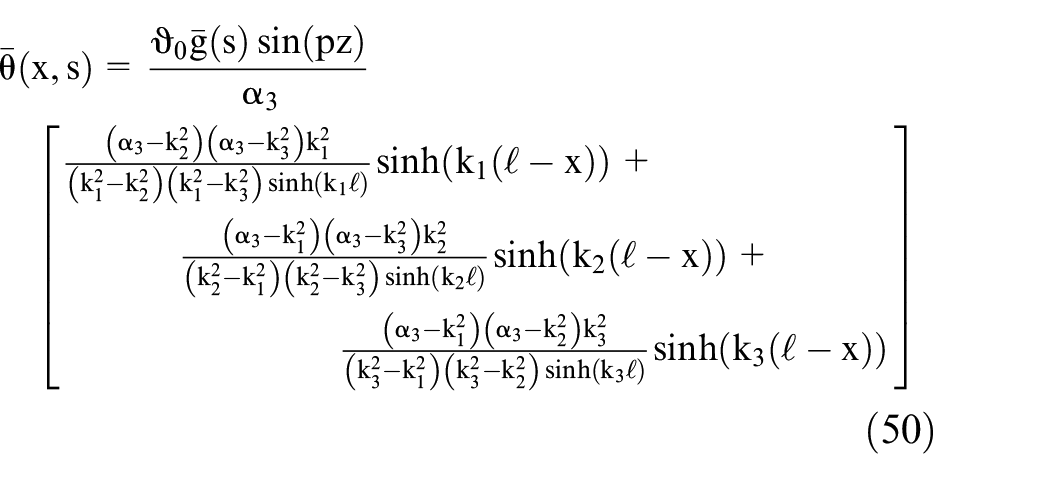
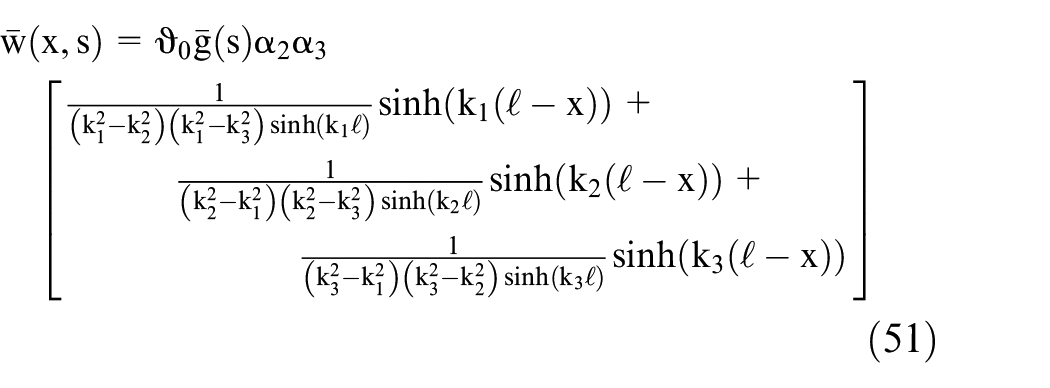
The lateral deflection is:
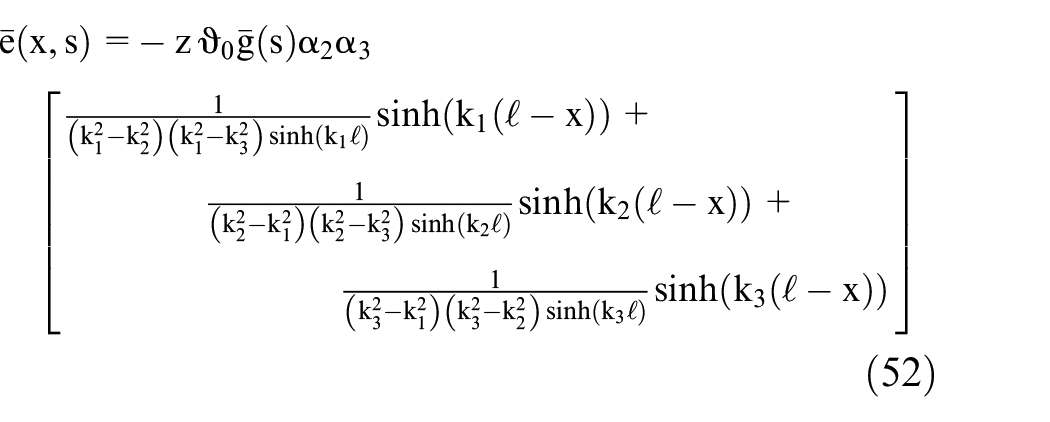
and the strain takes the form:
Using Refs.,11,47,48 the strain-energy density function generated on the beam is:

Thus, we have:

At this point, complete solutions are needed to proceed. We start by looking at the function of thermal loading

where
Therefore:

Numerical results and discussion
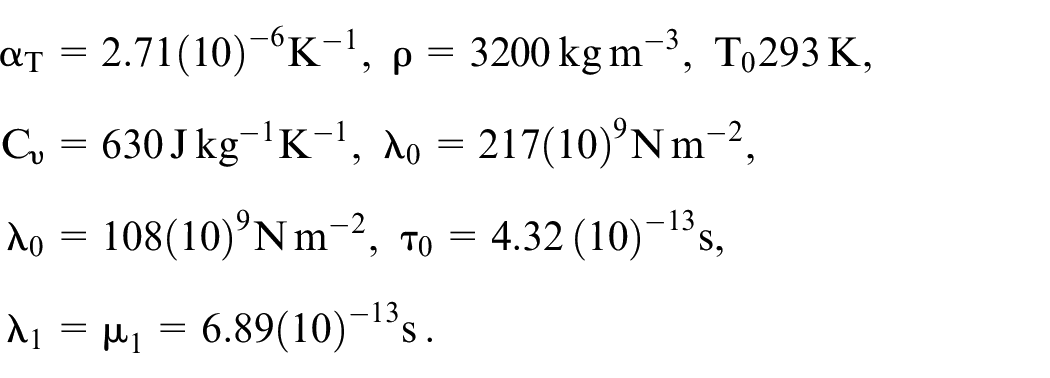
Based on the previous discussion, we take a computational result as a numerical example. As such, silicon nitride has been used as the material as follows43,45,49,50:
The aspect ratios of the nanobeam are fixed as
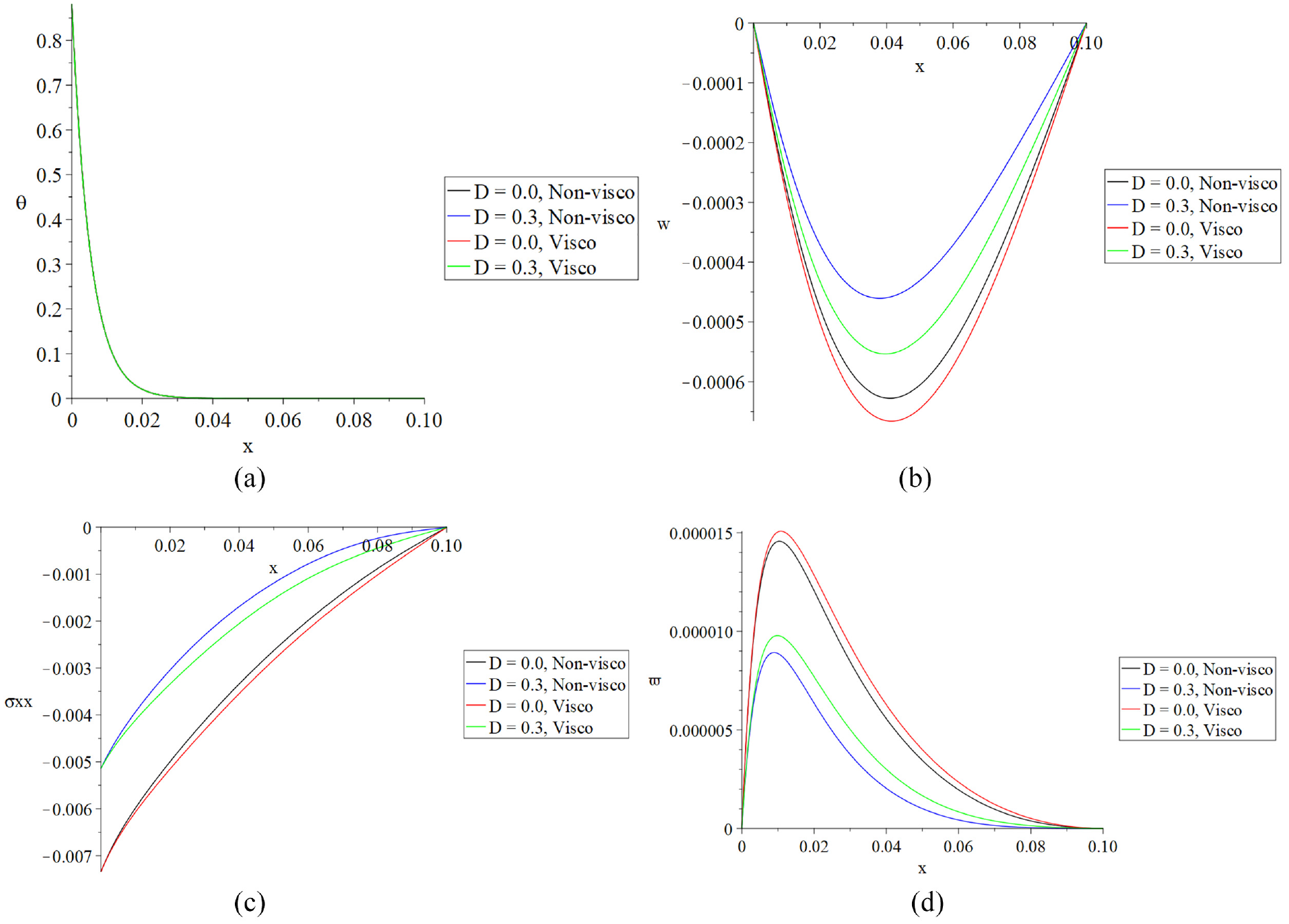
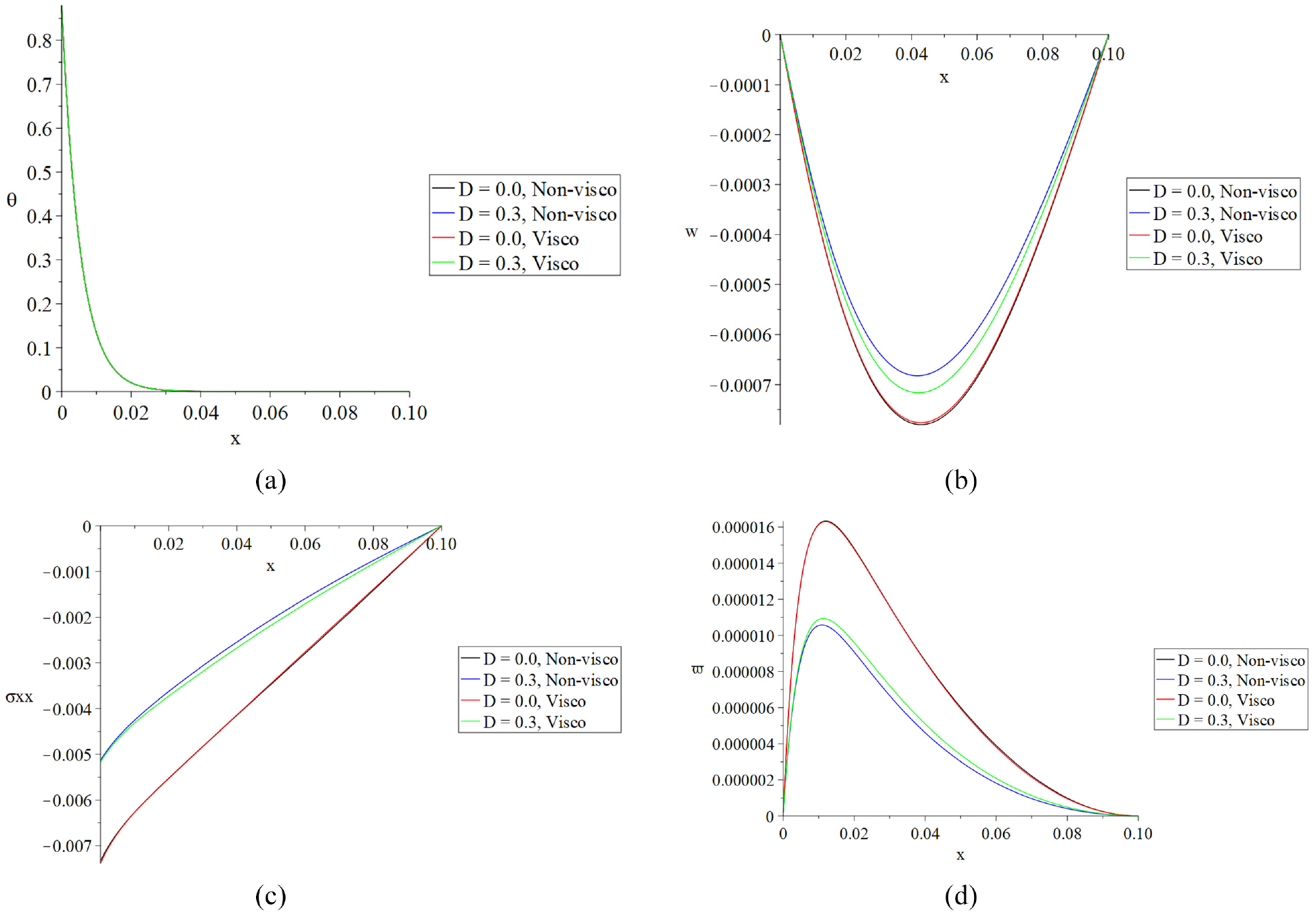
The studied functions when
Figure 2(a) gives that neither the mechanical damage variable nor the viscothermoelastic parameter has any effect on the distribution of temperature increment.
Figure 2(b) shows that the mechanical damage variable and the viscothermoelastic parameter affect the lateral deflection distribution greatly. The four curves start and end at zero, noting that each curve has a peak. This aligns with the boundary conditions. The absolute values of the peak points of the lateral deflection take the following order:
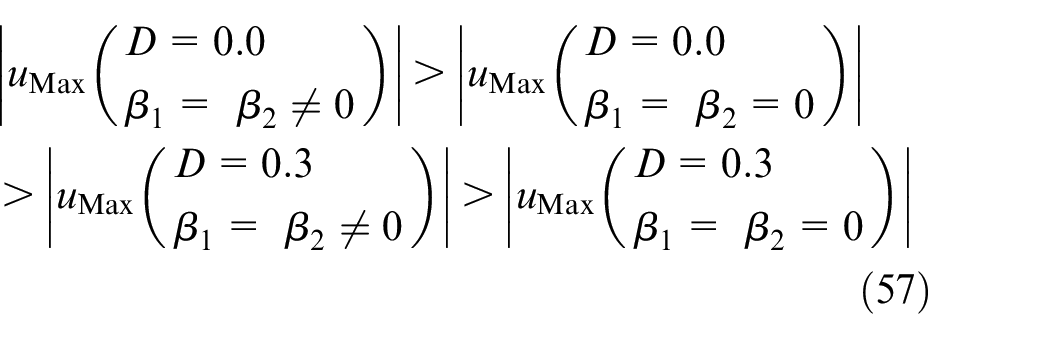
If we increase the viscoelastic parameter, the absolute value of the lateral deflection for the damaged and undamaged situation increases. On the other hand, if we increase the mechanical damage parameter, the absolute value of the lateral deflection for the viscoelastic and non-viscoelastic cases decreases.
Figure 2(c) represents that the mechanical damage variable and the viscothermoelastic parameter have significant effects on the stress distribution. Each of the four curves starts with different values. They all end at zero though. By increasing the viscoelastic parameter, the absolute value of the stress for the damaged and undamaged situation increases. On the other hand, increasing the mechanical damage parameter decreases the absolute value of the stress for the viscoelastic and non-viscoelastic cases.
Figure 2(d) shows that the mechanical damage variable and the viscothermoelastic parameter have significant effects on the strain-energy density function. The four curves start and end at zero, each with their peak points, agreeing with the boundary conditions. The peak points of the stress-strain distribution assume the following order:
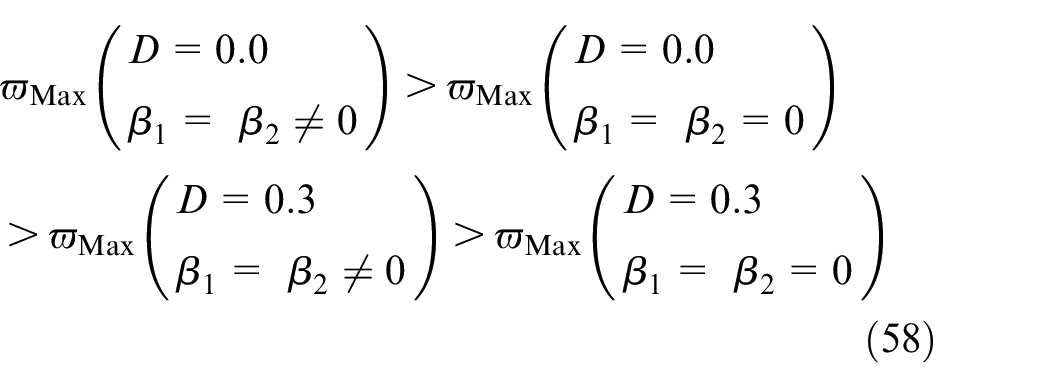
Similarly, increasing the viscoelastic parameter increases the absolute value of the lateral deflection for the damaged and undamaged situation. On the other hand, if we increase the mechanical damage parameter, the absolute value of the lateral deflection for the viscoelastic and non-viscoelastic cases decreases.
Figure 3(a) to (d) represent the temperature increment, the lateral deflection, the stress, and the stress-strain energy functions with different values of mechanical damage parameter
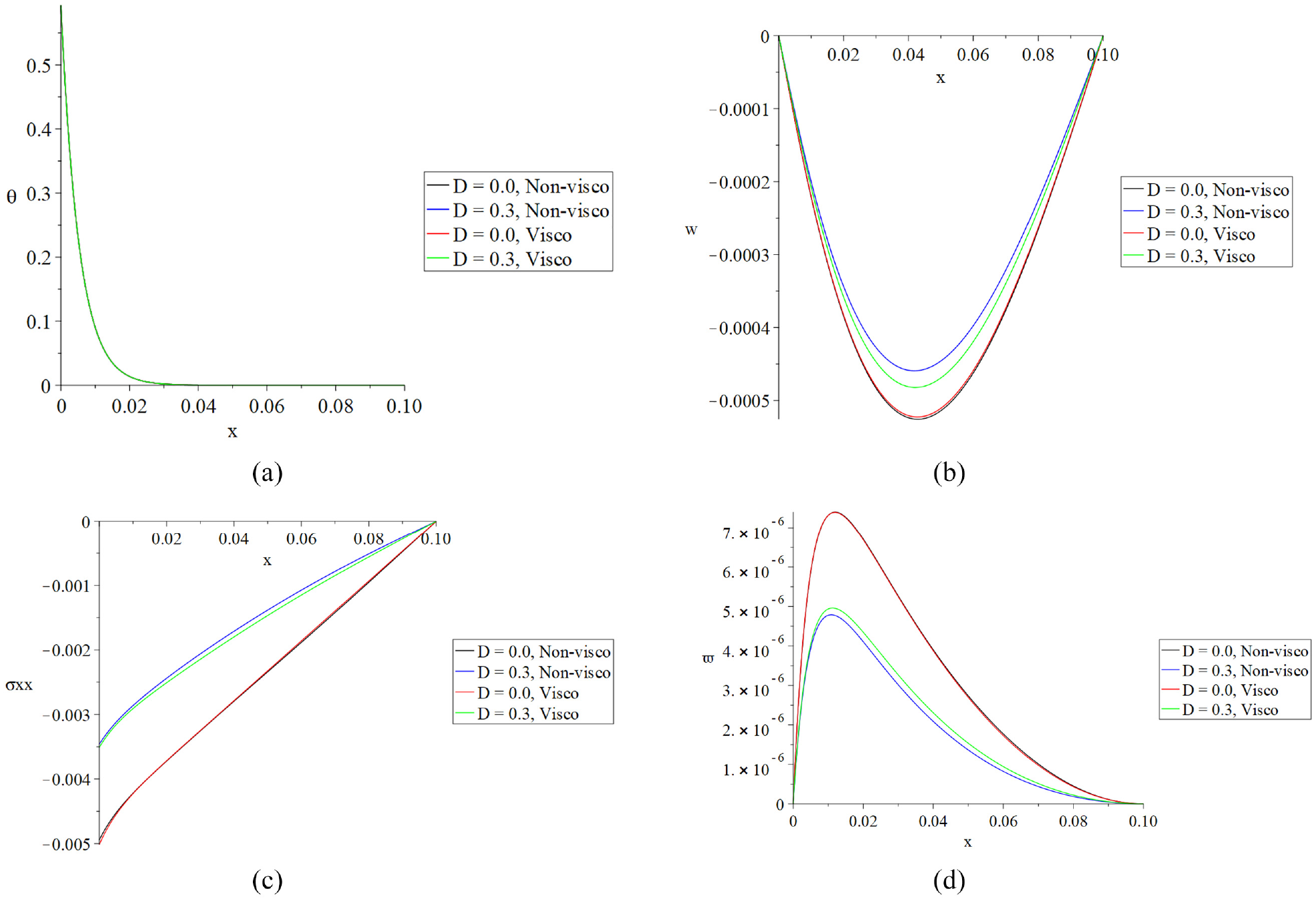
The studied functions when
Figure 4(a) to (d) represent the temperature increment, the lateral deflection, the stress, and the strain-energy density function with different values of mechanical damage parameter
The studied functions when
Figure 5(a) to (d) show the temperature increment, the lateral deflection, the stress, and the stress-strain energy distributions for various values of ramping time parameter
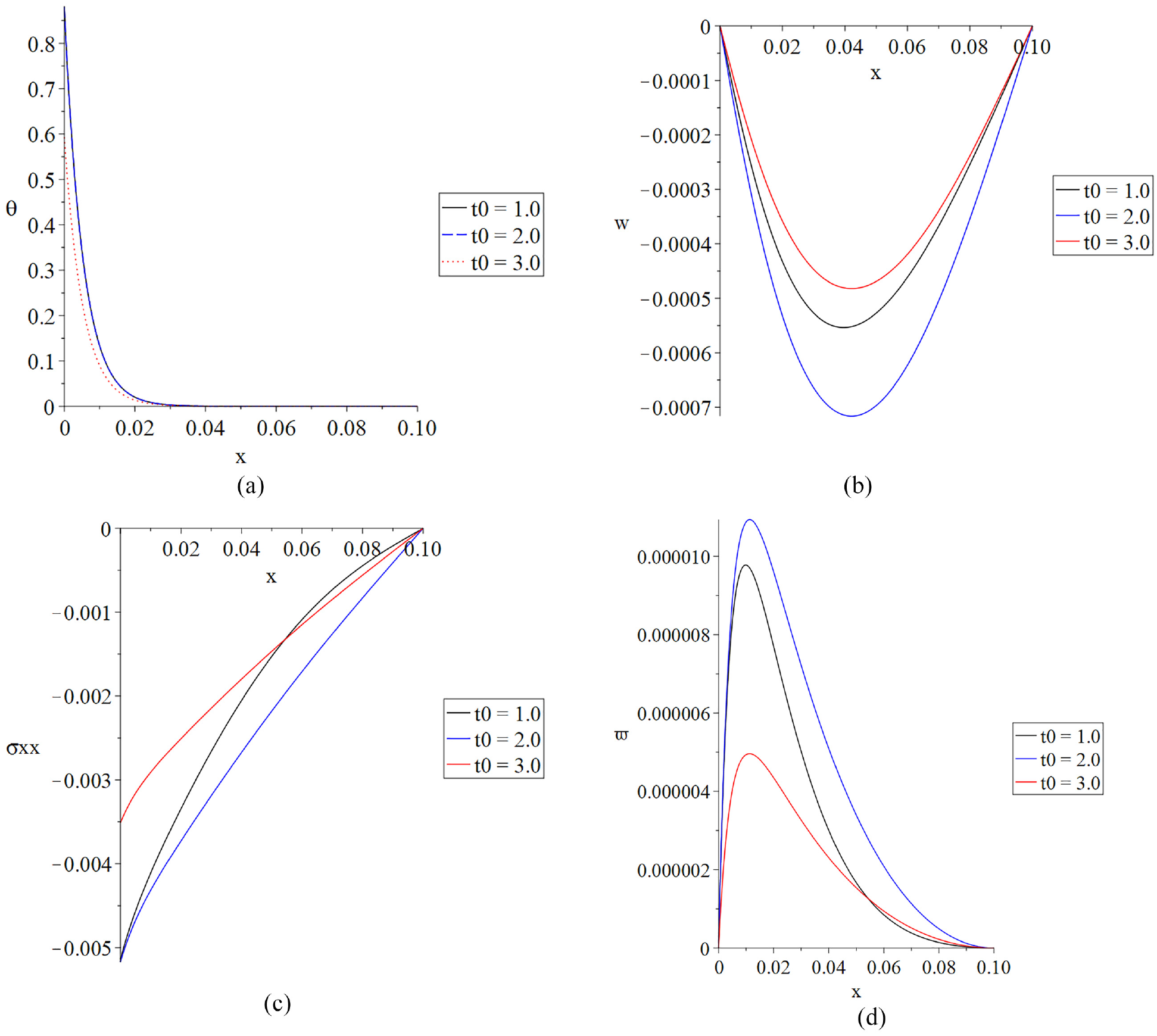
The studied functions when
Figure 5(b) represents the lateral deflection where the three curves start and end at zero. Every curve has a peak point that assumes the following order:

Figure 5(c) demonstrates the distribution of stress. We see that the curves of the cases
Figure 5(d) represents the strain-energy density function where the three curves start and end at zero. Each curve peaks in the following order:

We may conclude that the ramp-type heating parameter is impactful on all functions understudy, and it can be used as a controller or tuner to the energy generated on the beam.
For validation, the results of the current work agree with the results of the reference. 51
Conclusion
Based on the previous discussion, we have examined a viscothermoelastic nanobeam when it is simply supported and thermally loaded using ramp-type heating under the influence of damage mechanics. We conclude that the damage parameters, the mechanical relaxation times parameters, and the ramp-time heat parameter affect the reaction and the vibration of the nanobeam greatly.
Therefore, we conclude the followings:
Increasing the viscoelastic parameter increases the absolute value of the lateral deflection (vibration), the absolute value of stress, and the strain-energy density function for the damaged and undamaged situation.
On the other hand, if the mechanical damage parameter increases, the absolute value of the lateral deflection, absolute value of stress, and strain-energy density function for the viscoelastic and non-viscoelastic situations decrease.
The ramp-type heating parameter is essential in the energy damping of the nanobeam and could be used to tune the energy which has been generated through the thermoelastic nanobeam and plays a vital role in its damping.
Footnotes
Acknowledgements
Not Applicable.
Declaration of conflicting interests
The author(s) declared no potential conflicts of interest with respect to the research, authorship, and/or publication of this article.
Funding
The author(s) received no financial support for the research, authorship, and/or publication of this article.

Data availability statement
Data sharing does not apply to this article as no datasets were generated or analyzed during the current study.