



Abstract
The purpose of this manuscript is to analyze the electroosmotic peristaltic motion of graphene-lubrication oil nanofluid. Rheological characteristics of such fluids are predicted by using the Carreau’s model. Effects of magnetic field, electric field, viscous dissipation, Joule heating, Brownian motion and thermophoresis are also reckoned. Debye-Hückel linearization and lubrication approach are employed in mathematical modeling. Obtained non-linear system of equations are analytically solved by using the builtin command NdSolve and parametric study is carried out to visualize the variation in temperature, velocity, heat transfer rate, concentration profiles, pressure gradient and pressure rise per wavelength. Results unveil that strong electroosmotic parameter enhances both velocity and temperature. Temperature and velocity decline on the enlargement of the Helmholtz-Smoluchowski velocity. Variation in electroosmotic parameter decreases and Helmholtz-Smoluchowski velocity increases mass transfer rate. Pumping region can also be maintained by thickening and thinning the Electric Double Layer (EDL). Present study has useful applications in industries, defect sensor, energy saving, domestic air conditioning, cooling power electronic components and heat extraction and heat transportation.
Keywords
Introduction
Nanofluids (NF) are studied because of their incredible thermal and rheological attributes. Nanofluids are colloidal suspensions of nanoscale metallic particles into conventional base fluids. Naoparticles are made of metals (Ag, Cu etc.), metallic oxides (FexOy, CuO, Al2O3 etc.), carbons (graphite, diamond, carbon nanotubes etc.), metal carbides (SiC etc) and metal nitrides (ZrN, TaN, AIN etc). Water, oil and ethylene-glycol are commonly used as base fluids. Nanofluids have tremendous applications in biological, pharmaceutical and technological sciences. Novel idea of Nanofluids was introduced by Choi and Eastman 1 and addition of solid nanoparticles augments the thermal features of working fluid. Tiwari and Das 2 unveiled two-phase model to analyze the nanoliquids by considering effective viscosity, density and thermal conductivity. Buongiorno 3 suggested a model to scrutinize the nanofluid motion by using thermophoresis and Brownian motion effects. Recently, Izadi et al.4,5 reported useful analysis over natural convection of a micropolar and hybrid nanofluid inside a porous cavity with different configurations. Amelioration of pool boiling thermal performance by using the graphene-silver and new hybrid was discussed by Xu et al. 6 and Izadi et al. 7 respectively. Study of MHD thermogravitational convection of a micropolar nanoliquids in a porous chamber was also presented by Izadi et al. 8
Peristalsis phenomena is a mode of fluid motion inside a flexible channel or tube due to expansion and compression of continuous waves. Many physiological applications of this phenomena are found in daily life like urine movement from kidneys to bladder, food delivery via esophagus, chyme movement via gastrointestinal and vasomotion of small vessels etc. Industrial applications of peristalsis include movement of corrosive and sensitive fluids in finger and roller pumps etc. Initially, Latham 9 investigated the peristaltic motion of Newtonian fluids. Later, Shapiro et al. 10 theoretically investigated the peristaltic flow by using the “small-scale Reynold number and long wave length” approach. Ebaid 11 reported the impacts of magnetohydrodynamics over peristaltic movement of Newtonian fluid inside asymmetric duct along with wall slip conditions. Many studies are conducted to analyze the attributes of non-Newtonian fluids driven by peristaltic as well. Tiripathi et al. 12 studied peristaltic flow to see the slip effects of viscoelastic fluid by using fractional Burger’s model. Hayat et al. 13 explained the Jeffery fluids motion driven by peristalsis. Zahir et al. 14 illustrated the entropy generation in peristalsis of Casson fluid. Abbasi et al. 15 analyzed the magnetohydrodynamics peristaltic motion of Carreau-Yasuda (CY) fluid with Hall effects through curved channel.
Electroosmosis phenomena is defined as the ionized fluid flow in any capillary tube or microchannel under the effect of applied electric field. When a solid charged surface is attached with ionized solution or water, the negative charges gather on the surface. The cations from the liquid are attracted toward surface and anions are repelled from it. The remaining unbalanced charges then generate a thin layer is called electric double layer (EDL). While an electric field becomes parallel to this solid surface, the EDL moves in the same direction of electric field. Its applications are found in industrial, biomedical, oil and gas fields, mechanical and chemical engineering and so on as it works in micro channels. Chakraborty 16 explained the electroosmotically dragged capillary transport of biofluid through microchannel. Electroosmotic motion of power-law fluid in a micro-conduit was explained by Zhao et al. 17 Tang et al. 18 analyzed non-Newtonian fluids inside microchannel. The electroosmotic effect of power-law fluid for distinct zeta potential is discussed by Vasu and De. 19 Tripathi et al. 20 analyzed the EDL impacts on peristaltic transport. Magnetohydrodynamics (MHD) is an investigation of fluid flow subjected to the external magnetic field. It has applications in MRI, detection of tumors, petroleum industries and many more. Noreen 21 and Tanveer et al. 22 discussed peristaltic movement of MHD Carreau fluid in a curved conduit. Peristaltic movement of Carreau nanofluid in an asymmetric tapered conduit under the effect of magnetic field is reported by Kothandapani and Prakash. 23
Rheology is a study of materials flow behavior under applied stresses. The flow behavior of Newtonian fluids (e.g. urine) are studied through constitutive equations but rheological attributes of non-Newtonian fluids (shampoo, ketchup, drill mud, blood, and polymers) cannot be studied through a single constitutive relation. Therefore some interesting models are developed to study specific rheological attribute of non-Newtonian fluids. For example, Burger’s model, Maxwell model and Jeffery’s model are used to study the viscoelastic fluids. Casson fluid model is characterized for shear thinning behavior of non-Newtonian fluid. Carreau model, Power-law model, Second order fluid model, Eyring-Powell, Sisko, Hershel-Bulkley and Ellis model are used for Generalized Newtonian Fluids (GNF). Carreau fluid model illustrates the rheological attributes of non-Newtonian liquids and lubricants. BN-EG and Silicon oil are examples of Carreau nanofluids. Sobh, 24 Ali and Hayat 25 reported the peristalsis phenomena of Carreau fluid (CF) through asymmetric channel. Hayat et al. 26 discussed the peristaltic motion of CF subjected to the induced magnetic field. Carreau fluid motion through a regular duct is explained by Nadeem et al. 27 Abbasi et al. 28 unveiled the Hall effects over peristaltic motion of BN-EG nanofluid along with temperature depending on thermal conductivity. Bakak et al. 29 have proved during their experimental study that rheological attributes of nanofluids (suspension of Graphene nanoparticles into ethylene glycol and lubrication oil) are well computed by Carreau-Yasuda (CY) model. Moreover, the gathered results unveiled that CY is more suitable for GN-LO for the entire range of shear rates as compared to the GN-EG. The Graphene-based nanofluids have several applications in defect sensor, heat transfer, anti-infection therapy, cancer treatment, biomedical and energy saving system. 30
Rheological properties of graphene nanoparticles dispersed into lubrication oil have not got much attention so far. Present study is an attempt to reduce this space. This article explores the electroosmotic flow of GN-LO nanofluid driven by peristaltic in a symmetric channel. Effects of magnetic field, electric field, Joule heating, Brownian motion, thermophoresis and viscous dissipation are reckoned. Parametric study is performed for velocity, temperature, Nusselt number and concentration profiles, pressure gradient and pressure rise per wavelength. GN-LO has useful applications in industries, defect sensor, energy saving, domestic air conditioning, cooling power electronic components, heat extraction and heat transportation.
Problem construction
Problem Statement
Assume a

Here,
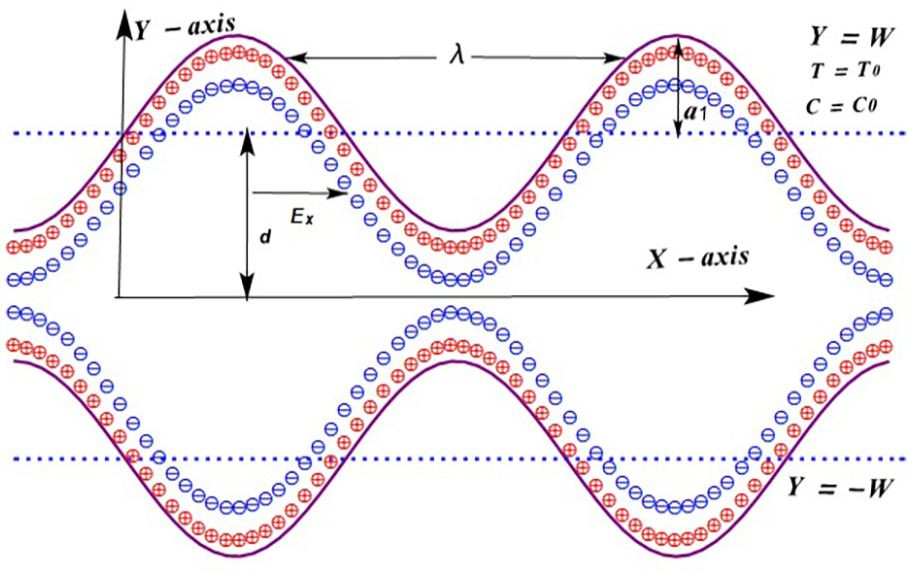
Geometry of physical model.
Electro-magnetohydrodynamics
Generalized Ohmic law prescribed in 31 is:

where


The Poisson equation in a symmetric channel according to Tanveer et al. 32 is defined as:

here


Here

Where

Solution of the equation (8) is given as:

Basic governing equations
The basic governing equations with the effects of electro-magnetohydrodynamics, viscous dissipation, Brownian motion and thermophoresis and Joule heating according to Refs.20,28 are modeled as:


In above equations,


where
The transformation of coordinates and velocities from fixed to moving frames are defined as:

In the light of the above transformation equations (11)–(15) for steady motion in moving frame are as follows:


Here

Non-dimensionalization
Following dimensionless quantities are considered here:

Where
Utilizing the above dimensionless quantities and employing the “small-scale Reynolds number and long wavelength” approximation, equations (19)–(23) are reduced and given below:


Eliminating pressure between equations (28) and (29) yields:

where

The boundary conditions dealing with the velocity slip, convective temperature and concentration are:

In above equations

where

Here,
The correlation between the dimensionless flow rates

In which

The dimensionless heat transmission coefficient is given by:

Moreover, non-dimensional form of pressure rise per wavelength

The system of dimensionless equations (30), (31), and (32) having boundary conditions (35) is solved numerically by using builtin command NDSolve in Mathematica. Outcomes are compiled graphically to facilitate physical analysis.
Outcomes and related discussion
The aim of this portion is to examine the consequences of Hartman number
Velocity variation
Figures 2 to 4 portray the impacts of different values of
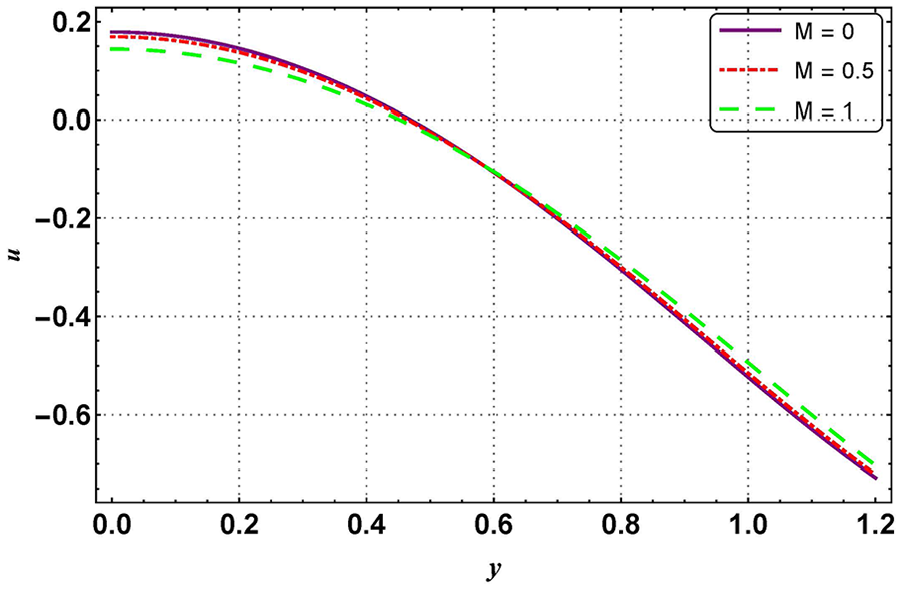
Velocity variance with

Velocity variance with
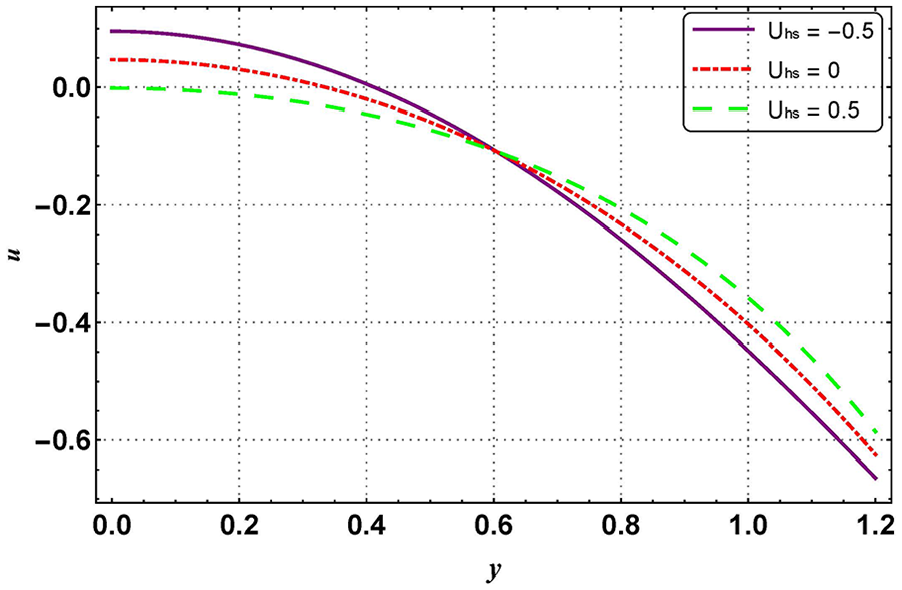
Velocity variance with
Temperature variation
Figures 5 to 7 depict the variations of temperature as a function of
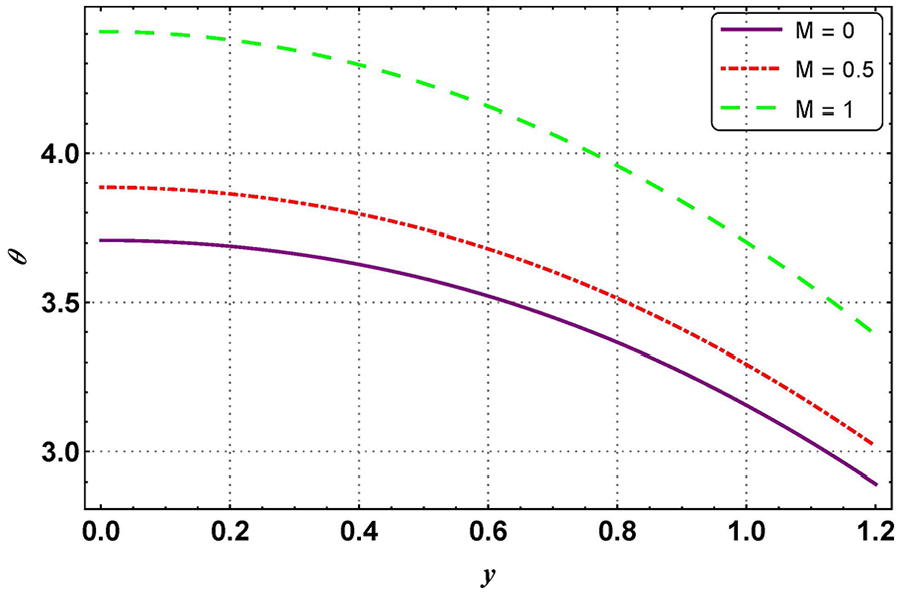
Temperature variance with

Temperature variance with

Temperature variance with
Heat transfer rate at walls
Figures 8 to 10 illustrate the consequences of M, κ and

Heat transfer rate variance with
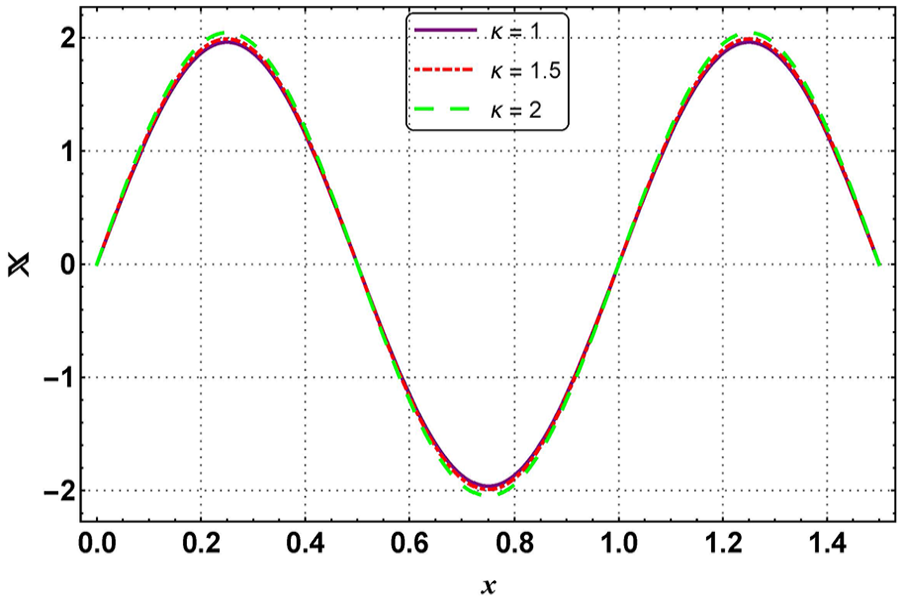
Heat transfer rate variance with

Heat transfer rate variance with
Concentration variation
Figures 11 to 13 indicate the impacts of M, κ and

Concentration variance with
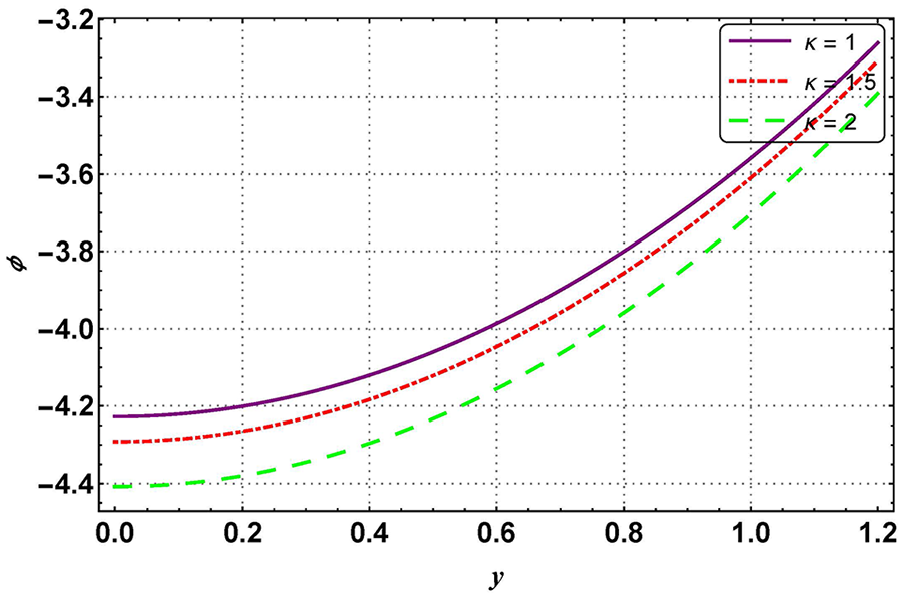
Concentration variance with
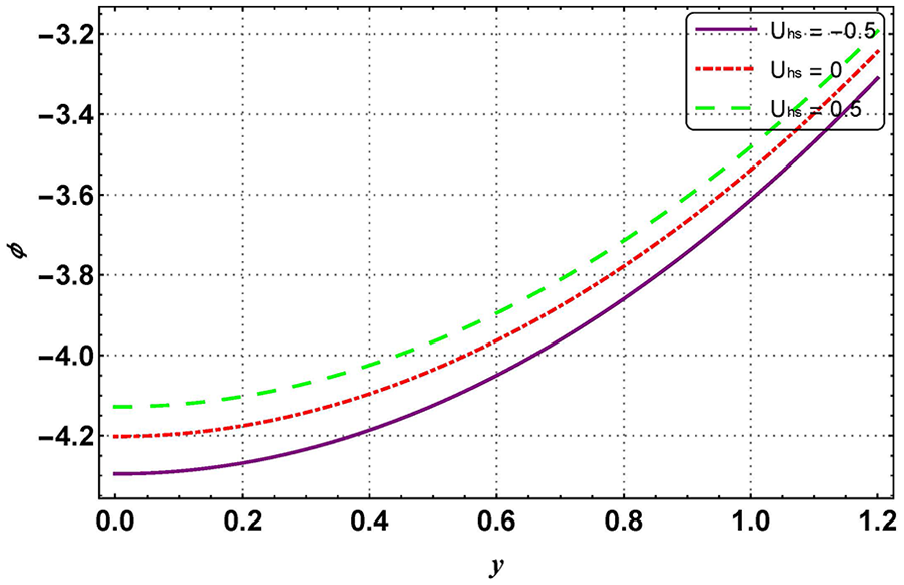
Concentration variance with
Pressure gradient
Figures 14 to 16 demonstrate the distribution of pressure gradient for different values of M, κ, and

Pressure gradient variance with
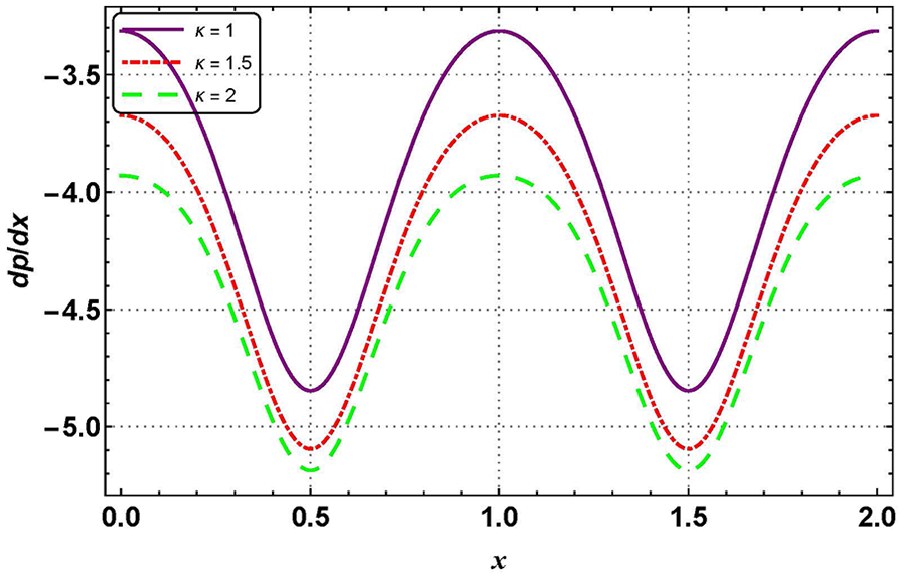
Pressure gradient variance with

Pressure gradient variance with
Pressure rise per wavelength
Figures 17 to 19 outline the average pressure rise

Pressure rise per wavelength variance with
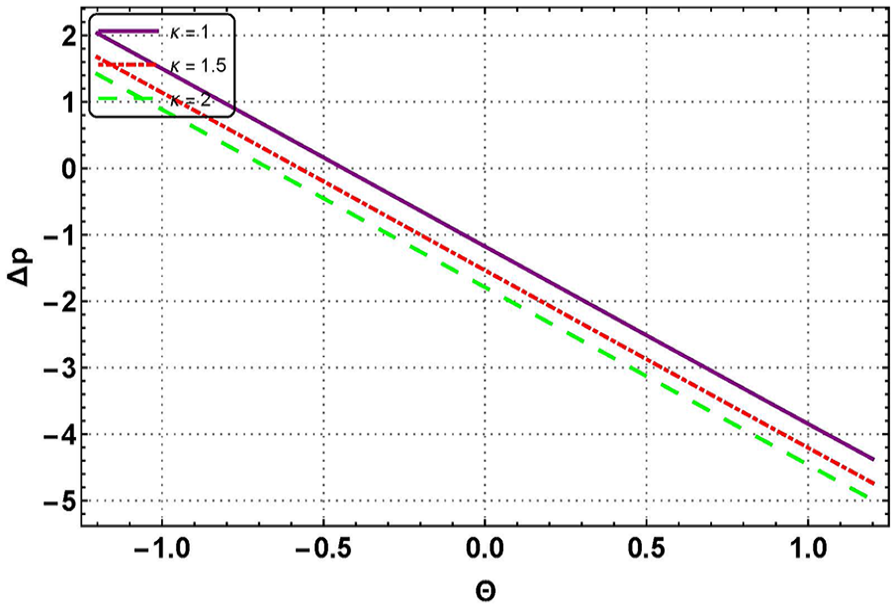
Pressure rise per wavelength variance with

Pressure rise per wavelength variance with
Comparison with previous results
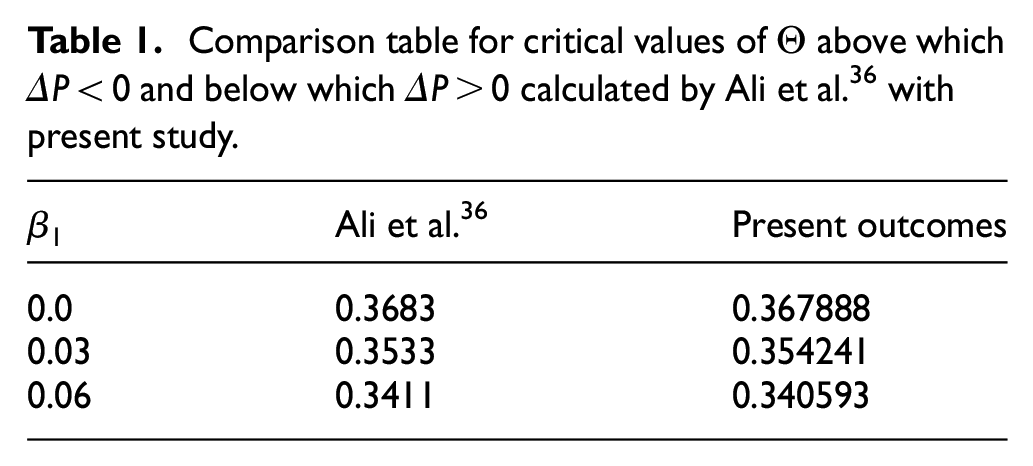
A comparison study is conducted to check the validity of the numerical technique. Numerical values of ΔP from exact solution calculated by Ali et al. 36 and from particular case of the present study are provided in Table 1. Both results have accuracy up to three decimal places which is a good agreement with previous study.
Comparison table for critical values of Θ above which ΔP < 0 and below which ΔP > 0 calculated by Ali et al. 36 with present study.
Conclusions
Electroosmotic peristaltic flow graphene-lubrication oil nanofluid through a symmetric conduit is examined. Effects of Brownian motion, viscous dissipation, thermophoresis and Joule heating are also reckoned. Key features are summarized below:
Temperature rapidly rises at higher Hartman number.
Strong electroosmotic parameter enhances velocity and temperature.
Velocity and temperature declines on the enlargement of the Helmholtz-Smoluchowski velocity.
Concentration decreases for higher values of
Pressure gradient decreases on increasing
Enhancement in pressure rise is noticed in retrograde pumping and co-pumping region while decrement in augment region for strong
The pumping rate decreases on enhancement of
Footnotes
Appendix
Handling Editor: Chenhui Liang
Declaration of conflicting interests
The author(s) declared no potential conflicts of interest with respect to the research, authorship, and/or publication of this article.
Funding
The author(s) received no financial support for the research, authorship, and/or publication of this article.
