



Abstract
In this paper, a new type of thin-walled energy absorbing structure filled with auxetic lattice structure has been proposed. The deformation mode and mechanical responses of the new filled tube under compression load have been studied through quasi-static compression experiment and numerical simulation. A theoretical model for predicting the average compression force has been established and verified with simulation analysis. The influences of the geometrical parameters in the compression performance of the filled tube have been studied. The results show that the failure mode of the filled tube under compression load is local buckling failure. Compared with the single thin-walled tube and the lattice structure, the filled tube has better compression resistance. Through parameter analysis, it is clear that the anti-compression property of the filled tube can be significantly improved by increasing the wall thickness of the cell rod and the angle of the lower support rod, which will provide an important reference for the anti-impact optimization design of the negative Poisson’s ratio lattice filled structure.
Keywords
Introduction
As a traditional energy absorbing structure, thin-walled metal tubes have the advantages of high specific stiffness, specific strength and energy absorbing efficiency, and are widely used in aerospace, automobile, rail transit, and other engineering fields.1–4 In the service process, thin-walled metal tubes often bear axial compression and bending pressure, the deformation mode is unstable in the process of deformation and energy absorption, and its buckling instability limits the energy absorption characteristics. Therefore, the research and optimization of the axial compression property of thin-walled metal tubes has always been the focus of the research in the field of structural impact resistance and energy absorption.5–7
At present, the research on the improvement of mechanical properties and energy absorption efficiency of thin-walled metal tubes mainly focuses on the optimization of cross-sectional shape, axial size, and the addition of fillers. Porous materials such as foam aluminum have been used in the design of thin-walled tube filling because of their good light-weight energy absorption characteristics, which has important practical significance to improve its anti-compression property. Wang et al. 8 carried out a comparative study on the energy absorption characteristics of the hollow thin-walled tube and the polyurethane filled thin-walled tube, verified the superior property of the filled tube, and established an equivalent mechanical model to characterize the interaction between the tube and foam. Wang et al. 9 and Li et al. 10 systematically studied the deformation behavior, failure mode and response characteristics of 3D printed multi-cell filled thin-walled structures under quasi-static and dynamic compression loads, and analyzed the influence of different structural parameters on the energy absorption characteristics of the filled tubes. Wang et al. 11 proposed a partially foam-filled double-tube crash box with combined triggers based on a double tubular structure, and the energy absorption capacity, deformation modes, and protection capability of the improved crash box have been systematically analyzed. Wang et al. 12 proposed a new type of elliptical tube filled with foam. The finite element simulation method was used to analyze the influence of structural parameters such as elliptical radial ratio, wall thickness, and foam density on the energy absorption characteristics of the tube, so as to improve the crashworthiness and safety of the vehicle under oblique impact.
Auxetic mechanical metamaterials are defined as a typical metamaterial with negative Poisson’s ratio, which exhibits transverse contraction phenomenon under longitudinal compression, possessing unusual mechanical properties such as negative Poisson’s ratio, porous lightweight, high specific strength, and impact resistance. 13 The auxetic metamaterials are thus recognized as one of the most promising new super tough lightweight material structures.14–16 Gibson and Ashby 17 first proposed concave hexagonal honeycomb with Poisson’s ratio of −1 on the basis of ordinary honeycomb, and deduced the analytical formula of structural elastic parameters. Lakes 18 first proposed the mechanical metamaterial of six ligament chiral honeycomb structure based on the concept of hand structure with rotatable circular nodes. Gao et al. 19 creatively proposed a negative Poisson’s ratio lattice structure of carbon fiber reinforced composites and its preparation method, and systematically studied the quasi-static compression characteristics in combination with the theoretical model. Baughman et al. 20 compared the equivalent mechanical properties of honeycomb materials with negative Poisson’s ratio in different configurations, and considered that the equivalent elastic modulus and yield strength of the metamaterial structure with double arrow geometry are relatively high, and its static bearing property is also better than other types of negative Poisson’s ratio metamaterials.
In order to further improve the mechanical properties of thin-walled tubes, a new filled thin-walled energy absorbing structure is proposed by combining the double arrow type negative Poisson’s ratio lattice structure with metal thin-walled tubes. The interaction effect is decoupled by classical methods, and its mechanical property characterization model is established and the reliability of the theoretical model is verified by axial compression experiments and numerical simulation analysis. On this basis, the deformation failure mode and mechanical response of the filled thin-wall energy absorbing structure are studied, and the influence of structural design parameters on mechanical properties is further analyzed.
Structural design of new type filled tube
In this paper, the double arrow type negative Poisson’s ratio lattice structure is filled in the square section metal thin-walled tube, thus forming a new filled thin-walled energy absorption structure, as shown in Figure 1. The three-dimensional lattice structure in the figure is formed by a three-dimensional array of double arched cell structures. Each cell structure is composed of eight square cross-sectional bars, which are divided into upper rib bars and lower support bars, the structural parameters in the figure can be expressed as: the half width of the cell is d, and the angles between the upper rib bar and the lower support bar and the vertical direction are respectively θ2, θ1, and the cell rod wall thickness is b.

Structural diagram of new filling tube.
The structural parameters of the square section metal thin-walled tube are: the height of the thin-walled tube is h, the section width of the thin-walled tube is w, and the wall thickness of the thin-walled tube is t.
According to the structural parameters shown in Figure 1, the relative density of the structure is directly related to the crashworthiness of the thin-walled tube. Therefore, the influence of structural design parameters on the relative density is further analyzed ρR can be expressed by the ratio of the actual volume of the structure to the occupied space volume:

In the formula, Vtube, VNPR, V′ are the volumes of thin-walled tube, negative Poisson’s ratio lattice and filled tube respectively, which can be expressed as:



Where, nx, ny, nz are the number of cells in each orthogonal direction of the double headed negative Poisson’s ratio lattice structure, and nx = ny. At the same time, since the lattice structure is tightly filled in the thin-walled tube, the size of the thin-walled tube can be expressed as:


Combining formula (1) to (6), the micro-topological configuration and relative density of the filled tube can be determined through the structural parameters (t, d, b, θ1, θ2, nx, nz).
Experimental design and simulation analysis of axial compression
In this section, the axial compression performance of the filled tube has been further studied through performing quasi-static compression experiment and numerical simulation analysis. The filled tube specimen including the outer thin-walled tube and the filled lattice structure has been fabricated by aluminum alloy T6063 through the selective laser melting (SLM) technique, as shown in Figure 2. The structural parameters of the specimen are set as follows: t = 1 mm, d = 5 mm, b = 1 mm, θ1 = 30°, θ2 = 60°, nx = 2, nz = 6. The mechanical properties of the base material T6063 are set as: elastic modulus E = 81 GPa, Poisson’s ratio μ = 0.25, yield strength σs = 229 MPa.

Axial quasi-static compression experiment of filled tube.
Quasi static compression experiment
The axial compression test has been carried out under the GB/T 1453-2005 on a universal testing system INSTRON 3360 at a constant velocity of 2 mm/min, and the test setup is shown in Figure 2. The specimen was placed between two rigid plates attached to the testing machine. The contact surfaces between the plates and the specimen have been oiled with grease to reduce friction. The total compression displacement is set as 60 mm. The compression load displacement data can be directly measured through the force sensor built in the upper head.
Finite element simulation analysis
The finite element simulation analysis of the compression property in the filled tube surface is carried out based on the HyperWorks software finite element software. The established finite element simulation model is shown in Figure 3. The structural parameters and material properties of the model are consistent with the experimental samples. The two-dimensional five-node Belytschko-Tasy shell element has been used to model the outer thin-walled tube and the lattice structure. Through performing the mesh sensitivity, the basic size for the simulation has been determined as 0.5 mm. The boundary condition is set as the fixed constraint at the bottom of the finite element model, and the top rigid wall moves gradually along the Z axis at a constant speed of 2 mm/min. In order to ensure the convergence of the calculation, the thin-walled tube and the filling structure are defined as face-to-face automatic contact (Type 1), and the structure itself is defined as one-sided automatic contact (Type 7).

Simulation of axial quasi-static compression of filled tube.
Analysis of axial compression property of filled tube
Based on the above experiments and finite element simulation, the deformation mode and load displacement curve of the filled tube under axial quasi-static compression load are obtained, as shown in Figure 4. From Figure 4(a), it can be seen that the deformation failure mode of the filled tube in the quasi-static compression test is basically consistent with the finite element results, which is from the collapse of the middle section to form a standard fold, and then gradually collapse and deform. Additionally, a good agreement can be achieved between the experimental and simulation results on the overall deformation characteristics, proving that the established FE model is reliable. With the verified simulation process, the deformation process of lattice structure from the numerical simulation is also depicted in Figure 4(a). As illustrated, it can be conclude that the deformation mode of lattice structure mainly exhibits a local collapsing deformation in layer by layer along the loading direction until reaching the densification stage. This deformation mode agrees well with that of a typical cellular honeycomb structure. The macroscopic failure mechanism can be summarized as the plastic hinge at the lattice bar joints and local buckling of the lower bars.

Axial quasi-static compression property of filled tube: (a) deformation mode and (b) load-displacement curve.
Figure 4(b) depicts the load displacement curve of the filled tube during compression. It can be seen from the comparison that the experimental results are in good agreement with the finite element results, which indicates that the established finite element model can accurately simulate the axial compression mechanical response of the filled tube. The variation between the results can be attributed to the welded thin-walled tube seam which can improve the bearing capacity under axial compression, possessing a lightly higher load level compared with that of a ideal simulation model as illustrated in Figure 4(b). As depicted in the figure, the compression load curve of the filled tube presents obvious three-stage characteristics: the first stage is the elastic stage, and the load gradually increases with the compression displacement and gradually reaches the initial peak; the second stage is the stage of load oscillation platform. In this stage, the filled tube begins to produce yield deformation, the collapse folds are produced layer by layer, and the load oscillates gradually with the displacement, forming a stable platform stage; the third stage is the densification stage. Both the outer thin-walled tube and the inner filling structure of the filled tube reach the densification strain, and the load rises rapidly. By comparing the characteristic values in the load curve, it can be seen that the initial peak value obtained in the experiment is 41.5 kN and the average collision force is 31.6 kN, and the initial peak value obtained in the simulation is 39.6 kN and the average collision force is 30.2 kN. The error is within 5%, which further verifies the reliability of the finite element results. Figure 4(b) also lists the load displacement curve obtained by axial quasi-static compression simulation for thin-walled tube and lattice structure. Additionally, the load for filled tube (black solid line) has been compared with the sum of bare thin-walled tube and auxetic lattice structure (green divide line) in Figure 4(b). It can be seen that the load superposition of the single thin-walled tube and the lattice structure in the compression process is lower than that of the new filled tube, mainly because the coupling deformation effect between the thin-walled tube and the filled structure in the filled tube improves the bearing capacity and anti-compression property of the structure. The enhancement mechanism can be explained as that the thin-walled tube constrains the collapse of filled lattice structure, and the compacted lattice structure provides continuous support for the tube from global buckling.
Analysis of anti-compression property parameters
Theoretical prediction model of average collision force
In the process of axial compression, the negative Poisson’s ratio lattice structure in the filled tube and the thin-walled tube are coupled and deformed, thus forming the strengthening effect. To further study the axial compression dynamic property of filled tubes, on basis of the theoretical prediction model of average compression force of foam aluminum filled tubes proposed by Wierzbicki and Abramowicz, 21 the theoretical formula of equivalent average compression force Pm of filled tubes with negative Poisson’s ratio lattice structure is established as:

Where, Pt and PNPR are the average collision force of thin-walled tube and filled structure respectively; C1 and C2 respectively represent the coupling enhancement coefficient of the corresponding word structure, taking C2 = C1 = 1.25.
The thin-walled tube absorbs the compression energy by forming the plastic strand energy during the folding deformation. Therefore, the average collision force of the thin-walled tube can be obtained by determining the analytical solution of the film dissipation energy in the deformation region. Figure 5 is a schematic diagram of square thin-wall management proposed by Wierzbicki and Abramowicz. 21 In the figure, AC and CD are horizontal fixed twisted wires, KC and CG are inclined moving twisted wires and the relevant included angle is 2ψ0 and π − 2β, etc.

Schematic diagram of folding deformation of square thin wall management.
For horizontally fixed plastic strands (JK, KL, FG, and GH in Figure 5), the plastic dissipation energy W1 can be obtained by integration as follows:

Where,
And the plastic dissipation energy of the inclined strand

Where, I2(ψ0) represents the second moment of inertia of the thin-walled tube section and I2(ψ0) = 1.11.
In addition to the above two kinds of dissipated energy, when the material is forcibly folded and deformed, an arc-shaped curved surface will be formed at the crease, and the material will also undergo plastic deformation and dissipate energy in this area. The corresponding dissipated energy W3 can be expressed as:

Where, I3(ψ0) represents the second moment of inertia of the thin-walled tube section and I3(ψ0) = 0.58.
According to the work conservation theorem of plastic property, the average collision force Pt is

Taking equations (8), (9) and (10) into equation (11), according to the principle of minimum energy

Wherein, σv represents the yield stress of the filled structural material.
In the process of axial compression, the collapse failure behavior of double arrow negative Poisson’s ratio lattice structure mainly includes plastic hinge, cell wall buckling, and bending failure. As shown in Figure 6, the schematic diagram of compression force in the cell structure plane is established.
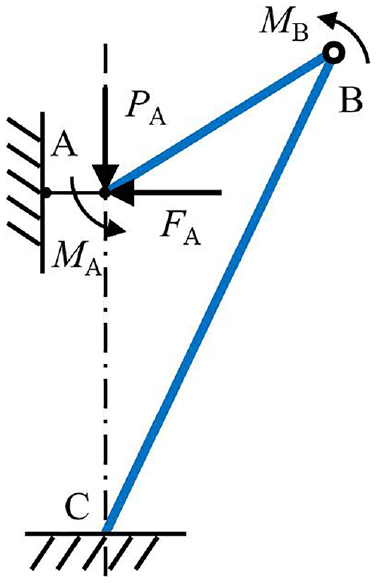
Compression force analysis of double headed negative Poisson’s ratio cell structure.
The displacement of point A in Figure 6 under the action of external force is:

According to the plastic dissipation theory, the plastic dissipation energy at the strand is equal to the work done by the external force:

Where MP represents the plastic bending moment, σ0 represents the equivalent failure stress of cell structure, which can be expressed as:

For an ideal elastoplastic beam with a square section, the plastic bending moment MP can be expressed as:

By combining equations (15) and (16), the equivalent compressive failure stress in the lattice structure plane σ0 can be obtained:

The average compression force Pt of the thin-walled tube obtained by equation (12) and the equivalent failure stress in the plane of the lattice structure obtained by equation (17)σ0 into equation (7), the theoretical expression of the average collision force of the filled tube can be obtained.
Structural design parameter analysis
In order to study the influence of design parameters of negative Poisson’s ratio filled structure on the axial compression property of filled tube,22–26 based on the above theoretical model and finite element model (d, b, θ1, θ2), the parameter influence analysis was carried out. According to the actual parameter limit, the values of the four design parameters are determined as shown in Table 1. When the theoretical model and finite element model are used to analyze the influences of the corresponding design parameters, the remaining structural design parameters remain unchanged.
Structural design parameter change table.

Figure 7 is a schematic diagram of the influence of different design parameters on the average compression force of the filling tube. It can be seen from the figure that the theoretical solution is in good agreement with the finite element solution, and the obtained trend is basically the same, indicating that the theoretical model can accurately predict the average collision force of the filled tube. The influences of different design parameters are as follows:
(1) Cell half width d: As shown in Figure 7(a), with the gradual increase of d, Pm slightly increases, but the change is not obvious, which indicates that the cell half width has little influence on the quasi-static compression property of the filled tube. The change of the cell half width parameter does not affect the meso-topological configuration of the cell structure, but it is related to the macro-structure size of the lattice filled structure. From the change trend of Figure 7(a), it can be seen that the size effect of the quasi-static compression property of the filled tube is not significant within the range of the studied parameters.
(2) Cell rod wall thickness b: In Figure 7(b), the average compression force Pm of the filled tube will increase with the increase of b, and the change trend is obvious, indicating that the cell rod wall thickness has a great influence on the quasi-static anti-compression property of the filled tube, and presents a positive correlation. From the process of establishing the theoretical model, it can be seen that the greater the wall thickness of the cell member, the greater the cross-sectional moment of inertia of the member, the higher the stability of the member, the better the anti-buckling property, and the anti-compression property of the lattice filled structure.
(3) Included angle of lower support rod θ1, included angle of upper rib θ2: In Figure 7(c) and (d), PM varies with θ1, θ2, but the increasing trend is different, the effect of θ1 on PM is obviously stronger than that of θ2. By establishing the mechanical model of the cell structure in the axial compression, it can be seen that the lower support bar mainly bears the axial compression and bending loads, while the upper rib bar mainly bears the axial tension and bending loads. Considering that the plastic hinge and the buckling of the member are the main failure forms in the process of structural compression. The anti-buckling property of the lower support bar is improved when θ1 is increased, which obviously enhanced the anti-compression property of the lattice filled structure. However, when θ2 is increased, the anti-compression property of the lattice filled structure is not significantly enhanced.

Relationship between average compression force of filled tube and design parameters of filled structure: (a) Pm-d relationship curve, (b) Pm-b relationship curve, (c) Pm-θ1 relationship curve, and (d) Pm-θ2 relationship curve.
Conclusions
In this paper, a new type of energy absorbing structure has been proposed by combining the double arrowed lattice structure and thin-walled tube. The deformation mode and compression strength of the proposed structure have been studied experimentally and numerically under axial compression. The conclusions can be summarized as follows:
(1) A good agreement has been achieved between the experimental and simulation results for the proposed filled tube, showing an enhanced compression strength and local buckling collapsing mode.
(2) The enhancement mechanism for filled tube can be explained as that the thin-walled tube constrains the collapse of filled lattice structure, and the compacted lattice structure provides continuous support for the tube from global buckling.
(3) On basis of coupling theory, a theoretical model for the filled tube has established to predict average compression force. With the verified simulation model, theoretical results prove to show great agreement with simulation results on the average compression force of filled tube.
(4) The influence of the meso-structure design parameters of the lattice structure on the compression performance of the filled tube has been studied through parameter analysis. The wall thickness of the cell rod and the angle between the lower support rod have a great influence, while the angle between the upper rib rod and the half width of the cell have a small influence. This conclusion provides an important reference for the anti-impact optimization design of the negative Poisson’s ratio lattice filled structure.
Footnotes
Handling Editor: Chenhui Liang
Declaration of conflicting interests
The author(s) declared no potential conflicts of interest with respect to the research, authorship, and/or publication of this article.
Funding
The author(s) disclosed receipt of the following financial support for the research, authorship, and/or publication of this article: Thanks for the funding of Key Project of Natural Science Research in Colleges and Universities of Anhui Province (Grant Nos. KJ2017A581, KJ2021A1210, 2022AH052431), Quality Engineering Project of Anhui Province (Grant No. 2020jxtd238), Key Projects of the Support Plan for Outstanding Young Talents in Colleges and Universities of Anhui Province (Grant Nos. gxyqZD2016555, gxyqZD2021162).
