



Abstract
This study was conducted to mathematically evaluate the impact of forced convection of viscous dissipation on a porous media filled with Williamson fluid and exposed to fixed surface heat flux. The technique of Darcy_Forchheimer_Brinkman was employed, then the non-dimensional equations were solved numerically over a flat plate by using bvp4c through the MATLAB package. Different parameters were examined including the profiles of velocity, temperature and shear_stress in addition to Nusselt Number. Furthermore, the study evaluated the effects of several essential parameters, including Forchheimer, Darcy, porous media, Williamson, and viscous dissipation, on the temperature and velocity profiles, heat transfer and friction coefficients. The numerical solution results showed that, under high Forchheimer_parameter values, all, shear_stress, Nusselt_number parameter and temperature showed an increase in their values. Also, as Williamson_parameter increased, the shear_stress and boundary layer velocity were improved, while a decrease in Nusselt_number caused an increased in values of temperature profile. Finally, the boundary layer of velocity and shear_stress showed an increase in their values when Darcy parameter increased. On the other hand, a decrease in the temperature profile and Nusselt_number were observed.
Keywords
Introduction
Research on fixed laminar flow along a vertical standing heated plate should consider the viscous dissipation of the fluid, which involves precise mathematical methods to solve the equations of boundary_layer. Both upward and downward flows are analyzed in the case of isothermal and uniform flux. A recent study revealed that the interface between viscous heating and buoyant force was significantly affected the outcomes. 1 Another study reported the steady flow of Williamson fluid boundary layer. 2 Using similarity conversions, the non-linear PDEs were transformed into ODEs in four Williamson fluid flow problems comprising Sakiadis, Blasius, stretching, and stagnation point flows. The Homotropy Analysis Method (HAM) was employed to achieve the series solutions. The study also examined the effect of Weissenbergnum-ber on the skin-friction coefficient and velocity via tabular and graphical data.
Furthermore, the Darcy-Forchheimer-Brinkman model was utilized to determine the forced convection of a non-Newtonian Casson fluid laminar boundary layer flow across an isothermal flat plate in a non-Darcy porous media. 3 In addition to the effect of viscous dissipation on the isothermal vertical flat plate in a fluid-saturated porous condition, numerical approaches were applied to study the impact of thermal dispersion on the natural, forced, and mixed convection heat transfer of the Darcy-Forchheimer model. 4 Meanwhile, a published report evaluated the similarity numerical solution of Magneto Hydrodynamics (MHD) for free convection heat and mass_transfer of an incompressible and electrically conductive together with viscous fluid above an inclined stretched sheet with fixed heat flux and viscous dissipation. 5 Also, the Nano-Williamson fluid was considered as a two-dimensional flow through a stretched sheet under the effects of Nano particles sizes. 6
Recently, a study by AlMasa’deh and Duwairi 7 demonstrated analytically and numerically flow of fluid and heat transfer within a saturated porous medium impenetrable conduit at a fixed heat flux. Besides, the mathematical study was performed to figure out the slip effects and radiation in a fully developed incompressible Newtonian fluid Williamson flow. 8 Moreover, the Duwairi et al. 9 found that the increase in squeezing and extrusion of a viscous fluid in an unstable approach between two parallel plates at fixed temperature caused a decrease in the fluid velocity and enhanced the rates of heat transfer. Additionally, Kausar et al. 10 studied the Darcy_Brinkman flow across a stretched sheet in the existence of frictional heating and porous dispersion.
In order to study the Forchheimer non-Boussinesq natural convection heat transport of water at approximately 4°C, Osman and Duwairi 11 analyzed flow in enclosure with different inclination angle (Ø) and aspect ratio (A), under modified Rayleigh number (Raw), and the non-Boussinesq-approximation exponent (n), which were verified as dimensionless parameters. Nevertheless, the buoyancy forces and mass flow rates were enhanced by the modified Rayleigh number, leading to the increased mean of the Nusselt_number. In another study, Nadeem et al. 12 reported a 2D flow of the Williamson fluid model across a stretched sheet. The study simulated the governing equations of the pseudoplastic Williamson fluid before reducing the formulation using the similarity transformation and boundary layer technique. Meanwhile, Khan explored the Williamson fluid flow model by using a chemically reactive species through 2D flows of the scaling transformation approach under the Reynolds and Weissenberg numbers approximation. 13
Previously, Megahed 14 evaluated the non-linear stretched sheet of Williamson boundary layer and heat transfer fluid flow. The developed model also included the analysis of the thermal radiation and viscous dissipation processes, which was a crucial component of the study. It was assumed that more precise data was required since the viscosity and fluid conductivity fluctuated with the temperature change. Apart from that, Hashim et al. 15 determined the performance of heat transfer of Williamson fluid over a stretched plane subjected to viscous dissipation and slip circumstances under stagnation flow. Using the similarity transformation, the DEs were converted into non-linear ODEs, and solved numerically by Runge-Kutta-Fehlberg (RKF) method. Furthermore, Hayat et al. 16 evaluated the flow of MHD Williamson fluid through an axis symmetry conduct. the porous channel material was filled with an incompressible fluid. The standard technique for modeling was performed in the analysis.
Numerous attempts have focused on non-Newtonian fluids through the utilization of incorrect classical Darcy’s law of viscous fluid. For instance, Duwairi and Al-Khliefat 17 applied the Darcy model to study slip velocity influences on the convection heat transfer from a vertical plate underneath a saturated porous media. The governing equations, Darcy law, energy, and continuity were modified into dimensionless forms via a sufficient collection of dimensionless variables. Additionally, Amanulla et al. 18 studied the 2D laminar and natural convective heat transfer flow in an electro_conductive polymer on the vertical plate under slip effects and radial magnetic field. Using the non-similarity transformation, the PDEs were converted into the standard ODEs. Bai et al. 19 A model of Darcy-Forchheimer-Brinkman is used, and the corresponding governing equations are expressed in dimensionless forms and solved numerically using bvp4c with MATLAB package. Boundary layer velocity, shear stress, and temperature profiles, in addition to the local Nusselt number parameter over a horizontal plate, is investigated. Quran et al. 20 developed forced convective flows in a channel, which filled with axially porous materials in order to explore temperature distribution along the wall.
The use of Williamson fluid starts to receive considerable importance because of the need to store thermal energy using different none Newtonian fluids, In view of the recent literature reports, this study will be performed to develop mathematical (governing equations) models, then solving the governing equations Numerically by using MATLAB built in bvp4c techniques to evaluate the heat transfer performance of forced convection of (Non-Newtonian) Williamson fluids existing in full porous media exposed to a fixed surface heat flux and under effect of viscous dissipation which is not discussed and covered in previous studies and the literature. The study also will explore the impact of the Darcy parameter, Forchheimer_parameter, porous_media, Williamson_parameter and viscous dissipation factotrs on the velocity distribution and the distribution of temperature, shear_stress, friction coefficient, and finally heat transfer coefficient.
Mathematical modeling
Figure 1 illustrates the schematic diagram of the flow and applied coordinate system used under consideration.

Schematic diagram of the flow.
Considering 2D incompressible flow through a porous media with viscous dissipation across a fixed horizontal surface heat flux under steady state condition, the flow is laminar, and the solid matrix is stationary, the working fluid is a Williamson fluid with given shear stresses in momentum equations, the governing equations are as follows 4 :


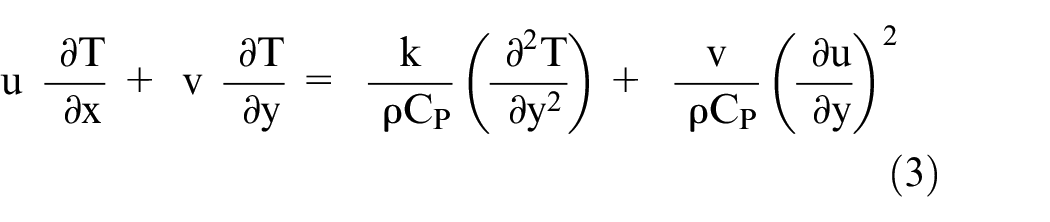
The boundary conditions are shown below:


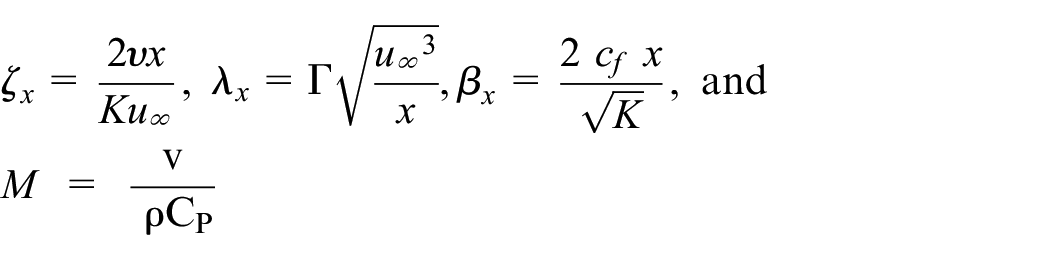
The non-dimensional conversion parameters will be as shown below:





When the parameters of conversions are applied, then the governing equations become:


Neglecting Williamson parameter,
Nadeem et al. 12 stated that the Nusselt_number and the skin-friction coefficient were associated with the temperature gradients and wall velocity profile, respectively:


The non-dimensional form of coefficient of the skin-friction will be as:

And:


Eventually, the dimensionless form of the Nusselt_number becomes:

Numerical solution
The non-linear and two differential (coupled) equations (9) and (10) according to boundary conditions were solved (mathematically) via the Runge-Kutta method which consists of a built-in routine bvp4c in MATLAB with the shooting technique, to get
Based on the mathematical methods, the initial step to solve equations (9) and (10) was converting them to a non-linear coupled_differential equations system, as shown in the following expression:

The solution applies the boundary conditions, as follows:

Validation
Next, the equation of the system is solved using the bvp4c code in MATLAB, which employs the finite difference method with the commonly known three-stage Lobatto IIIa formula. This collocation expression produces a fourth order continuous solution in the specified intervals. The error control and mesh sizing relied on the residual solution. Ultimately, the obtained codes were compared with the results from past studies,21,22 as shown in Table 1 to verify the overall findings of the present study.

Results and discussion
Boundary layer_velocity profiles for various values of Forchheimer_parameters,
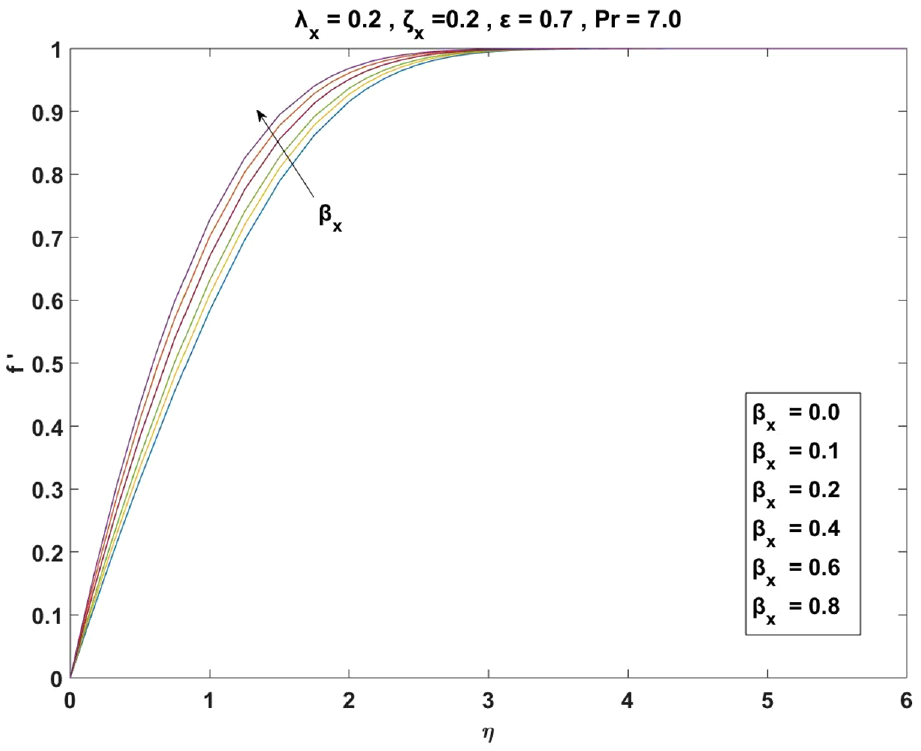
Effect of Forchheimer parameter (

Effect of Darcy parameter (

Effect of porosity (ε) on velocity profile.

Effect of Williamson_parameter (
As illustrate in Figure 6, the profiles of shear_stress using various Forchheimer_parameters,

Effect of Forchheimer parameter (

Effect of Darcy parameter (ζx) on shear stress profile.

Effect of porosity (ε) on Shear stress profile.

Effect of Williamson_parameter (λx) on Shear stress profile.
Figures 10 to 15 illustrate the impact of the Williamson, viscous dissipation, Darcy, Forchheimer, and porosity_parameter on the temperature profiles of the boundary layer. In Figure 10, the distribution of temperature in boundary layer under varying Forchheimer_parameter,

Effect of Forchheimer parameter (

Effect of Darcy parameter (ζx) on temperature profile.
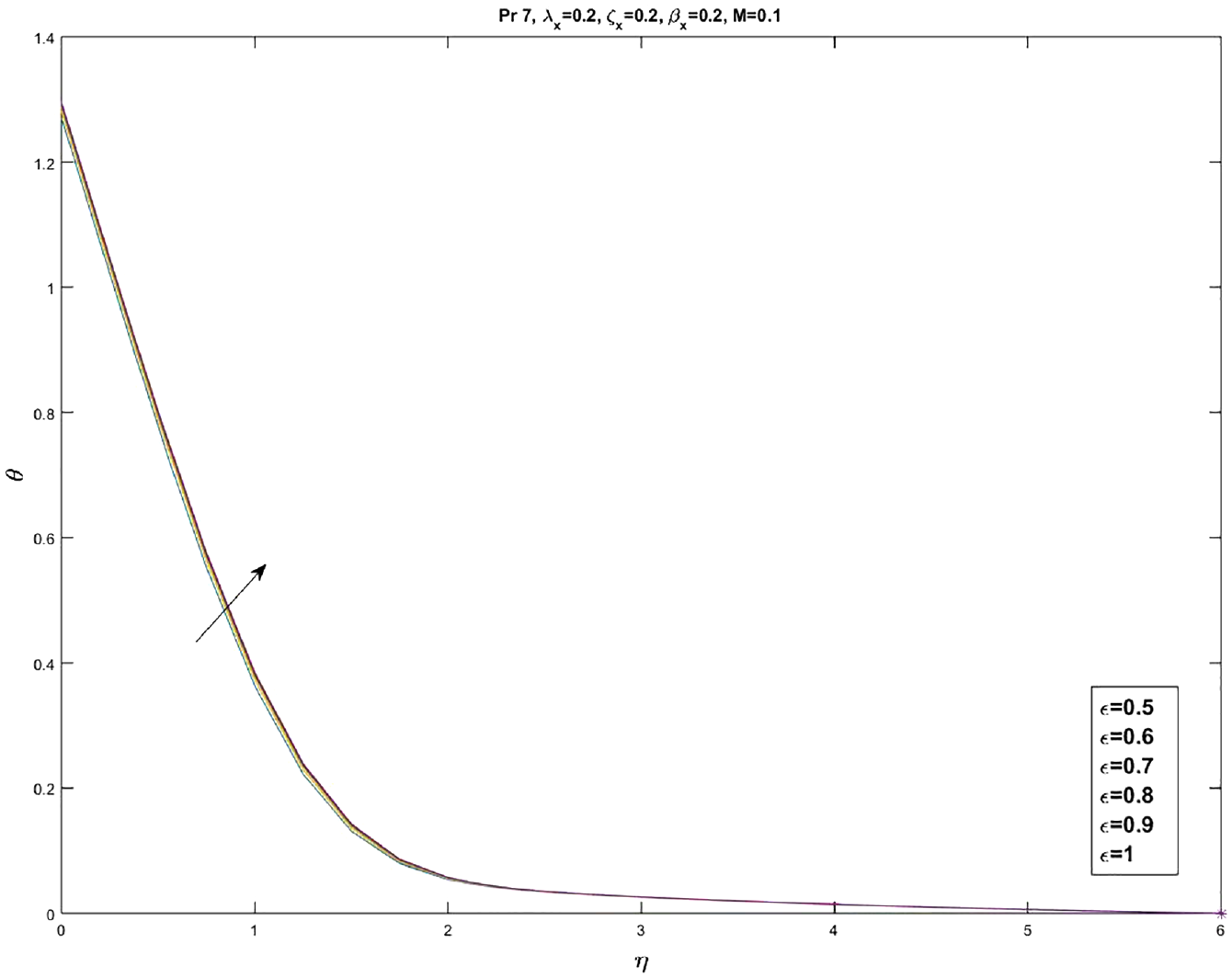
Effect of porosity (ε) on temperature profile.

Effect of Williamson_parameter (λx) on temperature profile.

Effect of viscous dissipation_parameter M on temperature profile.

Effect of Prandtl number Pr on Temperature profile.
Figures 16 to 20 depict the various influences of the Williamson, Forchheimer, porosity, and viscous dissipation parameters on the Nusselt_number. Specifically, the Nusselt_number at various Forchheimer_parameters,

Effect of Darcy parameter (ζx) on Nusselt Number for different

Effect of Darcy parameter (ζx) on the Nusselt Number for different
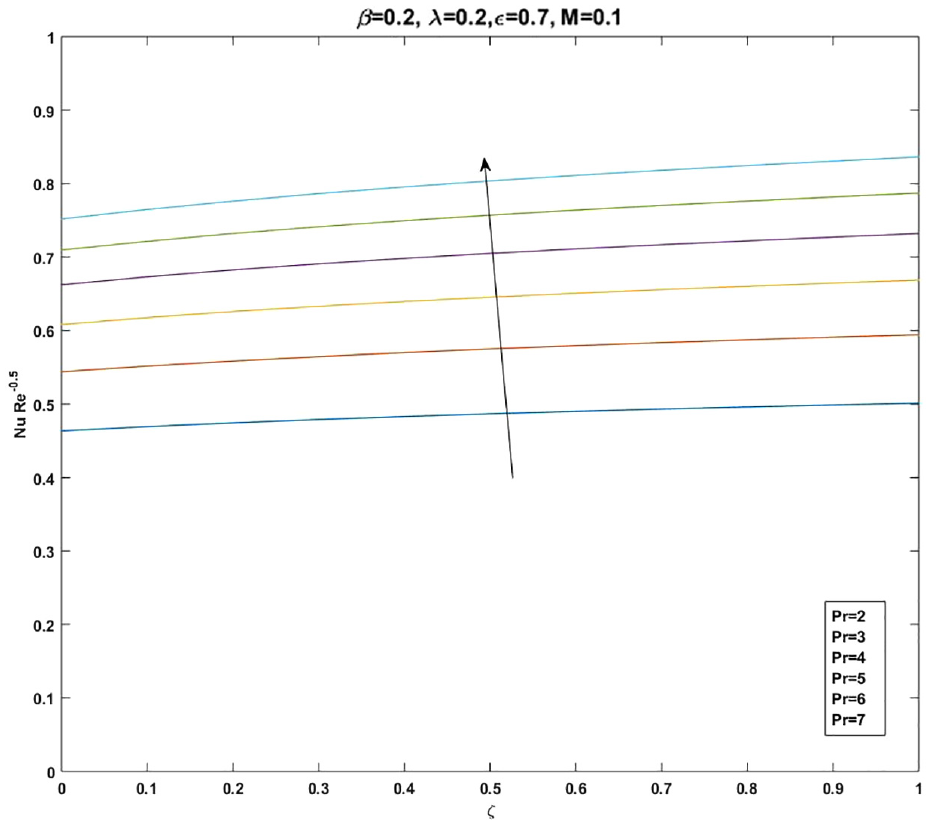
Effect of Darcy parameter (ζx) on the Nusselt Number for different

Effect of Darcy parameter (ζx) on the Nusselt Number for different

Effect of Darcy parameter (ζx) on the Nusselt Number for different
Conclusion
This paper presented the results of mathematical findings of the problem under consideration. Several conclusions can be pointed out:
i. Under higher values of the Forchheimer_parameter, all distributions of the boundary_layer velocity, the shear_stress, the temperature, and the Nusselt_number showed an increasing in their values.
ii. The velocity and shear_stress of the boundary layer showed an increase in their values when Darcy parameter increased. on the other hand, a drop in the temperature profile and the Nusselt_number were observed.
iii. The opposite responses to Darcy parameter were found for arise in the porosity_parameter with the velocity and the temperature profiles of boundary layer. while an increase in the shear_stress and the Nusselt_number were resulted.
iv. As Williamson_parameter increased, the shear_stress and boundary layer velocity were increased, while a decrease in Nusselt_number caused an increased in temperature profile.
v. A decrease in Nusselt_number and an increase in temperature profile were observed when viscous dissipation parameter was increased.
vi. An increase in Prandtl number, Pr led to increase in both Nusselt_number and temperature profile.
Future work
Extend the present study by considering the effect of magnetic field on model flow. In addition, it is intended to study the model flow exposing the heat flux to vertical flat plate.
Footnotes
Appendix
Handling Editor: Chenhui Liang
Declaration of conflicting interests
The author(s) declared no potential conflicts of interest with respect to the research, authorship, and/or publication of this article.
Funding
The author(s) received no financial support for the research, authorship, and/or publication of this article.
