



Abstract
The building walls temperatures are different, and there are radiation heat transfers between the walls, which have the characteristics of multiple reflections and multiple absorptions. The Gebhart absorption coefficient considers the radiation energy both directly absorbed by the wall and indirectly absorbed by other walls multiple times reflections. The absorption coefficient Gij is used to represent the proportion of radiation energy absorbed by surface j from the radiation energy of surface i. Through employing Gebhart absorption coefficient, the Gebhart absorption coefficient matrix is constructed based on the wall angle factors and the wall radiation emissivity. The building thermal environment solution model is established, which can calculate the indoor air temperature and wall temperature. The wall radiation heat transfer calculation model is built to calculate the net radiation heat transfer of the walls. An experimental bench was carried out to verify the above theoretical calculation results. The research results showed that the theoretical calculated values of the air temperatures of the building thermal environment solution model were basically consistent with the measured values, and the deviation was within 0.25°C. The deviation between the calculated values of the wall temperatures and the measured values was basically within 1.0°C. The error between the calculated values of the wall radiation heat transfer calculation model and the measured values varied within a small range. The Gebhart absorption coefficient is more appropriate in characterizing radiation heat transfer mechanism of the walls, and it provides a new way and thought for the analysis of radiation heat transfer on building wall.
Keywords
Introduction
The object surface transmits energy to outside world in the form of radiation. There is radiation heat transfer between the two wall surfaces with different temperatures. The high temperature surface shows net radiation heat loss, and the low temperature surface shows net radiation heat gain. Radiation from high temperature objects, such as sunlight, lighting lamps, etc., exists in the form of short-wave radiation. Radiation from normal temperature objects, such as radiation between building walls, exists in the form of long-wave radiation.1,2The exterior and interior of the building have different wall temperatures and widespread radiation heat transfer. Whether for the traditional convection air conditioning, or the air conditioning system that combines radiation and convection, the analysis of radiation heat transfer plays an important role in the determination of the cooling capacity and the analysis of energy consumption.3–5 At the same time, the thermal comfort of human body is mainly affected by air temperature, relative humidity, airflow velocity, ambient radiation temperature and other factors. Especially for radiation air conditioning, the radiation heat transfer has a great impact on human thermal comfort.6–8
Affected by the external solar radiation, for the whole room convection air conditioning, there is heat conduction of the non-transparent envelope inside, and convection heat and radiation heat on the inner surface. The temperatures of the ceiling and the exterior wall surface are higher than the temperatures of other interior wall surfaces, and there are radiation heat transfers.9,10 At the same time, the heat dissipation of indoor heat sources, equipment and other heat sources can be separated into convection heat and radiation heat, in which radiant heat also exists between the heat source and the building inner surfaces.11–13 The radiation heat is absorbed by the building interior walls, and then released into the indoor air as air conditioning load. Since indoor heat gain and air conditioning load are distinguished, the conversion calculation of radiation heat gain transformed into air conditioning load has become an important spot in the determination of air conditioning load.14,15
For radiation heating air conditioning room, hot water passes through the coils of the radiant panel. The surface temperature of the radiant panel is significantly higher than that of other walls, there is radiation heat transfer between the radiant panel and other walls, and the wall temperature of other envelope structures rises. Under the combined action of the radiation panel and other walls, the indoor air temperature rises. Compared with traditional convection air conditioning, the wall temperatures of the radiation heating room are rising. The radiation heat transfer with the human body is enhanced, and the thermal comfort of the human body is also greatly improved.16,17 Similarly, for the radiation cooling air conditioning system, the cooling radiation panel mainly bears the sensible heating load, and the latent heating load and the fresh air load are mainly undertook by the independent fresh air. The surface temperature of the radiation panel is low, which reduces the temperature of other walls, thereby reducing the indoor air temperature. The radiation load bore by the radiation panel is an important part of the radiation air conditioning load. At the same time, due to the low temperature of the radiation panel, radiation cooling air conditioning system directly conducts radiation heat exchange with the human body, which can improve the thermal comfort of the human body.18–20
Due to the high height and large volume of large space building, the persons are in the lower area, and stratified air conditioning is often used. The stratified air conditioning divides the indoor area in the height direction through airflow organization, forming the upper non-air conditioning area and the lower air conditioning area, and the temperature in the upper area is significantly higher than that in the lower area.21,22 The wall temperature of upper non-air conditioning area, especially the ceiling, is significantly higher than that of the lower air conditioning area, and there is radiation heat transfer between the upper non-air conditioning area walls and the lower air conditioning area walls. The lower air conditioning area walls absorb the radiation transfer heat from the upper non-air conditioning area, which leads to an increase in the wall surface temperature of the air conditioning area and an increase in the cooling load of the stratified air conditioning area. At the same time, the airflow velocity of air conditioning in large space building is relatively high, and the personnel distribution is relatively dense, which also have a great impact on the personnel thermal comfort in the lower air conditioning area.23,24
The building wall heat transfer is under coupling effect of convection heat and radiation heat between walls affected by other walls. Therefore, it is the key to seek a practical wall temperature prediction method, which is influenced by other wall temperatures and indoor air temperature. The calculation of wall temperature and indoor air temperature are the basis of building thermal environment analysis, and the basic parameters of air conditioning load determination and thermal comfort analysis.25–27 The building wall includes the heat conduction, convection heat and radiation heat process. By the building wall and indoor air, heat balance equations can be established, and the wall temperature and air temperature can be calculated. When establishing heat balance equations for the walls, it is necessary to select an appropriate radiation model according to the radiation heat transfer mechanism between the building walls.28–31 As seen that radiation heat transfer plays an important role in the prediction of thermal environment.
For the calculation of radiation heat transfer between walls, on the basis of obtaining the thermal conduction of the enclosure structure, the radiation heat gain can be obtained by multiplying the thermal conduction by the radiation proportional coefficient, and then the radiation heat gain of each wall can be determined by using the distribution coefficient method.32,33 Radiation heat transfer between walls can also be calculated according to the wall temperature, angle factor and radiation emissivity by establishing a calculation equation. For the building wall, after reaching other walls, part of the emitted radiation energy is absorbed, and the rest is reflected by other walls. The reflected part is transmitted to other walls again, absorbed and reflected by the walls again, and continuously reflected and absorbed until the absorption is completed.34,35 Therefore, the building walls possess radiation energy emitted by itself, absorbed radiation energy from other walls and reflected energy.
Whether it is a thermal environment prediction model or a radiation heat transfer calculation model, the radiation heat transfer mechanism of the wall surface needs to be considered when establishing the corresponding calculation equation. When considering the wall radiation model, there are currently effective radiation model, direct radiation model and Gebhart radiation model. The effective radiation model is the most widely accepted and most accurate radiation model, so many scholars use the effective radiation model in the analysis of building thermal environment.36,37 The direct radiation model is essentially a simplification of the effective radiation model, greatly reducing the amount of computation, thus it is widely used.38,39 The Gebhart radiation model is a new radiation model. The absorption coefficient Gij is used to represent the proportion of radiation energy absorbed by surface j from surface i, which includes direct radiation energy and indirect radiation energy by reflection radiation.40–42
For the whole room convection air conditioning, radiation air conditioning system and stratified air conditioning in large space building, radiation heat transfer is of great significance for air conditioning load determination, thermal environment analysis and energy consumption simulation. In the thermal environment prediction model and the radiation heat transfer calculation model, effective radiation model, direct radiation model and Gebhart radiation model are all applied. Compared with effective radiation model, the Gebhart model brings convenience to the calculation of the radiation heat transfer between walls; compared with direct radiation model, the calculation accuracy is improved, and more and more attention is paid on it. However, there is a lack of systematic research on the Gebhart radiation model in the current literatures, which is the focus of this paper.
Based on the above discussions, this paper investigates the application of Gebhart absorption coefficient in building thermal environment solution and radiation heat transfer calculation. Firstly, analyze the characteristics of wall radiation heat transfer, and structure Gebhart absorption coefficient matrix. Secondly, establish building thermal environment solution model based on Gebhart absorption coefficient, which can be used to calculate wall temperature and indoor air temperature. Finally, build radiation heat transfer calculation model based on Gebhart absorption coefficient to calculate the radiation heat transfer between walls. Meanwhile, set an experimental system to verity the calculation results of the thermal environment solution model and the radiation heat transfer calculation model. The research results provide a systematic and rigorous reference for the application of the Gebhart absorption coefficient.
Theoretical model establishment procedure
Derivation process of Gebhart absorption coefficient matrix
The Gebhart absorption coefficient Gij represents the proportion of radiation energy absorbed by surface j from the radiation energy of surface i, which includes radiation energy directly absorbed by surface j from surface i, and also includes radiation energy indirectly absorbed by surface j, which emits from surface i when reflects by other surfaces. The radiation energy, which emits from surface i, is reflected by surface k, and the absorption coefficient Gkj obtains the radiation energy ratio absorbed by surface j from surface k, and so on. Thus, the total radiation energy amount Qij, which obtains by the surface j from the energy radiation of surface i, is:1,5

Where Ei is radiation energy of wall i, W; εi is radiation emissivity; σ is Stephenson-Bolmanz number, 5.67 × 10⁻⁸ W m−2K−4; Ti is wall temperature, K; Si is wall area, m2; Xij is angle factor.
The radiation energy is emitted by surface i, the part is absorbed directly by surface j, and other parts are reflected by surface k (k = 1, 2, 3, …, N) and then absorbed by surface j. Specifically, the absorption coefficient Gij may be expressed by equation (2), and it is shown as:
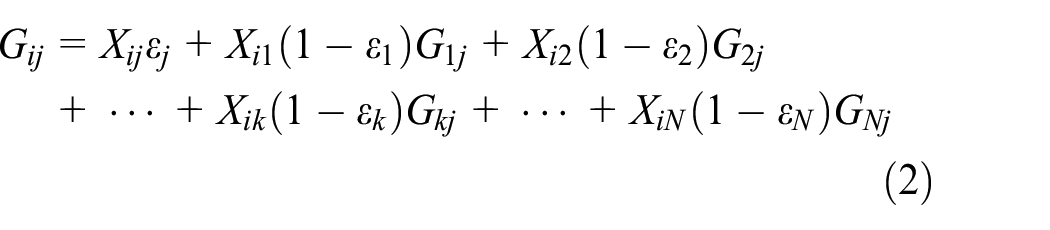
There are N (i = 1, 2, 3, …, N) surfaces, the absorption coefficient Gij of surface j on each surface i, which can be expressed by equation (3), and as shown:40–42

Furthermore, for indoor wall surface i (i = 1, 2, 3, …, N) and all surfaces are flat (Xii = 0), the above can be written in matrix form as shown in equation (4):

For building envelope with N surfaces, there is radiation heat transfer between each two surfaces, and it namely has N × N Gebhart absorption coefficients. According to the equation (4), extend the surface j (j = 1, 2, 3, …, N) and it can be written in the matrix form as shown in equation (5):

The equation (6) can be obtained by the matrix form transformation from equation (5), and the Gebhart absorption coefficient matrix can be calculated.

For the above N × N linear equation, it can be written in a simplified form of equation (7). It can be seen by equation (7), when the surface radiation emissivity εi and angle factor Xij are known, the Gebhart absorption coefficient Gij can be solved by the N × N linear equation.

In equation (7):

Establishment process of building thermal environment solution model
According to the above Gebhart absorption coefficient in Section 2.1, the wall thermal balance equation is constructed based on heat conduction, convection heat transfer and radiation heat transfer. The indoor air thermal balance equation is constructed based on convection heat transfer and heat quantity difference between supply air and return air. The solution model can simultaneously calculate wall temperature and indoor air temperature, namely the building thermal environment solution model.
Using the interchangeability and integrity of the surface radiation angle factor, the Gebhart absorption coefficient of the interior building wall also has the interchangeability and integrity, namely:

The wall surface i exists the radiation heat transfer with all other walls, and its net radiation amount obtained from the indoor radiation heat exchange is:3,9

Where qRi is the radiant heat flow of the wall i, W m−2. Equation (8) can be simplified by linearization method, and the net radiation heat flow of the wall i is shown as in equation (9).

Where
Based on the Gebhart absorption coefficient, wall thermal balance equation can be constructed by thermal conduction, convection and radiation, and it is shown as in equation (10). Meanwhile, the indoor air temperature is assumed uniform and it equals to the return air temperature. Take indoor air as the control body. Establish the indoor air heat balance equation, and it is shown as in equation (11). 14


Where α di is the convection heat exchange coefficient of wall i,W m−2K−1; t is indoor air temperature, °C; qλi is thermal conduction heat flow of wall i,W m−2; L is supply air rate, m3 min−1; Cp is supply air specific heat, J kg−1K−1; ρs is supply air density, kg m−3; th is return air temperature, °C; ts is supply air temperature, °C.
For indoor wall i (i=1, 2, 3, …, N), it has N wall thermal balance equations. For indoor temperature uniform environment, the indoor air thermal balance equation formed as equation (11). The building thermal environment solution model based on Gebhart absorption coefficient consists of equations (10) and (11), specifically:
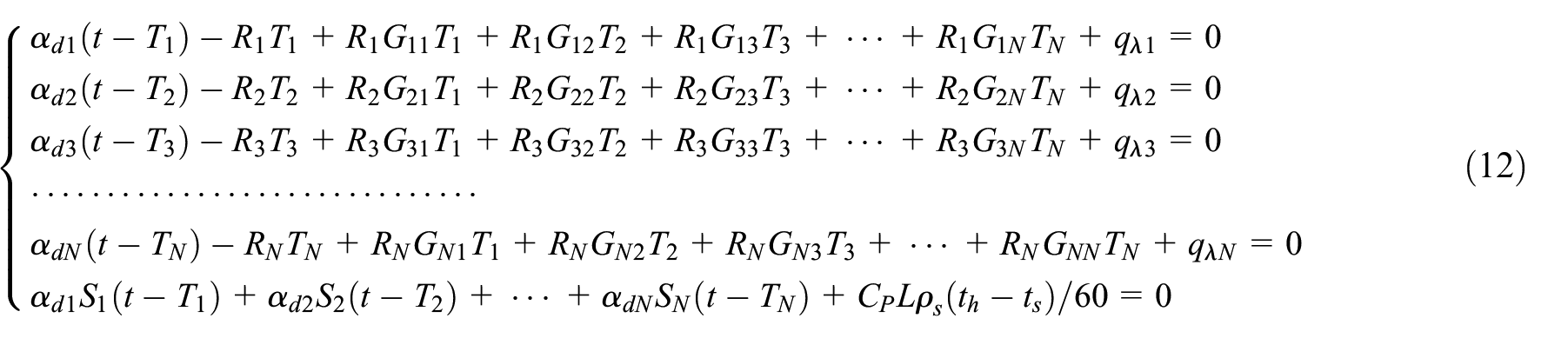
Equation (12) is a linear equation system (N + 1), and it can calculate wall temperatures and indoor air temperature by envelope parameters and supply air parameters. Equation (12) can be written as the matrix equation as shown in equation (13).

Where:


In the building thermal environment solution model, A, B, C are sub coefficient matrix, and they can be calculated by the building envelope and supply air parameters. D, E is a constant term sub matrix. As a model boundary condition, they can be calculated by pre-experiment and experimental conditions.
Construction process of radiation heat transfer calculation model
Based on the above Gebhart absorption coefficient in Section 2.1, the radiation heat transfer calculation model is established by wall radiation emissivity, angle factor, wall area and wall temperature etc. The radiation heat transfer between the wall surfaces can be calculated by Gebhart absorption coefficient, wall temperature and other parameters, and the net radiation exchange heat of the wall surface can be calculated. According to equation (1), for the indoor wall i (i = 1, 2, 3, …, N), the radiation energy absorbed by the wall j from all the walls is shown as follow in equation (14).6,22

Furthermore, the wall j is extended to j (j = 1, 2, 3, …, N), according to the radiation energy Ei of each wall and the Gebhart absorption coefficient, and the radiation energy Qij can be calculated by equation (15):

By equation (15), the radiant exchange heat φij between the wall i and the wall j can be calculated as follow in equation (16). 36

According to the radiation heat transfer characteristics between wall surfaces, the radiation exchange heat between walls can be calculated by equation (17).

On the basis of obtaining the radiation exchange heat between walls, for the interior wall surface i (i = 1, 2, 3, …, N), the net radiant heat Qi of each wall surface is shown in equation (18).

For radiation heat transfer calculation model, the Gebhart absorption coefficient is calculated by the wall radiation emissivity and angle factor. For different conditions, when the wall temperature changes, the Gebhart absorption coefficient of the building wall remains unchanged. By recalculating the radiation energy Ei of each wall surface, combined with the Gebhart absorption coefficient matrix, the net radiation heat transfer Qi of each wall can be calculated again.
Calculation program description
In the construction process of the above theoretical model, the building thermal environment solution model is constructed to calculate wall temperature and indoor air temperature, and the radiation heat transfer calculation model is established to calculate the net radiation heat transfer of each wall. The flow diagram of calculation program of the theoretical model is shown in Figure 1, The theoretical model is computed iteratively by excel spreadsheet and the flow diagram is described as follows:
(1) As shown in Section 2.1, build the matrix equation composed of wall radiation emissivity and angle factor of each wall, and the Gebhart absorption coefficient matrix can be obtained through the matrix calculation.
(2) According to Section 2.2, as shown in dotted green box on the left in Figure 1, construct the wall thermal balance equation based on the heat transfer analysis of the wall heat conduction, convection and radiation. Establish the indoor air thermal balance equation based on wall convection heat transfer and heat energy difference between supply air and return air. Through the building thermal environment solution model, wall temperature and indoor air temperature are obtained by using the building envelope parameters and the supply air parameters.
(3) According to Section 2.3, as shown in dotted blue box on the right in Figure 1, based on the above Gebhart absorption coefficient, the radiation energy Ei of each wall can be calculated by the wall temperature, wall radiation emissivity and other parameters. The radiation exchange heat between any walls can be calculated according to the Gebhart coefficient matrix, and the net radiation heat transfer can also be calculated.
(4) In the above theoretical model, the building thermal environment solution model and the radiation heat transfer calculation model can also be applied independently. If the wall temperature and indoor air temperature are required, output the wall temperature and indoor air temperature calculation results after completing dotted green box on the left in Figure 1. If the wall net radiation heat transfer is required and wall temperatures are known, the wall net radiation calculation results are output after dotted blue box on the right in Figure 1 is completed.

Flow diagram of calculation program.
Experiment descriptions
Experimental system and test scheme
The experimental system mainly consists of laboratory suite, environmental test room, cold source system, air treatment unit, electrical control and test system, etc., as shown in Figure 2(a)). The environmental test room (length × width × height) is 4.9 m × 3.5 m × 2.5 m and the enclosure is made of 100 mm thick polyurethane insulation storage plate. The south wall of the environmental room is attached with electric heat film to simulate the wall heat conduction, and the electric heat film heating power is controlled by the regulator. Supply air was cooled by the surface cooler and the air temperature set at 20°C. The electric heating could be adjusted in proportion, and electric heating reheat was controlled by Programmable Logic Controller (PLC). The supply air rate was adjusted and stabilized by the frequency conversion fan.

(a) experiment system diagram: 1 – Expansion tank, 2 – three-way valve, 3 – chilled pump, 4 – refrigeration machine, 5 – cooling pump, 6 – cooling tower, 7 – filter, 8 – surface cooler, 9 – electri heater, 10 – nozzle, and 11 – frequency conversion fan and (b) layout diagram of the test points.
The layout of the test points is shown in Figure 2(b)). Indoor air testing had 20 temperature measuring points, five measuring lines were evenly arranged on the horizontal surface. Each vertical line had four measuring points and the heights were 0.5, 1, 1.5 and 2 m respectively. Five temperature measuring brackets could be moved freely to facilitate the reasonable arrangement of the measurement points. The supply air outlet and return air outlet were all 0.4 m × 0.4 m, and each had one temperature measuring point at the center. There were two measuring points on the south wall of the heating surface, and the height was 1.25 m from the ground, and at 1.6 and 3.2 m from east wall. Other walls had one measuring point arranged at the center of the corresponding wall respectively. There was one measuring point in the laboratory suite outside the environmental test room.
The performance parameters of test instruments used in this experiment are shown in Table 1. Among them, indoor air temperature, supply air temperature and return air temperature were measured by homemade thermocouple. Inner wall temperatures were measured by thermocouple and infrared camera. Supply air rate and return air rate were measured by air volume hood. The experimental instruments were calibrated before going to use to ensure measurement precision. The wall emissivity was determined jointly by the infrared camera and the thermocouple. The inner wall temperature was measured by the thermocouple. By adjusting the wall emissivity in the infrared camera, so that the wall temperature measured value was the same value as the thermocouple, and the emissivity of the corresponding wall surface could be obtained.
Experimental test equipment and performance.

Experimental conditions
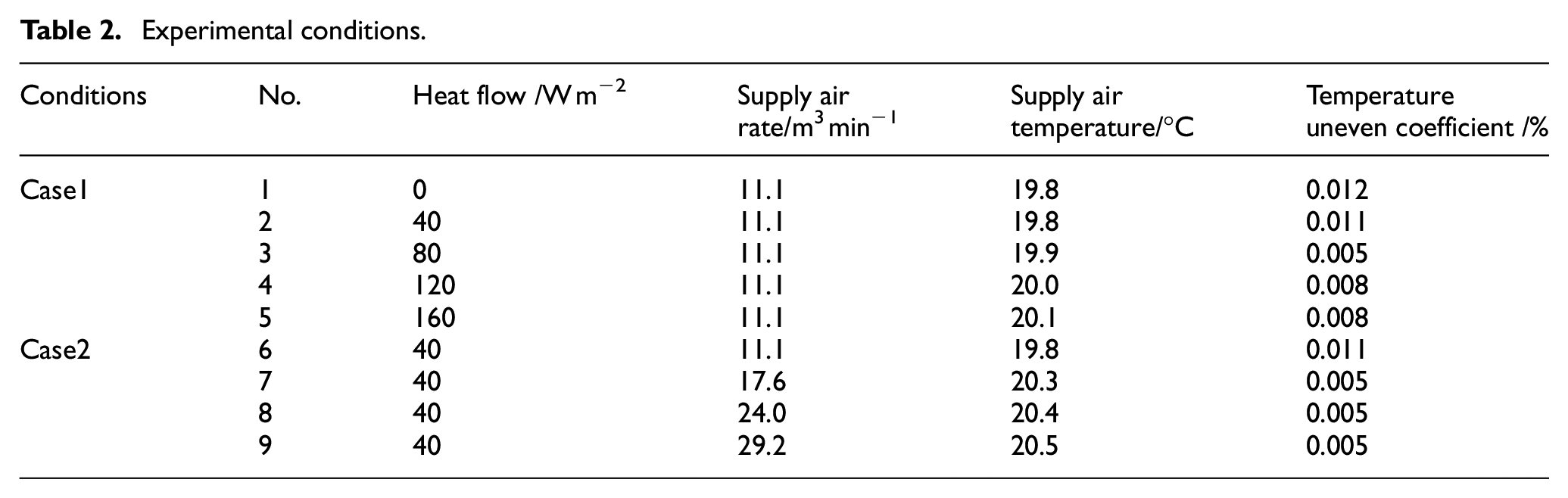
The imbalance rate of the supply air rate and return air rate is between 3.72% and 4.89%. The experimental conditions are shown in Table 2, and the verification tests are mainly carried out by adjusting the south wall heat flow and changing the supply air rate. The thermal environment solution model is based on the assumption of indoor air temperature uniform, the indoor air temperature is represented by the total parameter, and the indoor air temperature and return air temperature are equal. In order to understand the difference about the indoor air temperature points, the environmental room temperature uniformity was analyzed through the pre-experiment. The distribution index (“temperature uneven coefficient”) of the indoor temperature field was evaluated. Select n measurement points to find out the arithmetic mean and the analyzed result is shown as follow.5,21

Experimental conditions.
The root mean square of indoor temperature field is:

The temperature uneven coefficient is defined as:

The temperature uneven coefficient kt is a dimensionless parameter. The smaller the value is, the better the airflow distribution uniformity is. The indoor air temperature uneven coefficient is shown in Table 2. According to the pre-experiment, the temperature uneven coefficient of test conditions is less than 1.2%. Meanwhile, the relative error of return air temperature and indoor air average temperature is less than 1.73%. It shows that the indoor air temperature uniformity is well, and the above assumption is reasonable.
The experimental measured values of the indoor air temperature and wall temperature are used to compare with theoretical calculated values of the thermal environment solution model based on the Gebhart absorption coefficient. According to the Gebhart absorption coefficient matrix, the wall radiation exchange heat can be calculated by the building wall temperature and the wall radiation emissivity and then be verified with experimental test values.
Research results and analysis
Gebhart absorption coefficient determination
The Gebhart absorption coefficient was obtained through the construction matrix by wall radiation emissivity and angle factor of each wall. The angle factor is the basis of the Gebhart absorption coefficient calculation. Dimension of the environmental test room (length × width × height) is 4.9 m × 3.5 m × 2.5 m and the angle factors between walls are shown in Table 3.
Angle factors of the environmental test room.
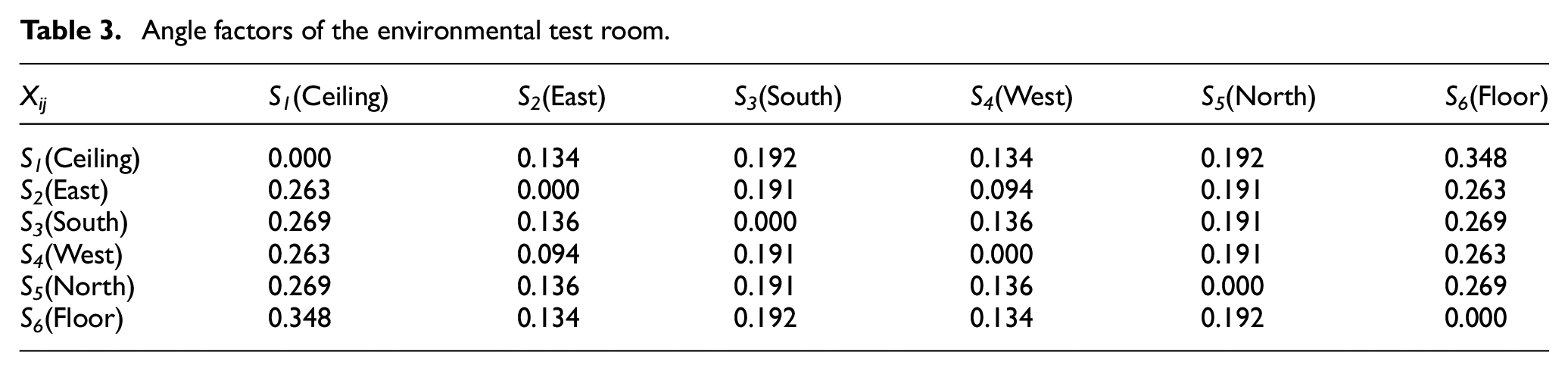
The Gebhart absorption coefficient Gij combines the radiation energy directly absorbed by the surface j from the surface i, and the radiation energy indirectly absorbed by the surface j, which emitted from the surface i and reflected by other walls. As shown in Section 2.1 equation (2), Xijεj represents the part of direct absorption radiation energy, and the others represent the part of indirect absorption radiation energy after being reflected by other walls. The direct absorption coefficient Xijεj and the Gebhart absorption coefficient Gij of the environmental test room are shown in Table 4. From Tables 3 and 4, we can know, considering indirect absorption radiation energy after other walls reflections, Gebhart absorption coefficient Gij is greater than the direct absorption coefficient Xijεj. Meanwhile, the angle factor X11 = X22 = X33 = X44 = X55 = X66 = 0, the corresponding direct absorption coefficient Xijεj is also 0, but the corresponding Gebhart absorption coefficient Gij is not 0. It can be seen that the Gebhart absorption coefficient is close to the actual heat transfer situation for the characteristics of multiple reflection and multiple absorption of radiant heat transfer on building walls.
Direct absorption coefficient Xijεj and Gebhart absorption coefficient Gij of the environmental test room.

Verification of building thermal environment solution model
For condition 1, the experimental measured values and the theoretical calculated values of the thermal environment solution model based on the Gebhart absorption coefficient were compared, and the results were shown in Figure 3. As the heat flow of the south wall increased, the other wall temperature and indoor air temperature all increased, and the temperature trend almost present linear to the heat flow. As shown in Figure 3(a)), the indoor air temperature changed range was 17.5°C –25.0°C, the theoretical calculated values were close to the measured values, and the deviation was within 0.25°C. For the wall temperature of the environmental test room, known from Figure 3(b) to (g), the wall temperature change range was 11.2°C–41.4°C. The south wall was heated wall, which temperature was most high. The floor surface emissivity was 0.35, and its heat loss was the maximum, so the floor temperature was basically 11.2°C–22.6°C. The other wall emissivity was 0.9 and their temperatures were close, and the temperature change range was 15.3°C–27.7°C. It can be seen that the deviation between the wall temperature measured values and the calculated values based on the Gebhart absorption coefficient is basically less than 1.0°C, it indicates that the calculation result of the thermal environment solution model based on the Gebhart absorption coefficient is reliable.
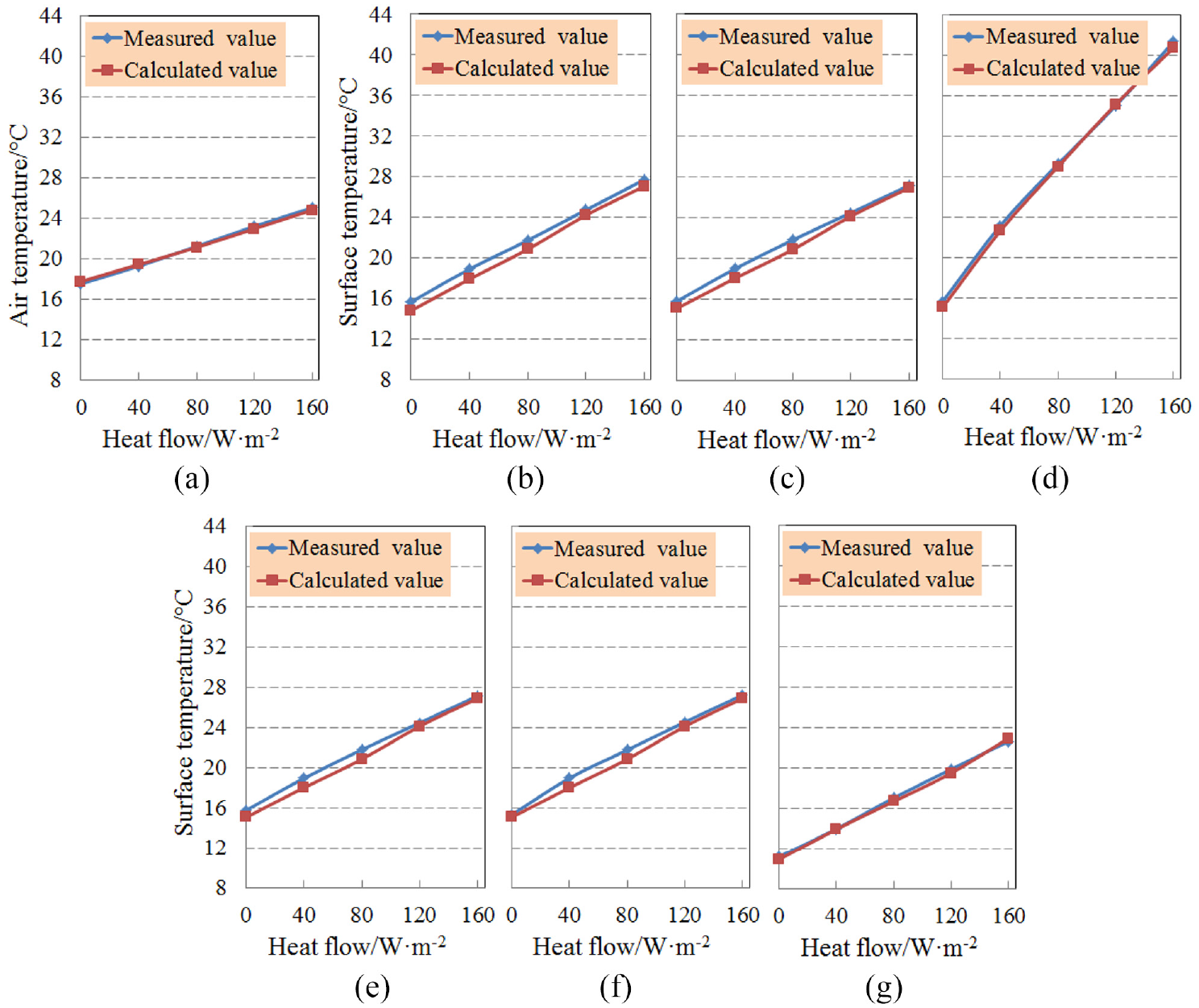
Verification of thermal environment solution model under wall heat flow variation: (a) indoor air, (b) ceiling, (c) east wall, (d) south wall, (e) west wall, (f) north wall, and (g) floor.
For condition 2, Figure 4 shows the comparison results of the experimental measured values and the theoretical calculated values of the thermal environment solution model based on the Gebhart absorption coefficient. As can be seen from Figure 4, with the supply air rate increases, the wall temperature and indoor air temperature increase, which have a linear relationship with the supply air rate. Compared with condition 1, the temperature variation was more gradual in condition 2. Similarly, the theoretical calculated values of indoor air temperature were relatively close to the measured values. The deviation value was within 0.17°C, and the air temperature change range was 19.2°C–20.5°C. From Figure 4(b) to (g), as the supply air rate increased, the walls temperatures of the environmental test room all increased. Among them, the south wall with electric thermal film heating had the highest temperature, and the change range was 23.2°C–24.4°C. The floor had the largest heat loss, so the floor temperature was lowest, which was basically 13.9°C–17.5°C. The other walls temperatures were relatively close, and the change range was 18.9°C–20.4°C. Overall, the wall temperature deviation of measured value and theoretical calculated value is basically less than 1.0°C, and it indicates that the calculation result of the thermal environment solution model based on Gebhart absorption coefficient is more accurate.

Verification of thermal environment solution model under supply air rate variation: (a) indoor air, (b) ceiling, (c) east wall, (d) south wall, (e) west wall, (f) north wall, and (g) floor.
The building wall is a complex coupled heat transfer of heat conduction, convection and radiation. The wall temperature is affected by the coupling of air temperature and other wall temperatures. The thermal environment solution model based on the Gebhart absorption coefficient can reliably predict indoor air temperature and wall temperature, and performs a new prediction idea under the coupling of conduction, convection and radiation.
Verification of radiation heat transfer calculation model
Based on the Gebhart absorption coefficient matrix, according to the building wall temperature and the wall radiation emissivity, calculate wall radiation exchange heat and then obtain the wall net radiation heat transfer. The comparison results of the calculated values and the measured values were shown in Figures 5 and 6. Among them, with the wall temperature test value of the environmental test chamber and the Gebhart absorption coefficient, the net radiation heat transfer calculation result was the measured value. According to the wall temperature calculation result in Section 4.2 (building thermal environment solution model) and Gebhart absorption coefficient, the net radiation heat transfer calculation result was the calculated value.
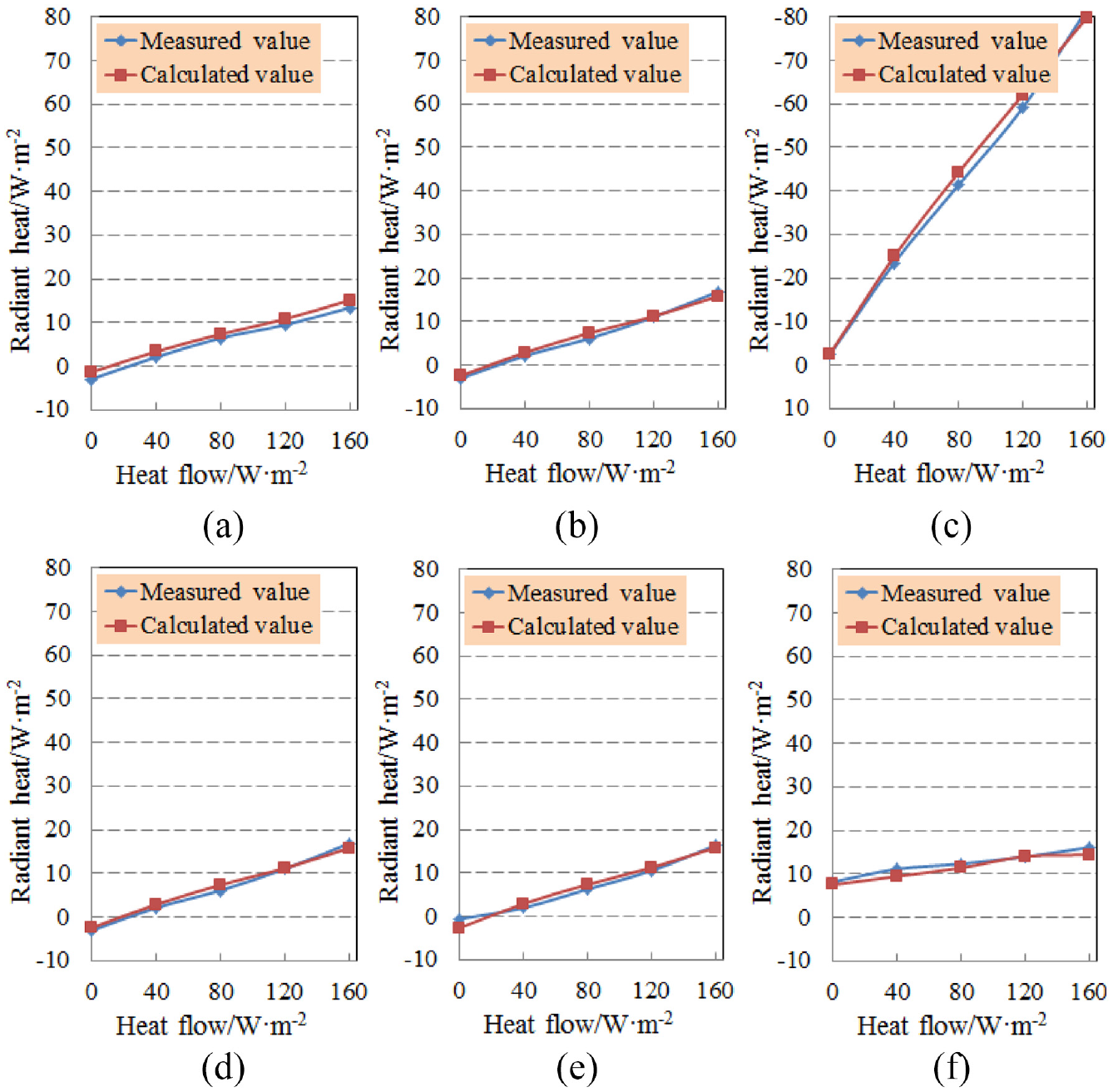
Verification of radiation heat transfer calculation model under wall heat flow variation: (a) ceiling, (b) east wall, (c) south wall, (d) west wall, (e) north wall, and (f) floor.

Verification of radiation heat transfer calculation model under supply air rate variation: (a) ceiling, (b) east wall, (c) south wall, (d) west wall, (e) north wall, and (f) floor.
For condition 1, the calculated values of radiation heat transfer based on Gebhart absorption coefficient were compared with the measured values, and the results were shown in Figure 5. As the south wall heat flow increased, each wall radiation heat transfer increased. Among them, the south wall had the highest temperature, and its net radiation heat transfer was lost. So its value was negative, and the change range was −2.4 to −81.7W/m2. Other walls had low temperatures, and they were radiation heat gain. The floor temperature was the lowest, and its wall net radiation transfer heat was 8.2–16.1 W/m2. The other walls temperatures were relatively closely, and the change range was −3.0 to 16.8 W/m2. Overall, the radiation heat transfer deviation value of the measured values and calculated values based on the Gebhart absorption coefficient is basically within 3.0 W/m2, and it indicates that the radiation heat transfer calculation result based on the Gebhart absorption coefficient is reliable.
For condition 2, Figure 6 showed the radiation heat transfer comparison results of the experimental measured values and the calculated values based on Gebhart absorption coefficient. It could be seen that with the supply air rate increases, the net radiation heat transfer of each wall was changed slightly. Among them, the south wall was heated wall, and its net radiation heat transfer showed loss heat. So it was negative value, and the change range was −22.1 to −23.5W/m2. The floor temperature was the lowest, and the net radiation heat transfer was 7.0–11.1 W/m2. The other wall temperature was relatively close, and the wall net radiation heat transfer range was 1.8–4.7 W/m2. Overall, the net radiation heat transfer deviation value of the measured values and the calculated values based on the Gebhart absorption coefficient is basically within 2.1 W/m2, and it indicates that the calculation result of the radiation heat transfer calculation model based on the Gebhart absorption coefficient is accurate.
Building wall heat transfer is basic of air conditioning load calculation, building energy analysis and air conditioning conservation operation. For the building wall radiation characteristics of multiple reflections and multiple absorptions, the radiation heat transfer calculation model based on the Gebhart absorption coefficient can perform simple and convenient calculation process.
Discussion and further confirmation
Error analysis of the building thermal environment solution model
In order to further understand the calculation accuracy of the thermal environment solution model based on Gebhart absorption coefficient. The error analysis of the calculated values and the experimental measured values was conducted, and the results were shown in Figure 7. From Figure 7(a)), with the south wall heat flow increased, the indoor air temperature error was −0.24°C to 0.24°C, the ceiling temperature error was 0.52°C–0.99°C, the east wall temperature error was 0.24°C–0.95°C, the south wall temperature error was −0.13°C to 0.61°C, the west wall temperature error was 0.24°C–0.95°C, and the north wall temperature error was 0.23°C–0.96°C, the floor temperature error was −0.30°C to 0.38°C. As could be seen from Figure 7(b), with the supply air rate increased, the indoor air temperature error was 0.09°C–0.17°C, the temperature errors of the ceiling, the east wall, the south wall, the west wall, the north wall, the floor were 0.55°C–0.99°C, 0.72°C–0.99°C, 0.24°C–0.52°C, 0.72°C–0.99°C, 0.47°C–0.96°C, and 0.03°C–0.92°C respectively. Therefore, it can be seen that with the south wall heat flow and supply air rate increase, the error of indoor air temperature and wall temperature changes a little.

Error analysis of the wall temperature calculation results: (a) condition 1 and (b) condition 2.
Error analysis of the radiation heat transfer calculation model
Similarly, the calculation accuracy of the wall radiation heat transfer calculation model based on Gebhart absorption coefficient is further evaluated, and the error analysis results of the calculated values and experimental measured values are shown in Figure 8. As could be seen from Figure 8(a), with the south wall heat flow increased, the ceiling radiation heat transfer error value was 0.91–1.73W m−2, the east wall radiation heat transfer error value was −1.03 to 1.26 W m−2, the south wall radiation heat transfer error value was −2.93 to 1.89 W m−2, the west wall radiation heat transfer error value was −1.03 to 1.26 W m−2, the north wall radiation heat transfer error value was −2.06 to 1.08 W m−2, and the floor radiation heat transfer error value was −1.68 to 0.09 W m−2. From Figure 8(b), with the supply air volume increased, the radiation heat transfer error values of the ceiling, the east wall, the south wall, the west wall, the north wall, the floor were −0.47 to 1.28 W m−2, 0.74 to 1.57 W m−2, −2.10 to 1.49 W m−2, 0.74 to 1.57 W m−2, −1.52 to 0.93 W m−2, −1.67 to 0.64 W m−2. Therefore, in general, with the south wall heat flow increases and supply air rate increases, the calculated value and measured value change within a certain range.

Error analysis of the wall radiation heat transfer calculation results: (a) condition 1 and (b) condition 2.
According to the experimental verification of building thermal environment solution model and radiation heat transfer calculation model, the calculated results based on Gebhart absorption coefficient are accurate and reliable. Compared with the effective radiation model and the direct radiation model, the Gebart absorption coefficient has the comprehensive advantages of calculation accuracy and simplicity, and it provides a new way and thought for the analysis of radiation heat transfer on building wall.
Conclusions
This paper introduces Gebhart absorption coefficient to analyze the radiation heat transfer process systematically. Building thermal environment solution model, which is based on wall thermal balance equation and indoor air thermal balance equation, is presented to calculate wall temperature and indoor air temperature. The radiation heat transfer calculation model is constructed to calculate the wall net radiation heat transfer based on wall radiation heat transfer mechanism. We also verify the theoretical calculation results through experiments, and the main conclusions are as follows:
The Gebhart absorption coefficient, which combines wall radiation emissivity and angle factor, can represent the wall radiation heat transfer mechanism of multiple reflections and multiple absorptions. The Gebhart absorption coefficient not only considers the radiation energy directly absorbed by the wall, but also considers the indirectly absorbed radiation energy that repeatedly reflected by other walls. The absorption coefficient Gij of each wall is not 0 and it is larger than the direct absorption coefficient Xijεj.
The actual verification results of the thermal environment solution model based on Gebhart absorption coefficient show that the theoretical calculated value of the indoor air temperature is basically the same as the experimental measured value. The deviation value of the wall heat flow variation condition was within 0.25°C, and for the supply air rate variation condition, the deviation value was within 0.17°C. For the wall temperature, both the wall heat flow variation condition and the supply air rate variation condition, the wall temperature deviation of the calculated values and the measured values was basically within 1.0°C. It is known that the calculation result of the thermal environment solution model based on the Gebhart absorption coefficient is accurate and reliable. At the same time, it performs a new idea for the prediction of wall temperature under the coupling of conduction, convection and radiation.
The actual verification results of the wall radiation heat transfer calculation model based on Gebhart absorption coefficient show that, under the wall heat flow variation condition, the radiation heat transfer deviation value of the theoretical calculated value and the experimental measured value was basically within 3.0 W/m2. For the supply air rate variation condition, the deviation of the theoretical calculated value and the experimental measured value was basically within 2.1 W/m2. It can be seen that the calculation result of the wall radiation heat transfer calculation model based on the Gebhart absorption coefficient is accurate and reliable. And it also shows the simplicity of the calculation process
For the accurate performance of building thermal environment solution model and radiation heat transfer calculation model based on Gebhart absorption coefficient, further evaluation shows that, with the wall heat flow increasing and the supply air rate increasing, the calculated value errors of the indoor air temperature and the wall temperature do not change much, and the wall radiation heat transfer error of the calculated value and the measured value is within a small range. Compared with the effective radiation model and the direct radiation model, the Gebart absorption coefficient has the comprehensive advantages of calculation accuracy and simplicity.
The Gebhart absorption coefficient is more appropriate to characterize the wall radiation heat transfer mechanism, and its accuracy in building thermal environment analysis and radiation heat transfer analysis is equally reliable. The Gebhart absorption coefficient provides a new way and thought for the analysis of radiation heat transfer on building wall. It can be predicted that the Gebhart absorption coefficient will have greater application prospects in the simulation and analysis of the thermal environment in building.
This paper focuses on the radiation heat transfer process based on Gebhart absorption coefficient, the theoretical model and experimental test are carried out systematically. For actual buildings such as the whole room convection air conditioning, radiation air conditioning system and stratified air conditioning in large space building, the application of Gebhart absorption coefficient in heat transfer analysis needs further research and experimental verification, so as to expand the application range and field of Gebhart absorption coefficient
Footnotes
Appendix
Handling Editor: Chenhui Liang
Authors’ contributions
Liugen Lv, Chen Huang, Yi Xiang conceived and designed the research plan; Liugen Lv, Yi Xiang, Chen Huang performed the implement of theory research; Liugen Lv, Yi Xiang, Chen Huang analyzed the data, drafted and prepared the paper; Liugen Lv, Yi Xiang, Chen Huang contributed materials/analysis tools.
Declaration of conflicting interests
The author(s) declared no potential conflicts of interest with respect to the research, authorship, and/or publication of this article.
Funding
The author(s) disclosed receipt of the following financial support for the research, authorship, and/or publication of this article: This research was supported by Scientific Research Fund of Zhejiang Provincial Education Department No.Y202147475.
