



Abstract
Considering that the internal friction angle of the surrounding rock is not a constant but a function of the mean normal stress, and the unified strength theory (UST) is used as the plastic condition of the tunnel surrounding rock, the plastic zone of the circular tunnel surrounding rock is divided into multiple annular regions. For different plastic zones, there are different yield conditions represented by different stress functions, the elastic-plastic analysis of circular tunnels is performed by using the piecewise linearization of nonlinear yield function, stress and displacement in the elastic-plastic zone and the radius of the plastic zone are obtained by combining the equilibrium equations. It is shown that the radius of the plastic zone increases, the radial stresses in the elastic-plastic zone and the circumferential stresses in the plastic zone become smaller and the circumferential stresses in the elastic zone becomes larger compared with that of only one plastic zone. By using single factor analysis method, the calculated values of the tunnel displacements and plastic radii by UST were compared with those obtained by the Mohr-Coulomb (M-C) criterion, Drucker-Prager (D-P) criterion, and Zienkiewicz-Pande (Z-P) criterion. The analysis shows that under the same conditions, the solution of UST is smaller than M-C criterion and D-P criterion, therefore, the selection of rock strength criterion has great influence on the calculation of rock mechanics and engineering, the proper application of UST will guarantee the safety of engineering practice and have more practical value.
Keywords
Introduction
After tunnel excavation, the stresses in the surrounding rock are redistributed, and in order to guarantee the stability of the tunnel, an elastic-plastic analysis must be performed to provide a basis for the tunnel support design. At present, the elastic-plastic analysis of the tunnel surrounding rock adopts M-C criterion1–3 or H-B criterion,4–6 etc. However, neither the M-C criterion nor the H-B criterion considers the effect of the intermediate principal stress. In fact, the rock mass strength is often observed to be dependent on the intermediate principal stress, and this effect is associated with the rock mass properties and stress states. 7 The UST, which considers all the stress components and their effects on the material yield and failure, can quantify the effect of the intermediate principal stress of various materials with different stress states and take full advantage of the material strength. 8
In routine engineering application, there are many examples of elastic-plastic analysis of surrounding rock based on the assumption that the internal friction angle of the rock is constant and to be governed by the UST. Tu et al. 9 investigated the radial subgrade modulus in an elastic-brittle-plastic rock mass, and modified analytical solutions were derived that are compatible with a generalized nonlinear unified strength criterion. Based on the unified strength theory and a non-associated linear flow rule, Zeng et al. 10 given an elastoplastic unified solution for displacements around a deep circular tunnel which taken the true elastic strains in the plastic zone into account. Sun et al. 11 present the analytical solutions for the responses of tunnels excavated in rock masses exhibiting strain-softening behavior by introducing the unified strength theory to analyze the tunnel response. Zou et al. 12 discussed the effect of the initial elastic displacement of the surrounding rock, stiffness of the support structure, and the coefficient b of the intermediate principal stress on the plastic zone. Hu and Yu 13 applied the unified strength theory to explore the strength properties of rocks under triaxial compressive loading and the elastic-plastic analysis of circular tunnel surrounds under hydrostatic pressure conditions. Zhang et al. 14 proposed the displacements accounting for three different definitions for elastic strains and different Young’s modulus in the plastic zone.
However, Matin and Chandler 15 proved that in the process of rock mass failure, the internal friction angle and cohesion were not constant values, and the cohesion strength and friction strength components could not be exerted simultaneously. Kennedy and Lindberg 16 showed the effect of yielding according to a nonlinear Mohr-Coulomb-type function in which the angle of internal friction decreases with increasing mean normal stress. Florence and Schwer 17 extended the linear Mohr–Coulomb criterion solution. Park et al. 18 discussed four different combinations of dilatancy angle and softening parameters to investigate the effects of elastic strain increments and variable dilatancy in the plastic region. Yang et al. 19 divided the plastic zone into multiple plastic zones based on the D-P criterion, and obtained a more accurate solution.
In this paper, the UST is used as the yield condition, and the elastic-plastic analysis of circular tunnels is performed by using the piecewise linearization of nonlinear yield function, the effects of variable internal friction angle within plastic region is considered. When the plastic zone is divided into seven circles, the solution of UST exhibits convergence and reaches stabilization, and this solution is compared with a plastic zone in which the internal friction angle of the rock remains unchanged. Lastly the UST solution is compared with M-C criterion solution, D-P criterion solution, and Z-P criterion solution, the accuracy and practical application of the proposed solution are illustrated by solving some examples.
Four yield criterion
Unified strength theory
If the compressive stresses are specified as positive and the tensile stresses are negative, the UST that which can appropriately reflect the effect of the intermediate principal stress can be written as

where b is the UST parameter that reflects the influence of the intermediate principal stress and also a parameter of failure criterion,

For the strength theory, b has a range of [0, 1]. The UST degenerates into M-C criterion with b = 0, which defines the lower bound of the UST; the UST degenerates into the twin shear stress strength theory with b = 1, which defines the upper bound of the UST. When 0 < b < 1, a series of failure criteria between the two extremes can be obtained to describe the strength behaviors for various materials.
Z-P yield criterion
Zienkiewicz et al. have modified and generalized the M-C criterion. The Z-P condition used a quadratic yield curve on the meridian plane, the general expression of the hyperbolic yield function is given by

Where
where
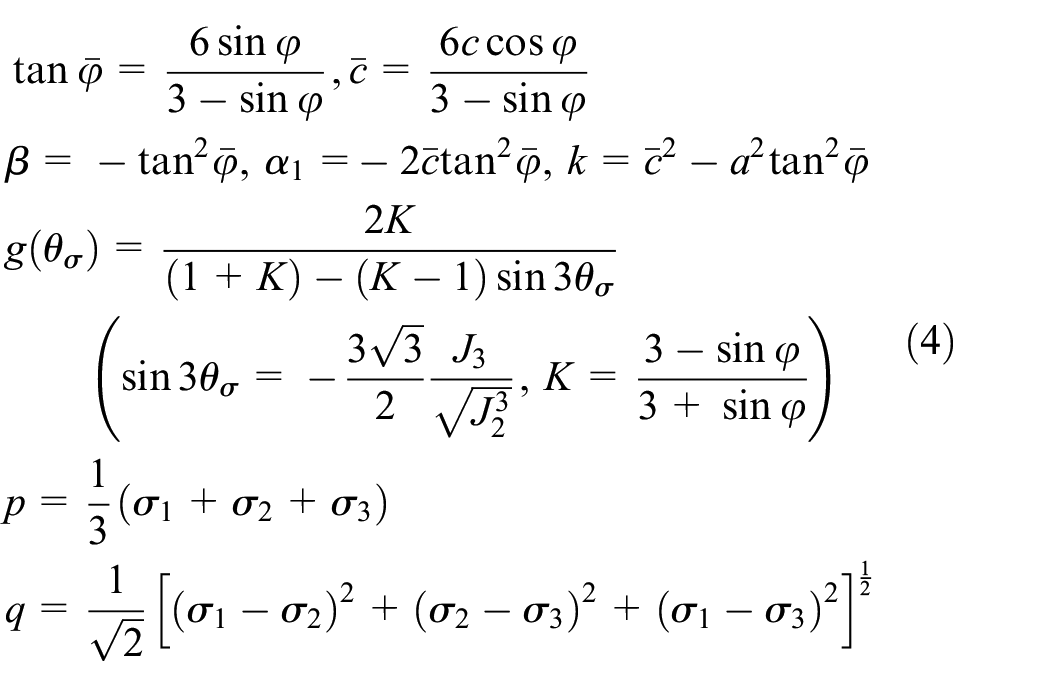
Substituting

The Z-P criterion yield curve can be taken arbitrarily close to the M-C straight line with a = 0, equation can be rewritten as

In engineering, the intermediate principal stress coefficient

Equation can be written as
20

Where

M-C yield criterion
In 1773, Cullen proposed that the failure of rock was mainly shear failure, the shear strength criterion in the plane is given by

Where

Substituting equation (11) into equation (10), the M-C criterion can be expressed by the principal stress as

D-P yield criterion
The D-P criterion with consideration of the influence of intermediate principal stress and hydrostatic pressure, can be written as

Where

Where

The relationship between the three principal stresses and the intermediate principal stress coefficient

Where

Elastic-plastic analysis of tunnel surrounding rock based on UST
Basic assumptions and stress state analysis
At first the following basic assumptions are made. (1) The surrounding rock is homogeneous, isotropic, linear elastic, and no creep or viscous behavior. (2) The tunnel section is circular, in the infinite length of the tunnel the nature of the surrounding rock is consistent. (3) When the deep burial is greater than or equal to 20 times the radius of the tunnel, ignoring the self-weight of the rock within the influence of the tunnel, the error with the original problem does not exceed 5%, so the horizontal stress of primary rock can be simplified to be homogeneous. (4) The lateral pressure coefficient

Mechanics model of axisymmetric tunnel.
Where

Plastic zone stress
The stresses in the plastic zone satisfy the static equilibrium equation and also satisfy the plastic yield criterion. Notably, it is an efficient way to calculate the elastic-plastic solution of tunnel excavation by using piecewise linear yield function to represent the nonlinear yield criterion. Based on the influence of the normal stress on the internal friction angle of the rock, by dividing the plastic region with a number of thin annular rings. Figure 2 show the plastic zone is divided into

Dividing plastic zone into k circles.
The equilibrium equation in the plastic region

Where r is the distance from any point on the surrounding rock of the tunnel section to the center of the tunnel circle.
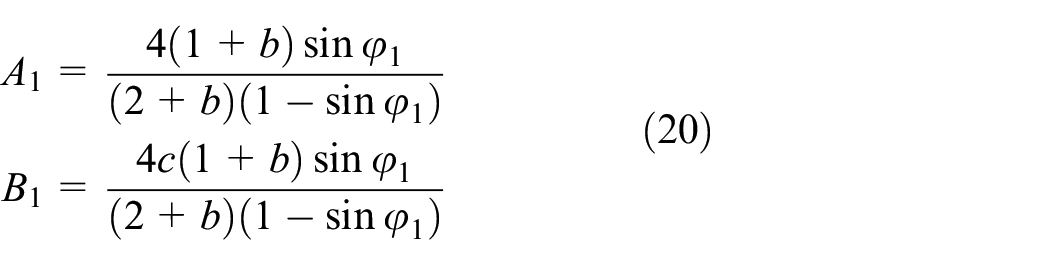
Equation may be modified as

Substituting equation into equation yields

The general solution can be obtained by solving equation

Where

Substituting equation into equations and (21), the stresses in the plastic zone

Similarly, substituting the yield condition of plastic region

where
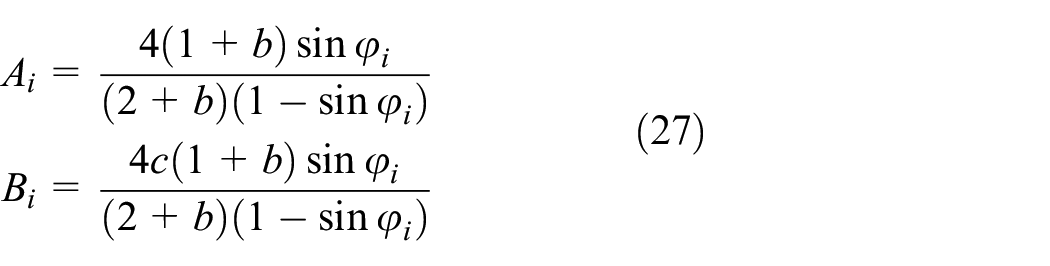
Considering the boundary condition
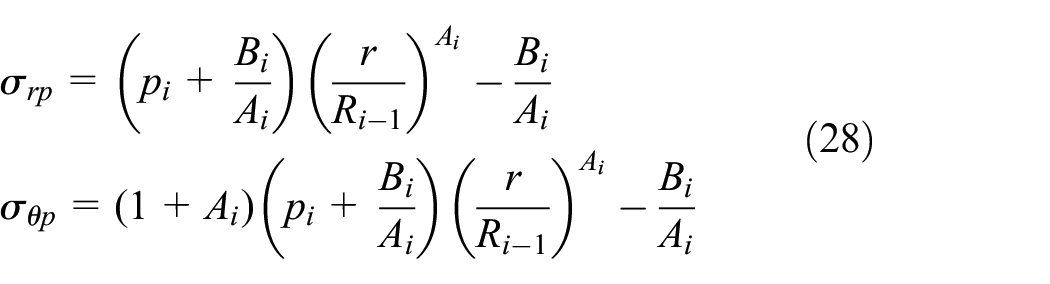
For the plastic region

Integrating equation (29), the stresses in the plastic region

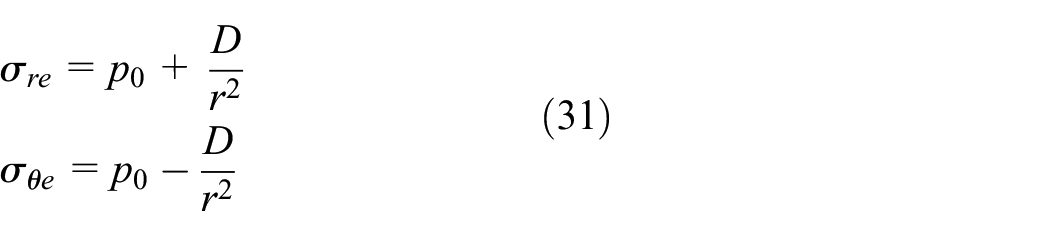
the stresses in the elastic zone can be written as
By utilizing the boundary conditions

Substituting equation (32) into equation (30), the radial stress

Radius of plastic zone
The boundary radius

Stress in the elastic zone
For the elastic zone of the tunnel surrounding rock, it can be considered as a thick-walled cylinder with the outer boundary approaches infinity and the inner boundary as

Displacement of elastic-plastic zone
In the plastic region


The law of plastic flow can be expressed as

Where
If


Where
Substitute equation (39) into equation (38), the plastic strain increments are obtained as

Integrate equation yields

Plastic volumetric strain is given by

Considering the plane strain condition

the constitutive equation is given by

the total strains can be decomposed into elastic and plastic parts as follows:

Substituting equation (46) into equation (36), the differential equation for

Substituting the radial stresses and circumferential stresses in the plastic region


Solving equation (47),

Where

Considering the boundary condition

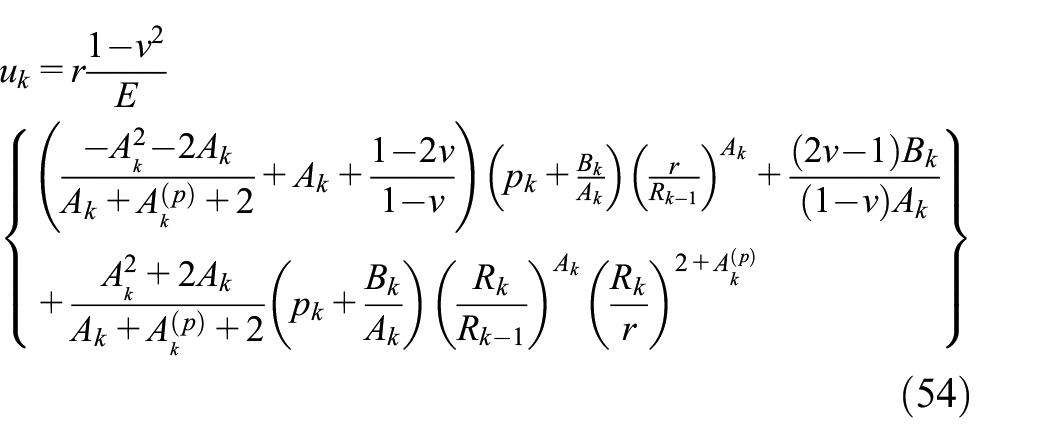
Substituting equations (49)–(51) into equation (37), the displacement of plastic zone

where
Similarly, the strains and displacement in other regions can be obtained.
In the elastic region, substituting equation (35) into equation (45), the elastic strains can be written as
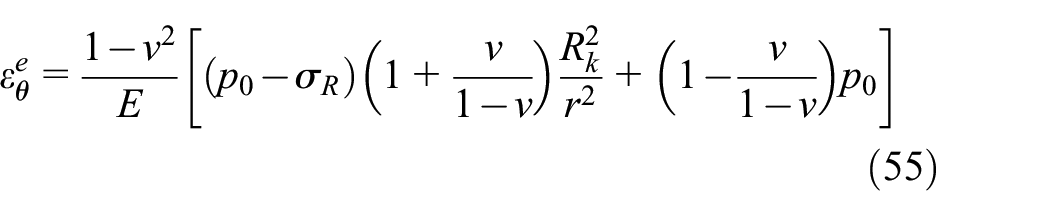
where

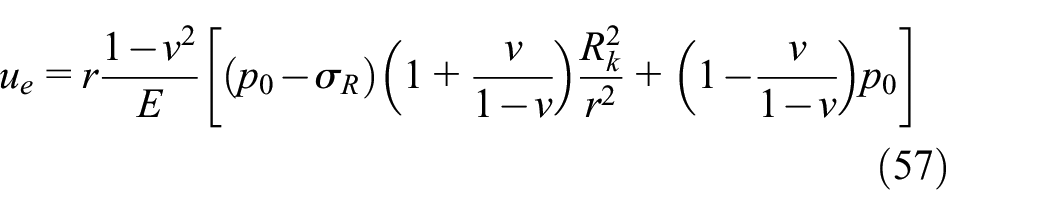
The displacement of the elastic region (i.e.
Example and analysis
An ideal circular tunnel arranged horizontally is used as the calculation model, the radius of the tunnel
UST solution for the elastic-plastic zone of the tunnel surrounding rock
According to the effect of normal stress on internal friction angle of rock, the plastic zone is divided into multiple circles.
When
When
When
When
When
When
When
When the surrounding rock is divided into multiple plastic zones and only one plastic zone (with an internal friction angle of

Stresses distribution of surrounding rock divided into one plastic zone and multiple plastic zones.
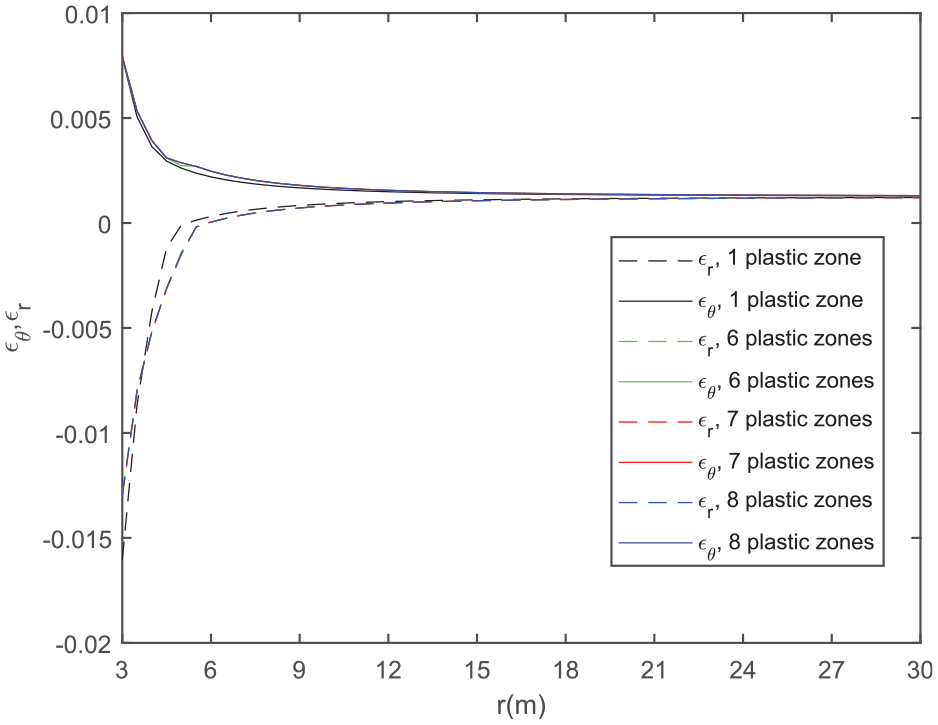
Strains distribution of surrounding rock divided into one plastic zone and multiple plastic zones.
From Figure 3, the circumferential stress reaches its maximum value at the elastic-plastic interface, whereas the radial stress increases monotonically along the radial direction. By dividing the plastic zone into multiple annular rings, the radius of the plastic zone increases. In the plastic zone, the radial and circumferential stresses decrease; in the elastic zone, the circumferential stress increases and the radial stress decrease, therefore, the effect of variable internal friction angle on the tunnel responses is remarkable. The stresses distribution curves almost coincide when the plastic zone is divided into six, seven, and eight circles. It can be seen that when the plastic zone is divided into seven circles, the stresses and radius of the plastic zone all converge to a solution of the problem.
From Figure 4, in comparison, the calculated values of the circumferential strain obtained by the proposed method is much larger than that obtained by the traditional method of calculation (the internal friction angle is constant). This once again proves the importance of considering the effect of the variable internal friction angle. So viewing from the accuracy and engineering safety, multiple plastic zones can be substitute for one plastic zone and applied to the practical engineering design with the piecewise linearization of nonlinear yield function method.
Comparison of UST with D-P criterion, Z-P criterion, and M-C criterion
In order to better analyze the radius and displacement of the plastic zone, the UST solution is compared with the D-P criterion solution, Z-P criterion solution, and M-C criterion solution. The effects of cohesion
Figure 5 shows the stresses distribution curves of the tunnel surrounding rock under the four yield criterion, from which it can be seen that the circumferential stresses in the elastic zone given by M-C criterion and D-P criterion are nearly equal, which are greater that of Z-P criterion and the UST, and the radial stresses curve of M-C criterion almost coincided with that of D-P criterion, which are smaller that of Z-P criterion and the UST. In comparison, the positions where the peak values are located are quite different, the circumferential stress at the elastic-plastic interface based on the M-C criterion is the largest and that D-P criterion is the smallest close to the UST, the radius of the plastic zone based on the D-P criterion is the largest and that Z-P criterion is the smallest.

Stress distribution based on different yield criterion.
Figures 6 to 9 show that the radius and displacement of the plastic zone decrease with the increase of the cohesion

Relationship between cohesion and plastic zone radius.

Relationship between internal friction angle and plastic zone radius.

Relationship between cohesion and plastic zone displacement.

Relationship between internal friction angle and plastic zone displacement.
It can be seen from Figures 10 and 11 that the radius and displacement of the plastic zone increase with the increase of the stress

Relationship between stress of primary rock and plastic zone radius.

Relationship between stress of primary rock and plastic zone displacement.
It is clear from Figures 12 and 13 that the calculated values of the radius and displacement by the four yield criterion are approximately linear distributing along the support resistance, they all decrease with the increase of the support resistance, and had a similar variation trend. Under the same support resistance condition, the solution of D-P criterion is the largest, the solution of M-C criterion is the second, the solution of UST is smaller, and the solution of Z-P criterion is the smallest.

Relationship between support resistance and plastic zone radius.

Relationship between support resistance and plastic zone displacement.
It can be seen that
Conclusions
The surrounding rock suffers various degrees of loosening caused by tunnel excavation, and the internal friction angle is no longer a constant but a function of the mean normal stress. In this paper, based on the unified strength theory, the plastic zone of the surrounding rock is divided into
(1) Compared with only one plastic zone, after dividing the plastic zone of the surrounding rock into seven annular rings with different internal friction angles, the solution of UST exhibits convergence and reaches stabilization. The variable internal friction angle showed a significant effect on the tunnel responses: the radius of the plastic zone increases, the radial stress of the elastic-plastic zone and the circumferential stress of the plastic zone decrease, and the circumferential stress of the elastic zone increases.
(2) Both the radius and displacement of the plastic zone decrease with the increase of cohesion, internal friction angle, and support resistance of the rock mass, while increase with the increase of stress of primary rock. Under the same conditions, the solution of the D-P criterion is the largest, the solution of the M-C criterion is the second largest, the solution of the UST is smaller, and the solution of the Z-P criterion is the smallest.
(3) The calculated values of the tunnel displacements and plastic radii by UST were lower than those obtained by the M-C criterion, indicating that the M-C criterion over-estimated the tunnel responses. The effect of intermediate principal stress helps prevent the surrounding rock from yielding and resisting tunnel displacement. The selection of rock strength criterion has great influence on the calculation of rock mechanics and engineering. The selection of strength criterion that conforms to the actual conditions of rock is the basis of the correct analysis of rock engineering mechanics.
(4) Although the solution proposed in this paper is limited in scope, it appears to be useful for the preliminary design of circular rock tunnels to provide a basis for the tunnel support design. Generally, correctly considering the effects of variable internal friction angle within plastic region is shown to be important in elastic-plastic analysis of circular tunnel. By comparison and considering the effect of the variable internal friction angle, the UST can comprehensively reflect the various strength characteristics of rock, which is closer to the engineering practice.
Footnotes
Handling Editor: Chenhui Liang
Declaration of conflicting interests
The author(s) declared no potential conflicts of interest with respect to the research, authorship, and/or publication of this article.
Funding
The author(s) disclosed receipt of the following financial support for the research, authorship, and/or publication of this article: The authors gratefully acknowledge the financial support provided by the Science and Technology Scheme of Guangzhou City (no.201904010141).

Data availability
The data used to support the findings of this study are available from the corresponding author upon request.