




Abstract
The inter-story isolated structure is an effective and feasible structure seismic technology and system, but most studies on inter-story isolated structures only consider the mainshock. A strong mainshock is usually accompanied by multiple aftershocks, the structure will be damaged under the action of the mainshock. Because of the short time interval between the main shock and the aftershocks, the structure is often not repaired in time, so it will be further damaged under the action of the aftershock. Therefore, it is meaningful to study the fragility of inter-story isolated structures under the action of main-aftershock sequences. In this study, the incremental dynamic analysis method was used, and the inter-story isolated structure of a frame shear wall was established. The vulnerability curves of each substructure under the action of a single mainshock and main-aftershock sequence were compared. A series structure system was used to calculate the overall vulnerability of the inter-story isolated structure. The vulnerability curves of different isolation layer setting positions and isolation bearing stiffness under the action of a single mainshock and main-aftershock were compared, and the collapse margin ratio (CMR) of the structure given. The results show that aftershocks increase the exceedance probability of each substructure, and with an increase in the limit state, the influence of aftershocks is more obvious. An appropriate isolation layer design reduces the influence of aftershocks and the exceedance probability of the entire structure.
Keywords
Introduction
Historical seismic data have shown that a strong main earthquake is often accompanied by multiple aftershocks. In the year after the 1999 Jiji earthquake in Taiwan, more than 10,000 aftershocks were recorded, and 87 aftershocks of magnitude 5.0 or greater, were recorded. 1 The Wenchuan magnitude 8.0 earthquake in China on May 12, 2008, a total of 8672 aftershocks were recorded as of May 30, including 28 of magnitude 5.0 and above, and 5 aftershocks with a magnitude above 6.0, of which the strongest was magnitude 6.4. 2 The structure will have some damage because of the mainshock, if the natural vibration period of the damaged structure is close to the excellent period of the aftershock ground motion, the aftershock has a stronger destructive force on the structure. The results of many post-earthquake reports also prove that the damage to structures caused by aftershocks should not be ignored.3–5 However, the vast majority of seismic codes worldwide mainly consider the role of a single main earthquake and do not regulate the adverse effects of aftershocks.
In recent years, a large number of studies have been conducted on the seismic performance of structures under the action of main-aftershock sequences by scholars. Bo and Jinping 6 proposed a damage analysis method for an RC structure under the action of a main-aftershock, established a multistory RC structure model, and carried out an elastoplastic time history analysis under the action of the main-aftershock. The results showed that the aftershock significantly increased the damage degree of the structure, and it is necessary to reasonably consider the role of the aftershock in the structural anti-collapse design. However, the use of artificial seismic waves may amplify the impact of the aftershocks. Amadio et al., 7 based on behavioral factors and damage parameters, carried out a dynamic response analysis of a nonlinear single-degree-of-freedom system and a steel frame under the action of a main-aftershock. The equivalent single-degree-of-freedom system underestimated the damage to the structure, and the aftershock increased the damage degree of the structure. However, using different components of the same seismic wave to construct the main-aftershock sequence may not accurately reflect the influence of the earthquake sequence. Hatzigeorgiou 8 conducted a parametric study of the inelastic response of multiple RC plane structures. They found that the displacement of the structure was amplified by the aftershock, the plastic hinge development sequence of the structure was affected, and the ductility requirements of the structure were increased. However, only five natural seismic waves were used, which is not enough to consider the uncertainty of the earthquake. Xiaohui et al.9–11 under the action of the main-aftershock sequence, found that the aftershocks will cause obvious incremental damage to the structure, considering that in the main-aftershock sequence of multiple aftershocks, the aftershocks with the greatest peak acceleration play a major control role in the cumulative damage of the structure. A seismic vulnerability function that considers fuzziness correction at the limit state was proposed. However, only a fixed structure was analyzed without considering the influence of the model parameter changes. Youfa et al. 12 carried out studies on the vulnerability of the mountain step-terrace structure and the ordinary ground structure under the action of the main-aftershock and determined the structural collapse margin ratio. The results show that compared with the ground structure, the aftershock makes the damage probability of the mountain step-terrace structure higher, the CMR of the mountain step-terrace structure smaller, and the collapse safety reserve lower, but the actual discussion is only the step-terrace structure, and there is no relevant parameter for the mountain. Chen et al. 13 investigated the seismic damage analysis of the AP1000 nuclear power plant under the action of the main-aftershock sequence. Their research indicated that the aggravating effect of the aftershock damage was mainly caused by the reinforced concrete auxiliary building of the nuclear power plant, and the concrete tensile damage under the main-aftershock sequence was more serious than the compressive damage. However, the use of seven seismic waves may not reflect the difference in earthquakes well. Di Sarno et al., 14 Xiaohui et al., 15 Zhang et al. 16 studied the performance of aging reinforced concrete structures, frame structures, and masonry structures under the action of main-aftershocks, respectively. However, the research on inter-story isolated structures under the action of main-aftershocks is still relatively scarce.
The inter-story isolated structure is a type of shock absorption technology that appears in the development of the base-isolated structure. Researchers have conducted many studies on the principle and analysis method of the inter-story isolated structure worldwide. Fulin et al. 17 proposed an optimization design method for isolation-layer parameters by establishing a simplified model of two particles and a multi-particle dynamic time history analysis model of the inter-story isolated system, which verified the effectiveness of the inter-story isolated system in controlling the seismic response. They found that the lower the position of the isolation layer, the more obvious the shock absorption effect. However, the influence of other parameter changes, except for the change in the isolation layer position, was not considered. Miao et al. 18 carried out a numerical simulation of a shaking table model test of an inter-story isolated structure with a soft limit of the isolation layer to verify the accuracy of the numerical value simulation. A numerical analysis model of the prototype structure was established, a numerical simulation of 28 working conditions was carried out, and the dynamic response of the isolation layer and the main structure under non-limit and limit conditions was compared and analyzed. However, only three seismic waves were used, and the uncertainty of the earthquake could not be adequately considered. Faiella et al. 19 used an inter-story isolated system to retrofit a masonry structure, and the results showed that an inter-story isolated system can significantly reduce the seismic response. However, the simplified particle model cannot accurately quantify the damage to masonry structures. Yingxiong et al. 20 carried out an experimental study on the shaking table of a model of an inter-story isolated structure on a soft soil foundation, compared and analyzed the floor acceleration and displacement response of the isolation layer and isolated structure under far-field long-term and ordinary ground motions, and studied the dynamic response law and damping effect of the soil-structure interaction under far-field long-term ground motions. The effect of different shear-wave velocities on the soil can be further discussed.
However, most of the research on inter-story isolation is only considered under the action of a single mainshock, and research on inter-story isolated structures under the action of the main-aftershock sequence is extremely scarce worldwide. In this study, an inter-story isolated structure was used as the research object, and the inter-story isolated of three-dimensional finite element modal was establishment. Eighteen real main-aftershock sequences and the incremental dynamic analysis method were used to evaluate the seismic vulnerability of the inter-story isolated structure under the action of the main-aftershock sequence. The influence of different isolation layer level height settings and isolation layer stiffness was considered, in order to explore a reasonable inter-story isolated design, balance the overall failure probability and the influence of aftershocks on inter-story isolated structure.
Structural model
The seismic fortification intensity of the reinforced concrete frame shear model was 8°, and the basic design acceleration was 0.2g. The site’s characteristic period was 0.4 s. The plane size of the structure was 25 m × 15 m, the first floor was 3.9 m high, the marked floor was 3.6 m high, the frame column interface size was 500 mm×500 mm, and the shear wall thickness was 200 mm. Reinforced concrete grade C40, with elastic modulus E0 of 3.25×10⁴ N/mm2, compressive strength fc=19.1 N/mm2, tensile strength ft = 1.71N/mm2, and steel HRB400, with elastic modulus E0 of 2 × 10⁵ N/mm2, yield strength fy = 360 N/mm2. The isolation layer was set at the top of the third layer, and the first-order vibration period of the storey isolation structure was 2.13 s. The planar and vertical arrangements and reinforcement of the structure are shown in Figure 1. The isolation bearing adopted was LRB600, and the basic parameters of the isolation bearing are listed in Table 1.

Study structure diagram: (a) vertical arrangement, (b) horizontal arrangement, and (c) structural reinforcement.
Isolation bearing parameters.

In this study, the Abaqus finite element platform was used for finite element modeling. A beam element was used for the beam and column, a layered shell element was used for the floor and shear wall, and the isolation bearing was simulated using connectors. Common node coupling was used between the components. The PQ-fiber 21 beam elements were used to consider the nonlinearity of the structure. The constitutive models of steel and concrete were simulated by Usteel0221–23 (Clough model considering bearing capacity degradation) and Uconcrete0221,24 (concrete model considering tensile strength), respectively, and the isolation bearing used a double-line model, as shown in Figure 2. In Figure 2(a), E0 is the initial elastic modulus, fy is the yield strength of the steel bar, εy is the yield strain, and εf is the tensile steel strain when the reinforced concrete member fails under monotonic loading. In Figure 2(b), E0 is the initial elastic modulus, ft is the tensile strength of concrete, fc0 is the peak compressive strength of concrete, εc0 is the strain corresponding to the peak strength of concrete, fu is the residual strength of concrete, εcu is the strain corresponding to the residual strength of concrete, and ysE0 is the tensile softening stiffness of the concrete. In Figure 2(c), Fy represents the yield force of the isolation bearing, Dy represents the yield displacement of the isolation bearing, K0 represents the stiffness of the isolation bearing before yielding, and K1 represents the stiffness of the isolation bearing after yielding. Fu is the ultimate bearing capacity of the isolation bearing and Du is the ultimate displacement of the isolation bearing.

Structural nonlinear constitutive relationships: (a) USteel02, (b) UConcrete02, and (c) LRB.
Figure 3 shows the hysteretic curve of the most unfavorable bearing under a fortification earthquake. It can be seen that the hysteretic curve is full, indicating that the established isolated model has better seismic performance and energy dissipation capacity. It can be seen from Figure 3 that the energy dissipated under the action of the mainshock is larger than that under the action of the main-aftershock.
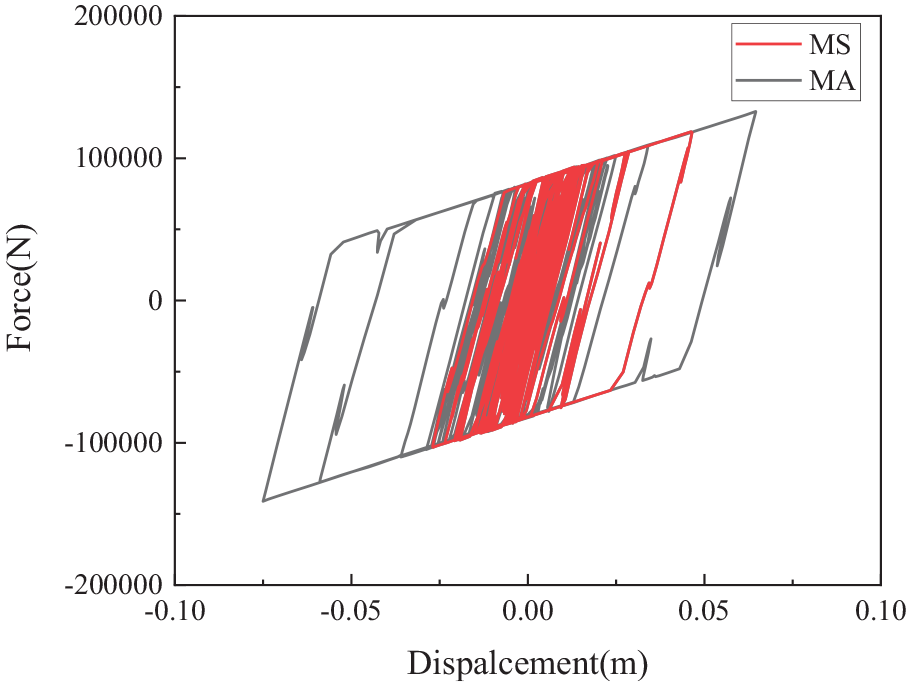
Hysteretic curve of structure.
Seismic selection and amplitude modulation
FEMA P58-1 25 states that performing nonlinear dynamic time-history analysis, if the response spectrum of the selected ground motion is well fitted with the target response spectrum, 11 or more ground motions at each intensity level are sufficient to consider the uncertainty effect of ground motion. Jianping et al. 26 found that the transcendence probability of the corresponding damage state under the action of the main-aftershock sequence based on the repetition method is higher than the transcendence probability under the real main-aftershock, indicating that the main-aftershock sequence of the repetition method overestimates the damage to the structure. Xiaohui et al. 11 investigated that in the main-aftershock sequence considering multiple aftershocks, the cumulative damage of the structure is mainly controlled by the maximum peak acceleration. Compared with the main-aftershock sequence considering only the maximum peak acceleration aftershock, the cumulative damage to the structure by the main-aftershock sequence considering multiple aftershocks does not increase significantly. In summary, 18 real mainshock sequences from the Pacific Earthquake Research Center (PEER) database were selected for calculation and analysis according to the literature. 27 The selected main-aftershock sequence information is presented in Table 2, and the acceleration response spectrum of the main-aftershock sequence is shown in Figure 4.
Main-aftershock sequence information.


Acceleration response spectrum of the main-aftershock sequence: (a) mainshock acceleration response spectrum and (b) aftershock acceleration response spectrum.
In this study, the peak ground acceleration (PGA) of the main earthquake was adjusted to 0.2, 0.4, 0.7, and 1.0 g.

Example of the acceleration time history of the main-aftershock.
Structural vulnerability analysis method
Fundamentals
Seismic vulnerability describes the probability that a structure will reach a certain failure state at a given seismic intensity (SI), which is generally expressed as a logarithmic normal cumulative distribution function28,29 :

where
The relationship between the median value of the seismic demand parameter D and seismic intensity SI approximately satisfies the power function 31 :

where α and β are regression parameters. Statistical regression is performed on the logarithm of the structural time-history analysis results, and then the fitting relationship between ln(D) and ln(SI) can be obtained. α and β can be obtained.

The logarithmic standard deviation of the fitting equation is:

where N is the total number of ground motions and Di (1,2, 3, … N) is the value of the seismic demand parameter D at different seismic intensities.
The isolated structure is different from the seismic structure. It is a series structure composed of lower structure, isolation layer, and upper structure. Damage to any substructure causes damage to the entire structure. Therefore, this study used the probability formula of the damage of the series system to evaluate the entire structure. Its formula is 32 :

where,
Limit state division
This study refers to the value of HAZUS, 33 and divides the damage state of the structure into four types: slight damage, moderate damage, extensive damage, and collapse damage. The median value Sc of seismic capacity corresponding to the four damage states are shown in Table 3. According to the literature, 30 the median seismic capability LRB corresponding to the four damage states of isolation bearings are also presented in the table below.
The division of the damage state and the value of the parameters.

Vulnerability analysis of inter-story isolated structure under main-aftershocks
Vulnerability analysis of each substructure
The PGA was used as the seismic intensity parameter, and the main-aftershock sequence described above was used as the ground motion input to analyze the nonlinear dynamic time history of the structure. The maximum story drift angle was used as the seismic demand parameter for the inter-story isolated structures. The lower structure of the isolation layer is denoted by

Fitting results of seismic demand parameters of each substructure: (a) Seismic demand parameters of single main shock for lower structure, (b) Seismic demand parameters of main-aftershock for lower structure, (c) Seismic demand parameters of single main shock for isolation bearing, (d) Seismic demand parameters of main-aftershock for isolation bearing, (e) Seismic demand parameters of single main shock for upper structure, and (f) Seismic demand parameters of main-aftershock for upper structure.
According to the slope and standard deviation of the fitting results in Figure 6, the mainshock-aftershock sequence has a greater structural demand for the inter-story isolated structure than the single mainshock.
The difference between the traditional seismic fragility analysis and the traditional seismic fragility analysis is that the former only considers a single main shock, and the main-aftershock sequence action is used for analysis in this study. The slope and standard deviation fitted in Figure 6, and the seismic capacity parameters in Table 3 are substituted into equation (1) to obtain the vulnerability curves of each substructure of the inter-story isolated structure under the action of the mainshock and main-aftershock sequences, and the vulnerability curve of the whole structure is obtained by equation (5). The vulnerability curves are listed in Figure 7 under different limit states.

Vulnerability curve: (a) LS1, (b) LS2, (c) LS3, and (d) LS4.
The results in Figure 7 show that the probability of exceeding the corresponding damage state decreases with an increase in the structural damage limit state, which conforms to the law of a general reinforced concrete structure.
Figure 7 shows that for the same damage state, the vulnerability curves of the lower, upper, and isolation layers under the action of the main-aftershock sequence are all above the vulnerability curves under the action of the mainshock alone. This shows that in each substructure of the inter-story isolated structure after experiencing the mainshock, the aftershock will increase their damage. It also shows that the mainshock will cause damage to the substructures of the inter-story isolated structure and reduce its seismic capacity; thus, the exceedance probability under the mainshock-aftershock is higher than that under the single mainshock. At the same time, Figure 7 also shows that under the four damage states, the maximum exceedance probability of each substructure underestimates the overall damage of the inter-story isolated structure, and the series structure system should be used to calculate the overall vulnerability of the inter-story isolated structure.
As shown in Figure 7, the fragility curves of the main-aftershock sequence and the single mainshock effect are relatively close for the slight damage state. With the increase in damage degree, the difference between the exceedance probability of the vulnerability curve of the main-aftershock and the vulnerability curve of the single mainshock under the limit state of moderate damage, extensive damage, and collapse damage gradually increases, indicating that with an increase in the limit state, the effect of the aftershock on the structure becomes more obvious. By comparing the differential between the mainshock and main-aftershock of each substructure, it can be seen that the aftershock has the greatest influence on the upper structure. Figure 7 also shows that for the inter-story structure, it is easier for the lower structure to reach the limit state of slight damage and moderate damage than the isolation bearing, whereas for the limit state of serious damage and collapse, the isolation bearing can easily reach the limit state than the lower structure.
Vulnerability analysis of isolation layer set at different position
To study the influence of the isolation layer set at different position on the vulnerability of the main-aftershock, the overall vulnerability of the inter-story isolation structure with an isolation layer on the top of the first, third, and fifth story is compared. The results are shown in Figure 8.

Vulnerability curves of isolation layer set at different position: (a) LS1, (b) LS2, (c) LS3, and (d) LS4.
When the isolation layer was set at the top of the first floor, the exceedance probability of the isolation bearing increased, and when the isolation layer was set at the top of the fifth floor, the exceedance probability of the lower structure increased. As shown in Figure 8, in the slight damage state, the medium damage state and extensive damage, whether it is under the action of the single mainshock or main-aftershock sequence, the exceeding probability is the lowest when the isolation layer is set at the top of the third floor, followed by the top of the first floor, and the exceeding probability is the largest when the isolation layer is set at the top of the fifth floor. In the state of collapse damage, under the mainshock, the exceedance probability is the lowest when the isolation layer is set at the top of the third floor, followed by the top of the fifth floor. The exceedance probability is the highest when the isolation layer is set at the top of the first floor, but under the main aftershock, the exceedance probability is the highest when the isolation layer is set at the top of the fifth floor. The differential between the vulnerability curve under the action of the main earthquake and that under the action of the main aftershock under the four damage states increases with an increase in the position of the isolation layer. The results in Figure 8 show that with an increase in the position of the isolation layer, the influence of the aftershock on the inter-story isolated structure becomes more obvious. An appropriate isolation layer setting can reduce the influence of the aftershock. Overall, the exceedance probability of the whole structure was the lowest when the isolation layer was set at the top of the third floor. This shows that the damping effect is optimal when the isolation layer is set at one-third of the structure.
Vulnerability analysis of different stiffness of isolation bearing
To explore the influence of the stiffness of the isolation bearing on the vulnerability of the main-aftershock, the overall structural vulnerability of the inter-story isolated structure with the isolation layer set at the top of the third floor was compared with 50% (0.435 kN/mm), 100% (0.87 kN/mm), and 150% (1.305 kN/mm) of the designed post-yield stiffness. The results are shown in Figure 9.

Vulnerability curve of isolation bearing under different stiffness: (a) LS1, (b) LS2, (c) LS3, and (d) LS4.
A decrease in the post-yield stiffness of the isolation bearing increases the exceedance probability of the isolation layer. An increase in the post-yield stiffness of the isolation bearing decreases the exceedance probability of the isolation layer and increases the exceedance probability of the lower structure and upper structure. As shown in Figure 9, in the four failure states, when the stiffness of the isolation bearing is 100%, the exceedance probability of the single main shock and the main aftershock sequence are the lowest. Under the action of main shock, the exceedance probability of 150% stiffness is the largest in the slight damage state, the exceedance probability of 50% stiffness is almost the same as that of 150% stiffness in the moderate damage state, and the exceedance probability of 50% stiffness is the largest under extensive damage state and collapse damage state. Under the action of main-aftershocks, the probability of exceeding the 150% stiffness is the largest in the slight damage state and the moderate damage state, while the probability of exceeding the 50% stiffness is the largest in the extensive damage and damage damage state. It can be observed from the differential between the vulnerability curve under a single mainshock and the vulnerability curve under the mainshock-aftershock sequence that the influence of aftershocks increases with the increase in stiffness. Selecting an appropriate stiffness can reduce the damage probability of the inter-story isolated structure under the main-aftershock sequence.
Collapse resistance reserve coefficient of the structure
The fragility curve can reflect the collapse state of the structure under different seismic intensities; however, a more intuitive indicator is still needed to quantify the collapse safety reserve of the structure. The American ATC-63 34 report recommends the use of the CMR as an important evaluation index of structural collapse resistance, which quantifies the seismic collapse safety reserve of the structure.35,36 The larger the CMR value, the lower the collapse probability of the structure, and the higher the safety reserve of the structure against earthquake collapse. In this study, when PGA was used as the ground motion intensity parameter, the ratio of the seismic intensity parameter PGA corresponding to the 50% collapse probability on the fragility curve to the seismic intensity parameter PGAMCE corresponding to the rare earthquake in the structural design was used as the CMR, the corresponding CMR calculation formula is :

According to equation (6), the CMR of the overall structure was obtained, as shown in Table 4.
CMR.

From Table 4, it can be seen that regardless of the change in the position and stiffness of the isolation layer, the CMR of the inter-story isolated structure under the action of the main-aftershock sequence is smaller than that of the CMR under the action of the single mainshock, indicating that the aftershock effect reduces the safety reserve of the structure against seismic collapse. Under the action of a single mainshock and main-aftershock, the CMR coefficient was the largest when the isolation layer was set at the top of the third floor, indicating that the safety reserve of the inter-story isolated structure against earthquake collapse was the largest when the isolation layer was set at the third floor. With an increase in the position of the isolation layer, the differential of the CMR under the action of the mainshock and the main-aftershock increases, indicating that the influence of the aftershock increases with an increase in the position of the isolation layer. When the isolation layer is set to the third floor, the change in stiffness also affects the CMR change of the inter-story isolated structure. Under the action of single mainshock and main-aftershock, the CMR was the largest when the post-yield stiffness of the isolation bearing was 100%, indicating that the probability of seismic collapse of the inter-story isolated structure was the lowest when the isolation bearing was 100%. With an increase in stiffness, the differential of the CMR coefficient under the action of the mainshock and main-aftershock increases, indicating that the influence of the aftershock increases with an increase in stiffness. Therefore, in the design of inter-story isolated structures, appropriate parameters should be selected to balance the collapse probability of the overall structure and the influence of aftershocks on the overall structure.
Conclusion
Based on the incremental dynamic analysis method, finite element models of inter-story isolated structures were established in this study. The fragility curves of the structure were established by inputting the single main shock and the main-aftershock sequence, and the following conclusions were obtained by comparative analysis:
(1) For each substructure of inter-story isolated structure, the exceedance probability increases with an increase in the ground motion intensity and decreases with an increase in the structural damage limit state. Under the action of aftershocks, the exceedance probability of each substructure increases, and with an increase in the limit state, the influence of the aftershocks is more obvious. The impact of the aftershocks on the upper structure was the most obvious. The maximum exceeding probability of each substructure underestimates the overall damage of the inter-story isolated structure, and the series structure system should be used to calculate the overall vulnerability of the inter-story isolation structure.
(2) With an increase in the position of the isolation layer, the influence of aftershocks gradually increases, but the probability of exceeding the overall structure when the isolation layer is set at the top of the third floor is lower than that when the isolation layer is set at the top of the first floor and the top of the fifth floor. Considering that the isolation layer is set at one-third of the structure, the damping effect is the best under the action of the main shock and main-aftershock.
(3) With an increase in the stiffness of the isolation bearing, the influence of the aftershock gradually increases, but the increase and decrease in the stiffness will increase the probability of exceedance of the overall structure. Considering that the stiffness of the isolation bearing after yielding is 100% of the design stiffness, the damping effect of the inter-story isolated structure is the best.
(4) The CMR of the isolated structure under the action of the main-aftershock sequence is smaller than that under the action of a single mainshock, indicating that the aftershock effect reduces the safety reserve of the inter-story isolated structure against seismic collapse. With an increase in the position of the isolation layer and the stiffness of the isolation bearing, the differential of the CMR under the action of the mainshock and the main-aftershock increases, indicating that with an increase in the position of the isolation layer and the stiffness of the isolation bearing, the influence of the aftershock increases. However, regardless of the mainshock or the main-aftershock, the CMR of the isolation layer set at the top of the third floor is larger than that of the top of the first floor and the top of the fifth floor, and the CMR of 100% stiffness is larger than that of 50% and 150% stiffness. This shows that when the isolation layer is set on the third floor and the stiffness of the isolation bearing is 100% of the design stiffness, the seismic collapse reserve coefficient of the overall structure is the best, and the isolation effect is the best. For design inter-story isolated structures, appropriate parameters should be selected to balance the damage probability of the overall structure and the influence of aftershocks on the structure.
Footnotes
Handling Editor: Chenhui Liang
Declaration of conflicting interests
The author(s) declared no potential conflicts of interest with respect to the research, authorship, and/or publication of this article.
Funding
The author(s) disclosed receipt of the following financial support for the research, authorship, and/or publication of this article: The writers gratefully acknowledge the financial support of National Natural Science Foundation of China (No.52168072, No.51808467), High-level Talents Support Plan for “Ten Thousand Talents ” in Yunnan Province of China (2020).
